Live: Monday, April 27, 2020

(Corrected the title day to Monday instead of Tuesday.)

10:55 a.m. New York time

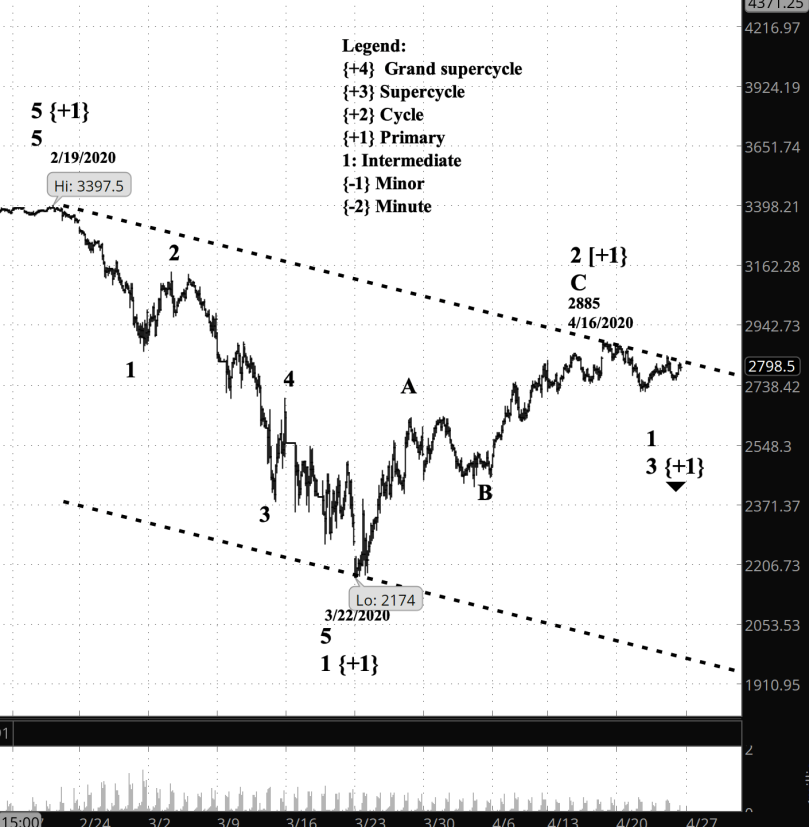
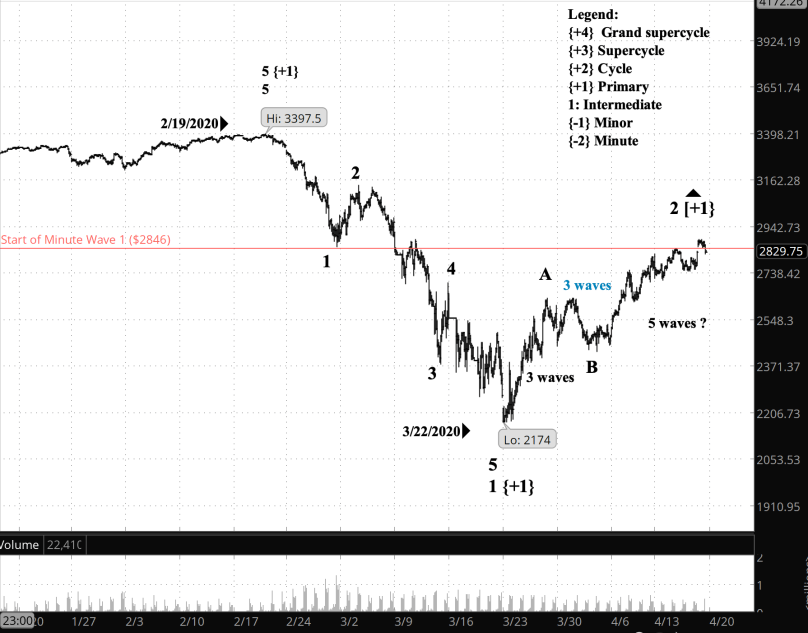
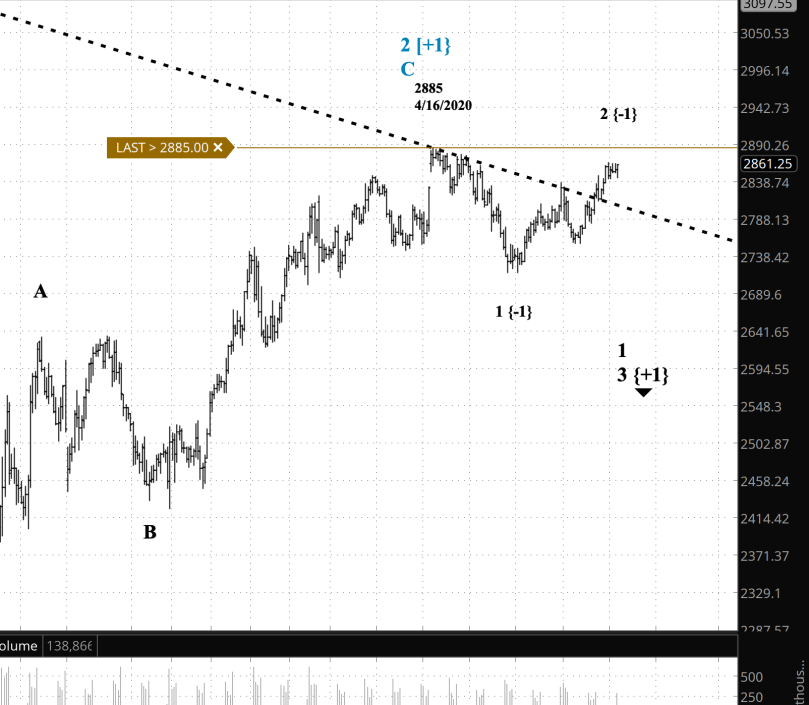
What’s happening now? Stocks continue their rise that began April 23, reaching 2865 on the S&P 500 before swing into a very low level sideways move. The price at today’s high is within 20 points of its peak since the downward movement from February resumed on on April 16.

What does it mean? The market continues its correction within a larger downtrend. A movement above 2885 would change that assessment.

What does Elliott wave theory say? The present rise is a 2nd wave of Minor degree. It had appeared last week that the 2nd wave was complete, but such proved not to be the case. If today’s sideways movement flips into further decline, then Minor wave 3 will have begun. This small-scale drama is happening within Intermediate Wave 1 of Primary wave 3, both downtrending.

Screen Shot 2020-04-27 at 7.53.08 AM

What is the alternative? If the price moves above 2885, then Primary wave 2, which by my preferred count ended April 16, is fact not yet over but instead is adding another zigzag or perhaps a flat to its journey. Ultimately, Primary wave 3 will begin. The question is when.

What about my trades? Holding. If Primary wave 3 is underway, then my three short bear call options spread positions on SPY will be profitable. If Primary 2 still has work to do, then the positions will be unprofitable. The entry analyse for the positions are linked to the lot numbers: Lots 12, 13 and 14, all expiring May 15.

Terminology. Here are some links to information about some of the technical jargon I use.

On the charts, waves have a subscript showing the degree above or below the Intermediate degree. Here are the subscripts and the degree each represents:

  • {+3} Supercycle
  • {+2} Cycle
  • {+1} Primary
  • No subscript: Intermediate
  • {-1} Minor
  • {-2} Minute
  • {-3} Minuette

By Tim Bovee, Portland, Oregon, April 27, 2020

Read More »

Live: Friday, April 24, 2020

10:35 a.m. New York time

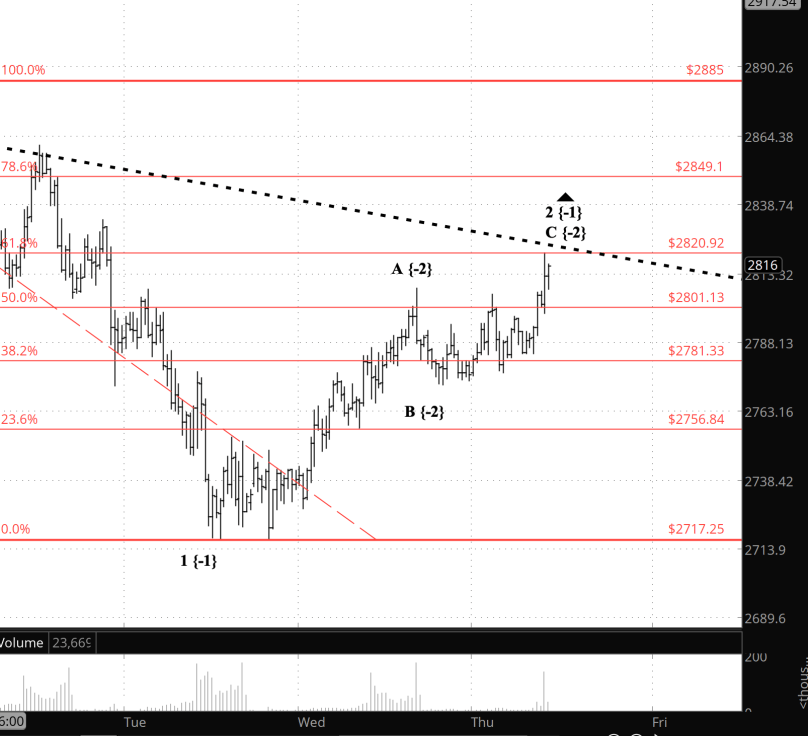
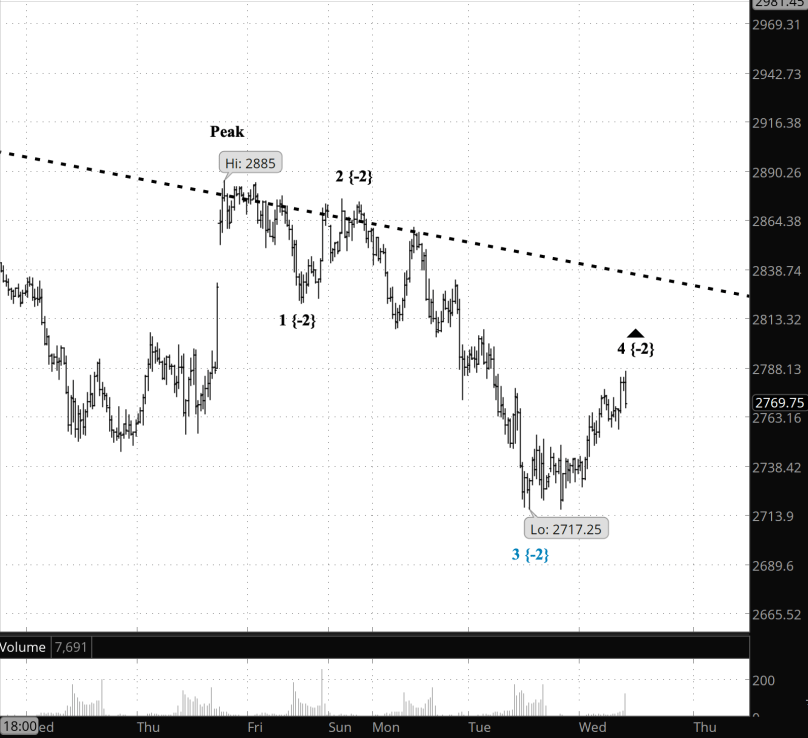
What’s happening now? The S&P 500 pierced the upper boundary of its channel ceiling yesterday and continues the opening stages of the resumption of its decline following completion of an upward correction.

What does it mean? The decline will carry the price down to the lower 2100s or below that level, perhaps significantly so.

What does Elliott wave theory say? I’ve placed the end of Primary wave 2 to the upside at 2885 achieved on April 16. The price declined to 2717.25 on April 24, the end of a small degree 1st wave in the early stages of an Intermediate 1st wave with a Primary 3rd wave, both declining the outset of the middle section of the Cycle 1st wave down that began February 19.

Screen Shot 2020-04-24 at 7.36.15 AM

What is the alternative? The Primary 3rd has yet to show much vigor in its decline, creeping cautiously below the channel ceiling. It is conceivable (although barely) that the Intermediate C wave of the Primary 2nd wave is developing into something more complex than a zigzag.

What about my trades? Today is management day, the day I sell my profitable options positions. None of my three short bear call options spread positions on SPY are profitable at this point, so I shall make no trades. The options are 21 days away from expiration on May 15, which gives the price time to pick up the pace of its decline. Here are links to the entry analyses of the three trades, Lots 12, 13 and 14.

Terminology. Here are some links to information about some of the technical jargon I use.

On the charts, waves have a subscript showing the degree above or below the Intermediate degree. Here are the subscripts and the degree each represents:

  • {+3} Supercycle
  • {+2} Cycle
  • {+1} Primary
  • No subscript: Intermediate
  • {-1} Minor
  • {-2} Minute
  • {-3} Minuette

By Tim Bovee, Portland, Oregon, April 24, 2020

Read More »

Live: Thursday, April 23, 2020

10:30 a.m. New York time

What’s happening now? The S&P 500 has retraced a Fibonacci 61.8% of its decline from April 16 and is approaching the upper boundary of its channel (the dotted black line in the chart).

What does it mean? The Fibonacci level and even more so, the channel boundary, are common reversal points to the downside at the end of  a rising market. The correction appears to be nearing its end.

Screen Shot 2020-04-23 at 7.10.19 AM

What does Elliott wave theory say? The rise from from April 22 is wave 2 of the Minor degree . The first leg of the rise, wave A of Minute degree peaked on April 22 after retracing 50% of the Minor wave 1 decline. The Minute B wave was shallow and swift, and has been followed by Minute wave C, which appears to be in its most energetic phase, the 3rd wave of Minuette degree. The end of Minor wave 2 will mark the start of the Minor 3rd wave, which will carry the price down a minimum of 700 or so points, to the 2100s, and most likely well below that level.

What is the alternative? Minor wave 2 could by the rules stretch out into a complex form, such as a double zigzag. This isn’t the usual shape of 2nd waves, and I don’t expect it.

What about my trades? Holding on amid heavy losses to my three short bear call options spread positions on SPY: Lots 12, 13 and 14, all expiring May 15. (The lot numbers link to the entry analyses.)

Terminology. Here are some links to information about some of the technical jargon I use.

By Tim Bovee, Portland, Oregon, April 23, 2020

Read More »

Live: Wednesday, April 22, 2020

10 a.m. New York time

What’s happening now? The S&P 500 has completed a 6.2% decline to 2717.25 from its April 16 reversal from 2885.00, the near term peak.

What does it mean? Most likely it is a small upward correction within a larger downtrend that began April 16. However, it could be a continuation of a larger scale correction to the upside that began March 22.

What does Elliott wave theory say? I have counted the larger downtrend as Intermediate wave 1 within Primary wave 3, both downtrending. The upward movement that began overnight is, in my opinion, a wave 2 of Minor degree within Intermediate wave 1. The preceding Minor wave 1 has shown five waves, meeting the Elliott wave theory standard. The assignment of Minor degree to the movement is very tentative. It could well be one degree lower, which is the Minute.Small view 0422
 

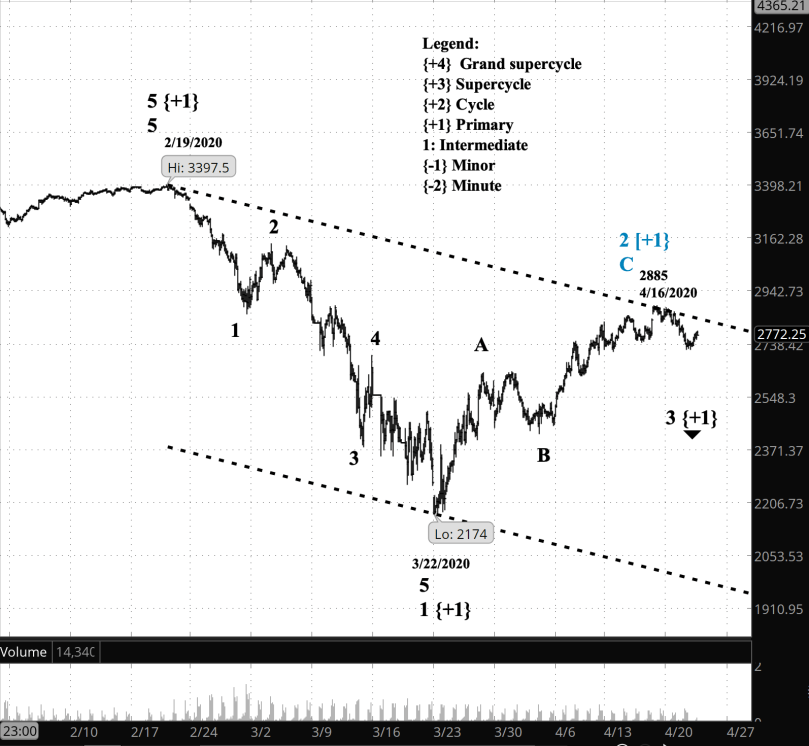
The beginning of Primary wave 3 within the decline from February 19 at last gives us the two points needed to draw a channel and to think about downside targets for the 3rd wave. The points of the channel ceiling are the start of wave 1 at 3397.50 and the start of wave 3 at 2885. The third point through which we draw the channel floor parallel to the ceiling is at 2174.

An often seen level for a wave’s end in a descending market is when the price meets the channel floor. The floor declines constantly, of course, and so the great unknown is what date we’re talking about.

The channel floor today is at 1980. A precipitous drop to that point from the present price of 2774 is unlikely, although not impossible.
Large view 0422

Let’s say, though, that wave 3 will last as long as wave 1 did, which is 32 days. That takes us to May 18, when the floor will be 1844. That’s a bit more reasonable.

But 3rd waves are almost always longer than 1st waves. A 3rd have that hit the breaks at equality would be extremely weak, and that seems like an irrational assumption give the power of the 1st wave to the downside.

A 3rd wave will sometimes have a Fibonacci relationship with the 1st. The Fibonacci ratio 1.618 is often seen in all sorts of relationships on charts. If we apply that to the 32 day length of the 1st wave, we get 52 days, or June 8. On that date the channel floor will be at 1708, a decline of 1,177 points, or 68.9%, which is is close to the 61.8% Fibonacci point. (Fibonacci points often being where a wave calls it quits).

The reality, of course, is that we don’t know how long Primary wave 3 will last. All we know is that it will be a five wave pattern. We can also guess that wave 3 will take longer to trace its path; the 1st wave was super energized in the speed with which dropped. We’ll gain clarity about the 3rd wave as it unfolds over time, especially through channelling of the Intermediate waves within the Primary 3rd. Before the 3rd meets its end, we likely will be able to say with a reasonable degree of certainty about where they end will occur. And even these early attempts at target analysis give a since of the magnitude of what lies before us.

What is the alternative? The decline from the April 16 peak may be a continuation of Primary wave 2. A rise above the channel ceiling would suggest that the alternative interpretation is likely correct, and a rise above the April 16 peak would move to the alternative to the preferred interpretation. A decline below the beginning of Primary wave 2, at 2174, would eliminate the alternative interpretation.

What about my trades? I’m continuing to hold my three short bear call options spread positions on SPY: Lots 12, 13 and 14, all expiring May 15. (The lot numbers link to the entry analyses.) If the S&P 500 is indeed in Primary wave 3, then the positions will return to profitability quickly. If Primary wave 2 is continuing, then I’ll probably be taking losses.

Terminology. Here are some links to information about some of the technical jargon I use.

By Tim Bovee, Portland, Oregon, April 22, 2020

Read More »
Live: Tuesday, April 21, 2020

11:15 a.m. New York time

What’s happening now? The S&P 500 overnight broke out of its channel at 2806.07 and has hit a low so far today of 2747.25, which 2.1% below the channel’s lower boundary.

What does it mean? The decline may be the beginning of Primary wave 3 to the downside, although that count won’t be confirmed until the price drops below the end of wave 1, at 2174.

What does Elliott wave theory say? If this is indeed the beginning of Primary wave, then we can a decline of great power and velocity. Traditionalists have a term “capitulation”, when the market realizes that all of its past ideas were wrong. “All that is solid melts into air, all that is holy is profaned, and man is at last compelled to face with sober senses, his real conditions of life…” In other words, wave 3 will be an exciting ride for bear positions and a disaster for bull positions. My positions are on the bear side.

Screen Shot 2020-04-21 at 8.13.08 AM

Primary wave 1 fell 1223.50, or 36%. Wave 3 can never be the shortest wave and often is the longest wave. Assuming that the future Primary wave 5 has a length of less than 1223.50, then we can calculate that wave 3 will fall from its peak of 2855 at the least to 1626.50, and potentially much further than that minimum. If wave 3 is less than wave, then wave 5 will have to be longer than the 1st wave, 1223.50.

What is the alternative? Primary wave 2 may in fact not be over. The subwave, Intermediate wave C, never touched the channel ceiling and in fact crawled along the channel floor like a cockroach. A touch of the channel ceiling and then a sharp decline, with a gap, would strengthen my conviction that Primary wave 3 had begun. Honestly, the decline below the channel so far has been rather, Meh! As noted above, a drop below 2174 will confirm that wave 3 has begun. A rise back into the channel will provide evidence that wave 2 is continuing.

What about my trades? My three short bear call options spread positions on SPY have improved to below maximum loss, with the loss metrics now ranging from 86.5% to 91.3% of maximum potential profit. The underlying’s price remains above the strike prices, which range from $261 to $263. The positions, lots 12, 13 and 14, all expire May 15. (The lot numbers link to the entry analyses.)

Terminology. Here are some links to information about some of the technical jargon I use.

By Tim Bovee, Portland, Oregon, April 21, 2020

Read More »

Live: Monday, April 20, 2020

9:35 a.m. New York time

What’s happening now? The S&P 500 reversed at 2885, the new peak of the present uptrend, and began to decline.

What does it mean? It’s unclear. There is no certainty that the upward correction that began March 22 is complete. Nor is there any indication that it’s not complete. What is clear is that once the correction is complete, the S&P 500 will resume the decline to below 2174, where the correction began, and perhaps significantly below that point.

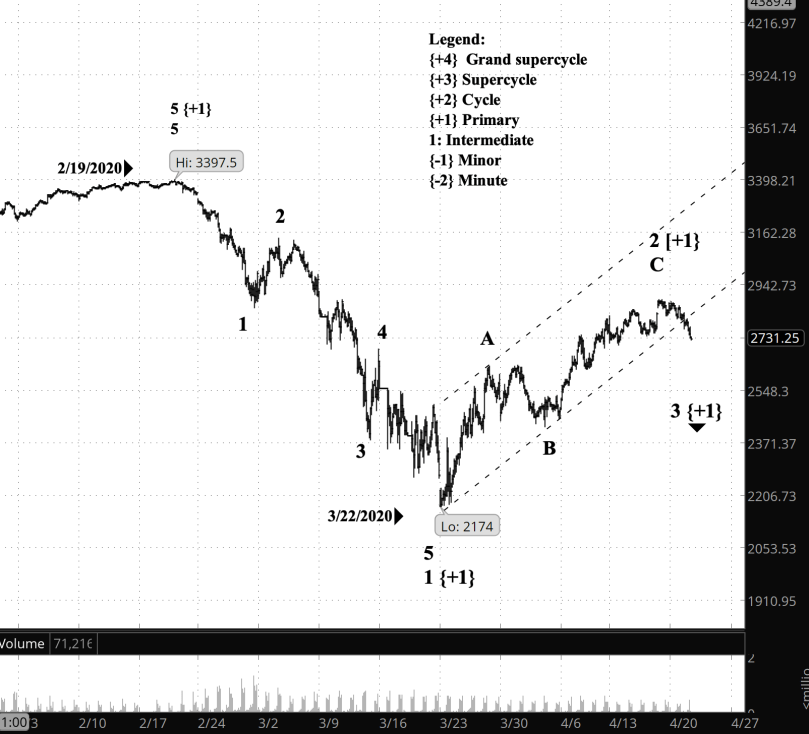
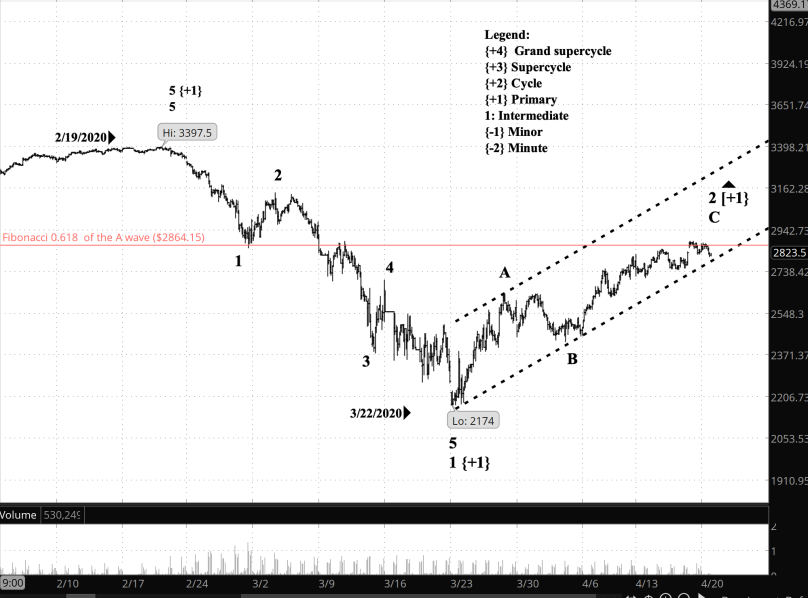
What does Elliott wave theory say? The Intermediate C wave’s rise from March 22 carried the S&P 500 to a 61.8% retracement of the preceding A wave. The price shot slightly above that Fibonacci level, dithered there for a couple of days, and then before the closing bell today declined in — so far — three waves. All of this is happening within the Primary 2nd wave to the upside of the Cycle 1st wave to the downside.

Screen Shot 2020-04-20 at 6.33.35 AM

I had counted the C wave as a nine-wave extension, and I think that’s unnecessary at best, incorrect at the worst. (The chart can be seen in Friday’s post.) It will count nicely as the common five-wave pattern, and applying Occam’s razor, that’s how I shall count it. That places the price in the Minor 5th wave of the Intermediate C, which means that the correction, if C is part of a zigzag pattern, is nearing its end. A zigzag is common in 2nd waves. The Fibonacci 61.8% retracement is a not uncommon ending point for a 2nd wave. The C wave has satisfied all of its requirements — five subwaves, 3rd wave not the shortest — and so today’s early decline may be the beginning of the Primary 3rd wave to the downside.

What is the alternative?

The 2nd wave channel suggests that there may be more upside to come. The C wave has yet to return to the channel’s upper boundary, which would be at 3272 today, rising about 40 points each subsequent day. There’s no requirement that a rising wave end at the upper boundary, but it often does, or at least approaches it, and the 5th wave is quite a distance from the top of the channel. A decisive break below the channel boundary, about 2790 today, would suggest that the Primary 3rd wave has begun, and a fall below 2174 would confirm it.

What about my trades? Time is not my friend with these short bear call options spreads on SPY: Lots 12, 13 and 14. They all expire May 15, which is 25 days away. The day to manage winners — 21 days before expiration — comes on Friday, and after that date my in-the-money options have a greater chance of involuntary assignment, complicating my record-keeping a bit. At this point the positions are about half a percent above maximum loss at expiration, so it is in my interest to hang on them and see what happens. (The lot numbers link to the entry analyses.)

Terminology. Here are some links to information about some of the technical jargon I use.

By Tim Bovee, Portland, Oregon, April 20, 2020

Read More »

Live: Friday, April 17, 2020

2:40 p.m. New York time

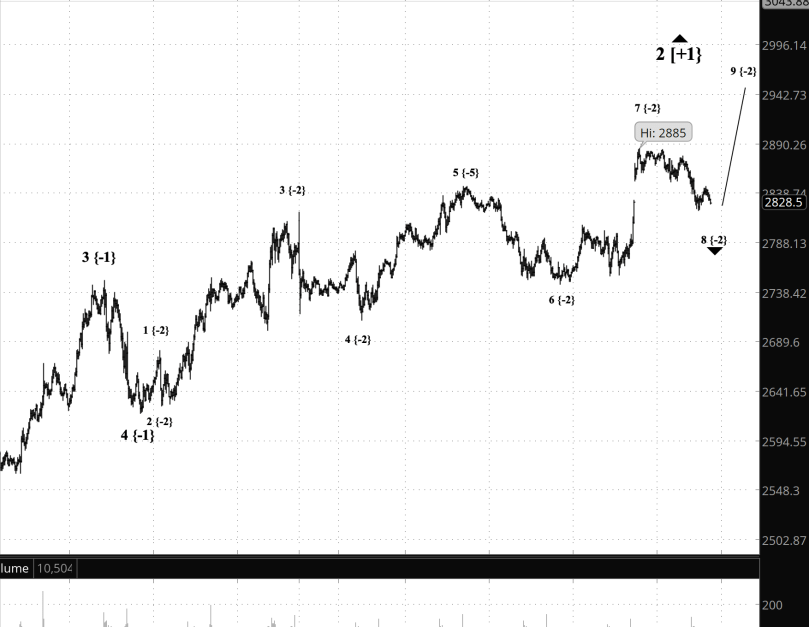
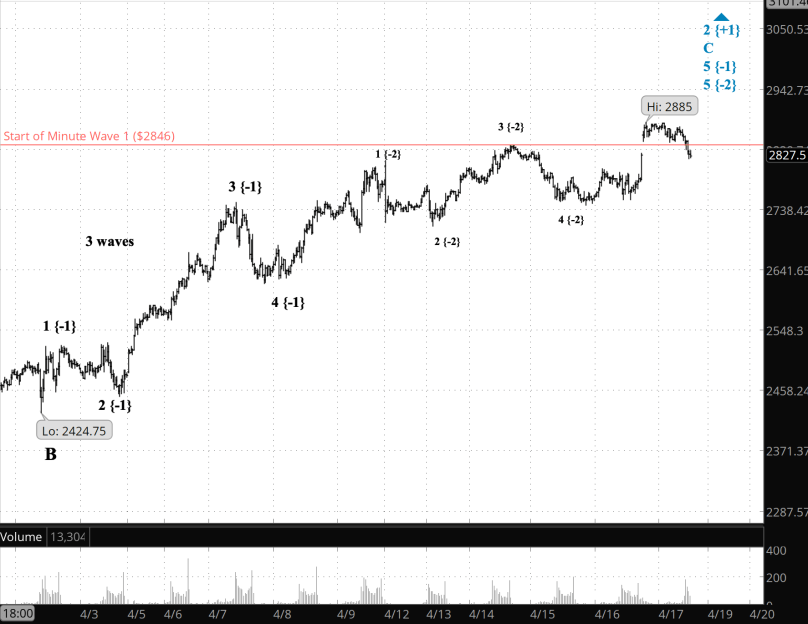
A reworking of the count within Intermediate wave C of Primary 2. It takes care of the malformation in the count that I referred to below. The new count sees Minor wave 5 of Intermediate wave C as an extended 5th wave.  Extended 5ths aren’t as common as extended 3rds, but I have certain seen them in my work with charts. An extended wave has nine subwaves, in this case of the Minuette degree. By my count we are in Minuette  wave 8 to the downside, to be followed by wave 9 to the upside, completing the Intermediate C wave.

Screen Shot 2020-04-17 at 11.34.50 AM

12 p.m. New York time

What’s happening now? The S&P 500 reversed its decline and moved above the previous high of the rise that began March 22.

Screen Shot 2020-04-17 at 8.12.44 AM

What does it mean? The upward correction of the larger market decline that began February 19 is not yet complete.

What does Elliott wave theory say? The alternative that I’ve outlined in prior posts turns out to be an accurate description of the course the market has taken. Wave 2 {+1} of the Primary degree is still underway. Wave 3 {+1} has not yet begun.

Screen Shot 2020-04-17 at 8.26.21 AM

Just after the closing bell the price gapped above 2846, the start of the Minute degree 1st wave within Intermediate wave C. At the Minor wave level, that broke one of the firm rules of Elliott wave analysis: If a wave moves beyond the start of wave 1, then it’s not a 2nd wave.

Honestly, the count within wave 5 {-1} that’s now underway seems a bit malformed. At this point in the market’s progress, however, it’s the best I’ve got.

What is the alternative? We could be dealing with a combination correction that I have not yet puzzled out, and I don’t have a rule for confirming or rejecting the alternative at this point. As Valentine Michael Smith in Robert Heinlein’s Stranger in a Strange Land put it, “Waiting is.”

What about my trades? My positions expire on May 15, which is 28 days away. They are all out of the money, which places them at maximum loss at expiration. At this point I have no choice but to hold on to the three lots of short bear call options spreads on SPY: Lots 12, 13 and 14. If wave 4 extends in a combination correction, then I will have a greater chance of loss on the positions. If wave 4 ends quickly and declines into wave 5, then I I have a greater chance of profit.

By Tim Bovee, Portland, Oregon, April 17, 2020

Read More »

Live: Thursday, April 16, 2020

10:55 a.m. New York time

What’s happening now? The S&P 500 is in an upward correction of a larger downtrend. The correction appears to be taking a zigzag pattern — up, down, up more — and to be in the middle part of the pattern.

What does it mean? Corrections are a normal part of any trend, as the number of bids and asks varies over time. This counter-trend upward correction doesn’t change my assessment that the market remains in the downtrend that began February 19.

What does Elliott wave theory say? The S&P 500 is in the 3rd wave of Primary degree

Screen Shot 2020-04-16 at 7.01.26 AM

as it comes off the 2nd wave peak of 2846 attained April 14. It ended a 1st wave at 2746 yesterday in after-hours trading, within the Primary 3rd. It was followed by the beginning of a correction, a pattern composed of three waves internally, labeled A through C. Since the larger trend is down, the A wave is an upward movement, B wave down and C wave up, the reversal of what we see in bull markets.

The S&P 500 is presently in the B wave of Minuette degree {B -2} within the 2nd wave of Minor degree (2 {-1}.

What is the alternative? The 2nd wave of Intermediate degree (2 {+1}) may in fact still be underway rather than having ended on April 14. That possibility will be eliminated if the price crosses below 2680.50, the end of the wave 1 internal to the Intermediate 2nd, since it would violate one of the rules of Elliott wave analysis.

What about my trades? As before, I’m continuing to hold my three short bear call options spreads on SPY: Lots 1213 and 14, all expiring May 15. (The lot numbers link to the entry analyses.)

By Tim Bovee, Portland, Oregon, April 16, 2020

Read More »

Live: Wednesday, April 15, 2020

2:55 p.m. New York time

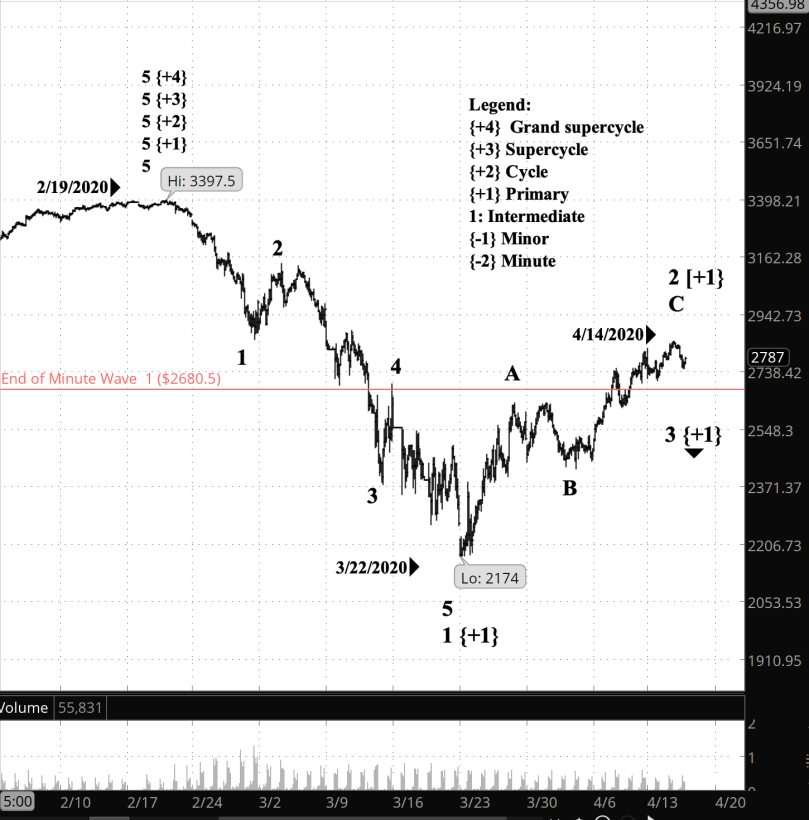
Some stats of Primary waves 1 and 2 within Cycle wave 1, and their Intermediate wave components. And a broad view chart.

  • Primary degree
    • Wave 1, down 1,223.50, or -36.0
      • Intermediate degree
        • Wave 1, down 544.25, or -16.0%
        • Wave 2, up 283.75, or 9.9%
        • Wave 3, down 730.75, or -23.3%
        • Wave 4, up 439.75, or 18.3%
        • Wave 5, down 148.75, or -5.5%
    • Wave 2, up 672.00, or 30.9%
      • Intermediate degree
        • Wave A, up 672.00, or 30.9%
        • Wave B, down 209.75, or -8.0%
        • Wave C, up 421.25, or 17.4%

The red line shows the end of wave 1 of the Minute degree. When the price moves below that level, it will confirm that we are indeed in Primary wave 3.

Screen Shot 2020-04-15 at 11.46.45 AM

10:30 a.m. New York time

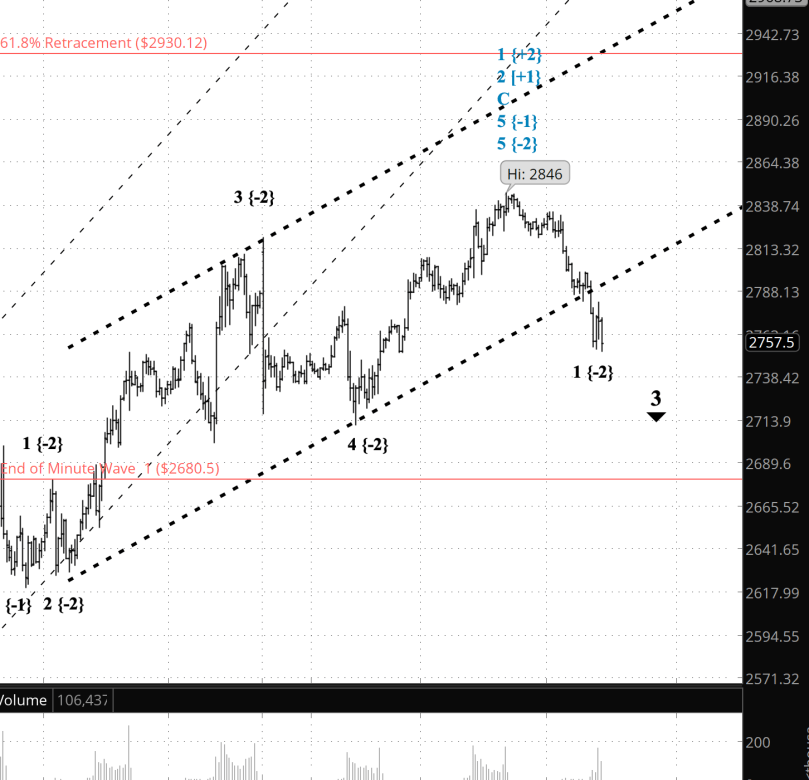
What’s happening now? The S&P 500 fell below its lower channel line in a five-wave move that appears to be ending with a triangle pattern.

What does it mean? It appears that a significant decline has resumed after an upward correction that lasted a bit more than a month.

What does Elliott wave theory say? By my count, primary wave 2 to the upside ended yesterday at 2846. The decline that followed breaks into five waves, the final one being a 5th wave triangle. I place that initial decline as being at the Minor degree, although that labelling could change as I gain greater knowledge of the unfolding structure.

The 1st wave decline is fairly tentative, as 1st waves often are. There has been no significant increase in volume nor a price gap.

Screen Shot 2020-04-15 at 7.24.11 AM

The initial decline will be followed by a retreat upward, the 2nd wave of Minor degree, and after the 2nd will come a 3rd wave most likely longer than the 1st wave, all part of the initial building blocks of the larger degree declines.

What is the alternative? Wave 4 of Primary degree might still be unfolding. A decline beyond the end of wave 1, at 2680.50, would invalidate this alternative. As of this moment the index futures are trading at 2759.00.

What about my trades? Unchanged. I’m continuing to hold my three short bear call options spreads on SPY: Lots 1213 and 14, all expiring May 15. (The lot numbers link to the entry analyses.)

By Tim Bovee, Portland, Oregon, April 15, 2020

Read More »

Live: Tuesday, April 14, 2020

10:15 a.m. New York time

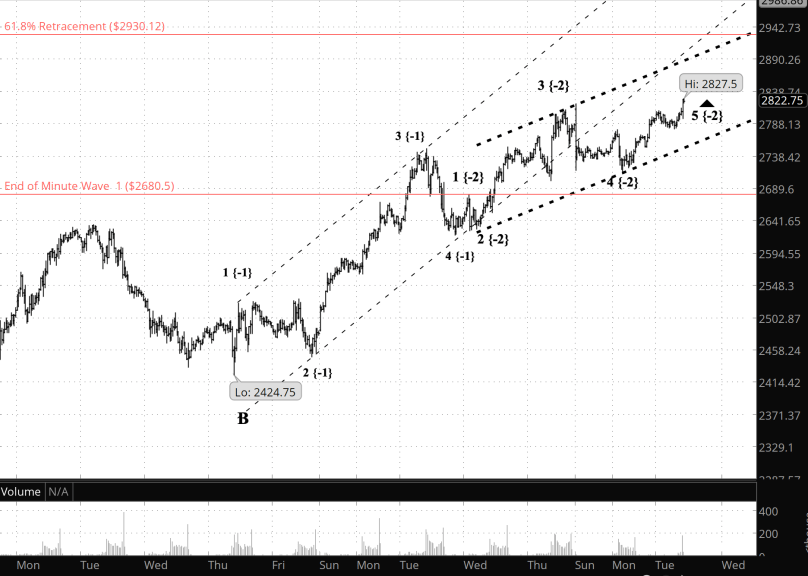
What’s happening now? The S&P 500 has resumed its rise after several days within a sideways range. It has exceeded its high of April 12 and as I write has set a high so far today of 2823.

What does it mean? The resumption of the rise is the final movement of the upward correction that began March 22. Once it is complete, then the S&P 500 will decline below 2174.

What does Elliott wave theory say? The rise signals the beginning of the 5th wave of Minuette degree within the Minor 5th wave within the Intermediate C wave. When the Minuette 5th is complete, that will also end the Minor 5th and the Intermediate C. With the completion of the 3rd wave have redone the channel, and the result suggests an upward target of 2900. However, the Minuette 5th wave has met all of the requirements in Elliott wave theory and so could reverse to the downside at any time.

Screen Shot 2020-04-14 at 7.09.01 AM

What is the alternative? The reversal to the upside could be a continuation of wave 4 of Minuette degree as it traces a complex correction, such as a double zigzag, although there are other alternative correction patterns. A reversal to the downside with a gap would give this interpretation less credence.

What about my trades? I’m continuing to hold my three short bear call options spreads on SPY: Lots 12, 13 and 14, all expiring May 15. (The lot numbers link to the entry analyses.)

By Tim Bovee, Portland, Oregon, April 14, 2020

Read More »