Trader’s Notebook

3:30 p.m. New York time

Half an hour before the closing bell. The S&P 500 zigzagged during the day, rising to 3876.50 on the futures and then falling below the overnight low, to 3819.50. The rise is consistent with a B wave, followed by a declining C wave, within wave 4{-15}. (See the Elliott wave analysis section below.) I’ve updated the chart.

9:35 a.m. New York time

What’s happening now? The S&P 500 E-mini futures continued to fall overnight, reaching into the lower 3800s before rising slightly.

What does it mean? The downward correction that began on June 30 continues to work through its end game. The 3rd and final leg of the correction is in its next-to-the-last segment, a small declining correction that will be followed by a final upward push and then a resumption of the downtrend that began on June 28,

What are the alternatives? There are two.

Alternative #1: The July 8 high was the end of the upward correction, and the downtrend has resumed.

Alternative #2: The 3rd leg will be the end of a corrective pattern but not the end of the upward correction. Instead, it will be connected to a second corrective pattern, and after that possibly to a third, significantly delaying completion of upward correction. When the compound correction is complete, then the downtrend will resume.
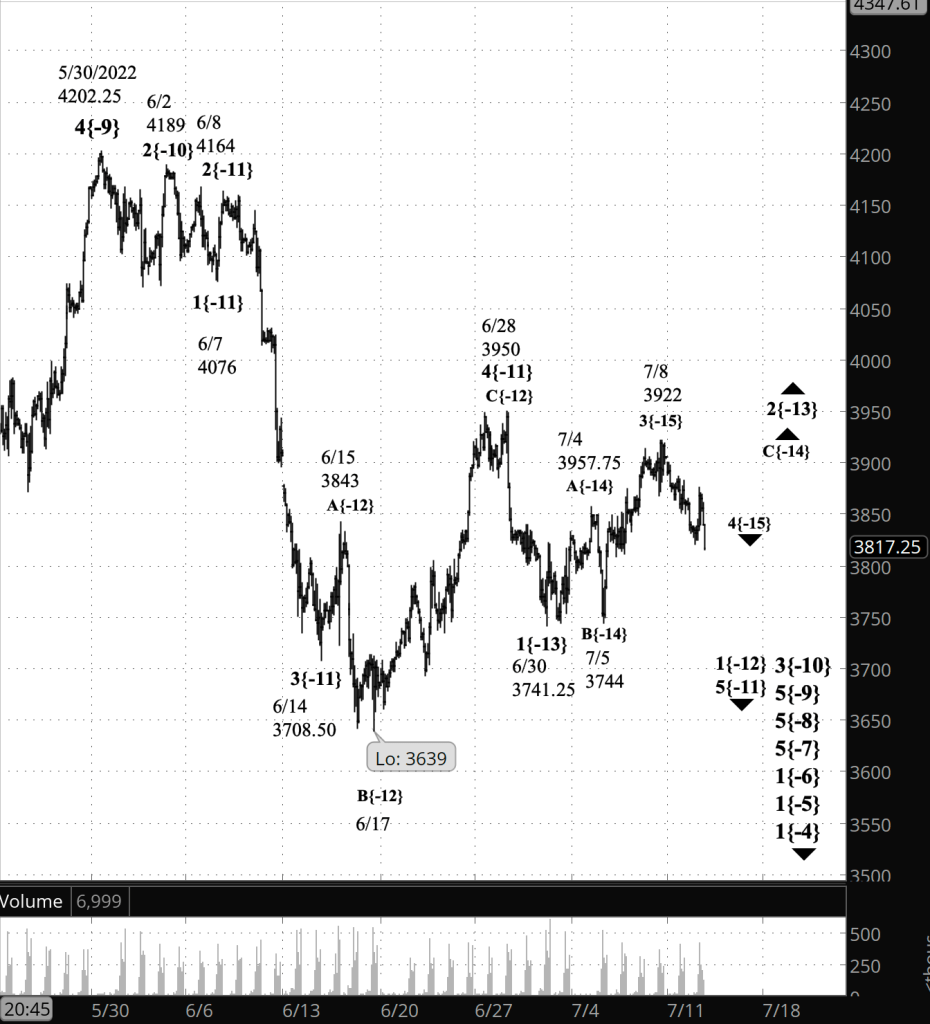
[S&P 500 E-mini futures at 3:30 p.m., 105-minute bars, with volume]

What does Elliott wave theory say? Under the principal analysis, the upward correction, wave 2{-13} is in its final wave, C{-14}, which in turn is in the 4th of 5 waves — wave 4{-15}.

Under alternative #1, the July 8 high, 3922, was the end of the upward correction, wave 2{-13}, and wave 3{-13} has begun. Like most 3rd waves, it will show a great deal of energy as it carries the price significantly below 3639, the lowest point reached since the January 4th peak triggered a large downtrend that is still in its early stages.

Under alternative #2, wave 2{-13} will form a compound correction. Wave C{-14} will be followed by a declining connector wave, X{-15}, which in turn will be followed by a second and then perhaps a third corrective pattern, forming a compound correction.

The January 4 peak I referred to above marked the end of rising wave 3{-1}, which began on February 23, 2020, from the low point of the early pandemic crash. Declining wave 4{-1} followed. Within it are a series of downtrending waves, the smaller nested within the larger. The smaller waves on the list are the upward correction, wave 2{-13}, its parent, wave 1{-12}, within wave 3{-10} within wave 5{-9}. From this point, the nested waves pick up with the “We Are Here” list below, from wave 5{-8} at the bottom and then working upward.

We Are Here.

These are the waves currently in progress under my principal analysis. Each line on the list shows the wave number, with the subscript in curly brackets, the traditional degree name, the starting date, the starting price of the S&P 500 E-mini futures, and the direction of the wave.

  • S&P 500 Index:
  • 5{+3} Supercycle, 7/8/1932, 4.40 (up)
  • 5{+2} Cycle, 12/9/1974, 60.96 (up)
  • 5{+1} Primary, 3/6/2009, 666.79 (up)
  • 5{0} Intermediate, 12/26/2018, 2346.58 (up)
  • 4{-1} Minor, 1/4/2022 4818.62 (down)
  • 1{-2} Minute, 1/4/2022 4818.62 (down)
  • S&P 500 Futures and index:
  • 1{-3} Minuette, 1/4/2022, 4808.25 (down) (futures), 4818.62 (down) (index)
  • S&P 500 Futures:
  • 1{-4} Subminuette, 1/4/2022, 4808.25 (down)
  • 1{-5} Micro, 1/4/2022, 4808.25 (down)
  • 1{-6} Submicro, 1/4/2022, 4808.25 (down)
  • 5{-7} Minuscule, 3/29/2022, 4631 (down)
  • 5{-8} Subminuscule, 4/21/2022, 4509, (down)

Learning and other resources. Elliott wave analysis provides context, not prophecy. As the 20th century semanticist Alfred Korzybski put it in his book Science and Sanity (1933), “The map is not the territory … The only usefulness of a map depends on similarity of structure between the empirical world and the map.” And I would add, in the ever-changing markets, we can judge that similarity of structure only after the fact.

See the menu page Analytical Methods for a rundown on where to go for information on Elliott wave analysis.

By Tim Bovee, Portland, Oregon, July 12, 2022

Disclaimer

Tim Bovee, Private Trader tracks the analysis and trades of a private trader for his own accounts. Nothing in this blog constitutes a recommendation to buy or sell stocks, options or any other financial instrument. The only purpose of this blog is to provide education and entertainment.

No trader is ever 100 percent successful in his or her trades. Trading in the stock and option markets is risky and uncertain. Each trader must make trading decisions for his or her own account, and take responsibility for the consequences.

License
Creative Commons License

All content on Tim Bovee, Private Trader by Timothy K. Bovee is licensed under a Creative Commons Attribution-ShareAlike 4.0 International License.

Based on a work at www.timbovee.com.
Trader’s Notebook

3:30 p.m. New York time

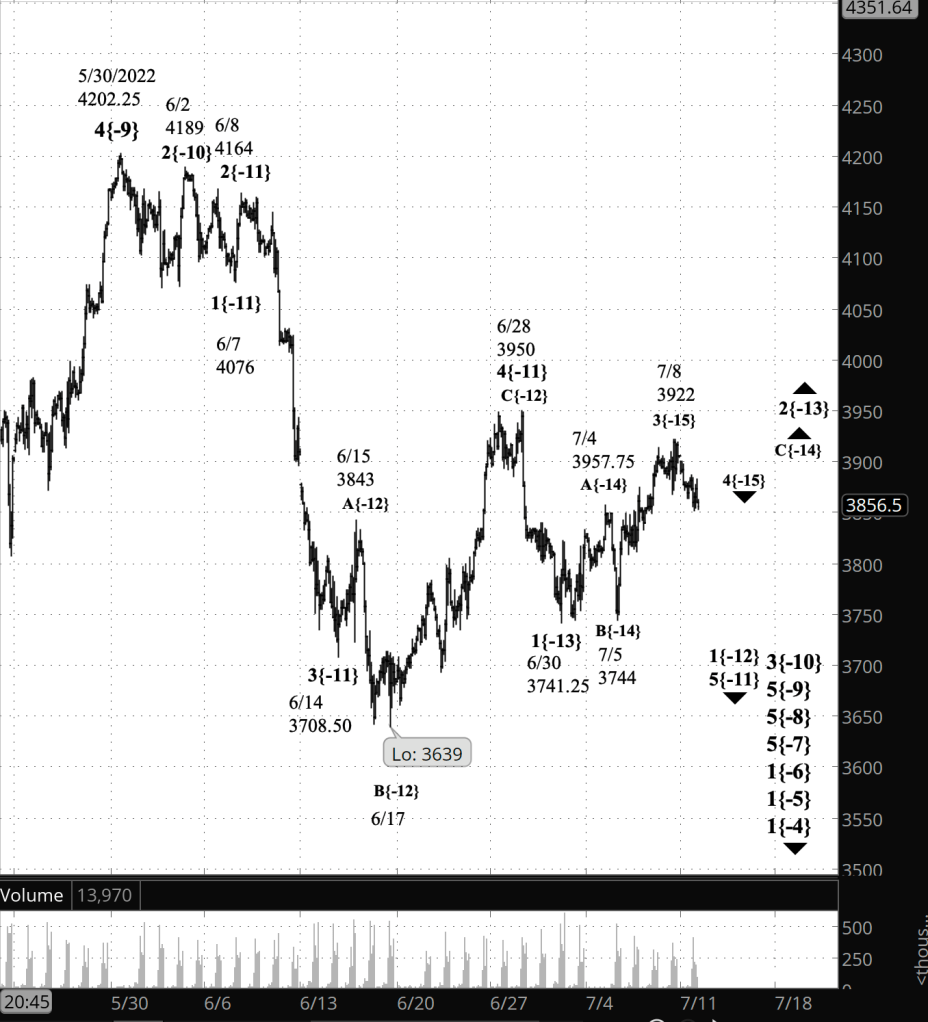
Half an hour before the closing bell. The S&P 500 has traded within a narrow range during the session. The principal analysis is unchanged: Wave 4{-15} within wave C{-14} within wave C{-13}, all within an upward correction, wave 2{-13}, are underway. I’ve updated the chart below.

9:35 a.m. New York time

What’s happening now? The S&P 500 E-mini futures declined when trading resumed overnight, reaching down into the mid-3800s, and then rising a little, reaching a high of 3881.50, well below Friday’s high of 3922.

What does it mean? Friday’s high was the end of the middle segment of the 3rd and final leg of an upward correction that began on June 30. The subsequent decline is a downward correction within that final leg. The overnight decline will be followed by a push upward that most likely will exceed Friday’s high and that will end the larger upward correction. Once the correction is over, the downtrend will resume, with the price reaching below 3709.50, the June 30 low, where the upward correction began.

What is the alternative? The upward correction from June 30 may form a compound structure, linking two or three corrective patterns together. Under this scenario, the 3rd leg within the upward correction will be followed by a connector wave to the downside, and then a second corrective pattern.

[S&P 500 E-mini futures at 3:30 p.m., 105-minute bars, with volume]

What does Elliott wave theory say? Under the principal analysis, Friday’s high is the end of wave 3{-15} within wave C{-14}, the third leg of wave 2{-13}, an upward correction that began on June 30 from 3708.50. The subsequent decline is wave 4{-15}, and it will be followed by wave 5{-15}, the final wave within wave 2{-13}.

What happens next is as yet unknown.

The most likely outcome is that wave C{-14} will be the final wave within wave 2{-13}, which will be followed by an energetic push downward, wave 3{-13}, which will move below the starting point of the wave 2{-13} correction, 3708.50, and perhaps significantly below that level, proportional to the scale of other waves at the {-13} degree, which is fairly small in the general scheme of things.

The alternative analysis acknowledges the possibility of a less common pattern: The compound correction, which links two or three corrective patterns together. I’ve seen compound corrections more often within 4th waves, but a compound 2nd wave correction isn’t unheard off. If wave 2{-13} forms a compound structure, then wave C{-14} will be followed by a downward connector wave, X{-14}, and then by a second corrective pattern. Once the compound correction is complete, then things will play out as described in the principal analysis, above: Wave 3{-13} will carry the price down below the starting point of the previous wave 2{-13}.

This is all happening within wave 1{-12}, the initial decline within its parent, downtrending wave 5{-11}, which is the final wave with its parent, wave 3{-10} — an energetic downtrending wave that began on June 2. It is the middle wave within downtrending wave 5{-9}, which began on May 30 from 4202.25.

Market price movements are fractal in nature — smaller waves within larger waves within still larger waves, each following the same patterns and rules no matter how large or small.

So wave 5{-9} has a parent, wave 5{-8}, which began on April 21, and it’s parent, wave 5{-7}, began on March 29. Another degree higher, wave 1{-6} began on January 4, a major turning point for the price structure reaching up to wave 4{-1}, which began on the same date, from 4818.62.

And the ancestor of them all is wave 5{0}, a huge uptrending wave that began on December 26, 2018, from 2346.58 and that is still underway. And wave 5{0} too has parent and grandparent waves, reaching up to wave 5{+3}, which began on Jul7 8, 1932 and has not yet reached its end.

We Are Here.

These are the waves currently in progress under my principal analysis. Each line on the list shows the wave number, with the subscript in curly brackets, the traditional degree name, the starting date, the starting price of the S&P 500 E-mini futures, and the direction of the wave.

  • S&P 500 Index:
  • 5{+3} Supercycle, 7/8/1932, 4.40 (up)
  • 5{+2} Cycle, 12/9/1974, 60.96 (up)
  • 5{+1} Primary, 3/6/2009, 666.79 (up)
  • 5{0} Intermediate, 12/26/2018, 2346.58 (up)
  • 4{-1} Minor, 1/4/2022 4818.62 (down)
  • 1{-2} Minute, 1/4/2022 4818.62 (down)
  • S&P 500 Futures and index:
  • 1{-3} Minuette, 1/4/2022, 4808.25 (down) (futures), 4818.62 (down) (index)
  • S&P 500 Futures:
  • 1{-4} Subminuette, 1/4/2022, 4808.25 (down)
  • 1{-5} Micro, 1/4/2022, 4808.25 (down)
  • 1{-6} Submicro, 1/4/2022, 4808.25 (down)
  • 5{-7} Minuscule, 3/29/2022, 4631 (down)
  • 5{-8} Subminuscule, 4/21/2022, 4509, (down)

Learning and other resources. Elliott wave analysis provides context, not prophecy. As the 20th century semanticist Alfred Korzybski put it in his book Science and Sanity (1933), “The map is not the territory … The only usefulness of a map depends on similarity of structure between the empirical world and the map.” And I would add, in the ever-changing markets, we can judge that similarity of structure only after the fact.

See the menu page Analytical Methods for a rundown on where to go for information on Elliott wave analysis.

By Tim Bovee, Portland, Oregon, July 11, 2022

Disclaimer

Tim Bovee, Private Trader tracks the analysis and trades of a private trader for his own accounts. Nothing in this blog constitutes a recommendation to buy or sell stocks, options or any other financial instrument. The only purpose of this blog is to provide education and entertainment.

No trader is ever 100 percent successful in his or her trades. Trading in the stock and option markets is risky and uncertain. Each trader must make trading decisions for his or her own account, and take responsibility for the consequences.

License
Creative Commons License

All content on Tim Bovee, Private Trader by Timothy K. Bovee is licensed under a Creative Commons Attribution-ShareAlike 4.0 International License.

Based on a work at www.timbovee.com.
Trader’s Notebook

3:30 p.m. New York time

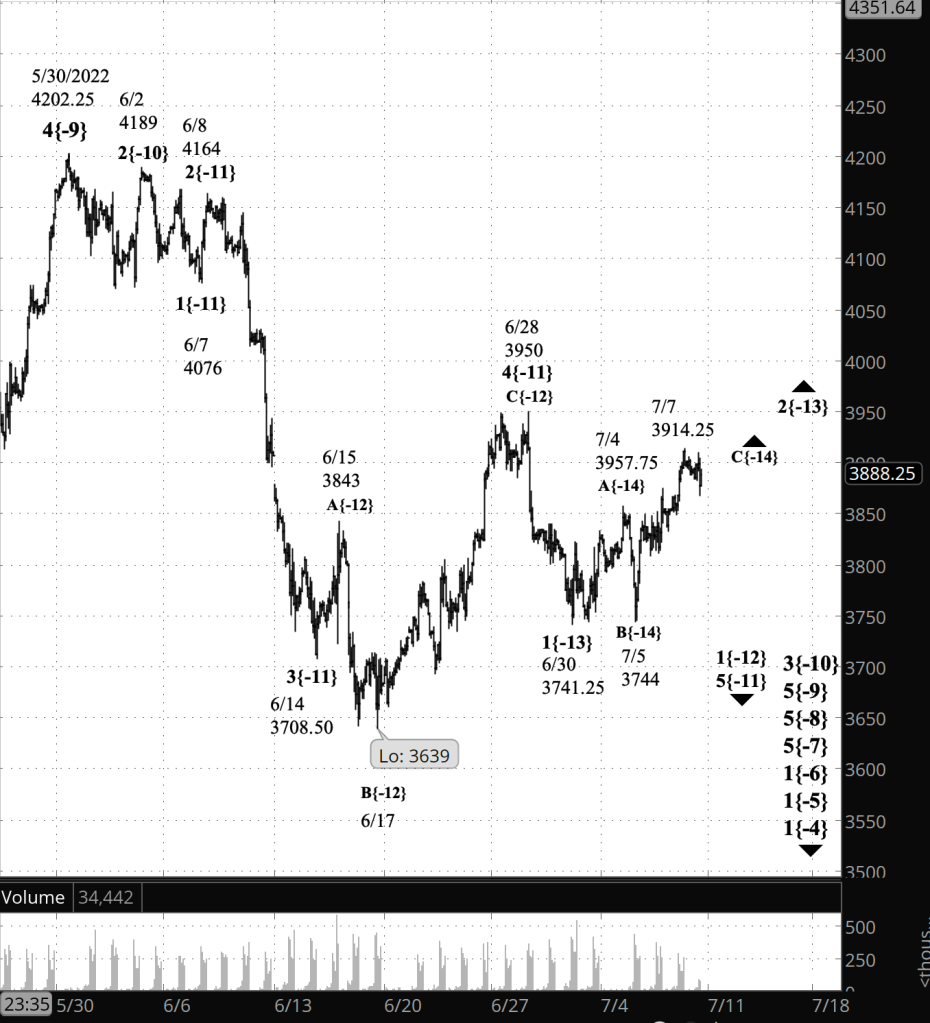
Half an hour before the closing bell. The S&P 500 has traded narrowly during the session, remaining in the low 3900s while reaching above Thursday’s high, 3914.25, to 3922.

The higher high confirms this morning’s principal analysis: Wave C{-14} within an upward correction, wave 2{-13}, is still underway. Within wave C{-14}, I see today’s new high as being part of the final wave, 5{-16} within wave 5{-15}, which is also the final wave within wave C{-14}.

As the baseball great Yogi Berra said, “It ain’t over ’til it’s over.” By my count, it’s almost over. And, potentially, today’s high could be the end of wave C{-14} and its upward correction parent, wave 2{-13}. But its completion is not yet a certainty.

I’ve updated the chart.

9:35 a.m. New York time

What’s happening now? The S&P 500 E-mini futures traded sideways in overnight trading, dropping sharply with the release of the employment data for June, a 3.6% unemployment rate and 372,000 jobs gained.

What does it mean? Although external events can cause rapid movements in the markets, the patterns that emerge still adhere to the framework of Elliott wave theory.

Under the principal analysis, the final leg of an upward correction that began on June 30 is still underway, although it is nearing its end. When complete, the correction will be followed by an energetic downtrend that will carry the price below the correction’s starting point, 3741.25.

What are the alternatives? There are two.

Alternative #1: Thursday’s high, 3914.25, was the end of the upward correction, and the futures are taking the first tentative steps in the downtrend.

Alternative #2: The third leg of the corrective pattern that began on June 30 ended at Thursday’s high, but the correction is forming a compound structure, in which two or three corrective patterns are linked together. The price movement since yesterday’s high is the beginning of a connector that will link the completed first corrective pattern to a second corrective pattern.

[S&P 500 E-mini futures at 3:30 p.m., 95-minute bars, with volume]

What does Elliott wave theory say? Under the principal analysis, an upward correction, wave 2{-13}, is underway and is in its 3rd and final wave, C{-14}. Under the first alternative analysis, wave C{-14} and its parent, wave 2{-13}, ended at the July 7 peak, 3914.25. That was yesterday, on Thursday.

Distinguishing between the principal analysis and the alternative #1 depends upon the internal structure of wave C{-14}. The C wave will have five internal waves. I see the Thursday’s high as the end of wave 3{-16} within wave wave wave 5{-15}, the final wave within wave C{-14}. Wave 3{-16} will be followed by a downward 4th wave correction, now underway, and then a final upward push, wave 5{-16}, that normally will reach higher than Thursday’s peak, but it may fall short, a condition known as truncation. The end of wave 5{-16} will also be the end of waves 5{-15}, C{-14} and the full correction, 2{-13}. It will be the starting point of downtrending wave 3{-13}.

If instead the price continues to fall, reaching below 3741.25, then the alternative #1 is correct: Wave 5{-15} within wave C{-14} within wave 2{-13} ended Thursday at 3914.25 and wave 3{-13} is now underway.

Under alternative #2: Thursday’s peak marked the end of wave C{-14}, also ending the first corrective pattern in a compound correction. The subsequent decline is a connector wave, X{-14}, and it will be followed by a second corrective pattern within wave 2{-13}.

We Are Here.

These are the waves currently in progress under my principal analysis. Each line on the list shows the wave number, with the subscript in curly brackets, the traditional degree name, the starting date, the starting price of the S&P 500 E-mini futures, and the direction of the wave.

  • S&P 500 Index:
  • 5{+3} Supercycle, 7/8/1932, 4.40 (up)
  • 5{+2} Cycle, 12/9/1974, 60.96 (up)
  • 5{+1} Primary, 3/6/2009, 666.79 (up)
  • 5{0} Intermediate, 12/26/2018, 2346.58 (up)
  • 4{-1} Minor, 1/4/2022 4818.62 (down)
  • 1{-2} Minute, 1/4/2022 4818.62 (down)
  • S&P 500 Futures and index:
  • 1{-3} Minuette, 1/4/2022, 4808.25 (down) (futures), 4818.62 (down) (index)
  • S&P 500 Futures:
  • 1{-4} Subminuette, 1/4/2022, 4808.25 (down)
  • 1{-5} Micro, 1/4/2022, 4808.25 (down)
  • 1{-6} Submicro, 1/4/2022, 4808.25 (down)
  • 5{-7} Minuscule, 3/29/2022, 4631 (down)
  • 5{-8} Subminuscule, 4/21/2022, 4509, (down)

Learning and other resources. Elliott wave analysis provides context, not prophecy. As the 20th century semanticist Alfred Korzybski put it in his book Science and Sanity (1933), “The map is not the territory … The only usefulness of a map depends on similarity of structure between the empirical world and the map.” And I would add, in the ever-changing markets, we can judge that similarity of structure only after the fact.

See the menu page Analytical Methods for a rundown on where to go for information on Elliott wave analysis.

By Tim Bovee, Portland, Oregon, July 8, 2022

Disclaimer

Tim Bovee, Private Trader tracks the analysis and trades of a private trader for his own accounts. Nothing in this blog constitutes a recommendation to buy or sell stocks, options or any other financial instrument. The only purpose of this blog is to provide education and entertainment.

No trader is ever 100 percent successful in his or her trades. Trading in the stock and option markets is risky and uncertain. Each trader must make trading decisions for his or her own account, and take responsibility for the consequences.

License
Creative Commons License

All content on Tim Bovee, Private Trader by Timothy K. Bovee is licensed under a Creative Commons Attribution-ShareAlike 4.0 International License.

Based on a work at www.timbovee.com.
Trader’s Notebook

3:30 p.m. New York time

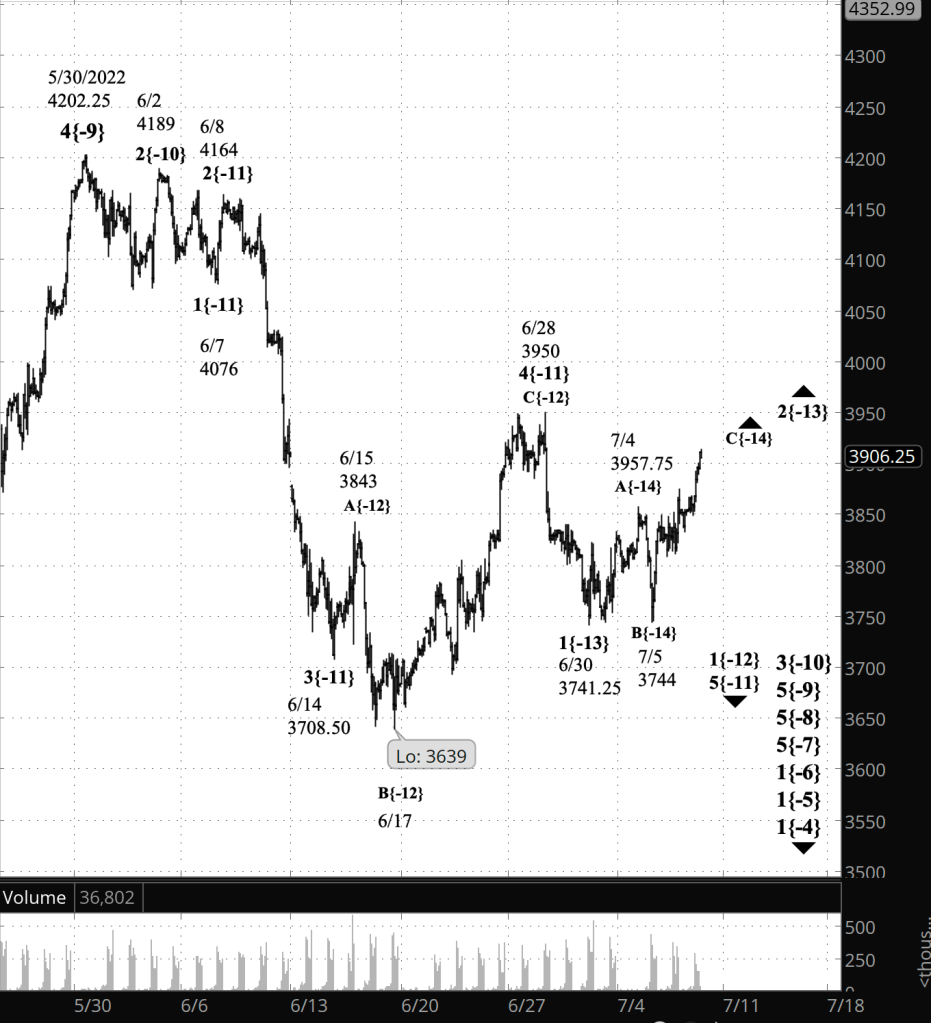
Half an hour before the closing bell. The S&P 500 rose during the session, reaching into the low 3900s on the futures. Wave C{-14} within an upward correction, wave 2{-13}, continues. Under the rules of Elliott wave analysis, a 2nd wave cannot move beyond the start of the preceding 1st wave. On the futures chart, wave 1{-13} began at 3950. If the present rise should exceed that level, then the analysis doesn’t match the chart — the map doesn’t match the territory — and I shall reanalyze.

At this point, the two alternatives are off the boards, and only the principal analysis remains. I’ve updated the upper chart.

9:35 a.m. New York time

What’s happening now? The S&P 500 E-mini futures traded narrowly overnight, exceeding Wednesday’s high of 3875 shortly after the opening bell after for the most part remaining the mid-3900s.

What does it mean? The upward correction that began on June 30 continues and is in its third and final segment. When the correction is complete, it will be followed by an energetic downtrend that will carry the price below the correction’s starting price, 3741.25, and perhaps significantly below that level.

What are the alternatives? There are two.

Alternative #1: Wednesday’s high was the end of the correction. The subsequent slip downward is the first tentative step in the downtrend.

Alternative #2: The correction forms a compound structure, linking two or three corrective patterns together, each connected by a declining segment.

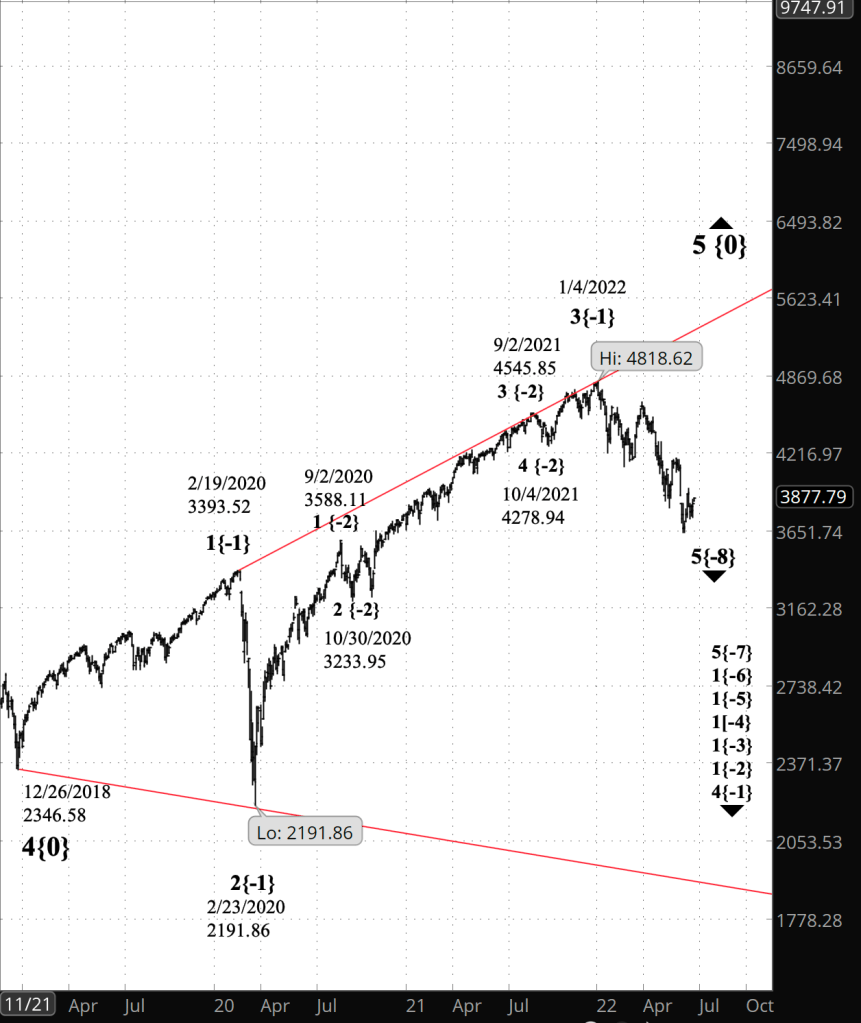
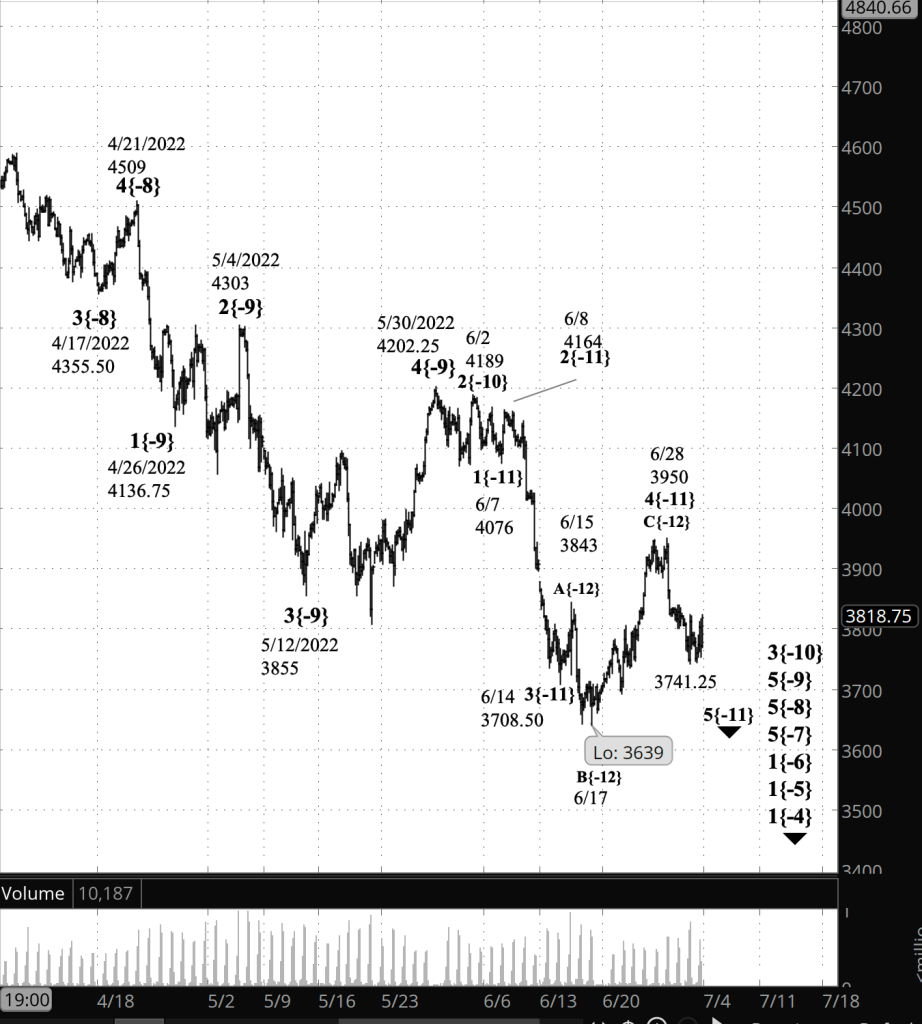
The charts. The upper chart gives a view of the S&P 500 futures stretching back to late May. The lower chart shows the S&P 500 index stretching back to mid-November.

[S&P 500 E-mini futures at 3:30 p.m., 90-minute bars, with volume]
[S&P 500 index at 9:35 a.m., 2-day bars, with volume]

What does Elliott wave theory say? Under the principal analysis, wave C{-14}, the final wave of an upward correction, wave 2{-13}, is underway. When complete, wave 2{-13} will be followed by downtrending wave 3{-13}. Third waves tend to be energetic and to cover significant distances compared to other waves in a trend.

Under alternative #1, the July 6 high, 3875, was the end of wave C{-14} and its parent, wave 2{-13}. Downtrending wave 3{-13} has begun.

Under alternative #2, wave 2{-13} is forming a compound correction, linking two or three corrective patterns together. Each pattern is connected to the one that came before by an X wave — X{-14} in this case. If this alternative is correct and Wednesday’s high was the end of wave C{-14}, then the present slip downward is the start of wave X{-14} within wave 2{-13}. If wave C{-14} is not yet complete and this alternative is correct, then wave X{-14} lies in the future.

All of this is happening within a series of downtrending waves, each of increasing magnitude compared to the one that came before. The wave of lowest degree is wave 1{-12}, which began on June 28, and the series stretches up 10 degrees of magnitude to wave 1{-2}, which began on January 4. The parent of them all is wave 4{-1}, a downward movement of large degree that began on January 4 and part of an expanding Diagonal Triangle, wave 5{0}, that began on December 26, 2018.

We Are Here.

These are the waves currently in progress under my principal analysis. Each line on the list shows the wave number, with the subscript in curly brackets, the traditional degree name, the starting date, the starting price of the S&P 500 E-mini futures, and the direction of the wave.

  • S&P 500 Index:
  • 5{+3} Supercycle, 7/8/1932, 4.40 (up)
  • 5{+2} Cycle, 12/9/1974, 60.96 (up)
  • 5{+1} Primary, 3/6/2009, 666.79 (up)
  • 5{0} Intermediate, 12/26/2018, 2346.58 (up)
  • 4{-1} Minor, 1/4/2022 4818.62 (down)
  • 1{-2} Minute, 1/4/2022 4818.62 (down)
  • S&P 500 Futures and index:
  • 1{-3} Minuette, 1/4/2022, 4808.25 (down) (futures), 4818.62 (down) (index)
  • S&P 500 Futures:
  • 1{-4} Subminuette, 1/4/2022, 4808.25 (down)
  • 1{-5} Micro, 1/4/2022, 4808.25 (down)
  • 1{-6} Submicro, 1/4/2022, 4808.25 (down)
  • 5{-7} Minuscule, 3/29/2022, 4631 (down)
  • 5{-8} Subminuscule, 4/21/2022, 4509, (down)

Learning and other resources. Elliott wave analysis provides context, not prophecy. As the 20th century semanticist Alfred Korzybski put it in his book Science and Sanity (1933), “The map is not the territory … The only usefulness of a map depends on similarity of structure between the empirical world and the map.” And I would add, in the ever-changing markets, we can judge that similarity of structure only after the fact.

See the menu page Analytical Methods for a rundown on where to go for information on Elliott wave analysis.

By Tim Bovee, Portland, Oregon, July 7, 2022

Disclaimer

Tim Bovee, Private Trader tracks the analysis and trades of a private trader for his own accounts. Nothing in this blog constitutes a recommendation to buy or sell stocks, options or any other financial instrument. The only purpose of this blog is to provide education and entertainment.

No trader is ever 100 percent successful in his or her trades. Trading in the stock and option markets is risky and uncertain. Each trader must make trading decisions for his or her own account, and take responsibility for the consequences.

License
Creative Commons License

All content on Tim Bovee, Private Trader by Timothy K. Bovee is licensed under a Creative Commons Attribution-ShareAlike 4.0 International License.

Based on a work at www.timbovee.com.
Trader’s Notebook

3:30 p.m. New York time

Half an hour before the closing bell. The S&P 500 resumed its rise during the session, reaching above the weekend high of 3957.75, to upper 3900s. Uptrending wave C{-14} within an upward correction, wave 2{-13}, continues. No change in the analysis. I’ve updated the chart.

9:35 a.m. New York time

What’s happening now? The S&P 500 E-mini futures traded in a narrow range overnight, covering fewer than 50 points low to high.

What does it mean? The pause is a small-sized correction within the rising third leg of a larger upward correction that began June 30. That rise will resume when the small-sized correction is complete. When the third leg of the larger correction is complete, the most likely next step is for the downtrend that began on June 28 to resume.

What are the alternatives? There are two.

Alternative #1: The third leg of the upward correction ended at the overnight high, 3848.75, and the downtrend that began on June 28 has resumed.

Alternative #2: The decline that began on June 28, rather than being a downtrend, is instead part of a compound correction that began on June 14 and is still underway.

[S&P 500 E-mini futures at 3:30 p.m., 80-minute bars, with volume]

What does Elliott wave theory say? Under the principal analysis, the overnight pause is wave 4{-15}, a correction within rising wave C{-14}, which in turn is the third and possibly final wave within wave 2{-13}, a downtrend that began on June 28 from 3950. All are subwaves of downtrending wave 1{-12}, which began on June 28.

It’s possible that wave 2{-13} will form a compound structure, and if it does, wave C{-14} will be followed by a connector, wave X{-14}, and then a second corrective pattern. Compound structures are less common within 2nd waves, compared to 4th waves, and I consider such a structure to be unlikely at this point. Nonetheless, it’s not beyond the realm of possibility.

Under the first alternative, the upward correction, wave 2{-13}, ended overnight at 3848.75 and an energetic decline, wave 3{-13}, is taking its first tentative steps. I would expect wave 3{-13} to fall below 3741.25, the end of the preceding wave 1{-13}, and perhaps significantly lower.

Under the second alternative, the larger upward correction that began on June 14, wave {4-11}, is still underway and is forming a compound structure. The June 28 peak marked the end of wave C{-12}, also ending the first corrective structure within wave 4{-11}. The decline that followed is wave X{-12}, a connector wave, and the first wave of a second corrective structure, wave A{-12}, is now underway.

The three scenarios are subwaves of wave 3{-10}, which began on June 2 from 4189, within wave 5{-9}, which on May 30 from 4202.25.

We Are Here.

These are the waves currently in progress under my principal analysis. Each line on the list shows the wave number, with the subscript in curly brackets, the traditional degree name, the starting date, the starting price of the S&P 500 E-mini futures, and the direction of the wave.

  • S&P 500 Index:
  • 5{+3} Supercycle, 7/8/1932, 4.40 (up)
  • 5{+2} Cycle, 12/9/1974, 60.96 (up)
  • 5{+1} Primary, 3/6/2009, 666.79 (up)
  • 5{0} Intermediate, 12/26/2018, 2346.58 (up)
  • 4{-1} Minor, 1/4/2022 4818.62 (down)
  • 1{-2} Minute, 1/4/2022 4818.62 (down)
  • S&P 500 Futures and index:
  • 1{-3} Minuette, 1/4/2022, 4808.25 (down) (futures), 4818.62 (down) (index)
  • S&P 500 Futures:
  • 1{-4} Subminuette, 1/4/2022, 4808.25 (down)
  • 1{-5} Micro, 1/4/2022, 4808.25 (down)
  • 1{-6} Submicro, 1/4/2022, 4808.25 (down)
  • 5{-7} Minuscule, 3/29/2022, 4631 (down)
  • 5{-8} Subminuscule, 4/21/2022, 4509, (down)

Learning and other resources. Elliott wave analysis provides context, not prophecy. As the 20th century semanticist Alfred Korzybski put it in his book Science and Sanity (1933), “The map is not the territory … The only usefulness of a map depends on similarity of structure between the empirical world and the map.” And I would add, in the ever-changing markets, we can judge that similarity of structure only after the fact.

See the menu page Analytical Methods for a rundown on where to go for information on Elliott wave analysis.

By Tim Bovee, Portland, Oregon, July 6, 2022

Disclaimer

Tim Bovee, Private Trader tracks the analysis and trades of a private trader for his own accounts. Nothing in this blog constitutes a recommendation to buy or sell stocks, options or any other financial instrument. The only purpose of this blog is to provide education and entertainment.

No trader is ever 100 percent successful in his or her trades. Trading in the stock and option markets is risky and uncertain. Each trader must make trading decisions for his or her own account, and take responsibility for the consequences.

License
Creative Commons License

All content on Tim Bovee, Private Trader by Timothy K. Bovee is licensed under a Creative Commons Attribution-ShareAlike 4.0 International License.

Based on a work at www.timbovee.com.
Trader’s Notebook

3:30 p.m. New York time

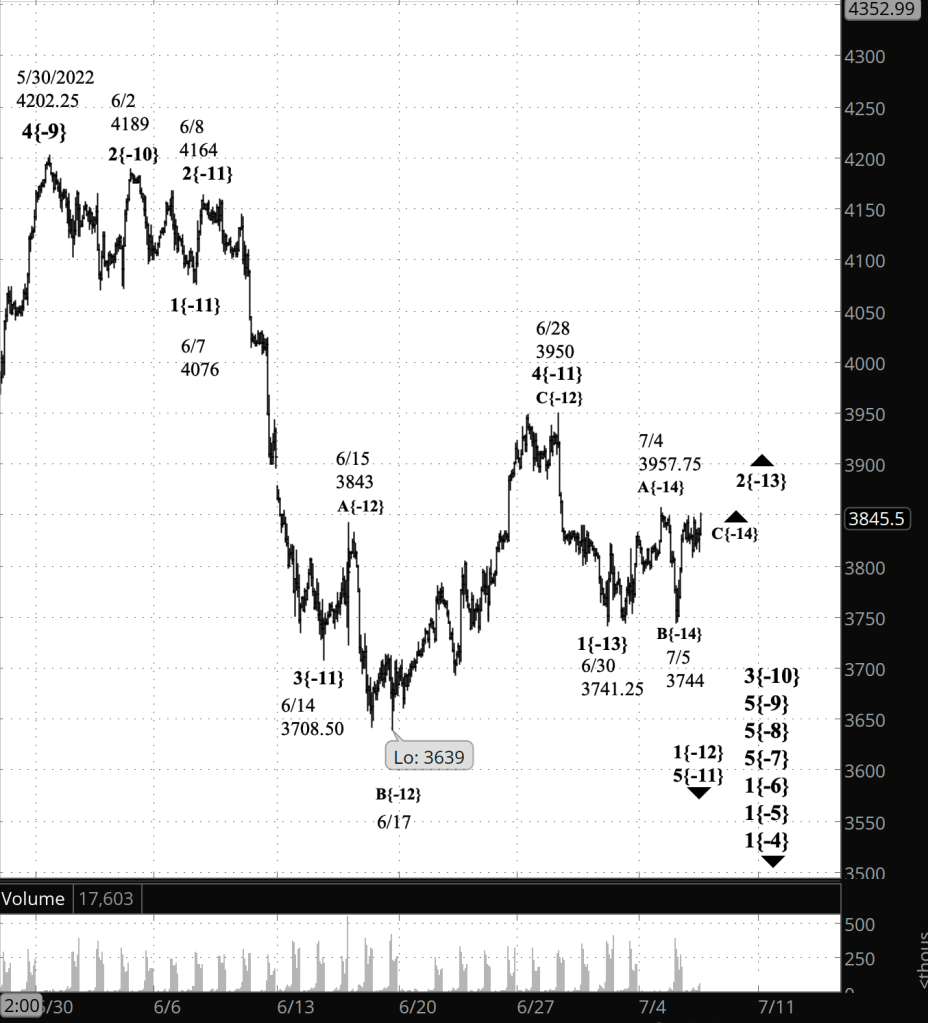
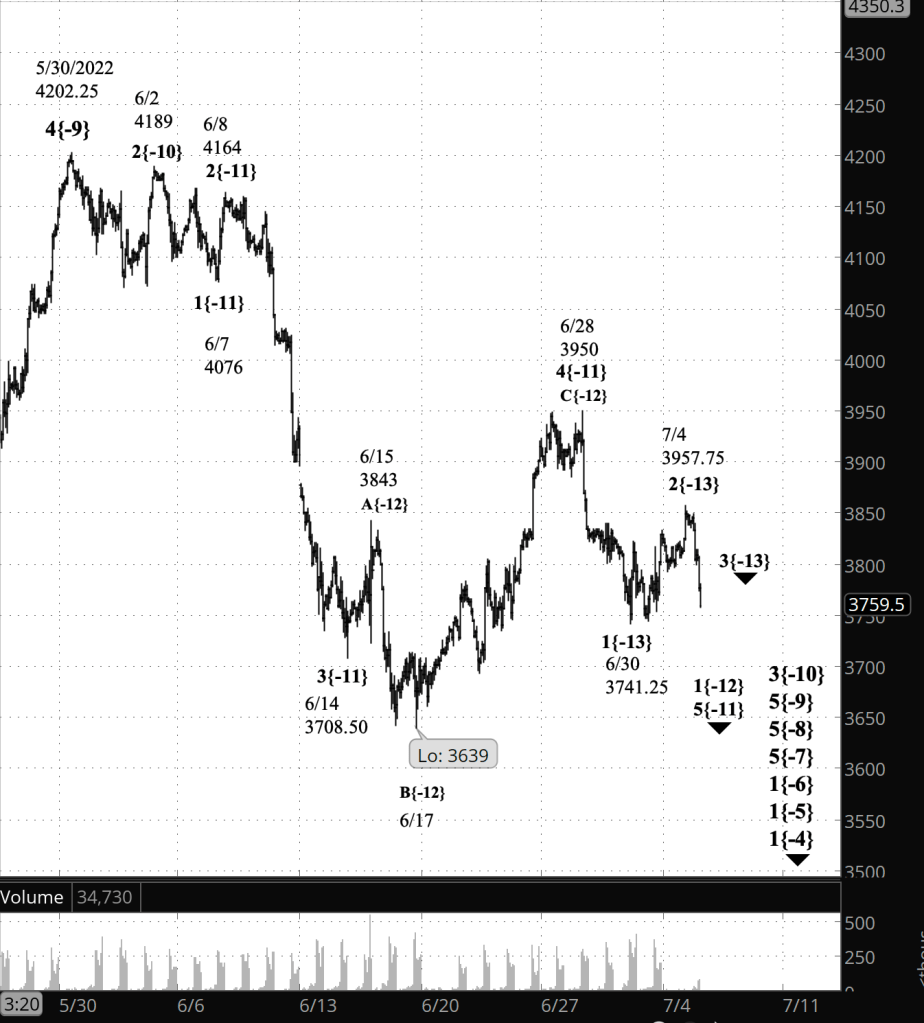
Half an hour before the closing bell. The S&P 500 fell for part of the session, to 3744 on the futures, and then reversed to the upside, remaining above the June 30 low, 3741.25, which marked the beginning of an upward correction of low degree.

Because the price remained above the June 30 low, I’ve revised this morning’s principal analysis to show that the upward correction has not ended. Rather, the correction, wave 2{-13}, has completed two waves and internally is now in its 3rd and possibly final wave, C{-14} to the upside.

The alternative is still viable: A larger correction, wave 4{-11}, that began on June 14 is still underway and is taking a compound form, as described below in this morning’s post.

Rather than revising this morning’s chart, I’m adding a new chart so that readers can compare the changes.

[S&P 500 E-mini futures at 3:30 p.m., 80-minute bars, with volume]

9:35 a.m. New York time

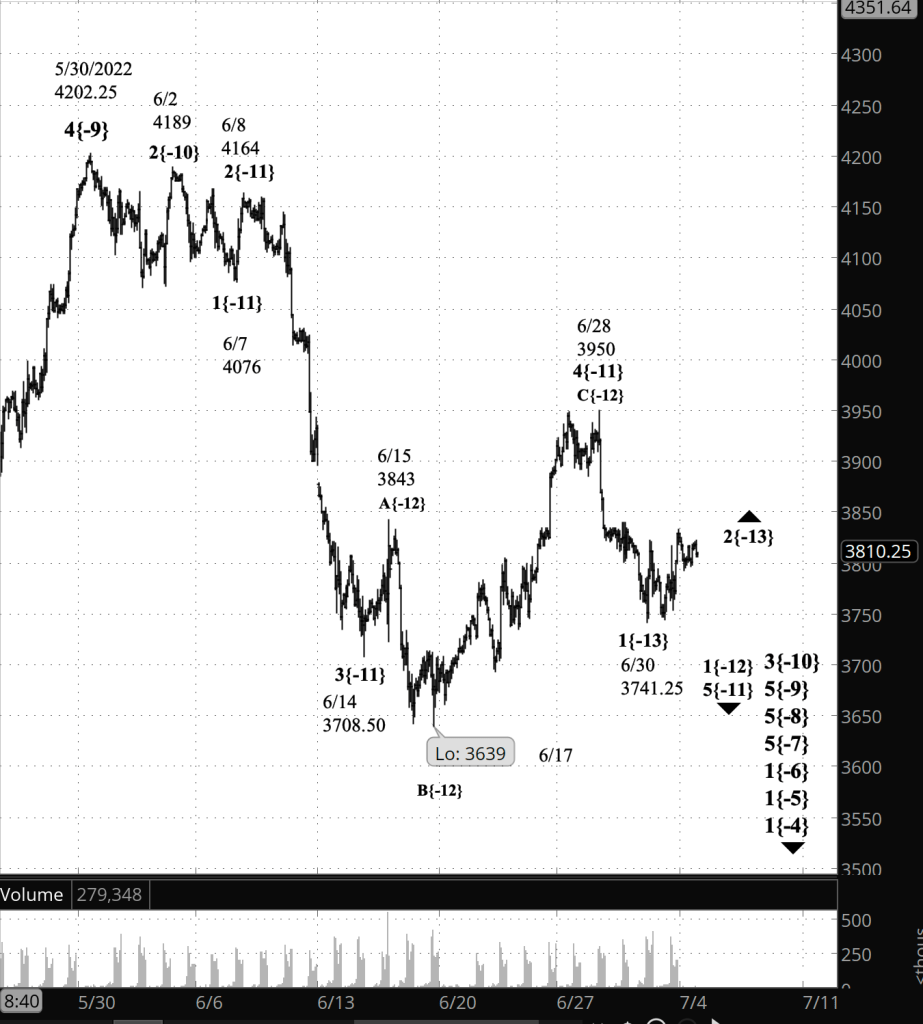
What’s happening now? The S&P 500 E-mini futures rose in overnight trading to 3957.75 and then reversed to the downside.

What does it mean? The rise was an upward correction within a larger downtrend, which began on June 28 from 3950, and the subsequent decline is a resumption of a smaller downtrend within the larger.

What is the alternative? The upward correction that began on June 14 is still underway and is forming a compound structure. The decline from the June 28 peak is a movement connecting the completed corrective pattern with a second corrective pattern, which has not yet begun.

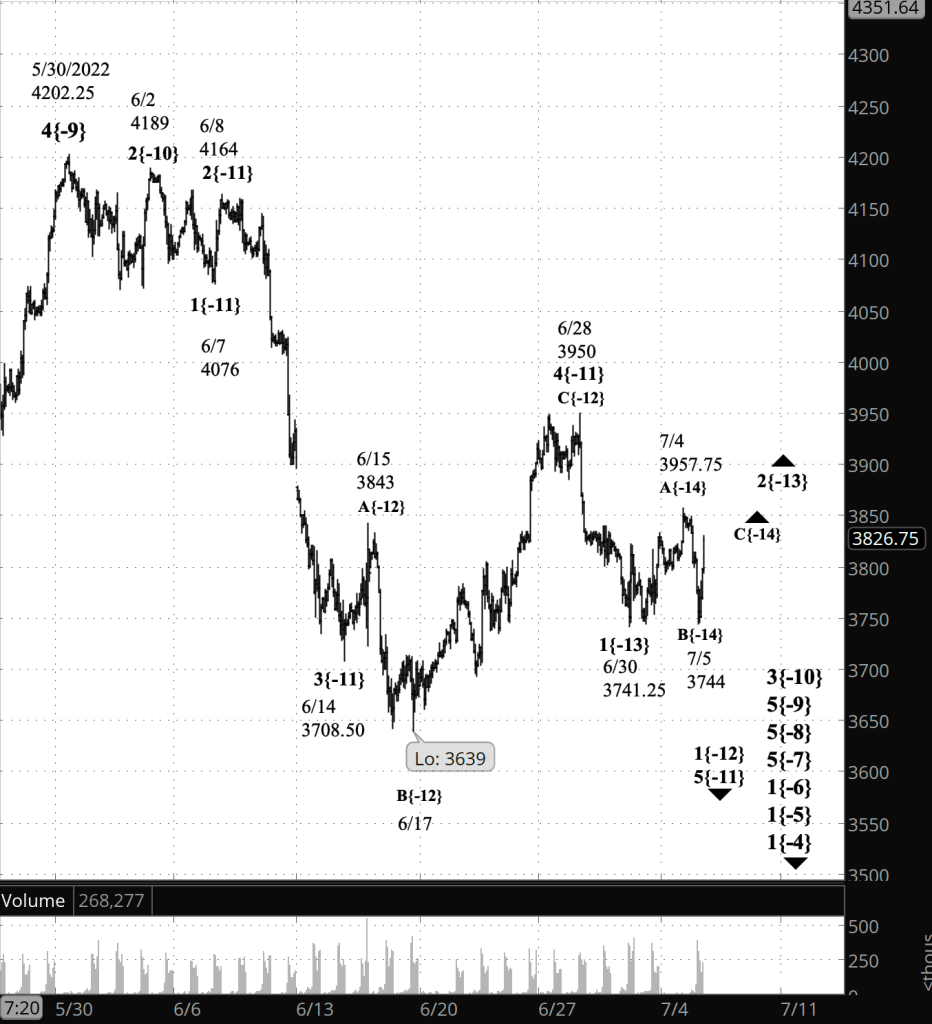
[Outdated analysis: S&P 500 E-mini futures at 9:35 a.m., 80-minute bars, with volume]

What does Elliott wave theory say? Under the principal analysis, downtrending wave 5{-11} began on June 28 from 3950 and internally is within its 1st wave — wave 1{-12} — which completed its first segment, wave 1{-13}, on June 30 at 3741.25 and its second segment, wave 2{-13}, overnight at 3957.75. The decline from the overnight peak is wave 3{-13}, which is likely to carry the price below the June 30 reversal point, 3741.25.

Under the alternative analysis, wave 4{-11}, an upward correction that began on June 14, completed a three-wave corrective pattern with wave C{-12}, ending on June 28 at 3950. The decline that followed is the first sign that wave 4{-11} is forming a compound correction. The decline is a connector wave, X{-12}, and it will be followed by a second corrective pattern.

Whichever analysis proves to match the events to come, it is all happening within downtrending wave 3{-10}, which began on June 2 from 4189, within wave 5{-9}, which began on May 30 from 4202.25.

We Are Here.

These are the waves currently in progress under my principal analysis. Each line on the list shows the wave number, with the subscript in curly brackets, the traditional degree name, the starting date, the starting price of the S&P 500 E-mini futures, and the direction of the wave.

  • S&P 500 Index:
  • 5{+3} Supercycle, 7/8/1932, 4.40 (up)
  • 5{+2} Cycle, 12/9/1974, 60.96 (up)
  • 5{+1} Primary, 3/6/2009, 666.79 (up)
  • 5{0} Intermediate, 12/26/2018, 2346.58 (up)
  • 4{-1} Minor, 1/4/2022 4818.62 (down)
  • 1{-2} Minute, 1/4/2022 4818.62 (down)
  • S&P 500 Futures and index:
  • 1{-3} Minuette, 1/4/2022, 4808.25 (down) (futures), 4818.62 (down) (index)
  • S&P 500 Futures:
  • 1{-4} Subminuette, 1/4/2022, 4808.25 (down)
  • 1{-5} Micro, 1/4/2022, 4808.25 (down)
  • 1{-6} Submicro, 1/4/2022, 4808.25 (down)
  • 5{-7} Minuscule, 3/29/2022, 4631 (down)
  • 5{-8} Subminuscule, 4/21/2022, 4509, (down)

Learning and other resources. Elliott wave analysis provides context, not prophecy. As the 20th century semanticist Alfred Korzybski put it in his book Science and Sanity (1933), “The map is not the territory … The only usefulness of a map depends on similarity of structure between the empirical world and the map.” And I would add, in the ever-changing markets, we can judge that similarity of structure only after the fact.

See the menu page Analytical Methods for a rundown on where to go for information on Elliott wave analysis.

By Tim Bovee, Portland, Oregon, July 5, 2022

Disclaimer

Tim Bovee, Private Trader tracks the analysis and trades of a private trader for his own accounts. Nothing in this blog constitutes a recommendation to buy or sell stocks, options or any other financial instrument. The only purpose of this blog is to provide education and entertainment.

No trader is ever 100 percent successful in his or her trades. Trading in the stock and option markets is risky and uncertain. Each trader must make trading decisions for his or her own account, and take responsibility for the consequences.

License
Creative Commons License

All content on Tim Bovee, Private Trader by Timothy K. Bovee is licensed under a Creative Commons Attribution-ShareAlike 4.0 International License.

Based on a work at www.timbovee.com.
Trader’s Notebook

11 a.m. New York time

What’s happening now? The S&P 500 E-mini futures traded in a narrow range on Monday, as U.S. markets were closed to celebrate American independence from the British Empire. The price decline from the lower 3800s into the upper 3700s, covering fewer than 40 points altogether.

What does it mean? The June 30 low, 3741.25, marked the end of the initial leg of the downtrend that began two days earlier. The largely sideways movement that followed is an upward correction within the downtrend.

What are the alternatives? It’s possible that the decline that began on June 28 is part of a compound correction, linking a second corrective pattern to the first and extending the upward correction that began on June 14.

[S&P 500 E-mini futures at 11 a.m., 80-minute bars, with volume]

What does Elliott wave theory say? Under the principal analysis, wave 5{-11} began on June 28 from 3950 and internally completed wave 1{-13} on June 30 at 3741.25. Wave 1{-13} is the initial wave within wave 1{-12}, the first wave within the wave 5{-11} downtrend. Wave 2{-13}, an small upward correction, is now underway, and will be followed by a relatively more powerful decline, wave 3{-13}.

Under the alternative analysis, wave 4{-11}, which began on June 14 from 3708.50 is still underway and is forming a compound correction. The first corrective pattern ended with wave C{-12} on June 28 at 3950, the decline that followed is wave X{-12}, connecting the first corrective pattern with a second pattern to come.

We Are Here.

These are the waves currently in progress under my principal analysis. Each line on the list shows the wave number, with the subscript in curly brackets, the traditional degree name, the starting date, the starting price of the S&P 500 E-mini futures, and the direction of the wave.

  • S&P 500 Index:
  • 5{+3} Supercycle, 7/8/1932, 4.40 (up)
  • 5{+2} Cycle, 12/9/1974, 60.96 (up)
  • 5{+1} Primary, 3/6/2009, 666.79 (up)
  • 5{0} Intermediate, 12/26/2018, 2346.58 (up)
  • 4{-1} Minor, 1/4/2022 4818.62 (down)
  • 1{-2} Minute, 1/4/2022 4818.62 (down)
  • S&P 500 Futures and index:
  • 1{-3} Minuette, 1/4/2022, 4808.25 (down) (futures), 4818.62 (down) (index)
  • S&P 500 Futures:
  • 1{-4} Subminuette, 1/4/2022, 4808.25 (down)
  • 1{-5} Micro, 1/4/2022, 4808.25 (down)
  • 1{-6} Submicro, 1/4/2022, 4808.25 (down)
  • 5{-7} Minuscule, 3/29/2022, 4631 (down)
  • 5{-8} Subminuscule, 4/21/2022, 4509, (down)

Learning and other resources. Elliott wave analysis provides context, not prophecy. As the 20th century semanticist Alfred Korzybski put it in his book Science and Sanity (1933), “The map is not the territory … The only usefulness of a map depends on similarity of structure between the empirical world and the map.” And I would add, in the ever-changing markets, we can judge that similarity of structure only after the fact.

See the menu page Analytical Methods for a rundown on where to go for information on Elliott wave analysis.

By Tim Bovee, Portland, Oregon, July 4, 2022

Disclaimer

Tim Bovee, Private Trader tracks the analysis and trades of a private trader for his own accounts. Nothing in this blog constitutes a recommendation to buy or sell stocks, options or any other financial instrument. The only purpose of this blog is to provide education and entertainment.

No trader is ever 100 percent successful in his or her trades. Trading in the stock and option markets is risky and uncertain. Each trader must make trading decisions for his or her own account, and take responsibility for the consequences.

License
Creative Commons License

All content on Tim Bovee, Private Trader by Timothy K. Bovee is licensed under a Creative Commons Attribution-ShareAlike 4.0 International License.

Based on a work at www.timbovee.com.
Trader’s Notebook

Market holiday on Monday. U.S. markets will be closed on Monday for a holiday celebrating America’s winning its independence from the British Empire. Trading will resume on Tuesday. The S&P 500 E-mini futures usually resume trading the day before the post-holiday trading session. I’ll keep an eye out for that on Monday and, if events warrant, will post an analysis.

3:30 p.m. New York time

Half an hour before the closing bell. The S&P 500 has continued trading within a narrow range, reaching into the low 3800s and remaining above yesterday’s low on the futures, 3741.25. Downtrending wave 5{-11} continues, having paused for a small internal upward correction. No change in the analysis. I’ve updated the chart.

9:45 a.m. New York time

MU earnings play exit. I’ve exited my short bear call vertical spread on MU for 26.7% of maximum potential profit and have updated the trade analysis with full results.

9:35 a.m. New York time

What’s happening now? The S&P 500 E-mini futures traded in a narrow range overnight, remaining above yesterday’s low, 3741.25.

What does it mean? The downtrend that began on June 28 continues.

What is the alternative? The upward correction that began on June 14 could still be underway, and if so, then the downward movement from June 28 would be a connecting wave within a compound structure, that strings together two or three corrective patterns.

[S&P 500 E-mini futures at 3:30 p.m., 3-hour bars, with volume]

What does Elliott wave theory say? Under the principal analysis, downtrending wave 5{-11} is underway. Its completion will also mark the end of its parent, wave 3{-10}, which began on June 6 from 4189. An upward correction, wave 4{-10}, will follow the 3rd wave, with 4189, the starting point of wave 3{-10} being the upper limit of how far the 4th wave correction can go. It could, of course, travel far less than that distance.

Under the alternative analysis, wave 4{-11}, an upward correction that began on June 14, is forming a compound structure. The first corrective pattern ended on June 28 with wave C{-12}, and the ensuing decline, wave X{-12}, will connect that first pattern with a second corrective pattern. And a third pattern could be added on in a like manner. When wave 4{-11} is complete, then wave 5{-11} will begin, as described above.

We Are Here.

These are the waves currently in progress under my principal analysis. Each line on the list shows the wave number, with the subscript in curly brackets, the traditional degree name, the starting date, the starting price of the S&P 500 E-mini futures, and the direction of the wave.

  • S&P 500 Index:
  • 5{+3} Supercycle, 7/8/1932, 4.40 (up)
  • 5{+2} Cycle, 12/9/1974, 60.96 (up)
  • 5{+1} Primary, 3/6/2009, 666.79 (up)
  • 5{0} Intermediate, 12/26/2018, 2346.58 (up)
  • 4{-1} Minor, 1/4/2022 4818.62 (down)
  • 1{-2} Minute, 1/4/2022 4818.62 (down)
  • S&P 500 Futures and index:
  • 1{-3} Minuette, 1/4/2022, 4808.25 (down) (futures), 4818.62 (down) (index)
  • S&P 500 Futures:
  • 1{-4} Subminuette, 1/4/2022, 4808.25 (down)
  • 1{-5} Micro, 1/4/2022, 4808.25 (down)
  • 1{-6} Submicro, 1/4/2022, 4808.25 (down)
  • 5{-7} Minuscule, 3/29/2022, 4631 (down)
  • 5{-8} Subminuscule, 4/21/2022, 4509, (down)

Learning and other resources. Elliott wave analysis provides context, not prophecy. As the 20th century semanticist Alfred Korzybski put it in his book Science and Sanity (1933), “The map is not the territory … The only usefulness of a map depends on similarity of structure between the empirical world and the map.” And I would add, in the ever-changing markets, we can judge that similarity of structure only after the fact.

See the menu page Analytical Methods for a rundown on where to go for information on Elliott wave analysis.

By Tim Bovee, Portland, Oregon, July 1, 2022

Disclaimer

Tim Bovee, Private Trader tracks the analysis and trades of a private trader for his own accounts. Nothing in this blog constitutes a recommendation to buy or sell stocks, options or any other financial instrument. The only purpose of this blog is to provide education and entertainment.

No trader is ever 100 percent successful in his or her trades. Trading in the stock and option markets is risky and uncertain. Each trader must make trading decisions for his or her own account, and take responsibility for the consequences.

License
Creative Commons License

All content on Tim Bovee, Private Trader by Timothy K. Bovee is licensed under a Creative Commons Attribution-ShareAlike 4.0 International License.

Based on a work at www.timbovee.com.
MU Trade

Micron Technology Inc. (MU)

Lot 2022-2

Update 7/1/2022: I exited my short bull put vertical spread on MU, 49 days before expiration, for a $0.87 debit per contract/share, a profit before fees of $31 per contract. Shares were trading at $53.23, down $1.34 from the entry level.

The Implied Volatility Rank at exit was 13.7%, up one point from the entry level.

I exited on the day after entry because the position reached 26.7% of maximum potential profit, slightly better than my normal exit point for earnings plays, 25% of max.

Shares fell by 2.5% over one day for a -896% annual rate. The options position produced a 36.5% return for a +13,312% annual rate.


I have entered a short bear call vertical spread on MU, using options that trade for the last time 50 days hence, on month day. The premium is a $1.16 credit per contract share and the stock at the time of entry was priced at $54.57.

The Implied Volatility Ratio stood at 12.7%.

Premium:$1.16Expire OTM
MU-bear call spreadStrikeOddsDelta
Calls
Long65.0085.0%20
Break-even61.1678.5%27.5
Short60.0072.0%35

The premium is 46.4% of the width of the position’s short/long spread. The profit zone covers a 12.1% move to the upside and an unlimited move to the downside.

The risk/reward ratio is 3.3:1, with maximum risk of $384 and maximum reward of $116 per contract.

How I chose the trade. The trade was placed to coincide with MU’s earnings announcement, after the closing bell on the day of entry. The short strikes were set to coincide with the expected move of $3.62 either way, based on options pricing, which gives a price range of $52.19 to $59.43.

By Tim Bovee, Portland, Oregon, June 30, 2022

Disclaimer

Tim Bovee, Private Trader tracks the analysis and trades of a private trader for his own accounts. Nothing in this blog constitutes a recommendation to buy or sell stocks, options or any other financial instrument. The only purpose of this blog is to provide education and entertainment.

No trader is ever 100 percent successful in his or her trades. Trading in the stock and option markets is risky and uncertain. Each trader must make trading decisions for his or her own account, and take responsibility for the consequences.

License
Creative Commons License

All content on Tim Bovee, Private Trader by Timothy K. Bovee is licensed under a Creative Commons Attribution-ShareAlike 4.0 International License.

Based on a work at www.timbovee.com.
Trader’s Notebook

3:30 p.m. New York time

Half an hour before the closing bell. The S&P 500 continued to decline during the morning, reaching 3741.25 on the futures and then reversing back in to the low 3800s before resuming the decline. The movement appears too small to be an immediate child wave of the downtrend that began on June 28. I’m staying with this morning’s labeling of that downtrend as wave 5{-11}. I consider it to still be in its first subwave, 1{-12}. No change in the analysis. I’ve updated the chart.

10:40 a.m. New York time

MU earnings play entry. I’ve entered a short bear call vertical spread on MU using options that trade for the last time on August 19 and have posted an analysis of the trade.

10 a.m. New York time

WBA earnings play exit. I’ve exited my short bear call spread options position on WBA for 53.8% of maximum potential profit and have updated the trade analysis with full results.

9:35 a.m. New York time

What’s happening now? The S&P 500 E-mini futures declined further overnight, into the upper 3700s.

What does it mean? The downtrend that began on June 28 continues and likely will carry the price significantly lower. It is a continuation of the larger downtrend that began on June 2

What is the alternative? The upward correction that began on June 14 from 3708.50 is still underway and is forming a compound structure. The present decline is a wave that will connect the just completed corrective pattern with a second corrective pattern.

[S&P 500 E-mini futures at 3:30 p.m., 170-minute bars, with volume]

What does Elliott wave theory say? Under the principal analysis, downtrending wave 5{-11}, which began on June 28, is underway. Although it could be cut short — “truncated” is the term of art — it will most likely fall below the end of the preceding wave 3{-11}, at 3708.50 on June 16, and typically it will move lower by a significant amount.

Under the alternative analysis, the wave 4{-11} upward correction that began on June 14 has completed one corrective pattern and is now in a declining connector wave, X{-12}, which will be followed by a second corrective pattern, and perhaps by a third. Once the compound correction is over, wave 5{-11} will begin and behave as described in the principal analysis.

The end of wave 5{-11} will also be the end of its parent, wave 3{-10}, which began on June 2 from 4189. The ensuing upward correction, wave, 4{-10}. A 4th wave correction typically ends within the 4th subwave of the preceding 3rd wave. In this case, wave 4{-10} would end in the range of wave 4{-11} within wave 3{-10} — between 3639 and 3950.

Wave 5{-10} will follow, carrying the price still lower. The end of wave 5{-10} will also be the end of 5th waves up to wave 5{-7}, three degrees larger. Wave 5{-7}, in turn, will be the final wave within wave 1{-6}, which began on January 4 from 4808.25. The ensuing wave 2{-6} upward correction may well retrace a significant amount of the wave 1{-6}, although that’s a tendency, not a guarantee.

The June 28 high, 3950, is as high as the S&P 500 is likely to go over the nearer term (weeks to a few months). Over the next six months or so, the 4700s are likely to be the upper limit of the market’s rise.

The end of wave 2{-6}, however high it goes, will also be the start of wave 3{-6}, a downtrending wave with all of the power that 3rd waves tend to display. Wave 1{-6} has covered about a thousand points so far.

Wave 3{-6} can be expected to cover several multiples of its final distance, although, again, with a caveat: The rule is that a 3rd wave can’t be shorter than both the preceding 1st wave and the ensuing 5th wave. If either the 1st or the 5th wave is uncharacteristically short, then the 3rd wave could turn out to be quite short without breaking the rule.

We Are Here.

These are the waves currently in progress under my principal analysis. Each line on the list shows the wave number, with the subscript in curly brackets, the traditional degree name, the starting date, the starting price of the S&P 500 E-mini futures, and the direction of the wave.

  • S&P 500 Index:
  • 5{+3} Supercycle, 7/8/1932, 4.40 (up)
  • 5{+2} Cycle, 12/9/1974, 60.96 (up)
  • 5{+1} Primary, 3/6/2009, 666.79 (up)
  • 5{0} Intermediate, 12/26/2018, 2346.58 (up)
  • 4{-1} Minor, 1/4/2022 4818.62 (down)
  • 1{-2} Minute, 1/4/2022 4818.62 (down)
  • S&P 500 Futures and index:
  • 1{-3} Minuette, 1/4/2022, 4808.25 (down) (futures), 4818.62 (down) (index)
  • S&P 500 Futures:
  • 1{-4} Subminuette, 1/4/2022, 4808.25 (down)
  • 1{-5} Micro, 1/4/2022, 4808.25 (down)
  • 1{-6} Submicro, 1/4/2022, 4808.25 (down)
  • 5{-7} Minuscule, 3/29/2022, 4631 (down)
  • 5{-8} Subminuscule, 4/21/2022, 4509, (down)

Learning and other resources. Elliott wave analysis provides context, not prophecy. As the 20th century semanticist Alfred Korzybski put it in his book Science and Sanity (1933), “The map is not the territory … The only usefulness of a map depends on similarity of structure between the empirical world and the map.” And I would add, in the ever-changing markets, we can judge that similarity of structure only after the fact.

See the menu page Analytical Methods for a rundown on where to go for information on Elliott wave analysis.

By Tim Bovee, Portland, Oregon, June 30, 2022

Disclaimer

Tim Bovee, Private Trader tracks the analysis and trades of a private trader for his own accounts. Nothing in this blog constitutes a recommendation to buy or sell stocks, options or any other financial instrument. The only purpose of this blog is to provide education and entertainment.

No trader is ever 100 percent successful in his or her trades. Trading in the stock and option markets is risky and uncertain. Each trader must make trading decisions for his or her own account, and take responsibility for the consequences.

License
Creative Commons License

All content on Tim Bovee, Private Trader by Timothy K. Bovee is licensed under a Creative Commons Attribution-ShareAlike 4.0 International License.

Based on a work at www.timbovee.com.