Trader’s Notebook

3:30 p.m. New York time

Half an hour before the closing bell. The S&P 500 futures rose during the session, approaching to within 53 points of the highest point this 4th wave upward correction can reach without violating the rules of Elliott wave analysis. As I put it in my cheatsheet: “If the wave moves beyond the end of wave 1, then it’s not wave 4”. No change in the analysis. I’ve updated the chart.

3:15 p.m. New York time

SPY options spread entry. I’ve entered a short bear call options spread on SPY, based on Elliott wave analysis, in an attempt to capture the 5th wave decline that will follow the end of the present 4th wave correction to the upside. I’ve posted an analysis of the trade.

2:25 p.m. New York time

UNP earnings play exit. I’ve exited my short iron condor spread on UNP for an 8.2% return and have updated the trade analysis with full results.

2 p.m. New York time

XOM earnings play exit. I’ve exited my short bull put spread on XOM for a 44.1% return and have updated the trade analysis with full results.

1:45 p.m. New York time

C earnings play exit. I’ve exited my short iron condor spread on C for a 40% return and have updated the trade analysis with full results.

1:15 p.m. New York time

GM earnings play entry. I’ve entered a short bull put options spread on GM timed to coincide with the company’s earnings announcement after the closing bell today. I’ve posted an analysis of the trade.

9:35 a.m. New York time

What’s happening now? The S&P 500 E-mini futures traded sideways overnight in the space between the 50% and 61.8% Fibonacci retracement levels.

What does it mean? The upward correction that began on January 24 is nearing an end. It may well rise further but will remain below 2572.75. It will be followed by a resumption of the downtrend that began on January 4.

What are the alternatives? There are 2. Both rely on the chart being analyzed as showing that the corrective pattern is complete.

  1. The downtrend following the correction is taking the first tentative steps of its resumption.
  2. The downtrend within the correction is the beginning of will be followed by a second corrective pattern in a complex correction.
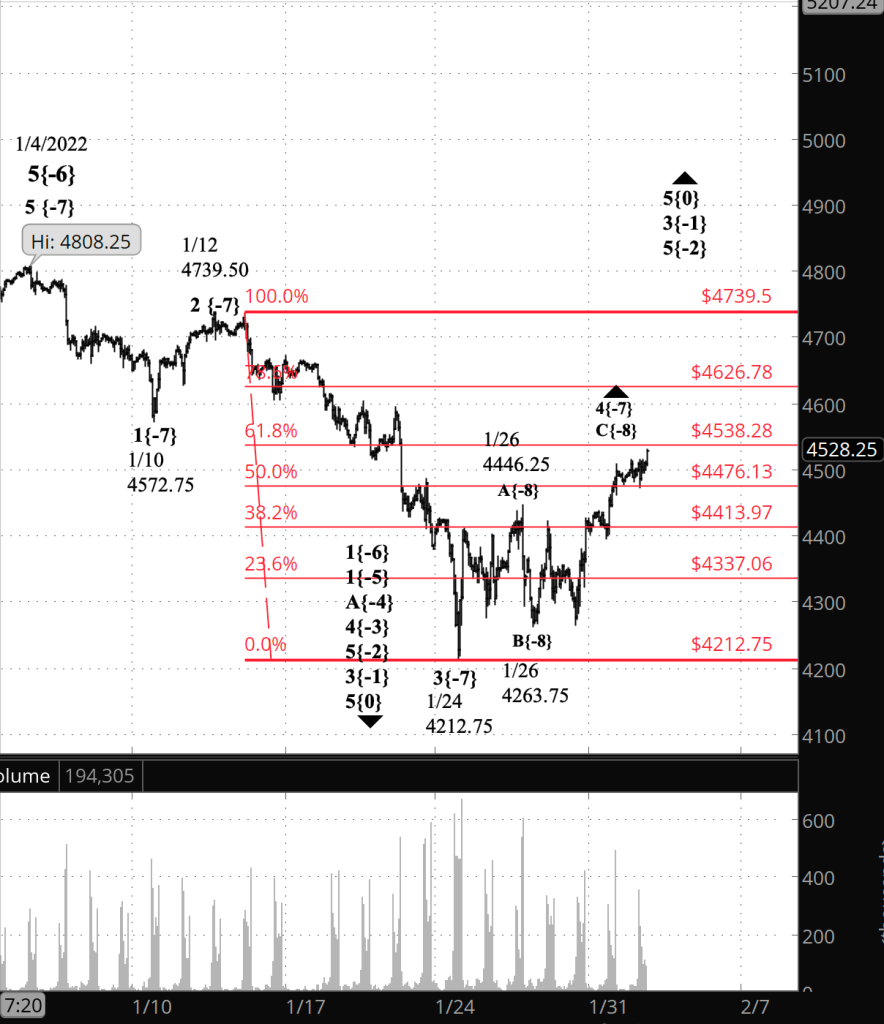
[S&P 500 E-mini futures at 3:30 p.m., 70-minute bars, with volume]

What does Elliott wave theory say? Wave 5{-9} within rising wave C{-8} is underway, as the parent wave 4{-7} nears it’s end. Under the rules of Elliott wave analysis, a rising 4th wave must remain below the end of the preceding 1st wave. Wave 1{-7} ended on January 10 at 4572.75. Wave 5{-9} has almost reached its end but could rise a bit more, perhaps to the 61.8% retracement level, 4538.28, which is 35 points below the end of wave 1{-7} and so is within the rules.

Under the first alternative, wave C{-8} is complete, along with its parent, wave 4{-7}. Downtrending wave 5{-7} has begun and will carry the price below 4212.75, the end of wave 3{-7}.

Under the second alternative, wave C{-8} is complete and will be followed by downward wave X{-8}, which marks the end of the first corrective pattern and the beginning of a second corrective pattern within a compound structure. Wave X will remain above 4212.75.

We Are Here.

These are the wave currently in progress. Each line on the list shows the wave number, with the subscript in curly brackets, the traditional degree name, the starting date, the starting price of the S&P 500 E-mini futures, and the direction of the wave.

  • 5{0} Intermediate, 12/21/2018, 2316.75 (up)
  • 3{1} Minor, 3/23/2018 2174 (up)
  • 5{-2} Minute, 10/4/2020, 4267.50 (up)
  • 4{-3} Minuette, 1/4/2022, 4808.25 (down)
  • A{-4} Subminuette, 1/4/2022, 4808.25 (down)
  • 1{-5} Micro, 1/4/2022, 4808.25 (down)
  • 1{-6} Submicro, 1/4/2022, 4808.25 (down)
  • 4{-7} Minuscule, 1/24/2022, 4212.75 (up)
  • C{-8} Subminuscule, 1/26/2022, 4263.75 (up)

Learning and other resources. Elliott wave analysis provides context, not prophecy. As the 20th century semanticist Alfred Korzybski put it this way in his book Science and Sanity (1933), “The map is not the territory … The only usefulness of a map depends on similarity of structure between the empirical world and the map.” And I would add, in the ever-changing markets, we can judge that similarity of structure only after the fact.

See the menu page Analytical Methods for a rundown on where to go for information on Elliott wave analysis.

By Tim Bovee, Portland, Oregon, February 1, 2022

Disclaimer

Tim Bovee, Private Trader tracks the analysis and trades of a private trader for his own accounts. Nothing in this blog constitutes a recommendation to buy or sell stocks, options or any other financial instrument. The only purpose of this blog is to provide education and entertainment.

No trader is ever 100 percent successful in his or her trades. Trading in the stock and option markets is risky and uncertain. Each trader must make trading decisions for his or her own account, and take responsibility for the consequences.

License
Creative Commons License

All content on Tim Bovee, Private Trader by Timothy K. Bovee is licensed under a Creative Commons Attribution-ShareAlike 4.0 International License.

Based on a work at www.timbovee.com.
XOM Trade

Exxon Mobil Corp. (XOM)

Update 2/1/2022: I exited my short bull put spread position on XOM, 45 days before expiration, for a $0.93 debit per contract/share, a profit before fees of $41.00 per contract. Shares were trading at $77.59, up $2.22 from the entry level.

The Implied Volatility Rank at exit was 29.3%, down 9 points from the entry level.

I exited because the position exceeded 25% of maximum potential profit, my normal exit point for earnings plays.

Shares rose by 2.9% in one day for a +1,075% annual rate. The options position produced a 44.1% return for a +16,091% annual rate.


I have entered a short bull put vertical spread on XOM, using options that trade for the last time 46 days hence, on March 18. The premium is a $1.34 credit per contract share and the stock at the time of entry was priced at $75.37.

The Implied Volatility Ratio stood at 38.3%.

Premium:$1.34Expire OTM
XOM-bull put spreadStrikeOddsDelta
Puts
Long67.5078.0%18
Break-even73.8468.5%26.5
Short72.5059.0%35

The premium is 53.6% of the width of the positions short/long spread. The profit zone covers a 2% move to the downside and an unlimited move to the upside.

The risk/reward ratio is 2.7:1, with maximum risk of $366 and maximum reward of $134 per contract.

How I chose the trade. The trade was placed to coincide with XOM’S earnings announcement, before the opening bell on the day of entry. The short strikes were set to coincide with the expected move of $2.06 either way, based on options pricing, which gives a price range of $73.22 to $77.34.

By Tim Bovee, Portland, Oregon, January 31, 2022

Disclaimer

Tim Bovee, Private Trader tracks the analysis and trades of a private trader for his own accounts. Nothing in this blog constitutes a recommendation to buy or sell stocks, options or any other financial instrument. The only purpose of this blog is to provide education and entertainment.

No trader is ever 100 percent successful in his or her trades. Trading in the stock and option markets is risky and uncertain. Each trader must make trading decisions for his or her own account, and take responsibility for the consequences.

License
Creative Commons License

All content on Tim Bovee, Private Trader by Timothy K. Bovee is licensed under a Creative Commons Attribution-ShareAlike 4.0 International License.

Based on a work at www.timbovee.com.
Trader’s Notebook

3:30 p.m. New York time

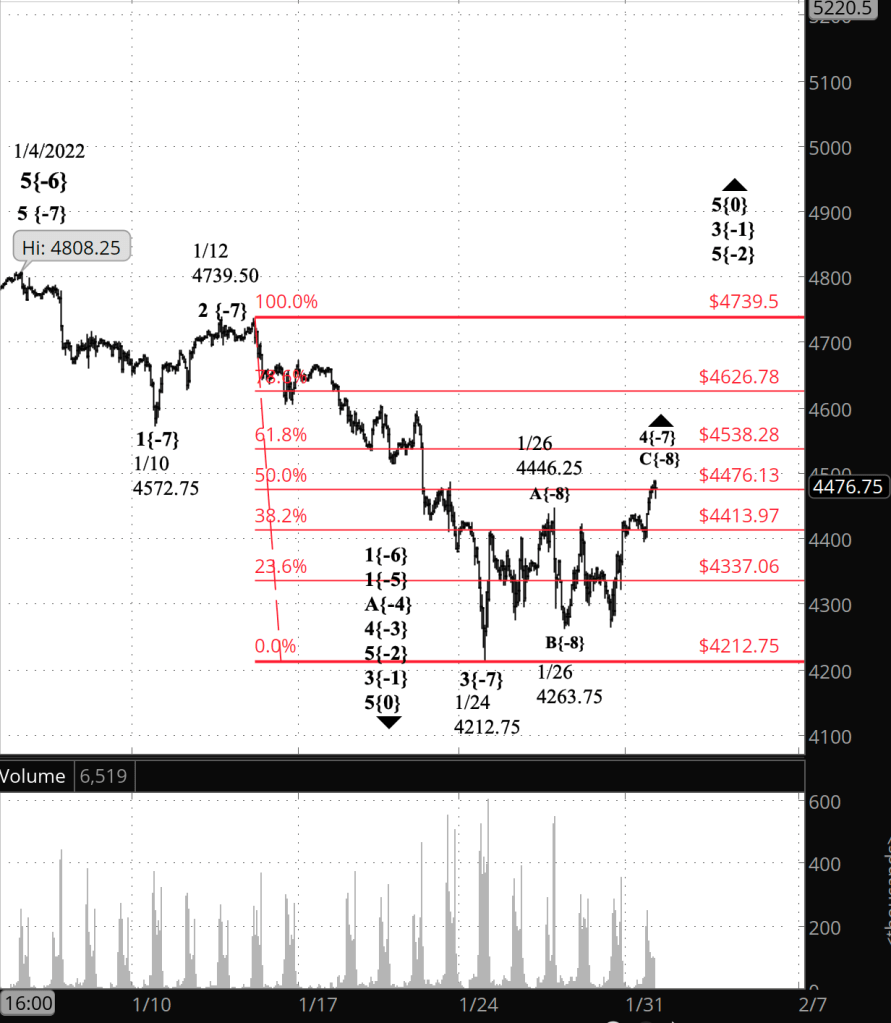
Half an hour before the closing bell. The S&P 500 futures pushed up to the 50% retracement level and again paused. The upward movement invalidates my first alternative from this morning, that the retracement had ended overnight. The present high of the session meets all of the requirements for completing the wave 4{-7}, the upward correction that began January 24. Under the rules of Elliott wave analysis, it could still rise further, but it must remain below the end of the preceding 1st wave, 4572.75. No change in the principal analysis. I’ve updated the chart.

11:30 a.m. New York time

XOM earnings play entry. I’ve entered a short bull put options vertical spread on XOM, timed to coincide with the company’s earnings announcement tomorrow before the opening bell. I’ve posted an analysis of the trade.

9:35 a.m. New York time

What’s happening now? The S&P 500 E-mini futures traded within a narrow range in overnight trading, staying close to the 38.2% Fibonacci retracement level.

What does it mean? The correction that began on January 24 continues and is now in its 4th leg within a five-leg pattern.

What are the alternatives? There are two, unchanged from Friday’s Notebook.

Alternative #1: It’s possible that the correction ended at the overnight peak. The internal structure of the rise to that high doesn’t appear to support such a reading of the chart. However, I can’t rule it out entirely.

Alternative #2: Corrections come with three waves internally, and this correction is now in its 3rd wave. However, it’s possible that the present correction will form a compound structure, with two corrective patterns connected by an intervening decline and rise.

[S&P 500 E-mini futures at 3:30 p.m., hourly bars, with volume]

What does Elliott wave theory say? Over the weekend I did an inventory of the Elliott waves I’ve identified within wave 5{0} — the Intermediate degree in the traditional naming — which began on December 21, 2018 from 2316.75 on the futures. In doing so I identified a few long-ago inelegancies enabled me to improve the count. As a result of that work, I’ve changed the degree level of the present-day chart, raising the degrees up three levels. What was wave C{-11} on Friday’s chart is now wave C{-8} on today’s chart, and other waves have had a corresponding adjustment.

Nothing significant has changed. The chart still shows us at the same place as Friday’s chart did; only the degree labelling has changed.

And so, wave C{-8} within wave 4{-7}, an upward correction, continues its rise. Overnight it stalled in a brief sideways correction — wave 4{-9} — and I expect it to follow with a final upward movement, wave 5{-9}.

The first alternative — that wave 4{-7} is complete — will be invalidated by a further rise. The second alternative — that wave 4{-7} will form a compound structure of two corrective patterns — will remain a possibility until the price falls below the beginning of wave 4{-7}, which is 4212.75.

The end of wave 4{-7} will be followed by a resumption of the downtrend that began on January 4 from 4808.25. Wave 5{-7} will stretch below 4212.75, perhaps significantly so. It’s end will also mark the end of its parent wave 1{-6}, which also began on January 4.

The We Are Here list. As part of my weekend work, I’ve built a list of waves that shows where we are at present with the S&P 500, from the lowly wave C{-8} corrective component, which is now in its 5th day. all the way up wave 5{0} itself, which has been with us for more than three years.

Each line on the list shows the wave number, with the subscript in curly brackets, the traditional degree name, the starting date, the starting price of the S&P 500 E-mini futures, and the direction of the wave.

We Are Here

  • 5{0} Intermediate, 12/21/2018, 2316.75 (up)
  • 3{1} Minor, 3/23/2018 2174 (up)
  • 5{-2} Minute, 10/4/2020, 4267.50 (up)
  • 4{-3} Minuette, 1/4/2022, 4808.25 (down)
  • A{-4} Subminuette, 1/4/2022, 4808.25 (down)
  • 1{-5} Micro, 1/4/2022, 4808.25 (down)
  • 1{-6} Submicro, 1/4/2022, 4808.25 (down)
  • 4{-7} Minuscule, 1/24/2022, 4212.75 (up)
  • C{-8} Subminuscule, 1/26/2022, 4263.75 (up)

Learning and other resources. Elliott wave analysis provides context, not prophecy. As the 20th century semanticist Alfred Korzybski put it this way in his book Science and Sanity (1933), “The map is not the territory … The only usefulness of a map depends on similarity of structure between the empirical world and the map.” And I would add, in the ever-changing markets, we can judge that similarity of structure only after the fact.

See the menu page Analytical Methods for a rundown on where to go for information on Elliott wave analysis.

By Tim Bovee, Portland, Oregon, January 31, 2022

Disclaimer

Tim Bovee, Private Trader tracks the analysis and trades of a private trader for his own accounts. Nothing in this blog constitutes a recommendation to buy or sell stocks, options or any other financial instrument. The only purpose of this blog is to provide education and entertainment.

No trader is ever 100 percent successful in his or her trades. Trading in the stock and option markets is risky and uncertain. Each trader must make trading decisions for his or her own account, and take responsibility for the consequences.

License
Creative Commons License

All content on Tim Bovee, Private Trader by Timothy K. Bovee is licensed under a Creative Commons Attribution-ShareAlike 4.0 International License.

Based on a work at www.timbovee.com.
Trader’s Notebook

3:30 p.m. New York time

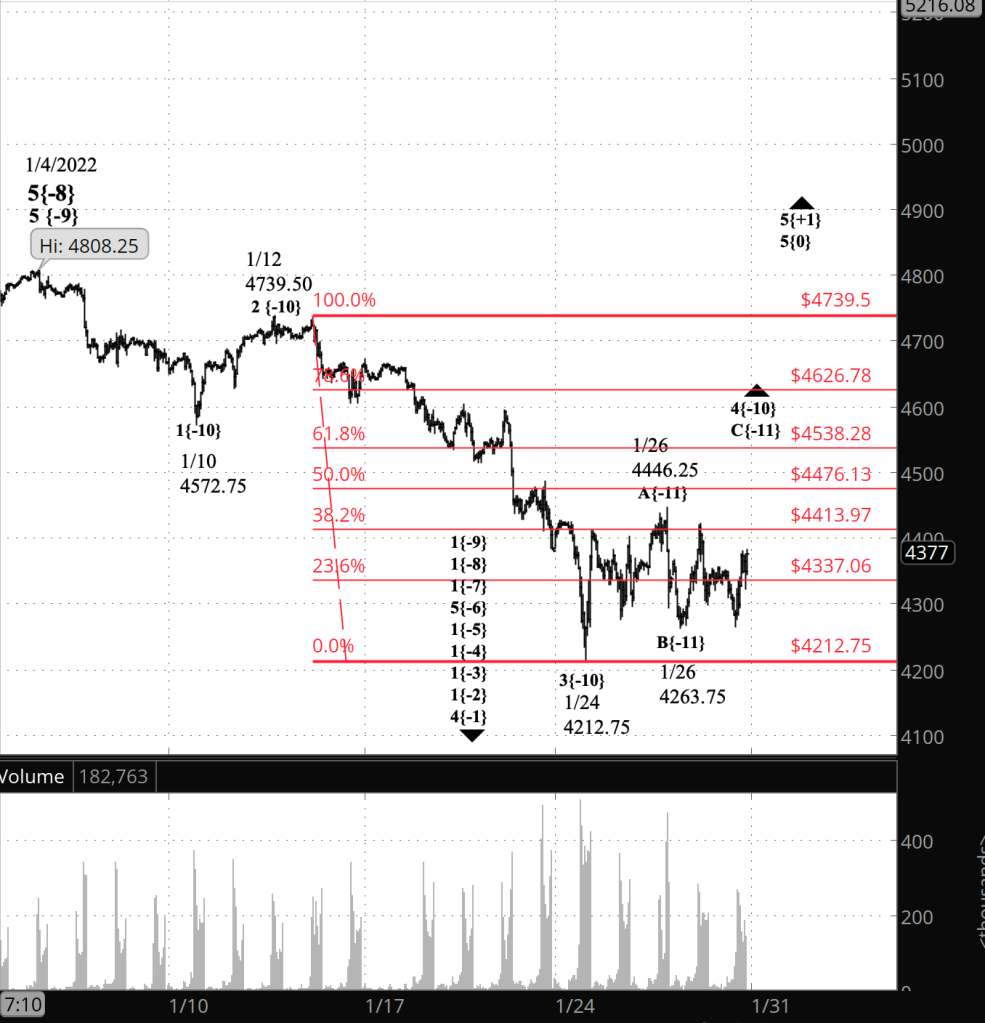
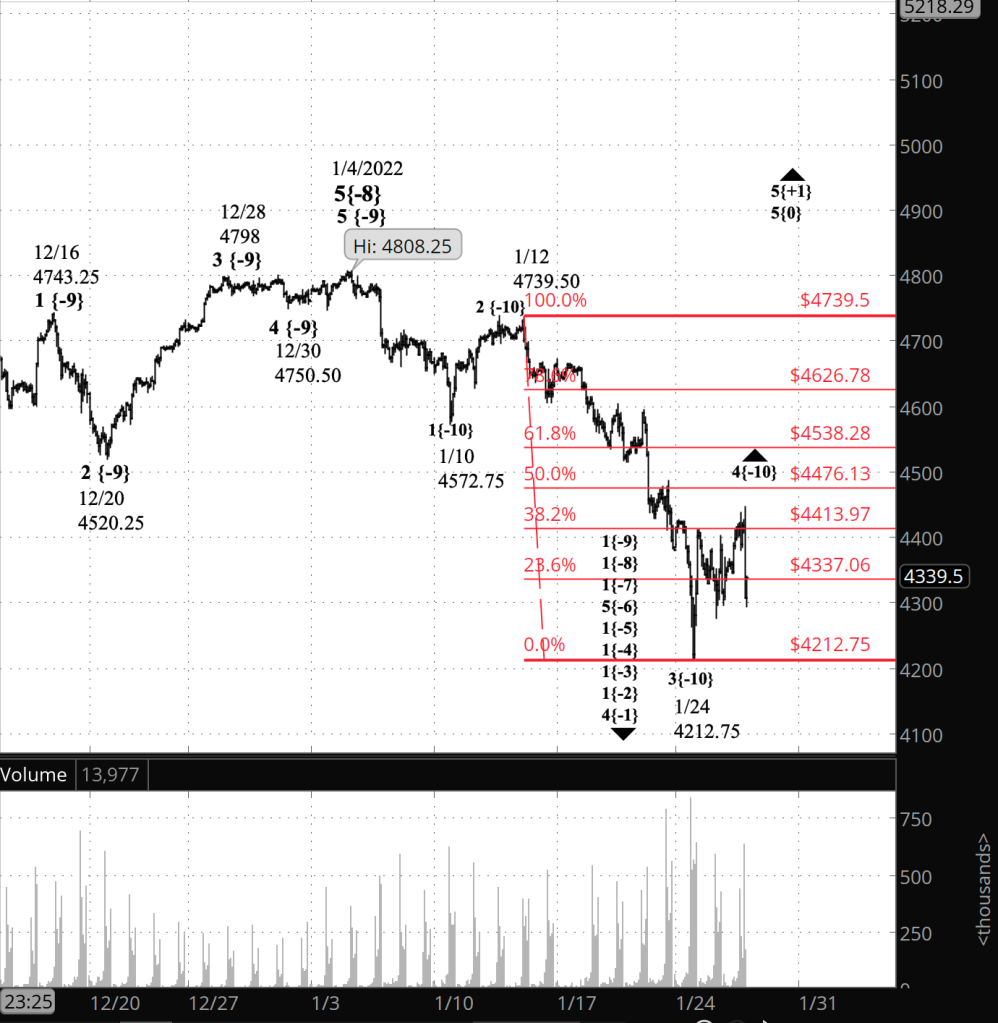
Half an hour before the closing bell. The S&P 500 futures spent the day crossing and recrossing the 23.6% retracement level. Just as a rough guess, based on several waves that don’t really go anywhere, each with three internal waves, wave C{-11} might well be taking the form of a Triangle, perhaps a Descending Triangle (flat lower boundary and descending upper boundary). At this point, though, it’s quite ambiguous, and I’m not proposing it as my principal analysis, which is unchanged this afternoon. I’ve updated the chart.

11:20 a.m. New York time

AAPL earnings play exit. I’ve exited my short bull put options spread on AAPL the day after entering the position as an earnings play. The return was 32.5%. I’ve updated the trade analysis with the result.

9:35 a.m. New York time

What’s happening now? The S&P 500 E-mini futures again declined below the 23.6% Fibonacci retracement level, with the overnight low, 4266.25, coming with 54 points of the January 24 low. The price then rose slightly as the opening bell approached.

What does it mean? The upward correction that began on January 24 from 4212.75 is still underway and is now in its 3rd and possibly final leg.

What are the alternatives? There are two.

Alternative #1: It’s possible that yesterday’s high just above the 38.2% Fibonacci retracement was the end of the correction, although the internal structure of the rise to that high point doesn’t appear to support such a reading of the chart with a great degree of clarity. Nonetheless, it’s conceivable.

Alternative #2: Although corrections come with three waves internally, there are variations. It’s possible that the present correction will form a compound structure, attaching a second corrective pattern to the first.

[S&P 500 E-mini futures at 3:30 p.m., 55-minute bars, with volume]

What does Elliott wave theory say? Under the principal analysis rising wave C{-11} within the upward wave 4{-10} correction is still underway.

Alternative #1: C waves in a Flat — the pattern of the present correction — have five waves internally. I can only count three in wave C{-11}, with a very minuscule correction in the middle. Nonetheless, if I squint real hard, it can be counted as five waves.

Alternative #2: If the wave 4{-10} correction expands into a complex pattern, then wave C{-11} will be followed by an X-wave, which will connect the two patterns, and then by a second corrective pattern.

Learning and other resources. Elliott wave analysis provides context, not prophecy. As the 20th century semanticist Alfred Korzybski put it this way in his book Science and Sanity (1933), “The map is not the territory … The only usefulness of a map depends on similarity of structure between the empirical world and the map.” And I would add, in the ever-changing markets, we can judge that similarity of structure only after the fact.

See the menu page Analytical Methods for a rundown on where to go for information on Elliott wave analysis.

By Tim Bovee, Portland, Oregon, January 28, 2022

Disclaimer

Tim Bovee, Private Trader tracks the analysis and trades of a private trader for his own accounts. Nothing in this blog constitutes a recommendation to buy or sell stocks, options or any other financial instrument. The only purpose of this blog is to provide education and entertainment.

No trader is ever 100 percent successful in his or her trades. Trading in the stock and option markets is risky and uncertain. Each trader must make trading decisions for his or her own account, and take responsibility for the consequences.

License
Creative Commons License

All content on Tim Bovee, Private Trader by Timothy K. Bovee is licensed under a Creative Commons Attribution-ShareAlike 4.0 International License.

Based on a work at www.timbovee.com.
AAPL Trade

Apple Inc. (AAPL)

Update 1/28/2022: I exited my short bull put spread earnings play on AAPL 49 days before expiration, for a $0.80 debit per contract/share, a profit before fees of $26 per contract. Shares were trading at $166.78, up $4.28 from the entry level.

The Implied Volatility Rank at exit was 54.7%, down 9.4 points from the entry level.

I exited because the position reached 25% of maximum potential profit, my normal exit point for earnings plays.

Shares rose by 2.6% over one day for a +961% annual rate. The options position produced a 32.5% return for a +11,863% annual rate.


I have entered a short bull put options spread on AAPL, using options that trade for the last time 50 days hence, on March 18. The premium is a $1.06 credit per contract share and the stock at the time of entry was priced at $162.50.

The Implied Volatility Ratio stood at 64.1%.

Premium:$1.06Expire OTM
AAPL-bull put spreadStrikeOddsDelta
Puts
Long145.0070.0%25
Break-even151.0666.5%28.5
Short150.0063.0%32

The premium is 42.4% of the width of the positions short/long spread. The profit zone covers a 7% move to the downside and an unlimited move to the upside.

The risk/reward ratio is 3.7:1, with maximum risk of $394 and maximum reward of $106 per contract.

How I chose the trade. The trade was placed to coincide with LVS’s earnings announcement, after the closing bell on the day of entry. The short strikes were set to coincide with the expected move of $5.53 either way, based on options pricing, which gives a price range of $156.97 to $168.03.

By Tim Bovee, Portland, Oregon, January 27, 2022

Disclaimer

Tim Bovee, Private Trader tracks the analysis and trades of a private trader for his own accounts. Nothing in this blog constitutes a recommendation to buy or sell stocks, options or any other financial instrument. The only purpose of this blog is to provide education and entertainment.

No trader is ever 100 percent successful in his or her trades. Trading in the stock and option markets is risky and uncertain. Each trader must make trading decisions for his or her own account, and take responsibility for the consequences.

License
Creative Commons License

All content on Tim Bovee, Private Trader by Timothy K. Bovee is licensed under a Creative Commons Attribution-ShareAlike 4.0 International License.

Based on a work at www.timbovee.com.
Trader’s Notebook

3:30 p.m. New York time

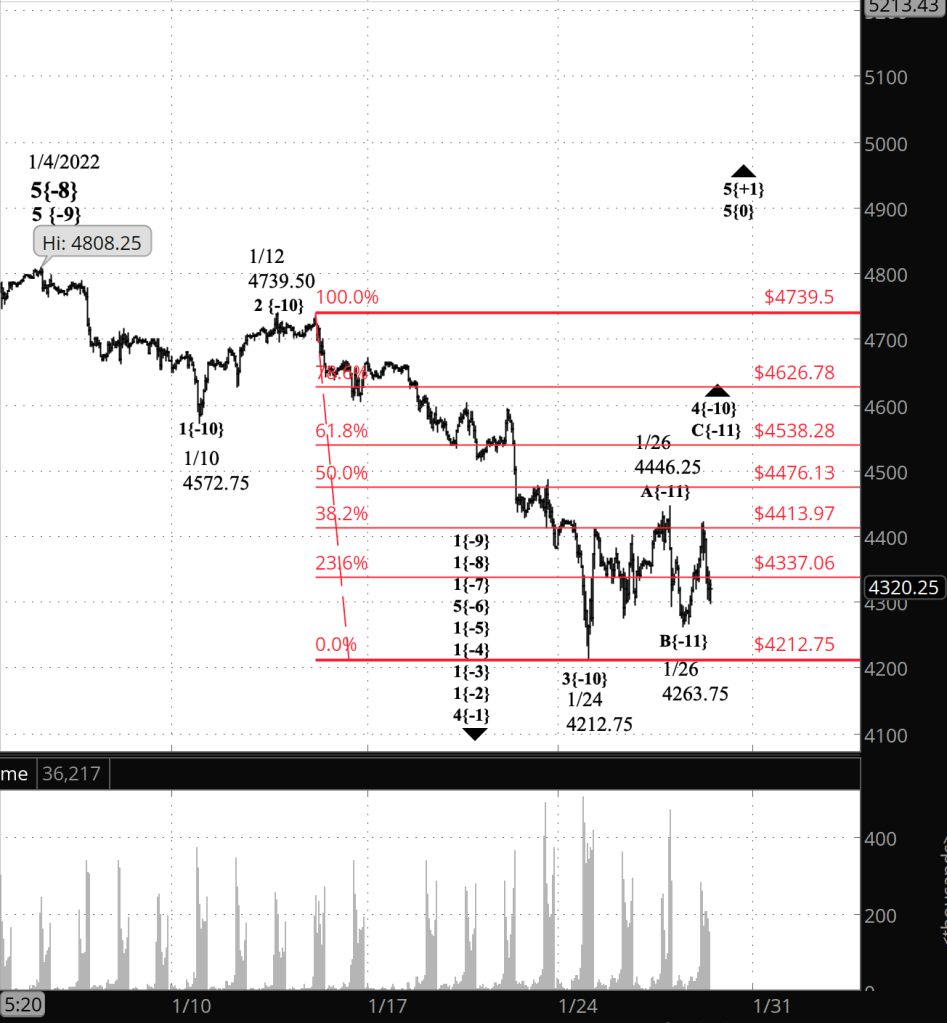
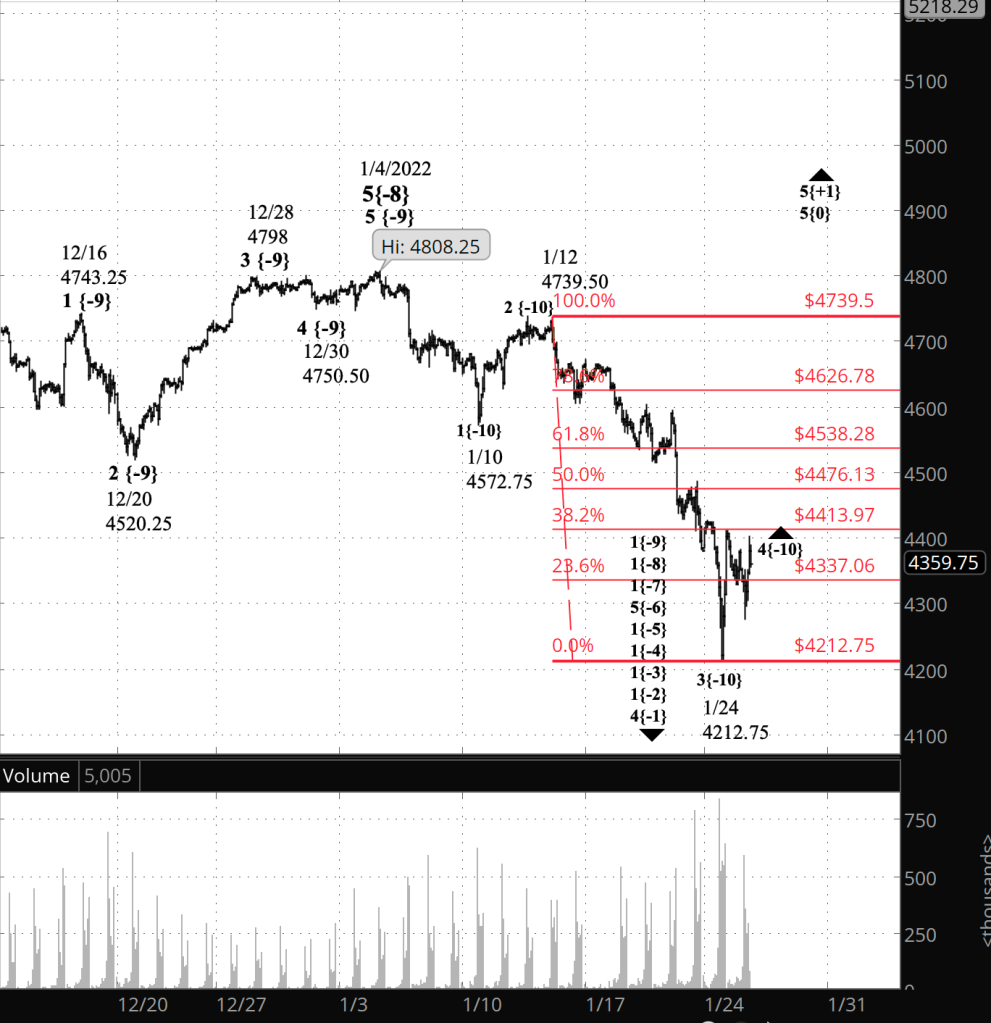
Half an hour before the closing bell. The S&P 500 futures spent much of the day at or below the 23.6% Fibonacci retracement level. Wave C{-11} within an upward correction, wave 4{-10} appears to still be underway. However, the first alternative — wave B{-11} is still underway — deserves consideration as long as the price is stalled well below the January 26 peak, 4446.25. No change in the analysis. I’ve updated the chart.

2:15 p.m. New York time

Earnings play entry, AAPL. I’ve entered a bull put options spread on AAPL, timed to coincide with the company’s earnings announcement after the closing bell today and have posted an analysis of the trade.

9:35 a.m. New York time

What’s happening now? The S&P 500 E-mini futures fell to 4263.25, 50 points above the January 24 low, and then reversed, rising more than 100 points.

What does it mean? The upward correction that began on January 24 continues. The overnight low was the middle leg of the correction, a retracement to the downside, and the subsequent rise is the final leg of the correction.

What are the alternatives? There are two:

Alternative #1: Yesterday’s high, 4446.25, marked the end of the upward correction, the subsequent decline is a resumption of the downtrend and the overnight rise is a low-level correction within the downtrend.

Alternative #2: The overnight rise is a continuation of the middle leg of the correction.

[S&P 500 E-mini futures at 3:30 p.m., 55-minute bars, with volume]

What does Elliott wave theory say? The upward correction that began on January 24 is wave 4{-10} — on that both the principal analysis and the alternatives agree. The disagreement is about the waves within that wave.

Principal analysis: Wave B{-11} ended with the overnight low and the subsequent rise is wave C{-11}, the final wave within wave 4{-10}, unless it forms a compound structure, a not uncommon occurrence in 4th waves.

Alternative #1: Wave 4{-10} ended with yesterday’s high, the subsequent decline is wave 1{-11} within wave 5{-10}, a resumption of the downtrend, and the rise that followed is wave 2{-11}, an upward correction.

Alternative #2: Wave B{-11} within wave 4{-10} is still underway.

If the price remains above the January 24 low, 4212.75, then either the principal analysis or the second alternative is correct. If the price falls below 4212.75, then the first alternative is correct.

Learning and other resources. Elliott wave analysis provides context, not prophecy. As the 20th century semanticist Alfred Korzybski put it this way in his book Science and Sanity (1933), “The map is not the territory … The only usefulness of a map depends on similarity of structure between the empirical world and the map.” And I would add, in the ever-changing markets, we can judge that similarity of structure only after the fact.

See the menu page Analytical Methods for a rundown on where to go for information on Elliott wave analysis.

By Tim Bovee, Portland, Oregon, January 27d, 2022

Disclaimer

Tim Bovee, Private Trader tracks the analysis and trades of a private trader for his own accounts. Nothing in this blog constitutes a recommendation to buy or sell stocks, options or any other financial instrument. The only purpose of this blog is to provide education and entertainment.

No trader is ever 100 percent successful in his or her trades. Trading in the stock and option markets is risky and uncertain. Each trader must make trading decisions for his or her own account, and take responsibility for the consequences.

License
Creative Commons License

All content on Tim Bovee, Private Trader by Timothy K. Bovee is licensed under a Creative Commons Attribution-ShareAlike 4.0 International License.

Based on a work at www.timbovee.com.

LVS Trade

Las Vegas Sands Corp. (LVS)

Update 2/25/2022: I exited my bull put vertical options spread on LVS, 21 days before expiration, for a $1.08 debit per contract/share, a profit before fees of $11 per contract. Shares were trading at $43.07, down $2.06 from the entry level.

The Implied Volatility Rank at exit was 59.1%, down 7.7 points from the entry level.

I exited because the position was within 21 days of expiration, with the exit price producing 9.2% of maximum potential profit. Under my rules for earnings plays, I exit at 25% of maximum potential profit up to 21 days prior to expiration. At that point, I exit for any amount of profit that will cover my fees.

Shares declined by 4.8% over 30 days for a -58% annual rate. The options position produced a 10.2% return for a +124% annual rate.


I have entered a short bull put options spread on LVS, using options that trade for the last time 51 days hence, on March 18. The premium is a $1.19 credit per contract share and the stock at the time of entry was priced at $45.23.

The Implied Volatility Ratio stands at 66.8%

Premium:$1.19Expire OTM
LVS-bull spreadStrikeOddsDelta
Puts
Long37.0080.0%16
Break-even43.1970.5%24.5
Short42.0061.0%33

The premium is 47.6% of the width of the positions short/long spread. The profit zone covers a 4.5% move to the downside and an unlimited move to the upside.

The risk/reward ratio is 3.2:1, with maximum risk of $381 and maximum reward of $119 per contract.

How I chose the trade. The trade was placed to coincide with LVS’s earnings announcement, after the closing bell on the day of entry. The short strikes were set to coincided with the expected move of $2.00 either way, based on options pricing, which gives a price range of $43.24 to $47.23.

By Tim Bovee, Portland, Oregon, January 26, 2022

Disclaimer

Tim Bovee, Private Trader tracks the analysis and trades of a private trader for his own accounts. Nothing in this blog constitutes a recommendation to buy or sell stocks, options or any other financial instrument. The only purpose of this blog is to provide education and entertainment.

No trader is ever 100 percent successful in his or her trades. Trading in the stock and option markets is risky and uncertain. Each trader must make trading decisions for his or her own account, and take responsibility for the consequences.

License
Creative Commons License

All content on Tim Bovee, Private Trader by Timothy K. Bovee is licensed under a Creative Commons Attribution-ShareAlike 4.0 International License.

Based on a work at www.timbovee.com.

Trader’s Notebook

3:30 p.m. New York time

Half an hour before the closing bell. The S&P 500 began to fall during the trading session, about 10 minutes after Federal Reserve Chair Powell began his news conference. The Fed’s Federal Open Markets Committee today declined to raise interest rates in response to higher inflation.

The futures fell from the 38.2% Fibonacci retracement level, where they had lingered during the early hours of the session, to below 23.6% Fibonacci retracement level. As a best guess, the peak at the 38.2% retracement looks like the end of wave A{-11} and the subsequent decline as wave B{-11}, all within the upward correction, wave 4{-9}.

It is a rule of Elliott wave analysis that a B wave cannot move beyond the start of the preceding wave A, which sets a lower boundary of 4212.75 or above.s

No change in the analysis. I’ve updated the chart.

2:45 p.m. New York time

LVS earnings play entry. I’ve entered a long bull put options spread on LVS, timed to coincide with the company’s earnings announcement after the closing bell. I’ve posted an analysis of the trade.

11:55 a.m. New York time

BA earnings play exit. I’ve exited my short bear call options spread on BA, one day after entry, for a 33.5% profit. I’ve updated the analysis with details of the exit.

9:35 a.m. New York time

What’s happening now? The S&P 500 E-mini futures barely moved in overnight trading, remaining at a 38.2% retracement of the preceding 12-day decline.

What does it mean? The upward correction that began on January 24 is still underway. It is happening within the early states of a larger downtrend that began on January 4 and will last for months and probably years.

What’s the alternative? The decline from January 4 is a downward correction within a larger uptrend that began on February 23, 2020, at the end of the market crash early in the pandemic.

[S&P 500 E-mini futures at 3:30 p.m., 85-minute bars, with volume]

What does Elliott wave theory say? Under my principal analysis, January 24 marked the end of wave 3{-10} within a series of 1st waves of increasingly larger degree. It is a new downtrend that eventually will reach below 2000.

The preceding uptrend ended on January 4 at 4808.25. Wave 3{-10} has been followed present upward correction, wave 4{-10}. Internally, it looks as though wave C{-11} is now underway, although this early in the correction it’s hard to accurately judge the degrees of internal waves. This is all happening within downtrending wave 1{-9 } within downtrending wave 1{-8}, which both began on January 4.

Under the rules of Elliott wave analysis, a 4th wave must remain below the end of the preceding 1st wave. In this case, wave 1{-10} ended on January 10 at 4572.75 and wave 4{-10} cannot move above that price.

Under my secondary analysis, the January 4 peak was a stopping point within a still ongoing wave 5{-8} and larger uptrending waves. The subsequent decline at lower degrees, which the S&P 500 is still in today, is a correction that in fact may have ended on January 24. Under this scenario, the subsequent rise — small so far — is the early portion of a resumption of the uptrend and will exceed 4808.25.

Learning and other resources. Elliott wave analysis provides context, not prophecy. As the 20th century semanticist Alfred Korzybski put it this way in his book Science and Sanity (1933), “The map is not the territory … The only usefulness of a map depends on similarity of structure between the empirical world and the map.” And I would add, in the ever-changing markets, we can judge that similarity of structure only after the fact.

See the menu page Analytical Methods for a rundown on where to go for information on Elliott wave analysis.

By Tim Bovee, Portland, Oregon, January 26, 2022

Disclaimer

Tim Bovee, Private Trader tracks the analysis and trades of a private trader for his own accounts. Nothing in this blog constitutes a recommendation to buy or sell stocks, options or any other financial instrument. The only purpose of this blog is to provide education and entertainment.

No trader is ever 100 percent successful in his or her trades. Trading in the stock and option markets is risky and uncertain. Each trader must make trading decisions for his or her own account, and take responsibility for the consequences.

License
Creative Commons License

All content on Tim Bovee, Private Trader by Timothy K. Bovee is licensed under a Creative Commons Attribution-ShareAlike 4.0 International License.

Based on a work at www.timbovee.com.

BA Trade

The Boeing Co. (BA)

Update 1/26/2022: I exited my short bear call spread position on BA 51 days before expiration, for a $2.12 debit per contract/share, a profit before fees of $71 per contract. Shares were trading at $195.93, down $4.59 from the entry level.

The Implied Volatility Rank at exit was 66.3%, down 10.5 points from the entry level.

I exited because the position reached 25% of maximum potential profit, my normal exit point for earnings plays.

Shares declined by 2.3% over one day for a +836% annual rate. The options position produced a 33.5% return for a +12,224% annual rate.


I have entered a short bear call options spread on BA, using options that trade for the last time 52 days hence, on March 18. The premium is a $2.83 credit per contract share and the stock at the time of entry was priced at $200.52.

The Implied Volatility Ratio stands at 85.6%

Premium:$2.83Expire OTM
BA-bear call spreadStrikeOddsDelta
Calls
Long225.0079.0%27
Break-even217.8374.0%32
Short215.0069.0%37

The premium is 56.8% of the width of the positions short/long spread. The profit zone covers an 8.6% move to the upside and an unlimited move to the downside.

The risk/reward ratio is 2.5:1, with maximum risk of $717 and maximum reward of $283 per contract.

How I chose the trade. The trade was placed to coincide with BA’s earnings announcement, before the opening bell on the day after entry. The short strike was set to coincide with the expected move of $9.50 either way, based on options pricing, which gives a price range of $191.02 to $210.02.

By Tim Bovee, Portland, Oregon, January 25, 2022

Disclaimer

Tim Bovee, Private Trader tracks the analysis and trades of a private trader for his own accounts. Nothing in this blog constitutes a recommendation to buy or sell stocks, options or any other financial instrument. The only purpose of this blog is to provide education and entertainment.

No trader is ever 100 percent successful in his or her trades. Trading in the stock and option markets is risky and uncertain. Each trader must make trading decisions for his or her own account, and take responsibility for the consequences.

License
Creative Commons License

All content on Tim Bovee, Private Trader by Timothy K. Bovee is licensed under a Creative Commons Attribution-ShareAlike 4.0 International License.

Based on a work at www.timbovee.com.

Trader’s Notebook

3:30 p.m. New York time

Half an hour before the closing bell. The S&P 500 declined during the session, with the futures remaining more than 50 points above yesterday’s low, and then rose again, remaining below the overnight high. Wave 4{-9}, an upward correction, as been underway since yesterday, and the wave pattern is consistent with an A wave within wave 4{-9}. No change in the analysis. I’ve updated the chart.

11:10 a.m. New York time

BA earnings play entry. I’ve entered a short bear call options spread on BA, whose earnings will be announced Wednesday, January 26, before the opening bell. I’ve posted an analysis of the trade.

10:50 a.m. New York time

GE earnings play exit. I exited my short bear call options spread on GE the day after entering for a 74.4% profit, as shares fell sharply after earnings were announced. I’ve updated the analysis with details of the exit.

9:35 a.m. New York time

What’s happening now? The S&P 500 E-mini futures rose in overnight trading, retracing 38.2% of the decline from January 12.

What does it mean? An upward correction of that decline is now underway. The 38.2% retracement is a Fibonacci level, a not uncommon turning point within corrections. I expect this correction to remain below 4572.75. More on that expectation in the Elliott wave section, below.

What are the alternatives? Alternative #1: The upward movement that began on January 24 is a lower level correction within the downtrend, rather than a correction at the level of the downtrend. That sounds obscure, but it’s not. A higher level correction will move higher and take more time to complete than will a lower level correction.

Alternative #2: The downward movement that began on January 4 is a correction within an ongoing uptrend. A move above 4572.75 will increase the odds of this scenario being correction, and a rise above 4808.25 will confirm it.

The chart. I’ve drawn a grid showing the Fibonacci retracement levels over the price chart, in red. See this Investopedia entry on Fibonacci levels for an explanation of what they are and how they relate to prices.

[S&P 500 E-mini futures at 3:30 p.m., 85-minute bars, with volume]

What does Elliott wave theory say? Under my principal analysis, wave 3{-10} within wave 1{-9} ended on January 24, at 4512.75, and the present rise is the early stage of wave 4{-10}. All of this is happening within wave 1{-8} a larger downtrend that began on January 4, the end of wave 5{-8} at 4808.25. Under the rules of Elliott wave analysis, 4th waves never move beyond the end of the preceding wave 1, which in this case ended on January 10 at 4572.75, slightly above the 61.8% retracement level. Given the tendency of corrections to fit within the structure of Fibonacci retracement levels, an upside target of 4538 — the 61.8% retracement — would be a reasonable expectation for the 4th wave’s ending point.

Fourth wave corrections tend to be of the Flat pattern, although not always. If this one is a Flat, then the A wave will have three subwaves, as will the B wave, and the C wave will have five subwaves.

Alternative #1 sees the present rise as an upward correction, but at a level below degree {-10}. A quick reversal to prices below 4512.75. would confirm this scenario.

Alternative #2 sees the January 24 low as the end of a correction within an ongoing uptrend, wave 5{-8}. A move above the January 4 high, 4808.25, would confirm this scenario.

Learning and other resources. Elliott wave analysis provides context, not prophecy. As the 20th century semanticist Alfred Korzybski put it this way in his book Science and Sanity (1933), “The map is not the territory … The only usefulness of a map depends on similarity of structure between the empirical world and the map.” And I would add, in the ever-changing markets, we can judge that similarity of structure only after the fact.

See the menu page Analytical Methods for a rundown on where to go for information on Elliott wave analysis.

By Tim Bovee, Portland, Oregon, January 25, 2022

Disclaimer

Tim Bovee, Private Trader tracks the analysis and trades of a private trader for his own accounts. Nothing in this blog constitutes a recommendation to buy or sell stocks, options or any other financial instrument. The only purpose of this blog is to provide education and entertainment.

No trader is ever 100 percent successful in his or her trades. Trading in the stock and option markets is risky and uncertain. Each trader must make trading decisions for his or her own account, and take responsibility for the consequences.

License
Creative Commons License

All content on Tim Bovee, Private Trader by Timothy K. Bovee is licensed under a Creative Commons Attribution-ShareAlike 4.0 International License.

Based on a work at www.timbovee.com.