Trader’s Notebook

10:45 a.m. New York time

What’s happening now? The S&P 500 E-mini futures traded sideways in overnight trading, remaining within a range of less than 35 points. The U.S. stock and options markets will be closed today for a day honoring the civil rights activist Martin Luther King. The futures and bond markets will hold shortened sessions.

What does it mean? The last leg of the correction is itself on its last leg, needing only one more decline to be complete.

What are the alternative? Alternative #1: The upward move from January 10 was a correction within a new downtrend that began on January 14. The subsequent decline is a movement in the direction of the downtrend that will carry the price below the December 20 low of 4520.25

Alternative #2: The downward correction ended on January 14, and the subsequent rise is the first tentative step of a resumption of the uptrend.

Alternative #3: The correction that began on January 14 has completed one corrective pattern, and after a connecting rise, will add a second corrective pattern in a compound structure.
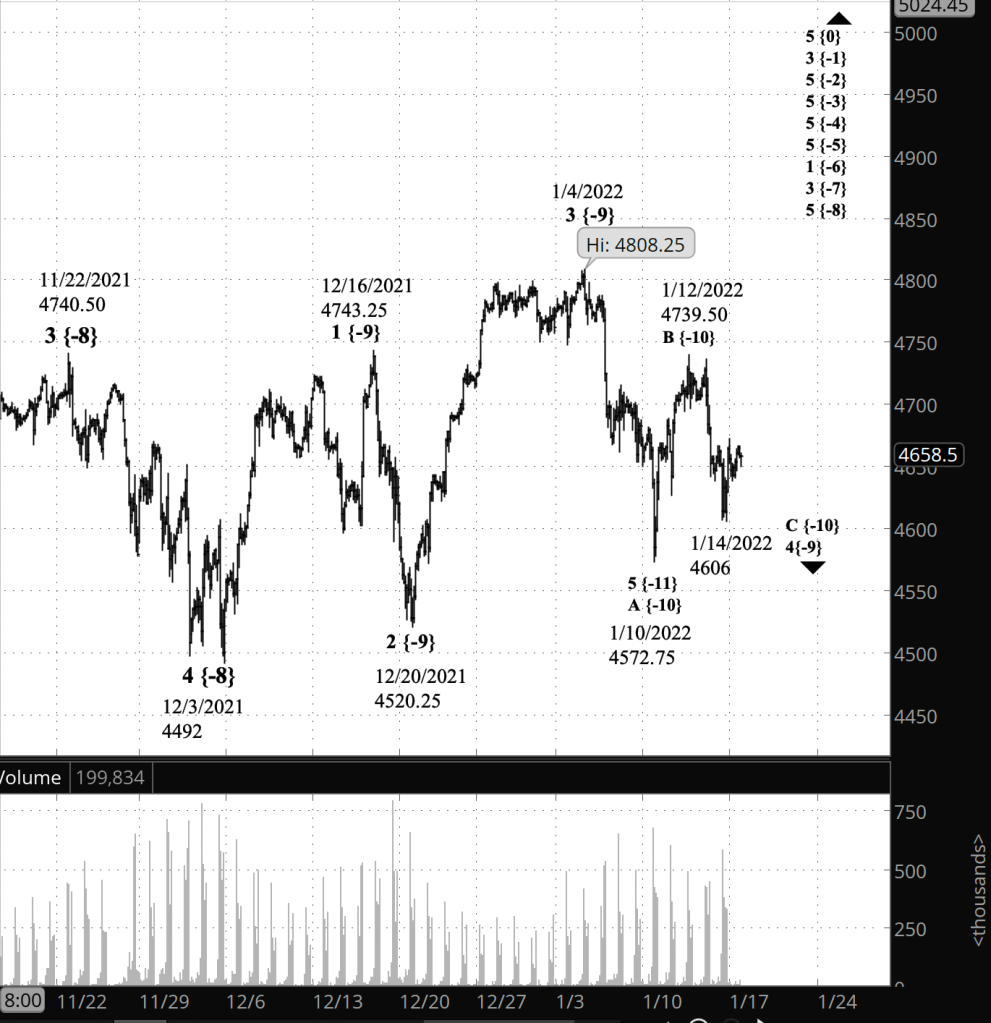
[S&P 500 E-mini futures at 10:45 a.m., 2-hour bars, with volume]

What does Elliott wave theory say? There is a stark contrast between my principal scenario and the first alternative. The one sees the beginning of an uptrend that will carry the price a considerable distance higher. The other sees the beginning of a major downtrend that over time will carry the price down to levels not seen since 2016.

Under the principal scenario, the decline from January 12 is wave C{-10} within wave 4{-9}. The C wave has three waves, and whether the decline is a Flat or a Zigzag, the C wave will have five waves internally. Arguably, four waves are complete; one more to go. The end of wave C will also be the end of wave 4{-9}, and the subsequent wave 5{-9} will carry the price to new heights, beyond the January 4 end of wave 3{-9}, leading to a series of ever-larger corrections and rises still higher.

The first alternative is the polar opposite. The January 4 peak ended wave 5{-9} and its parent, wave 5{-8}, and the subsequent decline is wave 1{-9} within wave 1{-8}, the first stage of a new downtrend that will reach below 2000.

The third alternate is less grandiose, focusing on the on the meaning of the decline since January 12. The principal analysis sees it as three waves within wave C, with a 4th wave now underway. The alternative sees the low of January 14 as being the end of wave C, and the subsequent rise as an X wave connecting two corrective patterns within a compound structure. As noted above, wave C must have five waves internally. And If I squint real hard, I can see a tiny 4th wave before the final fall to the January 14 low. Honestly, it seems too small for a 4th wave of degree {-11}, but it’s not impossible.

Learning and other resources. Elliott wave analysis provides context, not prophecy. As the 20th century semanticist Alfred Korzybski put it this way in his book Science and Sanity (1933), “The map is not the territory … The only usefulness of a map depends on similarity of structure between the empirical world and the map.” And I would add, in the ever-changing markets, we can judge that similarity of structure only after the fact.

See the menu page Analytical Methods for a rundown on where to go for information on Elliott wave analysis.

By Tim Bovee, Portland, Oregon, January 17, 2022

Disclaimer

Tim Bovee, Private Trader tracks the analysis and trades of a private trader for his own accounts. Nothing in this blog constitutes a recommendation to buy or sell stocks, options or any other financial instrument. The only purpose of this blog is to provide education and entertainment.

No trader is ever 100 percent successful in his or her trades. Trading in the stock and option markets is risky and uncertain. Each trader must make trading decisions for his or her own account, and take responsibility for the consequences.

License
Creative Commons License

All content on Tim Bovee, Private Trader by Timothy K. Bovee is licensed under a Creative Commons Attribution-ShareAlike 4.0 International License.

Based on a work at www.timbovee.com.
TFC Trade

Truist Financial Corp. (TFC)

Update 1/19/2022: I exited my short iron condor position on TFC 30 days before expiration, for a $1.75 debit per contract/share, a profit before fees of $60 per contract. Shares were trading at $65.11, down $1.98 from the entry level.

The Implied Volatility Rank at exit was 32.7%, down 5.0 points from the entry level.

I exited because the position reached 25% of maximum potential profit, my normal exit point for earnings plays.

Shares declined by 3.0% over five days for a 215% annual rate. The options position produced a 34.3% return for a 2,503% annual rate.


I have entered a short iron condor spread on TFC, using options that trade for the last time 35 days hence, on February 18. The premium is a $2.35 credit per contract share and the stock at the time of entry was priced at $67.09

The Implied Volatility Ratio stands at 37.7%

Premium:$2.35Expire OTM
TFC-iron condorStrikeOddsDelta
Calls
Long75.0095.0%7
Break-even69.8576.0%27
Short67.5057.0%47
Puts
Short62.5073.0%23
Break-even59.8581.5%15.5
Long57.5090.0%8

The premium is 37.6% of the width of the positions short/long spreads. The profit zone covers a 4.1% move to the upside and a 12.1% move to the downside. I skewed in favor of the downside because of analyst expectations of a negative earnings surprise.

The risk/reward ratio is 1.7:1, with maximum risk of $390 and maximum reward of $235 per contract.

How I chose the trade. The trade was placed to coincide with TFC’s earnings announcement, before the opening bell the day after the weekend. The short strikes were set to coincide with the expected move of $1.21 either way, based on options pricing, which gives a price range of $65.71 to $68.13. Zacks Earnings Surprise Predictor for TFC has a -1.30% score, based on switches in analysts ratings, indicating a higher likelihood of a negative earnings surprise. Overall, TFC has a Zacks rank of Hold.

By Tim Bovee, Portland, Oregon, January 14, 2022

Disclaimer

Tim Bovee, Private Trader tracks the analysis and trades of a private trader for his own accounts. Nothing in this blog constitutes a recommendation to buy or sell stocks, options or any other financial instrument. The only purpose of this blog is to provide education and entertainment.

No trader is ever 100 percent successful in his or her trades. Trading in the stock and option markets is risky and uncertain. Each trader must make trading decisions for his or her own account, and take responsibility for the consequences.

License
Creative Commons License

All content on Tim Bovee, Private Trader by Timothy K. Bovee is licensed under a Creative Commons Attribution-ShareAlike 4.0 International License.

Based on a work at www.timbovee.com.
Trader’s Notebook

3:30 p.m. New York time

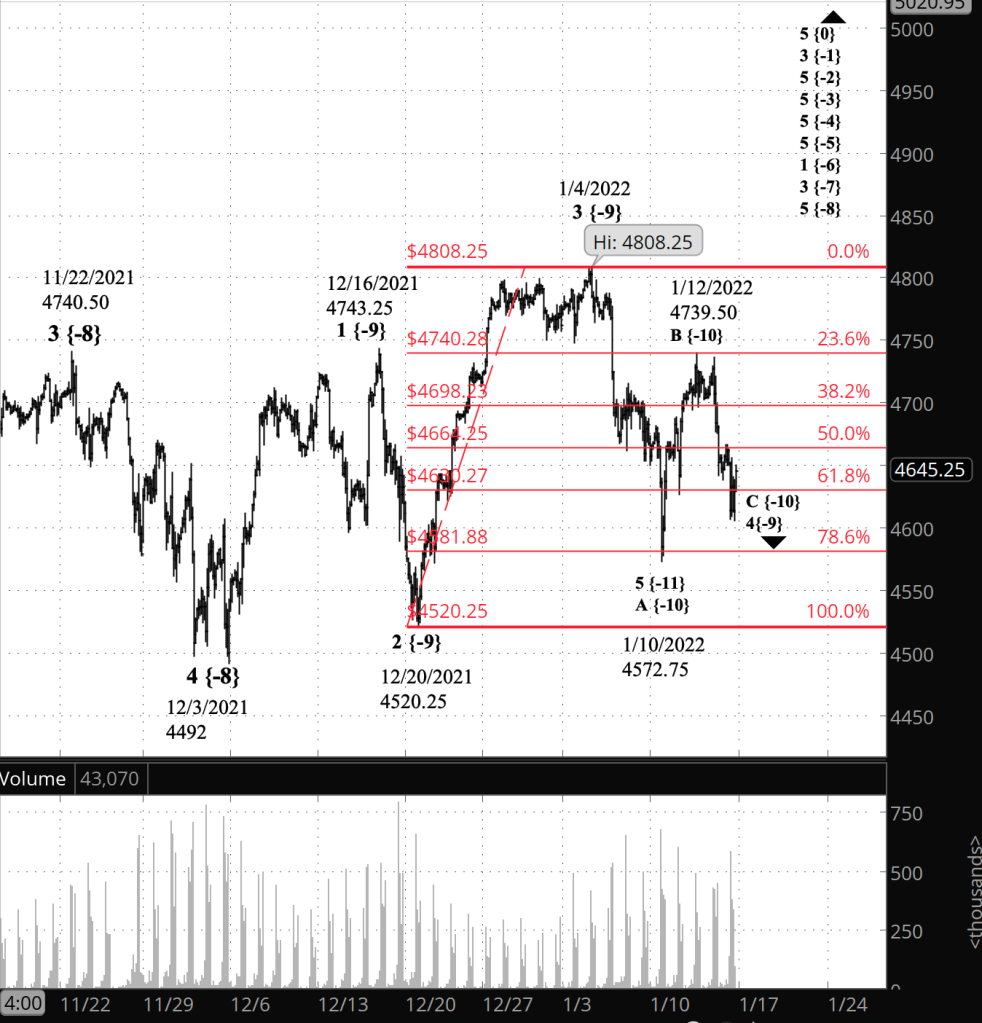
Half an hour before the closing bell. The S&P 500 reached a low of 4606 during the session and has reversed to the upside, reaching a bit more than 40 points higher. Downward wave C{-10} within the wave 4{-9} downward correction continues. No change in the analysis. I’ve updated the near-term (upper) chart.

2:15 p.m. New York time

My trades. I’ve entered a short iron condor position on TFC, timed for the company’s earnings announcement on Monday before the opening bell. Analyst opinion switches before earnings suggest a higher likelihood of a negative earnings surprise. I’ve posted a full analysis of the trade.

I’ve entered a long shares position on PNC, which also publishes earnings Monday morning. PNC has an implied volatility rank of 36.3, with an expected move either direction, based on options pricing, of 1.83, for a range of $220.15 to $223.81 at an entry price of $221.98. The Zacks Earnings Surprise Predictor score for PNC is $2.29, meaning a higher likelihood of a positive earnings surprise.

I’ve also entered a long shares position on SI — Monday morning earnings announcement. Implied volatility rank: 33.3%. Expected move either direction: $9.34, for a range of $125.72 to $144.40 based on the entry price, $135.06. The Zacks Earnings Surprise Predictor for SI is an1.81% score, indicating a likelihood of a positive earnings surprise.

I rejected two earnings plays using options. GS at $380 a share was a bit pricey for my taste, and SCHW had overly low implied volatility, which reduces potential profit.

9:35 a.m. New York time

What’s happening now? The S&P 500 E-mini futures continued falling in overnight trading, for a second time reaching below the 61.8% Fibonacci retracement level and stretching further to halfway to the 78.6% retracement mark.

What does it mean? The decline from the January 12 reversal to the downside is the third, and potentially final, leg of the correction that began January 4 from 4808.25.

What’s the alternative? The chart pattern since January 4 is also consistent with a new downtrend beginning January 4. If the price moves below the January 10 low, 4572.75, then this interpretation will be confirmed.

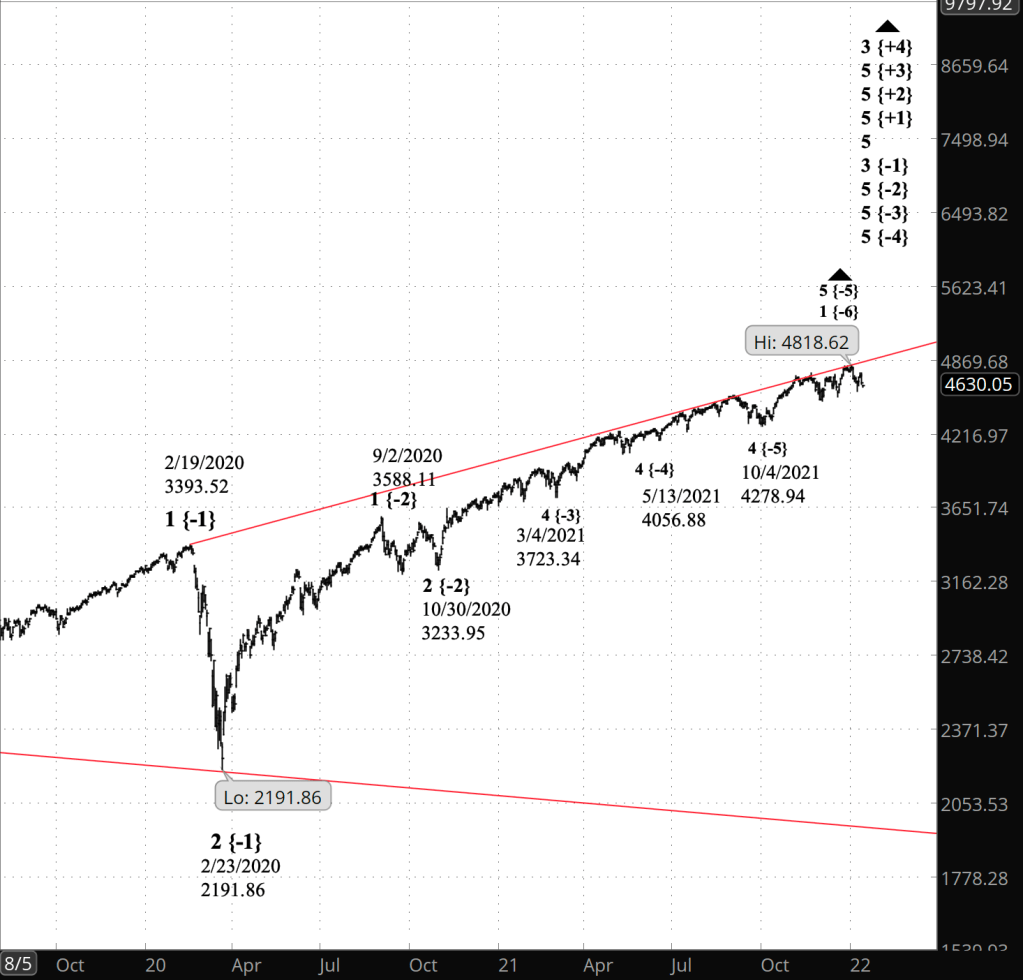
Two charts. The upper chart shows the S&P 500 futures beginning around last Thanksgiving. The lower chart shows the S&P 500 index price line since the beginning of the pandemic.

[S&P 500 E-mini futures at 3:30 p.m., 2-hour bars, with volume]
[S&P 500 index at 9:32 a.m., daily bars]

What does Elliott wave theory say? Under my principal analysis, wave 4{-9} began on January 4, has completed two waves, A{-10} and B{-10} and is now in wave C{-10}, the last of the three-wave pattern, unless wave 4 extends in a compound correction that has several corrective patterns.

Under my alternative analysis, the peak on January 4 marked the end of wave 5{-9} and its parent, wave 3{-8}, which began on December 3 from 4492. A wave 4{-8} downward correction has begun and will dominate the rest of January and probably much of February.

The longer term chart, with prices back to the early pandemic crash in February 2020, shows the scale of the decline since January 4: It’s that tiny scribble at the right end of the price line. It seems big in the headlnes and it may eventually turn big, but not yet.

The red lines are the boundaries of the expanding Diagonal Triangle that began in December 2018. One the decline takes hold, I expect the price to work its way down to the lower boundary and then back up to a still higher upper boundary (that’s the expanding part).

Learning and other resources. Elliott wave analysis provides context, not prophecy. As the 20th century semanticist Alfred Korzybski put it this way in his book Science and Sanity (1933), “The map is not the territory … The only usefulness of a map depends on similarity of structure between the empirical world and the map.” And I would add, in the ever-changing markets, we can judge that similarity of structure only after the fact.

See the menu page Analytical Methods for a rundown on where to go for information on Elliott wave analysis.

By Tim Bovee, Portland, Oregon, January 14, 2022

Disclaimer

Tim Bovee, Private Trader tracks the analysis and trades of a private trader for his own accounts. Nothing in this blog constitutes a recommendation to buy or sell stocks, options or any other financial instrument. The only purpose of this blog is to provide education and entertainment.

No trader is ever 100 percent successful in his or her trades. Trading in the stock and option markets is risky and uncertain. Each trader must make trading decisions for his or her own account, and take responsibility for the consequences.

License
Creative Commons License

All content on Tim Bovee, Private Trader by Timothy K. Bovee is licensed under a Creative Commons Attribution-ShareAlike 4.0 International License.

Based on a work at www.timbovee.com.
WFC Trade

Wells Fargo & Co. (WFC)

Update 1/20/2022: I exited my short iron condor position on WFC 29 days before expiration, for a $1.55 debit per contract/share, a profit before fees of $27 per contract. Shares were trading at $55.99, down $0.30 from the entry level.

The Implied Volatility Rank at exit was 17.3%, down 6.0 points from the entry level.

I exited below my target of 25% of maximum potential profit as a test of a more rapid exit strategy for earnings plays.

Shares declined by 0.5% over seven days for a 28% annual rate. The options position produced a 17.4% return for a 908% annual rate.


I have entered a short iron condor spread on WFC, using options that trade for the last time 36 days hence, on February 18. The premium is a $1.82 credit per contract share and the stock at the time of entry was priced at $56.29.

The Implied Volatility Ratio stands at 23.3%

Premium:$1.82Expire OTM
WFC-iron condorStrikeOddsDelta
Calls
Long65.0094.0%8
Break-even61.8285.5%17.5
Short60.0077.0%27
Puts
Short55.0058.0%38
Break-even51.8271.5%25.5
Long50.0085.0%13

The premium is 36.4% of the width of the positions short and long spreads. The profit zone covers a 9.8% move to the upside and an 8.6% move to the downside.

The risk/reward ratio is 1.7:1, with maximum risk of $318 and maximum reward of $182 per contract.

How I chose the trade. The trade was placed to coincide with WFC’s earnings announcement, before the opening bell on the day after entry. The short strikes were set to coincided with the expected move of $1.85 either way, based on options pricing, which gives a price range of $54.78 to $58.48.

By Tim Bovee, Portland, Oregon, January 13, 2022

Disclaimer

Tim Bovee, Private Trader tracks the analysis and trades of a private trader for his own accounts. Nothing in this blog constitutes a recommendation to buy or sell stocks, options or any other financial instrument. The only purpose of this blog is to provide education and entertainment.

No trader is ever 100 percent successful in his or her trades. Trading in the stock and option markets is risky and uncertain. Each trader must make trading decisions for his or her own account, and take responsibility for the consequences.

License
Creative Commons License

All content on Tim Bovee, Private Trader by Timothy K. Bovee is licensed under a Creative Commons Attribution-ShareAlike 4.0 International License.

Based on a work at www.timbovee.com.
C Trade

Citigroup Inc. (C)

Update 2/1/2022: I exited my short iron condor options spread on C, 17 days before expiration, for a $1.30 debit per contract/share, a profit before fees of $52.00 per contract. Shares were trading at $66.03, down $2.18 from the entry level.

The Implied Volatility Rank at exit was 42.8%, up 15.7 points from the entry level.

I exited because the position exceeded 25% of maximum potential profit, my normal exit point for earnings plays.

Shares declined by 3.2% over 19 days for a +61% annual rate. The options position produced a 40.0% return for a +768% annual rate.


I have entered a short iron condor spread on C, using options that trade for the last time 36 days hence, on February 18. The premium is a $1.82 credit per contract share and the stock at the time of entry was priced at $68.21.

The Implied Volatility Ratio stands at 27.1%

Premium:$1.82Expire OTM
C-iron condorStrikeOddsDelta
Calls
Long75.0092.0%10
Break-even71.8282.5%20.5
Short70.0073.0%31
Puts
Short65.0061.0%34
Break-even61.8273.5%23
Long60.0086.0%12

The premium is 36.4% of the width of the positions short and long spread. The profit zone covers a 5.3% move to the upside and a 10.3% move to the downside.

The risk/reward ratio is 1.7:1, with maximum risk of $318 and maximum reward of $182 per contract.

How I chose the trade. The trade was placed to coincide with C’s earnings announcement, before the opening bell on the day after entry. The short strikes were set to coincide with the expected move of $1.64 either way, based on options pricing, which gives a price range of $65.46 to $68.64.

By Tim Bovee, Portland, Oregon, January 13, 2022

Disclaimer

Tim Bovee, Private Trader tracks the analysis and trades of a private trader for his own accounts. Nothing in this blog constitutes a recommendation to buy or sell stocks, options or any other financial instrument. The only purpose of this blog is to provide education and entertainment.

No trader is ever 100 percent successful in his or her trades. Trading in the stock and option markets is risky and uncertain. Each trader must make trading decisions for his or her own account, and take responsibility for the consequences.

License
Creative Commons License

All content on Tim Bovee, Private Trader by Timothy K. Bovee is licensed under a Creative Commons Attribution-ShareAlike 4.0 International License.

Based on a work at www.timbovee.com.
Trader’s Notebook

3:30 p.m. New York time

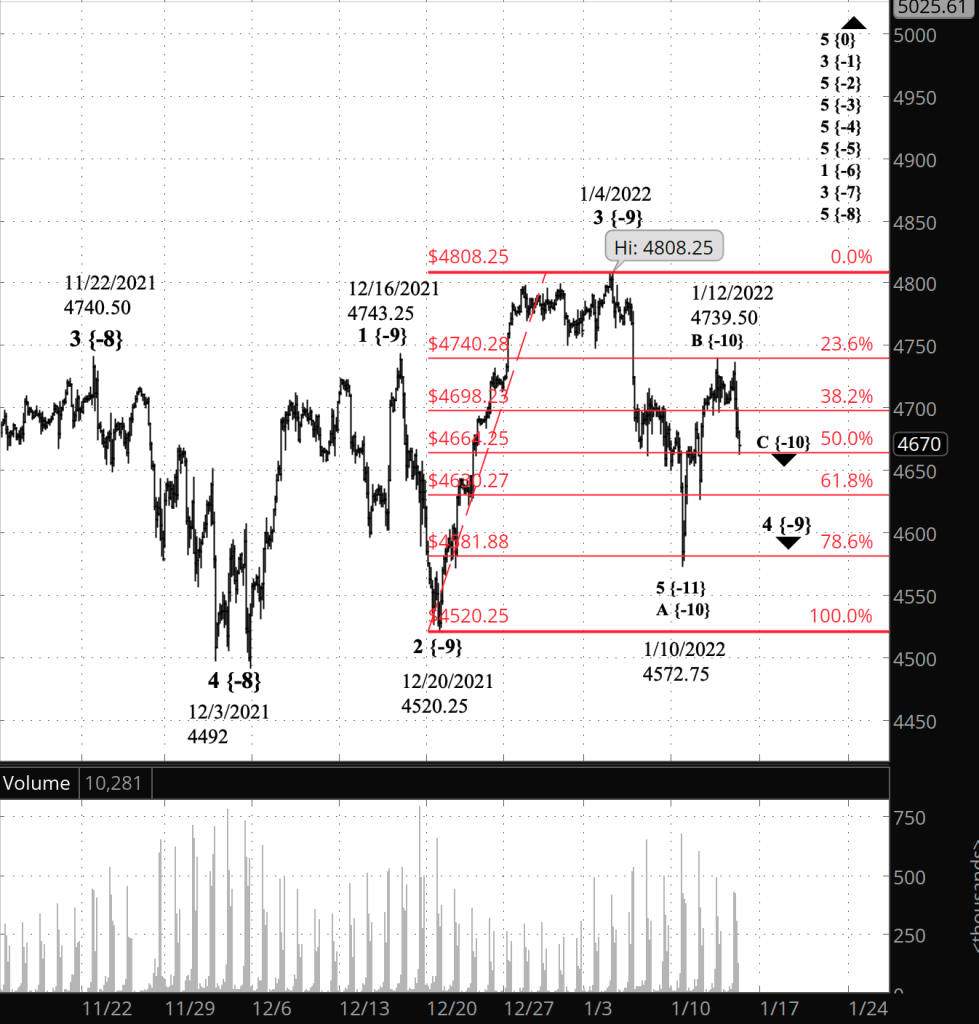
Half an hour before the closing bell. After re-touching the 23.6% Fibonacci retracement level on Wednesday, the S&P 500 futures declined in today’s session, dropping back to the 50% retracement. The magnitude of the fall has persuaded me that the January 12 high, 4739.50, marks the end of wave B{-10} — with three subwaves — and that wave C{-10} is now underway. Under the rules of the Elliott wave analysis, C{-10} will have five subwaves. The chart is also consistent with the second alternative discussed this morning (see below). Under that scenario, the rise to January 12 was a 2nd wave correction within a downtrend that began on January 4, and downtrending wave 3 has now begun. If the price declines below the end of wave 1 at 4572.75 — the decline from January 4 — then the second alternative is correct. If the price remains above that level, and then reverses to reach above the January 4 high, 4808.25, then the principal analysis is correct. I’ve updated the chart.

1:20 p.m. New York time

My trades. Trading opportunities are becoming more plentiful as earnings season kicks off. Today was heavy on the financials, and I entered two options positions and one shares position.

The options positions were on C and WFC, both structured as iron condors. The implied volatility was a bit lower than I like, but the positions as built have good risk/reward ratios and sufficiently high premium in relation to the width between the short and long options. The long shares position was on FRC, which isn’t liquid enough to meet my standards for options trading. All three companies publish earnings on Friday before the opening bell. I’ve posted full analysis for the options plays, C and WFC.

9:35 a.m. New York time

What’s happening now? The S&P 500 E-mini futures rose by a bit more than 30 points in overnight trading, remaining below yesterday’s high, 4739.50.

What does it mean? The second, rising leg of a downward correction that began on January 4 is still underway.

What are the alternatives? The correction ended on January 10, and a new uptrend is underway and will rise above the present all-time high of 2808.25, attained on January 4.

Another alternative: The January 4 high was the beginning of a downtrend that will fall below the December 3 low, 4492, and the rise from January 10 is an upward correction within that downtrend.

Chart. Late due to a problem with my almost-brand-new Macbook, fixed by a restart.

[S&P 500 E-mini futures at 3:30 p.m., 2-hour bars, with volume]

What does Elliott wave theory say? Under my principal analysis, the rise from January 10 is wave B{-10} within a downward correction, wave 4{-9}. The preceding A wave had five waves internally, meaning that the correction is likely to take the Zigzag form. Under the rules the B wave must have three waves. The third internal wave ended at yesterday’s high point, and the subsequent sideways movement suggests the possibility that wave B is adding on another push higher — a 5th wave following a 4th wave internal correction. Five internal waves would break the rules for B waves, and so the rise would have to recounted as something else.

For example, the alternatives for the rise from January 10 go like this:

1) It’s wave 5{-9} following wave 4{-9}, a downward correction that ended on January 10, and will exceed the January 4 high, 4808.25.

2) It’s a wave 2{-10} correction within a new downtrend, wave 1{-9}, that began on January 4, which under this scenario would be labelled as the end of wave 5{-9} rather than as a 3rd wave.

If the rise from January 10 has five waves internally, it invalidates the principal analysis, but not the alternatives. Under the first alternative, the rise from January 10 is a 1st wave — five waves internally — and under the second alternative, it is an A wave within a Zigzag pattern, with five waves internally.

Learning and other resources. Elliott wave analysis provides context, not prophecy. As the 20th century semanticist Alfred Korzybski put it this way in his book Science and Sanity (1933), “The map is not the territory … The only usefulness of a map depends on similarity of structure between the empirical world and the map.” And I would add, in the ever-changing markets, we can judge that similarity of structure only after the fact.

See the menu page Analytical Methods for a rundown on where to go for information on Elliott wave analysis.

By Tim Bovee, Portland, Oregon, January 13, 2022

Disclaimer

Tim Bovee, Private Trader tracks the analysis and trades of a private trader for his own accounts. Nothing in this blog constitutes a recommendation to buy or sell stocks, options or any other financial instrument. The only purpose of this blog is to provide education and entertainment.

No trader is ever 100 percent successful in his or her trades. Trading in the stock and option markets is risky and uncertain. Each trader must make trading decisions for his or her own account, and take responsibility for the consequences.

License
Creative Commons License

All content on Tim Bovee, Private Trader by Timothy K. Bovee is licensed under a Creative Commons Attribution-ShareAlike 4.0 International License.

Based on a work at www.timbovee.com.

DAL Trade

Delta Air Lines Inc. (DAL)

Update 1/20/2022: I exited my short iron condor position on DAL 29 days before expiration, for a $1.50 debit per contract/share, a profit before fees of $36 per contract. Shares were trading at $39.93, down $1.22 from the entry level.

The Implied Volatility Rank at exit was 15.2% down 9.7 points from the entry level.

I exited below my target of 25% of maximum potential profit as a test of a more rapid exit strategy for earnings plays.

Shares declined by 3.0% over eight days for a 135.3% annual rate. The options position produced a 24.0% return for a 1,095% annual rate.


I have entered a short iron condor spread on DAL, using options that trade for the last time 37 days hence, on February 18. The premium is a $1.86 credit per contract share and the stock at the time of entry was priced at $41.41.

The Implied Volatility Ratio stands at 24.1%, lower than I usually prefer, but the pricing allowed for a trade that meets my risk and return standards.

Premium:$1.86Expire OTM
DAL-iron condorStrikeOddsDelta
Calls
Long48.0091.0%12
Break-even44.8678.0%26
Short43.0065.0%40
Puts
Short39.0066.0%30
Break-even35.8678.0%19
Long34.0090.0%8

The premium is 37.2% of the width of the positions short and long spreads. The profit zone covers a 9% move to the upside and a 14.8% move to the downside.

The risk/reward ratio is 1.7:1, with maximum risk of $314 and maximum reward of $186 per contract.

How I chose the trade. The trade was placed to coincide with DAL’s earnings announcement, before the opening bell on the day after entry. The short strikes were set to coincided with the expected move of $1.40 either way, based on options pricing, which gives a price range of $39.70 to $42.36. The Zacks Earnings Surprise Predictor gives DAL a score of 64.06% in favor of a positive earnings surprise.

By Tim Bovee, Portland, Oregon, January 12, 2022

Disclaimer

Tim Bovee, Private Trader tracks the analysis and trades of a private trader for his own accounts. Nothing in this blog constitutes a recommendation to buy or sell stocks, options or any other financial instrument. The only purpose of this blog is to provide education and entertainment.

No trader is ever 100 percent successful in his or her trades. Trading in the stock and option markets is risky and uncertain. Each trader must make trading decisions for his or her own account, and take responsibility for the consequences.

License
Creative Commons License

All content on Tim Bovee, Private Trader by Timothy K. Bovee is licensed under a Creative Commons Attribution-ShareAlike 4.0 International License.

Based on a work at www.timbovee.com.

Trader’s Notebook

3:30 p.m. New York time

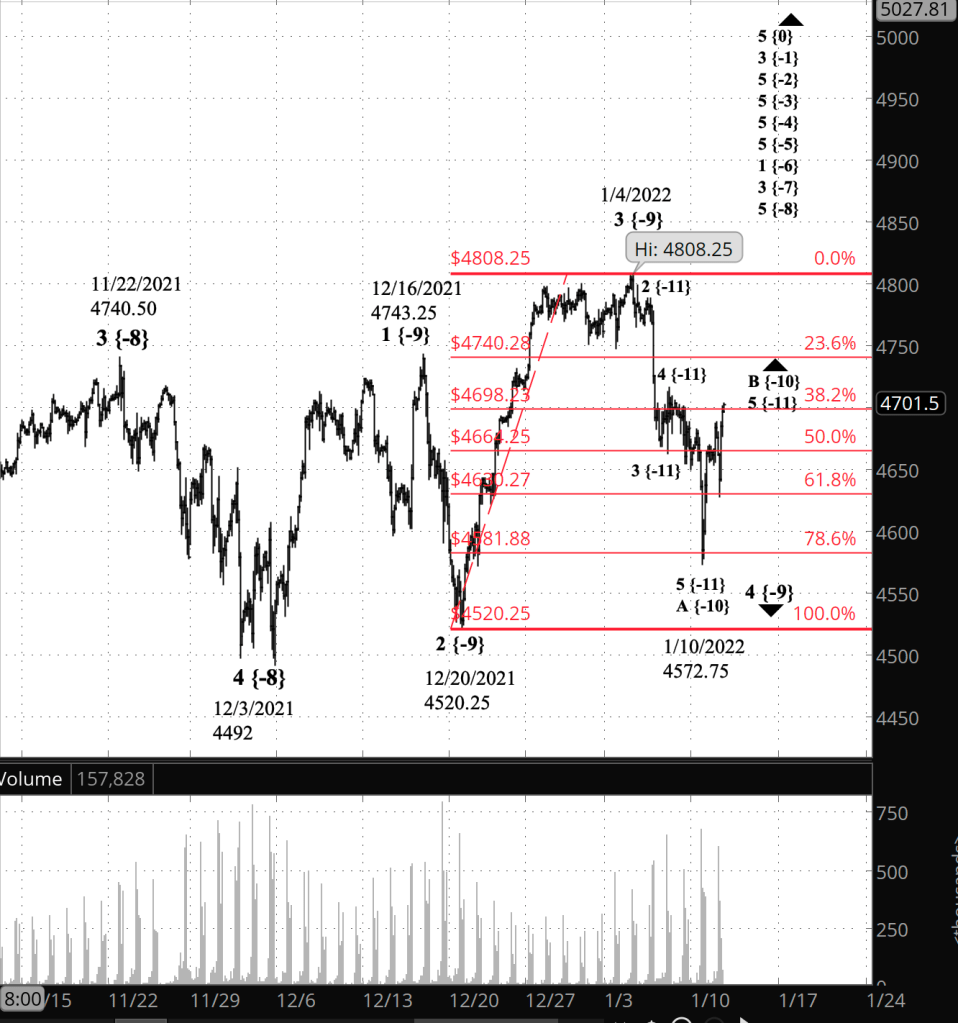
Half an hour before the closing bell. The S&P 500 rose to the 23.6% Fibonacci retracement level and then pulled back slightly. The movement was the third wave within wave B{-10} and fulfilled all requirements for completion of the B wave. The price could go higher, but under my principal analysis, can’t go above 4808.25, the January 4 peak. No change in the analysis from this morning, beyond the correction noted below. I’ve updated the chart.

2:47 p.m. New York time

Correction. I’ve updated the chart to correct the labelling of the rise that began January 10 and have corrected the designation in the first paragraph of the Elliott wave theory text below the chart.

10:15 a.m. New York time

Earnings play. I’ve opened a short iron condor position on DAL prior to the airlines’ earnings announcement on Thursday before the opening bell. The stock is ranked as “Hold” by Zacks, so I went with an iron condor. Zacks’ Earnings Surprise Predictor is 64% for a positive surprise, which is quite high. The implied volatility rank is lower than I like, but I was able to construct a trade that provided sufficient premium to meet my requirements. I’ve posted an analysis of the trade.

No earnings plays using stocks in sight today.

9:35 a.m. New York time

What’s happening now? The S&P 500 E-mini futures continued to rise in overnight trading, again approaching the 23.6% Fibonacci retracement level.

What does it mean? The second leg of a downward correction that began January 4 is still underway. A move above the January 4 high of 4808.25 would require that the analysis be revised.

What are the alternatives? The 2nd leg of a new downtrend that began January 4 is still underway. It presently has three segments internally. If another decline and rise are added, then this analysis would be invalidated.

Another alternative: The correction that began January 4 ended on January 10 at 4572.75, and the rise that followed is the first leg of a renewed uptrend. A move above 4808.25 would confirm this analysis. A move below 4572.75 would invalidate it. Also, to count decline from January 4 to 10 as having three legs internally — a necessity for this scenario — requires some creative viewing of the chart to make it work. I consider this to be the least likely scenario.

[S&P 500 E-mini futures at 3:30 p.m., 2-hour bars, with volume]

What does Elliott wave theory say? Under my principal analysis, the rise from January 10 is upward wave B{-10} [corrected from the initial post] within downward correction wave 4{-9}.

Under the first alternative analysis, the rise from January 10 is an upward correction, wave 2{-10}, within downtrending wave 1{-9}. The second wave must have three waves internally, unless it adds a second corrective pattern in a compound structure, which is not some common in second waves.

Under the second alternative, the low of January 10 ended downward wave C{-10} within downward correction wave 4{-9}, and the subsequent rise is uptrending wave 1{-10} within uptrending wave 5{-9}.

All of these scenarios, whichever map ends up conforming to the territory, are happening within uptrending wave 5{-8}, which began on December 3 from 4492.

Learning and other resources. Elliott wave analysis provides context, not prophecy. As the 20th century semanticist Alfred Korzybski put it this way in his book Science and Sanity (1933), “The map is not the territory … The only usefulness of a map depends on similarity of structure between the empirical world and the map.” And I would add, in the ever-changing markets, we can judge that similarity of structure only after the fact.

See the menu page Analytical Methods for a rundown on where to go for information on Elliott wave analysis.

By Tim Bovee, Portland, Oregon, January , 2022

Disclaimer

Tim Bovee, Private Trader tracks the analysis and trades of a private trader for his own accounts. Nothing in this blog constitutes a recommendation to buy or sell stocks, options or any other financial instrument. The only purpose of this blog is to provide education and entertainment.

No trader is ever 100 percent successful in his or her trades. Trading in the stock and option markets is risky and uncertain. Each trader must make trading decisions for his or her own account, and take responsibility for the consequences.

License
Creative Commons License

All content on Tim Bovee, Private Trader by Timothy K. Bovee is licensed under a Creative Commons Attribution-ShareAlike 4.0 International License.

Based on a work at www.timbovee.com.

Trader’s Notebook

3:30 p.m. New York time

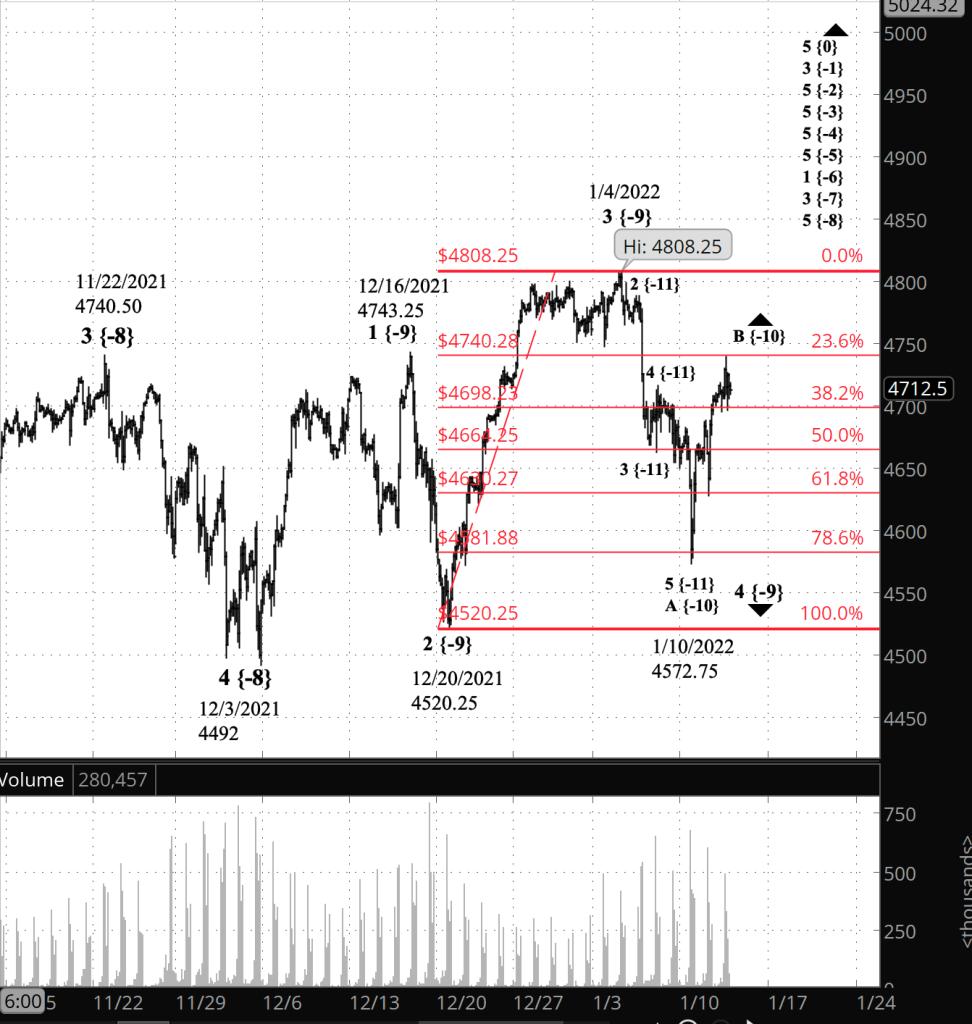
Half an hour before the closing bell. The S&P 500 has continued to work its way higher during the trading session, returning to the 38.2% Fibonacci retracement level. No change in the analysis. I’ve updated the chart.

3:15 p.m. New York time

Earnings play exited. I’ve exited my short iron condor position on CAG, six days after entering the position the day before the earnings announcement, for a return of 32.8%, or 1,998% annualized. I’ve updated the analysis with full results.

10:05 a.m. New York time

My trades. Actually, no trades today. JEF publishes earnings on Wednesday before the opening bell. I’ve done the options analysis, and JEF doesn’t provide sufficient return to support the position. The implied volatility rank is relatively low for this close to an earnings announcement, only 29.2%. I always prefer that my short options position be at 30% or above. Zacks expects no earnings surprise in either direction, so the position would be structured as a short iron condor. A construction covering the expected move based on options pricing: $1.11 in either direction, or $39.60 to $41.82, provides 28% coverage of the long-short intervals of the two legs of the iron condor. I prefer 33% or better. And the risk/reward ratio is 2.6:1, which is higher risk than I prefer with iron condors. Generally, my preference is for a ratio better than 1.5:1. A stock trade for JEF is also out of the picture; I trade stocks on earnings only when the Zacks Expected Surprise Prediction for earnings is greater than zero, and that’s not the case for JEF.

No other trades in sight today.

9:35 a.m. New York time

What’s happening now? The S&P 500 E-mini futures continued to rise in overnight trading, moving back above the 50% retracement of the rise from December 20 to January 4.

What does it mean? The rise is the second leg of a correction from the January 4 peak.

What’s the alternative? The rise is the second leg of a downtrend that began on January 4.

[S&P 500 E-mini futures at 3:30 p.m., 2-hour bars, with volume]

What does Elliott wave theory say? Under my principal analysis, the decline from January 4 — the end of wave 3{-9} to January 10 is wave A{-10}, the first wave of a three-wave downward correction. wave B{-10} will carry the price up but will remain bellow the January 4 high of 4808.25.

Under my alternative analysis, the January 4 to January 10 decline was wave 1{10} of an impulse wave, a new trend to the downside. The subsequent rise is wave 2{-10} The January 4 peak was the end of wave 5{-9} under this scenario.

Under both scenarios, the first wave can have five subwaves (as it has) and the second wave, three subwaves (as it almost certainly will). So the rise won’t clear up the present ambiguity about whether the S&P 500 is in a correction or a new downtrend.

See the Ellliott wave theory section of yesterday’s Trader’s Notebook for an extensive discussion of the possibilities.

Learning and other resources. Elliott wave analysis provides context, not prophecy. As the 20th century semanticist Alfred Korzybski put it this way in his book Science and Sanity (1933), “The map is not the territory … The only usefulness of a map depends on similarity of structure between the empirical world and the map.” And I would add, in the ever-changing markets, we can judge that similarity of structure only after the fact.

See the menu page Analytical Methods for a rundown on where to go for information on Elliott wave analysis.

By Tim Bovee, Portland, Oregon, January 11, 2022

Disclaimer

Tim Bovee, Private Trader tracks the analysis and trades of a private trader for his own accounts. Nothing in this blog constitutes a recommendation to buy or sell stocks, options or any other financial instrument. The only purpose of this blog is to provide education and entertainment.

No trader is ever 100 percent successful in his or her trades. Trading in the stock and option markets is risky and uncertain. Each trader must make trading decisions for his or her own account, and take responsibility for the consequences.

License
Creative Commons License

All content on Tim Bovee, Private Trader by Timothy K. Bovee is licensed under a Creative Commons Attribution-ShareAlike 4.0 International License.

Based on a work at www.timbovee.com.

ACI Trade

Albertsons Cos Inc. (ACI)

Update 2/19/2022: The remaining calls in my short iron condor position on ACI, reduced to a bear call vertical spread after i exited the puts in January, expired valueless on February 19 and imposed no debits on the position. The credit I received upon entry was all profit, less fees.

I gave results for the puts below when I exited them on January 24. In this update I shall first analysis the calls exit, and then put both together and analyze the original iron condor.

I exited my short bear call vertical spread on ACI when they expired out of the money for no debit per contract/share, a profit before fees of $95 per contract. Shares closed the day before expiration at $29.01, down $2.23 from the entry level.

The Implied Volatility Rank at exit was 19.4%, down 16.1 points from the entry level.

Shares declined by 7.1% over 40 days for a -65% annual rate. The options position produced a 100% return for a +913% annual rate.

I next turn to the entire iron condor, combining both the puts, which I exited early, and the calls, which expired without value.

I exited my short iron condor position on ACI in a piecemeal fashion, the final exit coming at expiration, for a $2.25 debit per contract/share, a loss before fees of $9.00 per contract. hares closed the day before expiration at $29.01, down $2.23 from the entry level.

The Implied Volatility Rank at exit was 19.4%, down 16.1 points from the entry level.

Shares declined by 7.1% over 40 days for a -65% annual rate. The options position produced a 4% loss for a -37% annual rate.


Update 1/24/2022: The short puts in my short iron condor position on ACI were out of the money the day before the company’s stock went ex-dividend, and rather than risk assignment, I exited the short and long puts 25 days before expiration, thereby splitting the iron condor into two vertical spreads.

Here I shall analyze the short bull put spread that I exited. The short bear call spread will, I hope, expire without value on February 18, and at that point I shall analyze both the bear call spread and the original iron condor.

I exited the short bull put spread for a $2.25 debit per contract/share, a loss before fees of $104 per contract. Shares were trading at $28.28, down $2.96 from the entry level.

The Implied Volatility Rank at exit was #, up/down # points from the entry level.

Shares declined by 9.5% over 14 days for a -247% annual rate. The options position produced a -46.2% loss for a 1,205% annual rate.


I have entered a short iron condor earnings play on ACI, using options that trade for the last time 39 days hence, on February 18. The premium is a $2.16 credit per contract share and the stock at the time of entry was priced at $31.24.

The Implied Volatility Rank stands at 35.5%

Premium:$2.16Expire OTM
ACI-iron condorStrikeOddsDelta
Calls
Long38.0090.0%14
Break-even35.1677.5%28
Short33.0065.0%42
Puts
Short30.0057.0%36
Break-even27.1672.5%22.5
Long25.0088.0%9

The premium is 43.2% of the width of the positions short/long spreads. The profit zone covers a 12.5% move to the upside and a 15.0% move to the downside.

The risk/reward ratio is 1.3:1, with maximum risk of $284 and maximum reward of $216 per contract.

How I chose the trade. The trade was placed to coincide with ACI’s earnings announcement, before the opening bell on the day after entry. The short strikes were set to coincided with the expected move of $2.49 either way, based on options pricing, which gives a price range of $30.21 to $32.70.

By Tim Bovee, Portland, Oregon, January 10, 2021

Disclaimer

Tim Bovee, Private Trader tracks the analysis and trades of a private trader for his own accounts. Nothing in this blog constitutes a recommendation to buy or sell stocks, options or any other financial instrument. The only purpose of this blog is to provide education and entertainment.

No trader is ever 100 percent successful in his or her trades. Trading in the stock and option markets is risky and uncertain. Each trader must make trading decisions for his or her own account, and take responsibility for the consequences.

License
Creative Commons License

All content on Tim Bovee, Private Trader by Timothy K. Bovee is licensed under a Creative Commons Attribution-ShareAlike 4.0 International License.

Based on a work at www.timbovee.com.