Monday, November 2, 2020

10:25 a.m. New York time

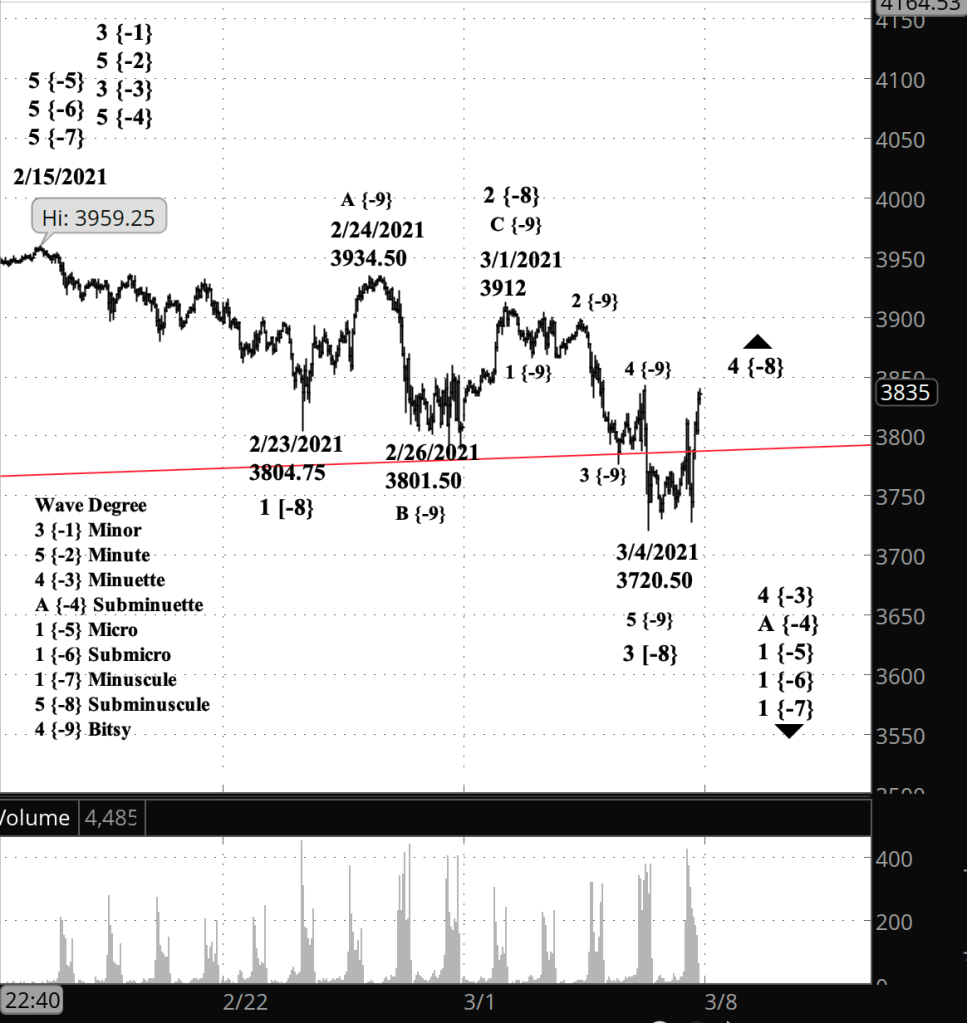
What’s happening now? The S&P 500 index’s low on Friday, October 30, marked the end of the decline from October 23 and the beginning of an upward correction

What does it mean? The decline a bit more than a week, and the position of the correction suggests it will be more of a sideways movement than a quick rush to the higher ground, so probably it the correction will carry into mid-November. The timing is a best guess, so the correction could take a shorter or a longer time to complete. The end wave the correction will be followed by a resumption of the main downward trend that will carry back into the 3200s and below.

What is the alternative? It’s still possible that the decline from October 23 is not yet complete. Based on the look of the chart, it seems unlikely to me.

[S&P 500 index, 45-minute bars]

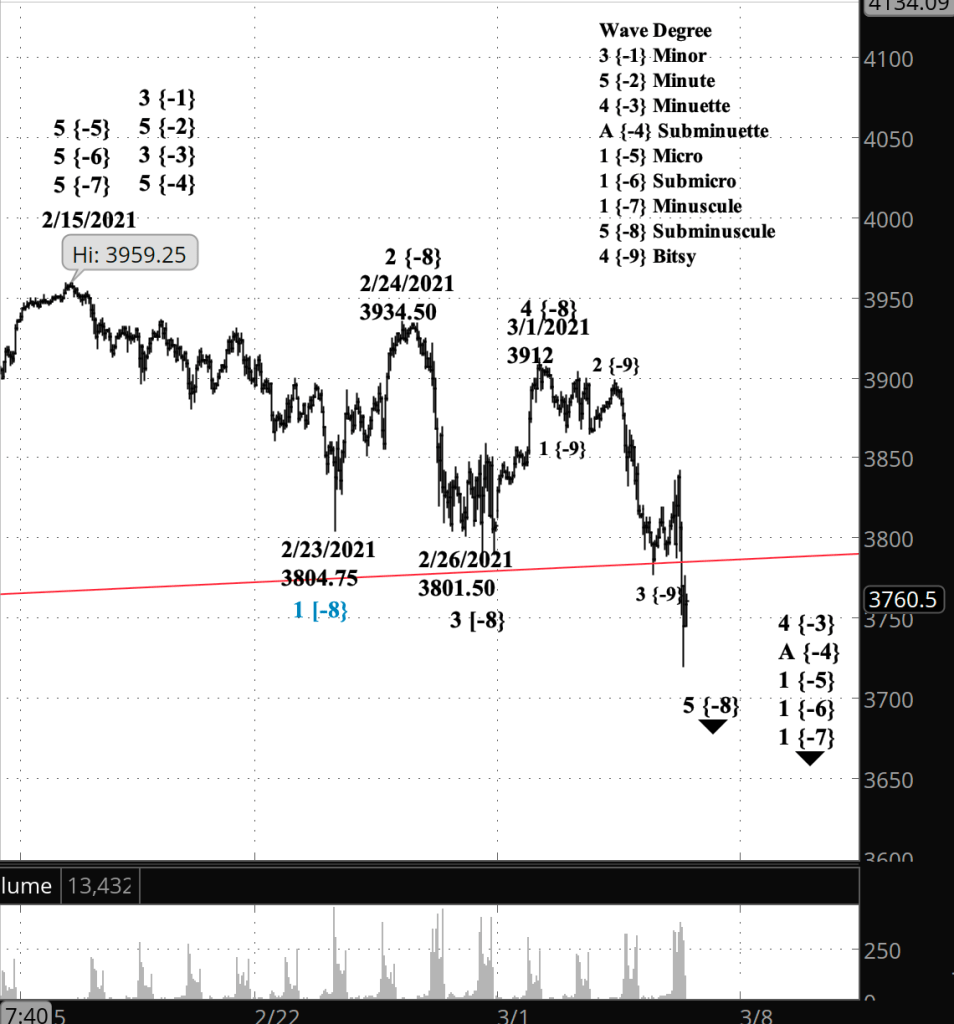
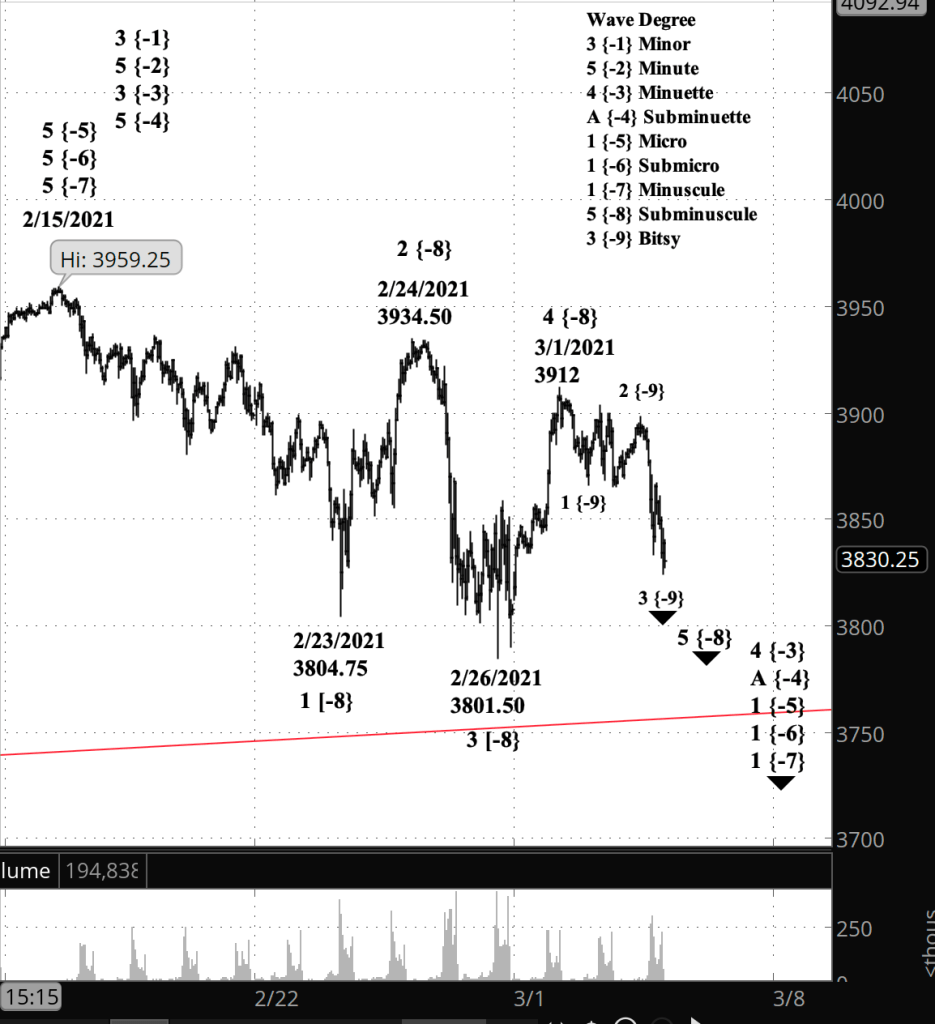
What does Elliott wave theory say? The October 30 low was the end of wave 3 of Minute degree, and the following wave in its early stage is wave 4 of Minute degree. The Minute 2nd wave was a Zigzag pattern, and Elliott’s rule of alternation says that the 4th wave will be either a Flat or a Triangle. Within Minute 4 the movement is tracing wave A of Minuette degree.

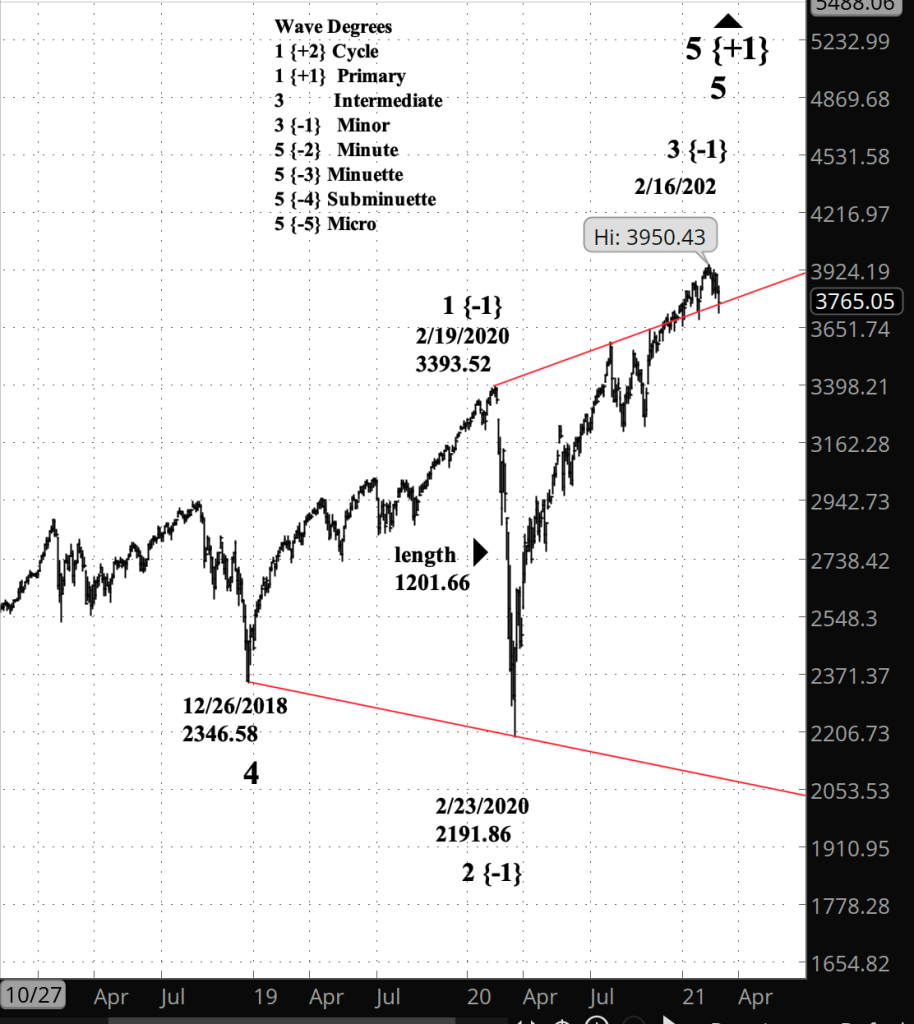
The Minute degree correction is a subwave of wave 3 of Minor degree, which in turn is a subwave of wave 3 of Intermediate degree. All of this is tracing the middle ground of wave 1 of Primary degree, which began on September 2.

My trading strategy. The time taken by the Minute 4th wave correction has implications for my next options play. I exited my short bear all options spread on IWM last Friday, 21 days before its November expiration.

If the chart allows it, the next options position, also a short bear call spreads, will have a December expiration. The optimal entry date will be Tuesday, November 3, with entry possible within a range running from October 27 of last week to November 10, next week.

I don’t trade 4th waves. They have too many variations for confident analysis. They tend to produce surprises. So my target entry is for the end of beginning of Minute wave 5.

I haven’t selected a vehicle yet. Like IWM in my prior trade, the vehicle must have an implied volatility rank of 30 and above. SPY at present meets that requirement, at 35.8%, as does IWM at 40.3% and QQQ at 40.7. All trace similar Elliott wave patterns. Those IV rank can change quickly, so it’s premature to focus on any single symbol at this point.

Read More »

Friday, October 30, 2020

10 a.m. New York time

What’s happening now? The S&P 500 E-mini futures hit a low of 3226 in overnight trading and then began to rise within an upward correction that is part of a larger downward trend.

What does it mean? The rise that began last night could carry to 3334 and beyond on the futures chart.

[S&P 500 E-mini futures, 10-minute bars]

What does Elliott wave theory say? The overnight rise is wave C of Subminuette degree within wave 4 of Minuette degree. A C wave under the Elliott rules can move beyond the end wave A. In this instance wave B moved below the start of wave A. When both B and C envelope A, it is called an expanded Flat. In any case, the pattern suggests that we may have a rise in price to usher us into Halloween night and the weekend.

My trading strategy. This is the day I exit profitable options positions. A glance at the chart at the opening bell told me that my short bear call options spread position on IWM is unlikely to show additional profit today, so I exited immediately, at 39.5% of maximum potential profit. My goal for spreads is 50% of max. So, not the best but not too shabby. I’ll update IWM Analysis with detailed results later today.

Read More »

Thursday, October 29, 2020

3:30 p.m. New York Time

The S&P 500 and associated products rose by nearly 100 points and then showed the early stages of a reversal, in a correction at the 4th wave of Minuette degree. Tentatively, I count the A wave of Subminuette degree to be complete, with two more waves — B and C — to go.

The upward correction may delay my intended exit from my short bear call spread options positions on IWM, a decision that I’m due to make tomorrow, October 30.

[S&P 500 E-mini futures, 10-minute bars]

10:10 a.m. New York time

What’s happening now? The S&P 500 index rose in a low-level correction overnight and then continued its fall.

What does it mean? The price stands about 120 points above the lower boundary of the trend channel that began on September 2. It will eventually reach the channel, and the longer it takes, the lower the boundary will sink. A week from today, the lower channel will be at about 3172.

[S&P 500, 45-minute bars]

What does Elliott wave theory say? The decline that began September 23 is wave 3 of Minute degree within wave 3 of its parent series, the Minor degree. Both in turn are subwaves of wave 3 of Intemediate degree. So, a 3rd of a 3rd of a 3rd — that is a powerhouse in Elliott wave theory.

The Minute and Minor degrees within Intermediate 3 each have a 4th wave upward correction and a 5th wave grand finale decline ahead of them.

What lies immediately ahead? More down, punctuated by a few upward attempts.

My trading strategy. I’ve put a sell order in on my short bear call options position on IWM, at a price that is 50% of maximum potential profit, about 12 cents below the present price of the position. Tomorrow, October 30, is 21 days before expiration, when I sell the position at any level of profit, unless the chart suggests I should wait.

Read More »

Wednesday, October 28, 2020

12:05 p.m. New York time

Here is a chart analyzing wave 5 of Minute degree, a downward movement that will complete the larger wave 5 of Minor degree and the still larger wave 3 of Intermediate degree. The completion of the present wave 5 of Micro degree will complete its parent, wave 3 of Subminuette degree, which will be followed by an upward Subminuette 4 movement that under the Elliott wave rules is likely to stay bellow 3308 on the futures chart.

[S&P 500 E-mini futures, 5-minute bars]

9:45 a.m. New York time

What’s happening now? The S&P 500 E-mini futures fell sharply overnight.

What does it mean? The fall is the final movement that began on October 23, from 3462.50, and its parent decline that began on October 12, from 3541. It’s completion will usher in a significant upward correction that will mostly be a Flat pattern that will reach somewhere in the range of 3402 (the October 21 low) to 3460 (the October 23 high on the index, or 3402 to 3462 on the E-mini futures on the same dates.

What is the alternative? The sharpness of the decline leaves no apparent alternative. That’s not to say that ambiguities won’t appear; I just can’t see any at present

[S&P 500 E-mini futures, 30-minute bars]

What does Elliott wave theory say? The sharp decline that began yesterday, October 28, is wave 5 of Minute degree within wave 5 of Minor degree within wave 3 of Intermediate degree. The completion of the fifth waves will mark the beginning of the Intermediate wave 2 correction to the upside. Fourth waves often end within the span of the 4th wave one degree lower. The 4th wave of Minor degree ran from October 21 to October 23, and that provided the targets I noted above. Minor wave 5 internally is in Minute wave 5, so Minor 5 is nearing its end.

All of this is happening within wave 1 of Primary degree, which began September 2.

My trading strategy. Short bear call spread options on IWM: Exit at 50% of maximum potential profit, or on Friday, the 21st day before expiration, or on any sign that Minor wave 5 has reached its end. SDS shares: Continuing to hold until Primary wave 1 nears completion.

Read More »

Tuesday, October 27, 2020

12:30 p.m. New York time

I’ve updated the chart with about 30 minutes to go before the closing bell. Very little movement today, beyond a slight hook downward that could mark the end of wave 4 of Minute degree, or a continuation of that upward correction — impossible to say which at this point.

9:40 a.m. New York time

What’s happening now? The S&P 500 index is in the late stage of its decline from October 12. It presently stands midway between the boundaries of the trend channel.

What does it mean? Once the decline is over, the index and its associated funds and futures will trace an upward correction, perhaps to the 3450s, and then turn to the final portion of the decline.

[S&P 500 index, 30-minute bars]

What does Elliott wave theory say? October 12 marked the beginning of wave 3 of Intermediate degree, the middle portion of the greater wave 1 of Primary degree, which began September 2.

Considered in greater detail, Intermediate wave 3 has reached its Minor 5 subwave, which in turn is tracing its Minute 4 subwave, the final upward correction within Intermediate 3.

At the opening bell this morning the price declined below yesterday’s low (October 26), which could mark the beginning of Minute wave 5, one level below Minor. Or perhaps not. It could be a continuation of Minute wave 4, which began yesterday.

My trading strategy. I’m holding my short bear call options spreads on IWM until at least Friday, longer if they’re not yet profitable. I’m operating on the presumption that Minute wave 5 of Minor wave 5 will return the position to profitability. I must avoid the start of Intermediate wave 4, an upward correction. I’m continuing to hold my shares in SDS, which profit when the S&P 500 decline, using Primary wave 1 as my guide.

Read More »

Monday, October 26, 2020

3:30 p.m. New York time

I’ve updated the chart with about half an hour to go before the closing bell. The S&P 500 completed its 3rd wave of Minute degree and has begun the 4th wave. All of this within a 5th wave of Minor degree, which is in turn a subwave of the 3rd wave of Intermediate degree.

9:40 a.m. New York time

What’s happening now? The S&P 500 E-mini futures continued to decline in overnight trading.

What does it mean? The further the drop in the S&P 500 price, the greater the likelihood that the major downtrend that began in September has.

What is the alternative? A fresh high an hour and 45 minutes before the opening bell opened a higher possibility that the bearish correction is continuing in a compound pattern, where several simple patterns are linked together.

[S&P 500 E-mini futures]

What does Elliott wave theory say? On the S&P 500 index chart, the Primary wave 1 downtrend that began September 2 completed its Intermediate wave 1 on September 24, and then moved into an Intermediate wave 2 correction that ended on October 12. The ensuing Intermediate wave 3 resumption of the downtrend is tracing out its 4th wave of Minor degree.

My trading strategy. Friday in management day for my short bear call options spreads on IWM. The positions are not profitable at this point. So if they turn profitable, I exit on Friday. If they remain unprofitable, I continue to hold as I suss out the best exit strategy.

Read More »

Friday, October 23, 2020

3:40 p.m. New York time

I’ve replaced this morning’s chart with one for 22 minutes before the closing bell. The S&P 500 is in stages of Minor wave 1 to the downside.

9:40 a.m. New York time

What’s happening now? The S&P 500 index and the E-mini futures continue their small upward correction within the dominant downtrend.

What does it mean? An analysis of the movements within the upward correction suggests that it is nearing its end.

[S&P 500 E-mini Futures, 25-minute bars]

What does Elliott wave theory say? The present position is uptrending wave 4 of Minor degree within downtrending wave 3 of Intermediate degree. By my count of wave 4’s internals, it is tracing wave 5 of Minute degree, indicating that it is near completion. And indeed, a small step down immediately after the opening bell this morning suggests the possibility that wave 4 has ended, at a high of 3462.50. If the price moves above that level, then wave 4 is still in progress.

My trading strategy. I continue to hold my options and shares positions in anticipation of a continuation of the downtrend.

Read More »

Thursday, October 22, 2020

10:15 a.m. New York time

What’s happening now? The S&P 500 E-mini futures fell overnight to 3402.50, eight points below the October 19 minimum of 3410.75, the lowest the price has gone since the upward correction peak of 3549.85 on October 12.

What does it mean? That new low resolves much of the ambiguity in my count, and I’ve renumbered the chart to reflect an end to the upward correction and a resumption of the downtrend that began September 2. This is what I called the first alternative in my post yesterday, October 21.

What is the alternative? The first alternative having now become the principle count, the former principle is still on the books as an alternative. A rise above the peak of October 20, of 3508.50, would heighten the likelihood the correction is still underway.

The charts. I’ve used the futures for the chart in order to capture the overnight trading in detail. The index itself doesn’t trade outside of normal exchange hours. For the big picture, I’ve added a second chart showing the index itself.

[S&P 500 E-mini futures, 20-minute bars]

What does Elliott wave theory say? Wave 2 of intermediate degree, the upward correction, peaked on October 12 and internally is close to completing its 3rd wave of Minor degree. If the Intermediate 3rd wave is rapid, it will carry the price down to the mid-3100s, the lower level of the price channel shown on the index chart.

[S&P 500 index, 30-minute bars]

My trading strategy. The new principle count will be good for my options positions, which are bearish. Assuming, of course, if the chart plays out as my analysis suggests. Likewise, the advent of Intermediate wave 3 will benefit my shares of SDS, an inverse fund.

Read More »

Wednesday, October 21, 2020

9:35 a.m. New York time

What’s happening now? The S&P 500 index continues to wind through the ambiguities I discussed in detail in yesterday’s post, climbing either as the late stage of an upward correction, or as an early stage of a resumption of the downward trend.

What does it mean? My principle count continues to favor the continuing upward correction scenario, in part because it requires three waves to the upside, and I don’t see that yet with each wave having roughly the same magnitude as its siblings. So the peak of October 12, under this scenario, counts as the end of the first movement within the upward correction.

What is the alternative? The October 12 high marks the end of the upward correction, probably, although there is a third scenario that has the correction continuing in a more complex form.

The Chart. I show two scenarios on this chart: The principle scenario in black and the first alternative — upward correction complete — in red. The price channel assumes that the October 12 high is the end of the upward correction.

[S&P 500 index, 30-minute bars]

What does Elliott wave theory say? So, let’s put some waves to the various scenarios.

Principle: The October 12 high is the end of wave A of Minor degree within wave 2 of Intermediate degree.

Alternative: The October 12 high is the end of wave 2 of Intermediate degree, and the ensuing decline is the start of wave 3 of the same degree.

Another alternative: Same as the first alternative except the ensuing decline, rather than marking the start of Intermediate 3, is instead an X wave of Minor degree that separates the two portions of what will prove to be a compound structure within Intermediate wave 2.

My trading strategy. Happily, the two alternative scenarios work nicely with my short bear call options spreads, providing sufficient downside to allow for a profit. The principle analysis — not so much. It will probably result in a loss. In any case, having crossed the Rubicon, a trader has no choice but to march forward, adjusting strategy to match the market reality.

I shall continue to hold my shares of the inverse fund SDS, probably until Minor wave 5 within Intermediate wave 3, always keeping in mind the favorable tax treatment of long-term capital gains, on positions held for at least a year.

Read More »

Tuesday, October 20, 2020

3:35 a.m. New York time

I’ve updated the map with the view within half an hour of the closing bell.

8 a.m. New York time

What’s happening now? The S&P 500 index fell to 3419.93 from the peak of September 12 and reversed to the upside.

What does it mean? My principle count interprets the rise from yesterday (October 19) as a continuation of an upward correction within a larger downtrend.

What is the alternative? One alternative counts the September 12 peak as the end of the upward correction, and the subsequent fall and then the rise that began yesterday as downward steps within the larger down trend.

A second, less likely, alternative counts the decline from September 12 as a divider in a compound correction composed of two corrective patterns, back to back, with the rise from yesterday being the first wave up of the second pattern.

The Chart. On the chart below I’ve labeled the principle count in black and the first alternative count in red. I’ve used the S&P 500 E-mini futures, which never stop trading except on weekends, in order to have a more complete picture of the relative small movements we’re examining.

[S&P 500 E-mini futures, 20-minute bars]

What does Elliott wave theory say? By the principle count (black on the futures chart), the fall from September 12 was Minor wave B to the downside, and the rise that began yesterday is the beginning of Minor wave C, all within the Intermediate wave 2 upward correction within Primary wave 1, which began its downward course on September 2

By the first alternative count (red on the futures chart), the peak on September 12 was the end of Intermediate wave 2 and the beginning of Intermediate 3, with yesterday’s low being the end of wave 3 of, probably, Minute degree. I say “probably” because this early in a parent wave the subwaves lack context and their degree is at best a guess.

If the principle (black) count is correct, then the present upward movement, the Minor wave C will almost certainly move beyond the end of wave A, to an extent that C will be about the same length as A, which would bring the price up to the 3700s. However, a second wave can’t move beyond the start of the preceding first wave, so 3588.11 — the September 2 high on the index chart — is as high as the Intermediate wave 2 correction and the Minor C wave within it can go. If that barrier should be breached, then the entire count from September 2 will need to be redone.

If the first alternative (red) count is correct, then Minute wave 4, an upward correction, will tend toward a sideways move, reaching a bit higher but not dramatically so. It will be followed by Minute wave 5, which will carry the price below 3209.45 on the index chart, the start of Intermediate wave 2.

My trading strategy. If the principle count is correct, then my bear call options spread positions may be in trouble. If the first alternative is correct, then I may be able to exit profitably. I’m holding my shares of SDS, the inverse fund based on the S&P 500, in the confidence that Intermediate wave 3 and its parent will eventually bring those shares to profitability.

Read More »