SCHW Trade

The Charles Schwab Corp. (SCHW)

Update 4/18/2022: I exited my short bear call vertical spread on SCHW, 32 days before expiration, for a $7 debit per contract/share, a profit before fees of $0.48 per contract. Shares were trading at $73.03, down $11.48 from the entry level.

The Implied Volatility Rank at exit was 47.4%, up 17.2 points from the entry level.

I exited at 87.3% of maximum potential profit, well above my goal of 25% of max on earnings plays. The stock price declined sharply after the company announced it earnings and revenue results that fell short of analyst expectations.

Shares declined by 13.6% over four calendar days — one trading day — for a -1,240% annual rate. The options position produced a 685.7% return for a +62,751% annual rate (a +250,286% annual rate calculated as one trading day).


I have entered a short bear call spread on SCHW, using options that trade for the last time 36 days hence, on May 20. The premium is a $0.55 credit per contract share and the stock at the time of entry was priced at $84.51.

The Implied Volatility Ratio stood at 30.2%.

Premium:$0.55Expire OTM
SCHW-bear call spreadStrikeOddsDelta
Calls/Puts
Long92.5077.0%0.28
Break-even90.5581.0%9.64
Short90.0085.0%19

The premium is 44.0% of the width of the position’s short/long spread. The profit zone covers a 7.1% move to the upside and an unlimited move to the downside.

The risk/reward ratio is 3.5:1, with maximum risk of $195 and maximum reward of $55 per contract.

How I chose the trade. The trade was placed to coincide with SCHW’s earnings announcement, before the closing bell on Monday, April 18, a long holiday weekend after the day of entry. The short strikes were set to coincide with the expected move of $4.45 either way, based on options pricing, which gives a price range of $81.62 to $87.40.

By Tim Bovee, Portland, Oregon, April 14, 2022

Disclaimer

Tim Bovee, Private Trader tracks the analysis and trades of a private trader for his own accounts. Nothing in this blog constitutes a recommendation to buy or sell stocks, options or any other financial instrument. The only purpose of this blog is to provide education and entertainment.

No trader is ever 100 percent successful in his or her trades. Trading in the stock and option markets is risky and uncertain. Each trader must make trading decisions for his or her own account, and take responsibility for the consequences.

License
Creative Commons License

All content on Tim Bovee, Private Trader by Timothy K. Bovee is licensed under a Creative Commons Attribution-ShareAlike 4.0 International License.

Based on a work at www.timbovee.com.
Trader’s Notebook

3:30 p.m. New York time

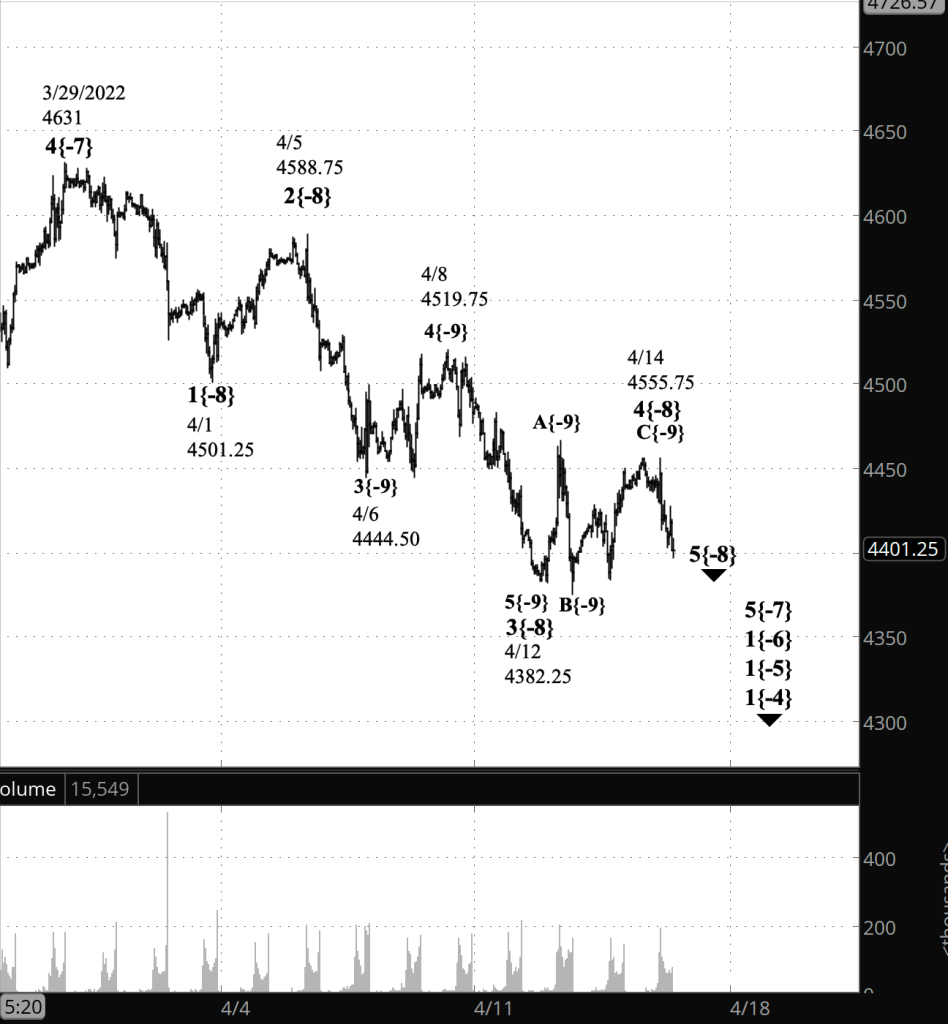
Half an hour before the closing bell. Under my principal analysis, the S&P 500 peaked at 4555.75 on the futures and reversed, resuming the downtrend that began on March 29. An alternative analysis, less common, is that the upward correction that began on April 12 is forming a compound structure, and the present decline is a wave connecting the completed corrective pattern with a second one.

Under the principal analysis, wave 4(-8} ended at the peak, and wave 5{-8} has begun. It will carry the price down to and likely beyond the end of the preceding 3rd wave, 4382.25, perhaps significantly beyond.

Under the alternative analysis, wave X{-9} within an ongoing wave 4{-8} is underway and most likely will remain above the end of the preceding 3rd wave, 4382.25.

2:05 p.m. New York time

SCHW earnings play entry. I’ve entered a short bear call vertical spread on SCHW, timed to catch the earnings announcement on Monday, April 18, a long holiday weekend after I made the trade. I’ve posted an analysis of the trade.

1:50 p.m. New York time

WFC earnings play exit. I’ve exited my short bear call options spread on WFC a day after entry for 54% of maximum potential profit and have updated the trade analysis with results.

9:35 a.m. New York time

What’s happening now? The S&P 500 E-mini futures rose to 4453.75 in overnight trading and then pulled back slightly.

What does it mean? The upward correction that began on April 12 continues and is in its third wave. I expect the decline from the overnight peak, a correction within that third wave , to quickly reverse and for the price to move above the overnight high in a final push to complete the parent wave.

What’s the alternative? I have no alternatives at present. The chart is exceptionally clear. That’s not to say that ambiguities won’t develop during the day.

Friday’s market closure. The U.S. stock exchanges will be closed on Friday for a holiday and will resume trading on Monday. If there should be any after-hours trading in the S&P 500 E-mini futures that impact the analysis, I’ll post a fresh analysis on Friday.

[S&P 500 E-mini futures at 3:30 p.m., 40-minute bars, with volume]

What does Elliott wave theory say? I read the overnight decline as wave 4{-10}, a correction within rising wave C{-9}, the third wave within the correction that began on April 12, wave 4{-8}. Wave C{-9} could be the end of the wave 4{-8} followed by a resumption of the downtrend, wave 5{-8}, or it could be followed by wave X{-9} to the downside, a wave connecting the corrective pattern just ended with a second corrective pattern in a compound structure.

We Are Here.

These are the waves currently in progress under my principal analysis. Each line on the list shows the wave number, with the subscript in curly brackets, the traditional degree name, the starting date, the starting price of the S&P 500 E-mini futures, and the direction of the wave.

  • Index:
  • 5{0} Intermediate, 12/26/2018, 2346.58 (up)
  • 4{-1} Minor, 1/4/2022 4818.62 (down)
  • 1{-2} Minute, 1/4/2022 4818.62 (down)
  • Futures and index:
  • 1{-3} Minuette, 1/4/2022, 4808.25 (down) (futures), 4818.62 (down) (index)
  • Futures:
  • 1{-4} Subminuette, 1/4/2022, 4808.25 (down)
  • 1{-5} Micro, 1/4/2022, 4808.25 (down)
  • 1{-6} Submicro, 1/4/2022, 4808.25 (down)
  • 5{-7} Minuscule, 3/29/2022, 4631 (down)
  • 5{-8} Subminuscule, 4/14/2022, 4555.75 (down)

Learning and other resources. Elliott wave analysis provides context, not prophecy. As the 20th century semanticist Alfred Korzybski put it in his book Science and Sanity (1933), “The map is not the territory … The only usefulness of a map depends on similarity of structure between the empirical world and the map.” And I would add, in the ever-changing markets, we can judge that similarity of structure only after the fact.

See the menu page Analytical Methods for a rundown on where to go for information on Elliott wave analysis.

By Tim Bovee, Portland, Oregon, April 14, 2022

Disclaimer

Tim Bovee, Private Trader tracks the analysis and trades of a private trader for his own accounts. Nothing in this blog constitutes a recommendation to buy or sell stocks, options or any other financial instrument. The only purpose of this blog is to provide education and entertainment.

No trader is ever 100 percent successful in his or her trades. Trading in the stock and option markets is risky and uncertain. Each trader must make trading decisions for his or her own account, and take responsibility for the consequences.

License
Creative Commons License

All content on Tim Bovee, Private Trader by Timothy K. Bovee is licensed under a Creative Commons Attribution-ShareAlike 4.0 International License.

Based on a work at www.timbovee.com.
WFC Trade

Wells Fargo & Co. (WFC)

Lot 2022-2

Update 4/14/2022: I exited my short bear call vertical spread on WFC, 36 days before expiration, for a $0.52 debit per contract/share, a profit before fees of $0.62 per contract. Shares were trading at $45.65, down $2.68 from the entry level.

The Implied Volatility Rank at exit was 32.2%, down 18.5 points from the entry level.

I exited the position at 54.4% of maximum potential profit, well in excess of my normal expit point for earnings plays, 25% of max.

Shares declined by 5.5% over one day for a -2,024% annual rate. The options position produced a 119.2% return for a +43,519% annual rate.


I have entered a short bear call vertical spread on WFC, using options that trade for the last time 37 days hence, on May 20. The premium is a $1.14 credit per contract share and the stock at the time of entry was priced at $48.33.

The Implied Volatility Ratio stood at 50.7%.

Premium:$1.14Expire OTM
WFC-bear call spreadStrikeOddsDelta
Calls
Long55.0089.0%14
Break-even51.1477.0%27
Short50.0065.0%40

The premium is 45.6% of the width of the position’s short/long spread. The profit zone covers a 5.8% move to the upside and an unlimited move to the downside.

The risk/reward ratio is 3.4:1, with maximum risk of $386 and maximum reward of $114 per contract.

How I chose the trade. The trade was placed to coincide with WFC’s earnings announcement, before the opening bell on the day after entry. The short strikes were set to coincide with the expected move of $1.90 either way, based on options pricing, which gives a price range of $46.52 to $30.52.

By Tim Bovee, Portland, Oregon, April 13, 2022

Disclaimer

Tim Bovee, Private Trader tracks the analysis and trades of a private trader for his own accounts. Nothing in this blog constitutes a recommendation to buy or sell stocks, options or any other financial instrument. The only purpose of this blog is to provide education and entertainment.

No trader is ever 100 percent successful in his or her trades. Trading in the stock and option markets is risky and uncertain. Each trader must make trading decisions for his or her own account, and take responsibility for the consequences.

License
Creative Commons License

All content on Tim Bovee, Private Trader by Timothy K. Bovee is licensed under a Creative Commons Attribution-ShareAlike 4.0 International License.

Based on a work at www.timbovee.com.
Trader’s Notebook

3:30 p.m. New York time

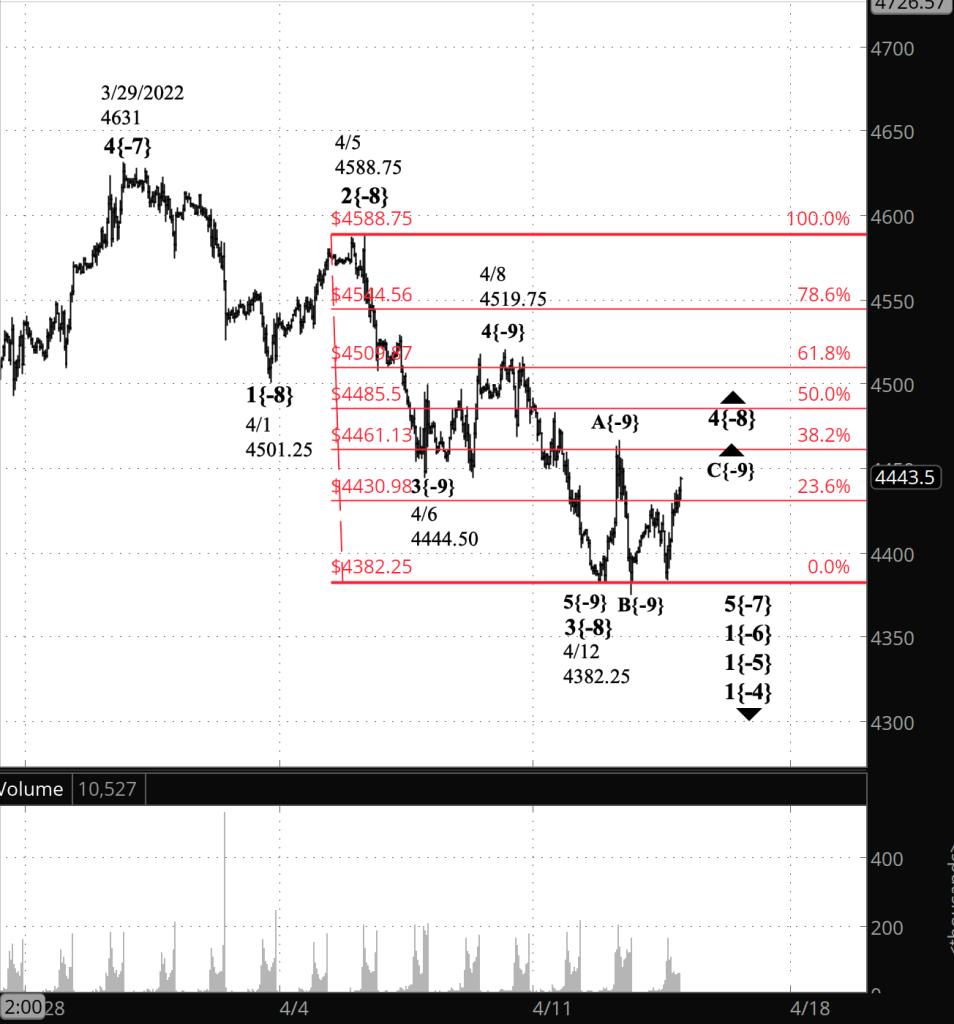
Half an hour before the closing bell. The upward correction that began on April 12 continues, and the corrective pattern is now on its third and final leg: Wave C{-9} within wave 4{-8}. No change in the principal analysis from this morning. The alternative wasn’t confirmed I’ve updated the chart.

11:35 a.m. New York time

WFC earnings play entry. I’ve entered a short bear call options spread on WFC and have posted an analysis of the trade.

11:20 a.m. New York time

JPM earnings play exit. I’ve exited my short bear call options spread on JPM, one day after entry and for 60% of maximum potential profit. I’ve updated the trade analysis with results.

9:35 a.m. New York time

What’s happening now? The S&P 500 E-mini futures rose in overnight trading, coming close to the 23.6% Fibonacci retracement level, and then retreated, approaching the starting price of the upward correction now underway.

What does it mean? The rise and retreat were part of the middle portion of the upward correction that began on April 12.

What is the alternative? If the price declines below 4382.25, then it raises the possibility that the correction ended at the overnight high, 4428.50. The result would be a misshapen corrective pattern and I don’t believe this alternative to be a likely description of the chart. Nonetheless, it’s improbable, not impossible.

[S&P 500 E-mini futures at 3:30 p.m., 40-minute bars, with volume]

What does Elliott wave theory say? Under my principal analysis, rising wave C{-9} within an upward correction, wave 4{-8}, is now underway. The overnight rise and fall are subwaves within wave C{-9}.

Under my alternative analysis, wave 4{-8} ended at the overnight high with a very truncated wave C{-9}. The decline that followed, under this scenario would either be a connecting wave — an X-wave — in a compound correction that links two or three corrective patterns together, or the first tentative steps of wave 5{-8} to the downside. As I noted above, I don’t believe this scenario to be at all likely. Nonetheless, it is a possible alternative.

We Are Here.

These are the waves currently in progress under my principal analysis. Each line on the list shows the wave number, with the subscript in curly brackets, the traditional degree name, the starting date, the starting price of the S&P 500 E-mini futures, and the direction of the wave.

  • Index:
  • 5{0} Intermediate, 12/26/2018, 2346.58 (up)
  • 4{-1} Minor, 1/4/2022 4818.62 (down)
  • 1{-2} Minute, 1/4/2022 4818.62 (down)
  • Futures and index:
  • 1{-3} Minuette, 1/4/2022, 4808.25 (down) (futures), 4818.62 (down) (index)
  • Futures:
  • 1{-4} Subminuette, 1/4/2022, 4808.25 (down)
  • 1{-5} Micro, 1/4/2022, 4808.25 (down)
  • 1{-6} Submicro, 1/4/2022, 4808.25 (down)
  • 5{-7} Minuscule, 3/29/2022, 4631 (down)
  • 4{-8} Subminuscule, 4/12/2022, 4382.25 (up)

Learning and other resources. Elliott wave analysis provides context, not prophecy. As the 20th century semanticist Alfred Korzybski put it in his book Science and Sanity (1933), “The map is not the territory … The only usefulness of a map depends on similarity of structure between the empirical world and the map.” And I would add, in the ever-changing markets, we can judge that similarity of structure only after the fact.

See the menu page Analytical Methods for a rundown on where to go for information on Elliott wave analysis.

By Tim Bovee, Portland, Oregon, April 13, 2022

Disclaimer

Tim Bovee, Private Trader tracks the analysis and trades of a private trader for his own accounts. Nothing in this blog constitutes a recommendation to buy or sell stocks, options or any other financial instrument. The only purpose of this blog is to provide education and entertainment.

No trader is ever 100 percent successful in his or her trades. Trading in the stock and option markets is risky and uncertain. Each trader must make trading decisions for his or her own account, and take responsibility for the consequences.

License
Creative Commons License

All content on Tim Bovee, Private Trader by Timothy K. Bovee is licensed under a Creative Commons Attribution-ShareAlike 4.0 International License.

Based on a work at www.timbovee.com.
JPM Trade

JPMorgan Chase & Co. (JPM)

Lot 2022-2

Update 4/13/2022: I exited my short bear call vertical options spread on JPM, 37 days before expiration, for a $0.54 debit per contract/share, a profit before fees of $81 per contract. Shares were trading at $127.86, down $6.27 from the entry level.

The Implied Volatility Rank at exit was 44.0%, down 6.7 points from the entry level.

I exited for 60% of maximum potential profit, well in excess of my normal exit point, 25% of max.

Shares fell by 4.7% over one day for a -1,706% annual rate. The options position produced a 150.0% return for a +54,750% annual rate.


I have entered a short bear call vertical spread on JPM, using options that trade for the last time 38 days hence, on May 20. The premium is a $1.35 credit per contract share and the stock at the time of entry was priced at $134.13.

The Implied Volatility Ratio stood at 50.7%.

Premium:$1.35Expire OTM
JPM-bear call spreadStrikeOddsDelta
Calls
Long145.0083.0%20
Break-even141.3577.0%27
Short140.0071.0%34

The premium is 54% of the width of the position’s short/long spread. The profit zone covers a 5.4% move to the upside and an unlimited move to the downside.

The risk/reward ratio is 2.7:1, with maximum risk of $135 and maximum reward of $365 per contract.

How I chose the trade. The trade was placed to coincide with JPM’s earnings announcement, before the opening bell on the day after entry. The short strikes were set to coincide with the expected move of $4.35 either way, based on options pricing, which gives a price range of $l29.78 to $138.48.

By Tim Bovee, Portland, Oregon, April 12, 2022

Disclaimer

Tim Bovee, Private Trader tracks the analysis and trades of a private trader for his own accounts. Nothing in this blog constitutes a recommendation to buy or sell stocks, options or any other financial instrument. The only purpose of this blog is to provide education and entertainment.

No trader is ever 100 percent successful in his or her trades. Trading in the stock and option markets is risky and uncertain. Each trader must make trading decisions for his or her own account, and take responsibility for the consequences.

License
Creative Commons License

All content on Tim Bovee, Private Trader by Timothy K. Bovee is licensed under a Creative Commons Attribution-ShareAlike 4.0 International License.

Based on a work at www.timbovee.com.
Trader’s Notebook

3:30 p.m. New York time

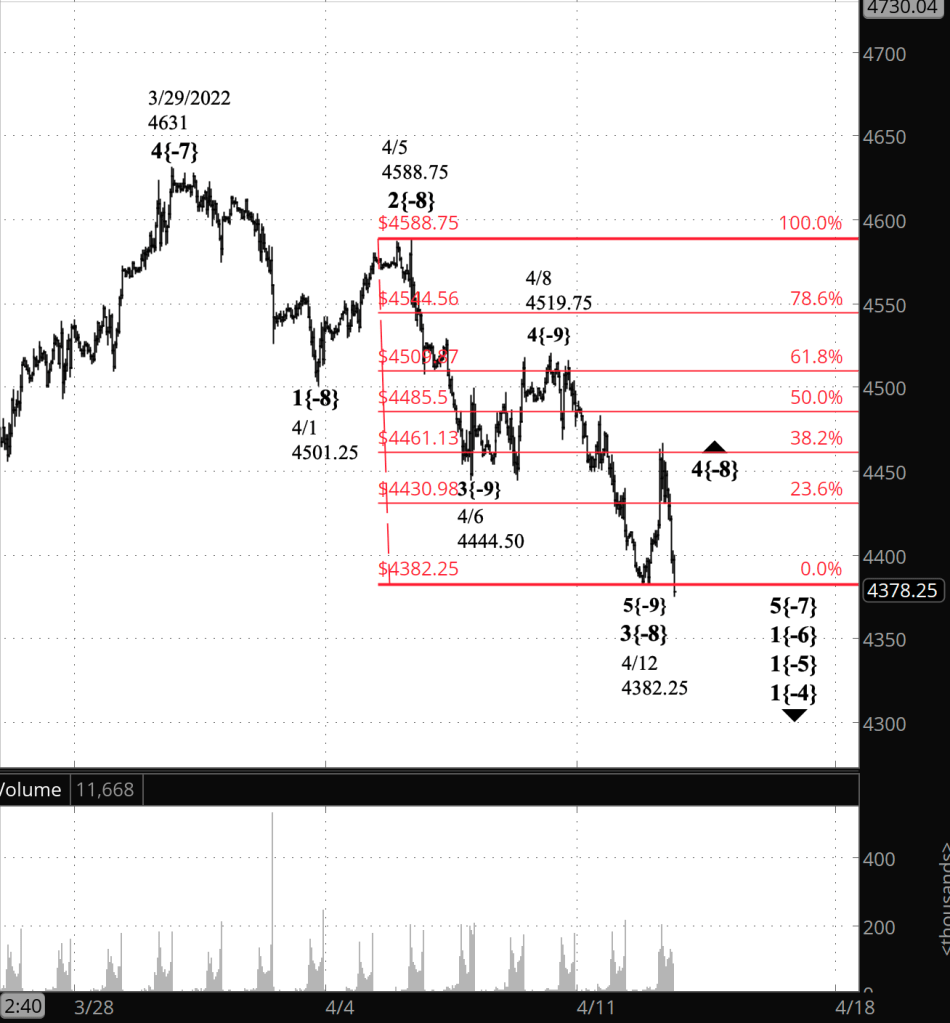
Half an hour before the closing bell. The S&P 500 rose sharply overnight, reversed shortly after the opening bell, and fell sharply to below where the rise had begun, the wave up can be counted as having five waves internally, although it’s a bit messy. And the subsequent decline counted be counted as having three waves internally, also messy. That pattern is consistent with a Zigzag correction under the principal analysis, and also with a lower-degree correction as set forth in the alternate analysis. Bottom line: I can’t choose between the two. The wave up is wave A{-9} within wave 4{-8} under the principal analysis, and the second, wave B{-9} within wave 4{-8}. For the alternative analysis, push the degrees down by one — A{-11} and B{-11} within wave 4{-10} within wave 5{-9}.

I’ve updated the chart.

1:20 p.m. New York time

JPM earnings play entry. I’ve entered a short bear call options spread on JPM, 38 days before expiration, and have posted an analysis of the trade.

1 p.m. New York time

SPY options position exit. I’ve exited my short bear call options spread on SPY, two days before expiration, for a loss and have posted details of the outcome in the trade analysis.

9:35 a.m. New York time

What’s happening now? The S&P 500 E-mini futures fell to 4382.25 in overnight trading and then reversed, swiftly retracing 38% of the week-long downtrend that began on April 5.

What does it mean? The overnight low was the end of the downtrend and an upward correction has begun.

What’s the alternative? It’s possible, just barely, that the rise is a smaller correction within a continuing downtrend. Given the power of the rise, I don’t buy this alternative, but I can’t rule it out entirely.

[S&P 500 E-mini futures at 3:30 p.m., 40-minute bars, with volume]

What does Elliott wave theory say? The overnight low marked the end of wave 3{-8}, which began on April 5 from 4588.75, and the beginning of an upward correction, wave 4{-8}. Fourth waves usually end within the range of the 4th subwave within the preceding 3rd wave. In this case, that’s wave 4{-9}, which ran from 4444.30 to 4519.75.

The price, which reached a high of 4462.75 before the opening bell, is already within that range, having retraced 38.2% of the wave 3{-8} decline and paused. That’s a Fibonacci retracement level, a place where pauses often happen during corrections. I’ve placed a Fibonacci retracement ladder on the chart, in red, to better track the levels of retracement.

If wave 4{-8} takes the form of a Flat or a Zigzag, then it will have three internal waves. If it’s a Flat, then waves A and B will each have three subwaves and wave C will have five. If it’s a Zigzag, then waves A and C will each have five subwaves, and wave B will have three.

All of this is happening within downtrending wave 5{-7}, which began on March 29 from 4631, and its parent wave, 1{-6}, which began on January 4 from 4808.25.

Wave 4{-8} will be followed by wave 5{-8}, a resumption of the wave 5{-7} downtrend that began on April 29.

The alternative analysis sees wave 3{-8} continuing its decline and the overnight rise as being an upward correction within the wave 5{-9} child wave of wave 3{-8}.

We Are Here.

These are the waves currently in progress under my principal analysis. Each line on the list shows the wave number, with the subscript in curly brackets, the traditional degree name, the starting date, the starting price of the S&P 500 E-mini futures, and the direction of the wave.

  • Index:
  • 5{0} Intermediate, 12/26/2018, 2346.58 (up)
  • 4{-1} Minor, 1/4/2022 4818.62 (down)
  • 1{-2} Minute, 1/4/2022 4818.62 (down)
  • Futures and index:
  • 1{-3} Minuette, 1/4/2022, 4808.25 (down) (futures), 4818.62 (down) (index)
  • Futures:
  • 1{-4} Subminuette, 1/4/2022, 4808.25 (down)
  • 1{-5} Micro, 1/4/2022, 4808.25 (down)
  • 1{-6} Submicro, 1/4/2022, 4808.25 (down)
  • 5{-7} Minuscule, 3/29/2022, 4631 (down)
  • 4{-8} Subminuscule, 4/12/2022, 4382.25 (up)

Learning and other resources. Elliott wave analysis provides context, not prophecy. As the 20th century semanticist Alfred Korzybski put it in his book Science and Sanity (1933), “The map is not the territory … The only usefulness of a map depends on similarity of structure between the empirical world and the map.” And I would add, in the ever-changing markets, we can judge that similarity of structure only after the fact.

See the menu page Analytical Methods for a rundown on where to go for information on Elliott wave analysis.

By Tim Bovee, Portland, Oregon, April 12, 2022

Disclaimer

Tim Bovee, Private Trader tracks the analysis and trades of a private trader for his own accounts. Nothing in this blog constitutes a recommendation to buy or sell stocks, options or any other financial instrument. The only purpose of this blog is to provide education and entertainment.

No trader is ever 100 percent successful in his or her trades. Trading in the stock and option markets is risky and uncertain. Each trader must make trading decisions for his or her own account, and take responsibility for the consequences.

License
Creative Commons License

All content on Tim Bovee, Private Trader by Timothy K. Bovee is licensed under a Creative Commons Attribution-ShareAlike 4.0 International License.

Based on a work at www.timbovee.com.
Trader’s Notebook

3:30 p.m. New York time

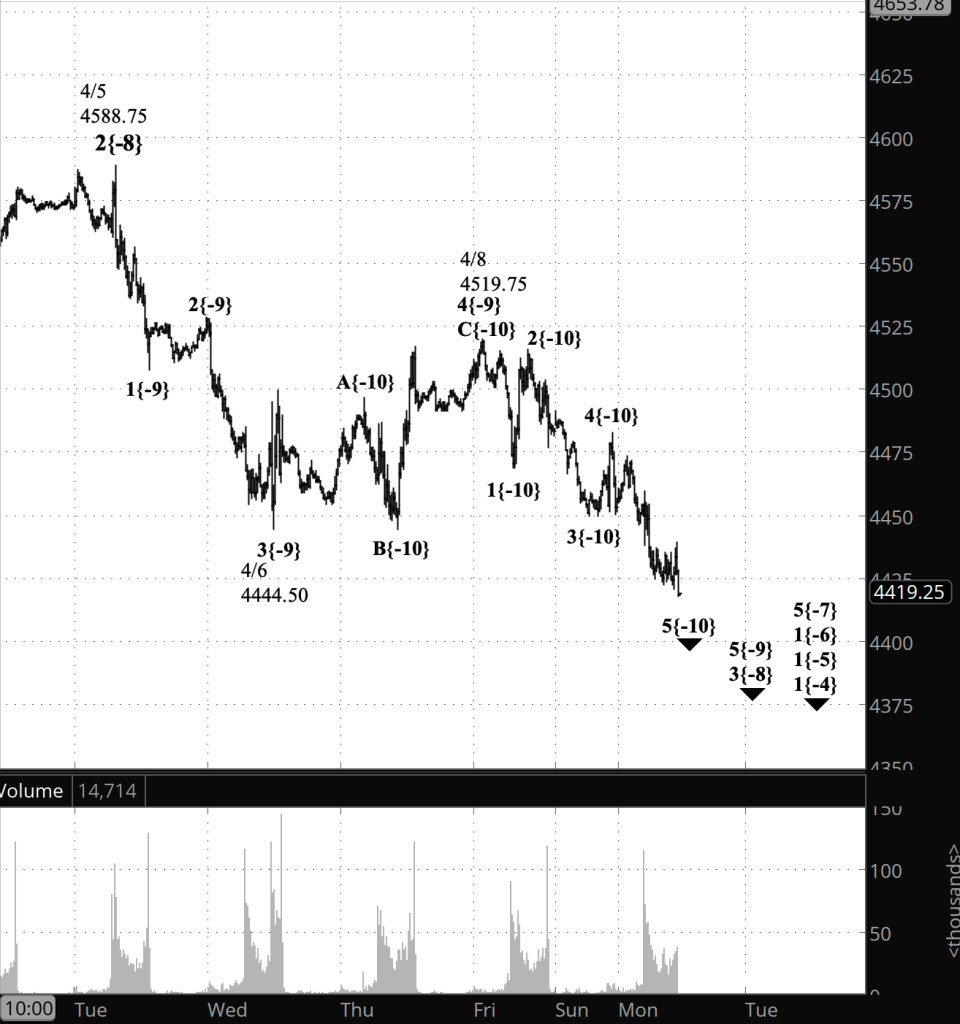
Half an hour before the closing bell. The S&P 500 E-mini futures continued to fall during the session, reaching below 4420 in the late afternoon.

The decline below 4444.50, the end of wave 3{-9} on April 6, confirms this morning’s principal analysis, that the upward correction, wave 4{-9} ended on April 8, and wave 5{-9} is now underway.

I’ve updated the chart.

9:35 a.m. New York time

What’s happening now? The S&P 500 E-mini futures opened at 4488.75 when trading began anew Sunday evening and immediately resumed the decline that began on Friday, reaching 4446.25 as the opening bell approached.

What does it mean? The power and form of the decline suggest that the downtrend that began on April 5 has resumed. That scenario will be confirmed if the price moves below 4444.50, the end of the middle leg of the decline and the beginning of the upward correction at ended on April 8 at 4519.75.

What’s the alternative? The decline can also be seen as connecting two corrective patterns in a compound structure. This interpretation will gain credibility if the price reverses significantly to the upside.

[S&P 500 E-mini futures at 3:30 p.m., 15-minute bars, with volume]

What does Elliott wave theory say? Under the principal analysis, the April 5 peak ended wave 4{-9}, an upward correction within wave 3{-8}, the middle wave of a downtrend that began on March 29. The final wave of the downtrend, wave 5{-9}, began on April 5 and internally appears to have completed four waves and to have begun its final wave.

Wave 5{-9}, when complete, will also mark the end of wave 3{-8}. It will be followed by an upward correction, wave 4{-8}. It will retrace a significant portion of the decline, wave 5{-7}, that began on March 29 from 4631. And after the correction, wave 5{-8} will carry the price below 4101.75, the end point of wave 3{-7}.

With so many endings ahead, the S&P 500 will feel like a roller coaster ride for awhile. One thing I shall keep in mind as I do my analysis is that the major trend is down, a decline that began on January 4 from 4808.25.

Under the alternative scenario, the April 5 peak marked the end of wave C{-10}, but the parent, wave 4{-9}, is still underway in a compound correction. In a compound correction two or three corrective patterns are strung together, each separated by an X-wave. So in the first upward corrective pattern — wave A, B and C, or up-down-up — is followed by a downward X-wave with three waves internally, and then by a second corrective pattern of three waves if its a Flat or a Zigzag, the most common corrective patterns.

We Are Here.

These are the waves currently in progress under my principal analysis. Each line on the list shows the wave number, with the subscript in curly brackets, the traditional degree name, the starting date, the starting price of the S&P 500 E-mini futures, and the direction of the wave.

  • Index:
  • 5{0} Intermediate, 12/26/2018, 2346.58 (up)
  • 4{-1} Minor, 1/4/2022 4818.62 (down)
  • 1{-2} Minute, 1/4/2022 4818.62 (down)
  • Futures and index:
  • 1{-3} Minuette, 1/4/2022, 4808.25 (down) (futures), 4818.62 (down) (index)
  • Futures:
  • 1{-4} Subminuette, 1/4/2022, 4808.25 (down)
  • 1{-5} Micro, 1/4/2022, 4808.25 (down)
  • 1{-6} Submicro, 1/4/2022, 4808.25 (down)
  • 5{-7} Minuscule, 3/31/2022, 4631 (down)
  • 3{-8} Subminuscule, 4/5/2022, 4588.75 (down)

Learning and other resources. Elliott wave analysis provides context, not prophecy. As the 20th century semanticist Alfred Korzybski put it in his book Science and Sanity (1933), “The map is not the territory … The only usefulness of a map depends on similarity of structure between the empirical world and the map.” And I would add, in the ever-changing markets, we can judge that similarity of structure only after the fact.

See the menu page Analytical Methods for a rundown on where to go for information on Elliott wave analysis.

By Tim Bovee, Portland, Oregon, April 11, 2022

Disclaimer

Tim Bovee, Private Trader tracks the analysis and trades of a private trader for his own accounts. Nothing in this blog constitutes a recommendation to buy or sell stocks, options or any other financial instrument. The only purpose of this blog is to provide education and entertainment.

No trader is ever 100 percent successful in his or her trades. Trading in the stock and option markets is risky and uncertain. Each trader must make trading decisions for his or her own account, and take responsibility for the consequences.

License
Creative Commons License

All content on Tim Bovee, Private Trader by Timothy K. Bovee is licensed under a Creative Commons Attribution-ShareAlike 4.0 International License.

Based on a work at www.timbovee.com.
Trader’s Notebook

3:30 p.m. New York time

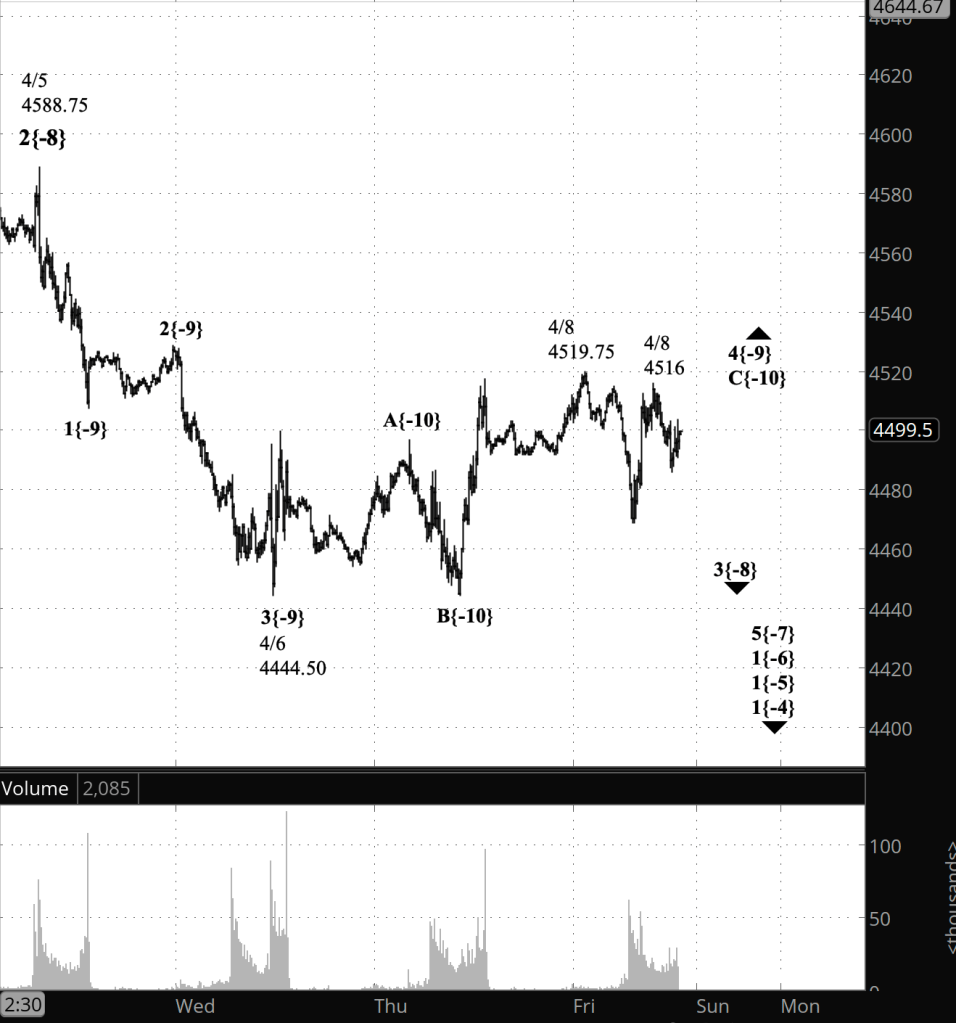
Half an hour before the closing bell. The S&P 500 rose into mid-session and then reversed at 4516, about 4 points short of the overnight high. It declined to 4486, and then reversed to the upside, half-heartedly. No change in the analysis. Wave C{-10} within the upward correction, wave 4{-9}, is still underway. I’ve updated the chart.

9:35 a.m. New York time

What’s happening now? The S&P 500 E-mini futures reached a high of 4519.75 in overnight trading and then reversed to the downside, falling by more than 25 points by the opening bell.

What does it mean? The upward correction that began on April 6 is still underway and the overnight reversal was but a stopping point in its continuing rise.

What’s the alternative? The upward correction ended with the overnight high, and the downtrend that began on April 5 has resumed. I consider the principal analysis and this alternative to be of equal likelihood at this point.

[S&P 500 E-mini futures at 3:30 p.m., 10-minute bars, with volume]

What does Elliott wave theory say? As the baseball great Yogi Berra said in 1973, “The game ain’t over until it’s over.” And the difficulty with Elliott wave analysis is that, unlike baseball, it’s impossible at times to figure out when a game — a wave — has truly ended. That was the problem encountered in yesterday’s analysis, and the problem persists today.

Under my principal analysis, the wave 4{-9} upward correction continues and the wave 5{-9} decline has not yet begun.

Or, alternatively, wave 4{-9} ended overnight at 4519.75 and wave 5{-9} has begun.

The question depends upon wave C{-10}, the final internal wave of the three-wave corrective pattern that began on April 6. Whether the pattern is a Zigzag or a Flat, the final wave C wave will have five waves internally. I count three waves. So despite the sharp drop, I consider wave C{-10} to not yet be over.

However, waves that are quick and short enough may not be visible at a certain level of granularity on the chart. Today’s chart has 10-minute bars, and those additional two waves may too small to see. On this chart, with 5-minute bars, there’s a slight downward slip in the final rise to the overnight high that could, with some imagination, be considered an internal wave that fills out the count. It doesn’t seem likely to me, but it’s not an impossible scenario.

If the price reverses and moves above 4519.75, then the principal analysis will be confirmed. The further the price falls, the more likely the alternative is, and a decline below 4444.50, the April 6 start of the correction, would confirm the alternative.

This is all happening within wave 3{-8} to the downside, which began on April 5 from 4588.75.

We Are Here.

These are the waves currently in progress under my principal analysis. Each line on the list shows the wave number, with the subscript in curly brackets, the traditional degree name, the starting date, the starting price of the S&P 500 E-mini futures, and the direction of the wave.

  • Index:
  • 5{0} Intermediate, 12/26/2018, 2346.58 (up)
  • 4{-1} Minor, 1/4/2022 4818.62 (down)
  • 1{-2} Minute, 1/4/2022 4818.62 (down)
  • Futures and index:
  • 1{-3} Minuette, 1/4/2022, 4808.25 (down) (futures), 4818.62 (down) (index)
  • Futures:
  • 1{-4} Subminuette, 1/4/2022, 4808.25 (down)
  • 1{-5} Micro, 1/4/2022, 4808.25 (down)
  • 1{-6} Submicro, 1/4/2022, 4808.25 (down)
  • 5{-7} Minuscule, 3/31/2022, 4631 (down)
  • 3{-8} Subminuscule, 4/5/2022, 4588.75 (down)

Learning and other resources. Elliott wave analysis provides context, not prophecy. As the 20th century semanticist Alfred Korzybski put it in his book Science and Sanity (1933), “The map is not the territory … The only usefulness of a map depends on similarity of structure between the empirical world and the map.” And I would add, in the ever-changing markets, we can judge that similarity of structure only after the fact.

See the menu page Analytical Methods for a rundown on where to go for information on Elliott wave analysis.

By Tim Bovee, Portland, Oregon, April 8, 2022

Disclaimer

Tim Bovee, Private Trader tracks the analysis and trades of a private trader for his own accounts. Nothing in this blog constitutes a recommendation to buy or sell stocks, options or any other financial instrument. The only purpose of this blog is to provide education and entertainment.

No trader is ever 100 percent successful in his or her trades. Trading in the stock and option markets is risky and uncertain. Each trader must make trading decisions for his or her own account, and take responsibility for the consequences.

License
Creative Commons License

All content on Tim Bovee, Private Trader by Timothy K. Bovee is licensed under a Creative Commons Attribution-ShareAlike 4.0 International License.

Based on a work at www.timbovee.com.

Trader’s Notebook

3:30 p.m. New York time

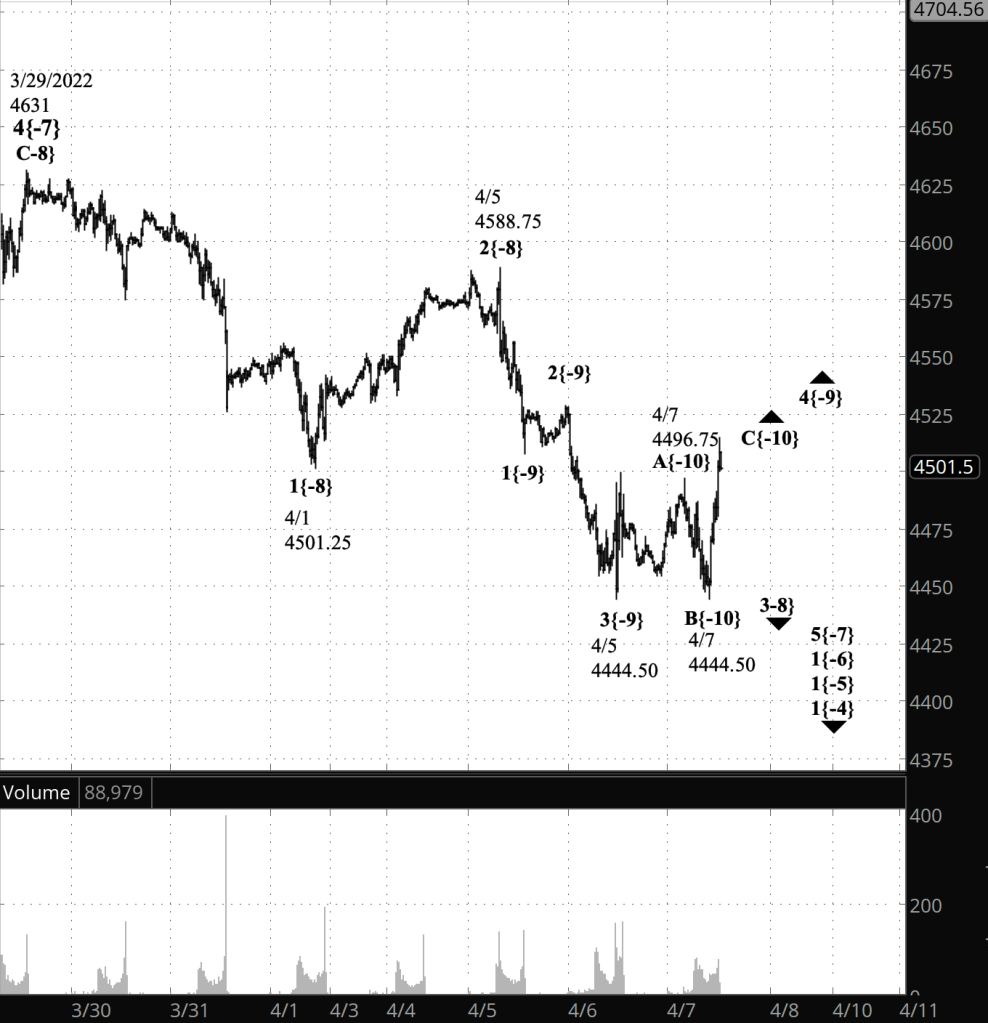
Half an hour before the closing bell. Once again the alternative analysis wins out. The price of the S&P 500 futures dropped to the level where the upward correction, wave 4{-9} began, but it didn’t below the level. Instead, it reversed and went above the high set in overnight trading, 4496.75.

Under the now discredited principal analysis, that would mean wave 4 went beyond the beginning of wave 1. That’s not allowed by a rule of Elliott wave analysis. Moving beyond that point isn’t a problem if its a C wave within a correction.

What it means in this: Wave 4{-9} is still underway, the 4496.75 high attained overnight is the end of wave A{-10} within the correction, the declined that followed was wave B{-10}, and the rise that is still underway is wave C{-10}.

Bottom line: The upward correction, wave 4{-9}, is still underway. The end of wave C{-10} will either be the end of wave 4{-9} and the beginning of a resumption of the downtrend, wave 5{-9}, or it will be followed by a connecting decline, wave X{-10}, which will be followed by a second corrective pattern within wave 4{-9}. I’ve retained this morning’s chart below and have added a new chart.

[S&P 500 E-mini futures at 3:30 p.m., 20-minute bars, with volume]

9:35 a.m. New York time

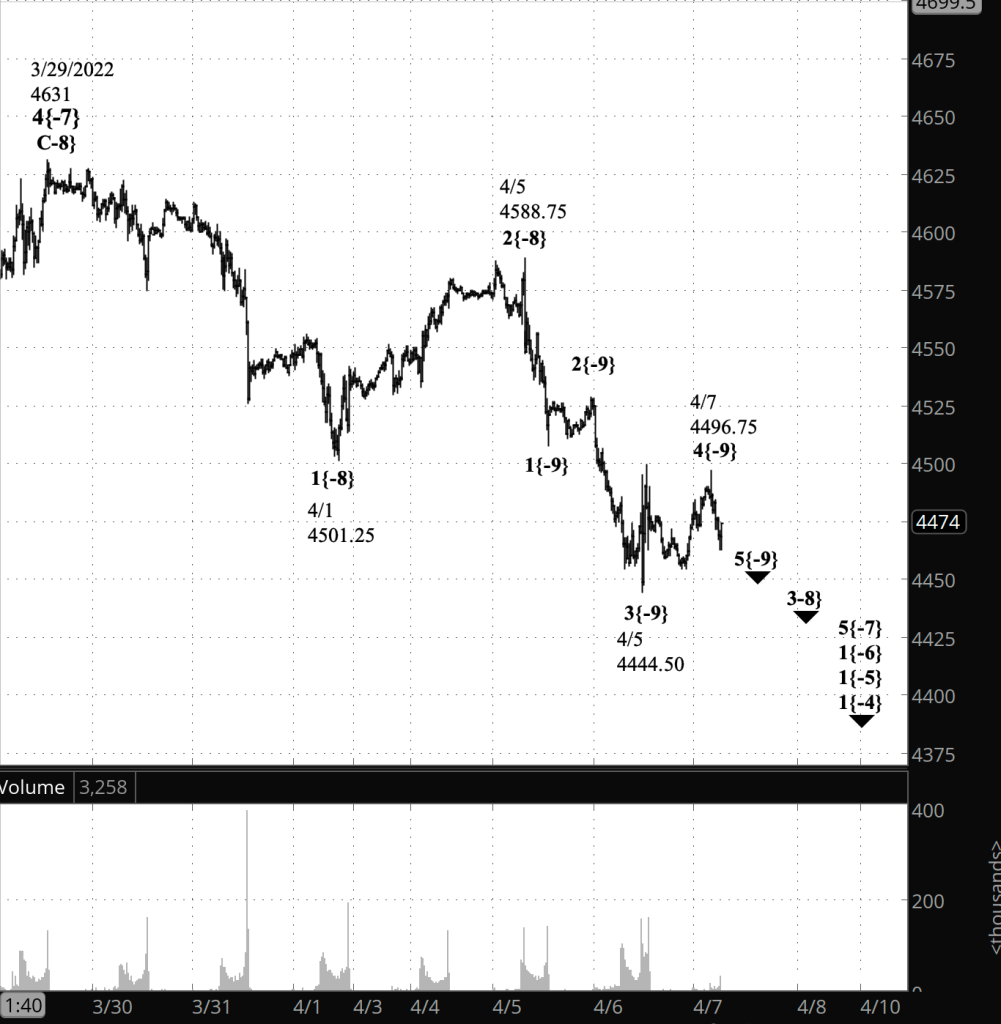
What’s happening now? The S&P 500 E-mini futures rose in overnight trading to 4496.75 and then reversed.

What does it mean? The overnight high completed an upward correction within a larger downtrend, which has resumed and will carry the price below the starting point of the correction, 4444.50 on April 5, and perhaps below the February 24 low of 4101.25.

What’s the alternative? The overnight high could be part of a subwave within the correction, which, under this scenario, would still be underway.

Note from later. This chart shows the morning’s principal analysis, which was disproven by the market movement during the session. For a new chart, based on this morning’s alternative analysis and this afternoon’s chart reality, see the “Half an hour before the closing bell” section above.

[S&P 500 E-mini futures at 9:35 a.m., 20-minute bars, with volume]

What does Elliott wave theory say? Under the principal analysis, wave 5{-9} within wave 3{-8} began from the overnight peak, 4496.50, and will carry the price below the start of the correction, wave 4{-9}, and perhaps below the end of wave 3{-7}, at 4101.75.

Under the alternative analysis, the upward correction, wave 4{-9} is still underway, and the overnight peak is part of wave C{-10} within the correction. Under this scenario wave C{-10} will likely remain above the the beginning of wave 4{-9}, at 4444.50, and will rise again, surpassing the overnight high, 4496.50.

Under both analyses, all of this is happening within downtrending wave 5{-7}, which began on March 31 from 4631.

We Are Here.

These are the waves currently in progress under my principal analysis. Each line on the list shows the wave number, with the subscript in curly brackets, the traditional degree name, the starting date, the starting price of the S&P 500 E-mini futures, and the direction of the wave.

  • Index:
  • 5{0} Intermediate, 12/26/2018, 2346.58 (up)
  • 4{-1} Minor, 1/4/2022 4818.62 (down)
  • 1{-2} Minute, 1/4/2022 4818.62 (down)
  • Futures and index:
  • 1{-3} Minuette, 1/4/2022, 4808.25 (down) (futures), 4818.62 (down) (index)
  • Futures:
  • 1{-4} Subminuette, 1/4/2022, 4808.25 (down)
  • 1{-5} Micro, 1/4/2022, 4808.25 (down)
  • 1{-6} Submicro, 1/4/2022, 4808.25 (down)
  • 5{-7} Minuscule, 3/31/2022, 4631 (down)
  • 3{-8} Subminuscule, 4/5/2022, 4588.75 (down)

Learning and other resources. Elliott wave analysis provides context, not prophecy. As the 20th century semanticist Alfred Korzybski put it in his book Science and Sanity (1933), “The map is not the territory … The only usefulness of a map depends on similarity of structure between the empirical world and the map.” And I would add, in the ever-changing markets, we can judge that similarity of structure only after the fact.

See the menu page Analytical Methods for a rundown on where to go for information on Elliott wave analysis.

By Tim Bovee, Portland, Oregon, April 7, 2022

Disclaimer

Tim Bovee, Private Trader tracks the analysis and trades of a private trader for his own accounts. Nothing in this blog constitutes a recommendation to buy or sell stocks, options or any other financial instrument. The only purpose of this blog is to provide education and entertainment.

No trader is ever 100 percent successful in his or her trades. Trading in the stock and option markets is risky and uncertain. Each trader must make trading decisions for his or her own account, and take responsibility for the consequences.

License
Creative Commons License

All content on Tim Bovee, Private Trader by Timothy K. Bovee is licensed under a Creative Commons Attribution-ShareAlike 4.0 International License.

Based on a work at www.timbovee.com.

LW Trade

Lamb Weston Holdings Inc. (LW)

Lot 2022-2

Update 4/29/2022: I exited my short bear call vertical spread on LW, 50 days before expiration, for a $6.80 debit per contract/share, a loss before fees of $4.48 per contract. Shares were trading at $67.92, up $7.97 from the entry level.

The Implied Volatility Rank at exit was 31.3%, down 8.6 points from the entry level.

I exited because the position reached 21 days before expiration, my normal day for managing trades. The position showed no signs of becoming profitable, and as an added incentive, the stock is scheduled no go ex-dividend on May 5 and would almost certainly have been assigned.

Shares rose by 13.4% over 23 days for a +212% annual rate. The options position produced a 65.9% loss for a -1,046% annual rate.


I have entered a short bear call options spread on LW, using options that trade for the last time 44 days hence, on May 20. The premium is a $2.32 credit per contract share and the stock at the time of entry was priced at $59.65.

The Implied Volatility Ratio stood at 39.9%.

Premium:$2.32Expire OTM
LW-bear call spreadStrikeOddsDelta
Calls
Long70.0092.0%12
Break-even62.3273.5%31.5
Short60.0055.0%51

The premium is 46.4% of the width of the position’s short/long spread. The profit zone covers a 4.5% move to the upside and an unlimited move to the downside.

The risk/reward ratio is 3.3:1, with maximum risk of $768 and maximum reward of $232 per contract.

How I chose the trade. The trade was placed to coincide with LW’s earnings announcement, before the opening bell on the day after entry. The short strikes was set to coincide with the expected move of $1.98 either way, based on options pricing, which gives a price range of $57.65 to $61.61.

By Tim Bovee, Portland, Oregon, April 6, 2022

Disclaimer

Tim Bovee, Private Trader tracks the analysis and trades of a private trader for his own accounts. Nothing in this blog constitutes a recommendation to buy or sell stocks, options or any other financial instrument. The only purpose of this blog is to provide education and entertainment.

No trader is ever 100 percent successful in his or her trades. Trading in the stock and option markets is risky and uncertain. Each trader must make trading decisions for his or her own account, and take responsibility for the consequences.

License
Creative Commons License

All content on Tim Bovee, Private Trader by Timothy K. Bovee is licensed under a Creative Commons Attribution-ShareAlike 4.0 International License.

Based on a work at www.timbovee.com.