Update 3/18/2022: I exited my bull put vertical options spread on FDX, 63 days before expiration, for a $3.10 debit per contract/share, a loss before fees of $67 per contract. Shares were trading at $217.67, down $9.68 from the entry level.
The Implied Volatility Rank at exit was 44.5%, down 22.9 points from the entry level.
When trading resumed after the earnings announcement, the stock opened $8.52 below the previous day’s close. putting the options at 41% of the maximum potential loss, and quickly fell further. The decline was within the expected movement based on options prices before the announcement.
Shares rose declined by 4.3% over one day for a -1,554% annual rate. The options position produced a 21.6% loss for a -7,889% annual rate.
I have entered a short bull put vertical spread on FDX, using options that trade for the last time 64 days hence, on May 20. The premium is a $2.43 credit per contract share and the stock at the time of entry was priced at $227.35.
The Implied Volatility Ratio stood at 67.4%.
Premium:
$2.43
Expire OTM
FDX-bull put spread
Strike
Odds
Delta
Calls/Puts
Long
200.00
73.0%
21
Break-even
212.43
69.0%
25
Short
210.00
65.0%
29
The premium is 48.6% of the width of the position’s short/long spread. The profit zone covers a 6.6% move to the downside and an unlimited move to the upside.
The risk/reward ratio is 3.1:1, with maximum risk of $757 and maximum reward of $243 per contract.
How I chose the trade. The trade was placed to coincide with FDX’s earnings announcement, after the closing bell on the day of entry. The short strikes were set to coincide with the expected move of $10.54 either way, based on options pricing, which gives a price range of $217.01 to $238.09. The strike prices are $10 apart, which required that the short put strike be a bit lower than usual in order to stay beyond the range suggested by the options pricing.
By Tim Bovee, Portland, Oregon, March 17, 2022
Disclaimer
Tim Bovee, Private Trader tracks the analysis and trades of a private trader for his own accounts. Nothing in this blog constitutes a recommendation to buy or sell stocks, options or any other financial instrument. The only purpose of this blog is to provide education and entertainment.
No trader is ever 100 percent successful in his or her trades. Trading in the stock and option markets is risky and uncertain. Each trader must make trading decisions for his or her own account, and take responsibility for the consequences.
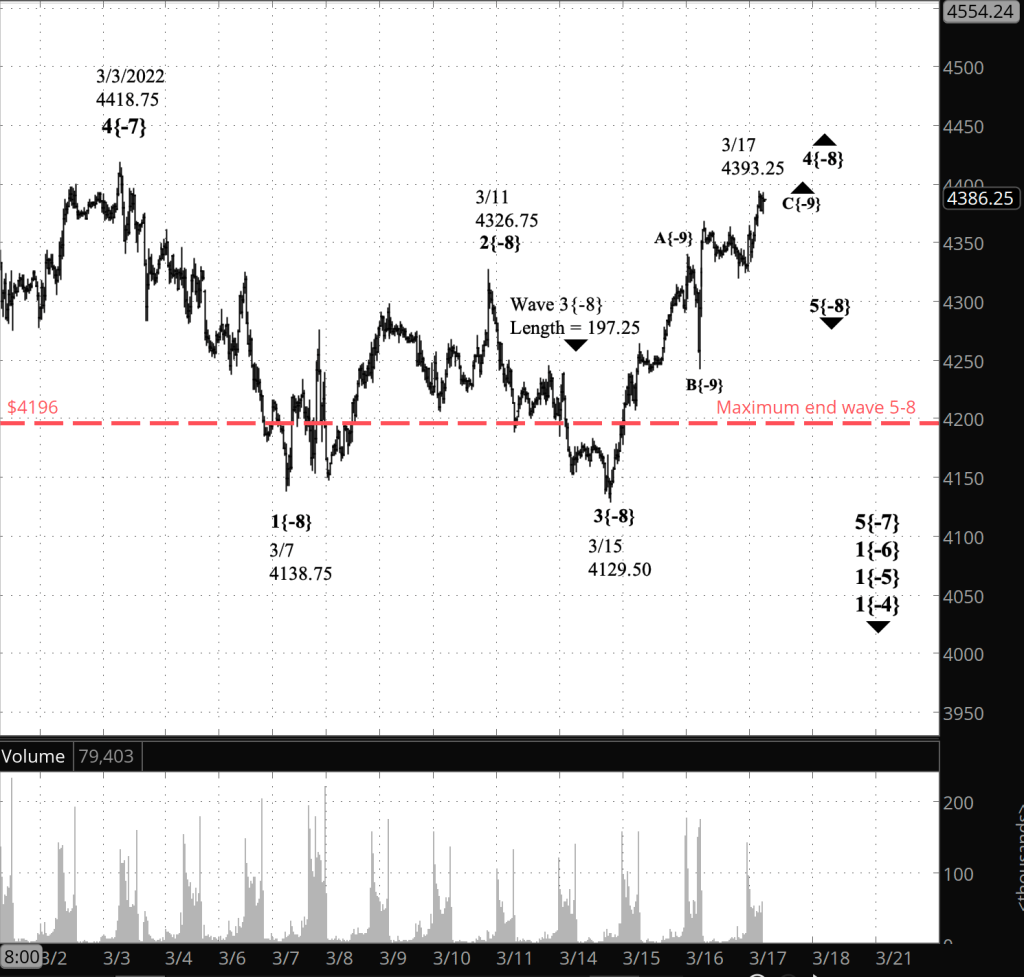
Half an hour before the closing bell. The S&P 500 continued to rise during the day, so far reaching 4393.25. The principal analysis from this morning — wave 4{-8) has ended — has been replaced by the alternative analysis — wave 4{-8} is continuing — and the chart reflects that change.
Wave 4{-8} can end at any turning point, including the most recent high. It has fulfilled its minimum requirements under the Elliott wave model.
The new high for wave 4{-8} also raises the lowest end point for the futures wave 5{-8}, for reasons explained in this morning’s Elliott wave analysis section. The new maximum end point is 4196. I’ve updated the chart.
1:15 p.m. New York time
FDX earnings play entry. I’ve entered a short bull put options spread on FDX timed to coincide with the company’s earnings announcement after the closing bell and have posted an analysis of the trade.
9:35 a.m. New York time
What’s happening now? The S&P 500 E-mini futures fell back slightly from yesterday’s peak, 4367.50.
What does it mean? The peak may be the end of the upward correction that began on March 15 and the beginning of a resumption of the downtrend that began on March 3.
lWhat’s the alternative? But it’s just as likely that the final leg of the correction will rise further and that the downtrend has not yet resumed.
[S&P 500 E-mini futures at 3:30 p.m., 30-minute bars, with volume]
What does Elliott wave theory say? The present rise is wave C{-9}, the final wave in an upward correction, wave 4{-8}. The end of 4{-8} marks the beginning of downtrending wave 5{-8}.
As discussed in the afternoon revision in yesterday’s post, wave 5{-8} has limited downward potential. Wave 3 is shorter than wave 1. Under the rules of Elliott wave analysis, wave 3 can’t be shorter than both waves 1 and 5. So wave 5{-8} can’t be longer than wave 3{-8}, which was 197.25 points long.
The new higher starting point for wave 5{-9} means that its ending point can’t be lower than 4170.25, marked with a red line on the chart.
I’ve marked the chart as though wave C{-9} were complete — the principal analysis — but I consider both the principal and the alternative analyses to have equal likelihood. There may be revisions ahead during the trading session.
We Are Here.
These are the waves currently in progress under my principal analysis. Each line on the list shows the wave number, with the subscript in curly brackets, the traditional degree name, the starting date, the starting price of the S&P 500 E-mini futures, and the direction of the wave.
Learning and other resources. Elliott wave analysis provides context, not prophecy. As the 20th century semanticist Alfred Korzybski put it in his book Science and Sanity (1933), “The map is not the territory … The only usefulness of a map depends on similarity of structure between the empirical world and the map.” And I would add, in the ever-changing markets, we can judge that similarity of structure only after the fact.
See the menu page Analytical Methods for a rundown on where to go for information on Elliott wave analysis.
By Tim Bovee, Portland, Oregon, March 17, 2022
Disclaimer
Tim Bovee, Private Trader tracks the analysis and trades of a private trader for his own accounts. Nothing in this blog constitutes a recommendation to buy or sell stocks, options or any other financial instrument. The only purpose of this blog is to provide education and entertainment.
No trader is ever 100 percent successful in his or her trades. Trading in the stock and option markets is risky and uncertain. Each trader must make trading decisions for his or her own account, and take responsibility for the consequences.
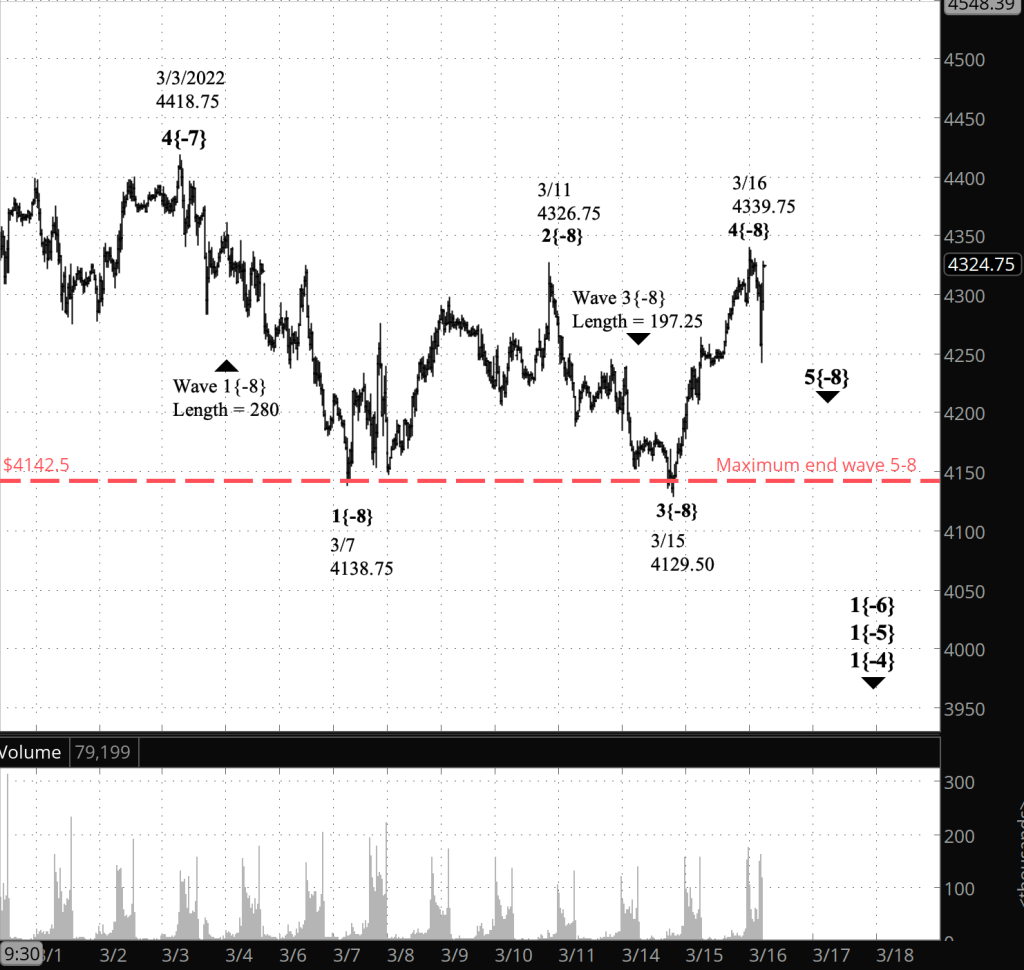
Half an hour before the closing bell. The S&P 500 has continued to decline from this morning peak, 4339.75 on the futures. The analysis is unchanged from the revisions posted at 2:45 p.m., below. I’ve updated the upper, close-up chart.
2:45 p.m. New York time
A new analysis. A close-up look at the chart following the Federal Open Market Committee’s statement requires an update to my principal analysis.
As I wrote this morning, the rise from the March 15 low is an upward correction, wave 4{-8}. Internally, it has three waves, as expected of a correction. It ended today at 4339.75, an hour before the Fed statement, and then began to decline as wave 5{-8}. Under this scenario, the middle wave, 3{-8}, is shorter than the preceding 1st wave.
The rules of Elliott wave analysis say that a 3rd wave can’t be shorter than both waves 1 and 5. So, the brevity of wave 3{-8} sets a lower boundary on the ensuing wave 5{-8}, to ensure that the 5th wave is no longer than the 3rd. Wave 3{-8} was 197.25 points long on the S&P 500 futures. Therefore, wave 5{-8} can move no lower than 4142.50, 13 points above the end of the preceding 1st wave. Such a condition is called a truncated 5th wave.
The revised alternative analysis labels today’s peak, 4339.75, as the end of wave A{-9} within wave 4{-8} — the upward correction — and the subsequent decline is wave B{-9}. A 4th wave cannot move beyond the end of the preceding wave 1, which is 4138.75. If wave B{-9} within wave 4{-8} moves below that level, then the count will need to be revised.
If the price within wave 5{-8} moves below 4142.50, then the count will be revised to place the end of wave 2{-8} at today’s high, 4339.75, and the subsequent decline would be wave 3{-8} to the downside, with no restriction on how far down it can go. Honestly, I’m not certain that the lower degree counts from March 7 will support such a hypothetical 2nd wave. Wave counts have a lot of ambiguity, especially in assigning the degree, and so I suspect it might be possible to find a count to fit the chart.
[S&P 500 E-mini futures at 3:30 p.m., 30-minute bar, with volume]
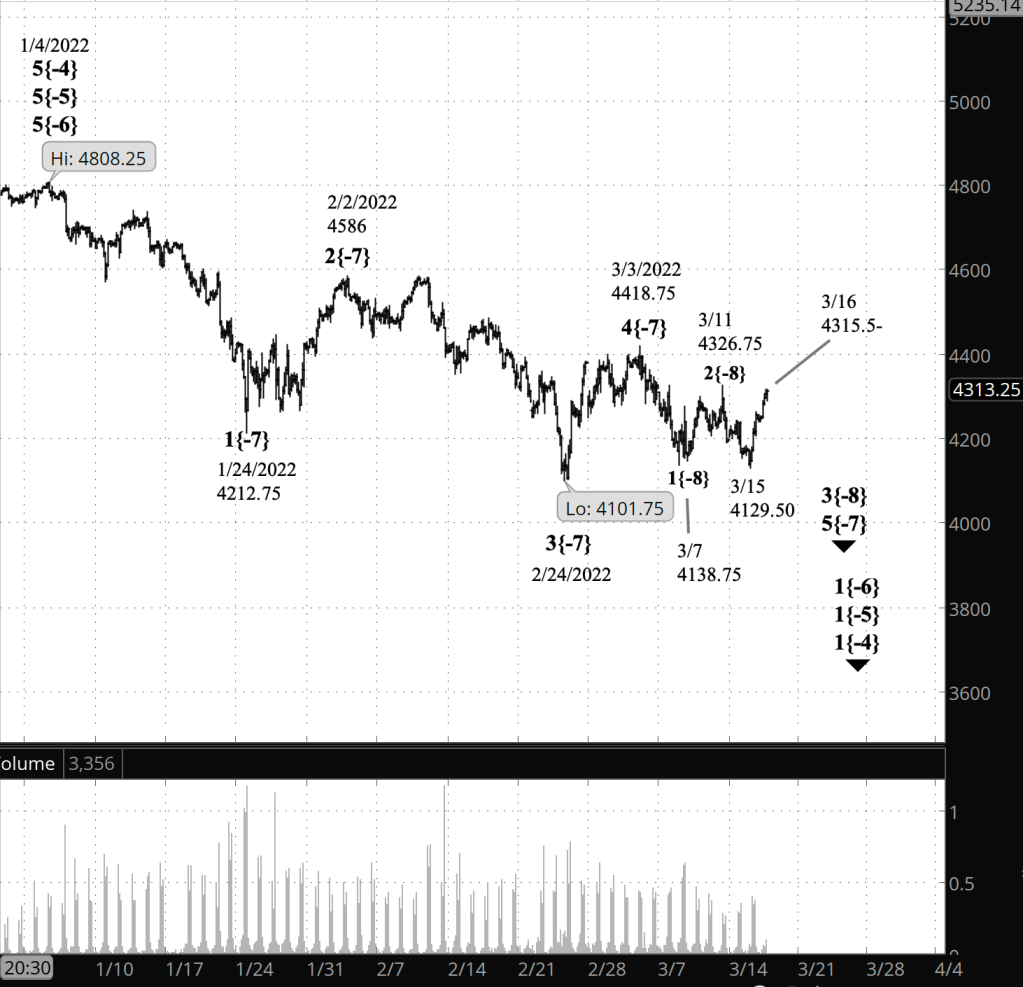
Charts. I’ve added a new upper chart, with close-up view. I’ve retained the lower chart from this morning’s analysis.
10 a.m. New York time
HAL earnings play exit. I’m continuing to close out my losing positions built from options that expire on Friday, March 18. Today I exited the puts on a short iron condor on HAL and expect the out-of-the-money calls to expire without a debit. I’ve updated the trade analysis with the puts results and a best-case scenario for the full position.
9:40 a.m. New York time
What’s happening now? The S&P 500 E-mini futures rose sharply in overnight trading to 4315.50, coming to within 11 points of yesterday’s high.
What does it mean? The rise is a low-degree upward correction that began on March 15 within the ongoing downtrend is underway.
What’s the alternative? The larger upward correction that began March 7 is still underway. This will become more likely if the price exceeds the March 11 high, 4236.75, although even then, the principal analysis can’t be rejected.
[S&P 500 E-mini futures at 9:40 a.m., 150-minute bars, with volume]
What does Elliott wave theory say? We’ve once again entered one of those periods of great ambiguity. This one will be resolved quite swiftly, I suspect.
Under principal analysis, the rise is wave 2{-9} within an ongoing wave 3{-8}. It has retraced 98% of the preceding 1st wave. One downside of this analysis is that it produces a very small 3rd wave — 188 points — which is smaller than wave 1, and which means the future wave 5 would have to be even shorter to avoid tripping over a firm rule of Elliott — the 3rd can’t be shorter than both waves 1 and 3.
If the price rises above 4326.75, the end of wave 2{-8}, then it becomes increasingly possible that wave 2{-8}, an upward correction, is in fact still underway, with the March 11 peak being the end of wave A{-9}, the March 15 low the end of wave B{-9}, and wave C{-9} to the upside being currently underway. But it’s not a certainty. The rules of Elliott wave analysis don’t prohibit a 3rd wave from being beyond the start of preceding wave 3.
We Are Here.
These are the waves currently in progress under my principal analysis. Each line on the list shows the wave number, with the subscript in curly brackets, the traditional degree name, the starting date, the starting price of the S&P 500 E-mini futures, and the direction of the wave.
Learning and other resources. Elliott wave analysis provides context, not prophecy. As the 20th century semanticist Alfred Korzybski put it in his book Science and Sanity (1933), “The map is not the territory … The only usefulness of a map depends on similarity of structure between the empirical world and the map.” And I would add, in the ever-changing markets, we can judge that similarity of structure only after the fact.
See the menu page Analytical Methods for a rundown on where to go for information on Elliott wave analysis.
By Tim Bovee, Portland, Oregon, March 16, 2022
Disclaimer
Tim Bovee, Private Trader tracks the analysis and trades of a private trader for his own accounts. Nothing in this blog constitutes a recommendation to buy or sell stocks, options or any other financial instrument. The only purpose of this blog is to provide education and entertainment.
No trader is ever 100 percent successful in his or her trades. Trading in the stock and option markets is risky and uncertain. Each trader must make trading decisions for his or her own account, and take responsibility for the consequences.
Half an hour before the closing bell. The S&P 500 futures spent the day in a narrow range, having risen less than 125 points from the overnight low as the closing bell approached, then then retreating a little. No change in the analysis. I’ve updated the chart.
3 p.m. New York time
GM earnings play exit. I’ve exited my short bull put options spread on GM for a loss and have updated the trading analysis with results.
12:05 p.m. New York time
FB earnings play assignment and exit. My deep in the money short put options on FB, part of a bull put spread position, were assigned three days before expiration. I exited the shares resulting from assignment and also the remaining long puts, and have put it altogether as combined results in an update to the trade analysis.
9:35 a.m. New York time
What’s happening now? The S&P 500 E-mini futures declined to 4129.50 in overnight trading and then rose slightly.
What does it mean? The downtrend that began on January 4 and resumed on March 3 after an upward correction continues.
What’s the alternative? The upward correction that began on February 24 is still underway.
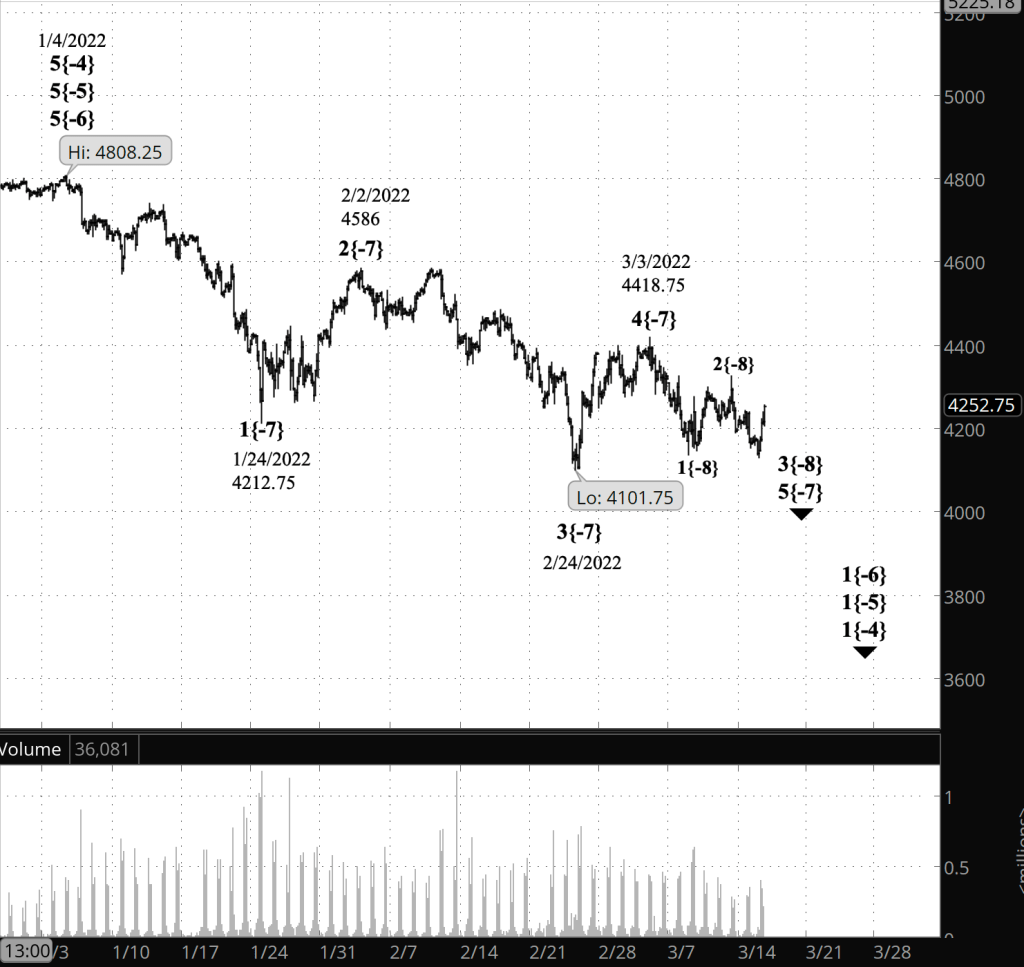
The chart. I’ve moved the view further out to show the entire downtrend that began on January 4 from 4808.25 and that continues today.
[S&P 500 E-mini futures at 3:30 p.m., 150-minute bars, with volume]
What does Elliott wave theory say? Note that I’ve moved the degrees higher since March 11 compared to Monday’s analysis.
Under my principal count the downtrend, wave 3{-8} within wave 5{-7} is underway.
Under my alternative analysis, wave 4{-7} is still underway, having retraced 91% of the preceding wave 3{-7} and is in its middle wave, B{-8}.
We Are Here.
These are the waves currently in progress under my principal analysis. Each line on the list shows the wave number, with the subscript in curly brackets, the traditional degree name, the starting date, the starting price of the S&P 500 E-mini futures, and the direction of the wave.
Learning and other resources. Elliott wave analysis provides context, not prophecy. As the 20th century semanticist Alfred Korzybski put it in his book Science and Sanity (1933), “The map is not the territory … The only usefulness of a map depends on similarity of structure between the empirical world and the map.” And I would add, in the ever-changing markets, we can judge that similarity of structure only after the fact.
See the menu page Analytical Methods for a rundown on where to go for information on Elliott wave analysis.
By Tim Bovee, Portland, Oregon, March 15, 2022
Disclaimer
Tim Bovee, Private Trader tracks the analysis and trades of a private trader for his own accounts. Nothing in this blog constitutes a recommendation to buy or sell stocks, options or any other financial instrument. The only purpose of this blog is to provide education and entertainment.
No trader is ever 100 percent successful in his or her trades. Trading in the stock and option markets is risky and uncertain. Each trader must make trading decisions for his or her own account, and take responsibility for the consequences.
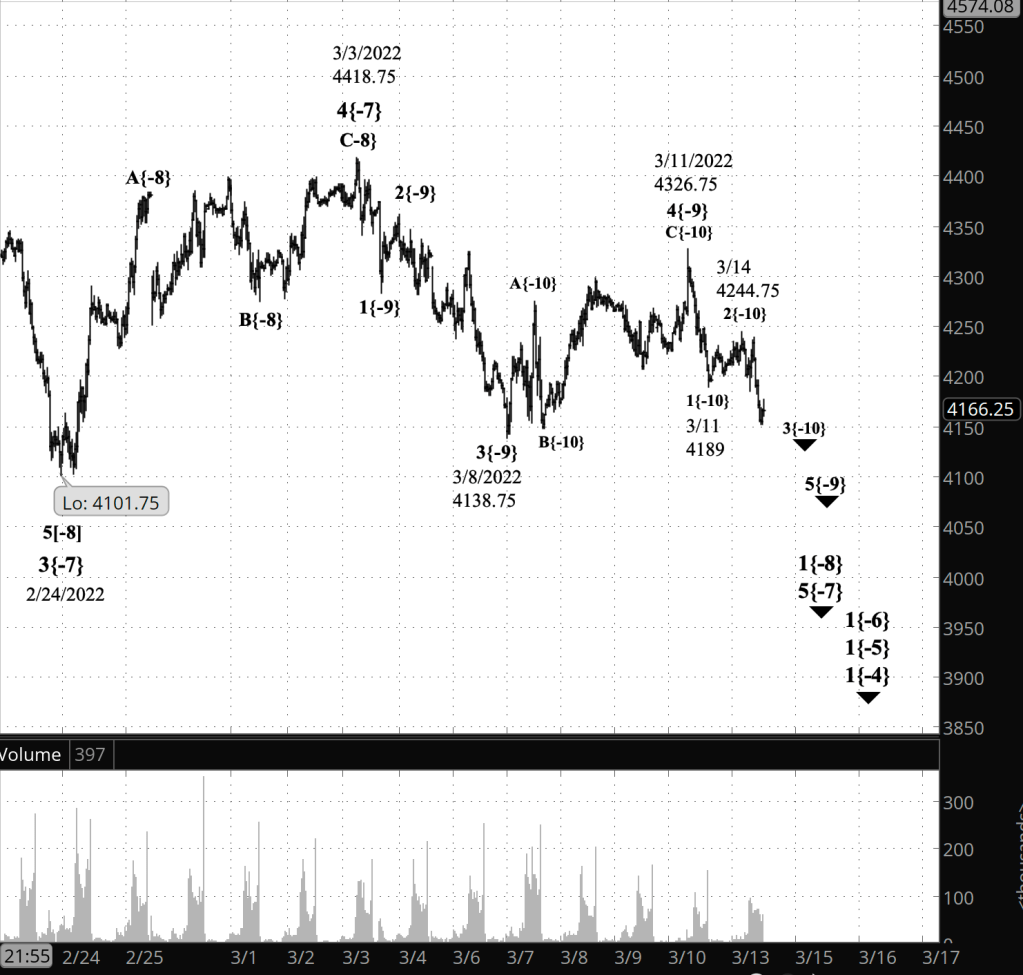
Half an hour before the closing bell. The S&P 500 futures moved below the March 11 low, 4189, reaching 4152.25 as the closing bell approached. The decline strengthened the likelihood that the upward correction ended on March 11 at 4326.75 and that the downtrend has resumed.
Under the analysis I’ve used for the chart, the upward correction was wave 4{-9}, the downtrend is now wave 3{-10} within wave 5{-9} within wave 1{-8}. A decline below 4138.25, the end of wave 3{-9} on March 8, will confirm that wave 5{-9} is underway.
The second alternative analysis, that wave 4{-9} is still underway, had an equal likelihood of being valid this morning, but the continuing decline has lessened its chances of being a valid analysis.
I’ve updated the chart, below.
9:35 a.m. New York time
What’s happening now? The S&P 500 E-mini futures stayed within a 55-point range after trading resumed overnight, remaining above the March 11 low, 4189.
What does it mean? I see two possible analyses, each having equal likelihood.
Analysis #1. The March 11 high marks the end of the upward correction that began on March 8, and the subsequent decline is a resumption of the downtrend that began on March 3. I chose to use this scenario for the chart because it is the most proportional of the analyses compared to earlier price movements of the same degree.
Analysis #2. The March 11 high is the end of an internal wave within the upward correction that began on March 8 and which is still underway. The subsequent decline is yet another internal wave within the correction. This is the scenario I used for Friday’s chart. It is less proportional than the first analysis, however, proportionality is a tendency, not a firm rule.
[S&P 500 E-mini futures at 3:30 p.m., 35-minute bars, with volume]
What does Elliott wave theory say? Under Analysis #1, the March 11 high, 4326.75, marks the end of wave C{-10} within an upward correction, wave 4{-9}. Under this scenario, wave 4{-9} ended midway between the 61.8% and the 78.6% Fibonacci retracement levels, which puts it within the range of the 4th subwave within the preceding wave 3, the usual end point for 4th waves that have taken the Flat pattern. The subsequent decline is wave 5{-9}, the final wave within the downtrend that began on March 3 from 4418.75. Fifth waves can be cut short or can move quite a distance. There’s no way to know which pattern wave 5{-9} will follow at this point.
Under Analysis #2, the March 11 high marks the end of A{-11} within wave C{-10} within wave 4{-9}. This scenario has the 4th wave upward correction still underway as it moves through wave B{-11} to the downside, which will be followed by C{-11} to the upside, which will complete the parent wave C{-10} and most likely the grand-parent wave 4{-9}.
Analysis #1 — declining wave 5{-9} is underway — will be strengthened if the price moves below the March 11 low, 4189, and confirmed if it moves below the March 8 low, 4138.75.
Analysis #2 — rising wave 4{-9} is underway — will be strengthened if the price moves above the overnight high, 4244.75, and confirmed if it approaches or moves above the March 11 high, 4326.75.
We Are Here.
These are the waves currently in progress under my principal analysis. Each line on the list shows the wave number, with the subscript in curly brackets, the traditional degree name, the starting date, the starting price of the S&P 500 E-mini futures, and the direction of the wave.
Learning and other resources. Elliott wave analysis provides context, not prophecy. As the 20th century semanticist Alfred Korzybski put it in his book Science and Sanity (1933), “The map is not the territory … The only usefulness of a map depends on similarity of structure between the empirical world and the map.” And I would add, in the ever-changing markets, we can judge that similarity of structure only after the fact.
See the menu page Analytical Methods for a rundown on where to go for information on Elliott wave analysis.
By Tim Bovee, Portland, Oregon, March 14, 2022
Disclaimer
Tim Bovee, Private Trader tracks the analysis and trades of a private trader for his own accounts. Nothing in this blog constitutes a recommendation to buy or sell stocks, options or any other financial instrument. The only purpose of this blog is to provide education and entertainment.
No trader is ever 100 percent successful in his or her trades. Trading in the stock and option markets is risky and uncertain. Each trader must make trading decisions for his or her own account, and take responsibility for the consequences.
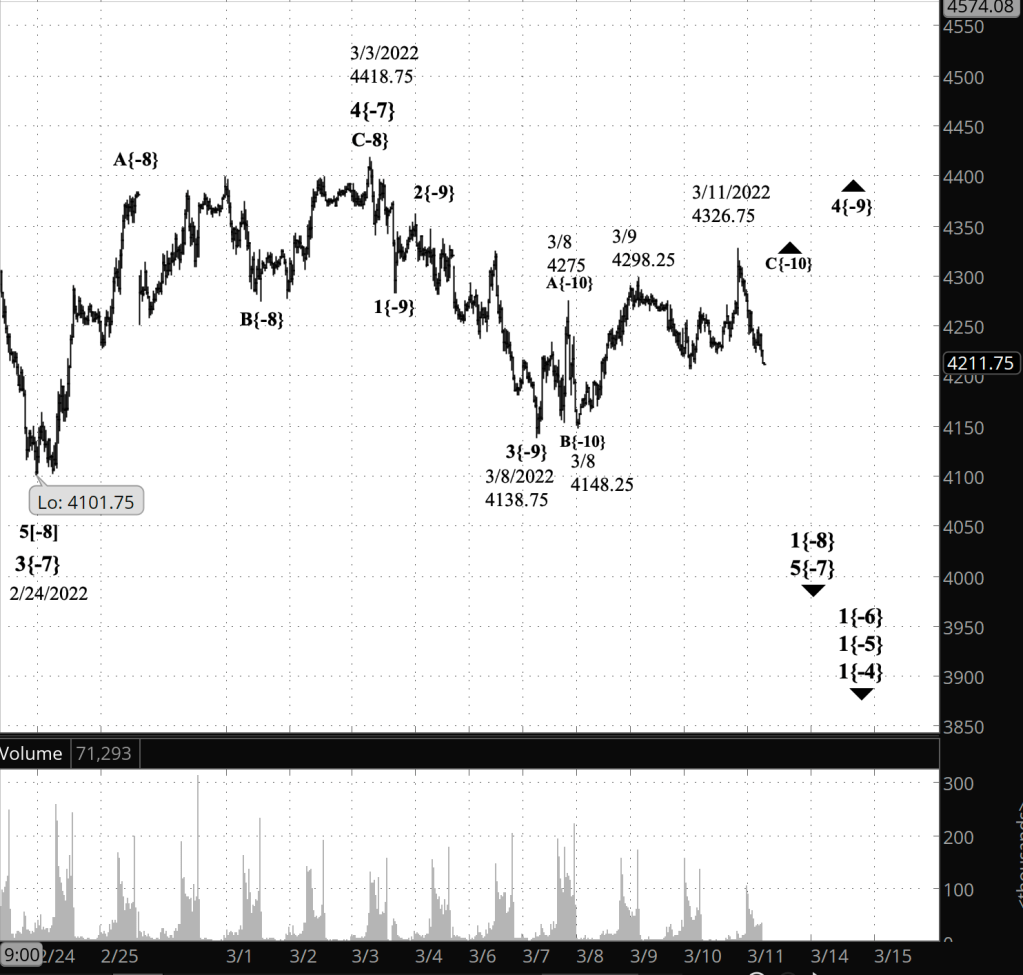
Half an hour before the closing bell. The S&P futures have continued to fall during the session, reaching below 4215. The present wave C{-10} has so far remained well above its starting point, 4148.25. Wave 4{-9}, the upward correction that began on March 8, continues, although the alternative, that wave 4{-9} ended at the overnight high, 4326.75, remains a strong possibility. I’ve updated the upper chart.
10:50 a.m. New York time
PFE earnings play exit. I have exited my short bull put options spread on PFE for 25% of maximum potential profit and have updated the trade analysis with full results.
9:35 a.m. New York time
What’s happening now? The S&P 500 E-mini futures in overnight trading moved to a new high within the upward correction that began on March 8, reaching 4326.75 so far.
What does it mean? By my principal analysis (yesterday’s alternative analysis), the third leg within the upward correction is still underway.
What are the alternatives? It’s possible that the overnight high marks the end of the correction, and the subsequent, still small downward movement that followed is a resumption of the downtrend that began on March 3.
It’s also possible that the upward correction ended on March 9 and that the resumed downtrend is forming a Diagonal Triangle.
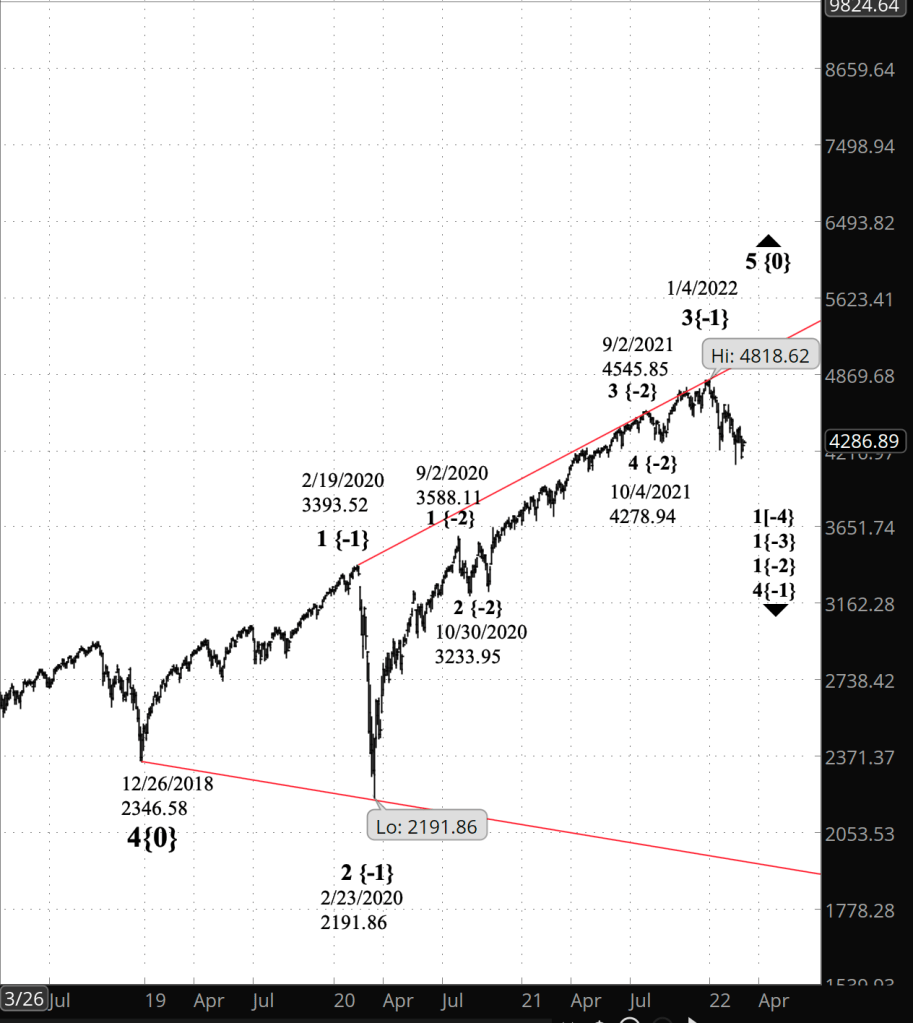
Charts. I’m discussing two charts today in the Elliott wave theory section. The upper chart is near-term look at the S&P 500 E-mini futures, stretching back to late February. The lower chart is a big-picture look at the S&P 500 index from December 2018 to the present.
[S&P 500 E-mini futures at 3:30 p.m., 30-minute bars, with volume]
[S&P 500 index at 9:33 a.m., 2-day bars]
What does Elliott wave theory say?I’ll discuss the near-term chart of the S&P 500 futures first.
Under my principal analysis, the wave 4{-9} upward correction is continuing, and internally is in wave C{-10} to the upside. This was presented as an alternative in yesterday’s post, and as it turns out, the alternative was correct, because of the price moving above the March 9 high, a level that my principal analysis had labeled as the end of wave 4{-9}.
There are several possibilities that could occur after the end of C{-10}, the 3rd wave of the correction.
One would be that wave 4{-9} turns out to be a simple three-wave correction, and the end of C{-10} is also the end of 4{-9} and the start of a wave 5{-9} resumption of the downtrend. I consider this to be the most likely outcome.
Or the correction could form a compound structure, connecting two or three corrective patterns together. If that occurs, then upward wave C{-10} will be followed by a downward connector wave X{-10} and then another three-wave corrective pattern within wave 4{-9}, beginning with a rising wave A{-10}.
And it’s possible, although not likely in my opinion, that yesterday’s principal analysis was correct: Wave 4{-9} ended on March 9 at 4298.25 and the subsequent decline and rise are the first steps of a five-wave Diagonal Triangle within downtrending wave 5{-9}.
Turning now to the big-picture chart of the S&P 500 index.
All of the near-term action discussed above is occurring within the downtrending 4th wave of an expanding Diagonal Triangle that began on December 26, 2018. The “expanding” part of the name means that the upper and lower boundaries progressively move further from each other. When complete the Triangle will have five waves internally. The 4th wave decline will carry the price into the region of the lower boundary, and then a 5th wave rise will move the price back to the by then higher upper boundary to complete the Triangle.
The Diagonal Triangle is uptrending wave 5{0}, which began on December 26, 2018 from 2346.58. Within it, wave 1{-1} ended at 3393.32 in February 2020, the subsequent wave 2{-1} decline — the early pandemic crash — ended at 2191.86 on February 23, 2020. Wave 3{-1}, the massive rise that we’ve seen since the crash, ended at 4818.62 on January 4, 2022. And in our present decline we see the early stages of wave 4{-1}, which eventually will carry the price down to the lower boundary, which is presently in the mid-1900s and moving lower each day. Wave 5{-1} will follow, rising back to the upper boundary, which is presently in the upper 4900s and by the time wave 5{-1} returns could well be in the 6000s.
Basically, wave 4{-1} will feel like the end of the world as we know it, and wave 5{-1} will at the peak will see people dancing in the street, certain that the uptrend will continue forever. Which it won’t. The end of wave 5{-1} will also be the end of wave 5{0}, and the subsequent long-term decline will be a life-altering event for the generations of people impoverished by it, a cautionary tale to tell the grandchildren who in turn will tell their grandchildren about those dark days, the Crash of 20??.
We Are Here.
These are the waves currently in progress under my principal analysis. Each line on the list shows the wave number, with the subscript in curly brackets, the traditional degree name, the starting date, the starting price of the S&P 500 E-mini futures, and the direction of the wave.
Learning and other resources. Elliott wave analysis provides context, not prophecy. As the 20th century semanticist Alfred Korzybski put it in his book Science and Sanity (1933), “The map is not the territory … The only usefulness of a map depends on similarity of structure between the empirical world and the map.” And I would add, in the ever-changing markets, we can judge that similarity of structure only after the fact.
See the menu page Analytical Methods for a rundown on where to go for information on Elliott wave analysis.
By Tim Bovee, Portland, Oregon, March 11, 2022
Disclaimer
Tim Bovee, Private Trader tracks the analysis and trades of a private trader for his own accounts. Nothing in this blog constitutes a recommendation to buy or sell stocks, options or any other financial instrument. The only purpose of this blog is to provide education and entertainment.
No trader is ever 100 percent successful in his or her trades. Trading in the stock and option markets is risky and uncertain. Each trader must make trading decisions for his or her own account, and take responsibility for the consequences.
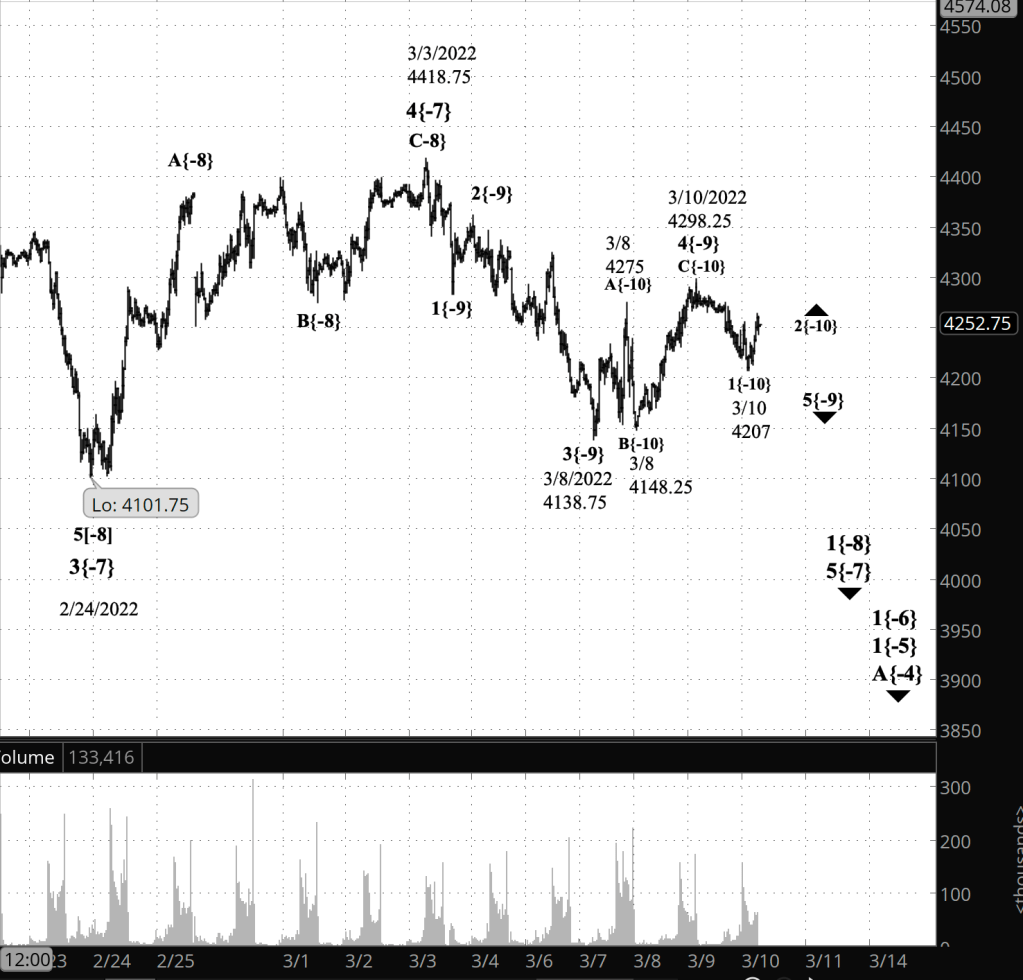
Half an hour before the closing bell. The S&P 500 futures fell to 4207 during the first two hours of the session, and then reversed to the upside. By my principal count, the decline was wave 1{-10} within downtrending wave 5{-9}. The rise that followed is wave 2{-10}. Second waves tend to take a Zigzag pattern, which means three subwaves labeled A, B and C. The A wave has five subwaves within it; the B, three; and the C, five.
The 2nd wave never moves beyond the start of the preceding 1st wave, so if events match my analysis, the price will remain at or below 4298.25. If it moves above that level, then my alternative analysis from this morning is correct: Wave 5{-9} hasn’t begun, but instead the upward correction, wave 4{-9}, is still underway.
I’ve updated the chart, below.
9:35 a.m. New York time
What’s happening now? The S&P 500 E-mini futures reached a high of 4298.25 in overnight trading and reversed.
What does it mean? Under my principal analysis, the downtrend that began on March 3 has resumed.
What’s the alternative? The decline that began overnight is the second wave within the final, upward movement of the correction that began on March 8.
[S&P 500 E-mini futures at 3:30 p.m., 30-minute bars, with volume]
What does Elliott wave theory say? Under my principal analysis, wave C{-10} and its parent wave 4{-9} ended overnight at 4298.25. For wave C, it was a 110% retracement of the preceding wave A. The correction pattern is a Flat, and in Flats, C waves retrace from 100% to 160% of the preceding A waves. The decline, wave 5{-9}, will fall below the end of wave 3{-9}, at 4138.75 on March 8, and perhaps significantly so.
Under the alternative analysis, the overnight peak ended the first of five waves within wave C{-10} and the subsequent decline is wave 2{-11}. The price won’t move below 4148.25, the start of the preceding 1st wave.
In Elliott wave theory, waves of the same degree tend to be proportional. It’s not a firm rule — I’ve seen disproportional waves many times, especially 4th and 5th waves. But the tendency is that waves in a set will take roughly the same amount of time to complete their work. Within wave 4{-9} each subwave has lasted about a day. The principal analysis keeps that proportionality intact. The alternative analysis would make wave C significantly longer than the other two waves within wave 4{-9}.
The principal analysis will be confirmed if the price moves below 4138.75, the end of wave 3{-9}.
The alternative analysis will be tentatively confirmed if the price reverses upward significantly while above 4138.75 and entirely confirmed if it moves above 4298.25, the end of wave B{-10} within wave 4{-9}.
We Are Here.
These are the waves currently in progress under my principal analysis. Each line on the list shows the wave number, with the subscript in curly brackets, the traditional degree name, the starting date, the starting price of the S&P 500 E-mini futures, and the direction of the wave.
5{0} Intermediate, 12/21/2018, 2316.75 (up)
3{1} Minor, 3/23/2018 2174 (up)
5{-2} Minute, 10/4/2020, 4267.50 (up)
4{-3} Minuette, 1/4/2022, 4808.25 (down)
A{-4} Subminuette, 1/4/2022, 4808.25 (down)
1{-5} Micro, 1/4/2022, 4808.25 (down)
1{-6} Submicro, 1/4/2022, 4808.25 (down)
5{-7} Minuscule, 3/3/2022, 4101.75 (down)
1{-8} Subminuscule, 3/3/2022, 4101.75 (down)
5{-9} Bitsy, 3/10/2022, 4298.25 (down)
2{-10} Subbitsy, 3/10/2022, 4207 (up)
Learning and other resources. Elliott wave analysis provides context, not prophecy. As the 20th century semanticist Alfred Korzybski put it in his book Science and Sanity (1933), “The map is not the territory … The only usefulness of a map depends on similarity of structure between the empirical world and the map.” And I would add, in the ever-changing markets, we can judge that similarity of structure only after the fact.
See the menu page Analytical Methods for a rundown on where to go for information on Elliott wave analysis.
By Tim Bovee, Portland, Oregon, March 10, 2022
Disclaimer
Tim Bovee, Private Trader tracks the analysis and trades of a private trader for his own accounts. Nothing in this blog constitutes a recommendation to buy or sell stocks, options or any other financial instrument. The only purpose of this blog is to provide education and entertainment.
No trader is ever 100 percent successful in his or her trades. Trading in the stock and option markets is risky and uncertain. Each trader must make trading decisions for his or her own account, and take responsibility for the consequences.
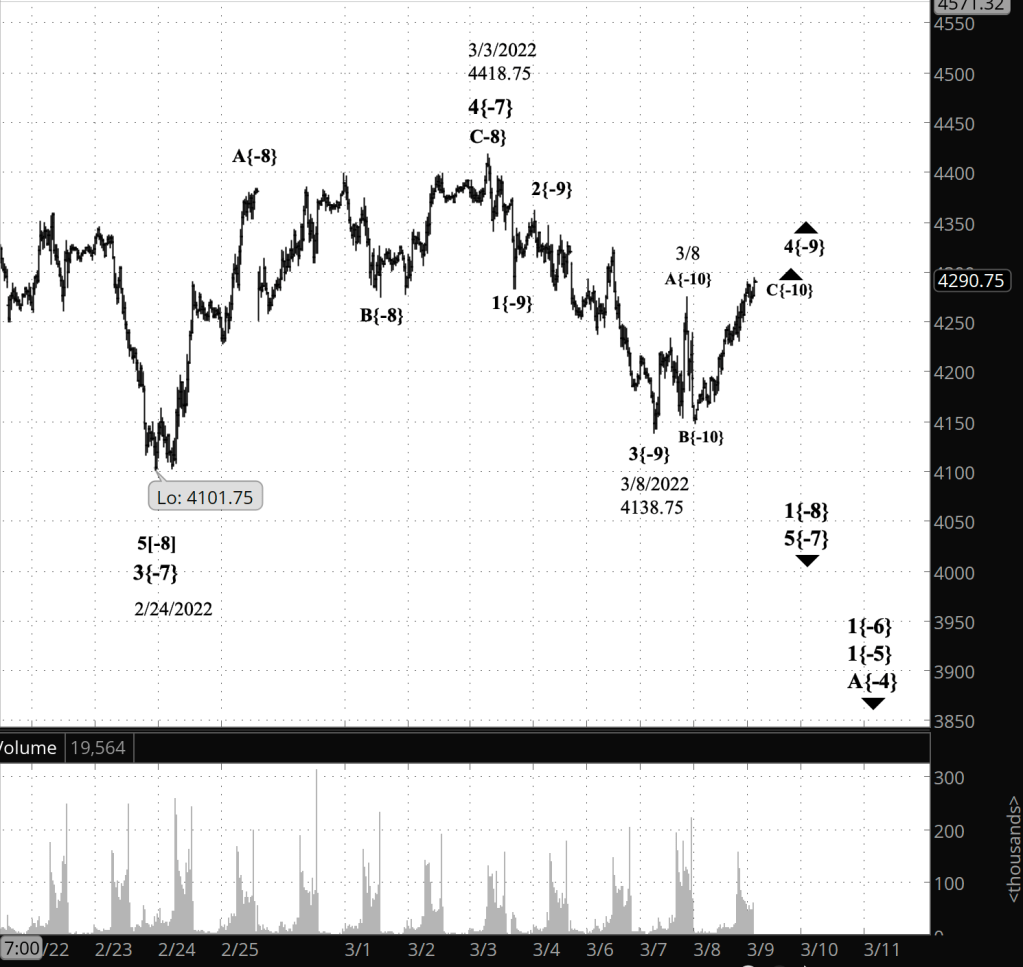
Half an hour before the closing bell. The S&P 500 futures have continued to rise during the trading session, coming close to 4300. The present wave in progress is rising wave C{-10} within an upward correction, wave 4{-9}, within downtrending wave 1{-8}. I’ve updated the chart.
9:35 a.m. New York time
What’s happening now? The S&P 500 E-mini futures rose in overnight trading, moving into the mid-4200s.
What does it mean? The rise is the third, and perhaps final, leg of an upward correction that began on March 8.
What’s the alternative? It’s possible that the upward correction ended at the March 8 high, 4275, and that the subsequent decline is a continuation of the larger downtrend that began on March 3.
[S&P 500 E-mini futures at 3:30 p.m., 30-minute bars, with volume]
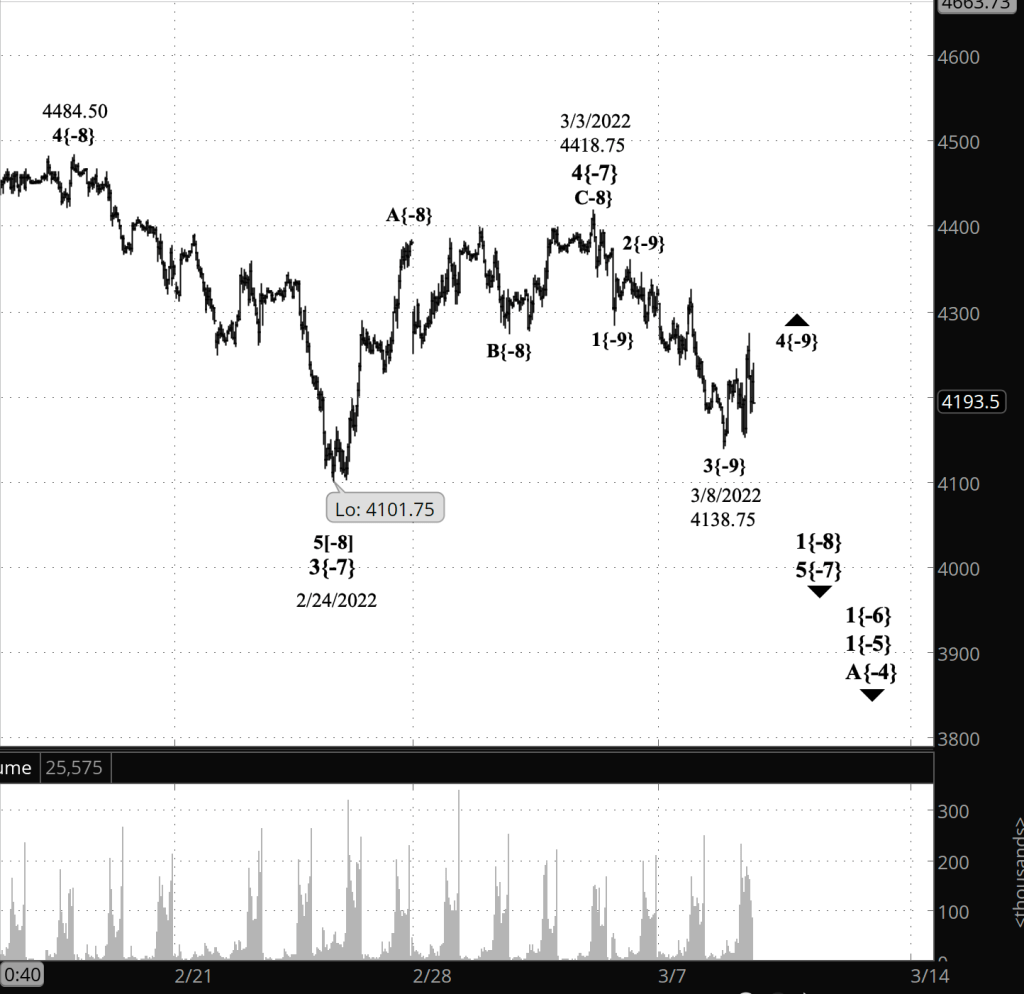
What does Elliott wave theory say? Under my principal analysis, the upward correction is wave 4{-9}, and within it, the overnight rise is wave C{-10}. Corrections tend to have three waves internally, but there is an exception. Wave 4{-9} could form a compound correction, where several three-wave corrective patterns within it are linked together. As many as three corrective patterns can be part of a compound correction. The correction is happening within wave 5{-7}, a downtrending impulse wave that began on March 3.
The alternative analysis places the end of wave 4{-9} at the March 8 high, the point labeled as the end of wave A{-10} in the principal analysis. Under this scenario, the subsequent decline is wave 5{-9}, the final wave within its parent wave 1{-8}, which began its downward trek on March 3.
Wave 4{-9} is a Flat corrective pattern, and so internally its A and B waves will have three waves internally, at the {-10} degree, and its C wave will have five waves internally. And indeed, A and B encompass three waves each.
However, wave-counting is never that simple. At a closer up view, it’s possible to see a lot of ambiguity in the count. The wave count I used in my principal analysis seems to best fit the Elliott rule set. And in either case — the principal or the alternative — the price will soon reverse, if it hasn’t already, and wave 5{-9} will carry the price down below 4101.75, the end of wave 3{-7} on February 24, and perhaps significantly below that level.
This is all happening within wave 1{-6}, which in turn is part of wave 1{-5} within wave A{-4}, all of which began on January 4 from 4808.25. Those structures are part of a downward correction, wave 4{-3}, which also began on January 4.
We Are Here.
These are the waves currently in progress under my principal analysis. Each line on the list shows the wave number, with the subscript in curly brackets, the traditional degree name, the starting date, the starting price of the S&P 500 E-mini futures, and the direction of the wave.
5{0} Intermediate, 12/21/2018, 2316.75 (up)
3{1} Minor, 3/23/2018 2174 (up)
5{-2} Minute, 10/4/2020, 4267.50 (up)
4{-3} Minuette, 1/4/2022, 4808.25 (down)
A{-4} Subminuette, 1/4/2022, 4808.25 (down)
1{-5} Micro, 1/4/2022, 4808.25 (down)
1{-6} Submicro, 1/4/2022, 4808.25 (down)
5{-7} Minuscule, 3/3/2022, 4101.75 (down)
1{-8} Subminuscule, 3/3/2022, 4101.75 (down)
4{-9} Bitsy, 3/8/2022, 4178.35 (up)
Learning and other resources. Elliott wave analysis provides context, not prophecy. As the 20th century semanticist Alfred Korzybski put it in his book Science and Sanity (1933), “The map is not the territory … The only usefulness of a map depends on similarity of structure between the empirical world and the map.” And I would add, in the ever-changing markets, we can judge that similarity of structure only after the fact.
See the menu page Analytical Methods for a rundown on where to go for information on Elliott wave analysis.
By Tim Bovee, Portland, Oregon, March 9, 2022
Disclaimer
Tim Bovee, Private Trader tracks the analysis and trades of a private trader for his own accounts. Nothing in this blog constitutes a recommendation to buy or sell stocks, options or any other financial instrument. The only purpose of this blog is to provide education and entertainment.
No trader is ever 100 percent successful in his or her trades. Trading in the stock and option markets is risky and uncertain. Each trader must make trading decisions for his or her own account, and take responsibility for the consequences.
Half an hour before the closing bell. The S&P 500 futures has reached a peak during today’s session of 4275. It reversed from that level, declined, and now has moved again back to the upside. A close view of the day’s trading suggests that internally, the upward movement is still in its third and most likely final leg. In Elliott wave terminology, the upward movement is wave 4{-9}, and within it, I count rising wave C{-10} as being underway. The C wave will most likely have five waves within it, and I count rising wave 3{-11} as now being underway, with declining wave 4{-11} and rising wave 5{-11} to follow.
10:15 a.m. New York time
Exited MRVL earnings play. I’ve exited my short bull put options spread on MRVL at 25% of maximum potential profit and have updated the trade analysis with full results.
9:35 a.m. New York time
What’s happening now? The S&P 500 E-mini futures declined to 4178.35 in overnight trading and then in the early morning hours reversed, rising nearly 95 points, to 4233.50.
What does it mean? By my principal analysis the low, 4178.35, marks the end of the middle leg of the decline that began on March 3 from 4418.75. The upward move is a low-level correction within the larger downtrend and will be followed by a push lower that I expect to reach below the February 24 low, 4101.75.
What’s the alternative? It possible to see the overnight low as being the end of the last leg of the decline from March 3, and the subsequent rise as the beginning of a larger upward correction that will carry the price up toward the March 3 high, 4418.75. I expect the price to remain below that level. I’ll discuss my reasoning for rejecting this scenario in the Elliott wave theory, below.
Also, as a second alternative, the downward leg could still be underway. If the subsequent rise continues with three legs — up, down, up — then this alternative will be disproven.
[S&P 500 E-mini futures at 3:30 p.m., 40-minute bars, with volume]
What does Elliott wave theory say? Under my principal analysis, the overnight low, 4138.75, was the end of wave 3{-9} within wave 1{-8}, both downtrending waves. The reversal from the overnight low is the beginning of wave 4{-9}, an upward correction, with three wave internally, within the larger downtrend.
Today’s analysis differs from Monday’s in that I’ve moved the end of wave 3{-9} to today’s low from Monday’s low point, 4181. The extent of the downward move had the feel of an energetic 3rd wave more than a 5th wave. Leaving the end of wave 3{-9} at 4181 produced an awkwardly short 3rd wave compared to the subsequent 5th.
Note that there is nothing in the rules that requires a 5th wave to be shorter than the preceding 3rd wave. The closest rule is that the 3rd wave can’t be shorter than both waves 1 and 5. And 5th waves have a lot of variety. They can be truncated, ending below the end of the preceding 3rd wave. Or they can extend, moving quite a bit further than seems reasonable.
As is often the case in Elliott wave analysis, it’s an aesthetic judgement — what analysis matches the look and feel of what I’ve seen before in my decades of chart analysis. If that look and feel changes, then I’ll readily alter my principal analysis to accommodate it.
So i rejected the alternative analysis, which labels the overnight low, 4138.75, as the end of wave 5{-9} within wave 1{-8}. the subsequent rise would be labeled wave A{-9} within wave 2{-8}, an upward correction.
A second alternative is that downtrendng wave 3{-9} is still underway. A rapid return to new lows after this morning’s rise will increase the likelihood of this scenario.
We Are Here.
These are the waves currently in progress under my principal analysis. Each line on the list shows the wave number, with the subscript in curly brackets, the traditional degree name, the starting date, the starting price of the S&P 500 E-mini futures, and the direction of the wave.
5{0} Intermediate, 12/21/2018, 2316.75 (up)
3{1} Minor, 3/23/2018 2174 (up)
5{-2} Minute, 10/4/2020, 4267.50 (up)
4{-3} Minuette, 1/4/2022, 4808.25 (down)
A{-4} Subminuette, 1/4/2022, 4808.25 (down)
1{-5} Micro, 1/4/2022, 4808.25 (down)
1{-6} Submicro, 1/4/2022, 4808.25 (down)
5{-7} Minuscule, 3/3/2022, 4101.75 (down)
1{-8} Subminuscule, 3/3/2022, 4101.75 (down)
4{-9} Bitsy, 3/8/2022, 4178.35 (up)
Learning and other resources. Elliott wave analysis provides context, not prophecy. As the 20th century semanticist Alfred Korzybski put it this way in his book Science and Sanity (1933), “The map is not the territory … The only usefulness of a map depends on similarity of structure between the empirical world and the map.” And I would add, in the ever-changing markets, we can judge that similarity of structure only after the fact.
See the menu page Analytical Methods for a rundown on where to go for information on Elliott wave analysis.
By Tim Bovee, Portland, Oregon, March 8, 2022
Disclaimer
Tim Bovee, Private Trader tracks the analysis and trades of a private trader for his own accounts. Nothing in this blog constitutes a recommendation to buy or sell stocks, options or any other financial instrument. The only purpose of this blog is to provide education and entertainment.
No trader is ever 100 percent successful in his or her trades. Trading in the stock and option markets is risky and uncertain. Each trader must make trading decisions for his or her own account, and take responsibility for the consequences.
Update 4/12/2022: I exited my short bear call vertical options spread on SPY, two days before expiration, for an $8.50 debit per contract/share, a loss before fees of $392 per contract. Shares were trading at $443.33, up $20.5 from the entry level.
The Implied Volatility Rank at exit was 37.8%, down 64.9 points from the entry level.
I exited because the position because the options it was built from were days away from expiration. The position became unprofitable shortly after I entered it, and remained unprofitable as the share price moved contrary to my expectations.
Shares rose by 4.9% over 36 days for a +50% annual rate. The options position produced a 46.1% loss for a -468% annual rate.
I have entered a short bear call vertical spread on SPY, using options that trade for the last time 37 days hence, on April 14. The premium is a $4.58 credit per contract share and the stock at the time of entry was priced at $422.58.
The Implied Volatility Ratio stood at 102.7%.
Premium:
$4.58
Expire OTM
SPY-bull call spread
Strike
Odds
Delta
Calls
Long
440.00
72.0%
32
Break-even
434.58
66.5%
38
Short
430.00
61.0%
44
The premium is 91.6% of the width of the position’s short/long spread. The profit zone covers a 1.8% move to the upside and an unlimited move to the downside.
The risk/reward ratio is 1.2:1, with maximum risk of $542 and maximum reward of $458 per contract.
How I chose the trade. SPY, along with the rest of the S&P 500 family of instruments, ended an upward correction on March 7 at 441.11 and resumed its downtrend. I expect the price to move below 410.64, where the correction began, and perhaps significantly below that level. I set the strike price for the long call close to the peak of the upward correction, anticipating that the price won’t move above that level.
By Tim Bovee, Portland, Oregon, March 7, 2022
Disclaimer
Tim Bovee, Private Trader tracks the analysis and trades of a private trader for his own accounts. Nothing in this blog constitutes a recommendation to buy or sell stocks, options or any other financial instrument. The only purpose of this blog is to provide education and entertainment.
No trader is ever 100 percent successful in his or her trades. Trading in the stock and option markets is risky and uncertain. Each trader must make trading decisions for his or her own account, and take responsibility for the consequences.

 Tim Bovee, Private Trader
You must be logged in to post a comment.