Trader’s Notebook

9:35 a.m. New York time

What’s happening now? The S&P 500 E-mini futures traded in a narrow range overnight

What does it mean? The third leg of an upward correction that began on May 12 continues. Internally, that third segment is in a correction to the downside.

What are the alternatives? The same three as those listed in yesterday’s Trader’s Notebook.

Alternative #1: The May 30 peak marks the end of the larger upward correction and the downtrend that began on April 21 has resumed.

Alternative #2: The final move to the upside may fall short of the May 30 peak, a condition known as truncation. Or it could move beyond the peak.

Alternative #3: Most corrections have three waves internally. Sometimes a correction will connect two or three corrective patterns together before reaching its end.
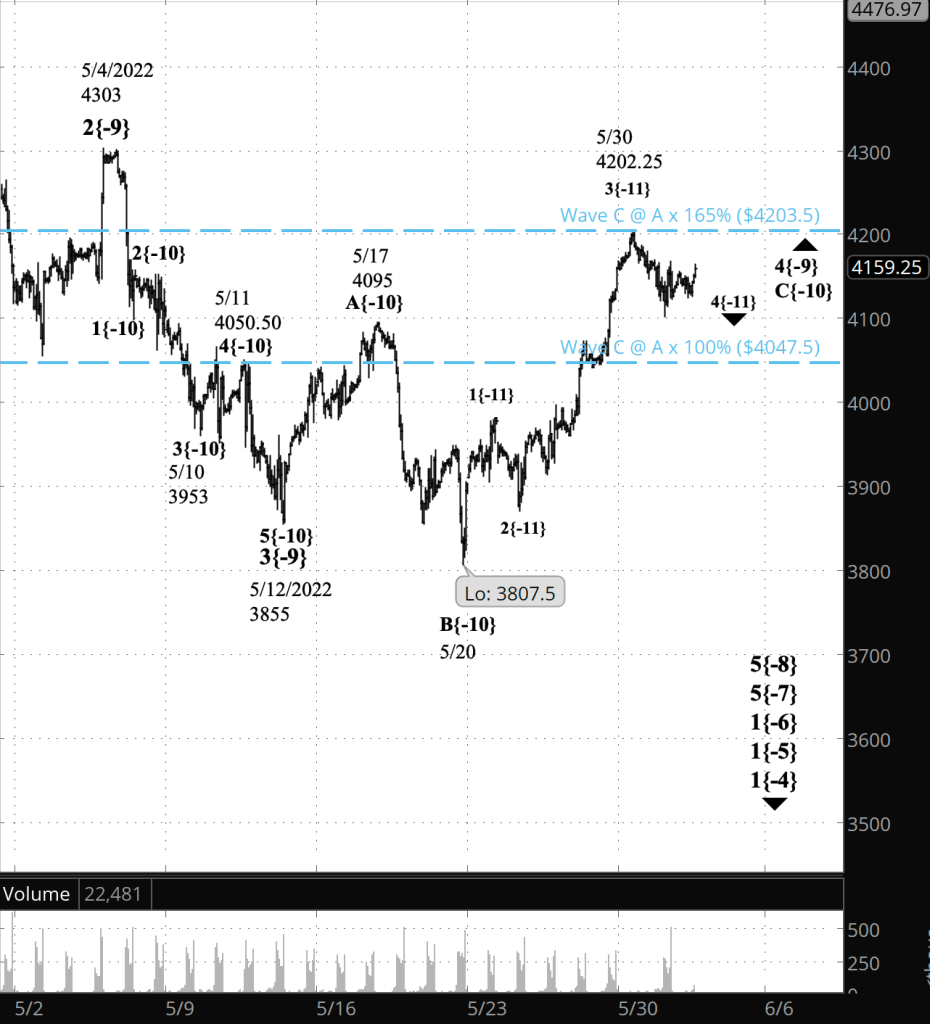
[S&P 500 E-mini futures at 9:35 a.m., 70-minute bars, with volume]

What does Elliott wave theory say? The larger upward correction is wave 4{-9}. It is in its third internal movement, wave C{-10}. The C wave in turn is undergoing a downward correction, wave 4{-11}, whose completion will be followed by a rise that will complete wave C{-10} and most likely wave 4{-9} as well.

The likely target range for completion of wave 4{-9} is marked with blue dashed lines on the chart. The upper boundary of the range is at 4203.50. That range is a tendency, not a firm rule, and so the price could move higher. However, it cannot move above the beginning of wave 1{-9}, at 4509.

Under Alternative #1, wave C{-10} ended at the May 30 peak.

Under Alternative #2, the upward wave 5{-11} that will follow the present wave 4{-11} pullback will fall short of 4303, the May 30 peak, in a truncated 5th.

Under Alternative #3, the end of wave C{-10} won’t be the end of its parent, wave 4{-9}. Instead, wave C{-10} will be followed by a downward connecting wave, X{-10} and then a second corrective pattern, which possibly will be followed by another connecting wave and then third corrective pattern.

We Are Here.

These are the waves currently in progress under my principal analysis. Each line on the list shows the wave number, with the subscript in curly brackets, the traditional degree name, the starting date, the starting price of the S&P 500 E-mini futures, and the direction of the wave.

  • S&P 500 Index:
  • 5{+3} Supercycle, 7/8/1932, 4.40 (up)
  • 5{+2} Cycle, 12/9/1974, 60.96 (up)
  • 5{+1} Primary, 3/6/2009, 666.79 (up)
  • 5{0} Intermediate, 12/26/2018, 2346.58 (up)
  • 4{-1} Minor, 1/4/2022 4818.62 (down)
  • 1{-2} Minute, 1/4/2022 4818.62 (down)
  • S&P 500 Futures and index:
  • 1{-3} Minuette, 1/4/2022, 4808.25 (down) (futures), 4818.62 (down) (index)
  • S&P 500 Futures:
  • 1{-4} Subminuette, 1/4/2022, 4808.25 (down)
  • 1{-5} Micro, 1/4/2022, 4808.25 (down)
  • 1{-6} Submicro, 1/4/2022, 4808.25 (down)
  • 5{-7} Minuscule, 3/29/2022, 4631 (down)
  • 5{-8} Subminuscule, 4/21/2022, 4509, (down)

Learning and other resources. Elliott wave analysis provides context, not prophecy. As the 20th century semanticist Alfred Korzybski put it in his book Science and Sanity (1933), “The map is not the territory … The only usefulness of a map depends on similarity of structure between the empirical world and the map.” And I would add, in the ever-changing markets, we can judge that similarity of structure only after the fact.

See the menu page Analytical Methods for a rundown on where to go for information on Elliott wave analysis.

By Tim Bovee, Portland, Oregon, June 1, 2022

Disclaimer

Tim Bovee, Private Trader tracks the analysis and trades of a private trader for his own accounts. Nothing in this blog constitutes a recommendation to buy or sell stocks, options or any other financial instrument. The only purpose of this blog is to provide education and entertainment.

No trader is ever 100 percent successful in his or her trades. Trading in the stock and option markets is risky and uncertain. Each trader must make trading decisions for his or her own account, and take responsibility for the consequences.

License
Creative Commons License

All content on Tim Bovee, Private Trader by Timothy K. Bovee is licensed under a Creative Commons Attribution-ShareAlike 4.0 International License.

Based on a work at www.timbovee.com.
Trader’s Notebook

3:30 p.m. New York time

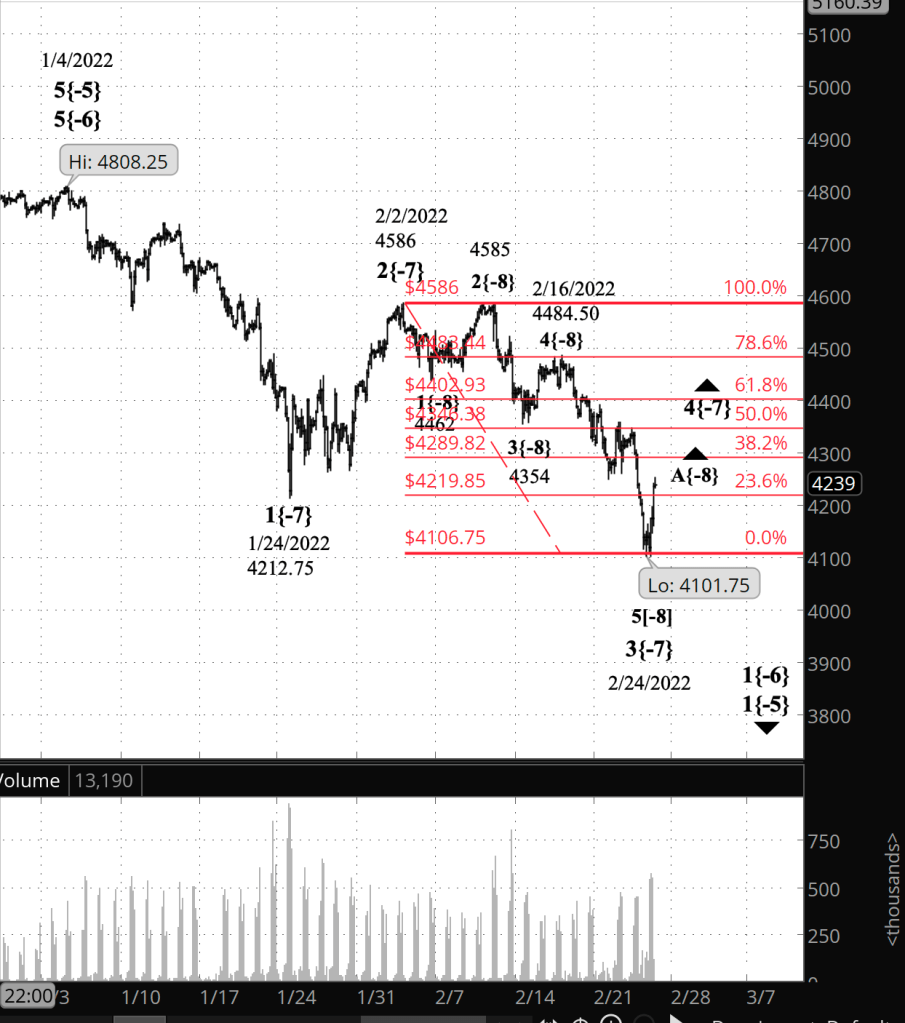
Half an hour before the closing bell. The overnight low, 4101.75, has ended the downtrend that began on February 2. After the the opening bell the price has risen so far to 4252.25 in what is the first leg of what will most likely be a three-part upward correction. I expect to it to take the form of a Flat, a sideways corrective pattern. So far it has moved above a 23.6% retracement of the decline. The 23.6% retracement is part of the Fibonacci series, and quite often prices will pause at Fibonacci levels. The next one higher is the 38.2% retracement, at 4289.82.

In Elliott wave terminology: Wave 5{-8} and its parent wave 3{-7} ended at 4101.75, the overnight low, and the subsequent upward movement is wave A{-8} within wave 4{-7}, a correction to the decline.

Fourth waves often end within the range of the the 4th wave one degree smaller within the preceding 3rd wave. In this case it would be wave 4{-8} within wave 3{-7}; the 4th subwave started at 4354 and ended on February 16 at 4484.50. Those start and end points are my expectation for the range within which wave 4{-7} will end, roughly a 50% to a 78.6% retracement.

The upward correction, wave 4{-7}, will contain three subwaves (unless it extends into a compound correction) — A, B and C, all at the {-8} degree — and will be followed by a declining wave 5{-7}, which will carry the price below the 4101.75, perhaps significantly lower.

2:40 p.m. New York time

LYFT earnings play exit. I’ve exited my short bear call vertical spread on LYFT for 70% of maximum potential profit and have updated the trade analysis with full results.

10:20 a.m. New York time

SPY options position exit. I’ve exited my short bear call vertical spread on SPY for 51% of maximum potential profit and have updated the trade analysis with full results.

10:05 a.m. New York time

DIS earnings play exit. I’ve exited my short bull put vertical spread on DIS for 29.4% of maximum potential profit and have updated the trade analysis with full results.

9:35 a.m. New York time

What’s happening now? The S&P 500 E-mini futures continued to decline in overnight trading, reaching a low of 4101.75 so far, the lowest it has been this year.

What does it mean? The downtrend that began on January 4 from 4808.75 and that, after an upward correction, resumed on February 2 continues. So far it has fallen more than 700 points below the January 4 peak, with more downside to come, with the usual corrections along the way that will interrupt its progress.

What’s the alternative? At this point I have none. The chart patterns have a high degree of clarity. As always, ambiguities will arise, but not today.

[S&P 500 E-mini futures at 3:30 p.m., 140-minute bars, with volume]

What does Elliott wave theory say? Wave 5{-8} is underway, tracing its course within wave 3{-7} within wave 1{-6}, all declining in the direction of the downtrend that began on January 4.

In Elliott, the term for a wave moving in the direction the trend is an impulse wave. Within wave 3{-7}, the 5th wave, the ending wave within an impulse wave, is the longest of the three. Normally, the 3rd (middle) wave is the longest. The Elliott wave analysis rule is only that the 3rd wave can’t be the shortest of the three waves moving in the direction of the trend, the 1st, 3rd and 5th.

Wave 1{-8} is the shortest of three, at 124 points; wave 3{-8} is next, at 231 points; and wave 5{-8} is the longest, at 382.75 points. So the Elliott wave rule is satisfied.

There is no rule limiting on how far a 5th wave can travel, although a grotesquely outsized 5th wave should prompt the analyst to re-evaluate the work.

I’ve seen headlines this morning linking the market decline to the Russian attack on the Ukraine. A principle of Elliott wave theory is that market movements, the waves, are driven by the public mood, what German philosophrs called the Zeitgeist. The public mood anticipates events, and so the market weeks ago priced in the war in Ukraine. The movements we see today will be anticipations of what happens next, not responses to what happened earlier today Ukraine time.

We Are Here.

These are the waves currently in progress under my principal analysis. Each line on the list shows the wave number, with the subscript in curly brackets, the traditional degree name, the starting date, the starting price of the S&P 500 E-mini futures, and the direction of the wave.

  • 5{0} Intermediate, 12/21/2018, 2316.75 (up)
  • 3{1} Minor, 3/23/2018 2174 (up)
  • 5{-2} Minute, 10/4/2020, 4267.50 (up)
  • 4{-3} Minuette, 1/4/2022, 4808.25 (down)
  • A{-4} Subminuette, 1/4/2022, 4808.25 (down)
  • 1{-5} Micro, 1/4/2022, 4808.25 (down)
  • 1{-6} Submicro, 1/4/2022, 4808.25 (down)
  • 4{-7} Minuscule, 2/24/2022, 4101.75 (up)
  • A{-8} Subminuscule, 2/24/2022, 4101.75 (up)

Learning and other resources. Elliott wave analysis provides context, not prophecy. As the 20th century semanticist Alfred Korzybski put it this way in his book Science and Sanity (1933), “The map is not the territory … The only usefulness of a map depends on similarity of structure between the empirical world and the map.” And I would add, in the ever-changing markets, we can judge that similarity of structure only after the fact.

See the menu page Analytical Methods for a rundown on where to go for information on Elliott wave analysis.

By Tim Bovee, Portland, Oregon, February 24, 2022

Disclaimer

Tim Bovee, Private Trader tracks the analysis and trades of a private trader for his own accounts. Nothing in this blog constitutes a recommendation to buy or sell stocks, options or any other financial instrument. The only purpose of this blog is to provide education and entertainment.

No trader is ever 100 percent successful in his or her trades. Trading in the stock and option markets is risky and uncertain. Each trader must make trading decisions for his or her own account, and take responsibility for the consequences.

License
Creative Commons License

All content on Tim Bovee, Private Trader by Timothy K. Bovee is licensed under a Creative Commons Attribution-ShareAlike 4.0 International License.

Based on a work at www.timbovee.com.
NEM Trade

Newmont Corp. (NEM)

Update 3/3/2022: I exited my bull put vertical options spread on NEM, 42 days before expiration, for a $1.38 debit per contract/share, a profit before fees of $54 per contract. Shares were trading at $70.48, up $2.08 from the entry level.

The Implied Volatility Rank at exit was 75, up 6.6 points from the entry level.

I exited because the position exceeded 25% of maximum potential profit, my normal exit point for earnings plays.I exited at 28.1% of maximum potential profit.

Shares rose by 3.0% over eight days for a +139% annual rate. The options position produced a 39.1% return for a +1,785% annual rate.


I have entered a short bull put options spread on NEM, using options that trade for the last time 50 days hence, on April 14. The premium is a $1.92 credit per contract share and the stock at the time of entry was priced at $68.40.

The Implied Volatility Ratio stood at 72.3%.

Premium:$1.92Expire OTM
NEM-bull put spreadStrikeOddsDelta
Puts
Long62.5071.0%24
Break-even69.4260.0%34
Short67.5049.0%44

The premium is 76.8% of the width of the position’s short/long spread. The profit zone covers a 1.5% move to the downside and an unlimited move to the upside.

The risk/reward ratio is 1.6:1, with maximum risk of $308 and maximum reward of $192 per contract.

How I chose the trade. The trade was placed to coincide with NEM’s earnings announcement, before the opening bell on the day after entry. The short strikes were set to coincide as closely as possible with the expected move of $1.94 either way, based on options pricing, which gives a price range of $66.39 to $70.27.

By Tim Bovee, Portland, Oregon, February 23, 2022

Disclaimer

Tim Bovee, Private Trader tracks the analysis and trades of a private trader for his own accounts. Nothing in this blog constitutes a recommendation to buy or sell stocks, options or any other financial instrument. The only purpose of this blog is to provide education and entertainment.

No trader is ever 100 percent successful in his or her trades. Trading in the stock and option markets is risky and uncertain. Each trader must make trading decisions for his or her own account, and take responsibility for the consequences.

License
Creative Commons License

All content on Tim Bovee, Private Trader by Timothy K. Bovee is licensed under a Creative Commons Attribution-ShareAlike 4.0 International License.

Based on a work at www.timbovee.com.
Trader’s Notebook

3:30 p.m. New York time

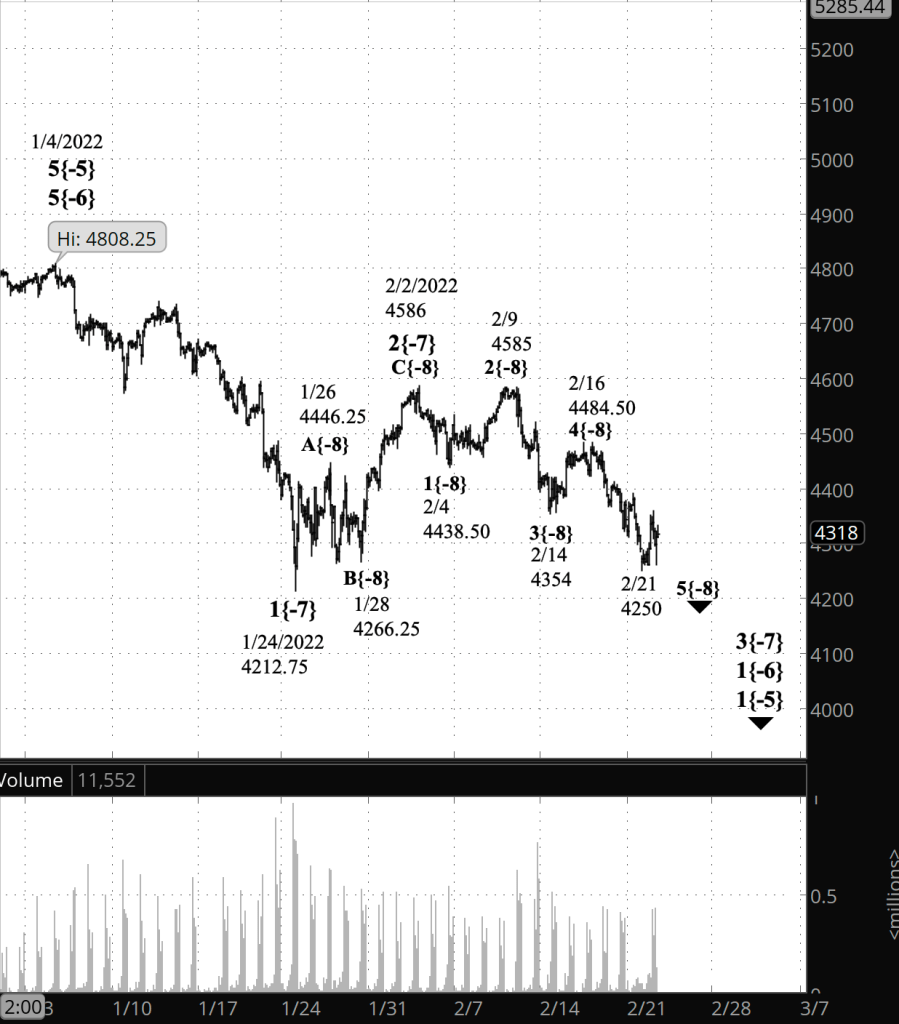
Half an hour before the closing bell. The S&P 500 futures ended their low level upward correction at the overnight high, 4345.50, and began a resumption of the downtrend that picked up speed at the opening bell. The overnight high was the end of wave 4{-9}, and the decline, the beginning of wave 5{-9}. The first decline from the January 4 peak, wave 1{-7}, ended at 4212.75 on January 24, and as the closing bell drew near, the price was again approaching that level, which I’ve marked with a dotted red line on the updated chart below.

Wave 5{-9} is a subwave of wave 5{-8}, which in turn is a subwave of wave 3{-7}. Third waves tend to have a lot of energy as they leap out in the direction of the trend, and that’s what we’re seeing here. Wave 1{-7} lasted for 20 days, and the present movement at that degree, wave 3{-7}, has lasted 21 days. Third waves tend to cover more terrain than first waves, so I expect wave 3{-7} to be with us for weeks to come, with the usual subwave upward corrections to make the journey interesting.

1:25 p.m. New York time

NEM earnings play entry. I’ve entered a short bull put vertical spread on NEM timed to coincide with the company’s earnings announcement tomorrow before the opening bell. I’ve posted an analysis of the trade.

9:35 a.m. New York time

What’s happening now? Overnight, the S&P 500 E-mini futures continued to trade 80 points and bit more above the February 21 low of 4250.

What does it mean? A low level upward correction that began two days ago is under way. It will be followed by a decline, most likely to below 4250, perhaps significantly lower.

What’s the alternative? The uncertainty about the degrees of the waves labelled on the chart continue, as is always the case early in trend. The relative degree among the various waves shown is quite clear, so yes, there are ambiguities, but they aren’t of great significance at this point.

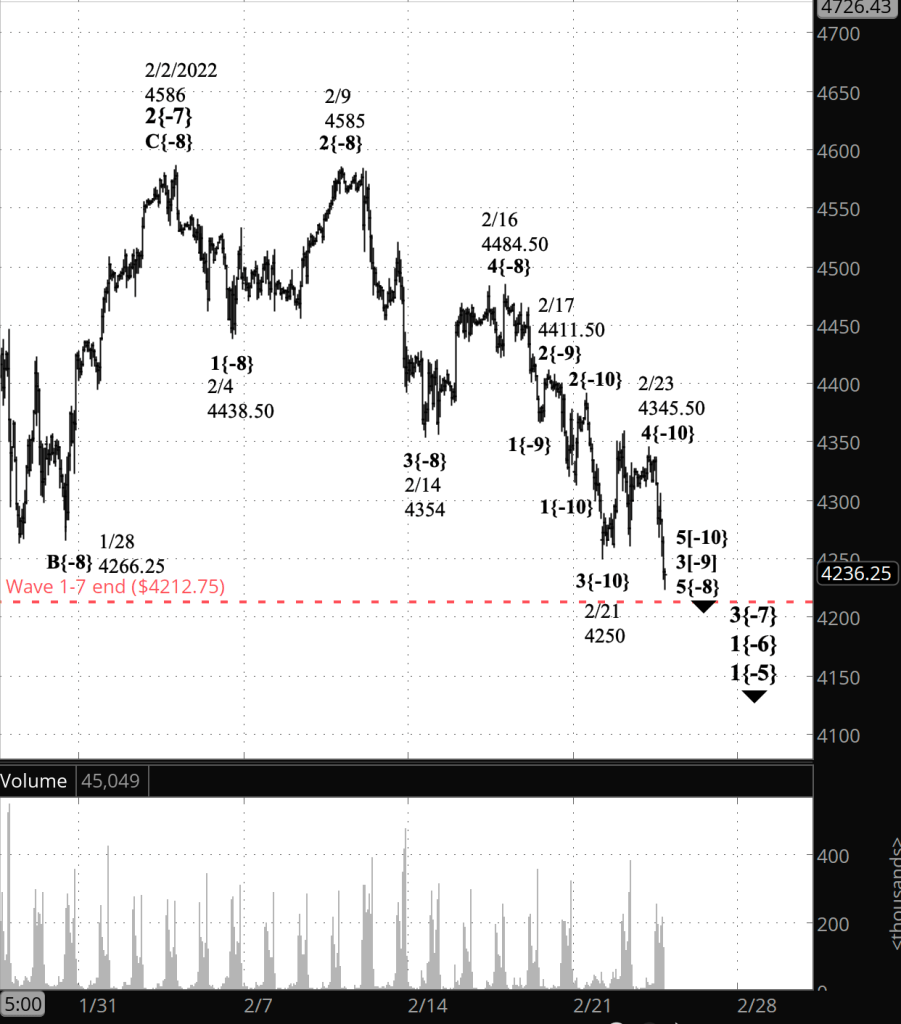
[S&P 500 E-mini futures at 9:35 a.m., hourly bars, with volume]

What does Elliott wave theory say? I moved the chart closer in today in order to gain a better understanding of the progress of wave 3{-7}, which began on February 7 from 4586. Internally, wave 5{-8}, the final wave within 3{-7}, began on February 16 from 4484.50. One degree lower, wave 3{-9} is underway, having begun on February 17 from 4411.50, and within it, an upward correction, wave 4{-10}, began on February 21 from 4250 and would appear to be in wave C{-11}, its final wave unless it becomes a compound correction.

The odds favor the downside at this point. When wave 4{-10} reaches its end, then wave 5{-10} will carry the price down. Fifth waves can move quite a distance below the end of the preceding 3rd wave, or they can truncate and never reach that level.

What is certain is that completion of wave 5{-10} will also be the end of its parent, wave 3{-9}, and the beginning of wave 4{-9}, most likely a Flat, which tends to be a sideways correction. The following wave 5{-9} will carry the price down still further, and the end of 5{-9} will also be the end of 5{-8}, which in turn will be the end of wave 3{-7}, which will be followed by a 4th wave correction that is most likely to be a Flat. So once our present wave 4{-10} ends, everything is a downtrend within the larger downtrend, and at the end, it hits what will most likely be a sideways correction, after which the downtrend will resume. The next directional upward movement will be wave 2{-6}, a correction of the decline that began on January 4 from 4808.25. It will remain below that level and will be followed by a truly impressive wave 3{-6} to the downside.

We Are Here.

These are the waves currently in progress under my principal analysis. Each line on the list shows the wave number, with the subscript in curly brackets, the traditional degree name, the starting date, the starting price of the S&P 500 E-mini futures, and the direction of the wave.

  • 5{0} Intermediate, 12/21/2018, 2316.75 (up)
  • 3{1} Minor, 3/23/2018 2174 (up)
  • 5{-2} Minute, 10/4/2020, 4267.50 (up)
  • 4{-3} Minuette, 1/4/2022, 4808.25 (down)
  • A{-4} Subminuette, 1/4/2022, 4808.25 (down)
  • 1{-5} Micro, 1/4/2022, 4808.25 (down)
  • 1{-6} Submicro, 1/4/2022, 4808.25 (down)
  • 3{-7} Minuscule, 2/2/2022, 4586 (down)
  • 5{-8} Subminuscule, 2/16/2022, 4484.50 (down)
  • 3{-9} Bitsy, 2/17/2022, 4411.50(down)
  • 4{-10} Subbitsy, 2/21/2022, 4250 (up)

Learning and other resources. Elliott wave analysis provides context, not prophecy. As the 20th century semanticist Alfred Korzybski put it this way in his book Science and Sanity (1933), “The map is not the territory … The only usefulness of a map depends on similarity of structure between the empirical world and the map.” And I would add, in the ever-changing markets, we can judge that similarity of structure only after the fact.

See the menu page Analytical Methods for a rundown on where to go for information on Elliott wave analysis.

By Tim Bovee, Portland, Oregon, February 23, 2022

Disclaimer

Tim Bovee, Private Trader tracks the analysis and trades of a private trader for his own accounts. Nothing in this blog constitutes a recommendation to buy or sell stocks, options or any other financial instrument. The only purpose of this blog is to provide education and entertainment.

No trader is ever 100 percent successful in his or her trades. Trading in the stock and option markets is risky and uncertain. Each trader must make trading decisions for his or her own account, and take responsibility for the consequences.

License
Creative Commons License

All content on Tim Bovee, Private Trader by Timothy K. Bovee is licensed under a Creative Commons Attribution-ShareAlike 4.0 International License.

Based on a work at www.timbovee.com.
SPY Trade

S&P 500 ETF Trust (SPY)

Lot 2022-3

Update 2/24/2022: I exited my bear call vertical options spread on SPY, 49 days before expiration, for a $2.06 debit per contract/share, a profit before fees of $214.00 per contract. Shares were trading at $412.53, down $17.21 from the entry level.

The Implied Volatility Rank at exit was 82.7%, up 18.9 points from the entry level.

I exited because the position reached 51% of maximum potential profit, one point above my normal 50% exit point for options positions.

Shares declined by 4.0% over two days for a -731% annual rate. The options position produced a 103.9% return for a +18,959% annual rate.


I have entered a short bear call options spread on SPY, using options that trade for the last time 51 days hence, on April 14. The premium is a $4.20 credit per contract share and the stock at the time of entry was priced at $429.74.

The Implied Volatility Ratio stood at 63.8%.

Premium:$4.20Expire OTM
SPY-bear call spreadStrikeOddsDelta
Calls
Long450.0076.0%27
Break-even444.2070.0%33.5
Short440.0064.0%40

The premium is 84% of the width of the position’s short/long spread. The profit zone covers a 3.4% move to the upside and an unlimited move to the downside.

The risk/reward ratio is 1.4:1, with maximum risk of $580 and maximum reward of $420 per contract.

How I chose the trade. The trade was placed to coincide with Elliott wave analysis of the S&P 500, which brings an expectation that the downtrend that began on January 4 has resumed.

By Tim Bovee, Portland, Oregon, February 22, 2022

Disclaimer

Tim Bovee, Private Trader tracks the analysis and trades of a private trader for his own accounts. Nothing in this blog constitutes a recommendation to buy or sell stocks, options or any other financial instrument. The only purpose of this blog is to provide education and entertainment.

No trader is ever 100 percent successful in his or her trades. Trading in the stock and option markets is risky and uncertain. Each trader must make trading decisions for his or her own account, and take responsibility for the consequences.

License
Creative Commons License

All content on Tim Bovee, Private Trader by Timothy K. Bovee is licensed under a Creative Commons Attribution-ShareAlike 4.0 International License.

Based on a work at www.timbovee.com.
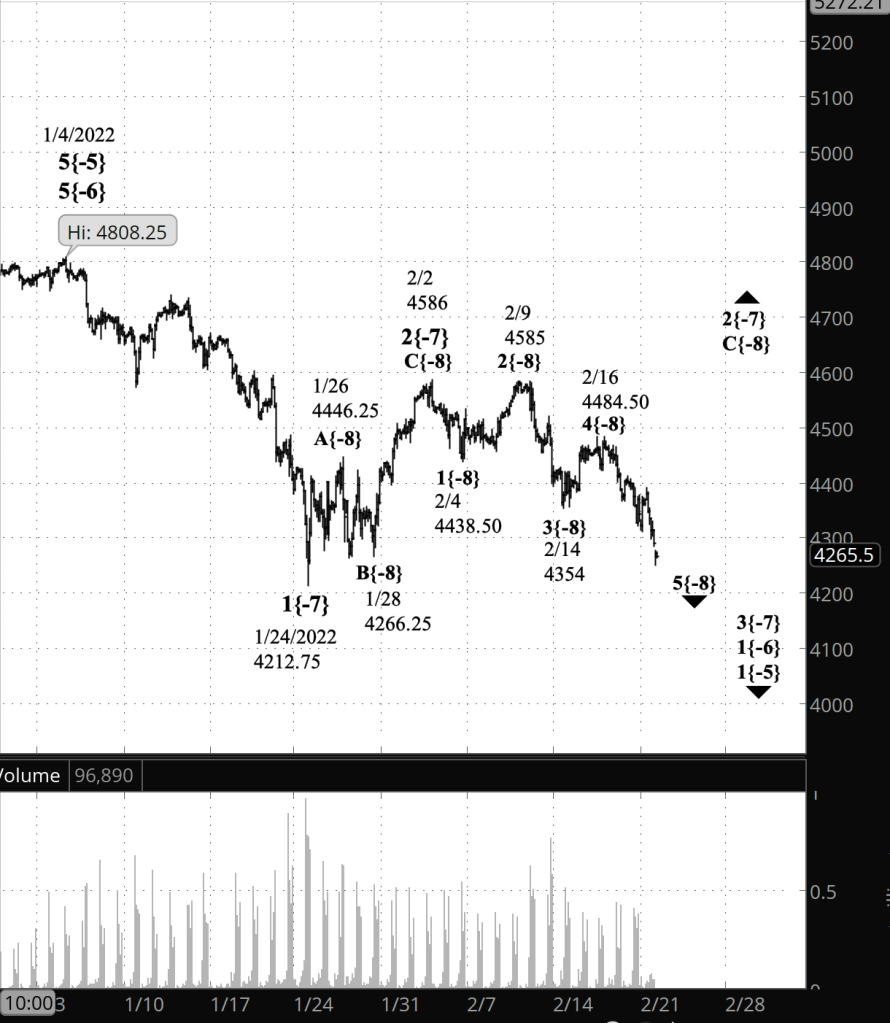
Trader’s Notebook

3:30 p.m. New York time

Half an hour before the closing bell. The S&P 500 futures rose by nearly 109 points during the session and then declined, coming to within a point and a half of the overnight low.

The downtrend continues, presently as wave 5{-9} within wave 3{-8}. The end of wave 5{-9} will also be the end of 3{-8}, which will be followed by a, most likely, sideways correction, wave 4{-8}, and then by a final push to the downside, wave 5{-8}.

Looking to the future, that final push at its completion will mark the end of its parent wave, 1{-7}, which began at the January 4 peak. The ensuing upward correction, wave 2{-7}, will most likely retrace much of the decline since early January. The only limit on its upward movement is the start of the preceding wave 1{-7}, at 4808.25. There’s no guarantee, of course, that the price will approach that neighborhood.

I’ve updated the chart.

1:30 p.m. New York time

SPY bear play. I’ve entered a short bear call vertical spread on SPY, based on my analysis of the S&P 500 E-mini futures showing that the downtrend that began January 4 has resumed after an upward correction. I’ve posted an analysis of the trade.

9:35 a.m. New York time

The holiday Trader’s Notebook. The stock markets may take holidays but the futures rarely do. The S&P 500 E-mini futures traded on Monday — a market holiday in the U.S. — and I posted an analysis. It proved to be an eventful day when trading resumed in the evening after a morning session and a break. Monday’s Trader’s Notebook can be found here. It contains charts of both the old analysis and the new one, for comparison. Another item in the Monday post points to the exit analysis of my options position in ACI, which can be read here.

What’s happening now? The S&P 500 E-mini futures fell below a key price level, 4266.25, early in overnight trading and around 3 a.m., the time that the London stock exchange opened, reversed, rising by more than 95 points.

What does it mean? The piercing of the 4266.25 level confirms a resumption of the downtrend that began on January 4 from 4808.25. The correction from January 24 ended and the middle leg of the downtrend began on February 2, from 4586. Internally, the first segment of that middle leg is nearing its end and will be followed by an upward correction of fairly small size. The overnight bounce may have been the beginning of the correction, although it could be smaller reversal within that first segment.

What’s the alternative? The ambiguities resolve around the size — the degree — of the decline so far, which in turn is important in understanding how great a decline is possible at this point. More on the subject in the Elliott wave theory section.

[S&P 500 E-mini futures at 3:30 p.m., 2-hour bars, with volume]

What does Elliott wave theory say? By my principal analysis, the futures are presently in wave 5{-8}, which began on February 16, within wave 3{-7}, beginning February 2, within wave 1{-6}, which began with the January 4 peak. Within wave 5{-8}, it would appear that it is in its final wave, 5{-9}, although it’s not an entirely clear count. The morning bounce could be a correction within wave 5{-9}, or it could be the beginning of a wave 4{-7} correction to the upside.

Prior to Monday evening, my principal analysis had wave 4{-9} underway, a downward compound correction that began on February 2. Under the Elliott rules, 4th waves can’t move beyond the end of the preceding 1st wave, which was at 4266.25. When the price moved below that level Monday evening, I re-analyzed the chart to bring it back into conformance withe the rules of Elliott wave analysis. The only way to do that was to count the correction — wave 2{-7} — as having ended on February 2, and the downtrend to have resumed, as wave 3{-7}, on that date.

In the revised analysis, I’ve counted the waves after February 2 as being of the {-8} degree. There’s no reason why they couldn’t be of the {-9} degree, or even the {-10} degree. Selecting a degree in a new movement is at best a guess. I chose {-8} because the durations seemed to fit in with previous {-8} movements. But an alternative labeling at the {-9} degree or lower is entirely possible.

We Are Here.

These are the waves currently in progress under my principal analysis. Each line on the list shows the wave number, with the subscript in curly brackets, the traditional degree name, the starting date, the starting price of the S&P 500 E-mini futures, and the direction of the wave.

  • 5{0} Intermediate, 12/21/2018, 2316.75 (up)
  • 3{1} Minor, 3/23/2018 2174 (up)
  • 5{-2} Minute, 10/4/2020, 4267.50 (up)
  • 4{-3} Minuette, 1/4/2022, 4808.25 (down)
  • A{-4} Subminuette, 1/4/2022, 4808.25 (down)
  • 1{-5} Micro, 1/4/2022, 4808.25 (down)
  • 1{-6} Submicro, 1/4/2022, 4808.25 (down)
  • 3{-7} Minuscule, 2/2/2022, 4586 (down)
  • 5{-8} Subminuscule, 2/16/2022, 4484.50 (down)

Learning and other resources. Elliott wave analysis provides context, not prophecy. As the 20th century semanticist Alfred Korzybski put it this way in his book Science and Sanity (1933), “The map is not the territory … The only usefulness of a map depends on similarity of structure between the empirical world and the map.” And I would add, in the ever-changing markets, we can judge that similarity of structure only after the fact.

See the menu page Analytical Methods for a rundown on where to go for information on Elliott wave analysis.

By Tim Bovee, Portland, Oregon, February 22, 2022

Disclaimer

Tim Bovee, Private Trader tracks the analysis and trades of a private trader for his own accounts. Nothing in this blog constitutes a recommendation to buy or sell stocks, options or any other financial instrument. The only purpose of this blog is to provide education and entertainment.

No trader is ever 100 percent successful in his or her trades. Trading in the stock and option markets is risky and uncertain. Each trader must make trading decisions for his or her own account, and take responsibility for the consequences.

License
Creative Commons License

All content on Tim Bovee, Private Trader by Timothy K. Bovee is licensed under a Creative Commons Attribution-ShareAlike 4.0 International License.

Based on a work at www.timbovee.com.
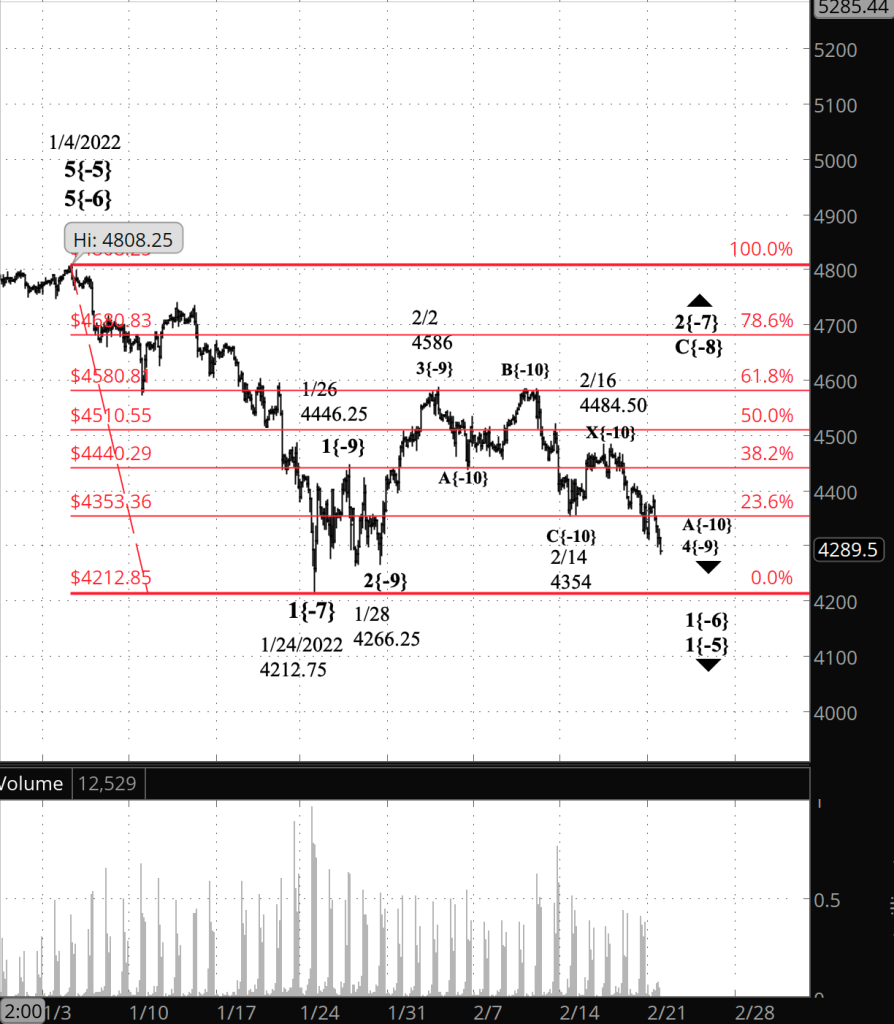
Trader’s Notebook

7:15 p.m. New York time

Next-day open. As the S&P 500 futures re-opened, at 5 p.m., for the overnight session leading to Tuesday’s market open, the price declined below the 4266.25 level — the end point 1{-7} — triggering a reanalysis of the chart, which I have completed with a glass of fine wine in hand while watching “The Guilded Age” (Season 1 Episode 2) on HBO Now. The price has so far dropped to 4250. The decline that began on January 4 has resumed. In Elliott wave terms, wave 2{-7} to the upside ended on February 7, wave 3{-7} to the downside is still underway, all within wave 1{-6} to the downside.

I’ve retained the old analysis in the chart from this morning, and here is the new chart.

[S&P 500 E-mini futures at 7:15 p.m., 2-hour bars, with volume]

3 p.m. New York time

At the close. The S&P 500 futures moved slightly lower during the shortened trading session but remained above the price level, 4266.25, that would trigger a re-analysis of the chart. No change in the present prime analysis. I’ve updated the chart.

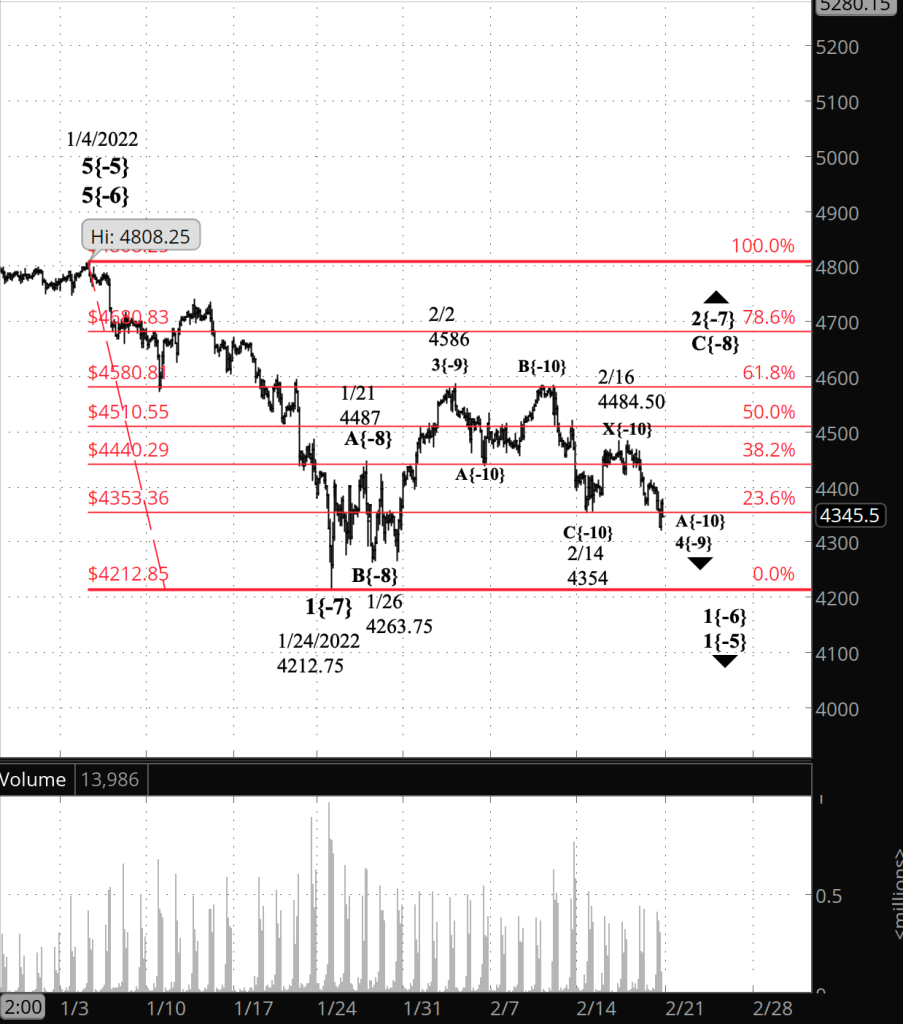
9:45 a.m. New York time

ACI earnings play expires. The call options in my earnings play on ACI expired on Saturday. In January I exited the put options which were in the money, in order to avoid exercise. The remaining call options remained out of the money and expired without value, providing maximum profit. I’ve updated the ACI analysis with results from the calls exit and with an analysis of the original iron condor position, puts and calls.

9:35 a.m. New York time

Holiday. Most U.S. markets will be closed today in observance of the President’s Day holiday. Futures traded overnight and will continue trading until 1 p.m. New York time.

What’s happening now? The S&P 500 E-mini futures initially rose by 50 points in overnight trading but then declined back into the 4310s.

What does it mean? The downward correction that began on February 2 continues. Having completed one one corrective pattern, it has entered the first leg of a second pattern within a compound correction.

What’s the alternative? It’s possible that the February 2 high marked the end of an upward correction, and that the decline since then has been a resumption of the downtrend that began at the January 4 peak. A decline below 4266.25– the January 28 low — would confirm the alternative count.

[S&P 500 E-mini futures at 3 p.m., 2-hour bars, with volume]

What does Elliott wave theory say? Under the principal analysis, the first corrective pattern with wave 4{-9} — a downward correction — ended on February 14, the connecting wave X{-10} ended on February 16, and the ensuing decline is wave A{-10}, the first wave of a second corrective pattern within a compound correction. A of Elliott wave analysis forbids a count that shows a 4th wave moving beyond the end of the preceding wave 1 of the same degree. A move below 4266.25 would violate that rule and force a re-analysis of the chart.

The most likely alternative, if the present principal analysis is invalidated, would be an analysis that labels the February 2 high as the end of wave 2{-7}, an upward correction, and the subsequent decline as wave 3{-7}, a resumption of the downtrend that began on January 4.

We Are Here.

These are the waves currently in progress under my principal analysis. Each line on the list shows the wave number, with the subscript in curly brackets, the traditional degree name, the starting date, the starting price of the S&P 500 E-mini futures, and the direction of the wave.

  • 5{0} Intermediate, 12/21/2018, 2316.75 (up)
  • 3{1} Minor, 3/23/2018 2174 (up)
  • 5{-2} Minute, 10/4/2020, 4267.50 (up)
  • 4{-3} Minuette, 1/4/2022, 4808.25 (down)
  • A{-4} Subminuette, 1/4/2022, 4808.25 (down)
  • 1{-5} Micro, 1/4/2022, 4808.25 (down)
  • 1{-6} Submicro, 1/4/2022, 4808.25 (down)
  • 3{-7} Minuscule, 2/2/2022, 4586 (down)
  • 5{-8} Subminuscule, 2/16/2022, 4484.50 (down)

Learning and other resources. Elliott wave analysis provides context, not prophecy. As the 20th century semanticist Alfred Korzybski put it this way in his book Science and Sanity (1933), “The map is not the territory … The only usefulness of a map depends on similarity of structure between the empirical world and the map.” And I would add, in the ever-changing markets, we can judge that similarity of structure only after the fact.

See the menu page Analytical Methods for a rundown on where to go for information on Elliott wave analysis.

By Tim Bovee, Portland, Oregon, February 21, 2022

Disclaimer

Tim Bovee, Private Trader tracks the analysis and trades of a private trader for his own accounts. Nothing in this blog constitutes a recommendation to buy or sell stocks, options or any other financial instrument. The only purpose of this blog is to provide education and entertainment.

No trader is ever 100 percent successful in his or her trades. Trading in the stock and option markets is risky and uncertain. Each trader must make trading decisions for his or her own account, and take responsibility for the consequences.

License
Creative Commons License

All content on Tim Bovee, Private Trader by Timothy K. Bovee is licensed under a Creative Commons Attribution-ShareAlike 4.0 International License.

Based on a work at www.timbovee.com.
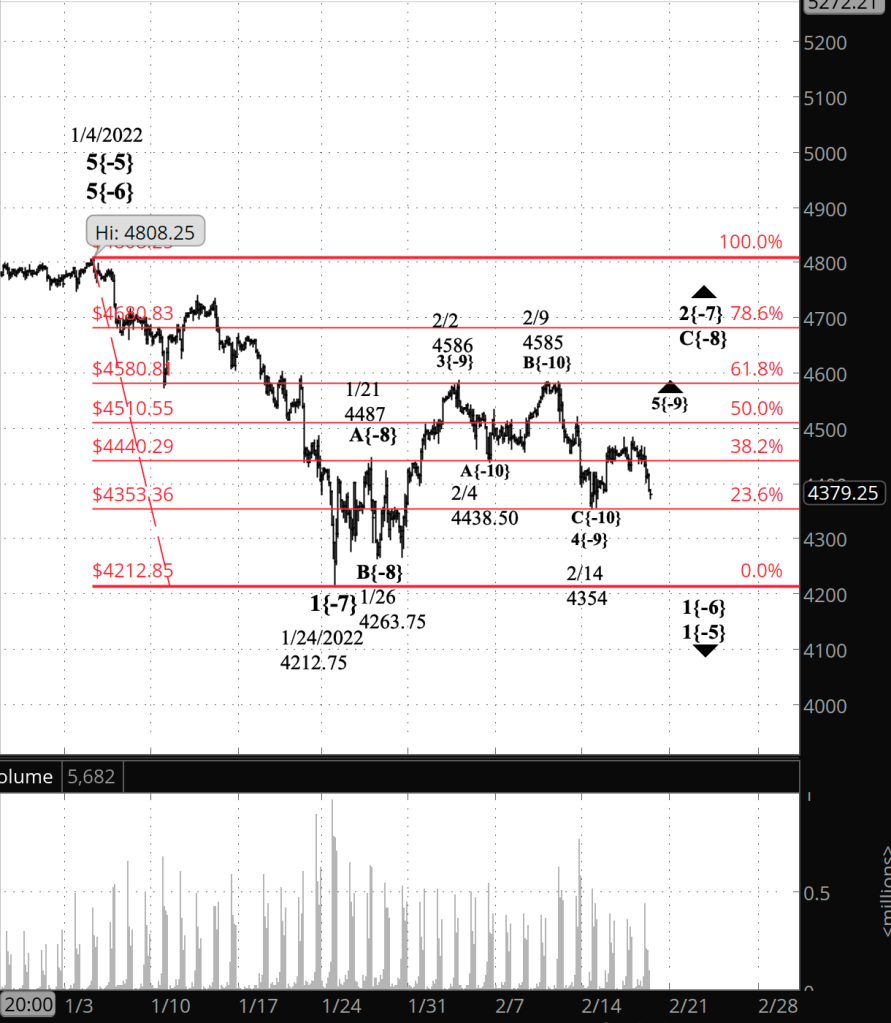
Trader’s Notebook

3:30 p.m. New York time

Half an hour before the closing bell. The S&P 500 futures continued to fall, slightly, during the trading session, reaching 30 points plus change below the 4354 level that triggered a reworking of the analysis, which remains as it was with this morning’s revision: The downward correction that began on February 2 continues. In Elliott wave terminology, the correction is wave 4{-9}. I’ve updated the chart.

11:02 a.m. New York time

S&P 500 futures fall below 4354. In my discussion this morning, below, I made the case for 4354 being an important price level in interpreting the chart. I said that a fall below that level would change the principal analysis.

At the time of this posting the price fell below 4354, down to 4340.50 so far.

Here’s the new principal analysis:

The downward correction that began February 2 from 4586 continues and is taking the form of a compound correction. The first corrective pattern ended on February 14 at 4354, and after a rise that connects the first pattern with what follows, a second corrective pattern has begun.

In Elliott wave analysis terminology: Wave 4{-9}, which began on February 2, is underway. Wave C{-10} within that 4th wave was completed on February 14. It was followed by wave X{-10} to the upside, which connects the first corrective pattern with a second pattern, which begins with wave A{-10} to the downside.

10:25 a.m.. New York time

MS earnings play exit. I’ve completed the second leg of my exit from an iron condor position on MS — I exited the puts on February 11, and today, the last trading day before expiration, I exited the calls. Overall, the iron condor produced a 53.2% loss. I’ve updated the trade analysis with the iron condor results, and it also has results for each leg of the exit.

9:35 a.m. New York time

What’s happening now? The S&P 500 E-mini futures rose to 4511.50 in overnight trading and then quickly retreated to 4359.50, just five points above the low of February 14.

What does it mean? The February 14 low, 4354, is important in analyzing the pattern on the chart, allowing us to distinguish between two possible interpretations. More on both in the Elliott wave theory section, but in plain terms, without the analytical jargon —

If the price remains above 4354, as it has so far, then it’s likely that the final leg of the downward correction that began on February 2 ended on February 14, and an uptrend has begun that will carry the price potentially into the 4700s and above.

What’s the alternative? If the price moves below 4354 — the low of February 14 — then under the rules of Elliott wave analysis the downward correction that began on February 2 is still underway.

[S&P 500 E-mini futures at 3:30 p.m., 2-hour bars, with volume]

What does Elliott wave theory say? The February 14 low is the beginning of wave 1{-10} within wave 5{-9}, an uptrend that has the potential of carrying the price significantly higher, although it must remain below the peak of 4808.25 set on January 4. That limit on upward movement is imposed at a higher degree: Wave 2{-7} to the upside is underway, 4808.25 marks the starting point of wave 1{-7} to the downside, and under the the Elliott rules no 2nd wave can move beyond the start of the preceding 1st wave of the same degree.

The limit on the downward movement is imposed the same restriction at a lower degree: Wave 2{-10} to the downside is underway, 4354 marks the starting point of wave 1{-10} to the upside, no 2nd wave can move beyond the starting point of the preceding 1st wave of the same degree.

If the price does move below 4354, then the parent wave 4{-9}, a downward correction that began on February 2, is still underway. Internally, wave 4{-9} has completed one three-wave corrective pattern at the {-10} degree, and the rise that began from February 14 to February 16 is wave X{-10}, a wave that connects the first corrective pattern with a second one that began on February 16 from 4484.50.

What the situation lacks in certainty it makes up for with clarity, a situation that warms the heart of any Elliott wave analyst.

We Are Here.

These are the waves currently in progress under my principal analysis. Each line on the list shows the wave number, with the subscript in curly brackets, the traditional degree name, the starting date, the starting price of the S&P 500 E-mini futures, and the direction of the wave.

  • 5{0} Intermediate, 12/21/2018, 2316.75 (up)
  • 3{1} Minor, 3/23/2018 2174 (up)
  • 5{-2} Minute, 10/4/2020, 4267.50 (up)
  • 4{-3} Minuette, 1/4/2022, 4808.25 (down)
  • A{-4} Subminuette, 1/4/2022, 4808.25 (down)
  • 1{-5} Micro, 1/4/2022, 4808.25 (down)
  • 1{-6} Submicro, 1/4/2022, 4808.25 (down)
  • 2{-7} Minuscule, 1/24/2022, 4212.75 (up)
  • C{-8} Subminuscule, 1/26/2022, 4263.75 (up)
  • 5{-9} Bitsy, 2/14/2022, 4354 (up)

Learning and other resources. Elliott wave analysis provides context, not prophecy. As the 20th century semanticist Alfred Korzybski put it this way in his book Science and Sanity (1933), “The map is not the territory … The only usefulness of a map depends on similarity of structure between the empirical world and the map.” And I would add, in the ever-changing markets, we can judge that similarity of structure only after the fact.

See the menu page Analytical Methods for a rundown on where to go for information on Elliott wave analysis.

By Tim Bovee, Portland, Oregon, February 18, 2022

Disclaimer

Tim Bovee, Private Trader tracks the analysis and trades of a private trader for his own accounts. Nothing in this blog constitutes a recommendation to buy or sell stocks, options or any other financial instrument. The only purpose of this blog is to provide education and entertainment.

No trader is ever 100 percent successful in his or her trades. Trading in the stock and option markets is risky and uncertain. Each trader must make trading decisions for his or her own account, and take responsibility for the consequences.

License
Creative Commons License

All content on Tim Bovee, Private Trader by Timothy K. Bovee is licensed under a Creative Commons Attribution-ShareAlike 4.0 International License.

Based on a work at www.timbovee.com.

Trader’s Notebook

3:30 p.m. New York time

Half an hour before the closing bell. The S&P 500 dropped during the session, approaching the 23.6% Fibonacci retracement level. I consider this to be a small-scale correction within uptrending wave 5{-9}, but will change my mind if it moves below 4354, the February 14 starting point of wave 5{-9}. A drop below that level could mean that a compound correction is underway, the alternative analysis from this morning. No change (yet) in my analysis. I’ve updated the chart.

10 a.m. New York time

WMT earnings play exit. I’ve exited my short bull put vertical spread on WMT for a 48.7% profit and have updated the entry analysis with full results.

9:35 a.m. New York time

What’s happening now? The S&P 500 E-mini futures continued to trade in a narrow range overnight, remaining close to the 38.2% Fibonacci retracement level.

What does it mean? By my principal analysis, the price is in the early stages of a rise that will complete the upward correction that began on January 24, from 4212.75. Upon completion of the correction, the price will resume the downtrend that began on January 4 from 4808.25.

What’s the alternative? The correction is taking a compound form, in which two or three corrective patterns are strung together. In this case, the price is tracing a rise that will connect the corrective pattern that ended on February 14 with a second pattern.

[S&P 500 E-mini futures at 3:30 p.m., 2-hour bars, with volume]

What does Elliott wave theory say? Principal analysis: Wave 5{-9} within wave C{-8} — both of them upward movements — is now underway. The completion of wave 5{-9} will also mark the end of C{-8} and its parent, wave 2{-7}. The subsequent resumption of the downtrend, wave 3{-7} within wave 1{-6}, will carry the price below the the 4212.75 level, perhaps significantly so.

I find the chart to be a bit confusing because of the A-B-C corrections at different levels. For guidance:

  • The low of February 14 ended the C wave of {-10} degree, part of a correction at the {-9} degree.
  • The subsequent wave, 5{-9}, is part of the C wave of the {-8} degree, part of a correction at the {-7} degree.
  • Wave 2{-7} — the larger correction — will end when wave 5{-9} completes wave C{-8}, which in turn completes wave C{-8}, and that event will mark the resumption of the downtrend that began January 4.

Alternative analysis: The wave that connects three-wave corrective patterns within a compound correction are called X waves. If wave 4{-9} is taking the form of a compound correction, then that wave is still underway — wave 5{-9} has not yet begun — and the rise from February 14 is wave X{-10} within wave 4{-9}. It will be followed by another three-wave corrective pattern.

We Are Here.

These are the waves currently in progress under my principal analysis. Each line on the list shows the wave number, with the subscript in curly brackets, the traditional degree name, the starting date, the starting price of the S&P 500 E-mini futures, and the direction of the wave.

  • 5{0} Intermediate, 12/21/2018, 2316.75 (up)
  • 3{1} Minor, 3/23/2018 2174 (up)
  • 5{-2} Minute, 10/4/2020, 4267.50 (up)
  • 4{-3} Minuette, 1/4/2022, 4808.25 (down)
  • A{-4} Subminuette, 1/4/2022, 4808.25 (down)
  • 1{-5} Micro, 1/4/2022, 4808.25 (down)
  • 1{-6} Submicro, 1/4/2022, 4808.25 (down)
  • 2{-7} Minuscule, 1/24/2022, 4212.75 (up)
  • C{-8} Subminuscule, 1/26/2022, 4263.75 (up)
  • 5{-9} Bitsy, 2/14/2022, 4354 (up)

Learning and other resources. Elliott wave analysis provides context, not prophecy. As the 20th century semanticist Alfred Korzybski put it this way in his book Science and Sanity (1933), “The map is not the territory … The only usefulness of a map depends on similarity of structure between the empirical world and the map.” And I would add, in the ever-changing markets, we can judge that similarity of structure only after the fact.

See the menu page Analytical Methods for a rundown on where to go for information on Elliott wave analysis.

By Tim Bovee, Portland, Oregon, February 17, 2022

Disclaimer

Tim Bovee, Private Trader tracks the analysis and trades of a private trader for his own accounts. Nothing in this blog constitutes a recommendation to buy or sell stocks, options or any other financial instrument. The only purpose of this blog is to provide education and entertainment.

No trader is ever 100 percent successful in his or her trades. Trading in the stock and option markets is risky and uncertain. Each trader must make trading decisions for his or her own account, and take responsibility for the consequences.

License
Creative Commons License

All content on Tim Bovee, Private Trader by Timothy K. Bovee is licensed under a Creative Commons Attribution-ShareAlike 4.0 International License.

Based on a work at www.timbovee.com.

WMT Trade

Walmart Inc. (WMT)

Update 2/17/2022: I exited my short bull put vertical spread on WMT, 29 days before expiration, for a $0.78 debit per contract/share, a profit before fees of $38 per contract. Shares were trading at $136.38, up $1.86 from the entry level.

The Implied Volatility Rank at exit was 51.4%, down 27.4 points from the entry level.

I exited because the position exceeded 25% of maximum potential profit, my normal exit point for earnings plays.

Shares rose by 1.4% over one day for a +505% annual rate. The options position produced a 48.7% return for a +17,782% annual rate.


I have entered a short bull put vertical spread on WMT, using options that trade for the last time 30 days hence, on March 18. The premium is a $1.16 credit per contract share and the stock at the time of entry was priced at $134.52.

The Implied Volatility Ratio stood at 78.8%.

Premium:$1.16Expire OTM
WMT-bull put spreadStrikeOddsDelta
Puts
Long125.0079.0%19
Break-even131.1672.0%25.5
Short130.0065.0%32

The premium is 46.4% of the width of the position’s short/long spread. The profit zone covers a 2.5% move to the downside and an unlimited move to the upside.

The risk/reward ratio is 3.3:1, with maximum risk of $384 and maximum reward of $116 per contract.

How I chose the trade. The trade was placed to coincide with WMT’s earnings announcement, before the opening bell on the day after entry. The short strikes were set to coincide with the expected move of $4.71 either way, based on options pricing, which gives a price range of $129.92 to $139.34.

By Tim Bovee, Portland, Oregon, February 16, 2022

Disclaimer

Tim Bovee, Private Trader tracks the analysis and trades of a private trader for his own accounts. Nothing in this blog constitutes a recommendation to buy or sell stocks, options or any other financial instrument. The only purpose of this blog is to provide education and entertainment.

No trader is ever 100 percent successful in his or her trades. Trading in the stock and option markets is risky and uncertain. Each trader must make trading decisions for his or her own account, and take responsibility for the consequences.

License
Creative Commons License

All content on Tim Bovee, Private Trader by Timothy K. Bovee is licensed under a Creative Commons Attribution-ShareAlike 4.0 International License.

Based on a work at www.timbovee.com.