Trader’s Notebook

3:30 p.m. New York time

Half an hour before the closing bell. The S&P 500 futures have traded within a 40-point range during the session, continuing a sideways movement. No change in the analysis; wave 5{-9} is in the early stages of its rise. I’ve updated the chart.

10 a.m. New York time

WMT earnings play entry. I’ve entered a short bull put options spread on WMT, timed to coincide with the company’s earnings announcement before the opening bell tomorrow, and have posted an analysis of the trade.

9:35 a.m. New York time

What’s happening now? In overnight trading, the S&P 500 E-mini futures remained close to a 38.2% retracement of the decline from January 4 to January 24.

What does it mean? Under my principal analysis, the sideways movement is a correction within the early portion of a rise that began on February 14 and that will carry the price noticeably higher, perhaps to the 61.8% retracement level. The end of the rise will also mark the end of the upward correction that began on January 24 and will be followed by a decline that will carry the price to 4212 and below, as the downtrend that began on January 4 resumes.

What’s the alternative? The rise from February 14 could be connecting the corrective pattern just ended with a second corrective pattern in a compound correction. Under this scenario, I still anticipate the rise followed by a significant decline, described above in the principal analysis. But they’ll be delayed until the compound correction is complete. Compound corrections can connect up to three corrective patterns.
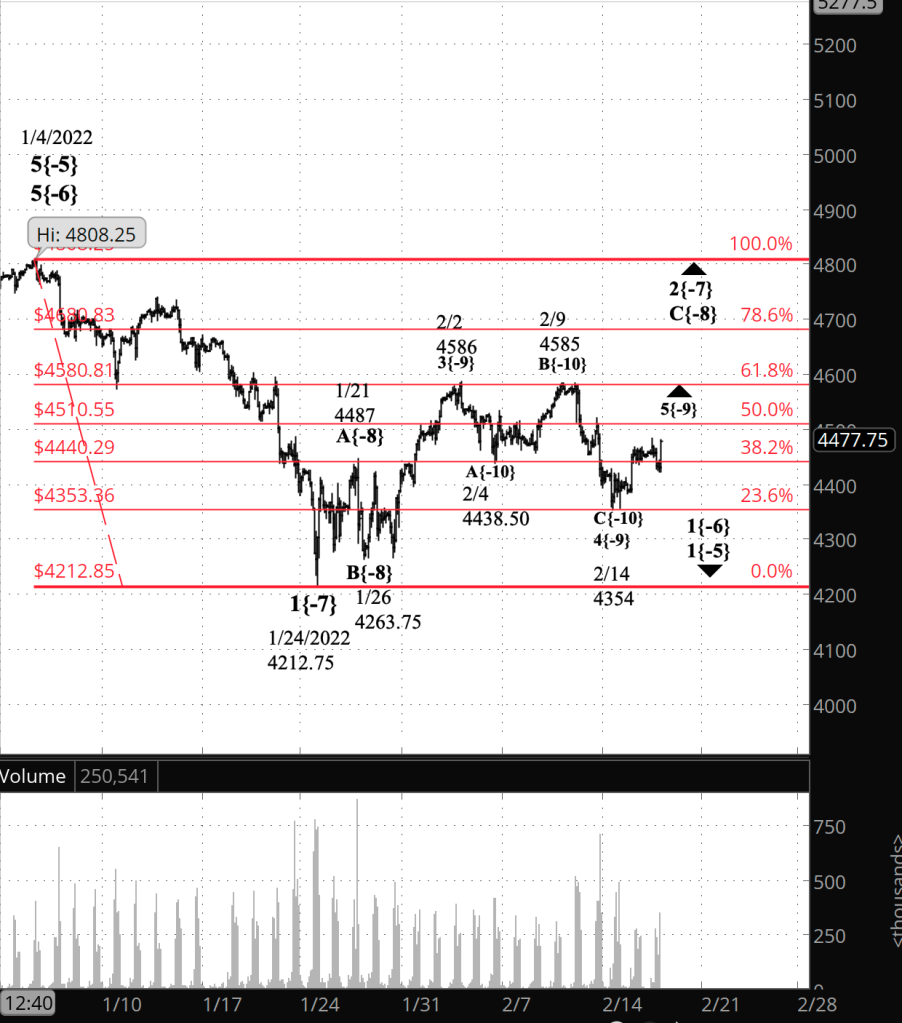
[S&P 500 E-mini futures at 3:30 p.m., 110-minute bars, with volume]

What does Elliott wave theory say? Under my principal analysis, the rise from February 14 is the early stage of wave 5{-9}, the final wave within wave C{-8}, the final wave in wave 2{-7}, an upward correction that began on January 24.

Wave 5{-9}’s endpoint will mark the end of both waves C{-8} and 2{-7}. Wave 3{-7} will follow, resuming the downtrend with the energy associated with 3rd waves. Wave 3{-7} will remove much of the ambiguity from the market, defining with great clarity that the dominant mood of traders is bearish.

Under the alternative analysis, wave 4{-9} is still underway, and the rise from February 14 is wave X{-10}, connecting two corrective patterns. The end of wave 4{-9}, after a compound correction of two or three corrective patterns, will be followed by uptrending wave 5{-9}, ending wave C{-8} and 2{-8}, and then by downtrending wave 3{-7}.

We Are Here.

These are the waves currently in progress under my principal analysis. Each line on the list shows the wave number, with the subscript in curly brackets, the traditional degree name, the starting date, the starting price of the S&P 500 E-mini futures, and the direction of the wave.

  • 5{0} Intermediate, 12/21/2018, 2316.75 (up)
  • 3{1} Minor, 3/23/2018 2174 (up)
  • 5{-2} Minute, 10/4/2020, 4267.50 (up)
  • 4{-3} Minuette, 1/4/2022, 4808.25 (down)
  • A{-4} Subminuette, 1/4/2022, 4808.25 (down)
  • 1{-5} Micro, 1/4/2022, 4808.25 (down)
  • 1{-6} Submicro, 1/4/2022, 4808.25 (down)
  • 2{-7} Minuscule, 1/24/2022, 4212.75 (up)
  • C{-8} Subminuscule, 1/26/2022, 4263.75 (up)

Learning and other resources. Elliott wave analysis provides context, not prophecy. As the 20th century semanticist Alfred Korzybski put it this way in his book Science and Sanity (1933), “The map is not the territory … The only usefulness of a map depends on similarity of structure between the empirical world and the map.” And I would add, in the ever-changing markets, we can judge that similarity of structure only after the fact.

See the menu page Analytical Methods for a rundown on where to go for information on Elliott wave analysis.

By Tim Bovee, Portland, Oregon, February 16, 2022

Disclaimer

Tim Bovee, Private Trader tracks the analysis and trades of a private trader for his own accounts. Nothing in this blog constitutes a recommendation to buy or sell stocks, options or any other financial instrument. The only purpose of this blog is to provide education and entertainment.

No trader is ever 100 percent successful in his or her trades. Trading in the stock and option markets is risky and uncertain. Each trader must make trading decisions for his or her own account, and take responsibility for the consequences.

License
Creative Commons License

All content on Tim Bovee, Private Trader by Timothy K. Bovee is licensed under a Creative Commons Attribution-ShareAlike 4.0 International License.

Based on a work at www.timbovee.com.
Trader’s Notebook

3:30 p.m. New York time

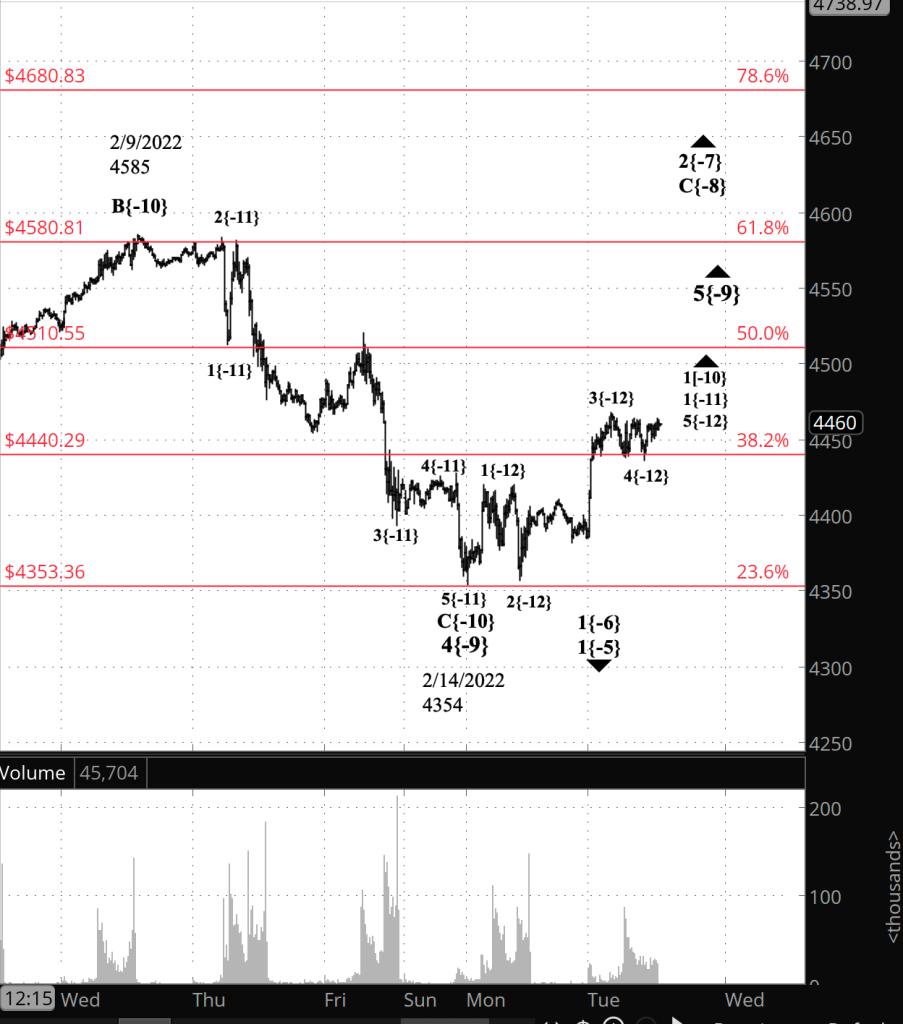
Half an hour before the closing bell. The S&P 500 futures spent the day trading just above the 38.2% retracement level. The very low level downward correction, wave 4{-12} has completed three waves and so has met the basic requirement for completion, and I’ve so marked it on the chart. Under this scenario, wave 5{-12} has begun its rise. It is situated within wave 1{-11} within wave 1{-10} within wave 5{-9} within wave C{-8} within wave 2{-7}. They are subwaves of wave C{-8}, which began on January 24.

9:35 a.m. New York time

What’s happening now? The S&P 500 E-mini futures rose in overnight trading, returning to the 38.2% retracement of the decline that began on January 4. [Corrected to 38.2% rather than 50%.]

What does it mean? The final leg of the final leg of the upward correction that began on January 26 is underway.

What’s the alternative? It’s possible that the rise that began overnight will connect two corrective patterns — the one just finished and one to come — in a compound structure. Such compound corrections can link up to three corrective structures.

[S&P 500 E-mini futures at 3:30 p.m., 15-minute bars, with volume]

What does Elliott wave theory say? The overnight rise marked the beginning of wave 5{-9}, the final wave within wave C{-8}, an upward correction that began on January 26 from 4263.75. The end of wave 5{-9} will also be the end of its parent wave C{-9} and of the correction’s parent, wave 2{-7}, which began on January 24 from 4212.75.

The structure within wave 5{-9} is consistent with an uptrend. From the smaller wave degree to the larger, the current fractal positioning is wave 4{-12} to the downside within a series of rising waves, beginning with wave 1{-11} within wave 1{-10} within wave wave 5{-9}, all of which began February 14 from 4354.

For a broader view, see the chart in yesterday’s Trader’s Diary.

We Are Here.

These are the waves currently in progress under my principal analysis. Each line on the list shows the wave number, with the subscript in curly brackets, the traditional degree name, the starting date, the starting price of the S&P 500 E-mini futures, and the direction of the wave.

  • 5{0} Intermediate, 12/21/2018, 2316.75 (up)
  • 3{1} Minor, 3/23/2018 2174 (up)
  • 5{-2} Minute, 10/4/2020, 4267.50 (up)
  • 4{-3} Minuette, 1/4/2022, 4808.25 (down)
  • A{-4} Subminuette, 1/4/2022, 4808.25 (down)
  • 1{-5} Micro, 1/4/2022, 4808.25 (down)
  • 1{-6} Submicro, 1/4/2022, 4808.25 (down)
  • 2{-7} Minuscule, 1/24/2022, 4212.75 (up)
  • C{-8} Subminuscule, 1/26/2022, 4263.75 (up)
  • 5{-9} Bitsy, 2/14/2022, 4354 (up)
  • 1{-10} Subbitsy, 2/14/2022, 4354 (up)
  • 1{-11} Deci, 2/14/2022, 4354 (up)
  • 5{-12} Centi, 2/15/2022, 4468 (up)

Learning and other resources. Elliott wave analysis provides context, not prophecy. As the 20th century semanticist Alfred Korzybski put it this way in his book Science and Sanity (1933), “The map is not the territory … The only usefulness of a map depends on similarity of structure between the empirical world and the map.” And I would add, in the ever-changing markets, we can judge that similarity of structure only after the fact.

See the menu page Analytical Methods for a rundown on where to go for information on Elliott wave analysis.

By Tim Bovee, Portland, Oregon, February 15, 2022

Disclaimer

Tim Bovee, Private Trader tracks the analysis and trades of a private trader for his own accounts. Nothing in this blog constitutes a recommendation to buy or sell stocks, options or any other financial instrument. The only purpose of this blog is to provide education and entertainment.

No trader is ever 100 percent successful in his or her trades. Trading in the stock and option markets is risky and uncertain. Each trader must make trading decisions for his or her own account, and take responsibility for the consequences.

License
Creative Commons License

All content on Tim Bovee, Private Trader by Timothy K. Bovee is licensed under a Creative Commons Attribution-ShareAlike 4.0 International License.

Based on a work at www.timbovee.com.
Trader’s Notebook

3:30 p.m. New York time

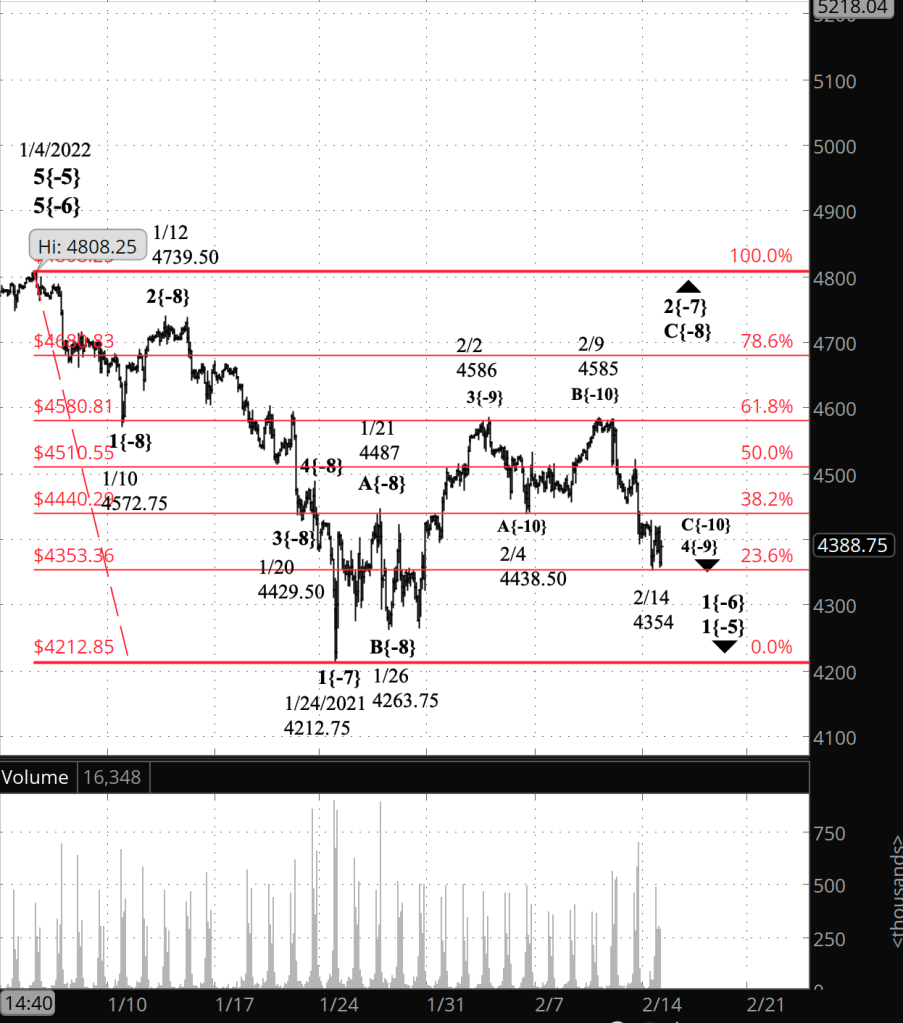
Half an hour before the closing bell. The S&P 500 futures rose toward the 38.2% retracement level and then fell back to the 23.6% level, remaining slightly above the overnight low, 4354. My analysis from the morning is unchanged, and the same goes for the caveat in the alternative analysis. Bottom line: Wave C{-10} within wave 4{-9} — a downward move within an upward correction — is underway, and may have ended at 4354, although that’s not a certainty. When it ends, then wave 5{-9} will begin. The price will rise but will remain below 4808.25, the high of January 4. I’ve updated the chart.

2:30 p.m. New York time

SPY short bear call spread exit. I’ve exited my short bear call options spread spread for an 85% profit and have updated the entry analysis with full details of the exit.

9:35 a.m. New York time

What’s happening now? The S&P 500 E-mini futures fell to 4354 after trading resumed overnight and then reversed, rising slightly. The reversal came at the 23.6% Fibonacci retracement level.

What does it mean? The downward correction continues. It began on February 2 from 4586. The downward correction is a component within an upward correction that began January 24 from 4212.75. Each correction is in its final leg final, and the end of the smaller correction will trigger a final rise that will bring the larger correction to an end.

There is much more to unravel in this complex moment for the markets. See the Elliott wave theory section below for discussion.

What’s the alternative? The primary question is when will the smaller correction end. It may have ended overnight at the 4354 level. But that’s not a certainty.

[S&P 500 E-mini futures at 3:30 p.m., 100-minute bars, with volume]

What does Elliott wave theory say? The smaller, downward correction is wave 4{-9} and internally, it is internally in wave C{-10}. The end of the wave C{-10} will also mark the end of wave 4{-9}, triggering an upward movement, wave 5{-9}, which will remain below the January 4 peak, 2808.25.

The larger correction is wave 2{-7}, which began January 24 from 4212.75, and internally, it is within its final leg, wave C{-8}, whose end will mark a resumption of the downtrend that began on January 4, wave 3{-7}, a powerful wave that almost certainly will carry the price below 4212.75, the end of the preceding 1st wave.

Wave 3{-7} is the middle leg of a 1st wave at the {-6} degree, which in turn is the 1st wave within its parent degree, {-5}, which in turn is part of a downward correction, wave A{-4} within wave 4{-3}, all of which began on January 4.

And so, on to the alternative. Everything hinges on whether wave C{-10} is over or not. It’s a downward movement and will have five subwaves. As I count it, it is now in its 5th wave, which is the shortest of the three downward waves. If the price reverses and that 5th wave continues downward, then it comes down to its length relative to that the preceding 3rd wave. The 3rd wave can’t be the shortest wave in the direction of the trend, and if the 5th wave turns out to be longer than the 3rd, then count will need to be redone

We Are Here.

These are the waves currently in progress under my principal analysis. Each line on the list shows the wave number, with the subscript in curly brackets, the traditional degree name, the starting date, the starting price of the S&P 500 E-mini futures, and the direction of the wave.

  • 5{0} Intermediate, 12/21/2018, 2316.75 (up)
  • 3{1} Minor, 3/23/2018 2174 (up)
  • 5{-2} Minute, 10/4/2020, 4267.50 (up)
  • 4{-3} Minuette, 1/4/2022, 4808.25 (down)
  • A{-4} Subminuette, 1/4/2022, 4808.25 (down)
  • 1{-5} Micro, 1/4/2022, 4808.25 (down)
  • 1{-6} Submicro, 1/4/2022, 4808.25 (down)
  • 2{-7} Minuscule, 1/24/2022, 4212.75 (up)
  • C{-8} Subminuscule, 1/26/2022, 4263.75 (up)
  • 4{-9} Bitsy, 2/2/2022, 4586 (down)
  • C{-10}Subbitsy, 2/9/2022, 4585 (down)

Learning and other resources. Elliott wave analysis provides context, not prophecy. As the 20th century semanticist Alfred Korzybski put it this way in his book Science and Sanity (1933), “The map is not the territory … The only usefulness of a map depends on similarity of structure between the empirical world and the map.” And I would add, in the ever-changing markets, we can judge that similarity of structure only after the fact.

See the menu page Analytical Methods for a rundown on where to go for information on Elliott wave analysis.

By Tim Bovee, Portland, Oregon, February 14, 2022

Disclaimer

Tim Bovee, Private Trader tracks the analysis and trades of a private trader for his own accounts. Nothing in this blog constitutes a recommendation to buy or sell stocks, options or any other financial instrument. The only purpose of this blog is to provide education and entertainment.

No trader is ever 100 percent successful in his or her trades. Trading in the stock and option markets is risky and uncertain. Each trader must make trading decisions for his or her own account, and take responsibility for the consequences.

License
Creative Commons License

All content on Tim Bovee, Private Trader by Timothy K. Bovee is licensed under a Creative Commons Attribution-ShareAlike 4.0 International License.

Based on a work at www.timbovee.com.
Trader’s Notebook

3:30 p.m. New York time

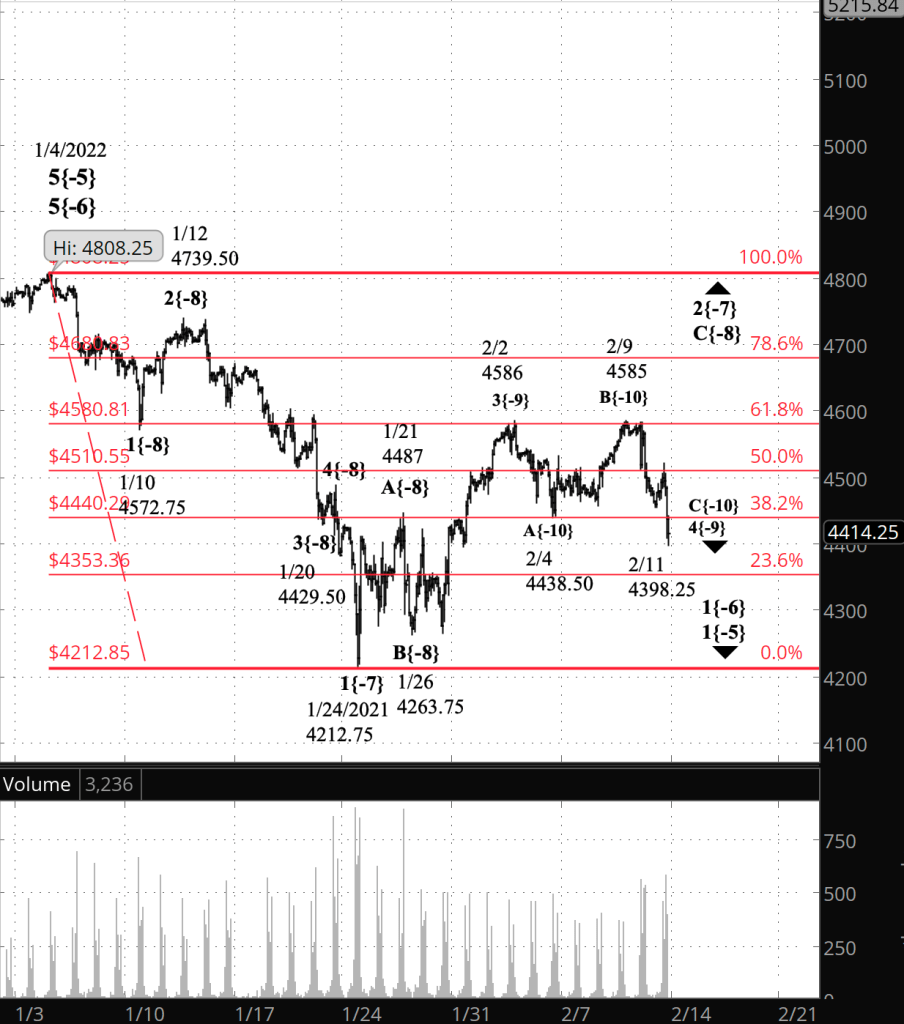
Half an hour before the closing bell. The S&P 500 declined during the session, reaching a low of 4398.25 so far on the futures. The decline put the price below the 38.2% retracement level. There’s nothing in today’s patterns that requires a change in this morning’s analysis, and so it stands. I’ve updated the chart.

2:10 p.m. New York time

MS earnings play, partial exit. MS soared beyond the boundaries of my iron condor after earnings were published, and with seven days left before expiration, I’ve exited the in-the-money calls for a loss to avoid the possibility of assignment. I’ve updated the entry analysis with details of the exit.

9:35 a.m. New York time

What’s happening now? The S&P 500 E-mini futures approached the 38.2% Fibonacci retracement level in overnight trading and then rose to the 50% retracement.

What does it mean? I’ve revised my labeling in light of yesterday’s market movements. The downward correction that began on February 2 is still underway and is in its third and most likely final phase. When the correction is complete, then the price will resume its rise, part of a larger upward correction that began on January 24. The large decline on February 10 was the middle leg of the final phase of the correction. I expect a rise and then a final decline to wrap up the correction.

What are the alternatives? There are two alternatives

Alternative #1: The correction could extend into a compound structure, stringing together two or three corrective patterns.

Alternative #2: The middle leg of the final phase could be the final leg of the final phase. If that’s the case, then the rise overnight is the beginning of the last leg of the larger correction that began on January 24.

[S&P 500 E-mini futures at 3:30 p.m., 100-minute bars, with volume]

What does Elliott wave theory say? My prior analysis had labeled the February 4 low as the end of wave 4{-9}. The magnitude of the movements on February 10 makes a new labeling more in line with the requirement in Elliott that waves have the “right look”. I interpret that to mean that there can’t be a wild divergence in size among waves of the same degree. Yesterday’s outsized movements placed my former labeling beyond “right look”.

So the new labels have the February 4 low as the end of of wave A{-10} within 4{-9}, the February 9 high as the end of wave B{-10}. And then it gets tricky. The low of February 10 would on the chart be a “right look” end point for wave C{-10}. However, the wave 4{-9} correction is taking the form of a Zigzag (with a 5-3-5 internal wave structure). I count only three waves so far within wave C{-10}. So a rise and then a decline will me need to complete C{-10}.

Under my principal analysis, the end of wave C{-10} will also mark the end of its parent wave 4{-9}. However, my Alternative #1 recognizes that it’s possible that the wave 4{-9} correction will take a compound form, with the present first corrective pattern being followed by wave X{-10} to the upside, which will be followed by a second corrective pattern. Compound corrections can contain up to three corrective patterns.

In either case, the correction will be followed by wave 5{-10}, a rise that most likely will move above the February 2 high, 4586, which ended the preceding wave 3{-9}. Fifth waves are sometimes truncated, so there’s no guarantee that wave 5{-9} will reach above that level.

Alternative #2 considers the low of February 10 to be the end of wave 4{-9}, and the subsequent upward movement to be the first tentative step in uptrending wave 5{-9}. In a Flat or Zigzag pattern, wave C{-10} must have five waves internally. I count only three so far, and so I consider this alternative to be less likely. However, there is ambiguity in all waves, and so it could be that wave 5{-9} is now underway.

We Are Here.

These are the waves currently in progress under my principal analysis. Each line on the list shows the wave number, with the subscript in curly brackets, the traditional degree name, the starting date, the starting price of the S&P 500 E-mini futures, and the direction of the wave.

  • 5{0} Intermediate, 12/21/2018, 2316.75 (up)
  • 3{1} Minor, 3/23/2018 2174 (up)
  • 5{-2} Minute, 10/4/2020, 4267.50 (up)
  • 4{-3} Minuette, 1/4/2022, 4808.25 (down)
  • A{-4} Subminuette, 1/4/2022, 4808.25 (down)
  • 1{-5} Micro, 1/4/2022, 4808.25 (down)
  • 1{-6} Submicro, 1/4/2022, 4808.25 (down)
  • 2{-7} Minuscule, 1/24/2022, 4212.75 (up)
  • C{-8} Subminuscule, 1/26/2022, 4263.75 (up)

Learning and other resources. Elliott wave analysis provides context, not prophecy. As the 20th century semanticist Alfred Korzybski put it this way in his book Science and Sanity (1933), “The map is not the territory … The only usefulness of a map depends on similarity of structure between the empirical world and the map.” And I would add, in the ever-changing markets, we can judge that similarity of structure only after the fact.

See the menu page Analytical Methods for a rundown on where to go for information on Elliott wave analysis.

By Tim Bovee, Portland, Oregon, February 11, 2022

Disclaimer

Tim Bovee, Private Trader tracks the analysis and trades of a private trader for his own accounts. Nothing in this blog constitutes a recommendation to buy or sell stocks, options or any other financial instrument. The only purpose of this blog is to provide education and entertainment.

No trader is ever 100 percent successful in his or her trades. Trading in the stock and option markets is risky and uncertain. Each trader must make trading decisions for his or her own account, and take responsibility for the consequences.

License
Creative Commons License

All content on Tim Bovee, Private Trader by Timothy K. Bovee is licensed under a Creative Commons Attribution-ShareAlike 4.0 International License.

Based on a work at www.timbovee.com.
Trader’s Notebook

3:45 p.m. New York time

And there’s more. The S&P 500 futures prices continued to decline, meaning that wave C{-11} within wave 4{-10} still has some downside to go before wave 5{-10} begins. The low as of this update is 4485.50.

3:30 p.m. New York time

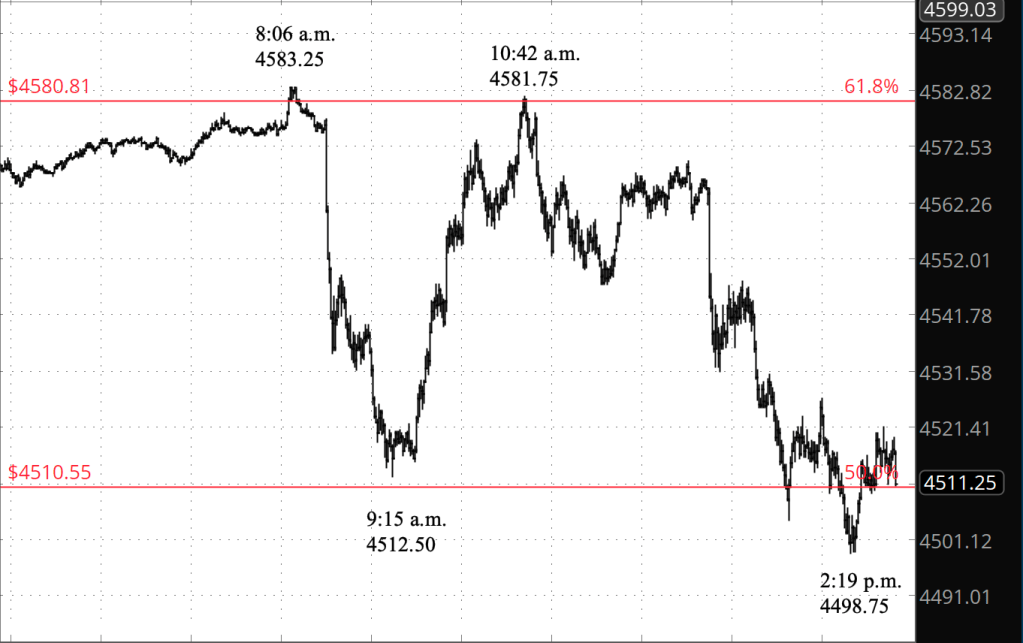
Half an hour before the closing bell. The S&P 500 traced a roller coaster ride today, dropping in less than an hour from the overnight peak of 4583.25 to 4512.50, and then reversing back up to 4581.75 in the first hour of trading session. During the session it worked its way still lower, to 4498.75, before reversing and rising again. As the closing bell approaches, the price is sticking close to the 50% retracement level after a journey that began from slightly above the 61.8% retracement level.

[S&P 500 E-mini futures at 2:50 p.m., 1-minute bars]

What to make of all of that? First, the February 9 high, 4585, was challenged but not surpassed, therefore this morning’s principal analysis stands: Wave 5{-9} within wave C{-8} within wave 2{-7} remains underway. Today’s drama was within wave 5{-9}.

I count it this way: The decline and rise is wave 4{-10}, a downward correction within uptrending wave 5{-9}. The first decline in overnight trading was wave A{-11} within wave 4{-10}, the subsequent rise is wave B{-11}, and the decline that followed is wave C{-11}, ending wave 4{-10}, unless the correction develops into a compound structure. In that latter case, there will be a rising X-wave and then a second corrective pattern.

So in the chart above, clearly, we’re seeing an A wave with three internal waves, a B wave with three waves within it, and a C wave with five waves internally. The 3-3-5 pattern means it’s a Flat, one of the standard corrective patterns identified by Elliott wave theory.

The rise this afternoon is the beginning of wave 5{-10} within wave 5{-9}. I expect it to rise above the February 9 high, 4585, which is the end of wave 3{-10}. If the price does rise above that level, then the wave 5{-10} analysis is proven. If the price stays below that level, then the compound correction analysis is more likely.

I’ve updated the chart below.

9:35 a.m. New York time

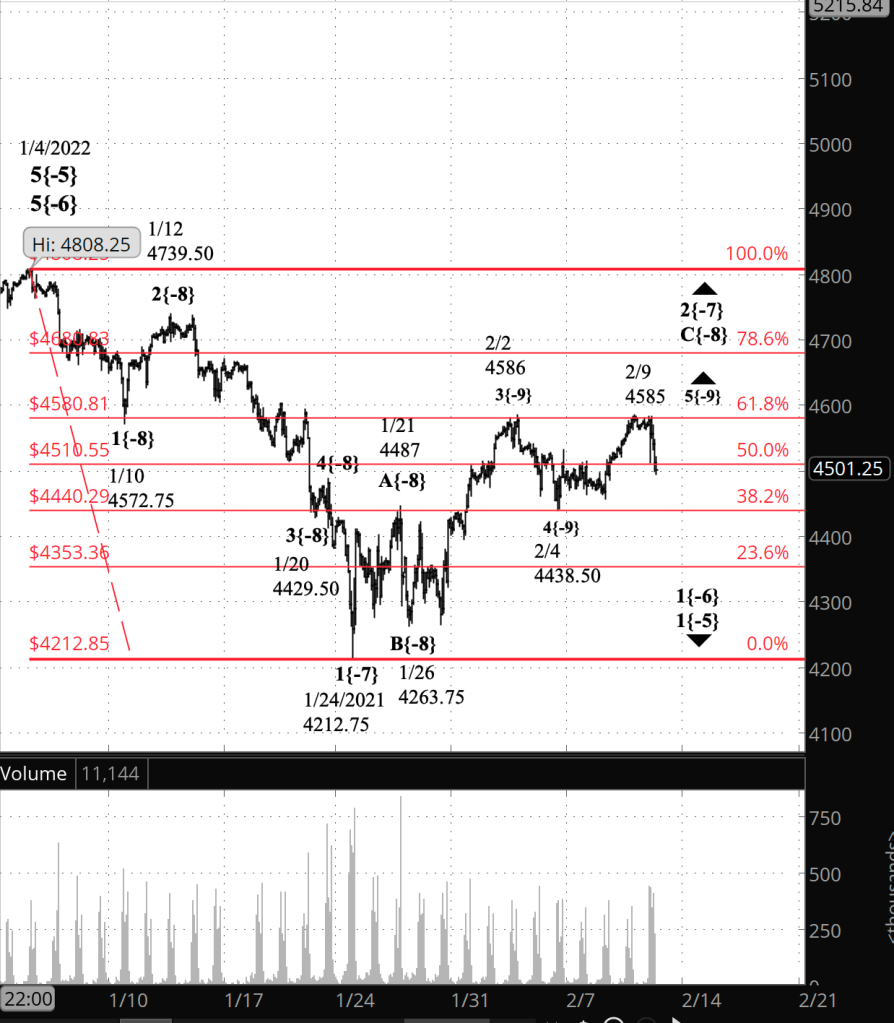
What’s happening now? The S&P 500 E-mini futures traded around the 61.8% retracement level overnight until an hour before the opening bell, when it dropped rapidly to the 50% retracement level. The drop covered 65 points in 44 minutes.

What does it mean? The timing of the sudden decline coincided with the release of inflation numbers in the United States. (The inflation report can be read here.)

By my principal analysis, yesterday’s high marked the end, at 4585, of the middle leg of a five-leg rise that began on February 4. The decline this morning is part of the ensuing correction, and the price will soon rise above yesterday’s high in the final leg of the rise from February 4. That final leg will complete the larger upward correction that began on January 24 from 4212.75 and will be followed by a decline below that level, perhaps significantly so.

What’s the alternative? Since the price yesterday remained below the February 2 high, 4586, the downward correction from February 2 within the upward correction that began January 24 can be seen as still underway rather than having ended on February 4. There are other alternatives looking further out (see yesterday’s Trader’s Notebook), but for now, this is the one that counts.

[S&P 500 E-mini futures at 3:30 p.m., 90-minute bars, with volume]

What does Elliott wave theory say? Under my principal analysis, this morning’s decline is wave 4{-10} within uptrending wave 5{-9} within uptrending wave C{-8} within the upward correction 4{-8},. which began on January 24.

Under my alternative analysis, this morning’s decline is the beginning of wave C{-10} within downward correction wave 4{-9} within uptrending wave C{-8} within the upward correction 4{-8},. which began on January 24.

We Are Here.

These are the waves currently in progress under my principal analysis. Each line on the list shows the wave number, with the subscript in curly brackets, the traditional degree name, the starting date, the starting price of the S&P 500 E-mini futures, and the direction of the wave.

  • 5{0} Intermediate, 12/21/2018, 2316.75 (up)
  • 3{1} Minor, 3/23/2018 2174 (up)
  • 5{-2} Minute, 10/4/2020, 4267.50 (up)
  • 4{-3} Minuette, 1/4/2022, 4808.25 (down)
  • A{-4} Subminuette, 1/4/2022, 4808.25 (down)
  • 1{-5} Micro, 1/4/2022, 4808.25 (down)
  • 1{-6} Submicro, 1/4/2022, 4808.25 (down)
  • 2{-7} Minuscule, 1/24/2022, 4212.75 (up)
  • C{-8} Subminuscule, 1/26/2022, 4263.75 (up)

Learning and other resources. Elliott wave analysis provides context, not prophecy. As the 20th century semanticist Alfred Korzybski put it this way in his book Science and Sanity (1933), “The map is not the territory … The only usefulness of a map depends on similarity of structure between the empirical world and the map.” And I would add, in the ever-changing markets, we can judge that similarity of structure only after the fact.

See the menu page Analytical Methods for a rundown on where to go for information on Elliott wave analysis.

By Tim Bovee, Portland, Oregon, February 10, 2022

Disclaimer

Tim Bovee, Private Trader tracks the analysis and trades of a private trader for his own accounts. Nothing in this blog constitutes a recommendation to buy or sell stocks, options or any other financial instrument. The only purpose of this blog is to provide education and entertainment.

No trader is ever 100 percent successful in his or her trades. Trading in the stock and option markets is risky and uncertain. Each trader must make trading decisions for his or her own account, and take responsibility for the consequences.

License
Creative Commons License

All content on Tim Bovee, Private Trader by Timothy K. Bovee is licensed under a Creative Commons Attribution-ShareAlike 4.0 International License.

Based on a work at www.timbovee.com.
DIS Trade

The Walt Disney Co. (DIS)

Update 2/24/2022: I exited my short bull put vertical options spread on DIS, 22 days before expiration, for a $1.14 debit per contract/share, a profit before fees of $46.00 per contract. Shares were trading at $142.42, down $2.32 from the entry level.

The Implied Volatility Rank at exit was 57.6%, down 17.6 points from the entry level.

I exited at 29.4% of maximum potential profit, 4.4 points above 25% of the maximum, my normal exit point for earnings plays.

Shares declined by 1.6% over 15 days for a -39% annual rate. The options position produced a 40.4% return for a +982% annual rate.


I have entered a short bear call options spread on DIS, using options that trade for the last time 37 days hence, on March 18. The premium is a $1.60 credit per contract share and the stock at the time of entry was priced at $144.74.

The Implied Volatility Ratio stood at 75.2%.

Premium:$1.60Expire OTM
DIS-bear call spreadStrikeOddsDelta
Calls
Long155.0075.0%30
Break-even151.6070.0%35
Short150.0065.0%40

The premium is 64% of the width of the position’s short/long spread. The profit zone covers a 4.7% move to the upside and an unlimited move to the downside.

The risk/reward ratio is 2.1:1, with maximum risk of $340 and maximum reward of $160 per contract.

How I chose the trade. The trade was placed to coincide with DIS’s earnings announcement, after the closing bell on the day of entry. The short strikes were set to coincide with the expected move of $8.88 either way, based on options pricing, which gives a price range of $133.14 to $150.90.

By Tim Bovee, Portland, Oregon, February 9, 2022

Disclaimer

Tim Bovee, Private Trader tracks the analysis and trades of a private trader for his own accounts. Nothing in this blog constitutes a recommendation to buy or sell stocks, options or any other financial instrument. The only purpose of this blog is to provide education and entertainment.

No trader is ever 100 percent successful in his or her trades. Trading in the stock and option markets is risky and uncertain. Each trader must make trading decisions for his or her own account, and take responsibility for the consequences.

License
Creative Commons License

All content on Tim Bovee, Private Trader by Timothy K. Bovee is licensed under a Creative Commons Attribution-ShareAlike 4.0 International License.

Based on a work at www.timbovee.com.
Trader’s Notebook

3:30 p.m. New York time

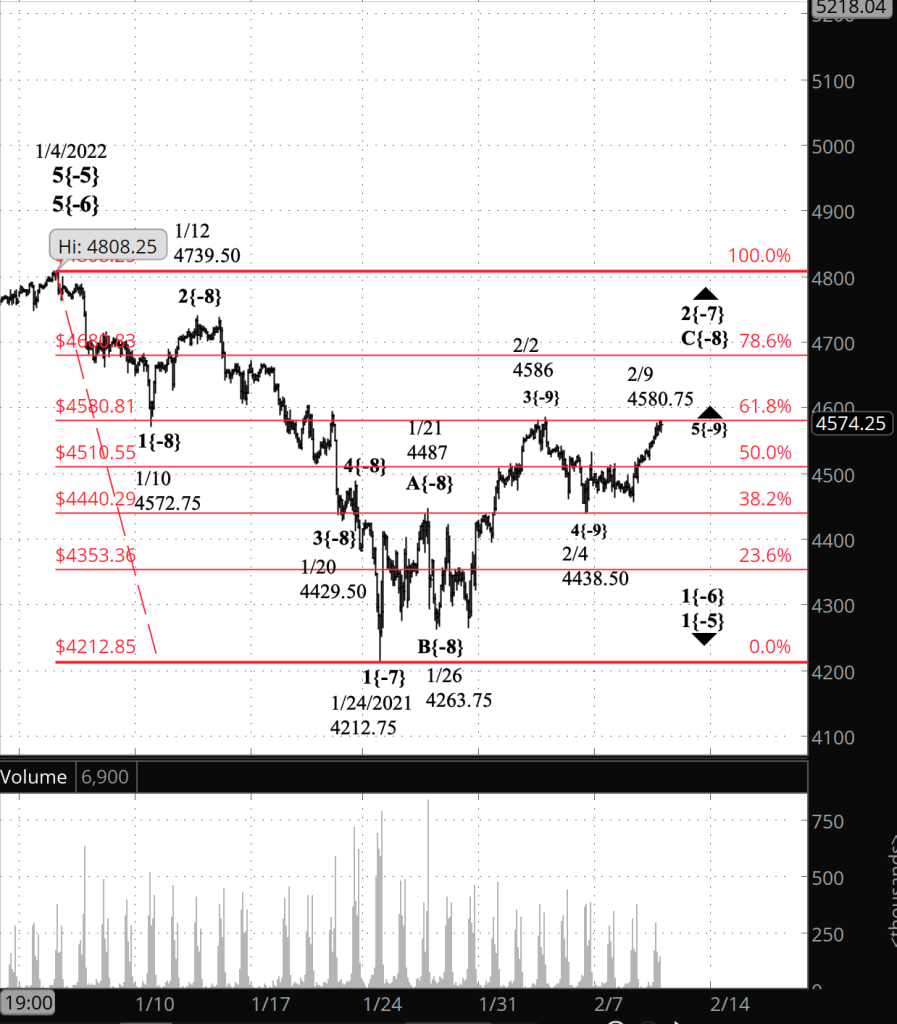
Half an hour before the closing bell. The S&P 500 futures came within 6 cents of the 61.8% retracement point and then pulled back slightly. If today’s high so far, 4580.75, is the peak of wave 5{-9} within C{-8}, then that’s in line with the rules of Elliott wave analysis, which allow the 5th wave to fall short of the end of the preceding 3rd wave, a condition known as truncation. On the other hand, falling short in this way could well mean that a compound correction is underway, a pattern described in the discussion of Alternative #1. I’m leaving my principal analysis unchanged at this point: Upward wave 5{-9} within wave C{-8} within wave 2{-7} is still underway. I’ve updated the chart.

10:15 a.m. New York time

DIS earnings play entry. I’ve entered a short bear call options spread on DIS and have posted an analysis of the trade.

I also analyzed KO as a potential earnings play, but the market was offering too small a premium by my standards. I prefer that the premium cover 33% of the width between the short and long legs of a vertical spread. KO came it at 30%.

9:35 a.m. New York time

What’s happening now? The S&P 500 E-mini futures rose in overnight trading, approaching the 61.8% retracement level and ending three days of sideways trading.

What does it mean? The correction from January 24 is in its third leg, and that leg is in its final upward push. In turn, that upward push began its third phase overnight, typically the most powerful of the three movements in the direction of the trend. The rise will remain below 4808.25 — the January 4 high — and when complete will mark the end of the correction and the resumption of the downtrend.

What are the alternatives? There are two:

Alternative #1: When the present rise is complete, the price might decline in a wave that links to a second corrective pattern, known as a compound correction, rather than resuming the downtrend. This alternative will be disproven if the price moves below the January 24 low, 4212.75.

Alternative #2: It’s still possible that the high of February 2 — 4586 — marked the end of the correction, the the subsequent decline was the first part of the resumed downtrend. This alternative will be disproven if the price moves above 4586. The closer the price moves toward that level, the less likely this alternative becomes.

[S&P 500 E-mini futures at 3:30 p.m., 90-minute bars, with volume]

What does Elliott wave theory say? Within wave 2{-7} — the upward correction that began on January 24 — upward wave C{-8} is in its final portion, wave 5{-10}, out of five waves total. And wave 5{-10} in turn is in its middle leg, wave 3{-11}.

Wave 5{-10} will complete wave C{-9}, but under Alternative #1, it may not be the completion of the parent, wave 2{-7}. A decline will follow C{-9}, but its meaning will be ambiguous. Either the decline will be the first wave within wave 3{-7} — the next leg of the downtrend — or it will be wave X{-9}, setting up a second corrective pattern. within an ongoing wave 2{-7}.

Under Alternative #2, the high of February 2 marked the end of wave 5{-9}, the February 4 low was the end of the first wave within wave 3{-7}, the the subsequent rise was a 2nd wave correction within wave 3{-7}.

We Are Here.

These are the waves currently in progress under my principal analysis. Each line on the list shows the wave number, with the subscript in curly brackets, the traditional degree name, the starting date, the starting price of the S&P 500 E-mini futures, and the direction of the wave.

  • 5{0} Intermediate, 12/21/2018, 2316.75 (up)
  • 3{1} Minor, 3/23/2018 2174 (up)
  • 5{-2} Minute, 10/4/2020, 4267.50 (up)
  • 4{-3} Minuette, 1/4/2022, 4808.25 (down)
  • A{-4} Subminuette, 1/4/2022, 4808.25 (down)
  • 1{-5} Micro, 1/4/2022, 4808.25 (down)
  • 1{-6} Submicro, 1/4/2022, 4808.25 (down)
  • 2{-7} Minuscule, 1/24/2022, 4212.75 (up)
  • C{-8} Subminuscule, 1/26/2022, 4263.75 (up)

Learning and other resources. Elliott wave analysis provides context, not prophecy. As the 20th century semanticist Alfred Korzybski put it this way in his book Science and Sanity (1933), “The map is not the territory … The only usefulness of a map depends on similarity of structure between the empirical world and the map.” And I would add, in the ever-changing markets, we can judge that similarity of structure only after the fact.

See the menu page Analytical Methods for a rundown on where to go for information on Elliott wave analysis.

By Tim Bovee, Portland, Oregon, February 9, 2022

Disclaimer

Tim Bovee, Private Trader tracks the analysis and trades of a private trader for his own accounts. Nothing in this blog constitutes a recommendation to buy or sell stocks, options or any other financial instrument. The only purpose of this blog is to provide education and entertainment.

No trader is ever 100 percent successful in his or her trades. Trading in the stock and option markets is risky and uncertain. Each trader must make trading decisions for his or her own account, and take responsibility for the consequences.

License
Creative Commons License

All content on Tim Bovee, Private Trader by Timothy K. Bovee is licensed under a Creative Commons Attribution-ShareAlike 4.0 International License.

Based on a work at www.timbovee.com.
LYFT Trade

Lyft Inc. (LYFT)

Update 2/24/2022: I exited my bear call vertical options spread on LYFT, 22 days before expiration, for a $0.32 debit per contract/share, a profit before fees of $76 per contract. Shares were trading at $38.14, down $1.63 from the entry level.

The Implied Volatility Rank at exit was 49.8, down 51.3 points from the entry level.

The price dropped after earnings were published, and after analyzing the chart, I decided to hold longer in the expectation of further decline. I exited at 70% of maximum potential profit, well above my usual earnings-play target of 25% of max.

Shares declined by 4.1% over 16 days for a -94% annual rate. The options position produced a 237.5% return for a +5,418% annual rate.


I have entered a short bear call options spread on LYFT, using options that trade for the last time 38 days hence, on March 18. The premium is a $1.08 credit per contract share and the stock at the time of entry was priced at $39.77.

The Implied Volatility Ratio stood at 101.1%.

Premium:$1.08Expire OTM
LYFT-bear call spreadStrikeOddsDelta
Calls
Long50.0088.0%16
Break-even46.0881.5%24
Short45.0075.0%32

The premium is 43.2% of the width of the position’s short/long spread. The profit zone covers a 15.9% move to the upside and an unlimited move to the downside.

The risk/reward ratio is 3.6:1, with maximum risk of $392 and maximum reward of $108 per contract.

How I chose the trade. The trade was placed to coincide with LYFT’s earnings announcement, after the closing bell on the day of entry. The short strikes were set to coincide with the expected move of $5.41 either way, based on options pricing, which gives a price range of $44.56 to $33.74.

By Tim Bovee, Portland, Oregon, February 8, 2022

Disclaimer

Tim Bovee, Private Trader tracks the analysis and trades of a private trader for his own accounts. Nothing in this blog constitutes a recommendation to buy or sell stocks, options or any other financial instrument. The only purpose of this blog is to provide education and entertainment.

No trader is ever 100 percent successful in his or her trades. Trading in the stock and option markets is risky and uncertain. Each trader must make trading decisions for his or her own account, and take responsibility for the consequences.

License
Creative Commons License

All content on Tim Bovee, Private Trader by Timothy K. Bovee is licensed under a Creative Commons Attribution-ShareAlike 4.0 International License.

Based on a work at www.timbovee.com.

Trader’s Notebook

3:30 p.m. New York time

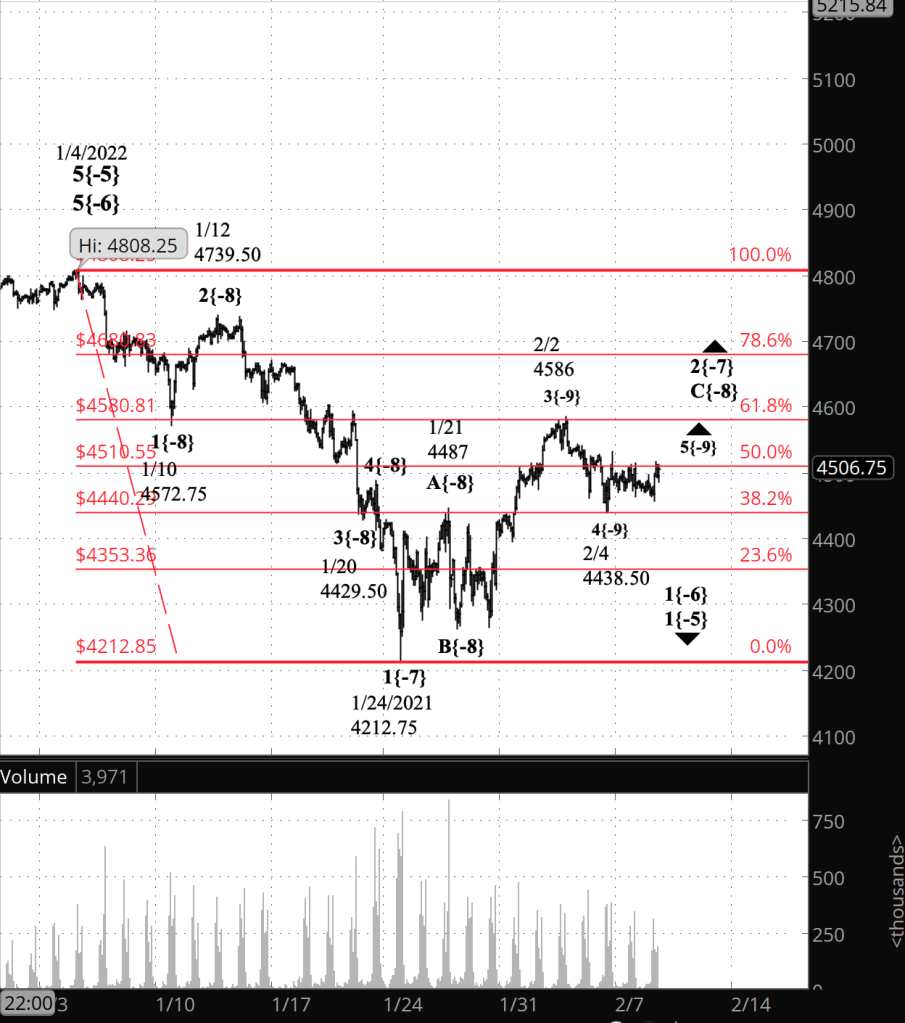
Half an hour before the closing bell. The S&P 500 futures spent the day, as it spent the night, in the space between the 50% and 38.2% retracement lines. The longer it puts off the rise expected under the principal analysis, discussed this morning, the more likely the first alternative seems to be. Under that scenario, the wave 4{-7} correction will take a compound form, consisting of several corrective patterns. Nonetheless, so far I’m keeping the principal analysis in place: Wave 5{-9} within uptrending wave C{-8} is still underway. I’ve updated the chart.

10 a.m. New York time

LYFT earnings play entry. I’ve entered a short bear call options spread on LYFT timed to coincide with the company’s earnings announcement after the closing bell today. I’ve posted an analysis of the trade.

9:35 a.m. New York time

What’s happening now? The S&P 500 E-mini futures traded narrowly overnight between the 38.2% and 50% retracement levels.

What does it mean? The upward correction that began on January 24 is playing its end game. A final push to the upside will conclude the correction. The price will remain below the January 4 peak, 4808.25. After the correction ends, the downtrend will resume and the price fall below the January 24 low, 4212.75, perhaps significantly lower.

What are the alternatives? There a two.

Alternative #1: The correction won’t end with the last leg of the present corrective pattern but instead will trace an intervening decline and then form a compound correction, adding on a second corrective pattern. The price will remain above 4212.75.

Alternative #2: The correction ended on February 2 at 4586, the downtrend and resumed and is in its early stages. The price will fall below 4212.75.

[S&P 500 E-mini futures at 3:30 p.m., 90-minute bars, with volume]

What does Elliott wave theory say? Principal analysis: The upward correction is wave 2{-7} and within it, wave C{-8} — the final wave of the corrective pattern, is nearing an end. It’s final internal component, wave 5{-9}, began on February 4. Wave 2{-7} will be followed by a resumption of the downtrend, wave 3{-7}, which will fall below 4212.75, which is the January 24 end point of wave 1{-7}.

Alternative #1: The present wave C{-8} won’t be the end of its parent, wave 2{-7}, but will instead be followed by wave X{-8} and then another three-wave corrective pattern. Such compound correction can contain up to three corrective components.

Alternative #2: The February 2 high marked the end of wave 5{-9} with wave C{-8}, rather than ending wave 3{-9}, as the principal analysis has it. Wave 5{-9} marks the end of wave C{-8} and also of the parent, wave 2{-7}.

We Are Here.

These are the waves currently in progress under my principal analysis. Each line on the list shows the wave number, with the subscript in curly brackets, the traditional degree name, the starting date, the starting price of the S&P 500 E-mini futures, and the direction of the wave.

  • 5{0} Intermediate, 12/21/2018, 2316.75 (up)
  • 3{1} Minor, 3/23/2018 2174 (up)
  • 5{-2} Minute, 10/4/2020, 4267.50 (up)
  • 4{-3} Minuette, 1/4/2022, 4808.25 (down)
  • A{-4} Subminuette, 1/4/2022, 4808.25 (down)
  • 1{-5} Micro, 1/4/2022, 4808.25 (down)
  • 1{-6} Submicro, 1/4/2022, 4808.25 (down)
  • 2{-7} Minuscule, 1/24/2022, 4212.75 (up)
  • C{-8} Subminuscule, 1/26/2022, 4263.75 (up)

Learning and other resources. Elliott wave analysis provides context, not prophecy. As the 20th century semanticist Alfred Korzybski put it this way in his book Science and Sanity (1933), “The map is not the territory … The only usefulness of a map depends on similarity of structure between the empirical world and the map.” And I would add, in the ever-changing markets, we can judge that similarity of structure only after the fact.

See the menu page Analytical Methods for a rundown on where to go for information on Elliott wave analysis.

By Tim Bovee, Portland, Oregon, February 8, 2022

Disclaimer

Tim Bovee, Private Trader tracks the analysis and trades of a private trader for his own accounts. Nothing in this blog constitutes a recommendation to buy or sell stocks, options or any other financial instrument. The only purpose of this blog is to provide education and entertainment.

No trader is ever 100 percent successful in his or her trades. Trading in the stock and option markets is risky and uncertain. Each trader must make trading decisions for his or her own account, and take responsibility for the consequences.

License
Creative Commons License

All content on Tim Bovee, Private Trader by Timothy K. Bovee is licensed under a Creative Commons Attribution-ShareAlike 4.0 International License.

Based on a work at www.timbovee.com.

PFE Trade

Pfizer Inc. (PFE)

Update 3/11/2021: I exited my bull put vertical options spread on PFE, seven days before expiration, for a $0.80 debit per contract/share, a profit before fees of $27 per contract. Shares were trading at $50.14, down $2.22 from the entry level.

The Implied Volatility Rank at exit was 61.9%, down 20.3 points from the entry level.

I exited because the position reached 25% of maximum potential profit, my normal exit point for earnings plays.

Shares declined by 4.2% over 32 days for a -48% annual rate. The options position produced a 33.8% return for a +385% annual rate.


I have entered a short bull put options spread on PFE, using options that trade for the last time 39 days hence, on March 18. The premium is a $1.07 credit per contract share and the stock at the time of entry was priced at $52.36.

The Implied Volatility Ratio stood at 82.2%.

Premium:$1.07Expire OTM
PFE-bull put spreadStrikeOddsDelta
Puts
Long45.0085.0%13
Break-even51.0773.0%23.5
Short50.0061.0%34

The premium is 42.8% of the width of the position’s short/long spread. The profit zone covers a 2.5% move to the downside and an unlimited move to the upside.

The risk/reward ratio is 3.7:1, with maximum risk of $393 and maximum reward of $107 per contract.

How I chose the trade. The trade was placed to coincide with PFE’s earnings announcement, before the opening bell on the day after entry. The short strikes were set to coincide with the expected move of $3.21 either way, based on options pricing, which gives a price range of $49.63 to $59.01.

By Tim Bovee, Portland, Oregon, February 7, 2022

Disclaimer

Tim Bovee, Private Trader tracks the analysis and trades of a private trader for his own accounts. Nothing in this blog constitutes a recommendation to buy or sell stocks, options or any other financial instrument. The only purpose of this blog is to provide education and entertainment.

No trader is ever 100 percent successful in his or her trades. Trading in the stock and option markets is risky and uncertain. Each trader must make trading decisions for his or her own account, and take responsibility for the consequences.

License
Creative Commons License

All content on Tim Bovee, Private Trader by Timothy K. Bovee is licensed under a Creative Commons Attribution-ShareAlike 4.0 International License.

Based on a work at www.timbovee.com.