Trader’s Notebook

3:30 p.m. New York time

Half an hour before the closing bell. The S&P 500 bounced during the day between two Fibonacci retracement levels: 50% and 38.2%. Wave A {-10} within the downtrending wave 4 {-9} correction continues. No change to the principal analysis. I’ve updated the upper, close-up chart.

10 a.m. New York time

Trades today. I’ve entered a long shares position on AYI, which publishes earnings before the opening bell tomorrow. The expected move is $4.58 in either direction, based on options pricing, and Zacks gives a 3.52% score to the likelihood of an upside earnings surprise, based on analyst revisions. The Zacks rank for AYI is Hold.

9:35 a.m. New York time

What’s happening now? The S&P 500 E-mini futures overnight retraced half of the rise from December 20 and then bounced back slightly. The decline from the January 4 high, 4808.25, covered 140.25 points, carrying the price down to 4668

What does it mean? By my principal analysis the January 4 peak ended the middle leg of the rise that began December 3 from 4492, and a correction is now underway.

What’s the alternative? If the January 4 peak is considered to have ended the final leg of the rise that began on December 3, then the January 4 peak marked the end of a month-long rise and isn’t a correction but instead is the beginning of a new downtrend.
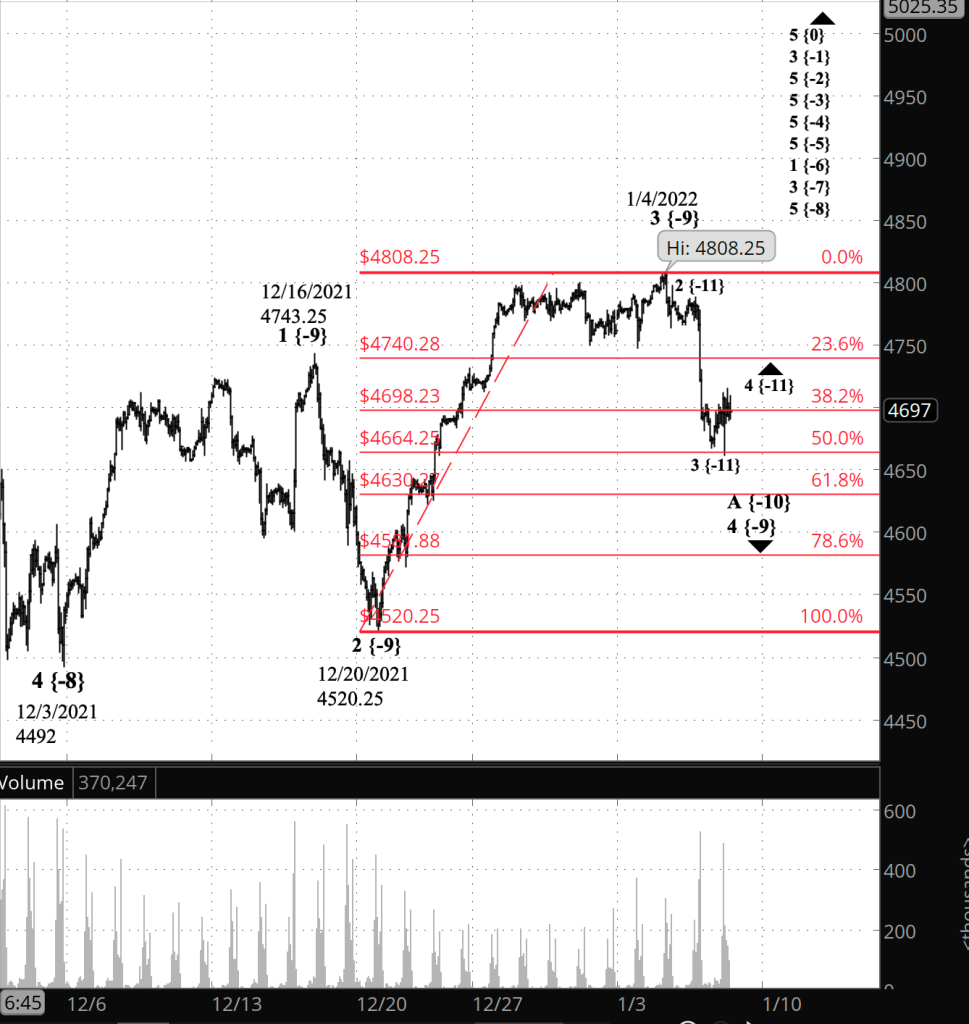
[S&P 500 E-mini futures at 3:30 p.m., 75-minute bars, with volume]

What does Elliott wave theory say? I’ve changed the labelling of the January 4 peak to the {-9th} degree rather than the {-10th}. That labelling best matches subsequent events.

Under my principal analysis, wave 4 {-9} is underway. It’s first wave internally is on wave 4 {-11} in what will end up as a five-wave pattern that will complete wave A {-10}, the first of three waves that will form the correction. The five waves within the wave A {-10} mean that the correction is most likely taking the form of a Zigzag, whose wave structure is 5-3-5, as compared to a Flat, which is 3-3-5. The preceding wave 2 {-9} also took the form of a Zigzag. Normally, waves 2 and 5 alternate in their form, but not always. So perhaps this will work out to be one of exceptions.

Wave 4 {-9} will be followed by a 5th wave that will carry the price to new heights.

Under my alternative analysis, the January 4 peak ended wave 5 {-9}, and the soon-to-be-five waves of the subsequent decline are the 1st wave of a new downtrend. The count of the rise from December 20 is a bit muddy. I think the alternative analysis is unlikely, but it’s possible. The alternative will be confirmed if the price moves below the December 20 low, 4520.25.

I’ve a seen a couple of OMG! scare headlines this morning. To put the decline in perspective, here’s a chart showing the entirety of the expanding Diagonal Triangle, the form the market has taken since December 2018. The small tan circle at the right side of the price line, pointed to by a large red arrow, is the decline since January 4. In the larger scheme of things, not yet a big deal, although it could develop into a significant move.
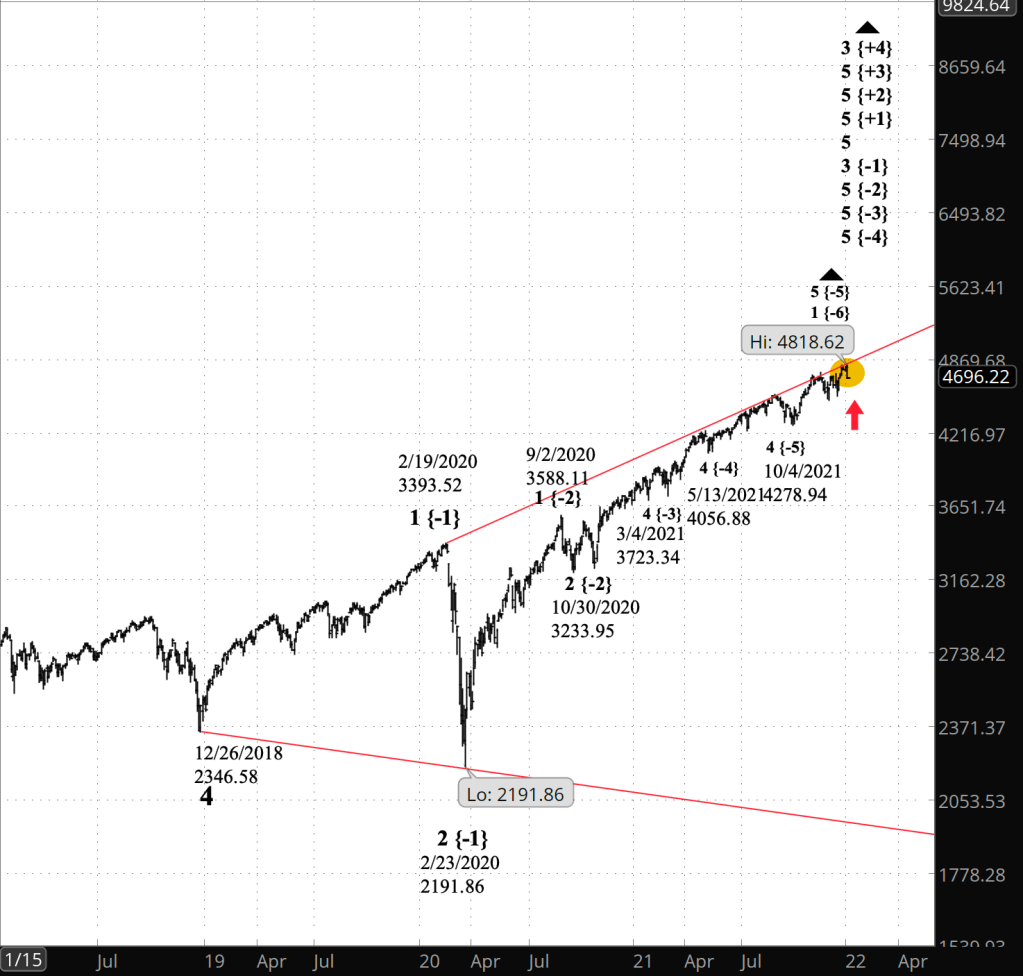
[S&P 500 index at 9:30 a.m., 2-day bars]

Learning and other resources. Elliott wave analysis provides context, not prophecy. As the 20th century semanticist Alfred Korzybski put it this way in his book Science and Sanity (1933), “The map is not the territory … The only usefulness of a map depends on similarity of structure between the empirical world and the map.” And I would add, in the ever-changing markets, we can judge that similarity of structure only after the fact.

See the menu page Analytical Methods for a rundown on where to go for information on Elliott wave analysis.

By Tim Bovee, Portland, Oregon, January 6, 2022

Disclaimer

Tim Bovee, Private Trader tracks the analysis and trades of a private trader for his own accounts. Nothing in this blog constitutes a recommendation to buy or sell stocks, options or any other financial instrument. The only purpose of this blog is to provide education and entertainment.

No trader is ever 100 percent successful in his or her trades. Trading in the stock and option markets is risky and uncertain. Each trader must make trading decisions for his or her own account, and take responsibility for the consequences.

License
Creative Commons License

All content on Tim Bovee, Private Trader by Timothy K. Bovee is licensed under a Creative Commons Attribution-ShareAlike 4.0 International License.

Based on a work at www.timbovee.com.
LW Trade

Lamb Weston Holdings Inc. (LW)

Update 1/18/2022: I exited my short iron condor position on LW 31 days before expiration, for a $1.22 debit per contract/share, a profit before fees of $43.00 per contract. Shares were trading at $67.99, up $4.37 from the entry level.

The Implied Volatility Rank at exit was 18.7%, down 37.7 points from the entry level.

I exited because the position exceeded 25% of maximum potential profit, my normal exit point for earnings plays.

Shares rose by 6.9% over 13 days for a 192% annual rate. The options position produced a 35.2% return for a 990% annual rate.


I have entered a short iron condor spread on LW, using options that trade for the last time 44 days hence, on February 18. The premium is a $1.65 credit per contract share and the stock at the time of entry was priced at $63.62.

The Implied Volatility Ratio stands at 56.4%

Premium:$1.65Expire OTM
LW-iron condorStrikeOddsDelta
Calls
Long75.009211
Break-even71.6546.417.5
Short70.0080.0%24
Puts
Short60.0064.0%31
Break-even56.6573.5%22.5
Long55.0083.0%14

The premium is 33% of the width of the positions short/long spreads. The profit zone covers a 12.6% move to the upside and a 12.3% move to the downside.

The risk/reward ratio is 2:1, with maximum risk of $335 and maximum reward of $165 per contract.

How I chose the trade. The trade was placed to coincide with LW’s earnings announcement, before/ the opening bell on the day after entry. The short strikes were set to coincided with the expected move of $0.87 either way, based on options pricing, which gives a price range of $62.43 to $64.17.

By Tim Bovee, Portland, Oregon, January 5, 2022

Disclaimer

Tim Bovee, Private Trader tracks the analysis and trades of a private trader for his own accounts. Nothing in this blog constitutes a recommendation to buy or sell stocks, options or any other financial instrument. The only purpose of this blog is to provide education and entertainment.

No trader is ever 100 percent successful in his or her trades. Trading in the stock and option markets is risky and uncertain. Each trader must make trading decisions for his or her own account, and take responsibility for the consequences.

License
Creative Commons License

All content on Tim Bovee, Private Trader by Timothy K. Bovee is licensed under a Creative Commons Attribution-ShareAlike 4.0 International License.

Based on a work at www.timbovee.com.
WBA Trade

Walgreens Boots Alliance Inc. (WBA)

Update 1/7/2022: I exited my short iron condor position on WBA 42 days before expiration, for a $1.05 debit per contract/share, a profit before fees of $56 per contract. Shares were trading at $53.93, down $0.53 from the entry level.

The Implied Volatility Rank at exit was 12.3%, down 20.2 points from the entry level.

I exited because the position had neared 25% of maximum potential profit, my normal exit point for earnings plays.

Shares declined by 1% over two days for a -178% annual rate. The options position produced a 26.7% return for a 4,867% annual rate.


I have entered a short iron condor spread on WBA, using options that trade for the last time 44 days hence, on February 18. The premium is a $1.33 credit per contract share and the stock at the time of entry was priced at $54.46.

The Implied Volatility Ratio stands at 32.5%

Premium:$1.33Expire OTM
WBA-iron condorStrikeOddsDelta
Calls
Long62.5093.0%10
Break-even58.8383.5%20.5
Short57.5074.0%31
Puts
Short50.0075.0%21
Break-even46.3383.0%14
Long45.0091.0%7

The premium is 26.6% of the width of the positions short/long spreads. The profit zone covers an 8% move to the upside and a 17.5% move to the downside.

The risk/reward ratio is 2.8:1, with maximum risk of $367 and maximum reward of $133 per contract.

How I chose the trade. The trade was placed to coincide with WBA’s earnings announcement, before the opening bell on the day after entry. The short strikes were set to coincided with the expected move of $2.06 either way, based on options pricing, which gives a price range of $52.00 to $56.12.

By Tim Bovee, Portland, Oregon, January 5, 2022

Disclaimer

Tim Bovee, Private Trader tracks the analysis and trades of a private trader for his own accounts. Nothing in this blog constitutes a recommendation to buy or sell stocks, options or any other financial instrument. The only purpose of this blog is to provide education and entertainment.

No trader is ever 100 percent successful in his or her trades. Trading in the stock and option markets is risky and uncertain. Each trader must make trading decisions for his or her own account, and take responsibility for the consequences.

License
Creative Commons License

All content on Tim Bovee, Private Trader by Timothy K. Bovee is licensed under a Creative Commons Attribution-ShareAlike 4.0 International License.

Based on a work at www.timbovee.com.
CAG Trade

Conagra Brands Inc. (CAG)

Update 1/11/2022: I exited my short iron condor position on CAG 39 days before expiration, for a $0.67 debit per contract/share, a profit before fees of $22 per contract. Shares were trading at $33.99, down $0.64 from the entry level.

The Implied Volatility Rank at exit was 15.1%, down 30.7 points from the entry level.

I exited because the position reached 25% of maximum potential profit, my normal exit point for earnings plays.

Shares declined by 1.8% over six days for a 112% annual rate. The options position produced a 32.8% return for a 1,998% annual rate.


I have entered a short iron condor spread on CAG, using options that trade for the last time 44 days hence, on February 18. The premium is a $0.89 credit per contract share and the stock at the time of entry was priced at $34.63.

The Implied Volatility Rank stands at 45.5%.

Premium:$0.89Expire OTM
CAG-iron condorStrikeOddsDelta
Calls
Long39.00196
Break-even36.890.960.5
Short36.0080.0%25
Puts
Short33.0067.0%29
Break-even30.8978.0%19
Long30.0089.0%9

The premium is 35.6% of the width of the positions short/long spread. The profit zone covers a 15.2% move to the upside and a 12.1 move to the downside).

The risk/reward ratio is 2.4:1, with maximum risk of $211 and maximum reward of $89 per contract.

How I chose the trade. The trade was placed to coincide with CAG’s earnings announcement, before the opening bell on the day after entry. The short strikes were set to coincided with the stocks expected move of $1.05 either way, based on options pricing, which gives a price range of $33.55 to $35.65.

By Tim Bovee, Portland, Oregon, January 5, 2022

Disclaimer

Tim Bovee, Private Trader tracks the analysis and trades of a private trader for his own accounts. Nothing in this blog constitutes a recommendation to buy or sell stocks, options or any other financial instrument. The only purpose of this blog is to provide education and entertainment.

No trader is ever 100 percent successful in his or her trades. Trading in the stock and option markets is risky and uncertain. Each trader must make trading decisions for his or her own account, and take responsibility for the consequences.

License
Creative Commons License

All content on Tim Bovee, Private Trader by Timothy K. Bovee is licensed under a Creative Commons Attribution-ShareAlike 4.0 International License.

Based on a work at www.timbovee.com.
Trader’s Notebook

3:30 p.m. New York time

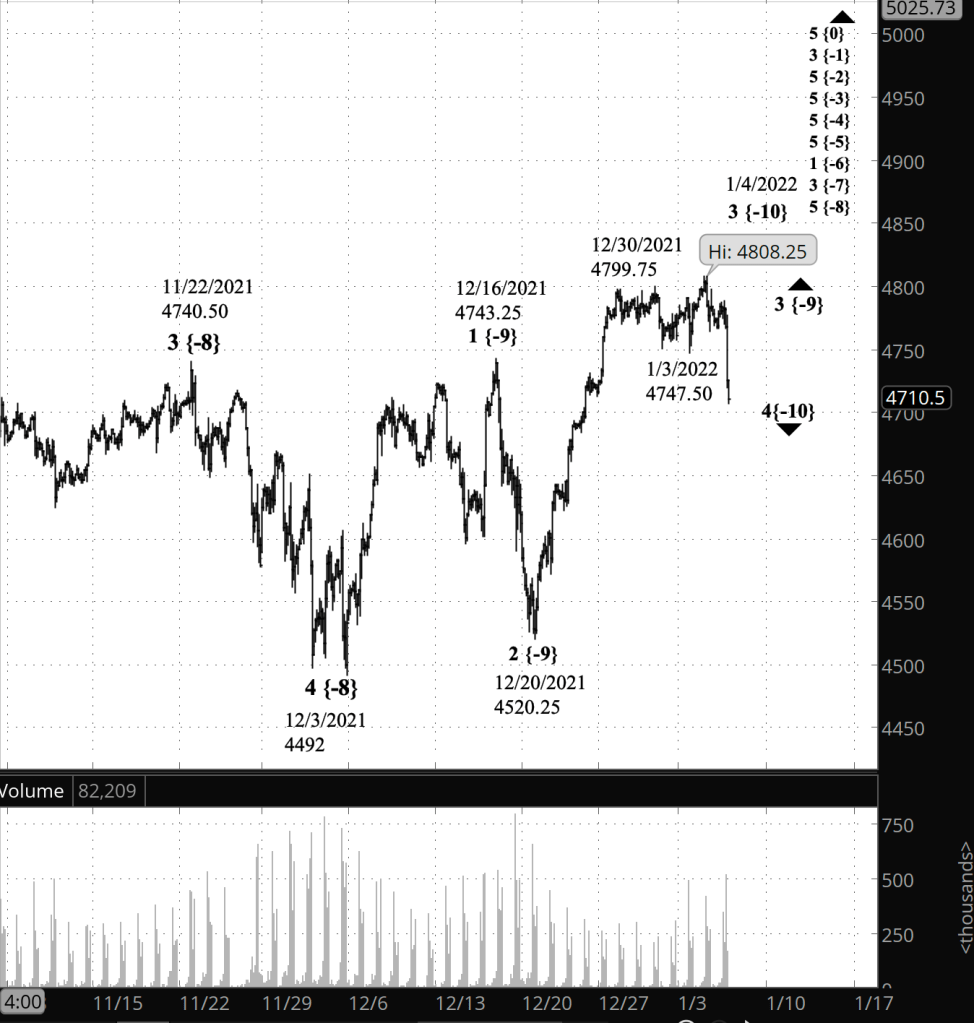
Half an hour before the closing bell. The S&P 500 took a sharp turn to the downside. I’m promoting my alternative analysis to principal and interpreting the decline to mean that wave 4 {-10} is still underway. This 4th wave is a downward correction within uptrending wave 3 {-9} within uptrending wave 5 {-8}. I’ve updated the chart to reflect the changes in my analysis.

2:40 p.m. New York time

Earnings play on LW. I’ve entered a short iron condor position on WBA timed to coincide with tomorrow morning’s earnings announcement and have posted an analysis of the trade.

2:15 p.m. New York time

Earnings play on WBA. I’ve entered a short iron condor position on WBA timed to coincide with tomorrow morning’s earnings announcement and have posted an analysis of the trade.

1:15 p.m. New York time

Earnings play on CAG. I’ve entered a short iron condor position on CAG timed to coincide with tomorrow morning’s earnings announcement and have posted an analysis of the trade.

10 a.m. New York time

Trades today. I’ll be looking at three earnings plays using options: A bull put spread on LW, a bear call spread on CAG, and possibly an iron condor on WBA. I looked at a long shares earnings play on STZ, but directionally it looks like a downward move to me so I’m passing. STZ has options, but it isn’t liquid enough to meet my standards. I’ll be posting analyses of the options trades as they are placed.

9:35 a.m. New York time

What’s happening now? The S&P 500 E-mini futures rose slightly in overnight trading.

What does it mean? The rise that began on January 3 continues, within the larger uptrend that began on December 20.

What’s the alternative? The correction that began on December 30 could still be underway. A push of the futures above the January 4 high, 4808.25, will eliminate this alternative analysis and confirm the principal analysis.

[S&P 500 E-mini futures at 3:30 p.m., 2-hour bars, with volume]

What does Elliott wave theory say? Under the principal analysis, wave 5 {-10} began on January 3 and is still taking its early, tentative steps. It will rise above 4808.25 — the January 4 high — perhaps significantly above that level.

This is all happening with wave 3 {-9}, which began on December 20, and one degree higher, within wave 5 {-8} which began on December 3 from 4492.

The alternative analysis recognizes that wave 4 {-10}, the correction that began on January 3, could still be underway. Only when the price rises above 4808.25 will this possibility be eliminated.

Learning and other resources. Elliott wave analysis provides context, not prophecy. As the 20th century semanticist Alfred Korzybski put it this way in his book Science and Sanity (1933), “The map is not the territory … The only usefulness of a map depends on similarity of structure between the empirical world and the map.” And I would add, in the ever-changing markets, we can judge that similarity of structure only after the fact.

See the menu page Analytical Methods for a rundown on where to go for information on Elliott wave analysis.

By Tim Bovee, Portland, Oregon, January 5, 2022

Disclaimer

Tim Bovee, Private Trader tracks the analysis and trades of a private trader for his own accounts. Nothing in this blog constitutes a recommendation to buy or sell stocks, options or any other financial instrument. The only purpose of this blog is to provide education and entertainment.

No trader is ever 100 percent successful in his or her trades. Trading in the stock and option markets is risky and uncertain. Each trader must make trading decisions for his or her own account, and take responsibility for the consequences.

License
Creative Commons License

All content on Tim Bovee, Private Trader by Timothy K. Bovee is licensed under a Creative Commons Attribution-ShareAlike 4.0 International License.

Based on a work at www.timbovee.com.
Trader’s Notebook

3:30 p.m. New York time

Half an hour before the closing bell. The S&P 500 futures fell more than 40 points during the day and then reversed, remaining below the peak set this morning, 4808.25. No change in the analysis. I’ve updated the chart.

10:55 a.m. New York time

Options trades? Not today. I attempted to build vertical options spreads for the five prospects listed below. None of them worked out to my satisfaction: Too much risk for too little reward. So I’m rejecting them all and will reserve my funds for earnings plays. The 4th quarter of 2021 earnings announcements will begin in earnest the week beginning January 16, with two early prospects lined up for Wednesday.

10 a.m. New York time

Trades today. I’ve bought shares of ABG, which has been rated “strong buy” according to Zacks‘ reading of analyst opinion. This is the optimal day to enter options positions expiring February 18, and I’ll be looking at five prospects: FXI, NIO, EWZ, XBI and FXE.

9:35 a.m. New York time

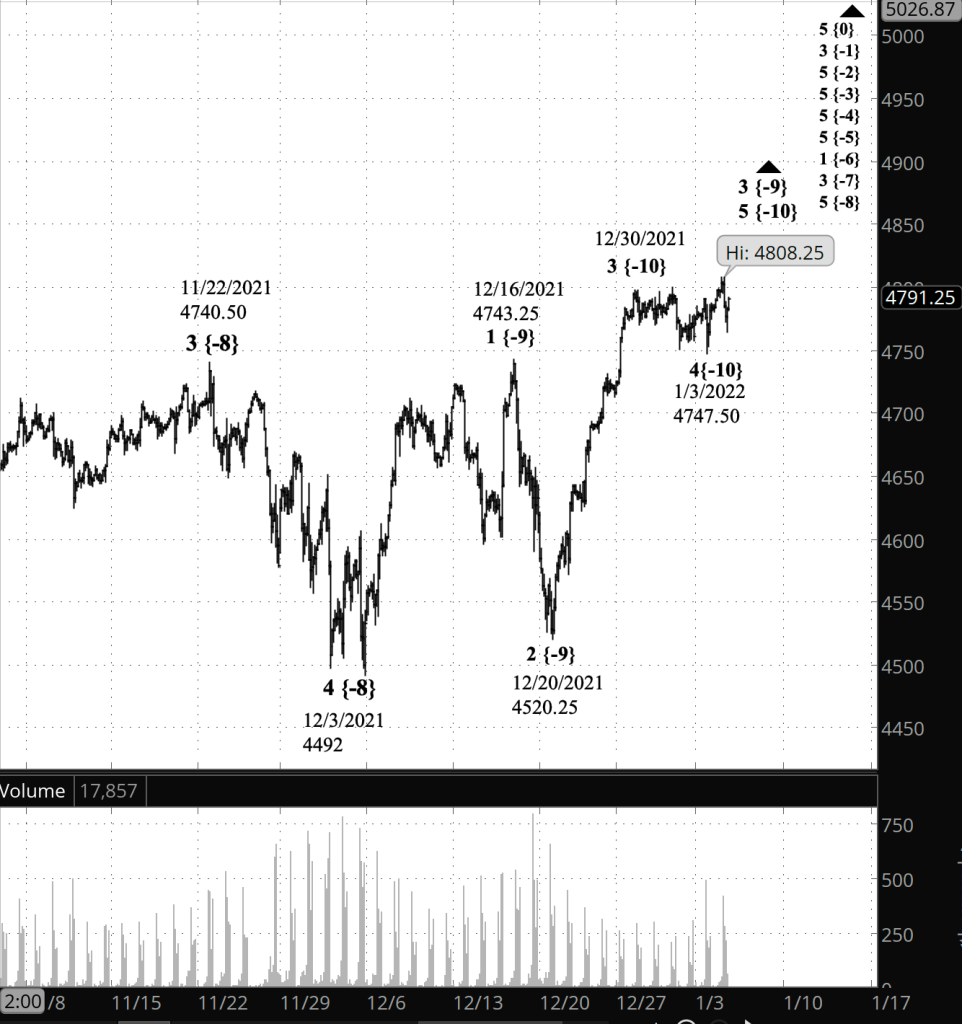
What’s happening now? The S&P 500 E-mini futures rose to a new peak, 4807.50, in overnight trading.

What does it mean? The low-level correction that had been underway since December 30 ended on Monday, and a push to the upside has begun. It is the last leg of the rise that began on December 20.

What’s the alternative? None in sight at the moment. Which isn’t to say that ambiguities won’t develop.

[S&P 500 E-mini futures at 3:30 p.m., 2-hour bars, with volume]

What does Elliott wave theory say? The rise that began on January 3 is wave 5 {-10} within wave 3 {-9}, which in turn is a subwave of the rise that began on December 3 from 4492: Wave 5 {-8}. When 3 {-9} is complete, it will be followed by a 4th wave correction, and then an even greater push to new heights, wave 5 {-9}.The completion of 5 {-9} will mark the end of wave 5 {-8} and, one degree higher, of wave 3 {-7}.

Learning and other resources. Elliott wave analysis provides context, not prophecy. As the 20th century semanticist Alfred Korzybski put it this way in his book Science and Sanity (1933), “The map is not the territory … The only usefulness of a map depends on similarity of structure between the empirical world and the map.” And I would add, in the ever-changing markets, we can judge that similarity of structure only after the fact.

See the menu page Analytical Methods for a rundown on where to go for information on Elliott wave analysis.

By Tim Bovee, Portland, Oregon, January 4, 2022

Disclaimer

Tim Bovee, Private Trader tracks the analysis and trades of a private trader for his own accounts. Nothing in this blog constitutes a recommendation to buy or sell stocks, options or any other financial instrument. The only purpose of this blog is to provide education and entertainment.

No trader is ever 100 percent successful in his or her trades. Trading in the stock and option markets is risky and uncertain. Each trader must make trading decisions for his or her own account, and take responsibility for the consequences.

License
Creative Commons License

All content on Tim Bovee, Private Trader by Timothy K. Bovee is licensed under a Creative Commons Attribution-ShareAlike 4.0 International License.

Based on a work at www.timbovee.com.
Trader’s Notebook

Changes, beginning today: A new title for this daily post, reflecting the broader range of material it covers. And in the Elliott wave analysis section, no more degree names. I’ll rely solely on the wave number and subscript in curly brackets. For details, click here.

3:30 p.m. New York time

Half an hour before the closing bell. The S&P 500 continued its low-level downward correction within a series of ever larger uptrending movements. Wave 4 {-10} within wave 3 {-9} within wave 5 {-8} continues. No change in the analysis. I’ve updated the chart.

10:25 a.m. New York time

Options earnings play exited. My short iron condor options position on NKE, an earnings play, turned profitable after 14 days, and exited for a 20.5% gain. I’ve updated the analysis with results.

9:45 a.m. New York time

Trades today. No earnings plays on the books for today. JEF was a possibility for options, but the time and even the date were uncertain, so I’m passing. I plan no earnings plays using shares. Non-earnings trades: I’ll be opening a position on LPX. It was just promoted to “strong buy” by Zacks, based on analyst opinions. It’s considered to be a value play, as upward momentum and is in an industry that ranks in the top 8% of industries when it comes to analyst “buy” opinions.

9:35 a.m. New York time

What’s happening now? The S&P 500 E-mini futures continued to rise when trading resumed Sunday evening and the price remains slightly below the December 30 peak of 4799.25.

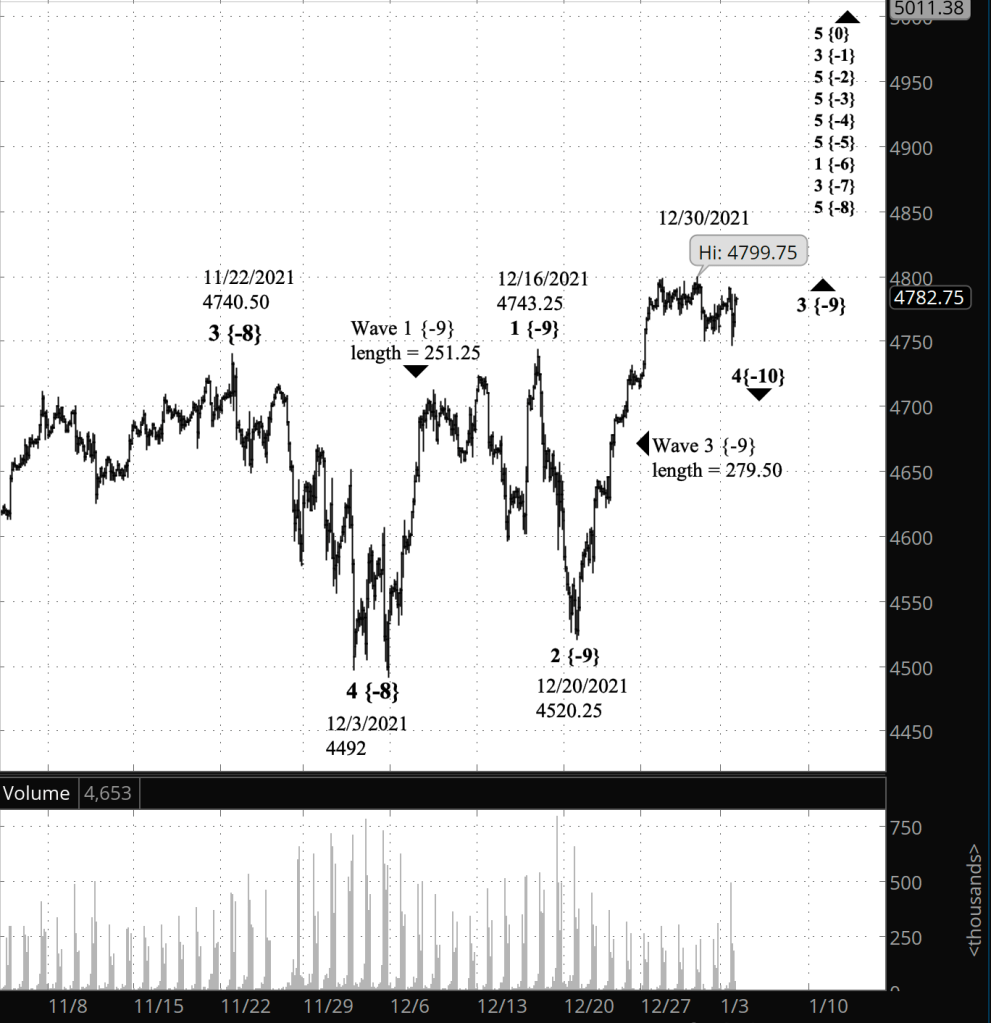
What does it mean? By my principal count, the rise that began December 20 from 4520.25 is still underway and will push beyond the peak to new heights.

What’s the alternative? The December 30 peak can be seen as the end of the rise from December 20, ushering in a correction to the downside.

[S&P 500 E-mini futures at 3:30 p.m., 2-hour bars, with volume]

What does Elliott wave theory say? My principal analysis sees the December 20 peak as a subwave of wave 3 {-9} within wave 5 {-8}, which began December 3 from 4492.

The rules discovered by R.N. Elliott require that the 3rd wave in a trend not be shorter than both the 1st and 5th waves. And usually, wave 3 is longer than wave 1. And such is the case with wave 3 {-9}, which is 279.50 points long from the starting point to the December 20 peak. wave 1 {-9} is 251.25 points long, beginning to end.

So why not mark the December 30 peak as the end of wave 3 {-9} and be done with it? That’s the alternative analysis, and my reasoning for rejecting it as the principal goes like this: The sideways movement in the days leading up to the peak look very much like a 4th wave, in this case one degree lower: wave 4 {-10} within wave 3 {-9}. The peak isn’t very far above the sideways trend and certainly an be seen as part of a correction. The pattern-recognition software between my ears tells me that such a short rise is a sorry excuse for a 5th wave, and so the better count is that wave 4 {-10} possibly ended with the decline off of the December 30 peak, and the subsequent rise is the first small step of wave 5 {-10}.

When 5 {-10} reaches completion, it will also mark the end of its parent, wave 3 {-9}, which will be followed by a 4th wave correction, wave 4 {-9} within uptrending wave 5 {-8}.

Learning and other resources. Elliott wave analysis provides context, not prophecy. As the 20th century semanticist Alfred Korzybski put it this way in his book Science and Sanity (1933), “The map is not the territory … The only usefulness of a map depends on similarity of structure between the empirical world and the map.” And I would add, in the ever-changing markets, we can judge that similarity of structure only after the fact.

See the menu page Analytical Methods for a rundown on where to go for information on Elliott wave analysis.

By Tim Bovee, Portland, Oregon, January 3, 2022

Disclaimer

Tim Bovee, Private Trader tracks the analysis and trades of a private trader for his own accounts. Nothing in this blog constitutes a recommendation to buy or sell stocks, options or any other financial instrument. The only purpose of this blog is to provide education and entertainment.

No trader is ever 100 percent successful in his or her trades. Trading in the stock and option markets is risky and uncertain. Each trader must make trading decisions for his or her own account, and take responsibility for the consequences.

License
Creative Commons License

All content on Tim Bovee, Private Trader by Timothy K. Bovee is licensed under a Creative Commons Attribution-ShareAlike 4.0 International License.

Based on a work at www.timbovee.com.

SP500 Analysis

3:30 p.m. New York time

Half an hour before the closing bell. Unless something dramatic happens in the next half hour, the stock markets are ending 2021, not with a bang, but whimper. Analysis unchanged. I’ve updated the chart.

This is the way the world endsThis is the way the world endsThis is the way the world ends. Not with a bang but a whimper.” –T.S. Elliott, “The Hollow Men” (poem) (1925)

9:35 a.m. New York time

Private Trader: Changes ahead. Beginning Monday, the first day of the new year, I’ll be making a couple of changes to Private Trader. One will be the title of this daily post, from “SP500 Analysis” to “Trader’s Notebook”, reflecting the broader range of material I’ll be covering. A second change will be that I shall no longer use the traditional degree names when writing about my Elliott wave analysis of the markets, but will use the wave number and a subscript in curly brackets, same as I do on the charts. So rather than writing “wave 5 of Subminuscule degree {-8}”, I’ll simplify it to “wave 5 {-8}”. On Monday I posted a discussion of the changes.

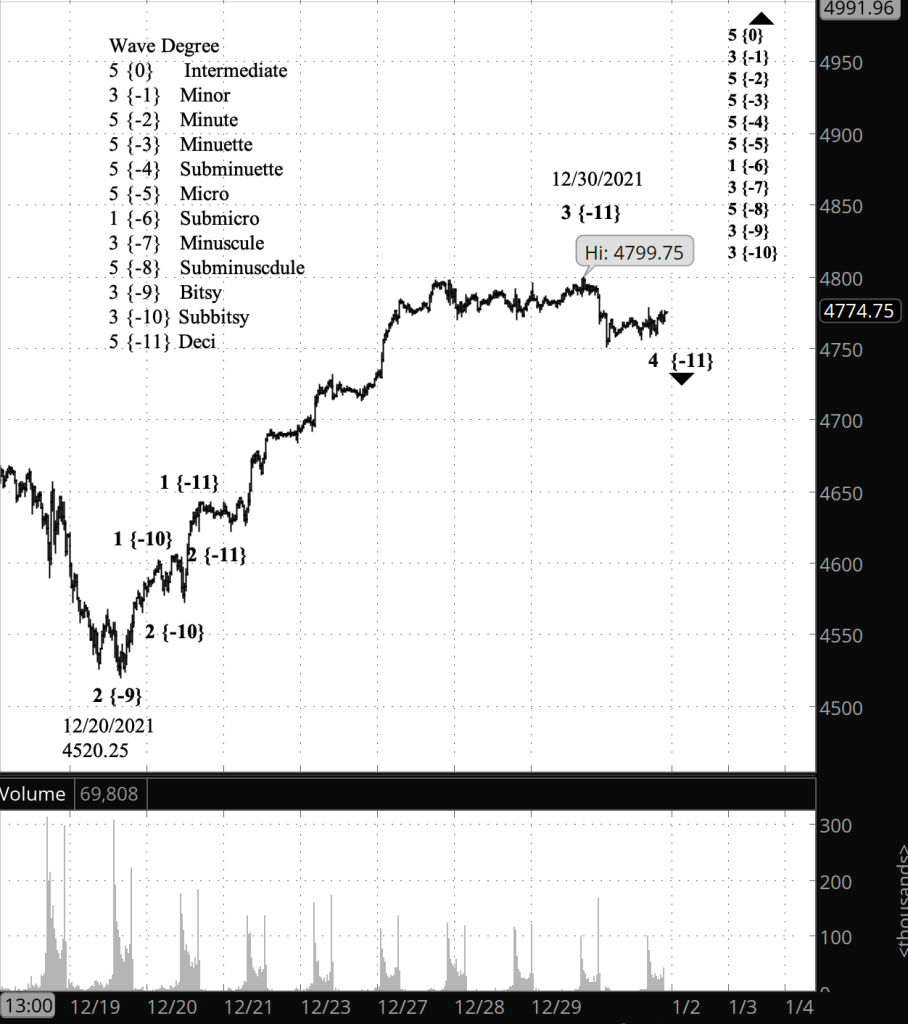
What’s happening now? The S&P 500 E-mini futures dropped by more than 40 points shortly before the closing bell on Thursday, and then began a sideways movement similar to that of the three days prior, albeit at a lower level.

What does it mean? The decline casts doubt on my labeling of yesterday’s peak as meaning that the correction was over. Under my principal analysis today, the uptrend preceding the correction ended at yesterday’s peak; the correction began from that point and is still underway.

What’s the alternative? No clear alternative at this point. Although the chart, with its holiday season flatness, lacks clarity.

[S&P 500 E-mini futures at 3:30 p.m., 30-minute bars, with volume]

What does Elliott wave theory say? Under my principal analysis, wave 4 of Deci degree — subscript {-11} — is continuing its course, which has largely been sideways. It is a downward correction within a series of ever larger uptrending movements: Wave 3 of Subbitsy degree {-10} within wave 3 of Bitsy degree {-9} within wave 5 of Subminuscule degree {-8}.

On the chart I moved the end of wave 3 of Deci degree to the December 30 peak of 4799.75, and the decline that followed is wave 4 of Deci degree.

Learning and other resources. Elliott wave analysis provides context, not prophecy. As the 20th century semanticist Alfred Korzybski put it this way in his book Science and Sanity (1933), “The map is not the territory … The only usefulness of a map depends on similarity of structure between the empirical world and the map.” And I would add, in the ever-changing markets, we can judge that similarity of structure only after the fact.

See the menu page Analytical Methods for a rundown on where to go for information on Elliott wave analysis.

By Tim Bovee, Portland, Oregon, December 31, 2021

Disclaimer

Tim Bovee, Private Trader tracks the analysis and trades of a private trader for his own accounts. Nothing in this blog constitutes a recommendation to buy or sell stocks, options or any other financial instrument. The only purpose of this blog is to provide education and entertainment.

No trader is ever 100 percent successful in his or her trades. Trading in the stock and option markets is risky and uncertain. Each trader must make trading decisions for his or her own account, and take responsibility for the consequences.

License
Creative Commons License

All content on Tim Bovee, Private Trader by Timothy K. Bovee is licensed under a Creative Commons Attribution-ShareAlike 4.0 International License.

Based on a work at www.timbovee.com.

SP500 Analysis

3:30 p.m. New York time

New Year’s Eve. The bond market in the U.S. will close early on Friday, at 2 p.m. New York time. The stock markets, however, will keep regular hours.

Half an hour before the closing bell. The S&P 500 index joined the futures and the SPY exchange-traded fund in reaching a higher high, 4808.93, in today’s trading. And futures added a bit to their opening-bell high, making the new peak 4799.75. However, once the S&P 500 family touched those higher highs, everyone yawned, laid down, figuratively, and took a long nap. The price went nowhere as it traded within a narrow range. No change in the analysis. I’ve updated the chart as wave 5 of Deci degree — subscript {-11} — slowly continues.

11:35 a.m. New York time

MU iron condor partial exit. I’ve exited the calls in my short iron condor on MU. The short calls were in the money and were at risk of exercise when the stock goes ex-dividend on December 31. Were that to happen, i would not only have hundreds of short shares of MU in my account, but I would have to pay the dividend on them. I’ve written up the results in the analysis, and will put it all together with another update after exiting the puts, which are now an out of the money short bull put spread.

9:40 a.m. New York time

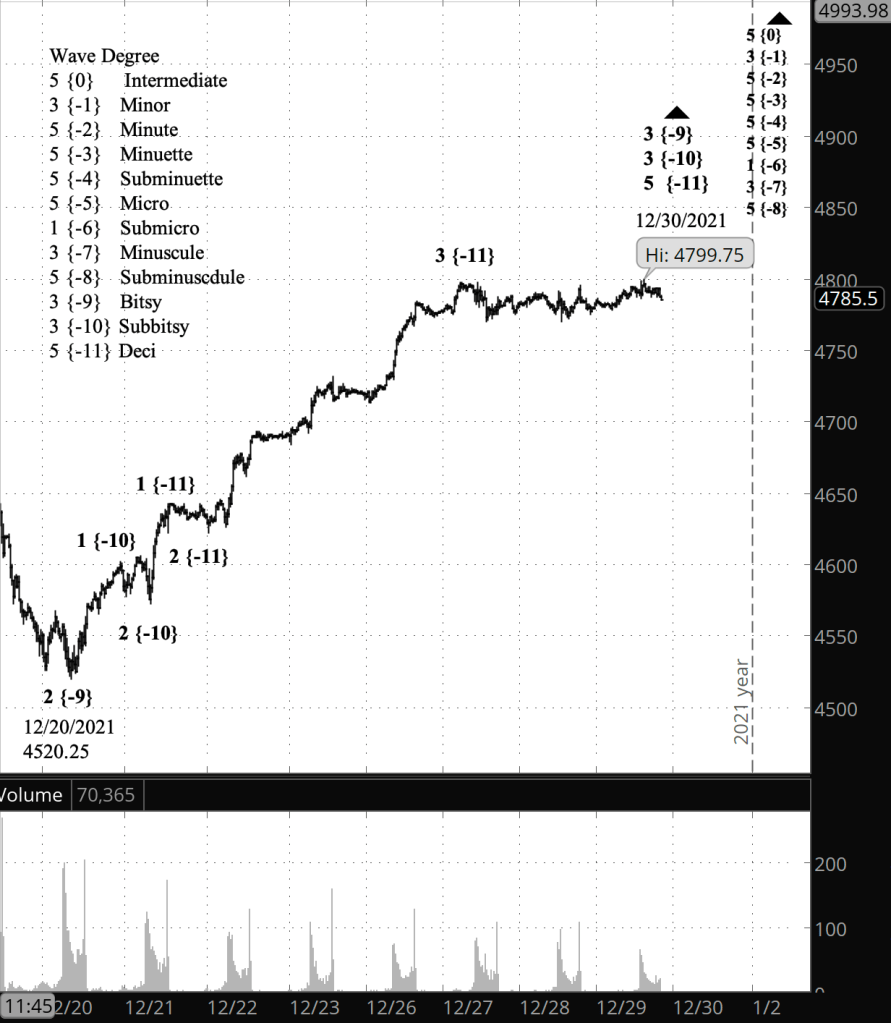
What’s happening now? The S&P 500 E-mini futures continued a sideways movement in overnight trading, remaining below the December 26 peak of 4798. However, within a minute after the opening bell, the price rose to a new high, 4799.

What does it mean? The decline below the peak was a downward correction. The new high set this morning suggests that the correction is over, and a new leg up will continue to carry the price to new heights.

What’s the alternative? The futures trade in 25-cent increments, so it’s possible that the new high is a rounding error, and the correction is still underway. The index did not reach a new high this morning, remaining below the December 28 high of 4807.02 and thereby lending some weight to the alternative analysis. However, the exchange-traded fund SPY, which tracks the S&P 500, did reach a new high this morning, 478.96.

[S&P 500 E-mini futures at 3:30 p.m., 25-minute bars, with volume]

What does Elliott wave theory say? The correction was wave 4 of Deci degree {-11} within uptrending wave 3 of Subbitsy degree {-9}, which began December 20. The end of Deci wave 4 marks the start of Deci wave 5. Fifth waves typically move beyond the end of the preceding 3rd wave — 4798 on December 27 — and often significantly beyond that level, although there is no requirement under the rules of Elliott wave analysis that wave 5 even move beyond the end of wave 3. A 5th wave ending below the end of wave 3 has been truncated in the terminology of Elliott wave analysis.

Learning and other resources. Elliott wave analysis provides context, not prophecy. As the 20th century semanticist Alfred Korzybski put it this way in his book Science and Sanity (1933), “The map is not the territory … The only usefulness of a map depends on similarity of structure between the empirical world and the map.” And I would add, in the ever-changing markets, we can judge that similarity of structure only after the fact.

See the menu page Analytical Methods for a rundown on where to go for information on Elliott wave analysis.

By Tim Bovee, Portland, Oregon, December 30, 2021

Disclaimer

Tim Bovee, Private Trader tracks the analysis and trades of a private trader for his own accounts. Nothing in this blog constitutes a recommendation to buy or sell stocks, options or any other financial instrument. The only purpose of this blog is to provide education and entertainment.

No trader is ever 100 percent successful in his or her trades. Trading in the stock and option markets is risky and uncertain. Each trader must make trading decisions for his or her own account, and take responsibility for the consequences.

License
Creative Commons License

All content on Tim Bovee, Private Trader by Timothy K. Bovee is licensed under a Creative Commons Attribution-ShareAlike 4.0 International License.

Based on a work at www.timbovee.com.

SP500 Analysis

3:30 p.m. New York time

Half an hour before the closing bell. The S&P 500, as the trading day neared its end, continued to trade sideways in a narrow zone. No change in the analysis. I’ve updated the chart.

9:35 a.m. New York time

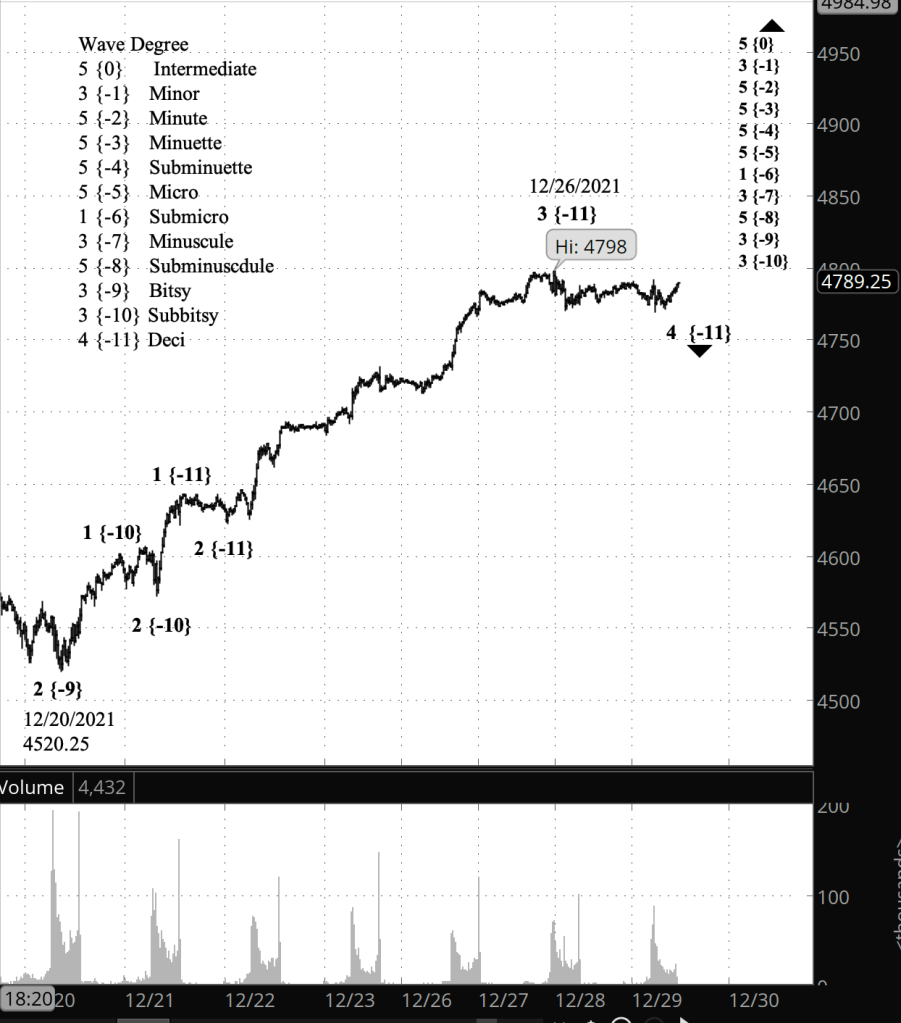
What’s happening now? The S&P 500 E-mini futures traded sideways overnight, remaining within a 16-point range.

What does it mean? The sideways movement is part of a low-level correction within an uptrend that began December 20. It will be followed by a rise to a rise that will carry the price above 4798, the starting point of the correction.

What’s the alternative? The unknown at this point is what form the correction will take. If it’s a simple correction, it will be over quickly. If it’s a compound correction, consisting of several simple corrections in a row, then it will take more time to reach completion. But it’s a low-level correction so whatever the form, it won’t last a long time.

[S&P 500 E-mini futures at 3:30 p.m., 20-minute bars, with volume]

What does Elliott wave theory say? The correction is wave 4 of Deci degree — subscript {-11} within wave 3 of Subbitsy degree {-10} within wave 3 of Bitsy degree {-9}, which began on December 20. All of this is happening within rising wave 5 of Subminuscule degree{-8}, which began on December 3 from 4492.

Wider view: The present correction is a very small bump in the road with the 3rd waves of three larger degrees, and those within a still larger 3rd wave within a 1st wave, and all of that within a series of ever-larger 5th waves stretching up four degrees, to wave 3 of Minor degree {-1} within wave 5 of Intermediate degree {0}.

Moreover, Intermediate wave 5 is a subwave within 5th waves stretching up three more degrees, to wave 5 of Grand Supercycle degree {+3}, which began in 1932.

Long story short: There’s a lot of upside in the S&P 500. Possibly. Fifth waves carry no expectation regarding how much distance they’ll cover, but Intermediate wave 5 has lasted nearly four years and has covered nearly 2,500 points in its rise. That gives some idea of what large-degree 5th waves are capable of. However, the fact that there are so many 5th waves up and down the fractal structure at this point provides a note of caution: When 5th waves reach their ends, they are followed often by devastating declines.

So the motto of this era in the markets, I think, is this: “Let the good times roll, but be mindful that the good times don’t last forever.”

Learning and other resources. Elliott wave analysis provides context, not prophecy. As the 20th century semanticist Alfred Korzybski put it this way in his book Science and Sanity (1933), “The map is not the territory … The only usefulness of a map depends on similarity of structure between the empirical world and the map.” And I would add, in the ever-changing markets, we can judge that similarity of structure only after the fact.

See the menu page Analytical Methods for a rundown on where to go for information on Elliott wave analysis.

By Tim Bovee, Portland, Oregon, December 29, 2021

Disclaimer

Tim Bovee, Private Trader tracks the analysis and trades of a private trader for his own accounts. Nothing in this blog constitutes a recommendation to buy or sell stocks, options or any other financial instrument. The only purpose of this blog is to provide education and entertainment.

No trader is ever 100 percent successful in his or her trades. Trading in the stock and option markets is risky and uncertain. Each trader must make trading decisions for his or her own account, and take responsibility for the consequences.

License
Creative Commons License

All content on Tim Bovee, Private Trader by Timothy K. Bovee is licensed under a Creative Commons Attribution-ShareAlike 4.0 International License.

Based on a work at www.timbovee.com.