SP500 Analysis

3:30 p.m. New York time

Half an hour before the closing bell. The S&P 500, as the trading day neared its end, continued to trade sideways in a narrow zone. No change in the analysis. I’ve updated the chart.

9:35 a.m. New York time

What’s happening now? The S&P 500 E-mini futures traded sideways overnight, remaining within a 16-point range.

What does it mean? The sideways movement is part of a low-level correction within an uptrend that began December 20. It will be followed by a rise to a rise that will carry the price above 4798, the starting point of the correction.

What’s the alternative? The unknown at this point is what form the correction will take. If it’s a simple correction, it will be over quickly. If it’s a compound correction, consisting of several simple corrections in a row, then it will take more time to reach completion. But it’s a low-level correction so whatever the form, it won’t last a long time.
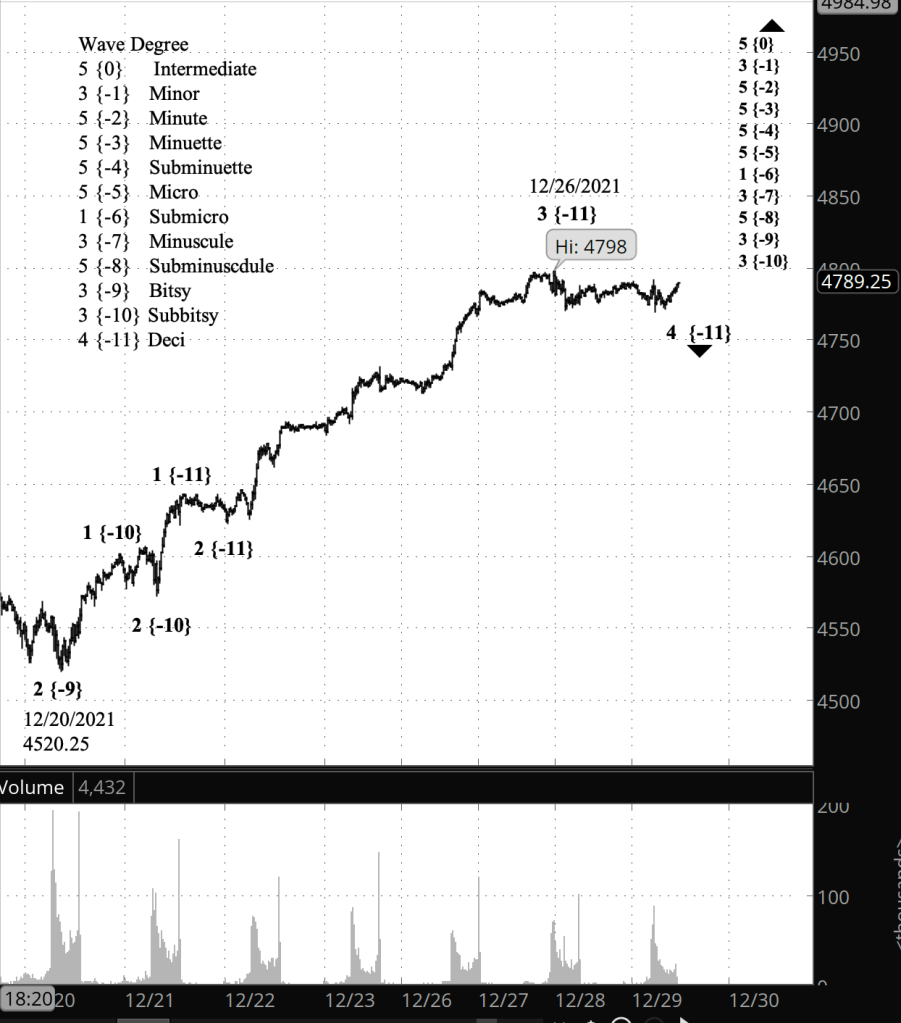
[S&P 500 E-mini futures at 3:30 p.m., 20-minute bars, with volume]

What does Elliott wave theory say? The correction is wave 4 of Deci degree — subscript {-11} within wave 3 of Subbitsy degree {-10} within wave 3 of Bitsy degree {-9}, which began on December 20. All of this is happening within rising wave 5 of Subminuscule degree{-8}, which began on December 3 from 4492.

Wider view: The present correction is a very small bump in the road with the 3rd waves of three larger degrees, and those within a still larger 3rd wave within a 1st wave, and all of that within a series of ever-larger 5th waves stretching up four degrees, to wave 3 of Minor degree {-1} within wave 5 of Intermediate degree {0}.

Moreover, Intermediate wave 5 is a subwave within 5th waves stretching up three more degrees, to wave 5 of Grand Supercycle degree {+3}, which began in 1932.

Long story short: There’s a lot of upside in the S&P 500. Possibly. Fifth waves carry no expectation regarding how much distance they’ll cover, but Intermediate wave 5 has lasted nearly four years and has covered nearly 2,500 points in its rise. That gives some idea of what large-degree 5th waves are capable of. However, the fact that there are so many 5th waves up and down the fractal structure at this point provides a note of caution: When 5th waves reach their ends, they are followed often by devastating declines.

So the motto of this era in the markets, I think, is this: “Let the good times roll, but be mindful that the good times don’t last forever.”

Learning and other resources. Elliott wave analysis provides context, not prophecy. As the 20th century semanticist Alfred Korzybski put it this way in his book Science and Sanity (1933), “The map is not the territory … The only usefulness of a map depends on similarity of structure between the empirical world and the map.” And I would add, in the ever-changing markets, we can judge that similarity of structure only after the fact.

See the menu page Analytical Methods for a rundown on where to go for information on Elliott wave analysis.

By Tim Bovee, Portland, Oregon, December 29, 2021

Disclaimer

Tim Bovee, Private Trader tracks the analysis and trades of a private trader for his own accounts. Nothing in this blog constitutes a recommendation to buy or sell stocks, options or any other financial instrument. The only purpose of this blog is to provide education and entertainment.

No trader is ever 100 percent successful in his or her trades. Trading in the stock and option markets is risky and uncertain. Each trader must make trading decisions for his or her own account, and take responsibility for the consequences.

License
Creative Commons License

All content on Tim Bovee, Private Trader by Timothy K. Bovee is licensed under a Creative Commons Attribution-ShareAlike 4.0 International License.

Based on a work at www.timbovee.com.
SP500 Analysis

3:30 p.m. New York time

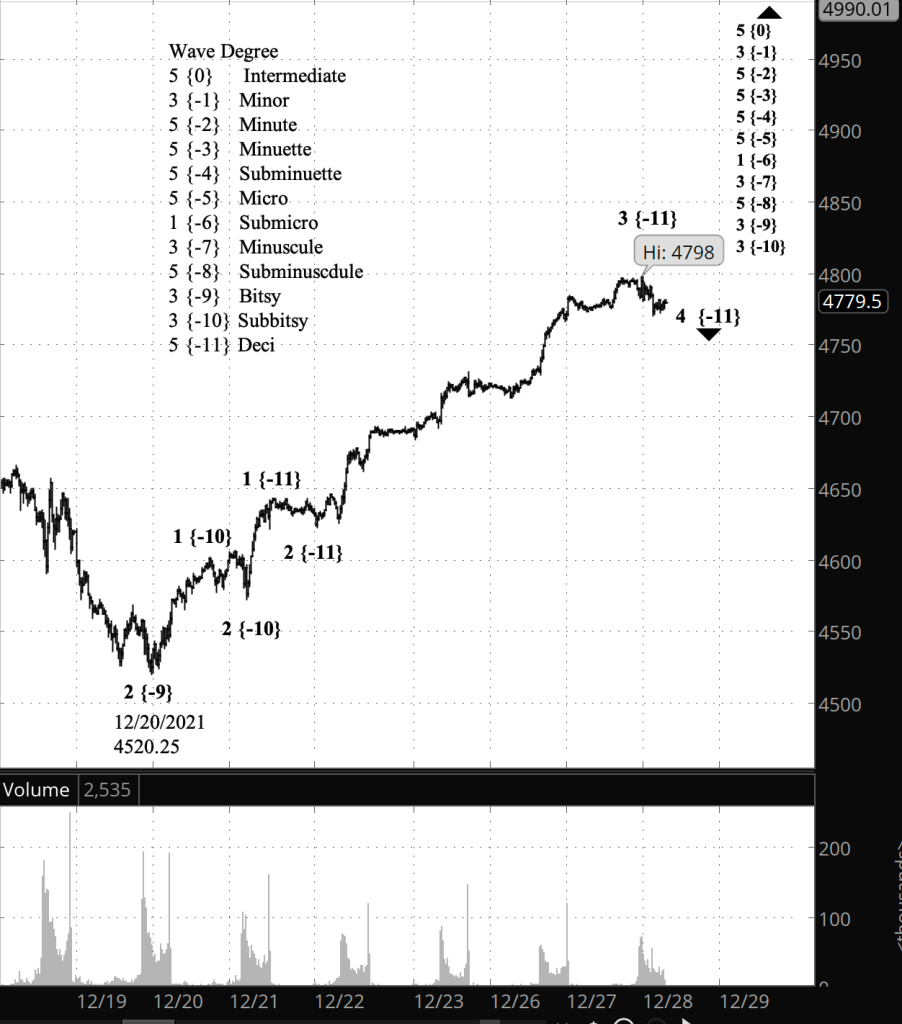
Half an hour before the closing bell. The S&P 500 peaked this morning and then began a slow decline. I’ve adjusted my principal analysis to show wave 3 of Deci degree {-11} ending at that peak, 4798 on the futures and 4807.02 on the index. The present wave is a 4th wave correction of Deci degree within uptrending wave 3 of Subbitsy degree. Otherwise, this morning’s analysis stands. I’ve updated the chart.

9:35 a.m. New York time

What’s happening now? The S&P 500 E-mini futures continued to rise in overnight trading, reaching 4797.25.

What does it mean? My principal analysis concludes that the rise from December 20 is in its final leg internally. When that last leg ends, the S&P 500 will enter a downward correction before resuming its upward course.

What’s the alternative? The final leg of a trend has no limit to how far it can travel, beyond a certain tendency to be of more or less of the same magnitude as other portions of the structure. So, yes, a correction lies ahead after the last leg reaches completion. And, no, it won’t necessarily be in the next few days, although it could be. As is often the case with stock market charts, ambiguity rules the day.

[S&P 500 E-mini futures at 3:30 p.m., 20-minute bars, with volume]

What does Elliott wave theory say? The rise from December 20 is wave 3 of Bitsy degree — subscript {-9} — and within it wave 3 of Subbitsy degree {-10} is underway. Further down the fractal structure, wave 5 of Deci degree {-11} began yesterday. When Deci wave 5 is complete, its parent wave 3 of Subbitsy degree will also be complete, ushering in a 4th wave correction. Subbitsy wave 4 will be followed by a 5th wave, which has no limits on how far it can go, but also no requirement that it travel any great distance.

The end of Subbitsy 5 will also be the end of Bitsy wave 3, which will mark the start of a 4th wave correction. Bitsy 4 will be followed by a 5th wave whose end will complete the rise from December 20, and also mark the completion the parent, wave 5 of Subminuscule degree {-8}.

When Subminuscule 5 reaches its end, it will also mark the end of its parent, wave 3 of Minuscule degree {-7} and the beginning of a noticeably large correction.

The analysis applies to both my principal and alternative analyses. The only unknown is the timing of the coming 4th wave corrections.

Calendar notes. No earnings plays in sight this week. The next trading opportunities will be on Wednesday, January 5. The next earnings kicks off the week of January 18, when AA publishes its earnings. For options trades not associated with events, the optimal entry window for options expiring February 22 is on Tuesday, January 4, and I’ll be looking for trades on that date.

Learning and other resources. Elliott wave analysis provides context, not prophecy. As the 20th century semanticist Alfred Korzybski put it this way in his book Science and Sanity (1933), “The map is not the territory … The only usefulness of a map depends on similarity of structure between the empirical world and the map.” And I would add, in the ever-changing markets, we can judge that similarity of structure only after the fact.

See the menu page Analytical Methods for a rundown on where to go for information on Elliott wave analysis.

By Tim Bovee, Portland, Oregon, December 28, 2021

Disclaimer

Tim Bovee, Private Trader tracks the analysis and trades of a private trader for his own accounts. Nothing in this blog constitutes a recommendation to buy or sell stocks, options or any other financial instrument. The only purpose of this blog is to provide education and entertainment.

No trader is ever 100 percent successful in his or her trades. Trading in the stock and option markets is risky and uncertain. Each trader must make trading decisions for his or her own account, and take responsibility for the consequences.

License
Creative Commons License

All content on Tim Bovee, Private Trader by Timothy K. Bovee is licensed under a Creative Commons Attribution-ShareAlike 4.0 International License.

Based on a work at www.timbovee.com.
Private Trader Changes for 2022

I’ll be making a couple of changes to my daily post on PrivateTrader, beginning on the first Monday of the new year, January 3, 2022.

First, the title of the daily post. As it started out after the early pandemic crash in February 2020, Elliott wave analysis of the S&P 500 futures was about all that I was doing. That has changed with the passage of time, and I’m now using that post for other purposes as well, such as to let people know when i’ve posted an analysis of an options trade.

In recognition of that fact, I’m changing the name of the daily post from “SP500 Analysis” to “Trader’s Notebook”. The S&P analysis will still be there, posted on market days shortly after the market open and updated throughout the day as events warrant.

Second, I’m eliminating the degree names from my analyses. On the charts I don’t use names but subscripts that show the relation between the various wave degrees. Subscript {-8} is a degree larger than {-10}, and {-7} is larger than both of them. The subscript numbers are above and below Intermediate degree, which has the subscript {0}. In the write-ups discussing the Elliott wave analysis, I presently use the degree names and have taken to adding in the subscripts as well.

The degree names are traditional. They date from the early work on Elliott wave analysis by R.N. Elliott, who first described his theory in 1938, in “The Wave Principle”. He created the the degree names of Subminuette degree — my subscript {-4} — all the way up to Grand Supercyle {+4}. Robert Prechter in his 1978 book Elliott Wave Principle, co-authored with Alfred Frost, expanded the nomenclature up to Grand Millennium Degree {+7} and down to Minuscule degree {-7}, and later to Subminuscule degree {-8}. In my work analyzing even smaller movements, I added Bitsy degree {-9} and Subbitsy degree {-10}.

But no more. The degree names add nothing to the understanding of the relative wave positions within the fractal structure of the market movements. Up to now, where I would have written “wave 3 of Bitsy degree {-9}”, going forward I shall write “wave 3 {-9}”. For those wanting to correlate my subscripts with the historical wave labels, I have a list on the Analytical Methods page proving that correlation. I link to the page at the bottom of the daily post.

And so, onward to 2022.


See the menu page Analytical Methods for a rundown on where to go for information on Elliott wave analysis.

By Tim Bovee, Portland, Oregon, December 27, 2021

Disclaimer

Tim Bovee, Private Trader tracks the analysis and trades of a private trader for his own accounts. Nothing in this blog constitutes a recommendation to buy or sell stocks, options or any other financial instrument. The only purpose of this blog is to provide education and entertainment.

No trader is ever 100 percent successful in his or her trades. Trading in the stock and option markets is risky and uncertain. Each trader must make trading decisions for his or her own account, and take responsibility for the consequences.

License
Creative Commons License

All content on Tim Bovee, Private Trader by Timothy K. Bovee is licensed under a Creative Commons Attribution-ShareAlike 4.0 International License.

SP500 Analysis

3:30 p.m. New York time

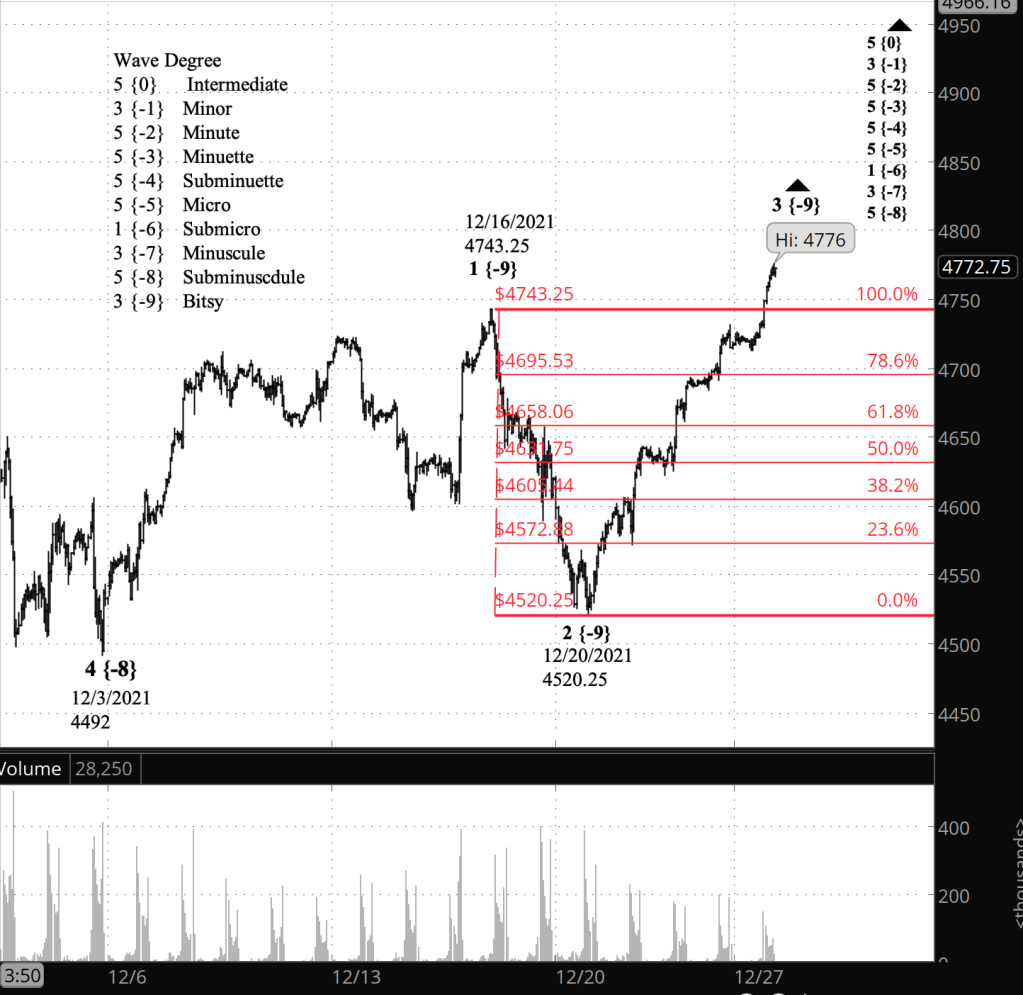
Half an hour before the closing bell. The S&P 500 rose during the trading session, reaching a peak of 4776 on the futures and 4784.72 on the index. Wave 3 of Bitsy degree continues its rise. The exchange-traded fund SPY, which tracks the index, also reached a new peak today.

The achievement of new highest highs by all three instruments resolves a discrepancy that has been on the charts since December 16. Both the futures and SPY track the index, but the correlation is never perfect and from time to time that truth becomes glaringly obvious.

The futures hit a new peak of December 16. But the index and SPY did not; their highest peaks were achieved on November 22 and remained the highest thereafter. Today’s upward push brought all three instruments to new peaks, resolving the discrepancy.

I’ve updated the futures chart below. No change in the analysis.

2:55 p.m. New York time

Private Trader Changes. I’ve posted a rundown of a couple of changes I shall be making to this daily post beginning the first Monday of the New Year, January 3.

9:55 a.m. New York time

New peak. The S&P 500 futures moved above the 4743.25, the all-time peak set on December 16, confirming that the 3rd wave uptrend of Bitsy degree {-9} is underway. The new all-time high, which is unlikely to survive for long, is 4746.75. The principal analysis is correct; the alternative, scrapped. I’ve updated the chart.

9:35 a.m. New York time

What’s happening now? The S&P 500 E-mini futures rose when trading resumed after the long holiday weekend, reaching a level 2 points below the all-time peak of 4743.25 set on December 16.

What does it mean? The rise that began December 20 from 4520.25 is the middle leg of a larger uptrend that began December 3 from 4492. I expect the rise to break above the prior high, 4743.25, to a new peak, perhaps even today.

What’s the alternative? If the price reverses downward without breaking above the December 16 peak, then the downward correction that began December 16 is still underway and is in its middle leg. The downward movement will be followed by another rise that will remain below 4743.25.

[S&P 500 E-mini futures at 3:30 p.m., 50-minute bars, with volume]

What does Elliott wave theory say? Under my principal analysis, the present rise is wave 3 of Bitsy degree — subscript {-9} — within uptrending wave 5 of Subminuscule degree {-8}. The December 16 all-time high marked the end of wave 1 of Bitsy degree. Second waves ALWAYS move beyond the start of the preceding 1st wave, so it’s only a matter of time, perhaps only hours, before it happens. It if fails to move beyond the end of wave 1, then it isn’t a 3rd wave and the alternative analysis is correct.

Under my alternative analysis, the decline that ended on December 20 was wave A of Subbitsy degree {-10} and the present rise that now underway is Subbitsy wave B, both subwaves of a correction, wave 2 of Bitsy degree. Most corrections are composed of three subwaves, so the falling wave that followed Subbitsy B will when complete mark the end of wave 2 of Bitsy degree. Second waves NEVER move beyond the end of the preceding wave 1. If it does move beyond that point, then it isn’t a 2nd wave and the principal analysis is correct.

Learning and other resources. Elliott wave analysis provides context, not prophecy. As the 20th century semanticist Alfred Korzybski put it this way in his book Science and Sanity (1933), “The map is not the territory … The only usefulness of a map depends on similarity of structure between the empirical world and the map.” And I would add, in the ever-changing markets, we can judge that similarity of structure only after the fact.

See the menu page Analytical Methods for a rundown on where to go for information on Elliott wave analysis.

By Tim Bovee, Portland, Oregon, December 27, 2021

Disclaimer

Tim Bovee, Private Trader tracks the analysis and trades of a private trader for his own accounts. Nothing in this blog constitutes a recommendation to buy or sell stocks, options or any other financial instrument. The only purpose of this blog is to provide education and entertainment.

No trader is ever 100 percent successful in his or her trades. Trading in the stock and option markets is risky and uncertain. Each trader must make trading decisions for his or her own account, and take responsibility for the consequences.

License
Creative Commons License

All content on Tim Bovee, Private Trader by Timothy K. Bovee is licensed under a Creative Commons Attribution-ShareAlike 4.0 International License.

Based on a work at www.timbovee.com.
SP500 Analysis

9:37 a.m. the next day, New York time

Chart update problem resolved. I’ve updated the lower chart, showing a close-up view, showing the S&P 500 E-mini futures half an hour before the closing bell.

3:30 p.m. New York time

Half an hour before the closing bell. As the closing bell approached, the S&P 500 continued to rise during the day, reaching 4727.75 on the futures, 4737.12 on the index. No change in the analysis. The WordPress system for some reason won’t allow me to update the close-up chart, down above Elliott wave analysis section. Imagine a line that goes up about two-thirds of the way from the 78.6% retracement line and the 100% retracement line, and you’ll have the 3:30 p.m. in your mind.

11:45 a.m. New York time

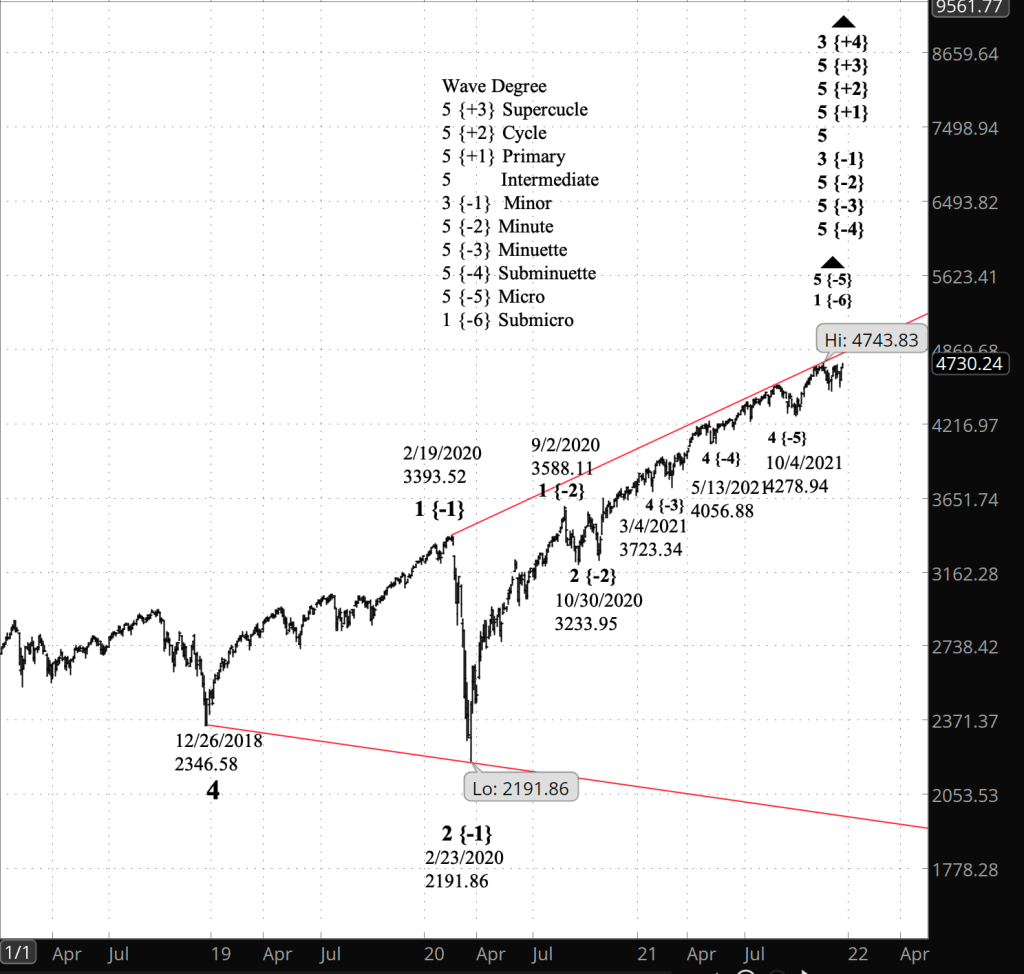
Long-term chart. Today is the last trading day of the week; the markets will observe Christmas on Friday, the day before the holiday itself. So as is my end-of-the-week practice, here’s a look at the long term. The chart shows the S&P 500 index stretching back to the summer of 2018, with the large structure that, by my analysis, has dominated the markets since that year, an expanding Diagonal Triangle, which began on December 26, 2018, from 2346.58.

[S&P 500 index at 11:41 a.m., 2-day bars]

Expanding triangles have a characteristic: The trend-line boundaries keep moving further away from each other. And so the end of the 2nd wave of the triangle was lower than the start of the 1st wave, something not normally allowed in a five-wave main trend.

In Elliott wave terms: The triangle is wave 5 of Intermediate degree — subscript {0}. Within it, the index is presently tracing wave 3 of Minor degree {-1}. Minor wave 3 began on February 23, 2020 — the end of the early pandemic crash — from 2191.86.

Within Minor 3, the index is positioned in a series of 5th waves down to Micro degree {-5}, which began on October 4 from 4278.94.

By that analysis there is still significant upside ahead. Minor wave 3 still hasn’t traced its 3rd wave internally, at Submicro degree {-6}, and it is 3rd waves that cover the most ground in the direction a trend.

The end of Minor wave 3 will signal the beginning of wave 4 of Minor degree, a downward movement that will in theory reach the lower boundary of the Diagonal Triangle, which is presently in the mid-1900s and moving lower each day. It will feel like an end-of-the-world major crash.

The good news: That 4th wave will be followed by Minor wave 5, which will carry the price back up to the upper boundary, which is moving higher day, creating the bull market for the record books. The end of Minor wave 5 will also end increasingly larger 5th waves, of the Primary {+1}, Cycle {+2} and Supercyle {+3} degrees. The 5th wave of Supercycle degree began in 1932, from the low point following the Great Crash of 1929.

And following that Supercycle rise? Well, the bull is always followed by the bear. In Elliott wave terms, the end of a 5th wave is followed by either a correction, within a larger degree, consisting of three waves, with variations, or a new downtrend, consisting of five waves.

One of the wisdom writings of Jewish scripture, composed somewhere between 450 and 200 BCE by an unknown author who says he is reporting the words of the king’s son, Kohelet, provides a perfect description of how the markets work, whether the viewpoint be big picture or close up: “The thing that hath been, it is that which shall be; and that which is done is that which shall be done: and there is no new thing under the sun.” Or as the humanistic Cylons of the reimagined Battlestar Galactica put it, repeatedly, in the 2004-2009 series: “All of this has happened before, and will happen again.”

That insight lies at the core of Elliott wave analysis.

11 a.m. New York time

Earnings plays rules. I’ve posted my rules for earnings plays in the “Trading Rules” section of the menu bar. After tinkering with it, where came down was this: There are rules for entry that are unique to earnings plays, but once the position has been entered, my rules are the same as they are short options spread, with the exception that I’m aiming for 25% of maximum potential profit, rather than 50%. The goal is to improve the turnover of funds for earnings plays.

10:50 a.m. New York time

Earning plays exited. Two of my earnings plays reached 25% of maximum potential profit, and as is my rule, I exited. I’ve updated the analyses of the two short iron condor positions — DRI and GIS — with results.

9:35 a.m. New York time

What’s happening now? The S&P 500 E-mini futures rose in overnight trading, reaching 4706.75 minutes after the opening bell, a bit above a Fibonacci 78.6% upward retracement of the decline from December 16 to December 20.

What does it mean? The uptrend that began on December 20 and will eventually break above the December 16 high, 4743.25, perhaps significantly above that level.

What’s the alternative? If the price reverses and falls back into the 4500s without moving above the December 16 high, then the present rise was the second leg of of a downward correction.

[S&P 500 E-mini futures at 3:30 p.m., 45-minute bars, with volume]

What does Elliott wave theory say? Under my principal analysis, the rise from 4520.25 on December 20 is wave 3 of Bitsy degree — subscript {-9} — within rising wave 5 of Subminuscule degree {-8}.

Learning and other resources. Elliott wave analysis provides context, not prophecy. As the 20th century semanticist Alfred Korzybski put it this way in his book Science and Sanity (1933), “The map is not the territory … The only usefulness of a map depends on similarity of structure between the empirical world and the map.” And I would add, in the ever-changing markets, we can judge that similarity of structure only after the fact.

See the menu page Analytical Methods for a rundown on where to go for information on Elliott wave analysis.

By Tim Bovee, Portland, Oregon, December 23, 2021

Disclaimer

Tim Bovee, Private Trader tracks the analysis and trades of a private trader for his own accounts. Nothing in this blog constitutes a recommendation to buy or sell stocks, options or any other financial instrument. The only purpose of this blog is to provide education and entertainment.

No trader is ever 100 percent successful in his or her trades. Trading in the stock and option markets is risky and uncertain. Each trader must make trading decisions for his or her own account, and take responsibility for the consequences.

License
Creative Commons License

All content on Tim Bovee, Private Trader by Timothy K. Bovee is licensed under a Creative Commons Attribution-ShareAlike 4.0 International License.

Based on a work at www.timbovee.com.
SP500 Analysis

3:30 p.m. New York time

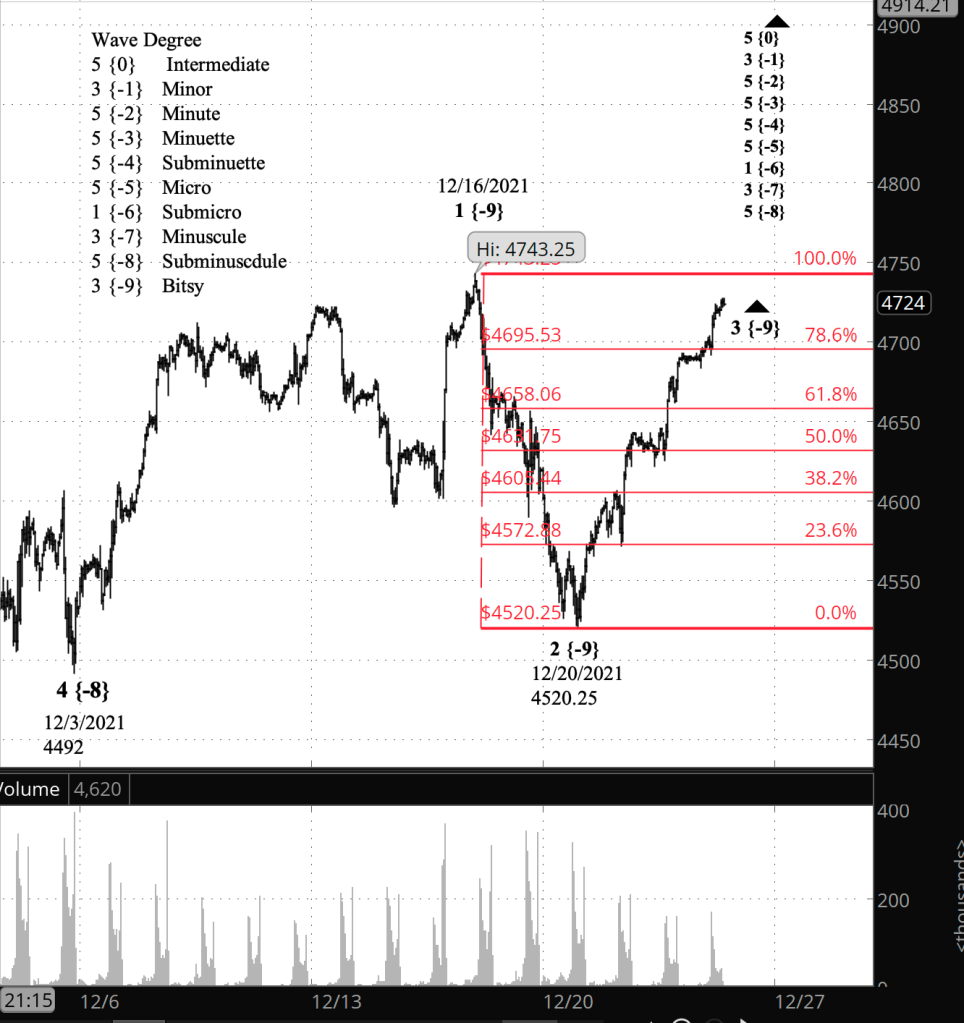
Half an hour before the closing bell. The S&P 500, before the opening bell, pushed past a Fibonacci 61.8% retracement of the 2nd wave downward correction that began on December 16. Thereafter, the 3rd wave rise dawdled throughout the session, staying within a range about $7 wide on the futures. No change in the analysis. I’ve updated the chart.

9:35 a.m. New York time

What’s happening now? The S&P 500 E-mini futures in overnight trading paused at a 50% retracement of the downward correction from December 16 to December 20.

What does it mean? The rise from December 20 is a resumption of the uptrend and will eventually rise above the December 12 high, 4743.25, perhaps significantly above that level.

What’s the alternative? If the price reverses back to the downside without reaching a new peak, then the correction is still underway. Under this scenario, the low of December 20 marked the end of the first leg of the correction, not of the entire correction.

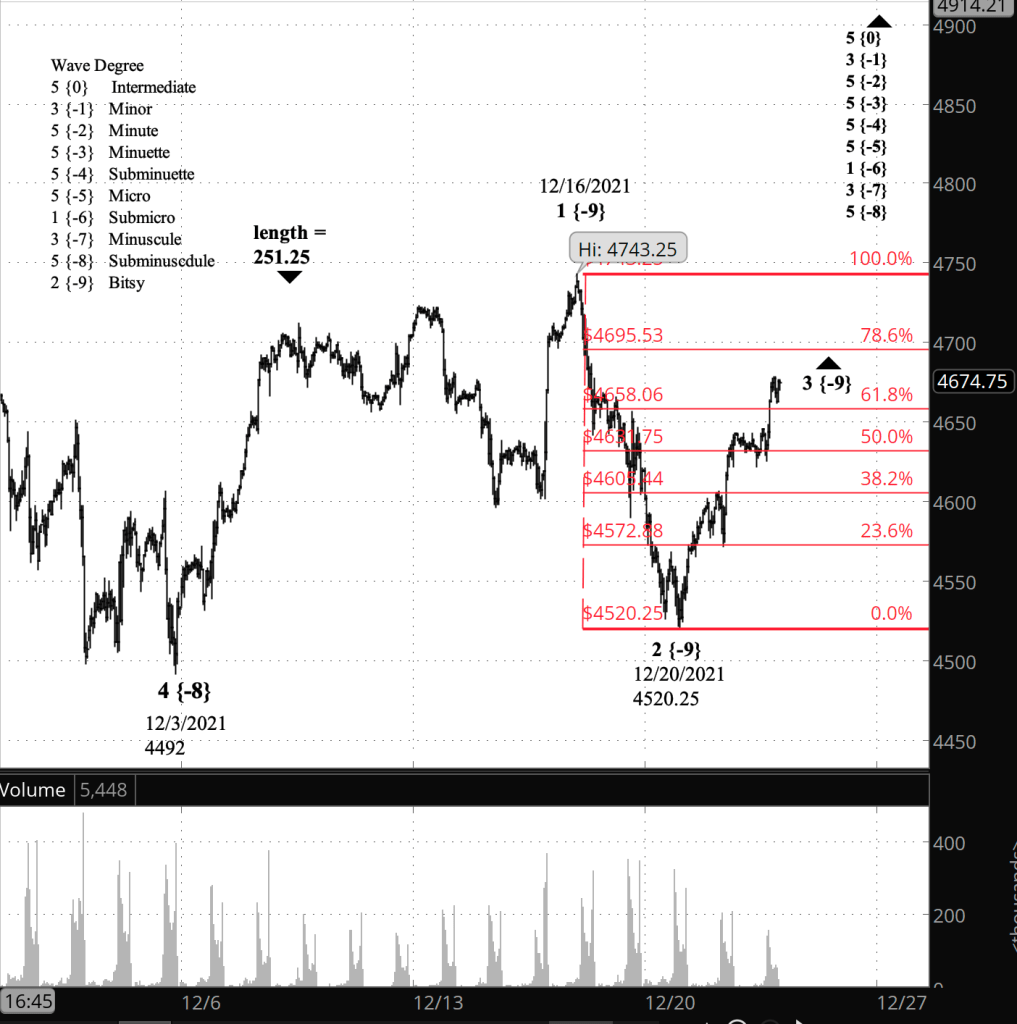
[S&P 500 E-mini futures at 3:30 p.m., 45-minute bars, with volume]

What does Elliott wave theory say? Under my principal analysis, the rise from December 20 is wave 3 of Bitsy degree — subscript {-9} — within uptrending wave 5 of Subminuscule degree {-8}. A 3rd wave typically is the longest of the three waves, out of five, that move in the direction of a trend, and under the rules of Elliott wave analysis, it cannot be the shortest of the three, non-corrective waves.

Wave 1 of Bitsy degree came in with a length of 251.25. The present wave 3 shortly before the opening bell had reached a length of 125.75. So to avoid being shorter than wave 1, the 3rd wave will need to reach, at a minimum, a price of 4771.50.

Of course, Bitsy wave 3 will be followed by a 4th wave and then a 5th. If that 5th wave turns out to be the shortest of the three movements in the direction of the trend, then the Ellliott rules allow wave 3 to be shorter than wave 1.

The end of the parent wave 5 of Subminuscule degree will also mark the end of wave 3 of Minuscule degree {-7}, which will be followed by a 4th wave correction, most likely tracing a Flat pattern.

Learning and other resources. Elliott wave analysis provides context, not prophecy. As the 20th century semanticist Alfred Korzybski put it this way in his book Science and Sanity (1933), “The map is not the territory … The only usefulness of a map depends on similarity of structure between the empirical world and the map.” And I would add, in the ever-changing markets, we can judge that similarity of structure only after the fact.

See the menu page Analytical Methods for a rundown on where to go for information on Elliott wave analysis.

By Tim Bovee, Portland, Oregon, December 22, 2021

Disclaimer

Tim Bovee, Private Trader tracks the analysis and trades of a private trader for his own accounts. Nothing in this blog constitutes a recommendation to buy or sell stocks, options or any other financial instrument. The only purpose of this blog is to provide education and entertainment.

No trader is ever 100 percent successful in his or her trades. Trading in the stock and option markets is risky and uncertain. Each trader must make trading decisions for his or her own account, and take responsibility for the consequences.

License
Creative Commons License

All content on Tim Bovee, Private Trader by Timothy K. Bovee is licensed under a Creative Commons Attribution-ShareAlike 4.0 International License.

Based on a work at www.timbovee.com.
PAYX Trade

Paychex Inc. (PAYX)

Update 1/10/2021: I exited my short iron condor position on PAYX 11 days before expiration, for a $1.03 debit per contract/share, a profit before fees of $92 per contract. Shares were trading at $126.63, up $0.19 from the entry level.

The Implied Volatility Rank at exit was 34.9%, down 11.5 points from the entry level.

I exited because the position exceeded 25% of maximum potential profit, my normal exit point for earnings plays. In the case of PAYX, there was a price gap down at the opening bell that allowed me to exit at 47.2% of maximum potential profit.

Shares rose by 0.2% over 20 days for a 2.7% annual rate. The options position produced an 89.2% return for a 1,630% annual rate.


I have entered a short iron condor spread on PAYX, using options that trade for the last time 31 days hence, on January 21. The premium is a $1.95 credit per contract share and the stock at the time of entry was priced at $126.43.

The Implied Volatility Ratio stands at 46.4%

Premium:$1.95Expire OTM
PAYX-iron condorStrikeOddsDelta
Calls
Long135.0084.0%19
Break-even131.9576.0%27.5
Short130.0068.0%36
Puts
Short120.0072.0%25
Break-even116.9578.0%19.5
Long115.0084.0%14

The premium is 39% of the width of the positions short/long spreads. The profit zone covers a 4.4% move to the upside and an 8.1% move to the downside.

The risk/reward ratio is 1.6:1, with maximum risk of $305 and maximum reward of $195 per contract.

How I chose the trade. The trade was placed to coincide with PAYX’s earnings announcement, before the opening bell on the day after entry. The short strikes were set to coincided with the expected move of $2.93 either way, based on options pricing, which gives a price range of $123.49 to $129.35.

By Tim Bovee, Portland, Oregon, December 21, 2021

Disclaimer

Tim Bovee, Private Trader tracks the analysis and trades of a private trader for his own accounts. Nothing in this blog constitutes a recommendation to buy or sell stocks, options or any other financial instrument. The only purpose of this blog is to provide education and entertainment.

No trader is ever 100 percent successful in his or her trades. Trading in the stock and option markets is risky and uncertain. Each trader must make trading decisions for his or her own account, and take responsibility for the consequences.

License
Creative Commons License

All content on Tim Bovee, Private Trader by Timothy K. Bovee is licensed under a Creative Commons Attribution-ShareAlike 4.0 International License.

Based on a work at www.timbovee.com.
SP500 Analysis

3:30 p.m. New York time

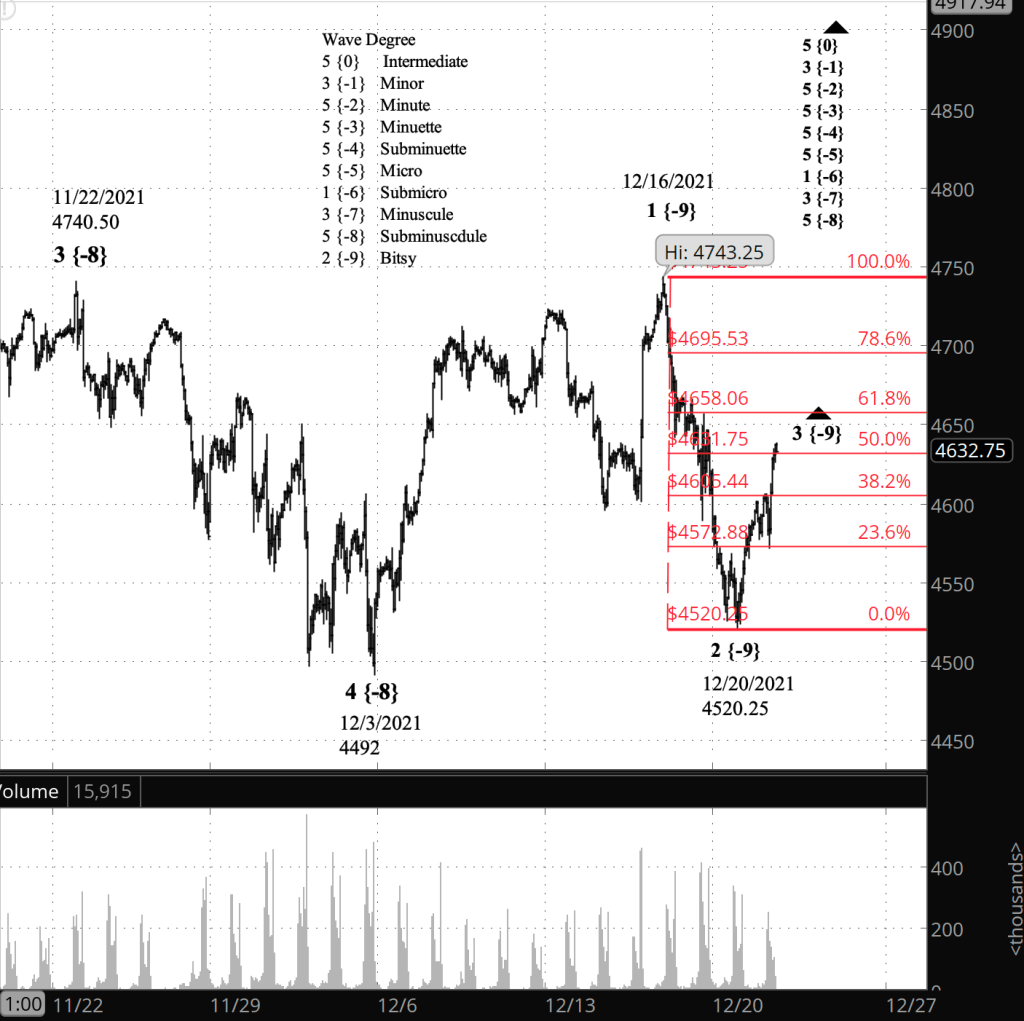
Half an hour before the closing bell. The S&P 500 rose during the trading session, reaching the 50% retracement level as the closing bell approached. Uptrending wave 5 of Bitsy degree {-9} continues.

2:25 p.m. New York time

New earnings play. I’ve entered an earnings play on PAYX and have posted an analysis of the trade.

9:35 a.m. New York time

What’s happening now? The S&P 500 E-mini futures rose overnight, so far retracing 38.2% of the decline that began on August 16 from a peak of 4743.25.

What does it mean? The correction that began on August 16 ended yesterday at 4520.25, and a rise that will ultimately reach new heights, beyond 4743.25, has begun.

What’s the alternative? Yesterday’s low can be read as being the end of the first leg of the correction, with the subsequent rise ending below 4743.25. That middle leg would be followed be a decline, perhaps approaching 4500.

[S&P 500 E-mini futures at 3:30 p.m., hourly bars, with volume]

What does Elliott wave theory say? Under my principal analysis, the decline from August 16 was wave 2 of Bitsy degree — subscript {-9} and has three waves internally, the number needed for completion. The rise from last night is wave 3 of Bitsy degree and will exhibit the power for which 3rd waves are famous. It will rise beyond the end of the preceding wave 1 of Bitsy degree, 4743.25, and typically quite a bit above that level.

The alternative analysis would read Bitsy wave 2 as so far having completed the 1st of its three waves, wave A, with the subsequent rise, wave B, coming up short of the beginning of Bitsy wave 1 before falling again in a C wave.

The retracement overnight paused at 38.2%, a Fibonacci level. (The Fibonacci ladder is on the chart in red.)

This is all happening within wave 5 of Subminuscule degree {-8}, whose completion will also mark the end of its parent, wave 3 of Minuscule degree. The subsequent 4th wave will be a downward correction larger than the correction we’ve just completed.

Trading plans. I’ll be taking a look at PAYX today as a potential earnings play.

Learning and other resources. Elliott wave analysis provides context, not prophecy. As the 20th century semanticist Alfred Korzybski put it this way in his book Science and Sanity (1933), “The map is not the territory … The only usefulness of a map depends on similarity of structure between the empirical world and the map.” And I would add, in the ever-changing markets, we can judge that similarity of structure only after the fact.

See the menu page Analytical Methods for a rundown on where to go for information on Elliott wave analysis.

By Tim Bovee, Portland, Oregon, December 21, 2021

Disclaimer

Tim Bovee, Private Trader tracks the analysis and trades of a private trader for his own accounts. Nothing in this blog constitutes a recommendation to buy or sell stocks, options or any other financial instrument. The only purpose of this blog is to provide education and entertainment.

No trader is ever 100 percent successful in his or her trades. Trading in the stock and option markets is risky and uncertain. Each trader must make trading decisions for his or her own account, and take responsibility for the consequences.

License
Creative Commons License

All content on Tim Bovee, Private Trader by Timothy K. Bovee is licensed under a Creative Commons Attribution-ShareAlike 4.0 International License.

Based on a work at www.timbovee.com.

GIS Trade

General Mills Inc. (GIS)

Update 12/23/2021: I exited my short iron condor position on GIS 29 days before expiration, for a $1.03 debit per contract/share, a profit before fees of $64 per contract. Shares were trading at $65.99, down $1.83 from the entry level.

The Implied Volatility Rank at exit was 23.9, down 48.1 points from the entry level.

I exited because the position reached 25% of maximum potential profit, my normal exit point for earnings plays.

Shares declined by 2.7% over three days for a 328% annual rate. The options position produced a 31.1% return for a 3,780% annual rate.


I have entered a short iron condor spread on GIS, using options that trade for the last time 32 days hence, on January 21. The premium is a $1.35 credit per contract share and the stock at the time of entry was priced at $67.81.

The Implied Volatility Ratio stands at 72.0%

Premium:$1.35Expire OTM
GIS-iron condorStrikeOddsDelta
Calls
Long75.0095.0%7
Break-even71.3583.5%19.5
Short70.0072.0%32
Puts
Short65.0069.0%28
Break-even61.3579.5%18
Long60.0090.0%8

The premium is 27% of the width of the position’s short/long spread. The profit zone covers a 5.2% move to the upside and a 10.5% move to the downside.

The risk/reward ratio is 2.7:1, with maximum risk of $265 and maximum reward of $135 per contract.

How I chose the trade. The trade was placed to coincide with GIS’s earnings announcement, beforer the opening bell on the day after entry. The short strikes were set to coincided with the expected move of $2.83 either way, based on options pricing, which gives a price range of $66.25 to $69.37

By Tim Bovee, Portland, Oregon, December 20, 2021

Disclaimer

Tim Bovee, Private Trader tracks the analysis and trades of a private trader for his own accounts. Nothing in this blog constitutes a recommendation to buy or sell stocks, options or any other financial instrument. The only purpose of this blog is to provide education and entertainment.

No trader is ever 100 percent successful in his or her trades. Trading in the stock and option markets is risky and uncertain. Each trader must make trading decisions for his or her own account, and take responsibility for the consequences.

License
Creative Commons License

All content on Tim Bovee, Private Trader by Timothy K. Bovee is licensed under a Creative Commons Attribution-ShareAlike 4.0 International License.

Based on a work at www.timbovee.com.

NKE Trade

Nike Inc. (NKE)

Update 1/3/2022: I exited my short iron condor position on NKE 18 days before expiration, for a $1.95 debit per contract/share, a profit before fees of $80 per contract. Shares were trading at $164.66, up $8.11 from the entry level.

The Implied Volatility Rank at exit was 21.9%, down 77 points from the entry level.

I exited because the position became profitable within 21 days of expiration, on the theory that if an unprofitable position becomes profitable that close to the end of the options’ lifespan, then best to grab the money and run.

Shares rose by 5.2% over 14 days for a 135% annual rate. The options position produced a 20.5% return for a 535% annual rate.


I have entered a short iron condor spread on NKE, using options that trade for the last time 32 days hence, on January 21. The premium is a $2.35 credit per contract share and the stock at the time of entry was priced at $156.55.

The Implied Volatility Ratio stands at 98.9%

Premium:$2.35Expire OTM
NKE-iron condorStrikeOddsDelta
Calls
Long170.0080.0%25
Break-even167.3575.5%29.5
Short165.0071.0%34
Puts
Short145.0069.0%27
Break-even142.3573.0%23.5
Long140.0077.0%20

The premium is 47% of the width of the positions short/long spread. The profit zone covers a 6.9% move to the upside and a 10.0% move to the downside.

The risk/reward ratio is 1.1:1, with maximum risk of $265 and maximum reward of $235 per contract.

How I chose the trade. The trade was placed to coincide with NKE’s earnings announcement, after the opening bell on the day of entry. The short strikes were set to coincided with the expected move of $9.36 either way, based on options pricing, which gives a price range of 146.48 to 165.20.

By Tim Bovee, Portland, Oregon, December 20, 2021

Disclaimer

Tim Bovee, Private Trader tracks the analysis and trades of a private trader for his own accounts. Nothing in this blog constitutes a recommendation to buy or sell stocks, options or any other financial instrument. The only purpose of this blog is to provide education and entertainment.

No trader is ever 100 percent successful in his or her trades. Trading in the stock and option markets is risky and uncertain. Each trader must make trading decisions for his or her own account, and take responsibility for the consequences.

License
Creative Commons License

All content on Tim Bovee, Private Trader by Timothy K. Bovee is licensed under a Creative Commons Attribution-ShareAlike 4.0 International License.

Based on a work at www.timbovee.com.