MU Trade

Micron Technology Inc. (MU)

Update 1/21/2022: The remaining bull put spread on MU expires today. I had hoped it would expire without value, but on the last day it moved from $0.00 to $0.05 per contract share, and so I exited to avoid assignment.

For today’s bull put spread transaction, I received a $1.14 credit per contract share and paid a $5 debit to exit. The transaction produced a $109 return per contract over 32 days, or a 2,180.0% profit, for a 24,866% annual rate.

Combining the separate spreads that composed the iron condor, here’s the analysis.

I exited my short iron condor position on MU, in two transactions, on the day of trading before expiration, for a $3.65 debit per contract/share, a loss before fees of $266 per contract. Shares were trading at $83.29, up $1.69 from the entry level.

The Implied Volatility Rank at exit was 65.6%, down 27.5 points from the entry level.

Shares rose by 2.1% over 32 days for a 23.6% annual rate. The options position produced a 36.4% loss for a -416% annual rate.


Update 12/30/2021: MU goes ex-dividend tomorrow, putting my in-the-money short call at risk of exercise. I exited the calls — a bear call spread — and retained the puts — a bull put spread — in the expectation that that they will grow more profitable as expiration approaches. After exiting the puts I’ll combine the two spreads’ results to show the outcome for the original short iron condor. For the calls that I exited, I received a $1.18 credit per contract share, and paid a $3.60 debit when I exited. The transactions produced a $456 loss per contract, a loss of 63.3%. Shares at exit were trading at $137.53, up $55.93 from their entry price. The IV Rank at the close was 35.5%, down 58.6 points from the entry level.


I have entered a short iron condor spread on MU, using options that trade for the last time 32 days hence, on January 21. The premium is a $2.32 credit per contract share and the stock at the time of entry was priced at $81.60.

The Implied Volatility Ratio stands at 93.1%

Premium:$2.32Expire OTM
MU-iron condorStrikeOddsDelta
Calls
Long92.0081.0%24
Break-even89.3275.5%30
Short87.0070.0%36
Puts
Short75.0066.0%29
Break-even72.3272.5%23
Long70.0079.0%17

The premium is 46.4% of the width of the position’s short/long spread. The profit zone covers a 9.5% move to the upside and a 12.8% move to the downside.

The risk/reward ratio is 1.2:1, with maximum risk of $268 and maximum reward of $232 per contract.

How I chose the trade. The trade was placed to coincide with MU’s earnings announcement, before the opening bell on the day after entry. The short strikes were set to coincided with the expected move of $5.84 either way, based on options pricing, which gives a price range of 75.29 to 86.97.

By Tim Bovee, Portland, Oregon, December 20, 2021

Disclaimer

Tim Bovee, Private Trader tracks the analysis and trades of a private trader for his own accounts. Nothing in this blog constitutes a recommendation to buy or sell stocks, options or any other financial instrument. The only purpose of this blog is to provide education and entertainment.

No trader is ever 100 percent successful in his or her trades. Trading in the stock and option markets is risky and uncertain. Each trader must make trading decisions for his or her own account, and take responsibility for the consequences.

License
Creative Commons License

All content on Tim Bovee, Private Trader by Timothy K. Bovee is licensed under a Creative Commons Attribution-ShareAlike 4.0 International License.

Based on a work at www.timbovee.com.
SP500 Analysis

3:30 p.m. New York time

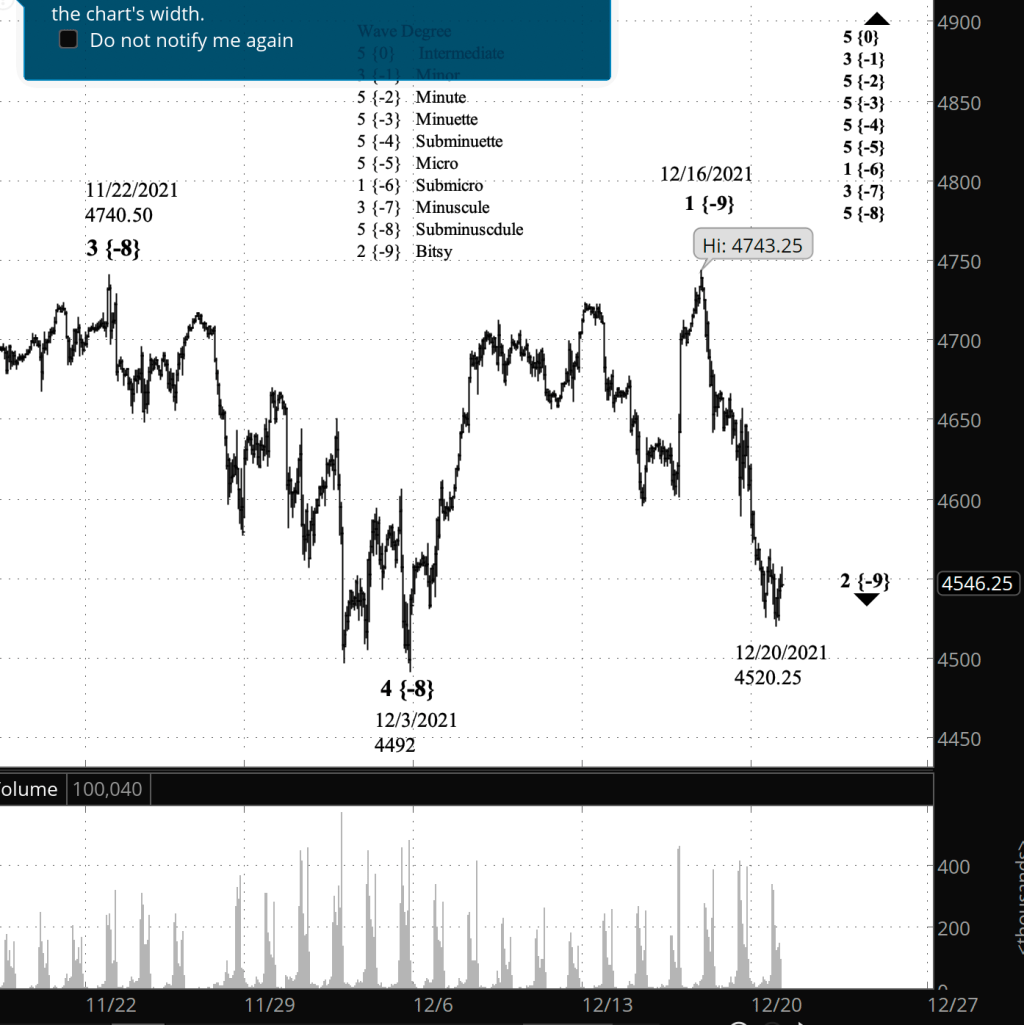
Half an hour before the closing bell. The S&P 500 continued its downward course throughout the day, with no significant upward moves. The low point attained so far is 4520.25 on the futures, 4531.10 on the index.

If the price reaches below 4492 on the futures, the starting point of uptrending wave 1 of Bitsy degree, which preceded the present wave 2 decline, then the principal analysis will need to be redone, since under the rules of Elliott wave analysis, if a “2nd wave” moves beyond the start of the preceding 1st wave, then it isn’t a 2nd wave.

No change in the analysis, and I’ve updated the chart.

2:35 p.m. New York time

Another earnings play. I’ve entered a short iron condor earnings play on GIS and have posted an analysis.

2:20 p.m. New York time

Earnings plays. I’ve entered two earnings plays today, short iron condors on two stocks, and have posted analyses for both MU and NKE. A third earnings play, on GIS, has not yet been filled.

10:35 a.m. New York time

My trades. I exited my short bear call spread position on SPY for a 131.5% profit and have updated the analysis with results.

9:35 a.m. New York time

What’s happening now? The S&P 500 E-mini futures declined after trading resumed on Sunday, to 4526.25, and then, shortly before midnight, reversed in a so-far small rise.

What does it mean? The first leg of the downward correction that began on December 16 continues and will be followed by a rise to new heights, beyond the 4743.25 attained on that date.

What’s the alternative? The overnight low could have marked the end of correction, but the internal structure suggests otherwise. Also, the high of December 16 could mark the end of the rise that began on December 3, and the subsequent decline in that case would be the beginning of a new downtrend.

Divergence. The present count is based on the all-time high set on December 16 by the futures. However, for the S&P 500 index, which fluctuates only during normal U.S. market hours, the highest high remains that set on November 22, at 4743.83. The highest high for SPY, the exchange-traded fund that tracks the index, was also set on November 22, at 473.54.

In the past such divergences have eventually ended, with the index and the ETF catching up with the futures, which trade 24/7 Sunday evening through Friday afternoon. I’ve seen analysts claim that the three products can be analyzed as separate entities, but I don’t buy that. They’re tracking the same collection of stocks, and any divergence is simply an artifact of the trading schedule. In my analysis, I consider the constantly traded futures to be the best reflection of the public mood’s impact on the S&P 500.

[S&P 500 E-mini futures at 3:34 p.m., hourly bars, with volume]

What does Elliott wave theory say? Under my principal analysis, I’ve labeled the decline from the December 16 high as wave 2 of Bitsy degree {-9} within rising wave 5 of Subminuscule degree {-8}. But Bitsy 2 could well be a degree lower.

Under the first alternative, Bitsy 2 ended with the Sunday night low. Under the second alternative, the December 16 high marked the end of wave 5 of Subminuscule degree, and the subsequent decline is wave 1 of a new downtrend that will carry the price significantly lower.

Earnings plays. I’ll be looking at three earnings plays today: MU, NKE and GIS.

Learning and other resources. Elliott wave analysis provides context, not prophecy. As the 20th century semanticist Alfred Korzybski put it this way in his book Science and Sanity (1933), “The map is not the territory … The only usefulness of a map depends on similarity of structure between the empirical world and the map.” And I would add, in the ever-changing markets, we can judge that similarity of structure only after the fact.

See the menu page Analytical Methods for a rundown on where to go for information on Elliott wave analysis.

By Tim Bovee, Portland, Oregon, December 20, 2021

Disclaimer

Tim Bovee, Private Trader tracks the analysis and trades of a private trader for his own accounts. Nothing in this blog constitutes a recommendation to buy or sell stocks, options or any other financial instrument. The only purpose of this blog is to provide education and entertainment.

No trader is ever 100 percent successful in his or her trades. Trading in the stock and option markets is risky and uncertain. Each trader must make trading decisions for his or her own account, and take responsibility for the consequences.

License
Creative Commons License

All content on Tim Bovee, Private Trader by Timothy K. Bovee is licensed under a Creative Commons Attribution-ShareAlike 4.0 International License.

Based on a work at www.timbovee.com.
SP500 Analysis

3:30 p.m. New York time

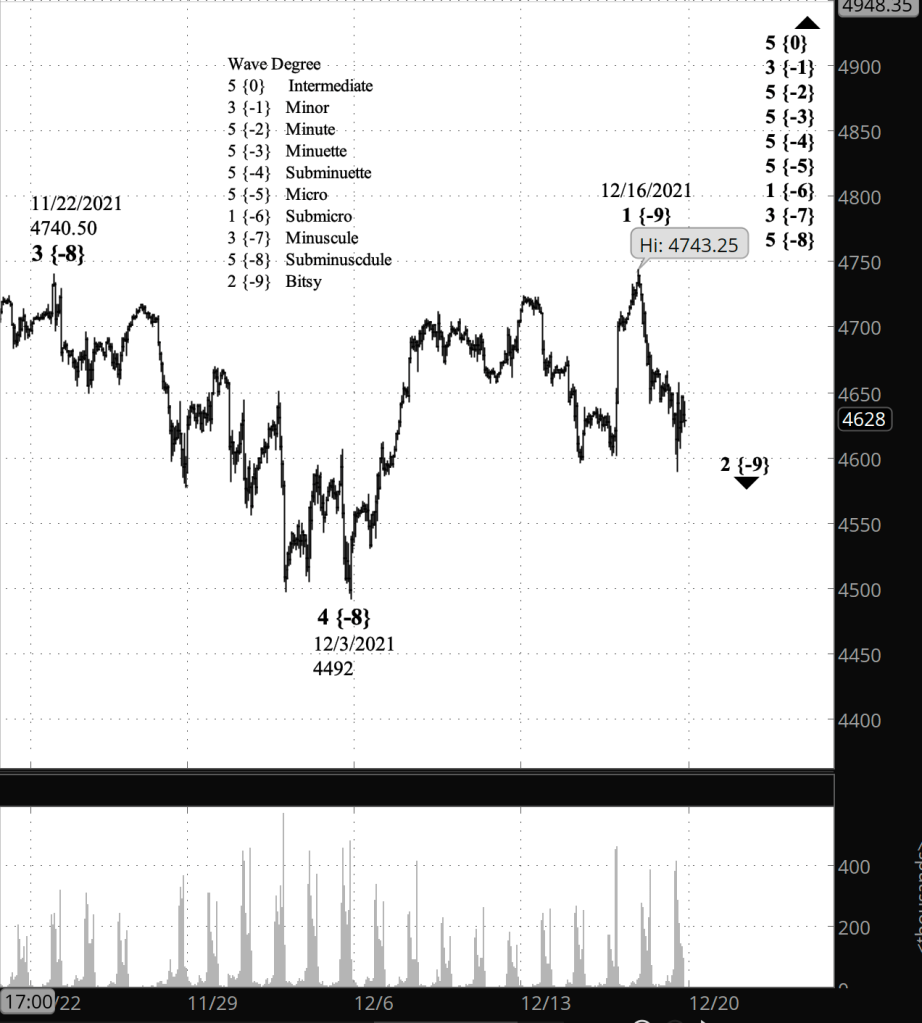
Half an hour before the closing bell. The S&P 500 futures continued to decline during the session, so far reaching a low of 4590. No change in the analysis. I’ve updated the upper chart.

12:45 p.m. New York time

Earnings play exit. I’ve exited my short iron condor position on FDX for a 19.4% return and have updated the analysis with full results.

9:50 a.m. New York time

My trades. The two short iron condor earnings plays I entered into yesterday, FDX and DRI, have overshot boundaries. FDX is showing a loss at present, and DRI a 9% profit. I shall wait a bit before exiting, in the hopes that the prices will return closer to their pre-announcement levels.

9:35 a.m. New York time

What’s happening now? The S&P 500 E-mini futures fell in overnight trading, reaching 4620.50 at the opening bell.

What does it mean? The decline marks a correction of the rise that began on December 3.

What’s the alternative? None so far today.

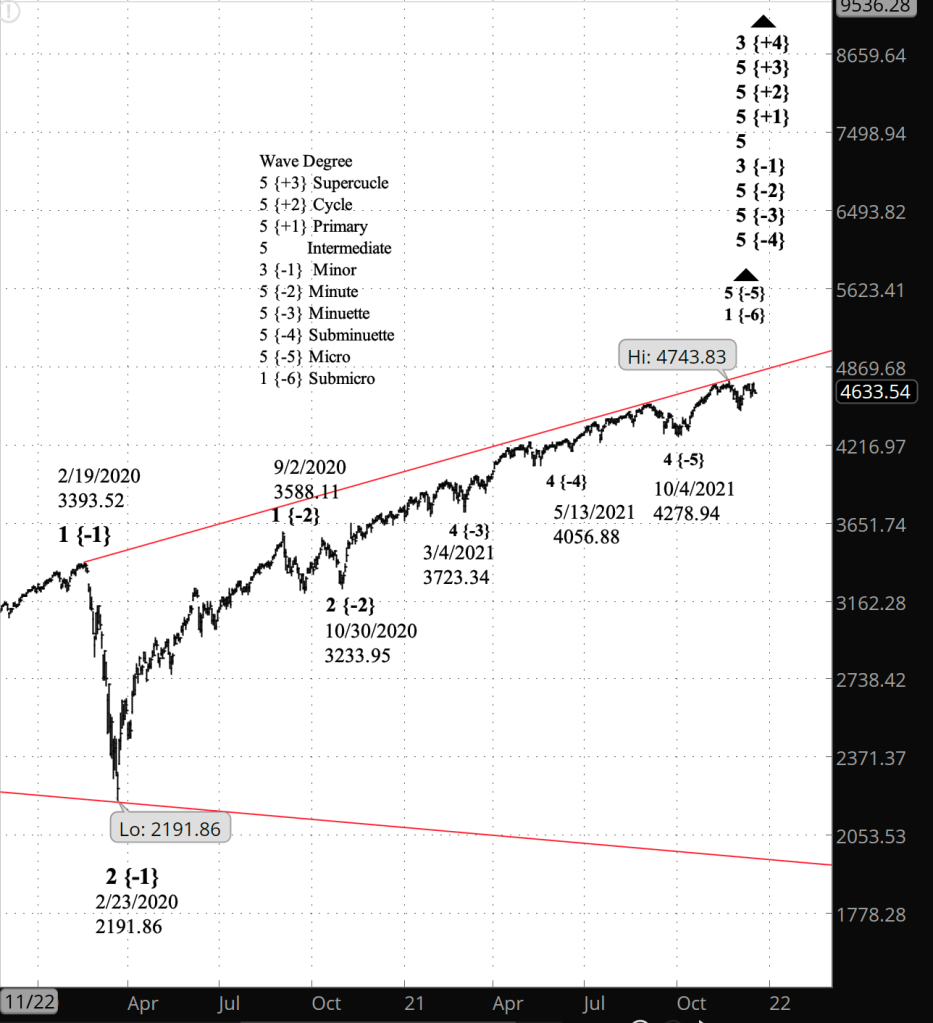
Charts. The upper chart is a close-up view beginning in late November. The lower chart is a long view, beginning in November 2019; it shows the early pandemic crash, and the redlines are the boundaries of an expanding Diagonal Triangle that began in December 2018.

[S&P 500 E-mini futures at 3:30 p.m., hourly bars, with volume]
[S&P 500 index at 9:35 a.m., daily bars]

What does Elliott wave theory say? I reworked the count to correct some inelegancies in wave length, in particular the decline overnight, which feels much more like a 2nd wave than a 4th.

Under my principal analysis, wave 2 of Bitsy degree — subscript {-9} — is underway and appears to be close to completing its first internal wave, A of Subbitsy degree {-10}. The structure is part of wave 5 of Subminuscule degree {-8}, which began on December 3.

Moving up the chain, the parent of Subminuscule 5 is wave 3 of Minscule degree {-7}, and the completion of Subminuscule 5 will mark the beginning of a 4th-wave correction at the Minuscule degree.

No change in the big picture. Wave of 1 of Submicro degree {-6} is still underway. Its parent, wave 5 of Micro degree {-5}, is the first in a line of 5th degrees stretching up to wave 5 of Minute degree {-2} within wave 3 of Minor degree {-1}.

Learning and other resources. Elliott wave analysis provides context, not prophecy. As the 20th century semanticist Alfred Korzybski put it this way in his book Science and Sanity (1933), “The map is not the territory … The only usefulness of a map depends on similarity of structure between the empirical world and the map.” And I would add, in the ever-changing markets, we can judge that similarity of structure only after the fact.

See the menu page Analytical Methods for a rundown on where to go for information on Elliott wave analysis.

By Tim Bovee, Portland, Oregon, December 17, 2021

Disclaimer

Tim Bovee, Private Trader tracks the analysis and trades of a private trader for his own accounts. Nothing in this blog constitutes a recommendation to buy or sell stocks, options or any other financial instrument. The only purpose of this blog is to provide education and entertainment.

No trader is ever 100 percent successful in his or her trades. Trading in the stock and option markets is risky and uncertain. Each trader must make trading decisions for his or her own account, and take responsibility for the consequences.

License
Creative Commons License

All content on Tim Bovee, Private Trader by Timothy K. Bovee is licensed under a Creative Commons Attribution-ShareAlike 4.0 International License.

Based on a work at www.timbovee.com.
FDX Trade

FDX Corp. (FDX)

Update 12/17/2021: I exited my short iron condor spread position on FDX 35 days before expiration and one day after the company published earnings, for a $3.35 debit per contract/share, a profit before fees of $65 per contract. Shares were trading at $251.18, up $10.35 from the entry level.

The Implied Volatility Rank at exit was 43.3%, down 44.8 points from the entry level.

After earnings were published after the closing bell on December 16, the share price rose to $259.50, dropped, and then rose further to $260.50, both above the expected move upside target of $256.75. The price declined somewhat during the day prior to my exit, improving the profit of the position.

Shares rose by 4.3% over one day for a 1,569% annual rate. The options position produced a 19.4% return for a 7,082% annual rate.


I have entered a short iron condor spread on FDX, using options that trade for the last time 36 days hence, on January 21. The premium is a $4.00 credit per contract share and the stock at the time of entry was priced at $240.83.

The Implied Volatility Ratio stands at 88.1%

Premium:$4.00Expire OTM
FDX-iron condorStrikeOddsDelta
Calls
Long270.0083.0%21
Break-even264.0079.0%25.5
Short260.0075.0%30
Puts
Short220.0073.0%23
Break-even214.0077.0%19
Long210.0081.0%15

The premium is 40% of the width of the positions short/long spread. The profit zone covers a 9.6% move to the upside and a 12.5% move to the downside, for total coverage of 22.2%.

The risk/reward ratio is 1.5:1, with maximum risk of $600 and maximum reward of $400 per contract.

How I chose the the trade. The position is timed to coincide with FDX’s publication of earnings after the closing bell and covers the expected move after that announcement, as inferred from the pricing of options expiring on December 17. The expected move would keep the price between $226.35 and $256.75.

By Tim Bovee, Portland, Oregon, December 16, 2021

Disclaimer

Tim Bovee, Private Trader tracks the analysis and trades of a private trader for his own accounts. Nothing in this blog constitutes a recommendation to buy or sell stocks, options or any other financial instrument. The only purpose of this blog is to provide education and entertainment.

No trader is ever 100 percent successful in his or her trades. Trading in the stock and option markets is risky and uncertain. Each trader must make trading decisions for his or her own account, and take responsibility for the consequences.

License
Creative Commons License

All content on Tim Bovee, Private Trader by Timothy K. Bovee is licensed under a Creative Commons Attribution-ShareAlike 4.0 International License.

Based on a work at www.timbovee.com.
DRI Trade

Darden Restaurants Inc. (DRI)

Update 12/23/2021: I exited my short iron condor position on DRI 29 days before expiration, for a $2.05 debit per contract/share, a profit before fees of $68 per contract. Shares were trading at $147.08, down $1.15 from the entry level.

The Implied Volatility Rank at exit was 35.9%, down 31.9 points from the entry level.

I exited because the position reached 25% of maximum potential profit, my normal exit point for earnings plays.

Shares declined by 0.8% over seven days for a +41% annual rate. The options position produced a 33.2% return for a +1,730% annual rate.


I have entered a short iron condor spread on DRI, using options that trade for the last time 36 days hence, on January 21. The premium is a $2.73 credit per contract share and the stock at the time of entry was priced at $148.23.

The Implied Volatility Ratio stands at 67.8%

Premium:$2.73Expire OTM
DRI-iron condorStrikeOddsDelta
Calls
Long160.0078.0%26
Break-even157.7358.5%31.5
Short155.0039.0%37
Puts
Short140.0063.0%32
Break-even137.7367.5%28
Long135.0072.0%24

The premium is 54.6% of the width of the position’s short/long spread. The profit zone covers a 6.4% move to the upside and a 7.6% move to the downside, for total coverage of 14%.

The risk/reward ratio is 0.8:1, with maximum risk of $227 and maximum reward of $273 per contract.

How I chose the trade. DRI publishes earnings after the opening bell on Friday, December 17. This position covers the expected move post-earnings as implied by the pricing for options expiring December 17. The expected move would keep the price between $140.52 and $155.90.

By Tim Bovee, Portland, Oregon, December 16, 2021

Disclaimer

Tim Bovee, Private Trader tracks the analysis and trades of a private trader for his own accounts. Nothing in this blog constitutes a recommendation to buy or sell stocks, options or any other financial instrument. The only purpose of this blog is to provide education and entertainment.

No trader is ever 100 percent successful in his or her trades. Trading in the stock and option markets is risky and uncertain. Each trader must make trading decisions for his or her own account, and take responsibility for the consequences.

License
Creative Commons License

All content on Tim Bovee, Private Trader by Timothy K. Bovee is licensed under a Creative Commons Attribution-ShareAlike 4.0 International License.

Based on a work at www.timbovee.com.
SP500 Analysis

3:30 p.m. New York time

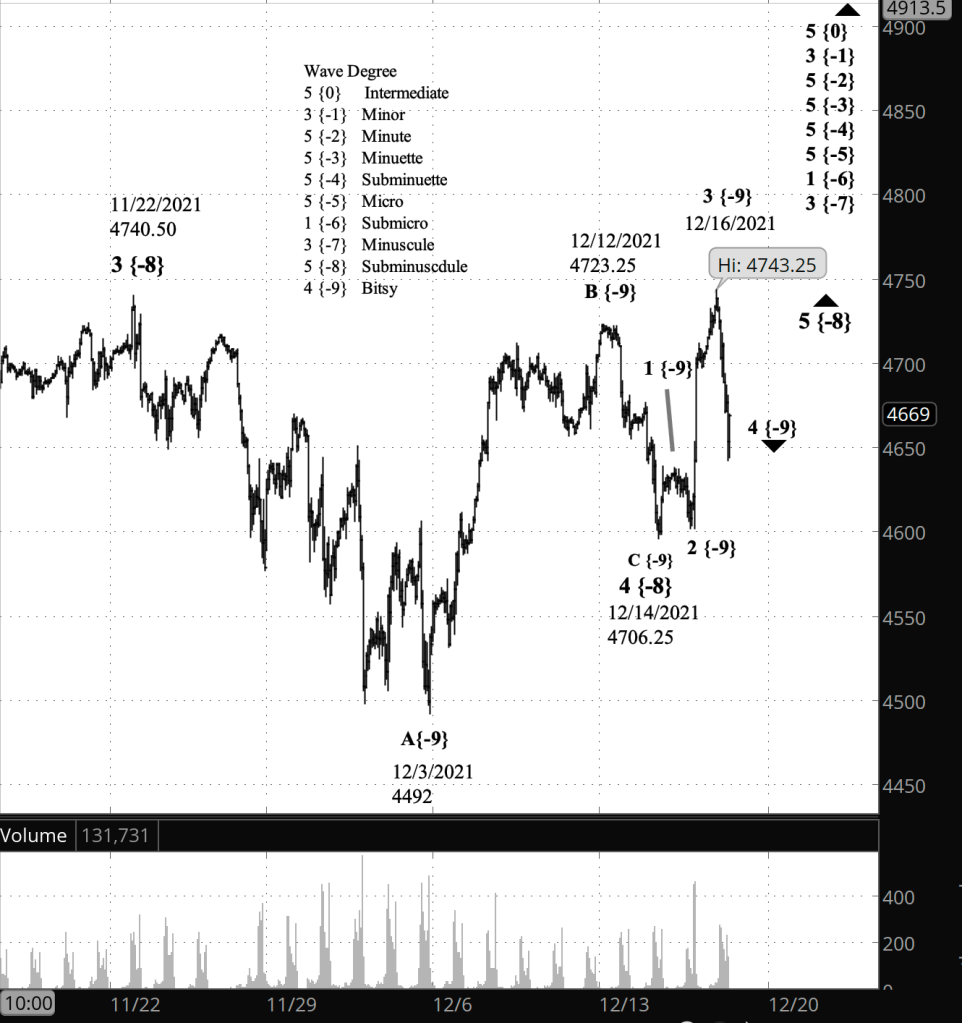
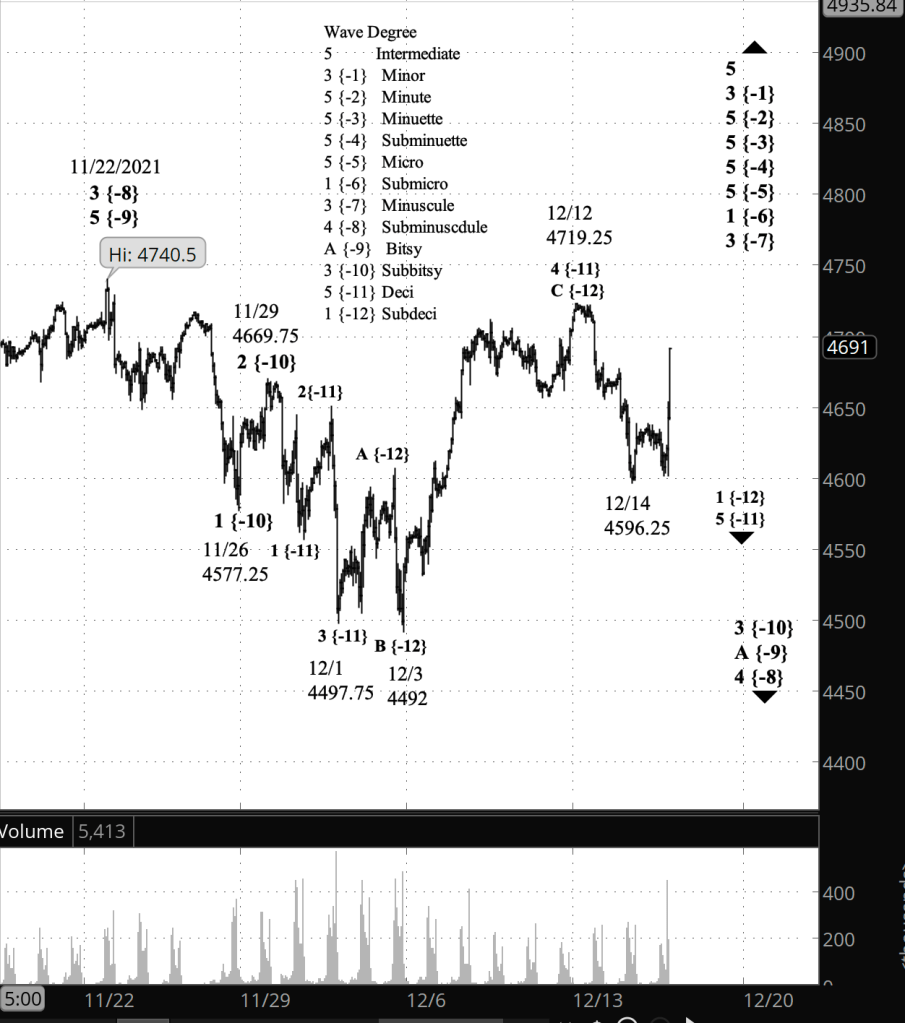
Half an hour before the closing bell. The S&P 500 declined during the session, reaching 4642 at the low point of the futures. I’m counting the overnight peak, 4743.25, as being the end of wave 3 of Bitsy degree, and the subsequent decline as a 4th wave correction. This early in a trend it’s hard to say what degree the waves are. The patterns are clear, but not where they fit into the bigger picture. The overnight peak could just as well be a degree or two lower that I’ve marked it. Nonetheless, no change in the analysis. I’ve updated the chart.

2:30 p.m. New York time

My trades. I’ve entered two short iron condor positions timed to coincide with earnings announcements and have published analyses, of FDX and DRI.

10:15 a.m. New York time

Trade exit. I’ve exited my short iron condor earnings play on LEN for a 12.5% profit before fees and have updated the analysis with results.

9:40 a.m. New York time

What’s happening now? The S&P 500 E-mini futures reached a new all-time high, 4743.25, in overnight trading, eclipsing the prior peak, 4740.50, attained on November 22.

What does it mean? The downward correction that began on November 22 ended on December 14, and the final leg of the uptrend that began on October 6, from 4273.75, is now underway.

What’s the alternative? I have none at this point. The chart has a great deal of clarity.

[S&P 500 E-mini futures at 3:30 p.m., hourly bars, with volume]

What does Elliott wave theory say? The new peak means that wave 4 of Subminuscule degree — subscript {-8} — ended on December 14 with a seriously shortened C wave, internally, and that Subminuscule wave 5 began on that date, and this morning before the opening bell eclipsed the end point of wave 3 of Subminuscule degree on November 22. Fifth waves have no limits, beyond those imposed by the need for them to be proportional to the rest of the larger wave of which they are a part. So this 5th could go high, or end quickly. There’s nothing in Elliott at this point to guide our expectations.

The uptrending higher degrees remain unchanged: Minuscule 3 {-7} all the way up to Intermediate 5 {0} seven levels higher.

Interestingly, the S&P 500 index has not hit a new peak, and so, not for the first time, we have a divergence between the futures, which trade overnight, and the index, which doesn’t track change between the closing and opening bells.

My trades. I’ll be looking at two symbols as potential earnings plays today. FDX publishes earnings today after the closing bell, and DRI announces on Friday before the opening bell.

Learning and other resources. Elliott wave analysis provides context, not prophecy. As the 20th century semanticist Alfred Korzybski put it this way in his book Science and Sanity (1933), “The map is not the territory … The only usefulness of a map depends on similarity of structure between the empirical world and the map.” And I would add, in the ever-changing markets, we can judge that similarity of structure only after the fact.

See the menu page Analytical Methods for a rundown on where to go for information on Elliott wave analysis.

By Tim Bovee, Portland, Oregon, December 16, 2021

Disclaimer

Tim Bovee, Private Trader tracks the analysis and trades of a private trader for his own accounts. Nothing in this blog constitutes a recommendation to buy or sell stocks, options or any other financial instrument. The only purpose of this blog is to provide education and entertainment.

No trader is ever 100 percent successful in his or her trades. Trading in the stock and option markets is risky and uncertain. Each trader must make trading decisions for his or her own account, and take responsibility for the consequences.

License
Creative Commons License

All content on Tim Bovee, Private Trader by Timothy K. Bovee is licensed under a Creative Commons Attribution-ShareAlike 4.0 International License.

Based on a work at www.timbovee.com.
LEN Trade

Lennar Corp. (LEN)

Update 12/16/2021: I exited my iron condor earnings play on LEN the day after earnings were announced, for a $3.60 debit per contract/share, a profit before fees of $45 per contract. Shares were trading at $107.46, down $3.18 from the entry level.

The Implied Volatility Rank at exit was 50.0%, down 20.7 points from the entry level.

Under my preliminary rules for earnings plays, my goal is to exit with a profit, big or small. Trades based on earnings have narrower profit zones than I would normally construct; the profit comes from the decline in implied volatility that almost always accompanies an earnings announcement. So the usual rule of exiting at 50% of maximum potential profit with any profit 21 days before expiration don’t apply to earnings plays. Basically, it’s role the dice and, win or lose, move on.

Shares declined by 2.9% over one day for a -1049% annual rate. The options position produced a 12.5% return for a +4,563% annual rate.


I have entered a short iron condor on LEN, using options that trade for the last time 37 days hence, on January 21. The premium is a $4.05 credit per contract share and the stock at the time of entry was priced at $110.64

The Implied Volatility Ratio stands at 70.5%

Premium:$4.05Expire OTM
LEN-iron condorStrikeOddsDelta
Calls
Long125.0086.0%17
Break-even119.0576.0%28
Short115.0066.0%39
Puts
Short105.0063.0%32
Break-even101.5571.5%24.5
Long97.5080.0%17

The premium is 48% of the width of the positions short/long spreads. The profit zone covers a 7.6% move to the upside and a 9.0% move to the downside, for a total width of 16.6%.

The risk/reward ratio is 1.2:1, with maximum risk of $470 and maximum reward of $405 per contract.

How I chose the trade. I entered the trade the day of the earnings announcement after the closing bell. Options prices closest to expiration, discounted for days remaining, imply a move of $5.07 in either direction. Elliott wave analysis didn’t give a clear direction to the chart, and Zacks ranks the company as neutral with little expectation of an earnings surprise.

By Tim Bovee, Portland, Oregon, December 15, 2021

Disclaimer

Tim Bovee, Private Trader tracks the analysis and trades of a private trader for his own accounts. Nothing in this blog constitutes a recommendation to buy or sell stocks, options or any other financial instrument. The only purpose of this blog is to provide education and entertainment.

No trader is ever 100 percent successful in his or her trades. Trading in the stock and option markets is risky and uncertain. Each trader must make trading decisions for his or her own account, and take responsibility for the consequences.

License
Creative Commons License

All content on Tim Bovee, Private Trader by Timothy K. Bovee is licensed under a Creative Commons Attribution-ShareAlike 4.0 International License.

Based on a work at www.timbovee.com.
SP500 Analysis

3:30 p.m. New York time

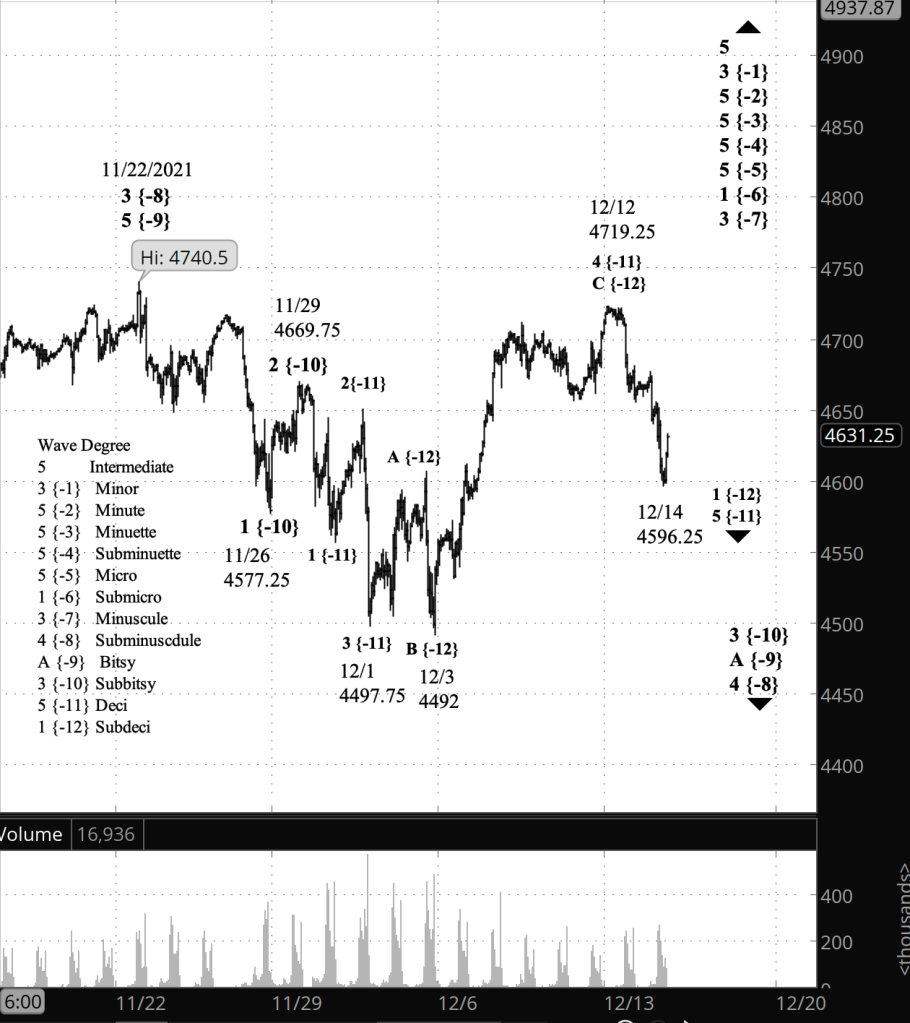
Half an hour before the closing bell. The counter-trend rise within a downward move that began on December 12 continues. Internally, the decline shows three clear waves. A downtrend in Ellliott wave analysis has five waves when complete. A corrective wave, including a wave connecting to corrective forms within a compound structure, has three waves total.

If the present 3rd wave internally reverses and resumes the downtrend to lower levels, then most likely we’ll be seeing a 5th wave within wave 1 of Subdeci degree {-12} within wave 1 of Deci degree {-11}. If the 3rd wave reverses without a significant decline to lower levels, then we’ll most likely be seeing a C wave within wave X of Subdeci degree in a compound correction, wave 4 of Deci degree.

No change in the analysis. I’ve updated the chart.

1:30 p.m. New York time

Earnings play. I’ve entered a short iron condor position on LEN, which announces earnings after the closing bell today, and have posted an analysis. I also analyzed JBL, which announces earnings tomorrow before the opening bell, but it produced a higher risk/reward ratio than I like, and so I passed on it.

9:35 a.m. New York time

What’s happening now? The S&P 500 E-mini futures rose slightly from yesterday’s low of 4596.25, reaching a high so far of 4638.25 in overnight trading.

What does it mean? The reversal upward is a correction within a downtrend that began on December 12 from 4596.25 and that will carry the price into the 4490s and below.

What’s the alternative? The reversal is an upward correction within a shallow downward movement that will connect the now complete corrective pattern that began on December 1 with a second corrective pattern in a compound structure.

[S&P 500 E-mini futures at 3:30 p.m., hourly bars, with volume]

What does Elliott wave theory say? Under my principal analysis, the decline that began on December 12 is wave 1 of Subdeci degree — subscript {-12} — within wave 5 of Deci degree {-11} within wave 3 of Subbitsy degree {-10}. The whole structure is part of a larger correction, standing within wave A of Bitsy degree {-9} within wave 4 of Subminuscule degree {-8}, a downward correction that began on November 22.

The alternative analysis notes that corrections sometimes form complex structures composed of several corrective patterns. Such a compound correction is a possible pattern for wave 4 of Deci degree. If such proves to be the case, then Deci 4 did not end on December 12, coincident with the end of its internal wave C. Instead, wave C ended the first corrective pattern, and the present decline is an X wave that connects the completed pattern with another pattern yet to come, mostly likely taking the form of a Flat or a Zigzag.

My trades. Today I’ll be looking at two potential earnings plays: LEN, which announces today after the closing bell, and JBL, which announces Wednesday before the opening bell. For a rundown of the methods I’ll be using, including a preliminary rule set, see my post “How to Play Earnings“, which went up on December 10.

Learning and other resources. Elliott wave analysis provides context, not prophecy. As the 20th century semanticist Alfred Korzybski put it this way in his book Science and Sanity (1933), “The map is not the territory … The only usefulness of a map depends on similarity of structure between the empirical world and the map.” And I would add, in the ever-changing markets, we can judge that similarity of structure only after the fact.

See the menu page Analytical Methods for a rundown on where to go for information on Elliott wave analysis.

By Tim Bovee, Portland, Oregon, December 15, 2021

Disclaimer

Tim Bovee, Private Trader tracks the analysis and trades of a private trader for his own accounts. Nothing in this blog constitutes a recommendation to buy or sell stocks, options or any other financial instrument. The only purpose of this blog is to provide education and entertainment.

No trader is ever 100 percent successful in his or her trades. Trading in the stock and option markets is risky and uncertain. Each trader must make trading decisions for his or her own account, and take responsibility for the consequences.

License
Creative Commons License

All content on Tim Bovee, Private Trader by Timothy K. Bovee is licensed under a Creative Commons Attribution-ShareAlike 4.0 International License.

Based on a work at www.timbovee.com.

SP500 Analysis

3:30 p.m. New York time

Half an hour before the closing bell. The S&P 500 has fallen during the trading session, reach the 4590s. No change in the analysis. I’ve updated the chart.

9:35 a.m. New York time

What’s happening now? The S&P 500 E-mini futures continued to fall in overnight trading and at the opening bell had reached 4223.75 on the futures.

What does it mean? The decline strengthens the case for the uptrending correction that began on December 1 having ended on December 12, and that a new downtrend has begun from that peak, 4719.25. It is likely to reach the 4490s at a minimum.

What’s the alternative? Corrections sometimes create complex structures, linking two corrective patterns together. If that’s the case here, then I expect the decline to end above the 4490s, signaling the start of another corrective pattern within the larger rise that began on December 1.

[S&P 500 E-mini futures at 3:30 p.m., hourly bars, with volume]

What does Elliott wave theory say? Under my principal analysis, uptrending wave 4 of Deci degree — subscript {-11} ended on December 12 and Deci wave 5 is now underway, internally tracing its 1st wave, of Subdeci degree {-12}. Wave 5 is tracing its downward course within the 3rd wave, of Subbitsy degree {-10}, within a larger downward correction, wave A of of Bitsy degree {-9}, the first wave within wave 4 of Subminuscule degree {-8}.

Under the alternative analysis, wave 4 of Deci degree is still underway, having completed a corrective pattern, and the present decline is wave X of Subdeci degree, which will, when complete, signal the start of another corrective pattern within wave 4.

Learning and other resources. Elliott wave analysis provides context, not prophecy. As the 20th century semanticist Alfred Korzybski put it in his book Science and Sanity (1933), “The map is not the territory … The only usefulness of a map depends on similarity of structure between the empirical world and the map.” And I would add, in the ever-changing markets, we can judge that similarity of structure only after the fact.

See the menu page Analytical Methods for a rundown on where to go for information on Elliott wave analysis.

By Tim Bovee, Portland, Oregon, December 14, 2021

Disclaimer

Tim Bovee, Private Trader tracks the analysis and trades of a private trader for his own accounts. Nothing in this blog constitutes a recommendation to buy or sell stocks, options or any other financial instrument. The only purpose of this blog is to provide education and entertainment.

No trader is ever 100 percent successful in his or her trades. Trading in the stock and option markets is risky and uncertain. Each trader must make trading decisions for his or her own account, and take responsibility for the consequences.

License
Creative Commons License

All content on Tim Bovee, Private Trader by Timothy K. Bovee is licensed under a Creative Commons Attribution-ShareAlike 4.0 International License.

Based on a work at www.timbovee.com.

SP500 Analysis

3:30 p.m. New York time

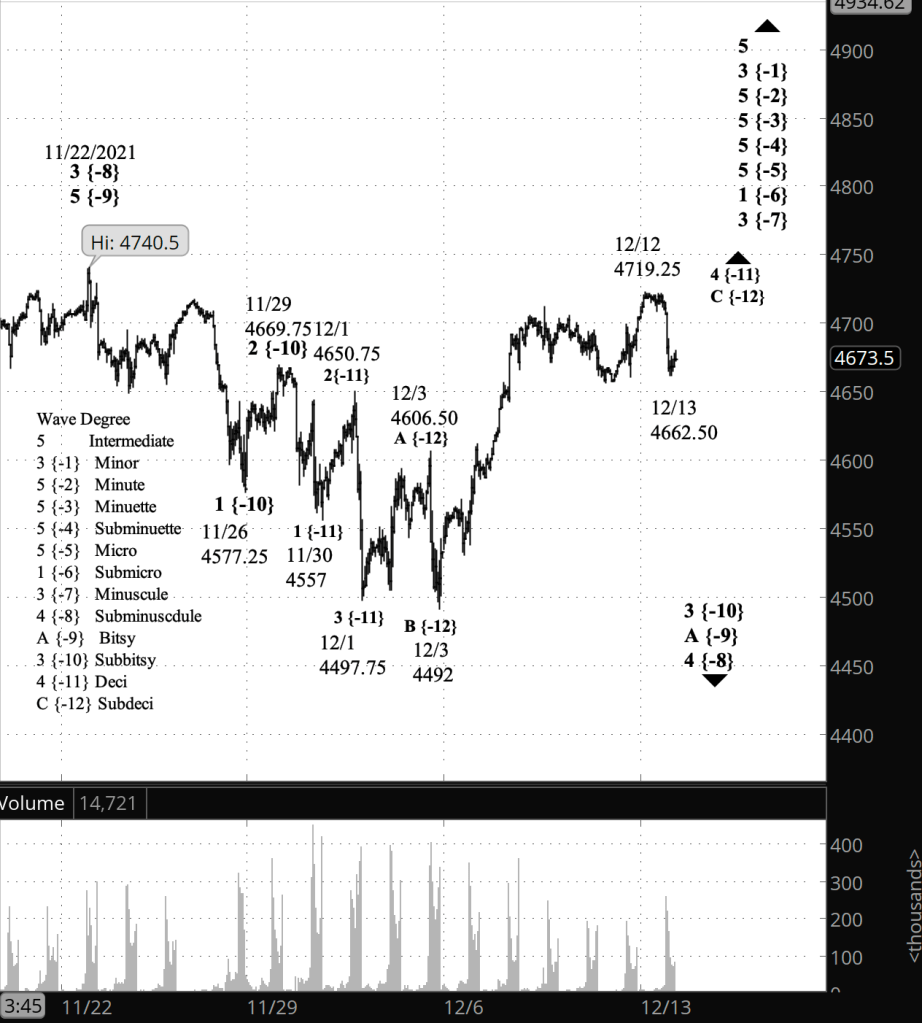
Half an hour before the closing bell. The S&P 500 has fallen during the day, reaching a low so far of 4662.50 on the futures, 4671.84 on the index. Although the index from this morning is unchanged, the 57-point decline strengthens the possibility that the Sunday’s high of 47198.25 on the futures marked the end of the 5th wave within wave C of Subdeci degree — subscript {-12} within wave 4 of Deci degree {-11} within downtrending wave 3 of Subbitsy degree {-10}, which began on November 29. If the decline continues tomorrow, I’ll rework the wave numbering to reflect the end of Deci 4 and the start of the subsequent 5th wave, which will carry the price down to the 4490s and perhaps lower. I’ve updated the chart.

9:35 a.m. New York time

What’s happening now? On Sunday night, the S&P 500 E-mini futures reached a new high, 4719.25, in the rise that has been underway since December 3.

What does it mean? The third wave of an upward correction that began on December 1 is still underway, although reaching its end. The correction is part of a larger downtrend.

What’s the alternative? If the price should exceed the all-time high of 4740.50 set on November 22, then the rise that began on October 6 may not have reached an end, and the decline of the past weeks can be seen as a downward correction within that rise.

[S&P 500 E-mini futures at 3:30 p.m., 55-minute bars, with volume]

What does Elliott wave theory say? My principal analysis remains unchanged from Friday. The price is moving through wave C of Subdeci degree within wave 4 of Deci degree within wave 3 of Subbitsy degree within wave A of Bitsy degree within wave 4 of Subminuscule degree. The subscripts are {-12} beginning with Subdeci up to {-8} for Subminuscule.

Internally, there’s an argument to be made that Sunday’s high within the correction could mark the end of the correction, as it is possible to count a five-wave rise, which is expected for this C wave. If this is the case, then the decline from the high is the start of wave 5 of Deci degree, which will reach down to the 4590s or lower.

The price is getting close to the November 22 high, 4740.50, that ended with 3 of Subminuscule degree. Under the norms identified within Elliott wave analysis, the price of this correction ought to remain below that level. If it exceeds it, then I’ll need to revisit the chart and revise my count of the waves.

Learning and other resources. Elliott wave analysis provides context, not prophecy. As the 20th century semanticist Alfred Korzybski put it in his book Science and Sanity (1933), “The map is not the territory … The only usefulness of a map depends on similarity of structure between the empirical world and the map.” And I would add, in the ever-changing markets, we can judge that similarity of structure only after the fact.

See the menu page Analytical Methods for a rundown on where to go for information on Elliott wave analysis.

By Tim Bovee, Portland, Oregon, December 12, 2021

Disclaimer

Tim Bovee, Private Trader tracks the analysis and trades of a private trader for his own accounts. Nothing in this blog constitutes a recommendation to buy or sell stocks, options or any other financial instrument. The only purpose of this blog is to provide education and entertainment.

No trader is ever 100 percent successful in his or her trades. Trading in the stock and option markets is risky and uncertain. Each trader must make trading decisions for his or her own account, and take responsibility for the consequences.

License
Creative Commons License

All content on Tim Bovee, Private Trader by Timothy K. Bovee is licensed under a Creative Commons Attribution-ShareAlike 4.0 International License.

Based on a work at www.timbovee.com.