Thursday, December 10, 2020

The platform for Private Trader is no longer sizing charts correctly. So until the problem is resolved, you’ll be seeing impressively gigantic charts in my posts.

3:30 p.m. New York time

Half an hour before the closing bell. Micro wave 5 and its parent, Subminuette wave 1, both to the downside, are complete. Subminuette wave 2 to the upside has begun. The entire structure will eventually resolve itself into Minute wave A within Minor wave 4, a downward correction. I’ve updated the chart below.

9:55 a.m. New York time

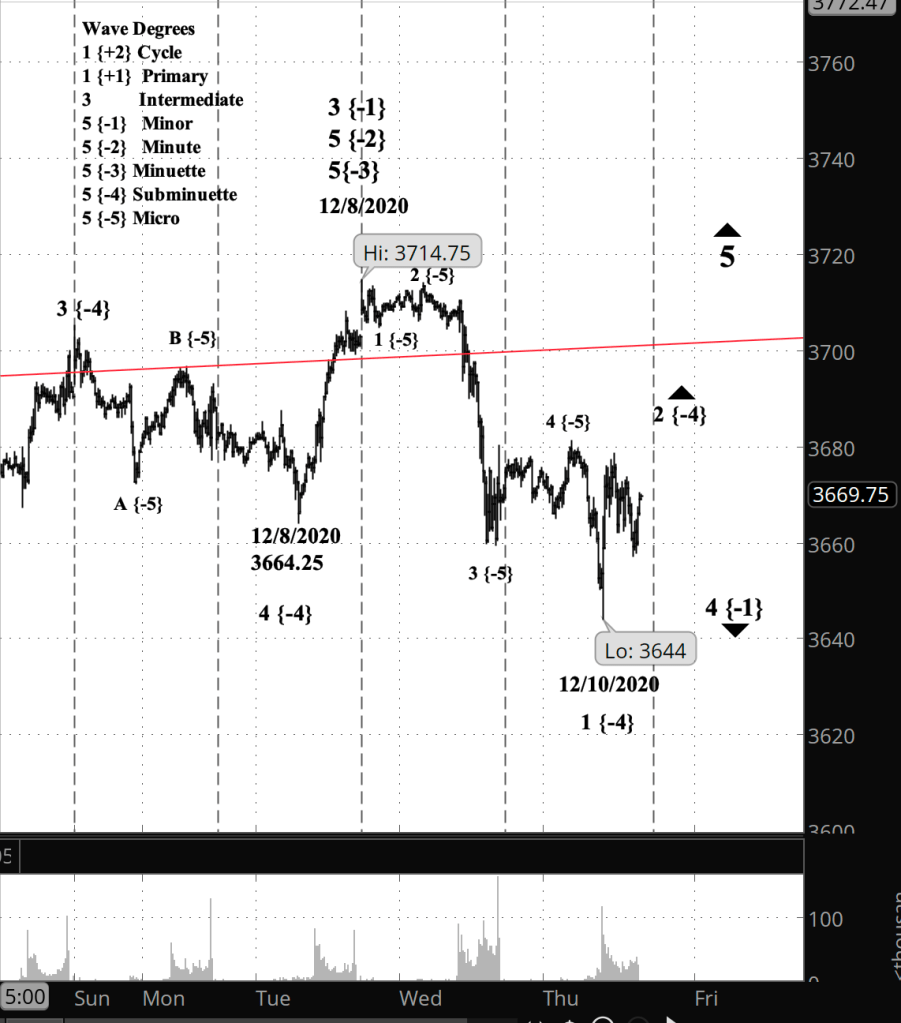
What’s happening now? The S&P 500 index and its derivatives continued their fall overnight, interspersed with a small-scale upward correction. The low of 3644 on the E-mini futures was reached soon after the opening bell.

What does it mean? The first small movement to the downside is in its final stage and will be followed by an upward correction that could take back much of the decline from the high of 3714.75 reached on December 8. Although there’s no requirement that it be that steep; a shallow correction is perfectly within the rules of Elliott wave analysis.
[S&P 500 E-mini futures, 15-minute bars, with volume]

What does Elliott wave theory say? I’ve labeled yesterday’s steep decline was wave 3 of Micro degree, although that assessment may well move up a degree or two as the downtrend develops. The futures traced a shallow sideways correction, Micro wave 4, in overnight trading, and then began Micro wave 5, the final subwave of Subminuette wave 1 to the downside.

The next step will be Subminuette wave 2, and in Elliott Wave Theory 2nd waves tend to be Zigzags that correct much of the preceding 1st wave.

Read More »
Wednesday, December 9, 2020

3:30 p.m. New York time

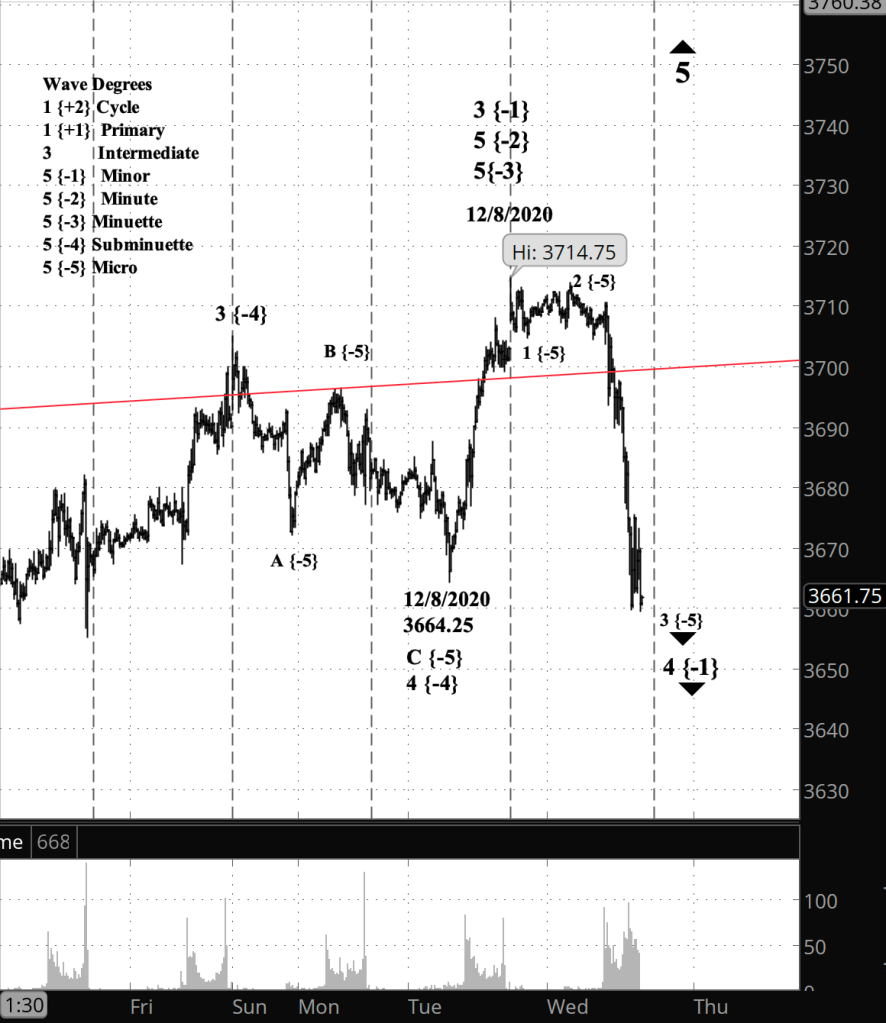
The S&P 500 continued to decline during the day. I’ve updated the chart, below, with some preliminary wave labels on the decline.

10:20 a.m. New York time

What’s happening now? The S&P 500 index and its derivatives remain above the upper boundary of a two-year-long Diagonal Triangle, peaking at 3714.75 on Tuesday and now curving around toward the downside.In the first 20 minutes of today’s trading the price fell back below the triangle boundary.

What does it mean? Three times so far I’ve had to adjust my analysis of the top of the rise that began in February, and the current top is within the rules of Elliott wave analysis show, as were its predecessors. If this indeed proves to be the top, then the market is preparing for a significant decline.

What is the alternative? It may be that Tuesday’s top will be exceeded, and if that happens, then I’ll adjust the wave count. Elliott wave analysis, after all, is about the implications of what has occurred. It says nothing about the timing of events.

[S&P 500 E-mini futures, 15-minute bars, with volume]

What does Elliott wave theory say? The rise from Tuesday’s low (3664.25) has so far traced five waves, with a bit of ambiguity regarding the first wave. I count that rise as wave 5 of Subminuette degree, leading to a wave 5 completion up to the parent Minute degree, and a wave 3 completion one degree up from there, at the Minor degree.

The fall below the triangle boundary, which happened just minutes ago, marks the beginning of wave 1 of Subminuette degree and, going up the scale, wave 4 of Minor degree.

My trading strategy. I’m continuing to hold my short bear call options spreads and my shares in SDS, an inverse exchange-traded fund based on the S&P 500.

Read More »

Tuesday, December 8, 2020

3:30 p.m. New York time

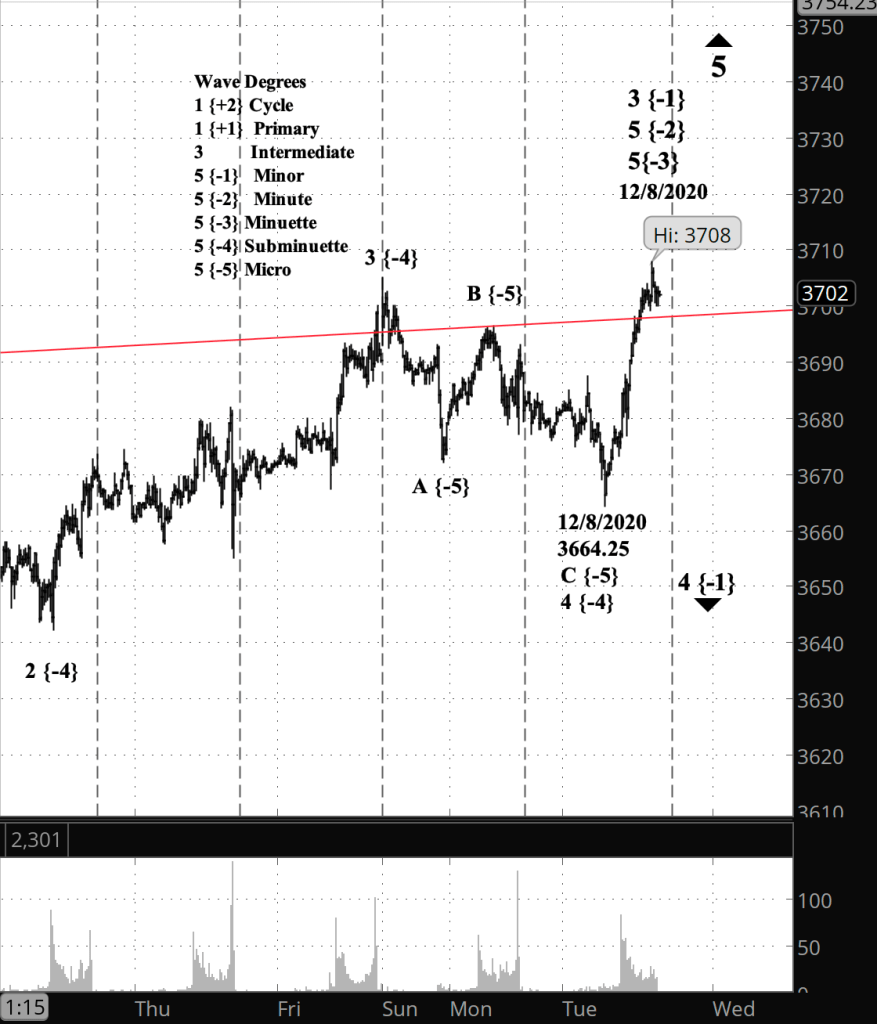
Half an hour before the closing bell. The S&P 500 followed the alternative path that discussed this morning, below. It broke above the upper boundary (red line) of the Diagonal Triangle that began in December 2018, reaching a new high of 3708. I’ve updated the chart below, updating the count to show Minor wave 3 peaking at today’s new high and the decline over the last two days being wave 4 of Subminuette degree. It is possible that the Subminuette wave 5 rise is not yet over, and that’s the new alternative count.

9:40 a.m. New York time

What’s happening now? The S&P 500 index continued to work its way downward overnight, along with its derivatives. The E-mini futures have fallen 32.25 points off of yesterday’s high, down to an overnight low of 3664.25.

What does it mean? The downward movement is the early stage of a downward correction that will attain significant magnitude by the time it’s complete.

What is the alternative? It’s possible that the December 4 peak, 3705, wasn’t the end of the massive rise rise since February 23, when the S&P 500 index sank to 2191.86. There could be more upside ahead if that rise is still underway, but the upper boundary of the Diagonal Triangle that began in December 2018 suggests that there is little upside potential.

[S&P 500 E-mini futures, 15-minute bars, with volume]

What does Elliott wave theory say? Under my principle analysis Minor wave 4 began on December 4 and so far has completed three waves of Subminuette degree, the first steps in Minuette wave 1 within Minute 1 within Minor wave 3. I may end up adjusting the smaller degrees depending upon the length and magnitude of waves to come.

Wave 3 of Subminuette degree ended this morning around 7 a.m. New York time, and Subminuette 4 is rising as the opening bell sounded.

Read More »

Monday, December 7, 2020

3:30 p.m. New York time

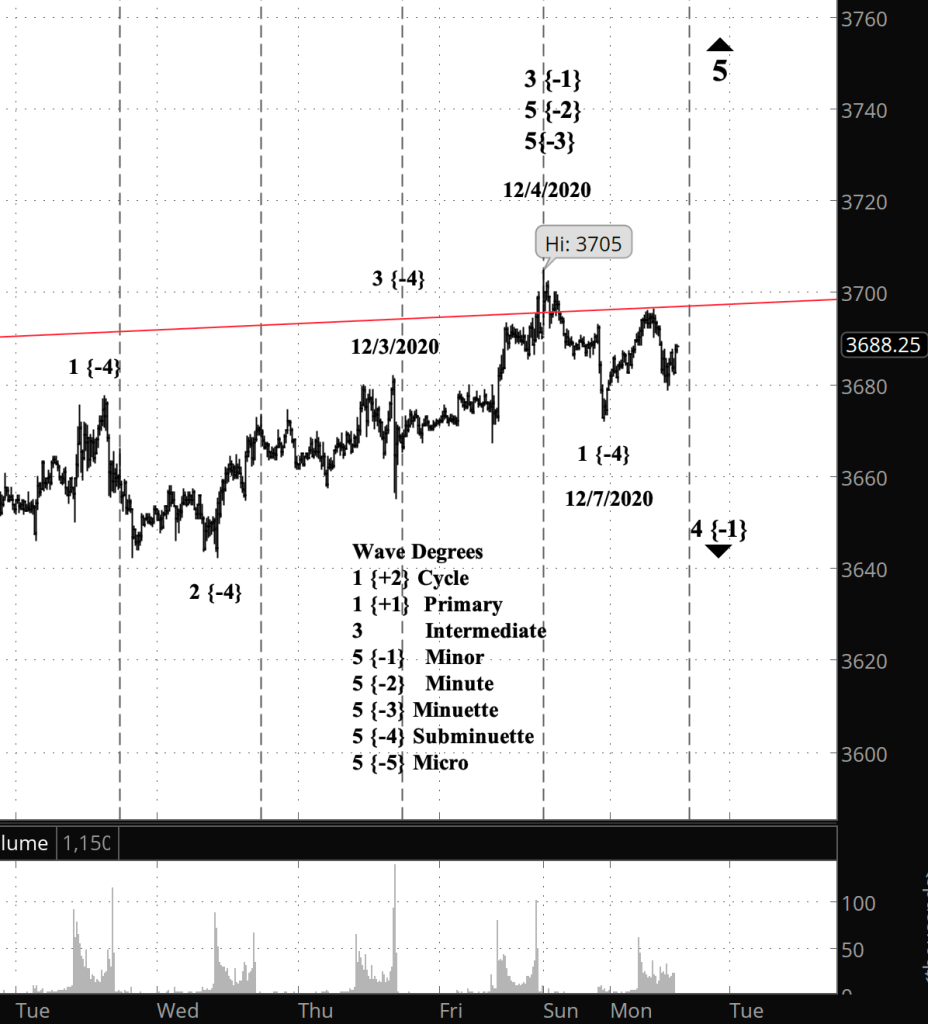
Half an hour before the closing bell. The S&P 500 completed five waves down, completing what I have labelled wave 1 of Subminuette degree, an early step in what will gain clarity as the parent wave, the 4th of Minor degree. I have updated the E-mini futures chart, below.

10 a.m. New York time

What’s happening now? The S&P 500 index and its derivatives continue to trace a sideways pattern in the early stages of a downward correction within an uptrend.

What does it mean? There is very little upside potential on the chart, and the correction is likely to be shallow rather than a sharp downward plunge.

[S&P 500 E-mini futures, 15-minute bars, with volume]

What does Elliott wave theory say? The downward correction is wave 4 of Minor degree within wave 5 of Intermediate degree. The upper boundary of the diagonal triangle that began in December 2018 (see Friday’s post for a chart) sets a loose limit on the upward potential, “loose” because prices will often move beyond such trend lines, in an overthrow, before returning to the area within the trend markers.

Fourth waves tend to be of a structure different than second waves. Wave 1 of Minor degree took the form of a Zig-zag, a steep decline, so wave 4 will most likely be a flat, and perhaps will extend in a compounds structure.

My trading strategy. My short bear call options spreads on IWM, expiring January 15, remain within what will eventually be the profit zone, and so I shall continue to hold the positions. My shares in SDS, an inverse S&P 500 exchange-traded fun, are unprofitable now but will return to profitability after Intermediate wave 5 completes its work.

Read More »

Friday, December 4, 2020

After 4 p.m. New York time

At the close. And as it turns out, the S&P 500, a minute before the closing bell, pulled itself up to a higher high, 3699.20 on the index and 3700 on the E-mini futures.

3:30 p.m. New York time

Half an hour before the closing bell. The S&P 500 remains within five points or so of yesterday’s high, having barely budged throughout the day.

9:35 a.m. New York time

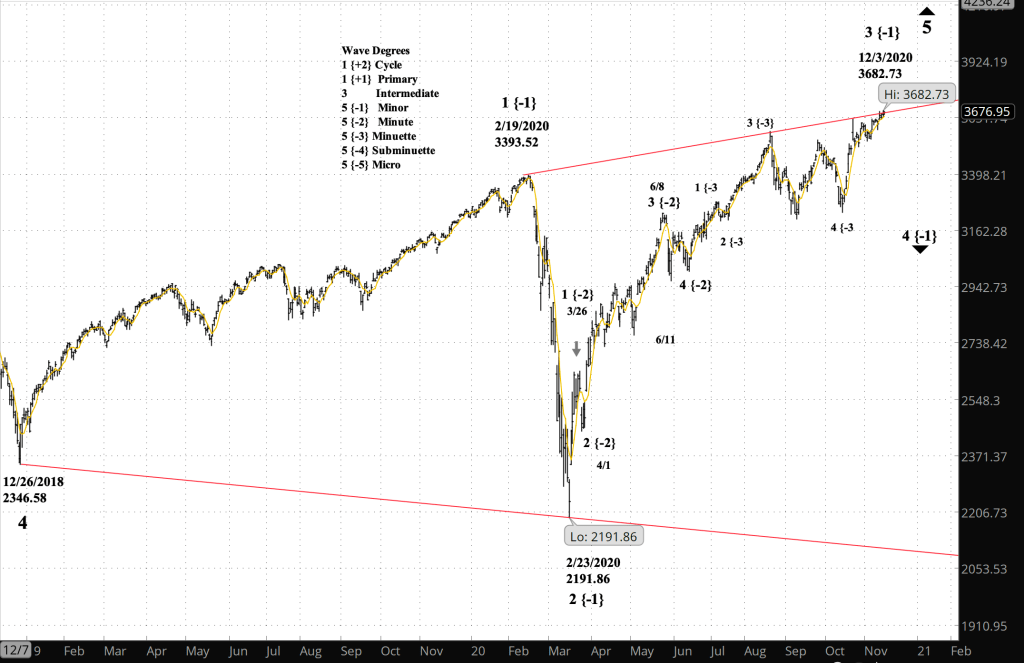
What’s happening now? The S&P 500 index and its derivatives remain at the upper boundary of a Diagonal Triangle that began in December 26, 2018. This morning is is trading slightly below the index’s December 3 peak of 3682.73.

What does it mean? Yesterday’s peak ended the middle wave of the rise that began March 23 from 2191.86. The next move will be significantly to the downside, followed by a rise back up to a new high, ending the triangle.

[S&P 500 index, daily bars]

What does Elliott wave theory say? The December 3 peak marked the end of Minor wave 3 to the upside. The index is now in the early stages of a Minor wave 4 correction within Intermediate wave 5, an uptrending wave.

My trading strategy. I’m continuing to hold both my short bear call spread options positions and my bearish stock positions in the inverse exchange-traded fund SDS, which moves the opposite of the S&P 500;.

Read More »

Thursday, December 3, 2020

3:35 p.m. New York time

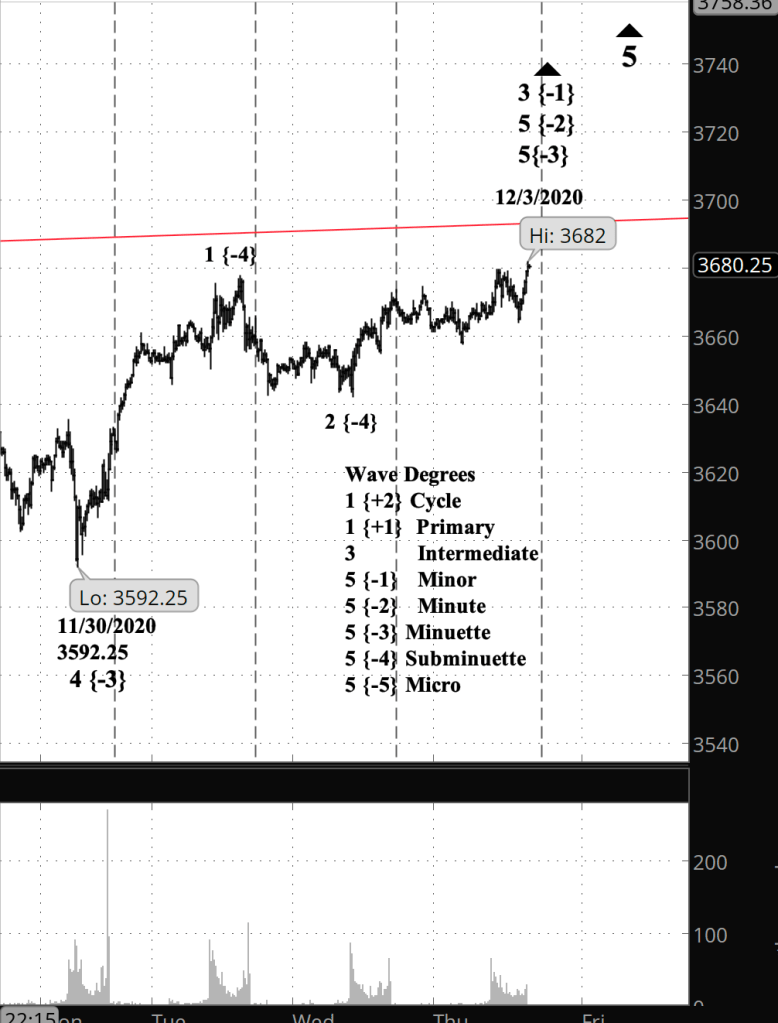
The S&P 500 index and futures moved above their high of December 1, extending the rise of Minor wave 3 and its subwaves. I’ve updated the chart, below, at half an hour before the closing bell.

10 a.m. New York time

What’s happening now? The S&P 500 index and its derivatives has completed one down-wave of five subwaves and one up-wave of three subwaves since the peak of December 1.

What does it mean? The pattern is typical of a downward correction.

[S&P 500 E-mini futures, 15-minute bars, with volume]

What does Elliott wave theory say? The parent wave is a 4th of Minor degree, and the subwaves are A and B of Minute degree (or possibly one degree down, of Minuette degree). Wave B took back most of wave A, which as is typical of B behavior.

My trading strategy. Down is eventually profitable for my short bear call spread options positions, and the pattern shows a downtrend, so I’m in hold mode. Same with my shares of SDS, an inverse exchange-traded fund based on the S&P 500, with a long time horizon.

Read More »

Wednesday, December 2, 2020

3:30 p.m. New York time

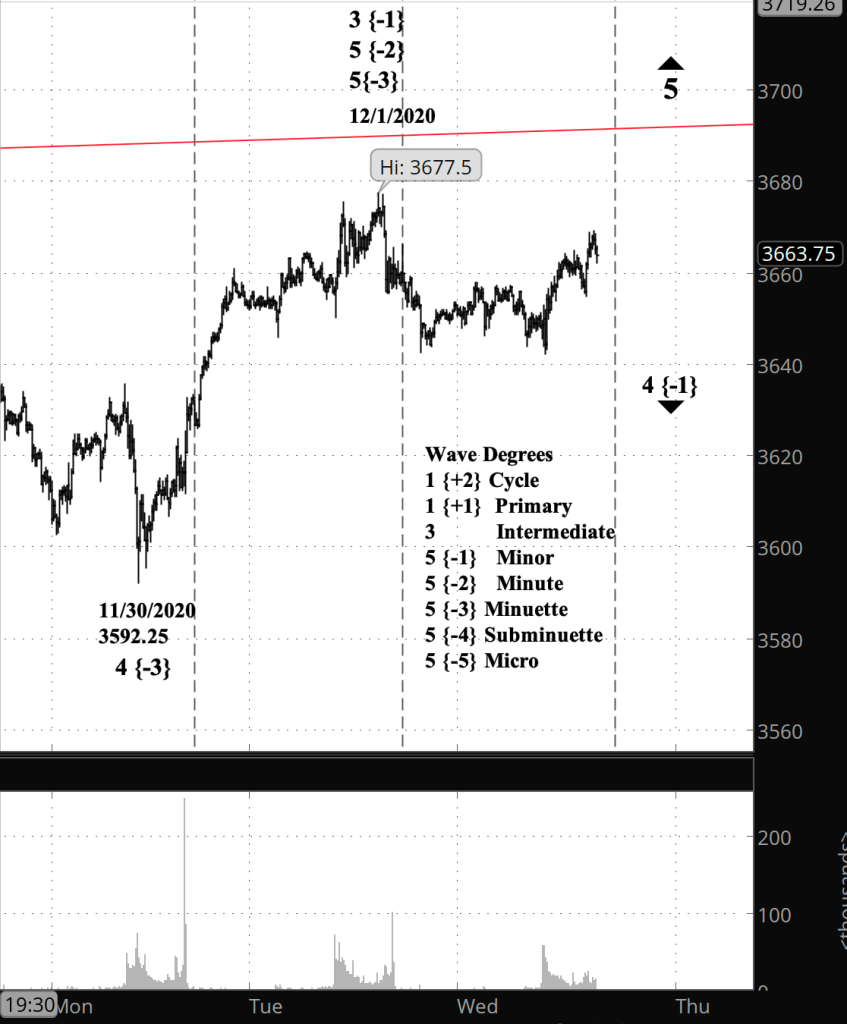
Half an hour before the closing bell the S&P 500 continues through the early stages of a downward correction, having completed five waves down and three waves up today as steps in the decline. I’ve updated the chart below.

10:35 a.m. New York time

What’s happening now? The S&P 500 index and its derivatives continue to pull back slightly from Tuesday’s high, 3678.45 around the upper boundary of a Diagonal Triangle form that began in December 2018.

What does it mean? The peak ended an upward push that began February 23, 2020 from 2191.86. The next move will be a downward correction and then a final wave to the upside.

What is the alternative? The price remains near the high and it is possible that rather than withdrawing immediately, the price might bounce up to a slightly higher level before beginning its downward movement.

[S&P 500 E-mini futures, 10-minute bars, with volume]

What does Elliott wave theory say? Tuesday’s high marks the end of wave 3 of Minor degree, after two days short of 10 months to the day. What follows is Minor wave 4 to the downside. Fourth wave corrections often tend to trend sideways, suggesting the downward move will be shallow. All of this is happening within Intermediate wave 5, which is one degree higher.

My trading strategy. My short bear call options spreads on IWM, with 44 days until expiration on January 15, continue to hold near the level of their entry credit. Decision day on exiting will come 21 days prior to expiration, on December 25 by the calendar. Since the market will be closed that day, the decision, at the latest, will made on December 23. I continue to hold my shares in the inverse S&P 500 fund SDS.

Read More »

Tuesday, December 1, 2020

3:30 p.m. New York time

Half an hour before the closing bell the S&P 500 remains about 16 points below its overnight high. Barely changed.

10:45 a.m. New York time

What’s happening now? The S&P 500 index and its derivatives rose rapidly after Monday’s closing bell. The index moved above the upper boundary of the Diagonal Triangle that began in December 2018, a condition known as a throw-over, taking the alternative course described in Monday morning’s analysis. The E-mini futures approached but remained below the boundary.

What does it mean? A throw-over is generally a short-lived condition, suggesting a reversal will soon be at hand.

What is the alternative? The degrees I have on the chart need revisiting — I’ve written before about the ambiguity inherent in labelling degrees, especially early in a trend.

What does Elliott wave theory say? On the chart I’ve moved the end of wave 3 of Minor degree from the previous high, on November 9, to the December 1 high of 3676.22 (so far). Uptrending Minor 3 will be followed by downtrending Minor 4, both being subwaves of uptrending wave 5 of Intermediate degree.

My trading strategy. My short bear call options spread positions remain within what will become the profit zone. As the entry analysis shows, the short call is at $192, which is $7 above the symbol’s high so far of $185.44, set on November 24. If the price exceeds $192, then I will need to make a hold or sell decision. I continue to hold my contrarian shares in SDS; as the S&P 500 rises, they fall. The Elliott wave analysis shows that a decline will happen soon.

Read More »

IWM Analysis

IShares Russell 2000 ETF (IWM)

Lot 2020-2

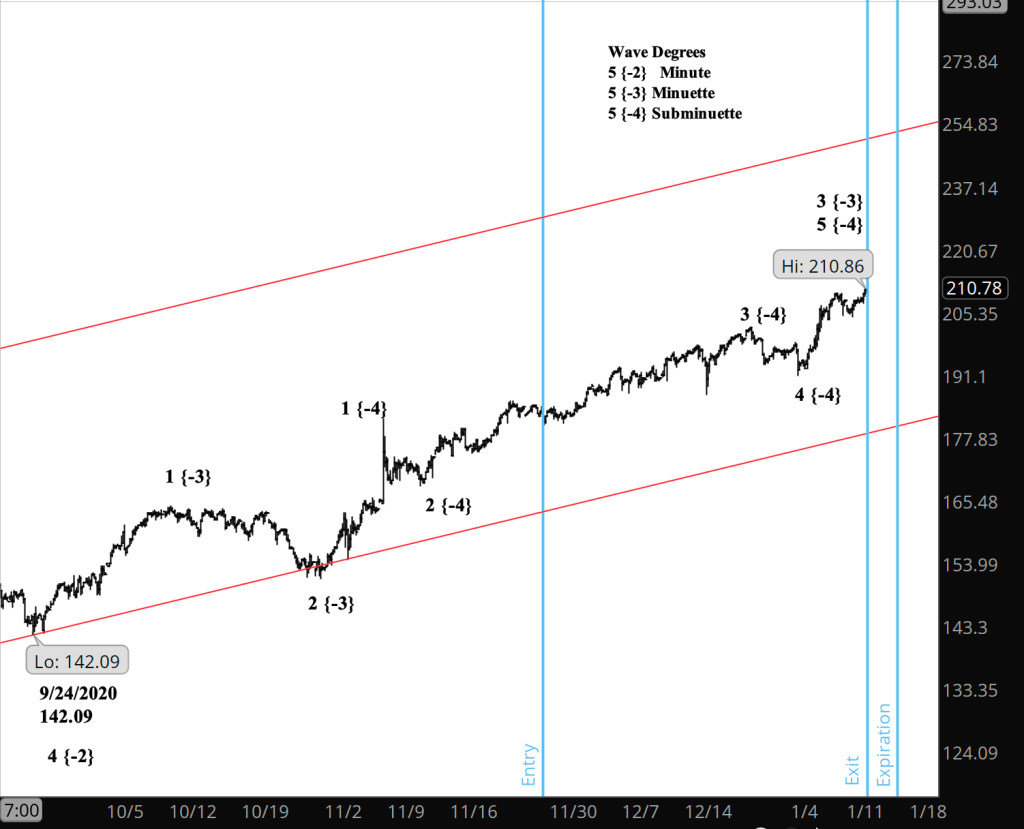
Update 1/12/2021: I exited my bear call options spread position on IWM 15 days before expiration, for a $4.93 debit per contract/share, a loss before fees of $3.85 per contract. Shares were trading at $210.49, up $28.90 from the entry level.

Referring to the chart below, showing IWM with three-hour bars, my decision to enter (blue vertical line to the left) was based on Elliott wave analysis that led me to conclude that a reversal to the downside had begun. What I had taken to be the end of a 5th wave of Subminuette degree turned out to be a subwave that by the time I exited (blue vertical line in the middle) had carried the price well above the zone of profitability. (The blue line to the right shows expiration.)

[IWM, 3-hour bars]

Shares rose by 28.9% over 43 days for a +340% annual rate. The options position produced a 78.1% loss for a -663% annual rate.

Lessons learned: The loss on this trade was compounded by my rule that requires an exit 21 days before expiration for profitable positions. This position was unprofitable at 21 days, and grew even more unprofitable in the last weeks of its life. A better rule would be to exit 21 days before expiration whether a position is profitable or not.


I have entered a short bear call spread on IWM, using options that trade for the last time 46 days hence, on January 15. The premium is a $1.08 credit per contract share and the stock at the time of entry was priced at $181.63.


The implied volatility rank (IVR) stands at 24.8, a bit on the low side.

Premium: $1.08 Expire OTM  
IWM-bear call spread Strike Odds Delta
Calls      
Long 197.00 85.0% 18
Break-even 190.92 80.5% 23
Short 192.00 76.0% 27

The premium is 43.2% of the width of the position’s wing.
The profit zone covers a 5.1% move to the upside.

The risk/reward ratio is 3.6:1, with maximum risk of $392 and maximum reward of $108 per contract.

My entry decision was based on Elliott wave analysis showing IWM to be at the beginning of a downtrending move, wave 5 of Minute degree within wave 4 of Minor degree.

By Tim Bovee, Portland, Oregon, November 30, 2020

Read More »

Monday, November 30, 2020

3:30 p.m. New York time

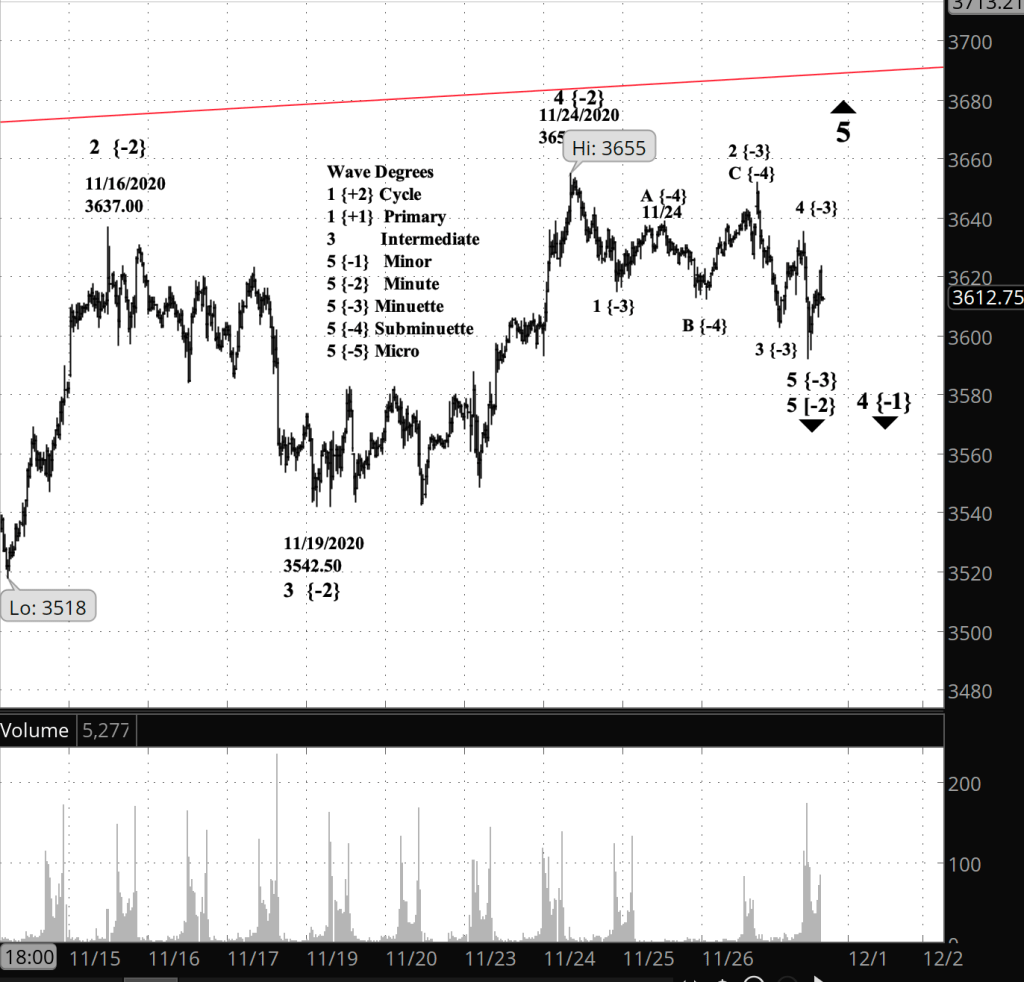
The S&P 500 took back a bit of its fall today but remains below the Minuette wave 3 peak of November 29. I’ve updated the chart, below.

11 a.m. New York time

I’ve entered short bear call options spreads positions on IWM and posted an analysis. The positions are Lot 2020-2 for IWM.

10:40 a.m. New York time

The S&P 500 E-mini futures have dropped below their low in overnight trading, suggesting that a downward move has begun: Wave 5 of Minuette degree within wave 5 of Minute degree within wave 4 of Minor degree. I’ll start analysis for options entry today rather than tomorrow. Chart below updated at 10:45 a.m. New York time.

9:45 a.m. New York time

What’s happening now? The S&P 500 index and its derivatives continue to meander just below the upper boundary of the Diagonal Triangle that began in December 2018, the structure that has defined much of the market movement for the past two years.

What does it mean? The boundary defines how much upside is in the market. The S&P 500 E-mini futures are about 60 points below the boundary, a condition suggesting that the prospect for the next month or more is a downward move.

What is the alternative? Prices sometimes extend beyond the boundary, although the condition, called a throw-over, is short-lived.

[S&P 500 E-mini futures, 30-minute bars, with volume[]

What does Elliott wave theory say? The index is in the early stages of a downtrending 4th wave correction of Minor degree within a 5th wave of Intermediate degree. The 5th wave, when complete, will mark the end of the rise that began in 1974.

The close-up view, in the chart, shows the index tracing a downtrending 4th wave of Minute degree — down one from Minor — that is either in its 3rd wave of Minuette degree or a Minuette X wave subdividing a complex correction.

My trading strategy. Tuesday, December 1, is 45 days before the January options expire, on the 15th, making it the optimal day for entry. I’ll wait until tomorrow to decide on entering options positions. I’m leaning toward short bear call options spreads as my vehicle.

My share positions are all in SDS, an S&P 500 derivative that grows in value as the index declines.

Read More »