Live: Friday, July 24, 2020

10:20 a.m. New York time

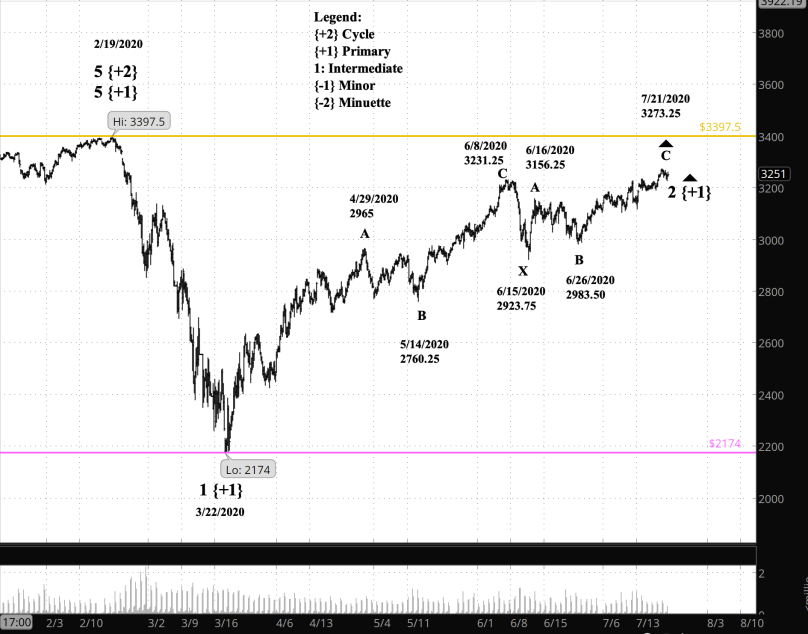
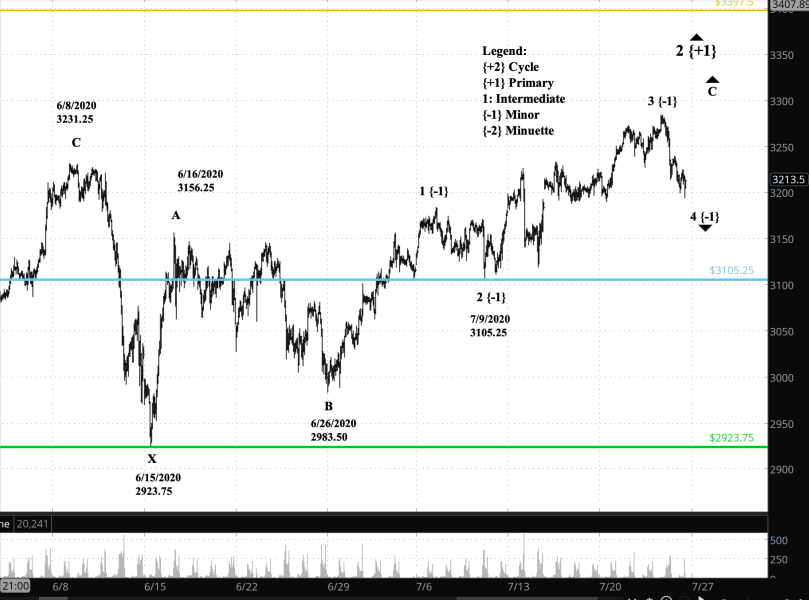
What’s happening now? The S&P 500 E-mini futures are continuing the decline that began on Thursday from 3284.50.

What does it mean? It means either a continuation of the correction that began March 22 from 2174 or the beginning of a new, significant decline that will carry the price well below 2174.

What does Elliott wave theory say? The significance of the declines hinges on whether Thursday’s peak was the end of Minor wave 3 or of Minor wave 5. I count it as the end of the 3rd Minor wave, but there are some ambiguities in the structure of the rise from July 9. It can also be counted as the 5th Minor.
Screen Shot 2020-07-24 at 7.18.26 AM

If the peak ended Minor wave 3, then we’ll see decline, although not a large one, and then a new rise to a higher high. If the peak ended Minor wave 5, then the Primary wave 2 correction may be complete and the price will show a more significant decline.

As I noted in Thursday’s Live  post, there are milestones that, when passed, increase the odds that Primary 3 is underway. One is 3105.25 (blue line), the beginning of the 3rd (or 5th) wave of Minor degree. The second is 2923.75 (green line), the beginning of the three wave correction of Intermediate degree, one up from minor, that began June 15.

What is the alternative? Primary wave 2 has taken the form of a compound correction: It completed a three-wave Zigzag on June 8, and then after an X-wave reset, launched into a second three-wave Zigzag. It is possible that there will be a third correction pattern added on when the second Zigzag is complete. That would stretch the correction out for months, perhaps even into the autumn.

What about my trades? I intend no new trades until Primary wave 2 is over.
Read More »

Live: Thursday, July 23, 2020

3:10 p.m. New York time

The S&P 500 has dropped more than 2% from the high. So when can we declare that Primary wave 2 is over? There’s no bright red stop-sign to make the start of the downturn, but clearly the further the price falls, the greater the likelihood that Primary wave 3 has begun. There are, however, milestones, that do a lesser or greater degree let us know that the likelihood of wave 3 having begun.

A decline below each these levels suggests that Primary 2 may be over, from the weaker to  stronger strength of the suggestion:

  • A fall below the start of Minor wave 2, at 3105.25
  • Below the start of the second Zigzag of the correction, at 2923.75
  • And the strongest, loudest suggestion, below the start of Primary wave 2, at 2174. This would offer complete verification that wave 3 is underway.

11:30 a.m. New York time

What’s happening now? The S&P 500 E-mini futures set a new high, 3284.50, before the opening bell this morning in its rise that began March 22.

What does it mean? The upward correction of the market crash that began February 19 continues.

Screen Shot 2020-07-23 at 8.28.36 AM
S&P 500 E-mini futures, 4-hour bars

What does Elliott wave theory say? The rise since March, Primary wave 2 is in the Intermediate C wave of the second  Zigzag of the correction. within Intermediate C, I count Minor wave 3  out of five waves as being complete. Wave C must remain below 3397.50 (the tan line), the beginning of the Primary wave 1 crash in February. There’s not a lot of upside left.

Once the future Minor wave 5 is complete, the price will either resume its decline, with Primary wave 3 dropping even deeper than the Primary wave 1 crash went last February or will trace a third Zigzag pattern, composed of three waves.

The alternative? Given the ambiguities inherent in wave counting, it is possible to count today’s peak as the end of Minor wave 5, and therefore of Intermediate wave C and possibly Primary wave 2. I think my count matches the chart better but there’s an argument to be made for the alternative.

What about my trades? Waiting for Primary wave 3.

Read More »

Live: Wednesday, July 22, 2020

11:25 a.m. New York time

What’s happening now? The S&P 500 E-mini futures pulled back from yesterday’s peak of 3273.25, although by only 34 points or so.

What does it mean? The correction that began March 22 may have ended on July 21, or perhaps not. At this point my analysis is stuck in a swamp of ambiguity. A drop below the start of the present near-term push upward, beginning June 26 from 2983.50, would suggest that the correction had ended. A drop below 2174 (the purple line) would confirm it.

What is the alternative? If the price moves above 3397.50 (the tan line), then the rise that began in December 1974 is still underway, and what we’ve seen since the February crash has been a correction within an ongoing uptrend.

Screen Shot 2020-07-22 at 8.21.27 AM

What does Elliott wave theory say? The recent push up is Intermediate wave C in the second part of a double Zigzag pattern taken by the Primary degree 2nd wave correction that began March 22. Multi-Zigzag patterns are separated by an X wave in my nomenclature, so the decline following the completion of Intermediate C will be an X wave if the correction turns out to be a triple Zigzag. If not, then the correction is over, and the initial decline will be Intermediate wave 1 of Primary wave 3.

So how do we know which it is? That’s the great frustration of Elliott wave analysis, because we can’t know for sure until the price breaks one of the rules of Elliott. Until a rule is broken, then it’s all a matter of probabilities.

The rule governing the present chart is that a 2nd wave (such as our present Primary wave 2) cannot move below the start of the preceding 1st wave of the same degree. Primary wave 1 began on March 22 at 2174, and so if the price drops below that level then and only then can we say for certain that Primary wave 3 has begun. That’s a long drop before the uncertainty is resolved.

However, the further down the price goes, even if it is above the start of wave 1, the greater the likelihood that Primary wave 3 has indeed begun.

Another technique is to count the waves that are internal to the downward movement — the waves of Minor degree in this case. If the correction is not over, it will be an Intermediate X wave, which has three subwaves Minor degree. So if the price traces three waves to the downside, Minor A, B and C, and then reverses upward with conviction, the odds are higher that the Primary 2 correction is still underway.

If the correction is over, then the downward move will be Intermediate wave 1, which has five subwaves of Minor degree, numbered 1 through 5. If the 3rd wave down shows a great deal of energy and the following upward movement, wave 4, lacks conviction, then our certainty that Primary 3 is underway will increase.

All of which shows, yet again, that Elliott wave analysis is decidedly not a forecasting technique. It instead plants a “You Are Here” sign on the chart and provides us with concepts to understand the implications of that sign’s placement.

What about my trades? I’m awaiting Primary wave 3 before entering new positions.

Read More »

Live: Tuesday, July 21, 2020

10:20 a.m. New York time

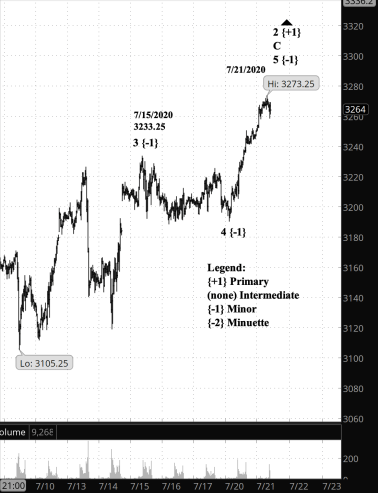
What’s happening now? The S&P 500 E-mini futures today pushed to a higher high of 3273.25 in the uptrending correction, eclipsing the prior high of 3233.25, set July 15. So far the correction that began March 22 has retraced 90% of the decline that began on February 19.

What does it mean? The one-day push to the new high is powerful enough to suggest that a turning point is at hand. Some traders call it an exhaustion move.

Screen Shot 2020-07-21 at 7.18.49 AM
S&P 500 E-mini futures, 30-minute bars

What does Elliott wave theory say? The Elliott wave count shows the rise to a new high to be Minor wave 5 — the last in the series — within Intermediate wave C, which in turn is within Primary wave 2, the corrective wave that began March 22.

The rules of Elliott wave analysis say a 2nd wave cannot move above the preceding 1st wave of the same degree. The 1st wave began February 19 at 3397.50. That means Primary wave 2 has only 124.25 of upside from its high remaining. A push above the February starting point would mean that Cycle wave 5, that began in December 1974, is still underway.

(See my July 16 “Live” post for a discussion of the chart since February.)

If the present high marks the end of Intermediate C, then what happens next depends upon whether the correction extends further. We’ve already seen a double Zigzag within Primary wave 2. A triple Zigzag is certainly allowed under the Elliott rules.

So a weak and meandering decline off of the high suggests that the correction is still underway: Either a new Zigzag or a continuation of Minor wave 5. If the decline off of the high has some strength behind it, that would suggest that Primary wave 2 is complete and Primary 3 has begun its powerful decline.

What is the alternative? The wave count may in fact be a degree lower than I’ve labelled it. What I’ve numbered as Minor wave 4 could in fact be Minuette wave 1 within Minor wave 4, and the label Minor 5 may in fact be Minuette wave 2. I think it’s unlikely, but it’s possible.

Read More »

Live: Monday, July 20, 2020

10:20 a.m. New York time

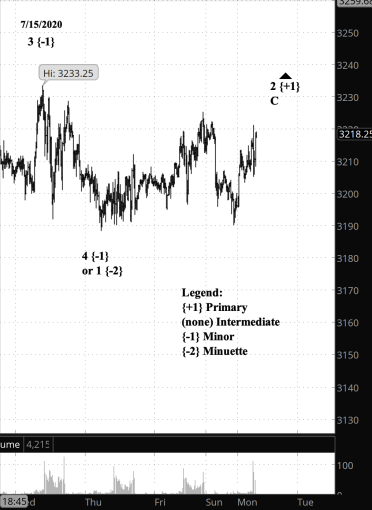
What’s happening now? The S&P 500 E-mini futures are in the midst of a rise that may finish off the upward correction that began March 22. At a smaller level, it is in the final stages of a downward correction, that began July 15, within the larger upward correction.

What does it mean? There’s not a lot of upside to the S&P 500 under the present analysis. The futures price must stay below 3397.50 for the analysis to hold. I consider a break above that level to be low probability.

Screen Shot 2020-07-20 at 7.16.32 AM
S&P 500 E-mini futures, 15-minute bars

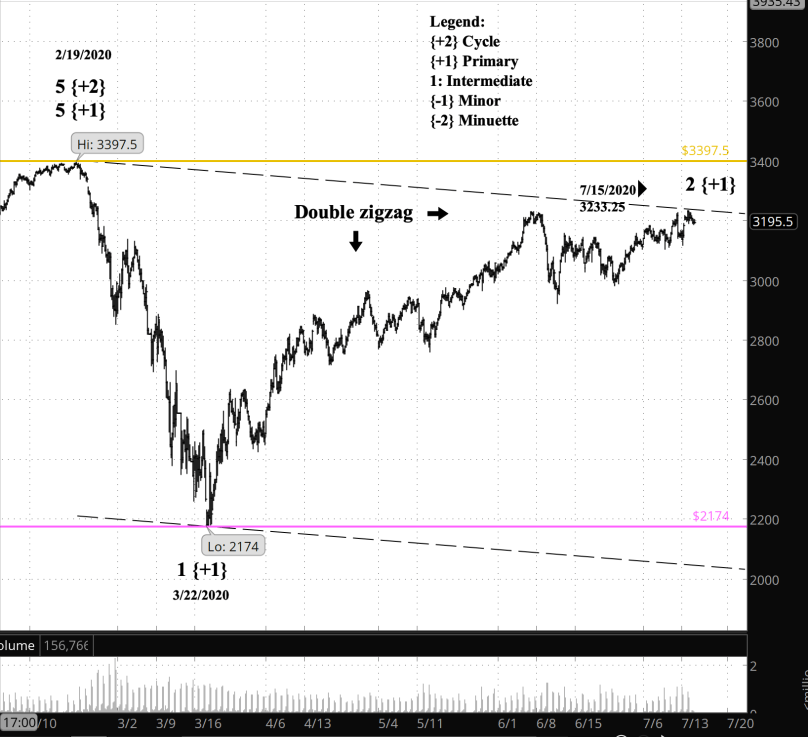
What does Elliott wave theory say? The Primary degree correction that began in March has broken down into a double Zigzag pattern. The price is working on Intermediate wave C within the second Zigzag. As I count the subwaves, C is in its 4th wave, a downward correction, and will soon enter its 5th and final wave to the upside. When the 5th wave is complete, either it will mark the end of Primary wave 2 and the beginning of a substantial Primary wave 3 decline. Or, the correction will continue, stretching out into a triple Zigzag.

What is the alternative? It’s possible to count the July 15 high of 3233.25 as being the end of the Minor 5th wave and also the end of Intermediate C.

What about my trades? Holding my bearish shares of SDS; deferring any options trades until we’re in Primary wave 3 to the downside.

Read More »

Live: Friday, July 17, 2020

10:10 a.m. New York time

What’s happening now? The S&P 500 E-mini futures are midway through an uptrending part of an upward correction.

What does it mean? There is a still  more upside left to the correction, although not a lot. The present near-term upward movement will be followed by a small decline and then a final push to the upside. Afterward, either the correction will be complete and the price will begin a major decline, or the correction will extend, perhaps for another month.

Screen Shot 2020-07-17 at 7.00.05 AM
S&P 500 E-mini futures, 2-hour bars

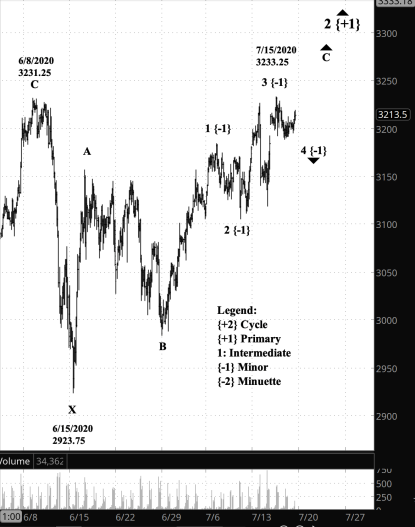
What does Elliott wave theory say? The peak of July 15 marks the end of Minor wave 3 within Intermediate wave C, all with the Primary wave 2 upward correction. Intermediate C requires two more waves for completion: Minor 4 down and Minor 5 up.

Primary 2 is in the second section of a complex correction, composed so far of two zigzags. It could go for a third section — a zigzag or a flat, perhaps — separated from the prior section by an X wave. In that case there will be more upside, although under the present count covering the entire decline since February 19, it cannot exceed 3397.50, the start of Primary wave 1 on that date.

What is the alternative? The end of Minor wave C could mark the end of the Primary wave 2 correction. It would be followed by Primary 3, a downward move of great energy down to the 2000s.

What about my trades? I’m holding back from entering new positions, shares or options, at this point.

Read More »

Live: Thursday, July 16, 2020

9:35 New York time

What’s happening now? There was a divergence among the three major S&P 500 products, with two crossing above what I had labelled the peak of Primary wave 2 on June 8. Here are the numbers:

  • S&P 500 index: June 8 high, 3233.13; July 15 high, 3238.28; broke above by 5.16 points
  • S&P 500 E-mini futures: June 8 high, 3231.25; July 15 high, 3233.25; broke above by 2.00 points
  • SPY exchange-traded fund: June high, 323.41; July 15 high, 323.04; fell short by 0.37.

All three are now below their July 15 highs, although by only a little.

What does it mean? The upward correction that began March 22 from 2174 is still underway. It did not end on June 8.

What does Elliott wave theory say? The two breakouts, if we’re willing to accept two out of three as action-worthy, mean that the July 8 peak of the end of an Intermediate wave within the end of Primary wave 2, whose high so far on the S&P 500 E-mini futures chart is 2233.25.

Screen Shot 2020-07-16 at 6.36.36 AM

However, does two out of three really dictate the status of the full range of products? I don’t think so; I want unanimity before I sign up on the idea that Primary wave 2 continued past June 8. At this point, in my opinion, the best we can say is that the chart is ambiguous. However, I’ve marked the chart to conform with the breakout as a working hypothesis, even though it’s not yet confirmed.

If the price continues with another three-wave pattern inclining up or sideways, with the SPY exchange-traded fund moving with the other two products rather than remaining a lone wolf, then the analysis placing the S&P 500 still in Primary wave 2 will be confirmed.

What is the alternative? If the price falls below 2174 (the red line) in a five-wave pattern, then Primary wave 2 is over and Primary wave 3 is confirmed.

And if the line rises above 3397.50, the tan line, the crash of February 19 was nothing more than a correction within the rise that began in December 1974 and is still continuing.

Read More »

Live: Wednesday, July 15, 2020

10:55 a.m. New York time

What’s happening now? The S&P 500 E-mini futures this morning did a repeat of Monday, moving back above the previous high. The new high is 3233.25, seven points higher.

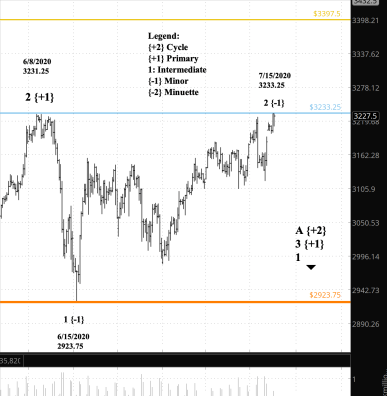
What does it mean? The correction that began July 15 is still underway. It will be followed by a sharp decline.

Screen Shot 2020-07-15 at 7.51.34 AM

What does Elliott wave theory say? The fresh breakout means that Minor wave 2, an upward correction, is still in force. It has completed two Zigzags of the Minuette degree, one level down from Minor. The continuation of the correction means that there will be at a minimum three more Minuette waves. Their duration varies, but so far that lower degree’s waves have taken anywhere from one to 10 days to run their course.

However, the futures also moved above the peak of June 8, the June 8 peak of Primary wave 2, which is two degrees above the Minor level. That point is also the start of Minor wave 1, and wave 2 under Elliott’s rules cannot move beyond the start of wave 1. It would require a significant reworking of my analysis. But is it a true signal?

As I noted in last Saturday’s post, “A Funny Thing Happened“, the S&P 500 is a family of products, and sometimes they diverge. They major three are the index itself, the exchange-traded fund SPY and the E-mini futures. I track the futures in my daily analysis because they provide a lot of after-hours trading and so my chart avoids the annoying gaps that we see, especially, in the index itself, which trades only during market hours.

The S&P 500 index and SPY didn’t  break above the Primary wave 2 level. So I consider that aspect of the breakout to be too close to call. Ultimately I need agreement among all three of the major products before accepting a breakout to be a true signal. The vote now is one in favor a breakout, two against.

What is the alternative?  Any analysis of alternatives relies on whether the breakout above the start of Minor wave 1 was a true signal.

Read More »

Live: Tuesday, July 14, 2020

10:15 a.m. New York time

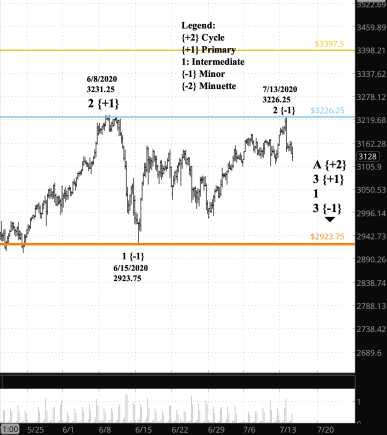
What’s happening now? The S&P 500 E-mini futures reached a peak of 3226.25 at 1:37 p.m. New York time on Monday, then began a rapid decline a low of 3140.50 two hours later, a decline of 2.7%. It has continued to decline this morning.

What does it mean? It appears that the upward drive from Sunday afternoon was a last effort in the upward correction that began on June 15. I’ve marked the peak with a blue line, since any resumption of the rise to beyond that level would change my interpretation of the chart. It will take a drop below the beginning of the rise, from 2923.75, to confirm that the correction has ended.

Screen Shot 2020-07-14 at 7.11.32 AM
S&P 500 E-mini futures, 4-hour bars

What does Elliott wave theory say? The present decline appears to be the early stages of Minor wave 3 to the downside. Each time I’ve thought that, the price has reversed and move to a higher high, showing Minor wave 2 was still underway. Minor wave 3 will be confirmed when the price drops below the end of Minor wave 1, which is 2923.75 (the red line). That’s about 200 points away. Nonetheless, I have changed the labeling to reflect the Minor wave 3 hypothesis.

What is the alternative? A move above 3226.25, the Minor wave 2 high, would mean the Minor 2 is still underway. However, there is only 5 points of upside remaining to the Minor wave 2 correction. If it were to cross 3231.25, then under the rules of Elliott wave analysis it would mean that Primary wave 2, which began March 23, is still underway. I don’t consider it to be likely, but unlikely isn’t the same as impossible.

What about my trades? Still holding off on options until Intermediate wave 3 to the downside.

Read More »

Live: Monday, July 13, 2020

10:05 a.m. New York time

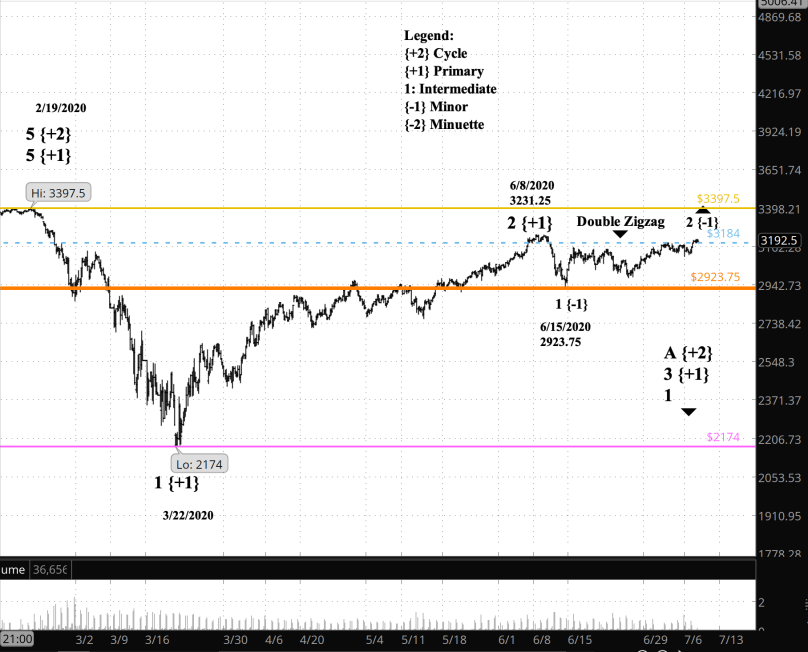
What’s happening now? The S&P 500 E-mini futures on Sunday joined the index and the exchange-traded fund SPY in breaking above the peak of July 6 (The dotted blue line on the chart; see “A Funny Thing Happened“, posted Saturday).

What does it mean? The break above that shows that the correction that began June 15 is continuing, although its upside potential is severely limited. A push above the start of  the major decline that began February 19, at 3397.50 (tan line), would mean that the major decline was over, having proven less major than my analysis at its outset had shown. Should that occur, then I would expect to see a continuation, in a very late stage, of the market rise that began in December 1974.

What does Elliott wave theory say? The breakout past the peak of what I had labeled as the Minor wave of 2nd degree means that Minor 2 is tracing a double zigzag pattern, a common sight in 2nd waves. By my count, internally the price is tracing the Minuette C wave — the final wave — of the second zigzag. From there, the next step is either a continuation of the correction as a triple zigzag, or the end of the correction and the beginning of Minor wave 3 to the downside.

Screen Shot 2020-07-13 at 7.02.39 AM
S&P 500 E-mini futures, 4-hour bars.

The end of Minor 3 will be followed by a Minor 4 upward correction and then a Minor wave 5 to the downside, which at its terminus will signal the end of Intermediate wave 1, a degree higher.

What is the alternative? The break-out above the June 15 peak has resolved the ambiguities for now. I see no alternatives.

What about my trades? Patiently awaiting Intermediate wave 3, or possibly Minor wave 3, depending upon the timing of things at it relates to the options calendar.

Read More »