Trader’s Notebook

3:15 p.m. New York time

Half an hour before the closing bell. After a quiet night the S&P 500 futures began to to fall during session, from the 3950s to the 3910s, reaching levels last seen a week earlier.

That decline is enough to give this morning’s alternative analysis the edge, and I’ve promoted it to primary analysis: The first leg of the upward correction that began on July 14 ended on July 22 at 4016.25, and the middle leg of the correction is now underway.

In Elliott wave terminology: The upward correction is wave 4{-12}, and within it wave A{-13} was completed on July 22, and wave B{-13} began from that point.

Wave 4{-12} appears to be taking the form of a Zigzag, which means that the B wave will retrace 38% to 79% of the preceding A wave. Wave A{-13} was 292.50 in length, so wave B{-13} will cover 111.15 to 231.08 points, giving price targets in the range of 3905.10 to 3795.17. Futures prices move in 25-cent intervals, so there will be some rounding on the chart as wave B{-13} progresses.

Wave B{-13} will have three waves internally, at the {-14} degree.

3:05 p.m. New York time

UPS earnings play exit. I’ve exited my short bull put options spread on UPS for 56.2% f maximum potential loss and have updated the trade analysis with full results.

2:30 p.m. New York time

BG earnings play entry. I’ve entered a short bull put spread on BG, using options that trade for the last time on 9/19, and have posted an analysis of the trade.

11 a.m. New York time

MCD earnings play exit. I’ve exited my short bull put options spread on MCD for 17.2% of maximum potential profit and have updated the trade analysis with full results.

9:35 a.m. New York time

What’s happening now? The S&P 500 E-mini futures were caged in a narrow range overnight, remaining below Friday’s high (4016.25) and above that day’s low (3941.50).

What does it mean? The chart remains ambiguous. As the principal analysis, I’ve marked the chart to show that within the upward correction that began on July 14, the first leg is underway.

What is the alternative? The alternative is of equal likelihood: The first leg of the correction ended on June 22 at 4016.25.
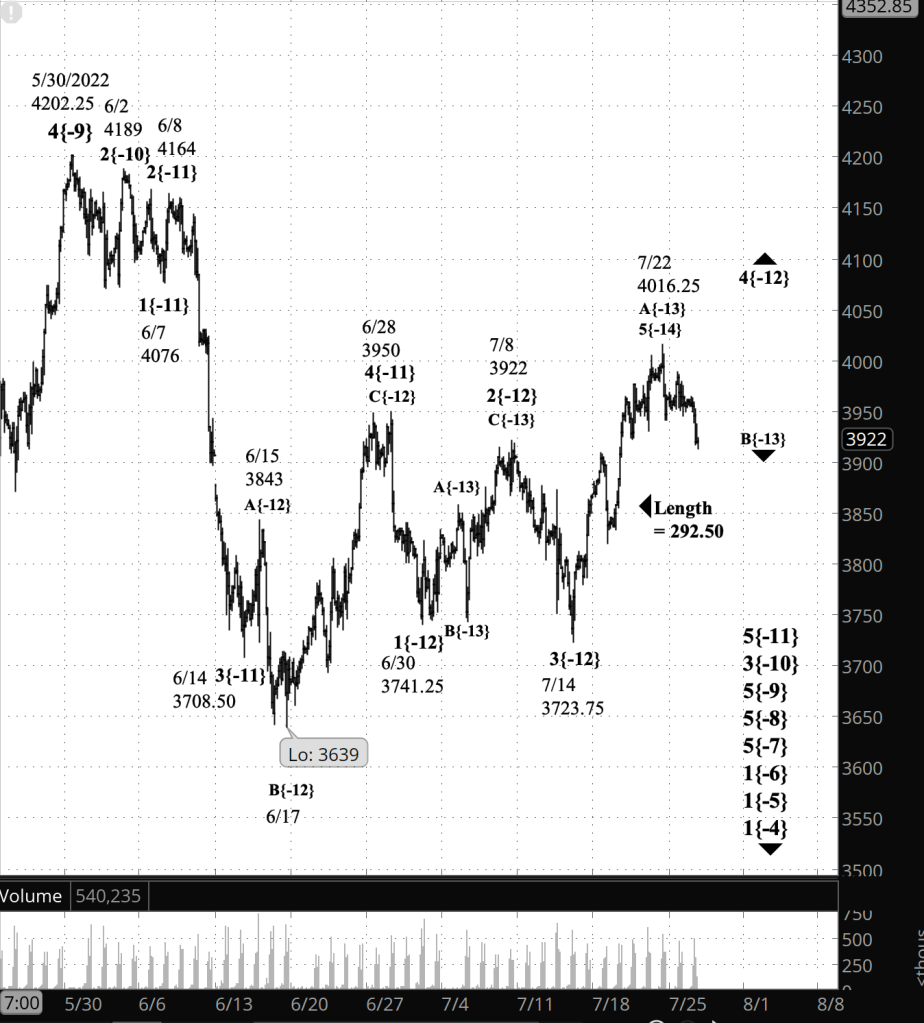
[S&P 500 E-mini futures at 3:30 p.m., 135-minute bars, with volume]

What does Elliott wave theory say? The upward correction is wave 4{-12}, and under the principal analysis, it’s first internal wave, rising A{-13} is underway. Under the alternative analysis, wave A{-13} ended on July 22 and descending wave B{-13} — the middle of a three-wave corrective pattern — is now underway.

The chart can be read either way, so basically, choosing between the principal analysis and the alternative is the flip of a coin.

It’s possible that wave 4{-12} will form a compound structure, connecting two or three corrective patterns before reaching its end. Among the two positions of corrective waves, compound corrections are more common in 4th waves than in 2nd waves. In both cases, most corrections are simple, with a single corrective pattern.

Whatever the form of wave 4{-12}, it will be followed by wave 5{-12}, a resumption of the wave 5{-11} downtrend that began on June 28. Wave 5{-12} will carry the price down into the 3700s, probably 3600s and perhaps even lower.

We Are Here.

These are the waves currently in progress under my principal analysis. Each line on the list shows the wave number, with the subscript in curly brackets, the traditional degree name, the starting date, the starting price of the S&P 500 E-mini futures, and the direction of the wave.

  • S&P 500 Index:
  • 5{+3} Supercycle, 7/8/1932, 4.40 (up)
  • 5{+2} Cycle, 12/9/1974, 60.96 (up)
  • 5{+1} Primary, 3/6/2009, 666.79 (up)
  • 5{0} Intermediate, 12/26/2018, 2346.58 (up)
  • 4{-1} Minor, 1/4/2022 4818.62 (down)
  • 1{-2} Minute, 1/4/2022 4818.62 (down)
  • S&P 500 Futures and index:
  • 1{-3} Minuette, 1/4/2022, 4808.25 (down) (futures), 4818.62 (down) (index)
  • S&P 500 Futures:
  • 1{-4} Subminuette, 1/4/2022, 4808.25 (down)
  • 1{-5} Micro, 1/4/2022, 4808.25 (down)
  • 1{-6} Submicro, 1/4/2022, 4808.25 (down)
  • 5{-7} Minuscule, 3/29/2022, 4631 (down)
  • 5{-8} Subminuscule, 4/21/2022, 4509 (down)
  • 5{-9} Bitsy, 5/30/2022, 4202.25 (down)
  • 3{-10} Subbitsy, 6/2/2022, 4189 (down)
  • 5{-11} Deci, 6/8/2022, 4164 (down)

Learning and other resources. Elliott wave analysis provides context, not prophecy. As the 20th century semanticist Alfred Korzybski put it in his book Science and Sanity (1933), “The map is not the territory … The only usefulness of a map depends on similarity of structure between the empirical world and the map.” And I would add, in the ever-changing markets, we can judge that similarity of structure only after the fact.

See the menu page Analytical Methods for a rundown on where to go for information on Elliott wave analysis.

By Tim Bovee, Portland, Oregon, July 26, 2022

Disclaimer

Tim Bovee, Private Trader tracks the analysis and trades of a private trader for his own accounts. Nothing in this blog constitutes a recommendation to buy or sell stocks, options or any other financial instrument. The only purpose of this blog is to provide education and entertainment.

No trader is ever 100 percent successful in his or her trades. Trading in the stock and option markets is risky and uncertain. Each trader must make trading decisions for his or her own account, and take responsibility for the consequences.

License
Creative Commons License

All content on Tim Bovee, Private Trader by Timothy K. Bovee is licensed under a Creative Commons Attribution-ShareAlike 4.0 International License.

Based on a work at www.timbovee.com.
UPS Trade

United Parcel Service Inc. (UPS)

Update 7/26/2022: I exited my short bull put vertical spread on UPS, 24 days before expiration, for a $2.05 debit per contract/share, a loss before fees of $70 per contract. Shares were trading at $180.39, $8.19 from the entry level.

The Implied Volatility Rank at exit was 31.0%, down 33.0 points from the entry level.

I exited on the day after entry, for 56.2% of maximum potential loss, because experience has shown me that waiting to exit from a losing position generally means greater losses, over the short-term at least. I am a short-term trader. Earnings beat the estimates by 15 cents per share. Nonetheless, the share price headed south.

Shares fell by 4.3% over one day for a -1,585% annual rate. The options position produced a 34.1% loss for a -12,463% annual rate.


I have entered a short bull put vertical spread on UPS, using options that trade for the last time 25 days hence, on August 19. The premium is a $1.35 credit per contract share and the stock at the time of entry was priced at $188.58.

The Implied Volatility Ratio stood at 64.0%.

Premium:$1.35Expire OTM
UPS-bull put spreadStrikeOddsDelta
Puts
Long175.0073.0%23
Break-even181.3569.0%27
Short180.0065.0%31

The premium is 54.0% of the width of the position’s short/long spread. The profit zone covers a 3.8% move to the downside and an unlimited move to the upside.

The risk/reward ratio is 2.7:1, with maximum risk of $365 and maximum reward of $135 per contract.

How I chose the trade. The trade was placed to coincide with UPS’s earnings announcement, before the opening bell on the day after entry. The short strikes were set to coincide with the expected move of $9.16 either way, based on options pricing, which gives a price range of $179.42 to $197.74.

By Tim Bovee, Portland, Oregon, July 25, 2022

Disclaimer

Tim Bovee, Private Trader tracks the analysis and trades of a private trader for his own accounts. Nothing in this blog constitutes a recommendation to buy or sell stocks, options or any other financial instrument. The only purpose of this blog is to provide education and entertainment.

No trader is ever 100 percent successful in his or her trades. Trading in the stock and option markets is risky and uncertain. Each trader must make trading decisions for his or her own account, and take responsibility for the consequences.

License
Creative Commons License

All content on Tim Bovee, Private Trader by Timothy K. Bovee is licensed under a Creative Commons Attribution-ShareAlike 4.0 International License.

Based on a work at www.timbovee.com.
MCD Trade

McDonald’s Corp. (MCD)

Update 7/26/2022: I exited my short bull put vertical spread on MCD, 33 days before expiration, for a $1.11 debit per contract/share, a profit before fees of $23 per contract. Shares were trading at $254.08, up $1.9 from the entry level.

The Implied Volatility Rank at exit was 33.0%, down 11.7 points from the entry level.

I exited on the day after entry as the position reached 17.2% of maximum potential profit, a bit less than my normal exit point for earnings plays, 25% of max. My goal is to get out of a position the next trading day after entry, and so I was willing to accept less than my goal in order to accomplish that result.

Shares rose by 1.9% over one day for a +676% annual rate. The options position produced a 20.7% return for a +7,563% annual rate.


I have entered a short bull put vertical spread on MCD, using options that trade for the last time 25 days hence, on August 19. The premium is a $1.34 credit per contract share and the stock at the time of entry was priced at $249.46.

The Implied Volatility Ratio stood at 44.78%.

Premium:$1.34Expire OTM
MCD-bull put spreadStrikeOddsDelta
Puts
Long240.0071.0%27
Break-even246.3465.5%32
Short245.0060.0%37

The premium is 53.6% of the width of the position’s short/long spread. The profit zone covers a 1.3% move to the downside and an unlimited move to the upside.

The risk/reward ratio is 2.7:1, with maximum risk of $366 and maximum reward of $134 per contract.

How I chose the trade. The trade was placed to coincide with MCD’s earnings announcement, before the opening bell on the day after entry. The short strikes were set to coincide with the expected move of $5.75 either way, based on options pricing, which gives a price range of $243.71 to $255.21.

By Tim Bovee, Portland, Oregon, July 25, 2022

Disclaimer

Tim Bovee, Private Trader tracks the analysis and trades of a private trader for his own accounts. Nothing in this blog constitutes a recommendation to buy or sell stocks, options or any other financial instrument. The only purpose of this blog is to provide education and entertainment.

No trader is ever 100 percent successful in his or her trades. Trading in the stock and option markets is risky and uncertain. Each trader must make trading decisions for his or her own account, and take responsibility for the consequences.

License
Creative Commons License

All content on Tim Bovee, Private Trader by Timothy K. Bovee is licensed under a Creative Commons Attribution-ShareAlike 4.0 International License.

Based on a work at www.timbovee.com.

Trader’s Notebook

3:30 p.m. New York time

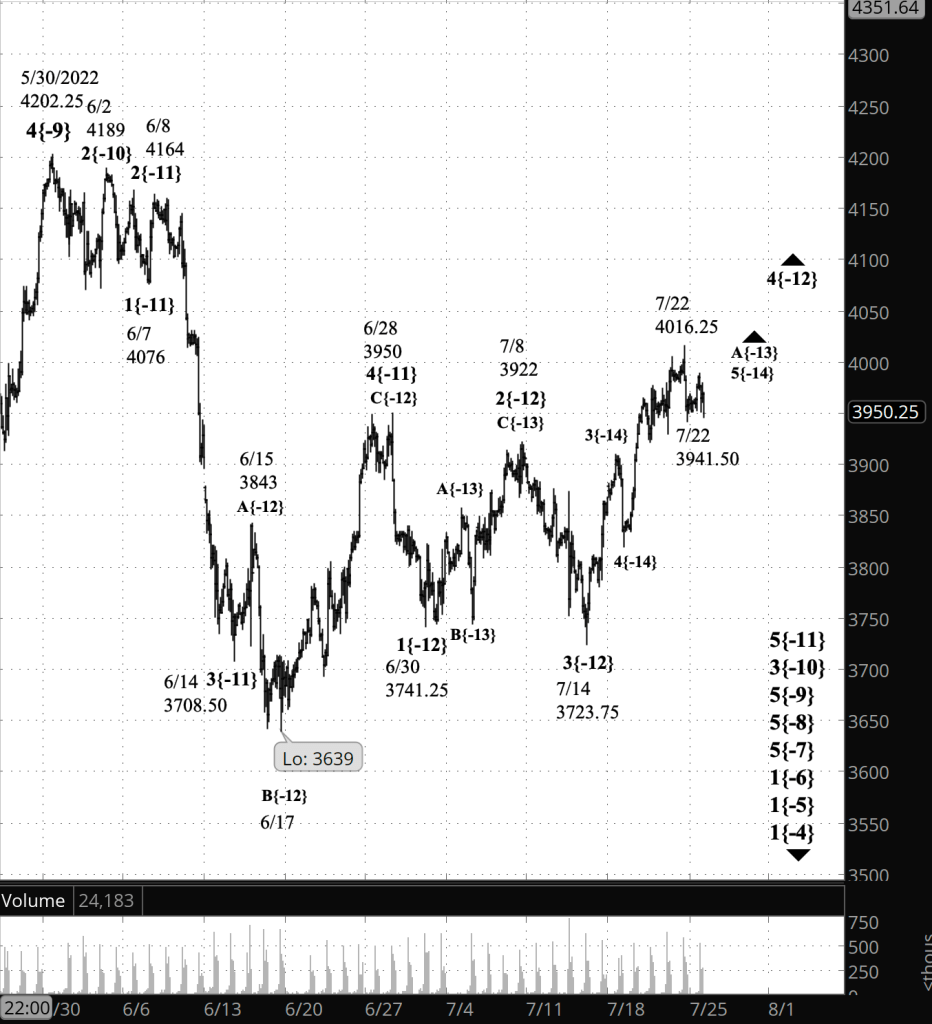
Half an hour before the closing bell. The S&P 500 has traded in a narrow range, remaining below Friday’s high, 4016.25, and above that day’s low, 3941.50. No change in this morning’s analysis. I’ve updated the chart, below.

2:05 p.m. New York time

MCD, UPS earnings plays entered. I’ve entered two short bear put vertical spreads, using options that trade for the last time on August 19. I’ve posted trade analyses for MCD and UPS.

9:35 a.m. New York time

What’s happening now? The S&P 500 E-mini futures rose overnight from the mid-3900s back into the upper 3900s. The price remained below Friday’s high, 4016.25.

What does it mean? The nature of Friday’s high remains uncertain. For my primary analysis, I’ve chosen to treat it as a stopping point within the first leg of an upward correction that began on July 14. Under this scenario, the overnight rise is a step leading to a new high.

What is the alternative? Of equal likelihood, Friday’s high could mark the end of the first leg of the upward correction, and the subsequent decline and rise are the early stages of the correction’s middle leg.

[S&P 500 E-mini futures at 3:30 p.m., 125-minute bars, with volume]

What does Elliott wave theory say? Under the principal analysis, wave A{-13} began on July 14 and is still underway. It is the first segment of an upward correction, wave 4{-12}.

Under the alternative analysis, wave A{-13} ended at Friday’s high, 4016.25, and from that point wave B{-13} began its decline.

In either case, the future rising wave C{-13} will likely be the final wave within the upward correction. The end of the correction, wave 4{-12}, will also be the beginning of wave 5{-12}, a resumption of the downtrend, wave 5{-11}, that began on June 28 from 3950. Wave 5{-12} will eventually carry the price back down to the 3700s or 3600s, and perhaps even lower.

It’s possible that wave 4{-12} will form a compound structure containing two or three corrective patterns. Most 4th wave corrections form simple structures, with with a single corrective pattern.

Wave 5{-11} is the final wave of a larger downtrend, wave 3{-10}, which in turn is part of a series of waves a increasingly greater magnitude, listed below in the “We Are Here” section.

We Are Here.

These are the waves currently in progress under my principal analysis. Each line on the list shows the wave number, with the subscript in curly brackets, the traditional degree name, the starting date, the starting price of the S&P 500 E-mini futures, and the direction of the wave.

  • S&P 500 Index:
  • 5{+3} Supercycle, 7/8/1932, 4.40 (up)
  • 5{+2} Cycle, 12/9/1974, 60.96 (up)
  • 5{+1} Primary, 3/6/2009, 666.79 (up)
  • 5{0} Intermediate, 12/26/2018, 2346.58 (up)
  • 4{-1} Minor, 1/4/2022 4818.62 (down)
  • 1{-2} Minute, 1/4/2022 4818.62 (down)
  • S&P 500 Futures and index:
  • 1{-3} Minuette, 1/4/2022, 4808.25 (down) (futures), 4818.62 (down) (index)
  • S&P 500 Futures:
  • 1{-4} Subminuette, 1/4/2022, 4808.25 (down)
  • 1{-5} Micro, 1/4/2022, 4808.25 (down)
  • 1{-6} Submicro, 1/4/2022, 4808.25 (down)
  • 5{-7} Minuscule, 3/29/2022, 4631 (down)
  • 5{-8} Subminuscule, 4/21/2022, 4509 (down)
  • 5{-9} Bitsy, 5/30/2022, 4202.25 (down)
  • 3{-10} Subbitsy, 6/2/2022, 4189 (down)
  • 5{-11} Deci, 6/8/2022, 4164 (down)

Learning and other resources. Elliott wave analysis provides context, not prophecy. As the 20th century semanticist Alfred Korzybski put it in his book Science and Sanity (1933), “The map is not the territory … The only usefulness of a map depends on similarity of structure between the empirical world and the map.” And I would add, in the ever-changing markets, we can judge that similarity of structure only after the fact.

See the menu page Analytical Methods for a rundown on where to go for information on Elliott wave analysis.

By Tim Bovee, Portland, Oregon, July 25, 2022

Disclaimer

Tim Bovee, Private Trader tracks the analysis and trades of a private trader for his own accounts. Nothing in this blog constitutes a recommendation to buy or sell stocks, options or any other financial instrument. The only purpose of this blog is to provide education and entertainment.

No trader is ever 100 percent successful in his or her trades. Trading in the stock and option markets is risky and uncertain. Each trader must make trading decisions for his or her own account, and take responsibility for the consequences.

License
Creative Commons License

All content on Tim Bovee, Private Trader by Timothy K. Bovee is licensed under a Creative Commons Attribution-ShareAlike 4.0 International License.

Based on a work at www.timbovee.com.

Trader’s Notebook

3:30 p.m. New York time

Half an hour before the closing bell. The S&P 500 peaked in the first half hour of trading, at 4016.25 on the futures, and since then has declined back into the mid-3900s. The further the decline, the more likely it is that the morning’s peak was the end of the first leg of the upward correction that began on July 14. If the price reverses and moves still higher, then that first leg of the correction is still underway.

The possibilities, using the terminology of Elliott wave analysis: Wave 4{-12}, an upward correction, is still underway. It’s first internal wave, A{-13}, might have ended this morning at 4016.25, but that is not yet a certainty. If the A wave did end this morning, then wave B{-13} to the downside has begun.

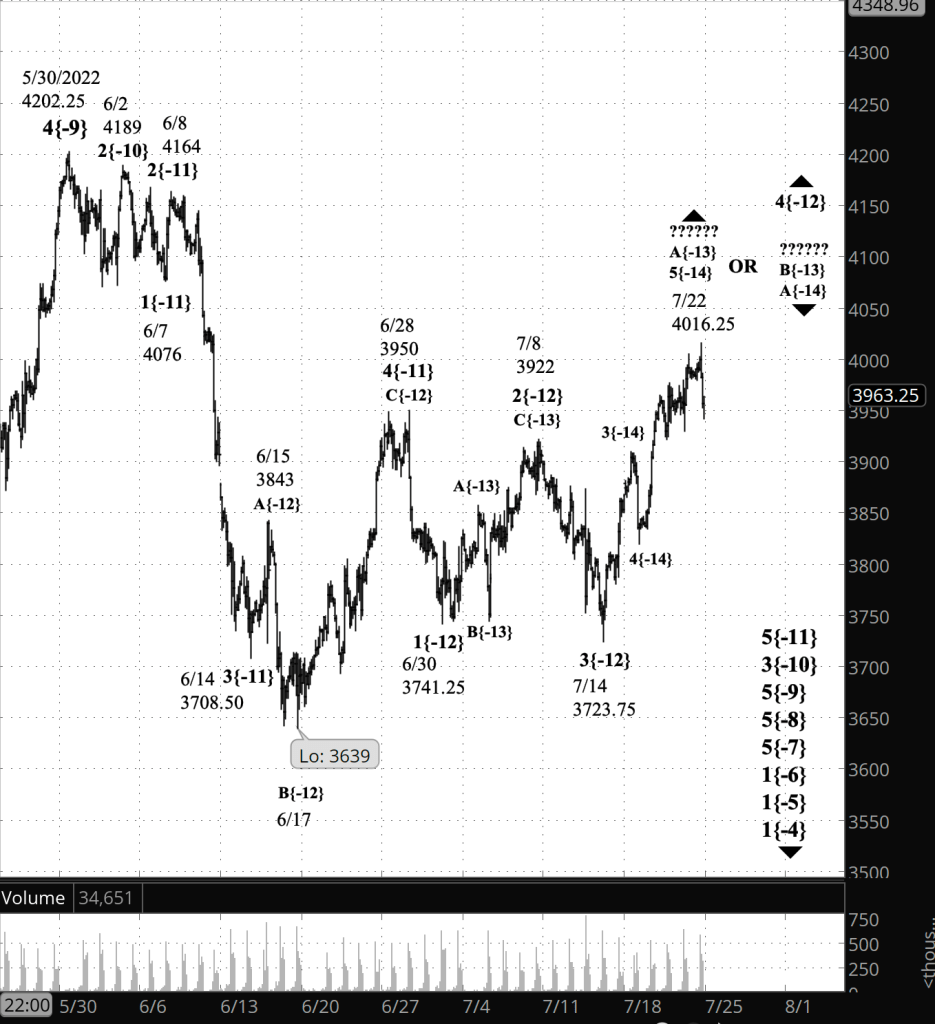
I’ve updated the chart, leaving this morning’s ambiguous labelling in place.

9:55 a.m. New York time

NEE earnings play exit. I’ve exited my short bull put vertical spread on NEE for 35% of maximum potential profit and have updated the trade analysis with full results.

9:35 a.m. New York time

What’s happening now? The S&P 500 E-mini futures traded in a narrow range overnight and then moved higher at the opening bell, to 4009, which is 4.25 points above yesterday’s peak.

What does it mean? The chart is trapped in the same ambiguity that it has gripped it for several days: Each high possibly could be the end of the first leg of the upward correction that began on July 14 from 3723.75. But it’s also possible that further highs lie ahead before the next leg of the correction begins. Whichever scenario plays out, the one certainty is that the upward correction is still underway.

What is the alternative? Because of the ambiguity of the chart at this point, rather than a principal analysis and an alternative, I’m going with two principal analyses, of equal likelihood, as described in the “What does it mean?” section, above.

[S&P 500 E-mini futures at 3:30 p.m., 125-minute bars, with volume]

What does Elliott wave theory say? On the chart, I’ve placed the notations for both possible scenarios, each with a line of question marks at the top to flag the ambiguities. Within the upward correction, wave 4{-12}, either wave A{-13} is still underway, with further upside ahead beyond the high so far today, 4009, or wave B{-13} began at the peak high and is now descending.

Whichever scenario proves to be true, upward wave A{-13} is or will be followed by downward wave B{-13}, and then by upward wave C{-13}, likely completing the parent wave 4{-12}. Another less likely possibility is that wave 4{-12} will form a compound structure. If that’s the case, then wave C{-13} will be followed by a descending connector, wave X{-13}, and then a second corrective pattern.

When wave 4{-12} is complete, wave 5{-12} will carry the price down into the 3700s and possibly into the 3600s or lower.

This is all happening within wave 5{-11}, a downtrending wave that began on June 8 from 4164. As is always the case with the fractal structure of market charts, wave 5{-11} is a subwave of a parent wave, in a genealogy of waves that stretch far in the past. See the “We Are Here” section below for a list of ancestral waves back to the great bull market that began in 1932..

We Are Here.

These are the waves currently in progress under my principal analysis. Each line on the list shows the wave number, with the subscript in curly brackets, the traditional degree name, the starting date, the starting price of the S&P 500 E-mini futures, and the direction of the wave.

  • S&P 500 Index:
  • 5{+3} Supercycle, 7/8/1932, 4.40 (up)
  • 5{+2} Cycle, 12/9/1974, 60.96 (up)
  • 5{+1} Primary, 3/6/2009, 666.79 (up)
  • 5{0} Intermediate, 12/26/2018, 2346.58 (up)
  • 4{-1} Minor, 1/4/2022 4818.62 (down)
  • 1{-2} Minute, 1/4/2022 4818.62 (down)
  • S&P 500 Futures and index:
  • 1{-3} Minuette, 1/4/2022, 4808.25 (down) (futures), 4818.62 (down) (index)
  • S&P 500 Futures:
  • 1{-4} Subminuette, 1/4/2022, 4808.25 (down)
  • 1{-5} Micro, 1/4/2022, 4808.25 (down)
  • 1{-6} Submicro, 1/4/2022, 4808.25 (down)
  • 5{-7} Minuscule, 3/29/2022, 4631 (down)
  • 5{-8} Subminuscule, 4/21/2022, 4509 (down)
  • 5{-9} Bitsy, 5/30/2022, 4202.25 (down)
  • 3{-10} Subbitsy, 6/2/2022, 4189 (down)
  • 5{-11} Deci, 6/8/2022, 4164 (down)

Learning and other resources. Elliott wave analysis provides context, not prophecy. As the 20th century semanticist Alfred Korzybski put it in his book Science and Sanity (1933), “The map is not the territory … The only usefulness of a map depends on similarity of structure between the empirical world and the map.” And I would add, in the ever-changing markets, we can judge that similarity of structure only after the fact.

See the menu page Analytical Methods for a rundown on where to go for information on Elliott wave analysis.

By Tim Bovee, Portland, Oregon, July 22, 2022

Disclaimer

Tim Bovee, Private Trader tracks the analysis and trades of a private trader for his own accounts. Nothing in this blog constitutes a recommendation to buy or sell stocks, options or any other financial instrument. The only purpose of this blog is to provide education and entertainment.

No trader is ever 100 percent successful in his or her trades. Trading in the stock and option markets is risky and uncertain. Each trader must make trading decisions for his or her own account, and take responsibility for the consequences.

License
Creative Commons License

All content on Tim Bovee, Private Trader by Timothy K. Bovee is licensed under a Creative Commons Attribution-ShareAlike 4.0 International License.

Based on a work at www.timbovee.com.

NEE Trade

NextEra Energy Inc. (NEE)

Update 7/22/2022: I exited my short bull put vertical spread on NEE, 28 days before expiration, for a $0.80 debit per contract/share, a profit before fees of $43 per contract. Shares were trading at $80.89, up $2.35 from the entry level.

The Implied Volatility Rank at exit was 54.0%, down 2.5 points from the entry level.

I exited on the day after entry because the position reached 35% of maximum potential profit, above my normal exit point for earnings plays of 25% of max.

Shares rose by 3.0% over one day for a +1,092% annual rate. The options position produced a 53.8% return for a +19,619% annual rate.


I have entered a short bull put vertical spread on NEE, using options that trade for the last time 29 days hence, on August 19. The premium is a $1.23 credit per contract share and the stock at the time of entry was priced at $78.54.

The Implied Volatility Ratio stood at 56.5%.

Premium:$1.23Expire OTM
NEE-bull put spreadStrikeOddsDelta
Puts
Long72.5086.0%12
Break-even78.7377.0%20
Short77.5068.0%28

The premium is 49.2% of the width of the position’s short/long spread. The profit zone covers a 0.2% move to the downside and an unlimited move to the upside.

The risk/reward ratio is 3.1:1, with maximum risk of $377 and maximum reward of $123 per contract.

How I chose the trade. The trade was placed to coincide with NEE’s earnings announcement, before the opening bell on the day after entry. The short strikes were set to coincide with the expected move of $4.24 either way, based on options pricing, which gives a price range of $75.78 to $81.30.

By Tim Bovee, Portland, Oregon, July 21, 2022

Disclaimer

Tim Bovee, Private Trader tracks the analysis and trades of a private trader for his own accounts. Nothing in this blog constitutes a recommendation to buy or sell stocks, options or any other financial instrument. The only purpose of this blog is to provide education and entertainment.

No trader is ever 100 percent successful in his or her trades. Trading in the stock and option markets is risky and uncertain. Each trader must make trading decisions for his or her own account, and take responsibility for the consequences.

License
Creative Commons License

All content on Tim Bovee, Private Trader by Timothy K. Bovee is licensed under a Creative Commons Attribution-ShareAlike 4.0 International License.

Based on a work at www.timbovee.com.
Trader’s Notebook

3:30 p.m. New York time

Half an hour before the closing bell. The S&P 500 continued rising by small increments during the session, reaching into the 3990s. Wave A{-13} within wave 4{-12} is still underway. No change in the analysis. I’ve updated the chart.

1:30 p.m. New York time

NEE earnings play entry. I’ve entered a bull put vertical spread on NEE, using options that trade for the last time on August 19, and have posted an analysis of the trade.

10:15 a.m. New York time

AN earnings play exit. I’ve exited my bull put vertical spread on AN for a wash — neither a profit nor a loss. That works out to 44.9% of the maximum potential loss on the position. I’ve updated the trade analysis with full results.

9:35 a.m. New York time

What’s happening now? The S&P 500 E-mini futures traded narrowly in the upper and mid-3900s overnight, rising slightly above Wednesday’s high, to 3979, as the opening bell approached.

What does it mean? The rising first leg within the upward correction that began on July 14 is still underway.

What is the alternative? The first leg has met all of the requirements for completion, and so any high and reversal could signal that the upward correction has ended and the declining second leg has begun.

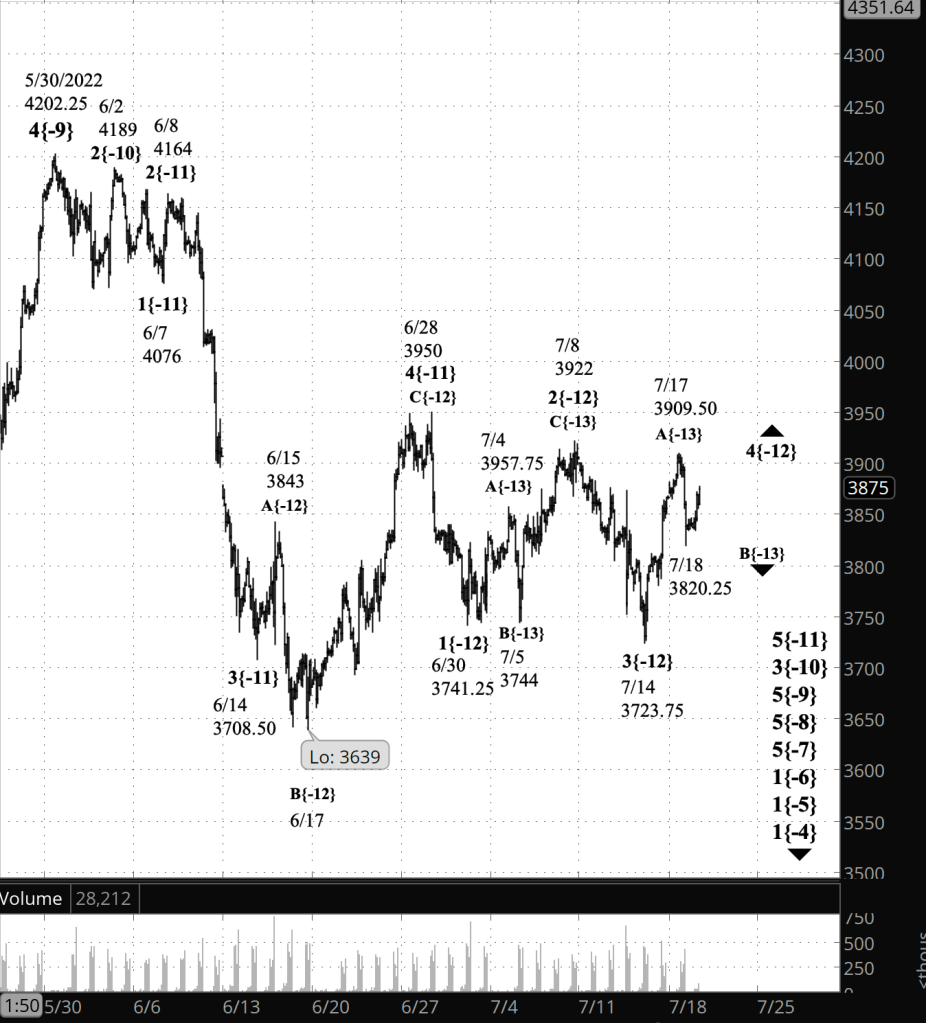
[S&P 500 E-mini futures at 3:30 p.m., 125-minute bars, with volume]

What does Elliott wave theory say? An upward correction, wave 4{-12}, began on July 14 from 3723.75. It will have three waves internally.

Under the principal analysis, the first wave within wave 4{-12}, upward wave A{-13}, with five internal waves, is not yet complete. The fact that the A wave had five internal waves means that the correction is taking the form of a Zigzag.

Under the alternative analysis, this morning’s high marked the end of wave A{-13} and the beginning of downward wave B{-13}, which will have three internal waves.

In either case, wave B{-13} will be followed by a third wave, upward wave C{-13}, with five internal waves that will complete the Zigzag corrective pattern. In most cases the end of the C wave will also be the end of the correction. In some cases, the correction forms a compound structure, linking two or three corrective patterns together.

Whether simple or compound, wave 4{-12} will be followed by a downtrending wave 5{-12}, which will most likely carry the price down into the 3600s, and perhaps lower.

This is all happening within downtrending wave 5{-11}, which began on June 8 from 4164. It is the smallest of a series of nested downtrending waves listed below in the “We Are Here” section.

We Are Here.

These are the waves currently in progress under my principal analysis. Each line on the list shows the wave number, with the subscript in curly brackets, the traditional degree name, the starting date, the starting price of the S&P 500 E-mini futures, and the direction of the wave.

  • S&P 500 Index:
  • 5{+3} Supercycle, 7/8/1932, 4.40 (up)
  • 5{+2} Cycle, 12/9/1974, 60.96 (up)
  • 5{+1} Primary, 3/6/2009, 666.79 (up)
  • 5{0} Intermediate, 12/26/2018, 2346.58 (up)
  • 4{-1} Minor, 1/4/2022 4818.62 (down)
  • 1{-2} Minute, 1/4/2022 4818.62 (down)
  • S&P 500 Futures and index:
  • 1{-3} Minuette, 1/4/2022, 4808.25 (down) (futures), 4818.62 (down) (index)
  • S&P 500 Futures:
  • 1{-4} Subminuette, 1/4/2022, 4808.25 (down)
  • 1{-5} Micro, 1/4/2022, 4808.25 (down)
  • 1{-6} Submicro, 1/4/2022, 4808.25 (down)
  • 5{-7} Minuscule, 3/29/2022, 4631 (down)
  • 5{-8} Subminuscule, 4/21/2022, 4509 (down)
  • 5{-9} Bitsy, 5/30/2022, 4202.25 (down)
  • 3{-10} Subbitsy, 6/2/2022, 4189 (down)
  • 5{-11} Deci, 6/8/2022, 4164 (down)

Learning and other resources. Elliott wave analysis provides context, not prophecy. As the 20th century semanticist Alfred Korzybski put it in his book Science and Sanity (1933), “The map is not the territory … The only usefulness of a map depends on similarity of structure between the empirical world and the map.” And I would add, in the ever-changing markets, we can judge that similarity of structure only after the fact.

See the menu page Analytical Methods for a rundown on where to go for information on Elliott wave analysis.

By Tim Bovee, Portland, Oregon, July 21, 2022

Disclaimer

Tim Bovee, Private Trader tracks the analysis and trades of a private trader for his own accounts. Nothing in this blog constitutes a recommendation to buy or sell stocks, options or any other financial instrument. The only purpose of this blog is to provide education and entertainment.

No trader is ever 100 percent successful in his or her trades. Trading in the stock and option markets is risky and uncertain. Each trader must make trading decisions for his or her own account, and take responsibility for the consequences.

License
Creative Commons License

All content on Tim Bovee, Private Trader by Timothy K. Bovee is licensed under a Creative Commons Attribution-ShareAlike 4.0 International License.

Based on a work at www.timbovee.com.

AN Trade

AutoNation Inc. (AN)

Update 7/21/2022: I exited my short bull put vertical spread on AN, 29 days before expiration, for a $1.55 debit per contract/share, a wash before fees, meaning the exit and entry prices were the same. Shares were trading at $119.74, down $0.68 from the entry level.

The Implied Volatility Rank at exit was 29.1%, down 15.5 points from the entry level.

Although AN’s earnings beat the estimates, the price fell. I exited on the day after entry for neither a profit nor a loss. The exit point was 44.9% of maximum potential loss.

Shares fell by 0.6% over one day for a -206% annual rate. The options position produced neither a return nor a loss.


I have entered a short bull put vertical spread on AN, using options that trade for the last time 30 days hence, on August 19. The premium is a $1.55 credit per contract share and the stock at the time of entry was priced at $120.42.

The Implied Volatility Ratio stood at 44.6%.

Premium:$1.55Expire OTM
AN-bull put spreadStrikeOddsDelta
Puts
Long110.0070.0%26
Break-even116.5565.0%30.5
Short115.0060.0%35

The premium is 62% of the width of the position’s short/long spread. The profit zone covers a 3.2% move to the downside and an unlimited move to the upside.

The risk/reward ratio is 2.2:1, with maximum risk of $345 and maximum reward of $155 per contract.

How I chose the trade. The trade was placed to coincide with AN’s earnings announcement, before the opening bell on the day after entry. The short strikes were set to coincide with the expected move of $10.97 either way, based on options pricing, which gives a price range of $109.45 to $131.39.

By Tim Bovee, Portland, Oregon, July 20, 2022

Disclaimer

Tim Bovee, Private Trader tracks the analysis and trades of a private trader for his own accounts. Nothing in this blog constitutes a recommendation to buy or sell stocks, options or any other financial instrument. The only purpose of this blog is to provide education and entertainment.

No trader is ever 100 percent successful in his or her trades. Trading in the stock and option markets is risky and uncertain. Each trader must make trading decisions for his or her own account, and take responsibility for the consequences.

License
Creative Commons License

All content on Tim Bovee, Private Trader by Timothy K. Bovee is licensed under a Creative Commons Attribution-ShareAlike 4.0 International License.

Based on a work at www.timbovee.com.

Trader’s Notebook

3:30 p.m. New York time

Half an hour before the closing bell. The S&P 500 rose during the session, from the low 3900s to a high of 3977.25, which is 13 points above the overnight high. The alternative analysis proved to be correct: Wave A{-13} within wave 4{-12} is still underway. This switch is the upward version of bottom fishing, where a trader tries to figure out where a trend has ended and has hit a false call. A reversal to the downside will trigger a return to this morning’s principal analysis, that wave A{-13} is over and B{-13} has begun, with a higher A-wave end point than this morning. I’ve updated the chart.

12:50 p.m. New York time

AN earnings play entry. I’ve entered short bull put vertical spread on AN, using options that trade for the last time on August 19, and have posted an analysis of the trade.

9:35 a.m. New York time

What’s happening now? The S&P 500 E-mini futures reached an overnight high of 3964.25 and then reversed.

What does it mean? The high marks the end of the first leg of an upward correction that began on July 14.

What is the alternative? It’s possible that the high marked the end of a subwave within the first leg of the still incomplete correction.

[S&P 500 E-mini futures at 3:30 p.m., 115-minute bars, with volume]

What does Elliott wave theory say? Under the principal analysis, the first leg, rising wave A{-13| of the upward correction, wave 4{-12}, has completed five waves internally, meaning that wave 4{-12} is taking the form of a Zigzag. Falling wave B{-13} has begun and will have three waves internally. This scenario means that the potential over the next few days is mainly to the downside.

Wave B{-13} will be followed by rising wave C{-13}, which will complete the correction, unless it takes a compound form, linking two or three corrective patterns together. In that latter case, wave C{-13} will be followed by a falling connector wave, X{-13}, and then a second corrective pattern.

Under the alternative analysis, wave A{-13} is not yet complete and wave B{-13} hasn’t yet begun. This scenario means that there is more upside potential in the next few days.

Wave 4{-12} and its subwaves are all happening within wave 5{-11}, which began on June 28, which in turn is a subwave of wave 3{-10}, which began on June 2 and is a subwave of wave 5{-9}, which began on May 30. They are all subwaves wave 5{-8}, which began on April 21 and is the smallest degree listed in “We Are Here”, below. Wave 5{-8}, in turn, has a series of parent and grandparent waves stretching up to downtrending wave 4{-1}, which began on January 4, and waves of even larger degree, up to uptrending wave 5{+3}, which began on July 8, 1932.

We Are Here.

These are the waves currently in progress under my principal analysis. Each line on the list shows the wave number, with the subscript in curly brackets, the traditional degree name, the starting date, the starting price of the S&P 500 E-mini futures, and the direction of the wave.

  • S&P 500 Index:
  • 5{+3} Supercycle, 7/8/1932, 4.40 (up)
  • 5{+2} Cycle, 12/9/1974, 60.96 (up)
  • 5{+1} Primary, 3/6/2009, 666.79 (up)
  • 5{0} Intermediate, 12/26/2018, 2346.58 (up)
  • 4{-1} Minor, 1/4/2022 4818.62 (down)
  • 1{-2} Minute, 1/4/2022 4818.62 (down)
  • S&P 500 Futures and index:
  • 1{-3} Minuette, 1/4/2022, 4808.25 (down) (futures), 4818.62 (down) (index)
  • S&P 500 Futures:
  • 1{-4} Subminuette, 1/4/2022, 4808.25 (down)
  • 1{-5} Micro, 1/4/2022, 4808.25 (down)
  • 1{-6} Submicro, 1/4/2022, 4808.25 (down)
  • 5{-7} Minuscule, 3/29/2022, 4631 (down)
  • 5{-8} Subminuscule, 4/21/2022, 4509, (down)

Learning and other resources. Elliott wave analysis provides context, not prophecy. As the 20th century semanticist Alfred Korzybski put it in his book Science and Sanity (1933), “The map is not the territory … The only usefulness of a map depends on similarity of structure between the empirical world and the map.” And I would add, in the ever-changing markets, we can judge that similarity of structure only after the fact.

See the menu page Analytical Methods for a rundown on where to go for information on Elliott wave analysis.

By Tim Bovee, Portland, Oregon, July 20, 2022

Disclaimer

Tim Bovee, Private Trader tracks the analysis and trades of a private trader for his own accounts. Nothing in this blog constitutes a recommendation to buy or sell stocks, options or any other financial instrument. The only purpose of this blog is to provide education and entertainment.

No trader is ever 100 percent successful in his or her trades. Trading in the stock and option markets is risky and uncertain. Each trader must make trading decisions for his or her own account, and take responsibility for the consequences.

License
Creative Commons License

All content on Tim Bovee, Private Trader by Timothy K. Bovee is licensed under a Creative Commons Attribution-ShareAlike 4.0 International License.

Based on a work at www.timbovee.com.

Trader’s Notebook

3:30 p.m. New York time

Half an hour before the closing bell. The S&P 500 futures swiftly climbed into the mid-3900s, moving above the July 17 peak, 3909.50. As noted in this morning’s alternative analysis, a move above that level requires a re-analysis of the chart.

Under the new scenario, the first segment, wave A{-13}, of the upward correction that began on July 14, wave 4{-12}, is still underway. Internally, the A wave is in its final subwave, wave 5{-14}. Since wave A{-13} contains five internal waves, the correction is taking the form of a Zigzag. The B{-13} wave that will follow will have three internal waves and will retrace 38% to 79% of wave A{-13}. the final wave within wave Zigzag, wave C{-13}, will if it is typical be about the same length as wave A{-13}.

I’ve left this morning’s chart as it was, and marked it as outdated. I’ve added a new chart that shows the revised analysis.

[Revised analysis: S&P 500 E-mini futures at 3:30 p.m., 115-minute bars, with volume]

10:40 a.m. New York time

HAL earnings play exit; no new positions today. I’ve exited my short bull put options spread on HAL for 17.9% of maximum potential profit, a bit below my 25% of max goal. I’ve updated the trade analysis with results.

No entries today. I have four prospects, in order of attractiveness as a trade — JBHT, MTB, PNFP and BIIB. But all were less liquid than my standards require.

9:35 a.m. New York time

What’s happening now? The S&P 500 E-mini futures reversed from yesterday’s session low, 3820.25, reaching back into the upper 3800s.

What does it mean? Yesterday’s low marked the end of the first internal wave within the declining middle leg of an upward correction that began on July 14.

What is the alternative? If the price moves above 3909.50, then yesterday’s low was a correction within the rising first leg of the upward correction.

[Outdated analysis: S&P 500 E-mini futures at 9:35 a.m., 115-minute bars, with volume]

What does Elliott wave theory say? Both the principal analysis and the alternative analysis agree that wave 4{-12}, an upward correction that began on July 14 from 3723.75, is still underway. The question is what form that 4th wave is taking: A Flat, which would be most common for a 4th wave, or a Zigzag, which is more common for 2nd waves but not unheard of for 4th waves.

If the form is a Flat, as the principal analysis has it, then wave A{-13} ended on July 17 with three internal waves, and wave B{-13} began on that date, has completed the first internal wave of three, and is now in its second internal wave.

If the form is a Zigzag, as the alternative analysis has it, then wave A{-13} is still underway. The July 17 high was the end of the third internal wave of five within wave A{-13}, the subsequent decline was the fourth wave and the present rise is the fifth wave.

A Flat pattern must match these rules: The B wave always retraces at least 90% of the preceding A wave, which would carry the price down to 3742.50 or more. The price usually retraces 100% up to 138% of the A wave. At present the price is well above those levels, and a failure to reach at least 3742.50 would disqualify the Flat scenario, forcing a re-analysis.

The Zigzag scenario is still in its A-wave, and so there are little in the way of rules or guidance. A 4th wave never moves beyond the start of the preceding 1st wave, which in the case of wave 1{-12} would be 3950. If the price reverses and rises above 3950, then the Zigzag scenario is disqualified, forcing a re-analysis.

The Flat scenario seems more likely to me, but there are no guarantees that it will actually play out that way, given the ambiguities on the chart.

Wave 4{-12} is a subwave of declining wave 5{-11}, itself a subwave of declining wave 3{-10}, which in turn is a subwave of declining wave 5{-9} within downtrending wave 5{-8}. At this point the list of waves within waves picks up with the “We Are Here” list, below. Long story short: Whatever the movements within wave 4{-12}, the larger trends are down.

We Are Here.

These are the waves currently in progress under my principal analysis. Each line on the list shows the wave number, with the subscript in curly brackets, the traditional degree name, the starting date, the starting price of the S&P 500 E-mini futures, and the direction of the wave.

  • S&P 500 Index:
  • 5{+3} Supercycle, 7/8/1932, 4.40 (up)
  • 5{+2} Cycle, 12/9/1974, 60.96 (up)
  • 5{+1} Primary, 3/6/2009, 666.79 (up)
  • 5{0} Intermediate, 12/26/2018, 2346.58 (up)
  • 4{-1} Minor, 1/4/2022 4818.62 (down)
  • 1{-2} Minute, 1/4/2022 4818.62 (down)
  • S&P 500 Futures and index:
  • 1{-3} Minuette, 1/4/2022, 4808.25 (down) (futures), 4818.62 (down) (index)
  • S&P 500 Futures:
  • 1{-4} Subminuette, 1/4/2022, 4808.25 (down)
  • 1{-5} Micro, 1/4/2022, 4808.25 (down)
  • 1{-6} Submicro, 1/4/2022, 4808.25 (down)
  • 5{-7} Minuscule, 3/29/2022, 4631 (down)
  • 5{-8} Subminuscule, 4/21/2022, 4509, (down)

Learning and other resources. Elliott wave analysis provides context, not prophecy. As the 20th century semanticist Alfred Korzybski put it in his book Science and Sanity (1933), “The map is not the territory … The only usefulness of a map depends on similarity of structure between the empirical world and the map.” And I would add, in the ever-changing markets, we can judge that similarity of structure only after the fact.

See the menu page Analytical Methods for a rundown on where to go for information on Elliott wave analysis.

By Tim Bovee, Portland, Oregon, July 19, 2022

Disclaimer

Tim Bovee, Private Trader tracks the analysis and trades of a private trader for his own accounts. Nothing in this blog constitutes a recommendation to buy or sell stocks, options or any other financial instrument. The only purpose of this blog is to provide education and entertainment.

No trader is ever 100 percent successful in his or her trades. Trading in the stock and option markets is risky and uncertain. Each trader must make trading decisions for his or her own account, and take responsibility for the consequences.

License
Creative Commons License

All content on Tim Bovee, Private Trader by Timothy K. Bovee is licensed under a Creative Commons Attribution-ShareAlike 4.0 International License.

Based on a work at www.timbovee.com.