Trader’s Notebook

3:30 p.m. New York time

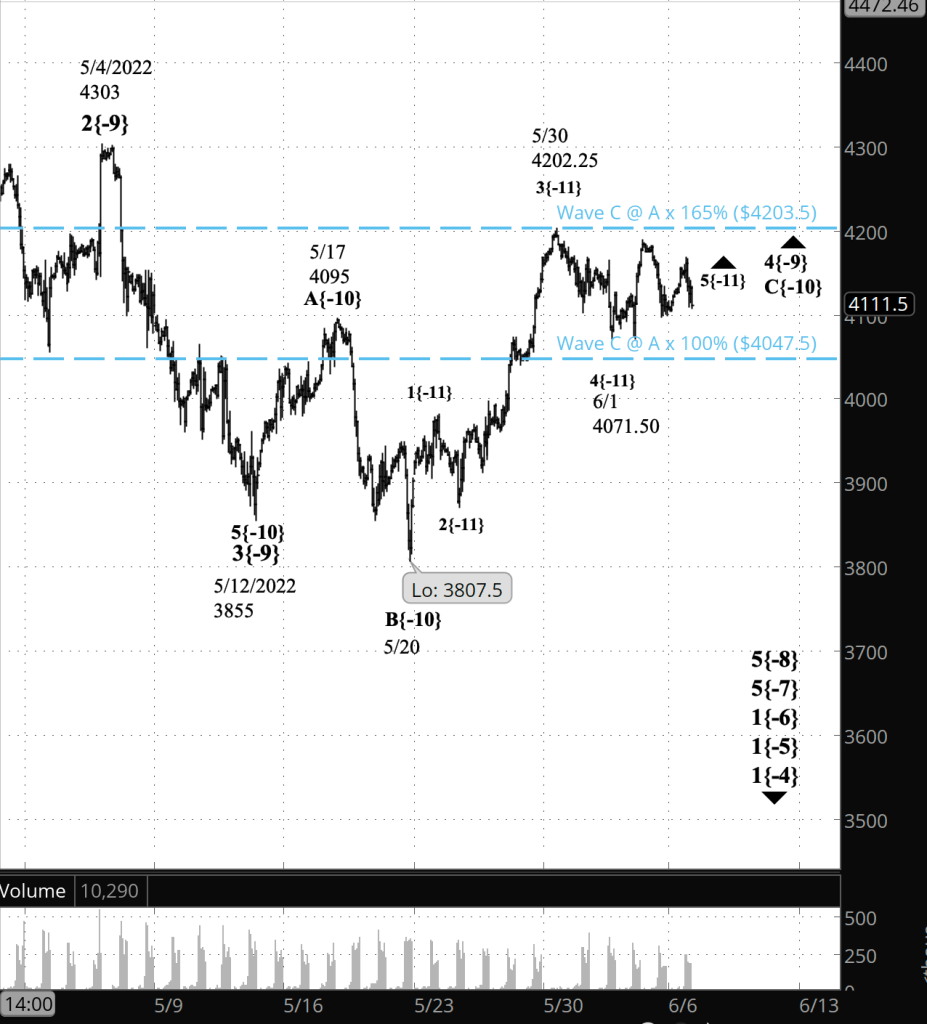
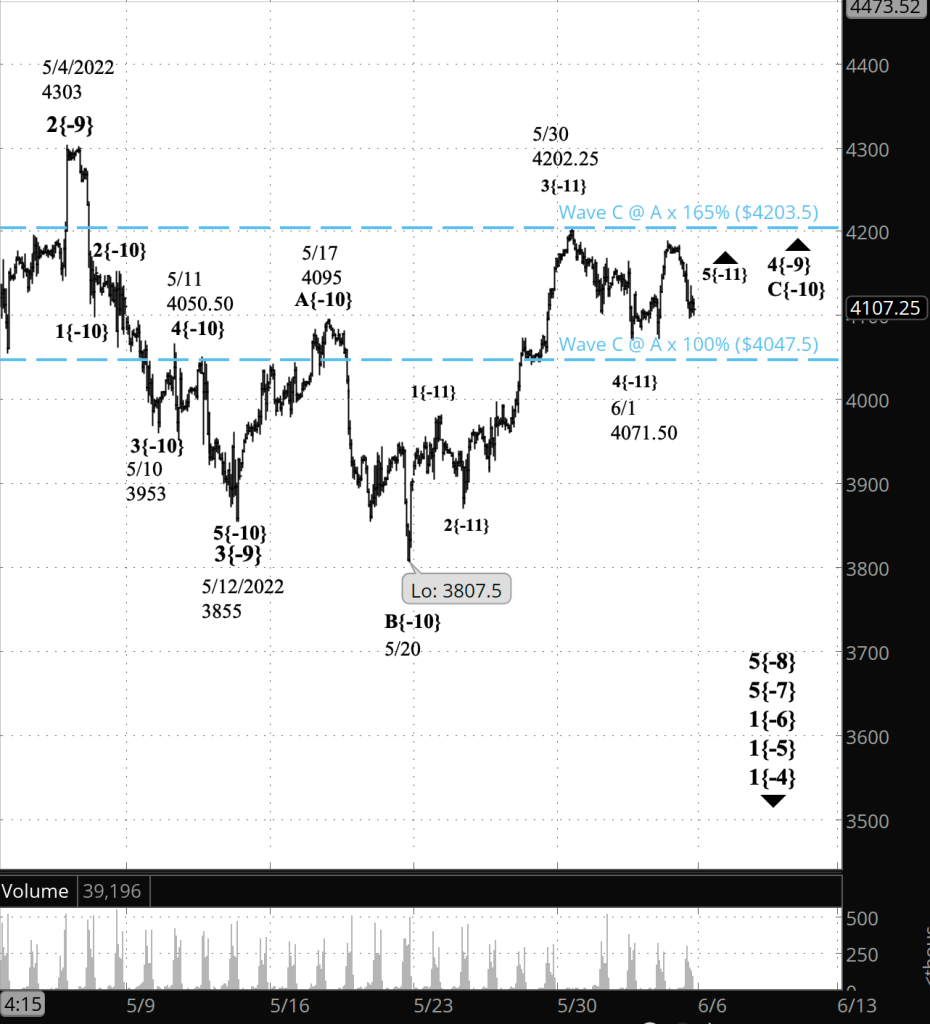
Half an hour before the closing bell. The S&P 500 has traded has within a small range during the session, the futures covering a bit more than 100 points between the low 3800s and the low 3700s. The price has stayed above yesterday’s low, 3708.50. No change in the analysis. I’ve updated the chart.

9:35 a.m. New York time

What’s happening now? The S&P 500 E-mini futures rose back into the high 3700s in overnight trading.

What does it mean? The rise was a low-level correction within the larger downtrend that began on May 30, within a series of downtrends of increasing size. See yesterday’s Trader’s Notebook for a description of the larger movements defining this market.

What are the alternatives? Any pause in the decline potentially marks the end of a segment within the larger downtrend and the beginning of an upward correction. See the Elliott wave theory section, below, for a discussion.
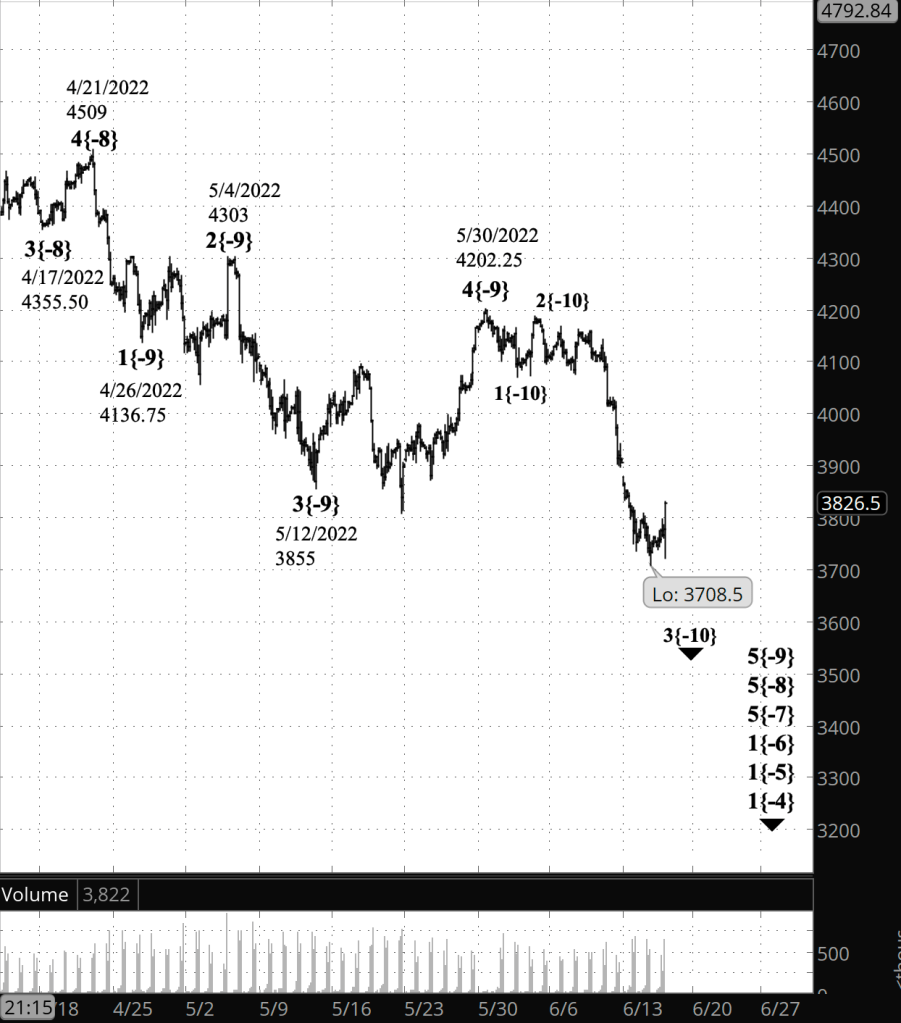
[S&P 500 E-mini futures at 3:30 p.m., 155-minute bars, with volume]

What does Elliott wave theory say? Wave 3{-10}, now underway, is the middle segment of wave 5{-9}, the downtrend that began on May 30 from 4202.25.

The power of the wave 3{-10} decline is such that the wave count internally has ambiguities. It’s possible that any pause, such as the one overnight, marks a transition to wave 4{-10}, an upward correction, and then perhaps a decline, wave 5{-10}, whose completion will mark the end of wave 4{-9}. I intend to retain the present analysis until there’s a clear sign that wave 4{-10} has begun.

The Federal Open Market Committee issues its money policy statement today at 2 p.m. New York time, which may create a disturbance on the chart. Nonetheless, the rules of Elliott wave analysis will remain in place, and the wave count will need to follow those rules in accounting for traders’ responses to the FOMC’s decisions.

We Are Here.

These are the waves currently in progress under my principal analysis. Each line on the list shows the wave number, with the subscript in curly brackets, the traditional degree name, the starting date, the starting price of the S&P 500 E-mini futures, and the direction of the wave.

  • S&P 500 Index:
  • 5{+3} Supercycle, 7/8/1932, 4.40 (up)
  • 5{+2} Cycle, 12/9/1974, 60.96 (up)
  • 5{+1} Primary, 3/6/2009, 666.79 (up)
  • 5{0} Intermediate, 12/26/2018, 2346.58 (up)
  • 4{-1} Minor, 1/4/2022 4818.62 (down)
  • 1{-2} Minute, 1/4/2022 4818.62 (down)
  • S&P 500 Futures and index:
  • 1{-3} Minuette, 1/4/2022, 4808.25 (down) (futures), 4818.62 (down) (index)
  • S&P 500 Futures:
  • 1{-4} Subminuette, 1/4/2022, 4808.25 (down)
  • 1{-5} Micro, 1/4/2022, 4808.25 (down)
  • 1{-6} Submicro, 1/4/2022, 4808.25 (down)
  • 5{-7} Minuscule, 3/29/2022, 4631 (down)
  • 5{-8} Subminuscule, 4/21/2022, 4509, (down)

Learning and other resources. Elliott wave analysis provides context, not prophecy. As the 20th century semanticist Alfred Korzybski put it in his book Science and Sanity (1933), “The map is not the territory … The only usefulness of a map depends on similarity of structure between the empirical world and the map.” And I would add, in the ever-changing markets, we can judge that similarity of structure only after the fact.

See the menu page Analytical Methods for a rundown on where to go for information on Elliott wave analysis.

By Tim Bovee, Portland, Oregon, June 15, 2022

Disclaimer

Tim Bovee, Private Trader tracks the analysis and trades of a private trader for his own accounts. Nothing in this blog constitutes a recommendation to buy or sell stocks, options or any other financial instrument. The only purpose of this blog is to provide education and entertainment.

No trader is ever 100 percent successful in his or her trades. Trading in the stock and option markets is risky and uncertain. Each trader must make trading decisions for his or her own account, and take responsibility for the consequences.

License
Creative Commons License

All content on Tim Bovee, Private Trader by Timothy K. Bovee is licensed under a Creative Commons Attribution-ShareAlike 4.0 International License.

Based on a work at www.timbovee.com.
Trader’s Notebook

3:30 p.m. New York time

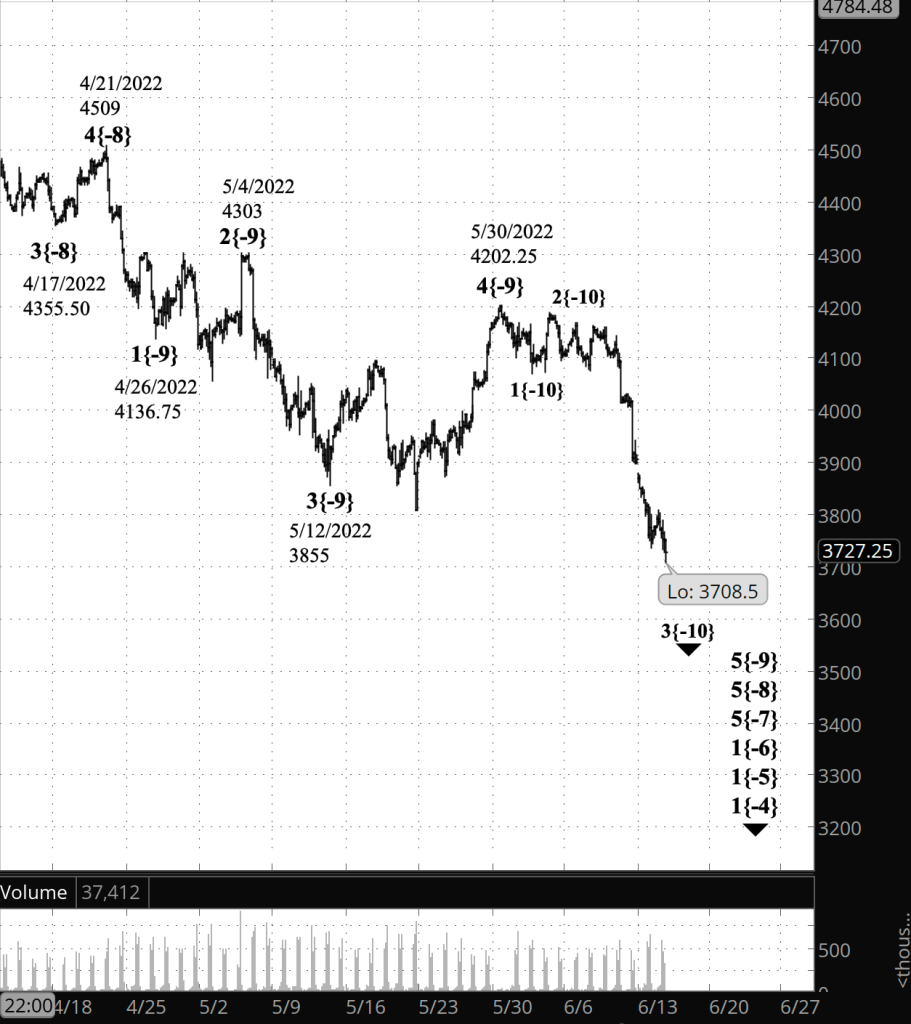
Half an hour before the closing bell. The S&P 500 continued to decline during the session, reaching the low 3700s. No change in the analysis. I’ve updated the upper (near-term) chart.

9:35 a.m. New York time

What’s happening now? The S&P 500 E-mini futures continued to decline in overnight trading, reaching the mid-3700s.

What does it mean? The middle segment within the last leg of a declined that began on April 21 is underway. That smaller, middle segment will be followed by an upward correction, and then a resumption of the downtrend that will end the larger last leg of the decline, also ending an even larger downtrend that began on January 4, which will be followed by a large upward correction, and then an even larger downtrend.

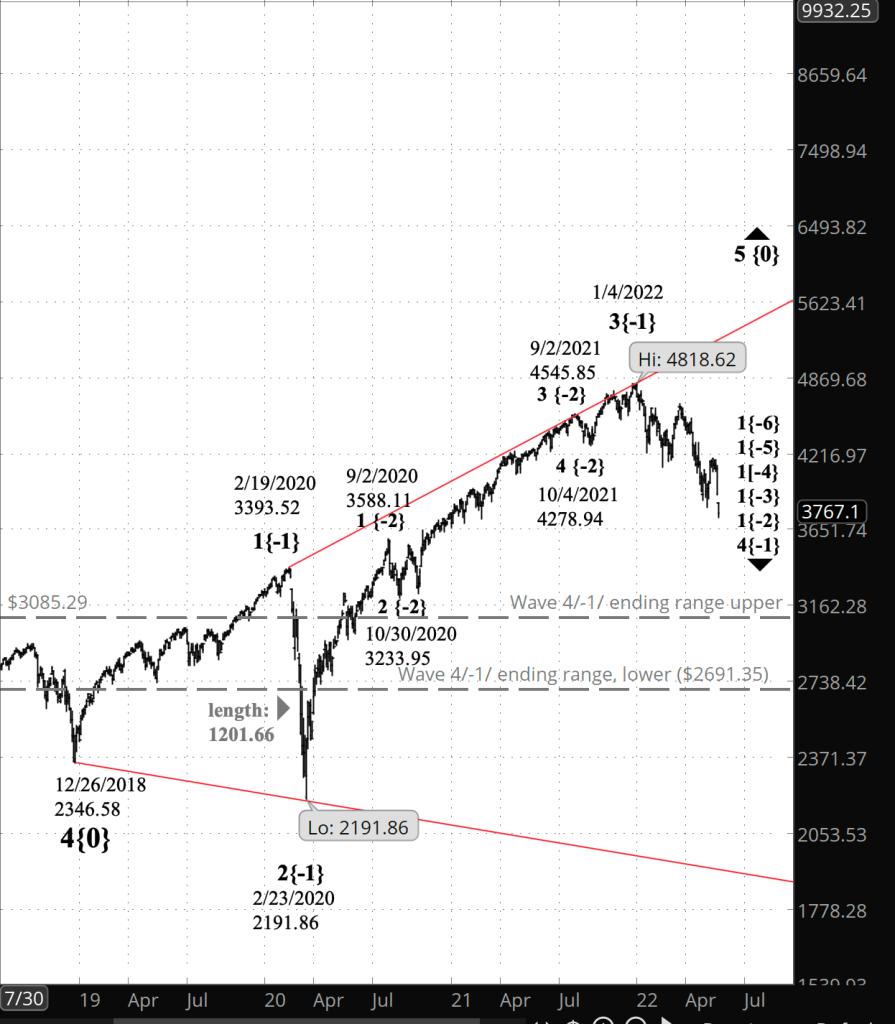
The decline underway since January 4 is still some distance away from its target ending range, 3085.29 to 2691.35. More on this in the Elliott wave section, below the charts.

What are the alternatives? I’ve adjusted sizes of the waves within the downtrend that began on May 30. As is often the case, where a wave fits in the hierarchy of waves is often ambiguous. Details

The Charts. The upper chart — the futures — focuses on the near term and shows the downtrend that began on April 21.

The lower chart — the index — focuses on the long term and shows the rise that began on December 26, 2018, and the the subsequent decline that began on January 4, 2022. The price target range of the present decline is marked by dashed lines on the lower chart.

[S&P 500 E-mini futures at 3:30 p.m., 150-minute bars, with volume]
[S&P 500 index at 9:32 a.m., 2-day bars]

What does Elliott wave theory say? Breaking with my usual practice, I’m going to describe the chart from the larger degrees down to the smaller.

Please refer to the lower chart for the first part of the discussion:

Everything we’ve experienced in the market from December 26, 2018 is within wave 5{0} — the Intermediate degree in the traditional nomenclature. That 5th wave has taken the form of an expanding Diagonal Triangle.

Within the triangle, wave 2{-1} was the early pandemic crash and ended on February 23, 2020. The ensuing rise was wave 3{-1}. It ended on January 4, 2022, the date that also marked the beginning of wave 4{-1}.

Under the rules of Elliott wave analysis, this 4th wave won’t move below the start of wave 1{-1}, 2346.589 on December 26, 2018, and will be longer than wave 2{-1}, which ended on December 23, 2020 at 2191.86, after a journey of 1,201.66 points on the index. Also, a 4th wave in an expanding triangle tends to retrace between 66% and 81% of the preceding 3rd wave.

So, this means that the present wave 4{-1}:

  1. likely will end between 3085.29 to 2691.35 (66% to 81% of wave 3{-1}),
  2. must end below 3616.34 (longer than wave 2{-1}),
  3. and won’t end below 2346.58 (not beyond the start of wave 1{-1}).

Please refer to the upper chart for the second part of the discussion:

Since March 29 wave 5{-7} to the downside has been underway. It contains within it three 5th waves that are underway: Wave 5{-8} began on April 21, and wave 5{-9}, on May 30 from 4202.25. When wave 5{-9} is complete, it will also be the end of 5{-8}, 5{-7} and the parent wave one degree higher, wave 1{-6}, which began on January 4.

Wave 1{-6} will be followed by a 2nd wave upward correction that will correct the decline from the January 1 high. Personally, I’ll be looking at that decline as an opportunity to get out of losing positions in anticipation of what will come afterward; that 2nd wave correction will be followed by wave 3{-6} to the downside, setting new lows within the downtrend that began on January 4.

How close is wave 5{-9} to completion? By my count it is now in its middle segment, wave 3{-10}, which will be followed by an upward correction, wave 4{-10}, and then a push further downward, wave 5{-10}, which will trigger completion of parent waves all the way up to wave 1{-6}.

My take-away from this is the certain knowledge that no trend moves in a single direction. A bear market isn’t the simplistic 20% decline metric used by the financial media. Each downtrend contains smaller downtrends and upward corrections, which in turn contain still smaller downtrends and upward corrections. And each correction includes trends and corrections of its own.

So, in Elliott wave terms, we’ve been in a bear market since January 4, and also since May 30, within a years-long bull market, wave 5{-0}, that is taking the form of an expanding Diagonal Triangle.

Bear markets aren’t as simple as the headlines would have us believe.

Regarding the subwaves of wave 5{-9}: I’ve moved the degree labels up one; what was labeled as wave 3{-11} within wave 1{-10} within wave 5{-9} is now labeled wave 3{-10} within wave 5{-9}, bumping the degree up by one.

We Are Here.

These are the waves currently in progress under my principal analysis. Each line on the list shows the wave number, with the subscript in curly brackets, the traditional degree name, the starting date, the starting price of the S&P 500 E-mini futures, and the direction of the wave.

  • S&P 500 Index:
  • 5{+3} Supercycle, 7/8/1932, 4.40 (up)
  • 5{+2} Cycle, 12/9/1974, 60.96 (up)
  • 5{+1} Primary, 3/6/2009, 666.79 (up)
  • 5{0} Intermediate, 12/26/2018, 2346.58 (up)
  • 4{-1} Minor, 1/4/2022 4818.62 (down)
  • 1{-2} Minute, 1/4/2022 4818.62 (down)
  • S&P 500 Futures and index:
  • 1{-3} Minuette, 1/4/2022, 4808.25 (down) (futures), 4818.62 (down) (index)
  • S&P 500 Futures:
  • 1{-4} Subminuette, 1/4/2022, 4808.25 (down)
  • 1{-5} Micro, 1/4/2022, 4808.25 (down)
  • 1{-6} Submicro, 1/4/2022, 4808.25 (down)
  • 5{-7} Minuscule, 3/29/2022, 4631 (down)
  • 5{-8} Subminuscule, 4/21/2022, 4509, (down)

Learning and other resources. Elliott wave analysis provides context, not prophecy. As the 20th century semanticist Alfred Korzybski put it in his book Science and Sanity (1933), “The map is not the territory … The only usefulness of a map depends on similarity of structure between the empirical world and the map.” And I would add, in the ever-changing markets, we can judge that similarity of structure only after the fact.

See the menu page Analytical Methods for a rundown on where to go for information on Elliott wave analysis.

By Tim Bovee, Portland, Oregon, June 14, 2022

Disclaimer

Tim Bovee, Private Trader tracks the analysis and trades of a private trader for his own accounts. Nothing in this blog constitutes a recommendation to buy or sell stocks, options or any other financial instrument. The only purpose of this blog is to provide education and entertainment.

No trader is ever 100 percent successful in his or her trades. Trading in the stock and option markets is risky and uncertain. Each trader must make trading decisions for his or her own account, and take responsibility for the consequences.

License
Creative Commons License

All content on Tim Bovee, Private Trader by Timothy K. Bovee is licensed under a Creative Commons Attribution-ShareAlike 4.0 International License.

Based on a work at www.timbovee.com.
Trader’s Notebook

3:36 p.m. New York time

Less than half an hour before the closing bell. Always embarrassing for a post to be outdated within six minutes. The downtrend that began on June 6 continues. Wave 3{-12} within wave 3{-11} within wave 1{-10} within wave 5{-9} is the location.

3:30 p.m. New York time

Half an hour before the closing bell. The decline that began on June 6 continued during the session, reversing from a low of 3750.50 in a small upward correction that is still underway. The small correction is wave 4{-12} within wave 3{-11} within wave 1{-10} within wave 5{-9}. No change in the analysis. I’ve updated the chart.

9:35 a.m. New York time

What’s happening now? The S&P 500 E-mini futures gapped below Friday’s close when trading resumed overnight. The decline continued, with the price reaching levels not seen since early last year.

What does it mean? The first leg of the decline that began on May 30 continues. Internally, that initial portion of the downtrend is in its middle, most energetic phase. The initial portion of the downtrend will be followed by its first internal correction, an upward move that will remain below 4202.25, the beginning of the downtrend. The first correction in a downtrend often takes back enough of the preceding decline to persuade traders that the bull market has returned, multiplying the shock when the downtrend resumes, as it will.

What are the alternatives? None at this point. The chart shows a straightforward downtrend.

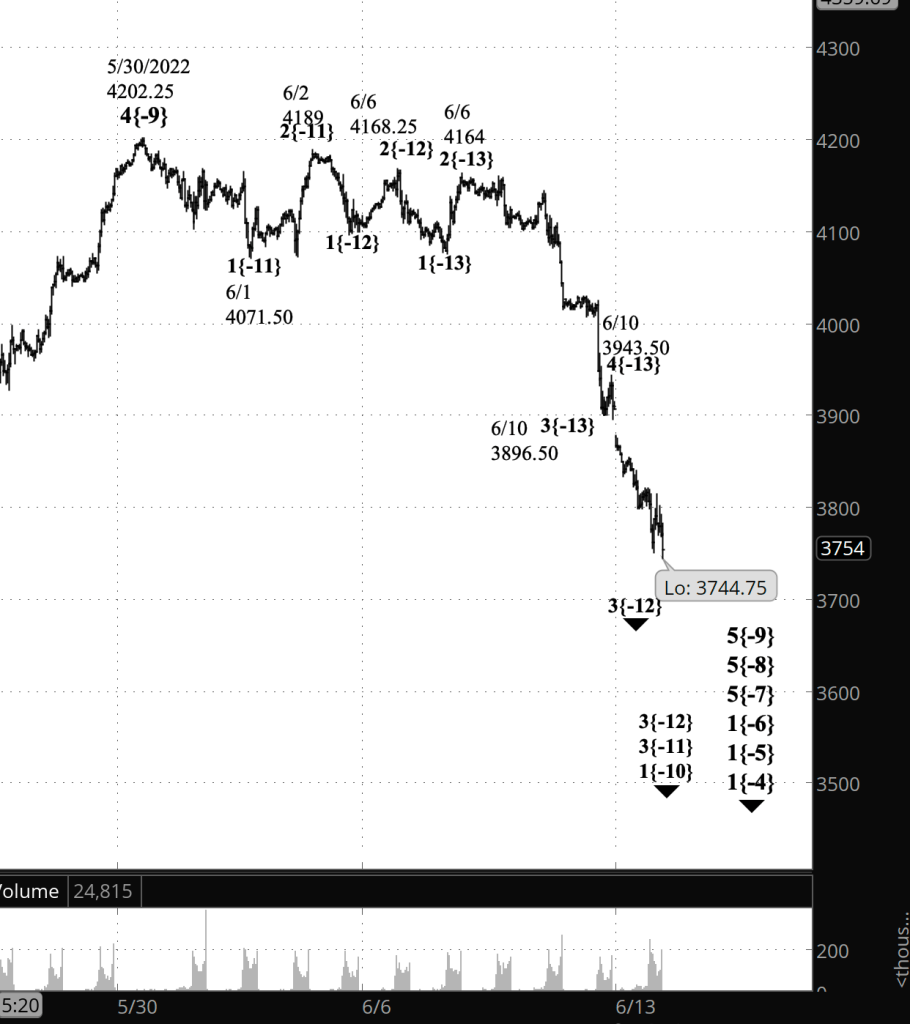
The Chart. I’ve moved in for a close-up view to better understand where we stand within the initial phase of the downtrend. For a broader view of the futures, see Friday’s Trader’s Notebook, and for a still broader view, of the index, see Thursday’s edition.

[S&P 500 E-mini futures at 3:36 p.m., 40-minute bars, with volume]

What does Elliott wave theory say? The downtrend that began May 30 is wave 4{-9}, starting from 4202.25. Internally, it is subdividing in the normal fashion, a series of ever smaller downtrends and correction that illustrate the fractal structure of the market’s movements.

Within wave 4{-9}, wave 1{-10} is underway. The present decline, which began June 10 from 3943.50, is three levels smaller, wave 5{-13}, within wave 3{-12}, which began June 6 from 4861.25, within wave 3{-11}, which began June 2 from 4189.

Third waves are almost always the most energetic, the most dramatic, of all of the waves in a trend, with 5th waves often coming in next. What we see here is a 5th wave set within two 3rd wave, each of higher degree, which explains the energy of the overnight decline.

Wave 1{-9} will be followed by an upward correction, wave 2{-9}, and then by the main event: A dramatic resumption of the downtrend as wave 3{-9} begins.

This is all happening within wave 5{-8}, a larger downtrend that began on April 21 from 4509.

We Are Here.

These are the waves currently in progress under my principal analysis. Each line on the list shows the wave number, with the subscript in curly brackets, the traditional degree name, the starting date, the starting price of the S&P 500 E-mini futures, and the direction of the wave.

  • S&P 500 Index:
  • 5{+3} Supercycle, 7/8/1932, 4.40 (up)
  • 5{+2} Cycle, 12/9/1974, 60.96 (up)
  • 5{+1} Primary, 3/6/2009, 666.79 (up)
  • 5{0} Intermediate, 12/26/2018, 2346.58 (up)
  • 4{-1} Minor, 1/4/2022 4818.62 (down)
  • 1{-2} Minute, 1/4/2022 4818.62 (down)
  • S&P 500 Futures and index:
  • 1{-3} Minuette, 1/4/2022, 4808.25 (down) (futures), 4818.62 (down) (index)
  • S&P 500 Futures:
  • 1{-4} Subminuette, 1/4/2022, 4808.25 (down)
  • 1{-5} Micro, 1/4/2022, 4808.25 (down)
  • 1{-6} Submicro, 1/4/2022, 4808.25 (down)
  • 5{-7} Minuscule, 3/29/2022, 4631 (down)
  • 5{-8} Subminuscule, 4/21/2022, 4509, (down)

Learning and other resources. Elliott wave analysis provides context, not prophecy. As the 20th century semanticist Alfred Korzybski put it in his book Science and Sanity (1933), “The map is not the territory … The only usefulness of a map depends on similarity of structure between the empirical world and the map.” And I would add, in the ever-changing markets, we can judge that similarity of structure only after the fact.

See the menu page Analytical Methods for a rundown on where to go for information on Elliott wave analysis.

By Tim Bovee, Portland, Oregon, June 13, 2022

Disclaimer

Tim Bovee, Private Trader tracks the analysis and trades of a private trader for his own accounts. Nothing in this blog constitutes a recommendation to buy or sell stocks, options or any other financial instrument. The only purpose of this blog is to provide education and entertainment.

No trader is ever 100 percent successful in his or her trades. Trading in the stock and option markets is risky and uncertain. Each trader must make trading decisions for his or her own account, and take responsibility for the consequences.

License
Creative Commons License

All content on Tim Bovee, Private Trader by Timothy K. Bovee is licensed under a Creative Commons Attribution-ShareAlike 4.0 International License.

Based on a work at www.timbovee.com.
Trader’s Notebook

12:30 p.m. New York time

Half an hour before the closing bell. The S&P 500 declined during the first half of the session, reaching a low of 3900 on the futures and then rising slightly. Altogether, wave 5{-9}, which began on May 30 from 4202.25, has fallen by 7.2%. It is still in the early stages of its progress. No change in the analysis. I’ve updated the chart.

9:35 a.m. New York time

What’s happening now? The S&P 500 E-mini futures dropped sharply in overnight trading, reaching into the 3930s shortly after the opening bell.

What does it mean? By dropping below the high of May 23 — 3980.50 — the price indicated that the downtrend that began on April 21 has resumed. The upward corrected that preceded it ended on May 30 at 4202.25.

What are the alternatives? None at this point, but I’m quite certain that alternatives will develop, as they always do.

[S&P 500 E-mini futures at 3:30 p.m.,140-minute bars, with volume]

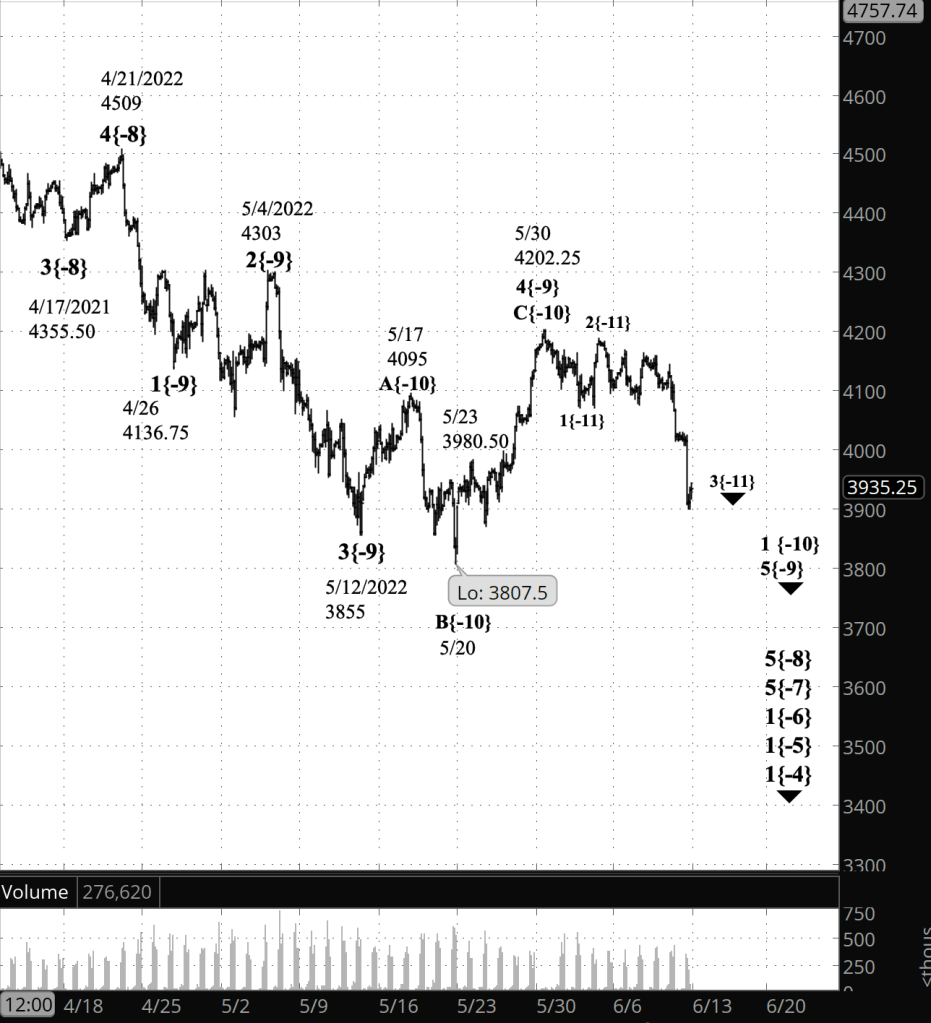
What does Elliott wave theory say? The 3980.50 peak was the end of 1{-12} under the prior analysis. If a 4th wave moves beyond the end of the preceding 1st wave — “beyond” means lower in this case — then it’s not a 4th wave, the map no longer matches the territory, and it’s a recount is required. And that’s what I’ve done.

See yesterday’s Trader’s Notebook for a chart showing the previous analysis.

Under the new principal analysis, the May 30 peak, 4202.25, marked the end the of wave 4{-9}, an upward correction, and the beginning of wave 5{-9}, the final wave in downtrend, wave 5{-8}, that began on April 21 from 4509.

The decline from May 30 is wave 1{-10} within wave 5{-9}. Internally, wave 1{-10} is now in its 3rd wave, which is often the most energetic of the waves in a trend.

Wave 1{-10} will be followed by an upward 2nd wave correction that will remain below the 4202.25 peak of May 30. Wave 2{-10} will be followed by an energetic wave 3{-10}, which will carry the price significantly lower.

We Are Here.

These are the waves currently in progress under my principal analysis. Each line on the list shows the wave number, with the subscript in curly brackets, the traditional degree name, the starting date, the starting price of the S&P 500 E-mini futures, and the direction of the wave.

  • S&P 500 Index:
  • 5{+3} Supercycle, 7/8/1932, 4.40 (up)
  • 5{+2} Cycle, 12/9/1974, 60.96 (up)
  • 5{+1} Primary, 3/6/2009, 666.79 (up)
  • 5{0} Intermediate, 12/26/2018, 2346.58 (up)
  • 4{-1} Minor, 1/4/2022 4818.62 (down)
  • 1{-2} Minute, 1/4/2022 4818.62 (down)
  • S&P 500 Futures and index:
  • 1{-3} Minuette, 1/4/2022, 4808.25 (down) (futures), 4818.62 (down) (index)
  • S&P 500 Futures:
  • 1{-4} Subminuette, 1/4/2022, 4808.25 (down)
  • 1{-5} Micro, 1/4/2022, 4808.25 (down)
  • 1{-6} Submicro, 1/4/2022, 4808.25 (down)
  • 5{-7} Minuscule, 3/29/2022, 4631 (down)
  • 5{-8} Subminuscule, 4/21/2022, 4509, (down)

Learning and other resources. Elliott wave analysis provides context, not prophecy. As the 20th century semanticist Alfred Korzybski put it in his book Science and Sanity (1933), “The map is not the territory … The only usefulness of a map depends on similarity of structure between the empirical world and the map.” And I would add, in the ever-changing markets, we can judge that similarity of structure only after the fact.

See the menu page Analytical Methods for a rundown on where to go for information on Elliott wave analysis.

By Tim Bovee, Portland, Oregon, June 10, 2022

Disclaimer

Tim Bovee, Private Trader tracks the analysis and trades of a private trader for his own accounts. Nothing in this blog constitutes a recommendation to buy or sell stocks, options or any other financial instrument. The only purpose of this blog is to provide education and entertainment.

No trader is ever 100 percent successful in his or her trades. Trading in the stock and option markets is risky and uncertain. Each trader must make trading decisions for his or her own account, and take responsibility for the consequences.

License
Creative Commons License

All content on Tim Bovee, Private Trader by Timothy K. Bovee is licensed under a Creative Commons Attribution-ShareAlike 4.0 International License.

Based on a work at www.timbovee.com.
Trader’s Notebook

3:30 p.m. New York time

Half an hour before the closing bell. The S&P 500 fell during the session, coming close to 4050 on the futures. No change in the analysis. I’ve updated the upper chart.

9:35 a.m. New York time

What’s happening now? The S&P 500 E-mini futures stair-stepped lower in overnight trading.

What does it mean? The final segment of a low-level downward corrective pattern that began on May 30 is nearing its end. It will be followed by a rise that will complete the larger upward correction that began on May 12.

What are the alternatives? if the low-level correction forms a compound structure, then the first corrective pattern will be connected to a second corrective pattern and perhaps a third.

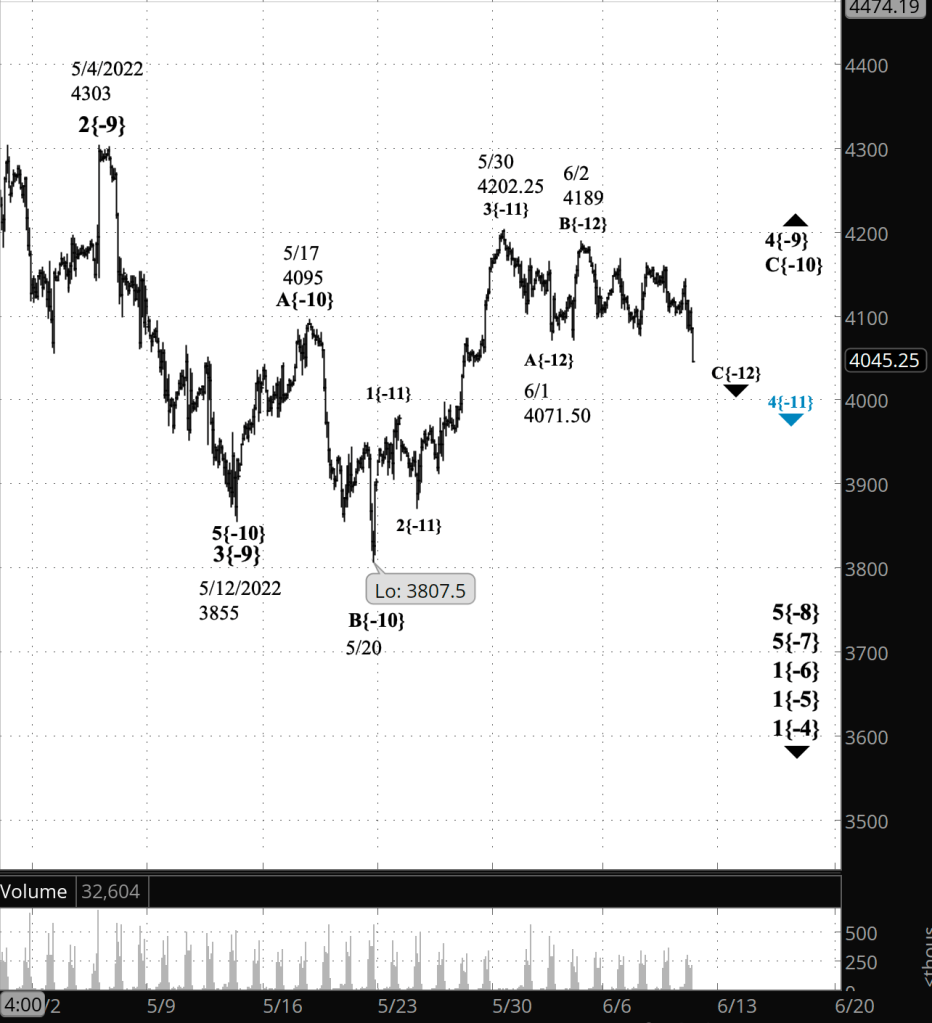
Charts. The upper chart shows the near-term S&P 500 E-mini futures, from early May. The lower chart shows the long term S&P 500 index, from December 2018..

[S&P 500 E-mini futures at 3:30 p.m., 90-minute bars, with volume]
[S&P 500 index at 9:33 a.m., 2-day bars]

What does Elliott wave theory say? There are two corrections of different degrees on the chart.

The lower-degree downward correction, wave 4{-11}, began May 30. Internally, it is the 5th and final wave of its third wave, C{-12}. When wave C{-12} is complete, in the normal course of things that wold be the end of wave 4{-11}. Wave 5{-11} would then carry the price higher. That’s the principal analysis.

Under the alternative analysis, wave 4{-11} will form a compounds structure. Wave C{-12} is followed by a connector, wave X{-12}, and then by a second corrective pattern. Such compound correction can contain up to three patterns. Once wave 4{-11} is complete, then wave 5{-11} will begin its rise.

The higher-degree upward correction is wave 4{-9}, which began on May 12 and is now in its 3rd wave internally, wave C{-10}, which began on May 20. Wave C{-10} will have five waves internally. Wave 4{-11}, the lower degree correction, is the next-to-the-last wave within C{-10}.

The end of wave C{-10} would normally be the the end of wave 4{-9}, but there’s the possibility here, at the higher degree, that wave 4{-9} will form a compound structure. If 4{-9} is a simple correction, wave 5{-9} will follow, carrying the price to significantly lower level. If it’s a simple correction, then wave C{-10} will be followed by a connecting wave, X{-10}, and then another corrective pattern and perhaps a third. After all of that, wave 5{-9} will begin its fall.

Move a degree higher, and things get simple. A downtrend of major proportions began on January 4, ending wave 3{-1}, the rise that began on February 23, 2020, the end of the early pandemic crash. What followed is wave 4{-1} to the downside — it’s still underway — and working up from one step above the future wave 5{-9}, we’re in wave 5{-8}, which began on April 21, within wave 5{-7}, from March 29, and within five increasingly larger waves that began on January 4, waves 1{-6}, 1{-5}, 1{-4}, 1{-3} and 1{2}.

Bottom line: There’s a lot of downside ahead of us in this chart. But as is always the case in the markets, a downtrend is built from smaller uptrends and downtrends, which in turn are built in the same way, at smaller and smaller levels. There will be ways to trade and profit along the way.

Market charts and their wave structures are visual representations of decisions made by millions of traders, and in that respect they are maps of human thought. I find the Elliott wave patterns to be an elegant structure, a thing of profound beauty.

We Are Here.

These are the waves currently in progress under my principal analysis. Each line on the list shows the wave number, with the subscript in curly brackets, the traditional degree name, the starting date, the starting price of the S&P 500 E-mini futures, and the direction of the wave.

  • S&P 500 Index:
  • 5{+3} Supercycle, 7/8/1932, 4.40 (up)
  • 5{+2} Cycle, 12/9/1974, 60.96 (up)
  • 5{+1} Primary, 3/6/2009, 666.79 (up)
  • 5{0} Intermediate, 12/26/2018, 2346.58 (up)
  • 4{-1} Minor, 1/4/2022 4818.62 (down)
  • 1{-2} Minute, 1/4/2022 4818.62 (down)
  • S&P 500 Futures and index:
  • 1{-3} Minuette, 1/4/2022, 4808.25 (down) (futures), 4818.62 (down) (index)
  • S&P 500 Futures:
  • 1{-4} Subminuette, 1/4/2022, 4808.25 (down)
  • 1{-5} Micro, 1/4/2022, 4808.25 (down)
  • 1{-6} Submicro, 1/4/2022, 4808.25 (down)
  • 5{-7} Minuscule, 3/29/2022, 4631 (down)
  • 5{-8} Subminuscule, 4/21/2022, 4509, (down)

Learning and other resources. Elliott wave analysis provides context, not prophecy. As the 20th century semanticist Alfred Korzybski put it in his book Science and Sanity (1933), “The map is not the territory … The only usefulness of a map depends on similarity of structure between the empirical world and the map.” And I would add, in the ever-changing markets, we can judge that similarity of structure only after the fact.

See the menu page Analytical Methods for a rundown on where to go for information on Elliott wave analysis.

By Tim Bovee, Portland, Oregon, June 9, 2022

Disclaimer

Tim Bovee, Private Trader tracks the analysis and trades of a private trader for his own accounts. Nothing in this blog constitutes a recommendation to buy or sell stocks, options or any other financial instrument. The only purpose of this blog is to provide education and entertainment.

No trader is ever 100 percent successful in his or her trades. Trading in the stock and option markets is risky and uncertain. Each trader must make trading decisions for his or her own account, and take responsibility for the consequences.

License
Creative Commons License

All content on Tim Bovee, Private Trader by Timothy K. Bovee is licensed under a Creative Commons Attribution-ShareAlike 4.0 International License.

Based on a work at www.timbovee.com.
Trader’s Notebook

3:30 p.m. New York time

Half an hour before the closing bell. The S&P 500 continued to fall during the session. Wave C{-12} within wave 4{-11} is still underway and internally is in its 5th and final wave. No change in the analysis. The chart has been updated.

1:25 p.m. New York time

OLLI bearish earnings play exit. The delayed earnings announcement by OLLI finally happened this morning. The metrics all pointed to a very negative earnings surprise, OLLI came through with lagging numbers for both earnings and revenue, and the price rose like a 4th of July fireworks rocket. I exited at 100% of maximum potential loss and have updated the trade analysis with details of the sad tale.

9:35 a.m. New York time

What’s happening now? The S&P 500 E-mini futures, in overnight trading, declined slightly from yesterday’s high, 4164.

What does it mean? The decline is the beginning of the final leg of the third segment of a corrective pattern that began on May 30. It will be followed by a resumption of the downtrend that began on April 21.

What are the alternatives? Corrections occasionally will form complex structures, linking two or three corrective patterns together. If this corrective pattern behaves that way, then the resumption of the downtrend will be delayed.

[S&P 500 E-mini futures at 3:30 p.m., 80-minute bars, with volume]

What does Elliott wave theory say? The decline that began on June 2 from 4189 is wave C{-12}, the third wave within a corrective pattern that began on May 30 from 4202.25. With the decline that began from yesterday’s peak, the C wave is now in its 5th and final subwave.

Under my principal analysis, the end of wave C{-12} will also be the end of its parent, wave 4{-9}, an upward correction that began on May 30.

Under my alternative analysis, wave 4{-9} will form a compound correction. In this scenario, wave C{-12} will be followed by a connecting wave, X{-12}, and then by a second corrective pattern, continuing wave 4{-9}.

In any case, once wave 4{-9} is complete, it will be followed by a significant decline, wave 5{-9}, which is likely to drop below the end of the previous downtrending wave, 3{-9}, which was completed on May 12 at 3855. Some 5th waves come up short. And some 5th waves move significantly below the end of wave 5{-9}.

This is all happening within wave 5{-8}, a downtrend that began on April 21 from 4509. The end of wave 5{-9} will also be the end of wave 5{-8} and also of its parent, wave 5{-7}, which began on March 29 from 4631.

It’s a clear illustration of the fractal structure of market movements, with waves within waves that form a quite complex whole.

We Are Here.

These are the waves currently in progress under my principal analysis. Each line on the list shows the wave number, with the subscript in curly brackets, the traditional degree name, the starting date, the starting price of the S&P 500 E-mini futures, and the direction of the wave.

  • S&P 500 Index:
  • 5{+3} Supercycle, 7/8/1932, 4.40 (up)
  • 5{+2} Cycle, 12/9/1974, 60.96 (up)
  • 5{+1} Primary, 3/6/2009, 666.79 (up)
  • 5{0} Intermediate, 12/26/2018, 2346.58 (up)
  • 4{-1} Minor, 1/4/2022 4818.62 (down)
  • 1{-2} Minute, 1/4/2022 4818.62 (down)
  • S&P 500 Futures and index:
  • 1{-3} Minuette, 1/4/2022, 4808.25 (down) (futures), 4818.62 (down) (index)
  • S&P 500 Futures:
  • 1{-4} Subminuette, 1/4/2022, 4808.25 (down)
  • 1{-5} Micro, 1/4/2022, 4808.25 (down)
  • 1{-6} Submicro, 1/4/2022, 4808.25 (down)
  • 5{-7} Minuscule, 3/29/2022, 4631 (down)
  • 5{-8} Subminuscule, 4/21/2022, 4509, (down)

Learning and other resources. Elliott wave analysis provides context, not prophecy. As the 20th century semanticist Alfred Korzybski put it in his book Science and Sanity (1933), “The map is not the territory … The only usefulness of a map depends on similarity of structure between the empirical world and the map.” And I would add, in the ever-changing markets, we can judge that similarity of structure only after the fact.

See the menu page Analytical Methods for a rundown on where to go for information on Elliott wave analysis.

By Tim Bovee, Portland, Oregon, June 8, 2022

Disclaimer

Tim Bovee, Private Trader tracks the analysis and trades of a private trader for his own accounts. Nothing in this blog constitutes a recommendation to buy or sell stocks, options or any other financial instrument. The only purpose of this blog is to provide education and entertainment.

No trader is ever 100 percent successful in his or her trades. Trading in the stock and option markets is risky and uncertain. Each trader must make trading decisions for his or her own account, and take responsibility for the consequences.

License
Creative Commons License

All content on Tim Bovee, Private Trader by Timothy K. Bovee is licensed under a Creative Commons Attribution-ShareAlike 4.0 International License.

Based on a work at www.timbovee.com.
Trader’s Notebook

3:30 p.m. New York time

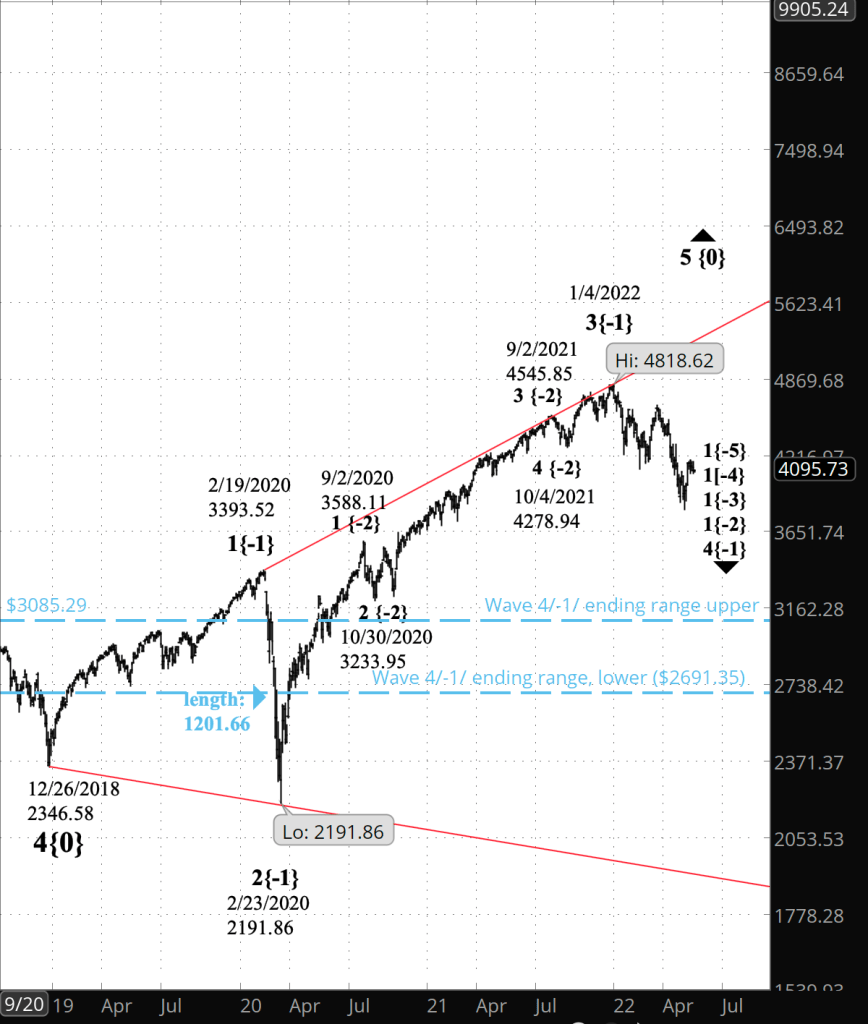
Half an hour before the closing bell. The S&P 500 declined during the session, reaching a low of 4076 on the futures, and then reversed upward. Wave C{-12} to the downside is still underway. The C wave can be expected to have five waves internally, whether the parent, wave 4{-11}, a downward correction, takes the form of a Flat or a Zigzag. So far wave C has completed three waves internally and today’s upward movement means that it is now in its 4th internal wave.

I’ve updated the chart.

9:35 a.m. New York time

What’s happening now? The S&P 500 E-mini futures fell in overnight trading, returning to the upper 4000s.

What does it mean? The depth of the decline strengthens the case that a downward correction, which began on May 30, is still underway, promoting the alternative analysis in yesterday’s Trader’s Notebook to the principal analysis. Further decline will confirm this scenario.

What is the alternative? The downward correction from May 30 ended on June 1 and a the uptrend that began on May 20 has resumed. A reversal to the upside will confirm this scenario.

Chart. Both the principal and the alternative analyses describe low-level movements within a larger upward correction that began on May 12. The price target range for that larger upward correction is 4047.50 to 4203.50, marked on the chart with blue dashed lines.

[S&P 500 E-mini futures at 3:30 p.m., 80-minute bars, with volume]

What does Elliott wave theory say? Under the principal analysis, the overnight decline is wave C{-12} within an upward correction, wave 4{-11}. Under the alternative analysis, the decline is part of uptrending wave 5{-11}.

Both scenarios are part of wave C{-10}, the final wave of a pattern within an upward correction, wave 4{-9}. This is all happening within wave 5{-8}, a downtrend that began on April 21 that is a wave of lower degree within a series of downtrends of increasingly higher degree, up to wave 4{-1}, which began on January 4.

We Are Here.

These are the waves currently in progress under my principal analysis. Each line on the list shows the wave number, with the subscript in curly brackets, the traditional degree name, the starting date, the starting price of the S&P 500 E-mini futures, and the direction of the wave.

  • S&P 500 Index:
  • 5{+3} Supercycle, 7/8/1932, 4.40 (up)
  • 5{+2} Cycle, 12/9/1974, 60.96 (up)
  • 5{+1} Primary, 3/6/2009, 666.79 (up)
  • 5{0} Intermediate, 12/26/2018, 2346.58 (up)
  • 4{-1} Minor, 1/4/2022 4818.62 (down)
  • 1{-2} Minute, 1/4/2022 4818.62 (down)
  • S&P 500 Futures and index:
  • 1{-3} Minuette, 1/4/2022, 4808.25 (down) (futures), 4818.62 (down) (index)
  • S&P 500 Futures:
  • 1{-4} Subminuette, 1/4/2022, 4808.25 (down)
  • 1{-5} Micro, 1/4/2022, 4808.25 (down)
  • 1{-6} Submicro, 1/4/2022, 4808.25 (down)
  • 5{-7} Minuscule, 3/29/2022, 4631 (down)
  • 5{-8} Subminuscule, 4/21/2022, 4509, (down)

Learning and other resources. Elliott wave analysis provides context, not prophecy. As the 20th century semanticist Alfred Korzybski put it in his book Science and Sanity (1933), “The map is not the territory … The only usefulness of a map depends on similarity of structure between the empirical world and the map.” And I would add, in the ever-changing markets, we can judge that similarity of structure only after the fact.

See the menu page Analytical Methods for a rundown on where to go for information on Elliott wave analysis.

By Tim Bovee, Portland, Oregon, June 7, 2022

Disclaimer

Tim Bovee, Private Trader tracks the analysis and trades of a private trader for his own accounts. Nothing in this blog constitutes a recommendation to buy or sell stocks, options or any other financial instrument. The only purpose of this blog is to provide education and entertainment.

No trader is ever 100 percent successful in his or her trades. Trading in the stock and option markets is risky and uncertain. Each trader must make trading decisions for his or her own account, and take responsibility for the consequences.

License
Creative Commons License

All content on Tim Bovee, Private Trader by Timothy K. Bovee is licensed under a Creative Commons Attribution-ShareAlike 4.0 International License.

Based on a work at www.timbovee.com.
Bitcoin Analysis

10:50 a.m. New York time

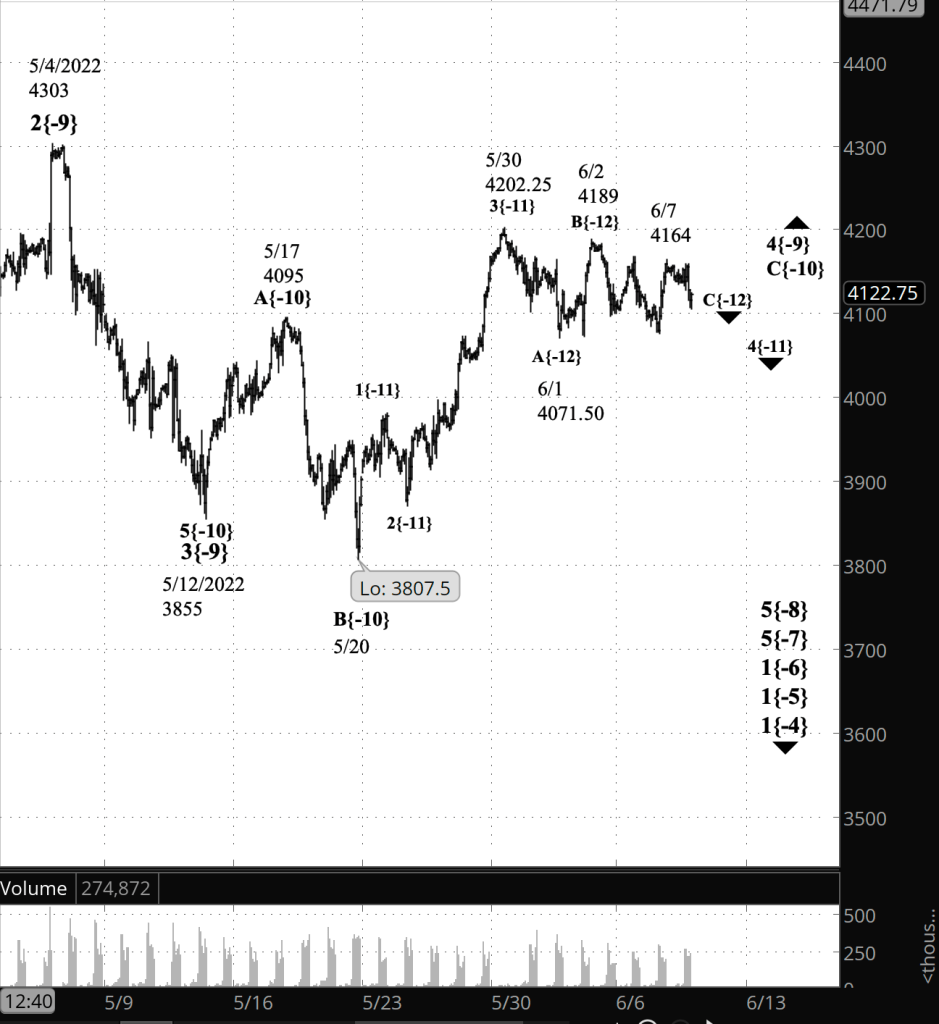
What’s happening now? Bitcoin futures continue to trade in a narrow range, as has been the case since May 12.

What does it mean? The sideways pattern is an upward correction, the next-to-the-last segment of a downtrend that began on March 28.

What’s the alternative? There’s some ambiguity in the chart, and the sideways pattern could be a degree smaller, the next-to-the-last segment of a downtrend that began on April 21.

[Bitcoin futures at 10:50 a.m., daily bars]

What does Elliott wave theory say? Under my principal analysis, the sideways pattern is an upward correction, wave 4{-4}, within downtrending wave 3{-3} within downtrending wave C{-2}. The C wave is the third and probably final wave within a large downtrending correction, wave 4{-1}, which began on April 14, 2021.

Under my alternative analysis, the sideways pattern is uptrending wave 4{-5} within a series of downtrending waves, each of greater degree: Wave 3{-4} within wave 3{-3} within wave C{-2}. As is the case with the principal analysis, the alternative is within wave 4{-1}.

Wave 4{-1} is the next-to-the-last wave are playing out within a very a large uptrend, wave 5{0}, which began on December 14, 2018.

So, for the near term, wave 4{-1} is in its last leg, and when that’s done, will have reached its end. It will be followed by wave 5{-1}, an uptrending wave. Fifth waves have a lot of variety. They can extend and cover a surprisingly large distance. They can be truncated and reach their end with unexpected rapidity. There’s no way to know for sure how it will play out.

For the longer term, the end of wave 5{-1} will also be the end of wave 5{0}, which is six months away from completing its the fourth year of its rise. It will be followed by an equally massive downtrend.

Bottom line: Wave 4{-1} has lasted for more than a year, and I would anticipate that uptrending wave 5{-1} could be of equal or greater length. That’s an expectation, not a certainty. However, the end of wave 5{-1} will mark the beginning of a downtrend, wave 5{0}. Bitcoin is too new to know what wave the degree above {0} is in. For convenience call it wave 1{+1}. The decline after the end of 5{0} would, in that case, be wave A{0} of wave 2{+1}. Second waves tend to retrace a large amount of the preceding 1st wave. We don’t know when the 1st wave began, but the low point on the futures is 3,120, the end of wave 4{0}. So we can certainly expect wave 2{+1} to move below that level, several years from now.

We Are Here.

These are the waves currently in progress under my principal analysis. Each line on the list shows the wave number, with the subscript in curly brackets, the traditional degree name, the starting date, the starting price of the S&P 500 E-mini futures, and the direction of the wave.

  • Futures:
  • 5{0} Intermediate, 12/14/2018, 3,120 (up)
  • 4{-1} Minor, 4/14/2021, 65,520 (down)
  • C{-2} Minute, 11/10/2021, 69,355 (down)
  • 3{-3} Minuette, 3/28/2022, 46,550 (down)

Learning and other resources. Elliott wave analysis provides context, not prophecy. As the 20th century semanticist Alfred Korzybski put it in his book Science and Sanity (1933), “The map is not the territory … The only usefulness of a map depends on similarity of structure between the empirical world and the map.” And I would add, in the ever-changing markets, we can judge that similarity of structure only after the fact.

See the menu page Analytical Methods for a rundown on where to go for information on Elliott wave analysis.

By Tim Bovee, Portland, Oregon, June 6, 2022

Disclaimer

Tim Bovee, Private Trader tracks the analysis and trades of a private trader for his own accounts. Nothing in this blog constitutes a recommendation to buy or sell stocks, options or any other financial instrument. The only purpose of this blog is to provide education and entertainment.

No trader is ever 100 percent successful in his or her trades. Trading in the stock and option markets is risky and uncertain. Each trader must make trading decisions for his or her own account, and take responsibility for the consequences.

License
Creative Commons License

All content on Tim Bovee, Private Trader by Timothy K. Bovee is licensed under a Creative Commons Attribution-ShareAlike 4.0 International License.

Based on a work at www.timbovee.com.
Trader’s Notebook

3:30 p.m. New York time

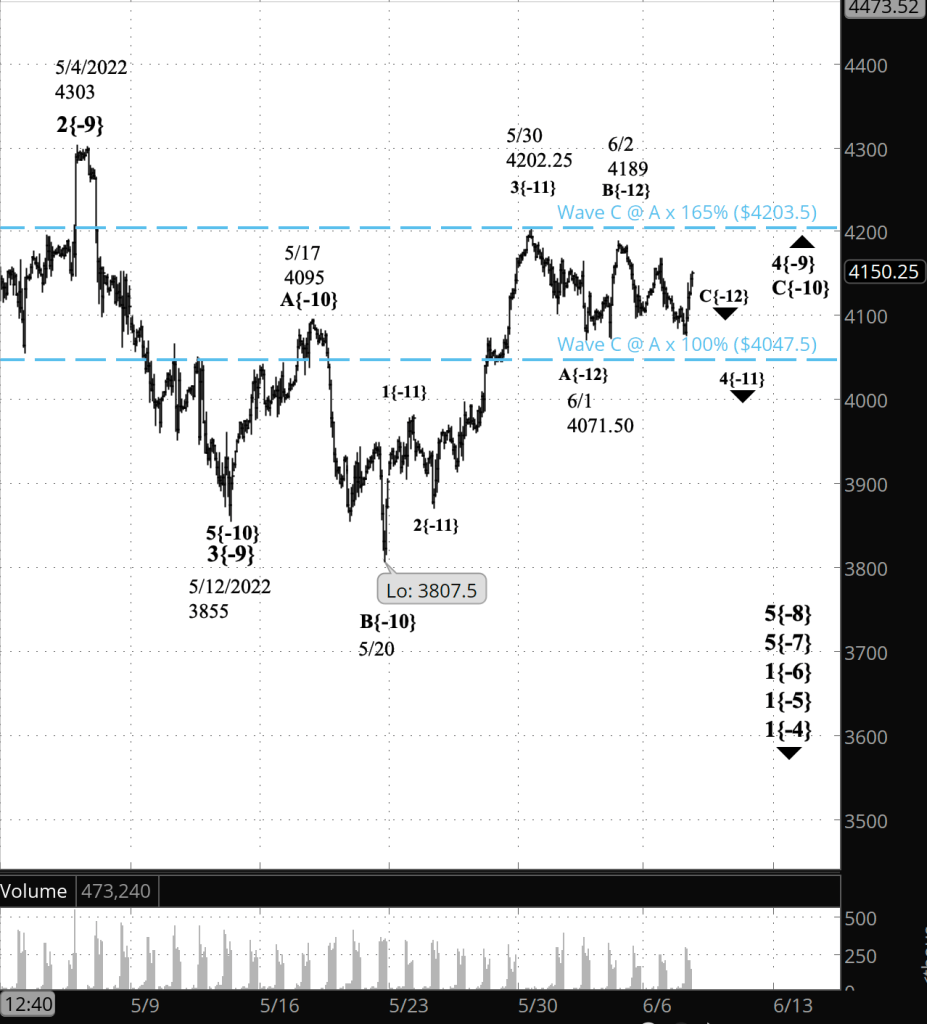
Half an hour before the closing bell. The S&P 500 rose, coming close the upper boundary of the price target range, and then retreated, remaining well above the lower boundary of the range.

So looking at the larger movements since June 1, we have three waves: Up, down and up again, but not as much.

Under my principal analysis, wave 4{-11} ended on June 1, and today’s movements are wave 1{-12}, 2{-12} and the beginning of 3{-12} within wave uptrending wave 5{-11}. Or perhaps wave 2{-12} is still underway.

Under my alternative analysis, the June 1 low is the end of wave A{-12} within wave 4{-11}. Today’s movements: The up wave is wave B{-12}, which may have ended at today’s peak. The subsequent downward movement and upward retreat are wave C{-12} and is still underway.

If the price moves above the upper price target boundary, that lends credence to the principal scenario. If it moves below the lower boundary, then the alternative scenario gain credence.

I’ve updated the chart.

9:35 a.m. New York time

What’s happening now? The S&P 500 E-mini futures rose in overnight trading, returning to the mid-4100s.

What does it mean? The final segment within the third and probably the last leg of an upward correction that began on May 12 is underway. The price remains within the projected range of the end of that upward correction (dashed blue lines on the chart), between 4203.50 and 4047.50.

What is the alternative? The next-to-the-last segment within the third leg of the upward correction is still underway.

[S&P 500 E-mini futures at 3:30 p.m., 80-minute bars, with volume]

What does Elliott wave theory say? Under my principal analysis, wave 5{-11} within wave C{-10} is underway. All of this is happening within wave 4{-9}, an upward correction that began on May 12, within wave 5{-8}, a downtrend that began on January 4.

Under my alternative analysis, wave 4{-11} within wave C{-10} is not yet complete. When it’s done, it will be followed by upward wave 5{-11}.

The wave 4{-9} correction is forming a Flat pattern, with three waves within wave A, three in B and five waves within wave C. I hedged my placement of wave C — “probably the last leg of an upward correction” — because sometimes corrections form a compound pattern, linking two or three corrective patterns together.

We Are Here.

These are the waves currently in progress under my principal analysis. Each line on the list shows the wave number, with the subscript in curly brackets, the traditional degree name, the starting date, the starting price of the S&P 500 E-mini futures, and the direction of the wave.

  • S&P 500 Index:
  • 5{+3} Supercycle, 7/8/1932, 4.40 (up)
  • 5{+2} Cycle, 12/9/1974, 60.96 (up)
  • 5{+1} Primary, 3/6/2009, 666.79 (up)
  • 5{0} Intermediate, 12/26/2018, 2346.58 (up)
  • 4{-1} Minor, 1/4/2022 4818.62 (down)
  • 1{-2} Minute, 1/4/2022 4818.62 (down)
  • S&P 500 Futures and index:
  • 1{-3} Minuette, 1/4/2022, 4808.25 (down) (futures), 4818.62 (down) (index)
  • S&P 500 Futures:
  • 1{-4} Subminuette, 1/4/2022, 4808.25 (down)
  • 1{-5} Micro, 1/4/2022, 4808.25 (down)
  • 1{-6} Submicro, 1/4/2022, 4808.25 (down)
  • 5{-7} Minuscule, 3/29/2022, 4631 (down)
  • 5{-8} Subminuscule, 4/21/2022, 4509, (down)

Learning and other resources. Elliott wave analysis provides context, not prophecy. As the 20th century semanticist Alfred Korzybski put it in his book Science and Sanity (1933), “The map is not the territory … The only usefulness of a map depends on similarity of structure between the empirical world and the map.” And I would add, in the ever-changing markets, we can judge that similarity of structure only after the fact.

See the menu page Analytical Methods for a rundown on where to go for information on Elliott wave analysis.

By Tim Bovee, Portland, Oregon, June 6, 2022

Disclaimer

Tim Bovee, Private Trader tracks the analysis and trades of a private trader for his own accounts. Nothing in this blog constitutes a recommendation to buy or sell stocks, options or any other financial instrument. The only purpose of this blog is to provide education and entertainment.

No trader is ever 100 percent successful in his or her trades. Trading in the stock and option markets is risky and uncertain. Each trader must make trading decisions for his or her own account, and take responsibility for the consequences.

License
Creative Commons License

All content on Tim Bovee, Private Trader by Timothy K. Bovee is licensed under a Creative Commons Attribution-ShareAlike 4.0 International License.

Based on a work at www.timbovee.com.
Trader’s Notebook

3:30 p.m. New York time

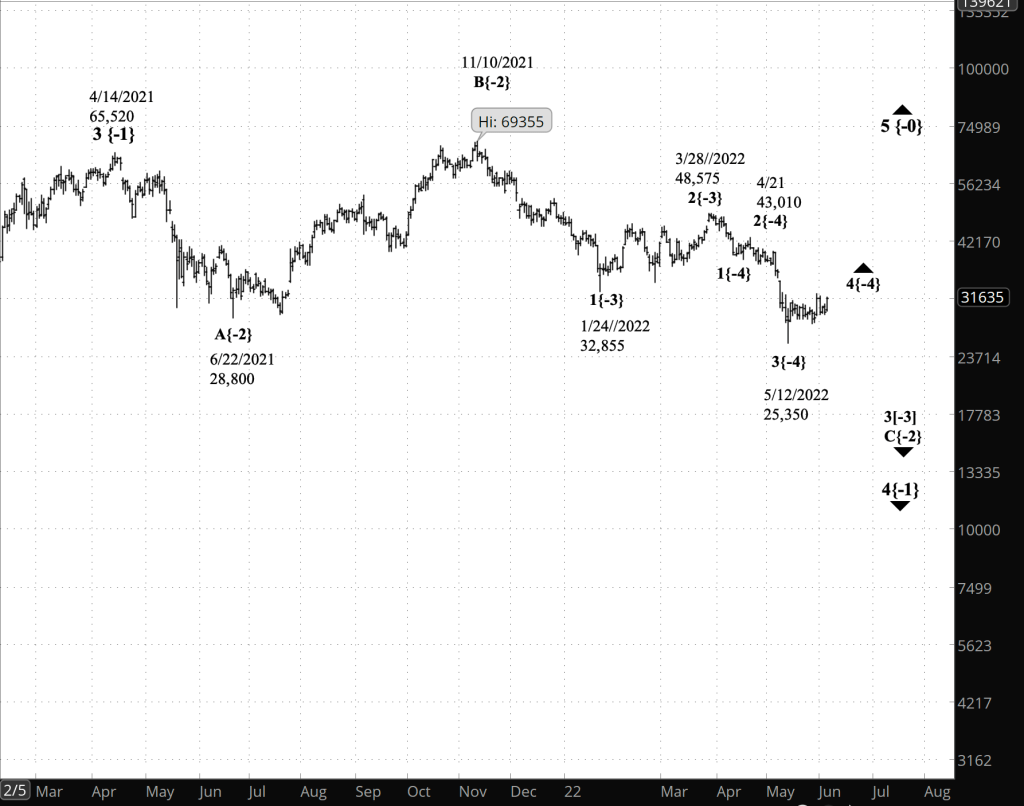
Half an hour before the closing bell. The S&P 500 fell during the trading session, reaching a low of 4096.75 on the futures, and then rose slightly. The movement is consistent with this morning’s principal analysis: Rising wave 5{-11} within rising wave C{-10} within an upward correction, wave 4{-9], is underway. The depth of the pullback suggests an additional alternative analysis: Wave 4{-11}, a downward correction within wave C{-10}, is still underway. I’m not ready to adopt that as the principal analysis yet, but it’s a possibility.

I’ve updated the chart.

9:35 a.m. New York time

What’s happening now? The S&P 500 E-mini futures rose to 4189 in overnight trading and then reversed, dropping by almost 60 points. At the overnight peak the price was within 14 points of the upper boundary of the target price range (the dashed blue lines on the chart).

What does it mean? The overnight peak ended the middle segment of the rise that began on June 1. After a small downward correction, that rise will resume in the final segment of the rise that began on May 20. When that rise is complete, it will also, most likely, mark the end of the upward correction that began on May 12 from 3855.

What are the alternatives? There are two.

Alternative #1: The overnight peak may have marked the end of the rise that began on May 20. That interpretation of the chart seems like a stretch to me, but charts always contain ambiguities, so i can’t rule it out entirely.

Alternative #2: The overnight peak marked the end of a three-segment corrective pattern, an upward correction that began on May 12.

[S&P 500 E-mini futures at 9:35 a.m., 75-minute bars, with volume]

What does Elliott wave theory say? In my principal analysis, the overnight peak, marked the end of wave 3{-12}, the middle wave of a five-wave pattern within wave 5{-11}, which in turn is the final wave of wave C{-9}. That C wave is likely to be the final wave of an upward correction, wave 4{9}, that began on May 12.

Under alternative #1, the overnight peak, 4189, was the end of wave 5{-12], the final wave within 5{-11} and its parent C{-10}, and it most likely marks the end of wave 4{-9}.

Under alternative #2, wave 4{-9} take for a compound structure. The three-wave pattern that will end with wave C{-10} will be followed by a downward connector, wave X{-10}, and then another corrective pattern.

The two blue dashed lines on the chart are the price range of the likely ending level of wave C{-10}. A tendency, according to Elliott wave analysis, is from wave C at a minimum to be the same length as the preceding wave A or to be up to 65% longer than wave A. The upper line marks the 65% longer level (4203.50), and the lower line marks the same length level (4047.50).

We Are Here.

These are the waves currently in progress under my principal analysis. Each line on the list shows the wave number, with the subscript in curly brackets, the traditional degree name, the starting date, the starting price of the S&P 500 E-mini futures, and the direction of the wave.

  • S&P 500 Index:
  • 5{+3} Supercycle, 7/8/1932, 4.40 (up)
  • 5{+2} Cycle, 12/9/1974, 60.96 (up)
  • 5{+1} Primary, 3/6/2009, 666.79 (up)
  • 5{0} Intermediate, 12/26/2018, 2346.58 (up)
  • 4{-1} Minor, 1/4/2022 4818.62 (down)
  • 1{-2} Minute, 1/4/2022 4818.62 (down)
  • S&P 500 Futures and index:
  • 1{-3} Minuette, 1/4/2022, 4808.25 (down) (futures), 4818.62 (down) (index)
  • S&P 500 Futures:
  • 1{-4} Subminuette, 1/4/2022, 4808.25 (down)
  • 1{-5} Micro, 1/4/2022, 4808.25 (down)
  • 1{-6} Submicro, 1/4/2022, 4808.25 (down)
  • 5{-7} Minuscule, 3/29/2022, 4631 (down)
  • 5{-8} Subminuscule, 4/21/2022, 4509, (down)

Learning and other resources. Elliott wave analysis provides context, not prophecy. As the 20th century semanticist Alfred Korzybski put it in his book Science and Sanity (1933), “The map is not the territory … The only usefulness of a map depends on similarity of structure between the empirical world and the map.” And I would add, in the ever-changing markets, we can judge that similarity of structure only after the fact.

See the menu page Analytical Methods for a rundown on where to go for information on Elliott wave analysis.

By Tim Bovee, Portland, Oregon, June 3, 2022

Disclaimer

Tim Bovee, Private Trader tracks the analysis and trades of a private trader for his own accounts. Nothing in this blog constitutes a recommendation to buy or sell stocks, options or any other financial instrument. The only purpose of this blog is to provide education and entertainment.

No trader is ever 100 percent successful in his or her trades. Trading in the stock and option markets is risky and uncertain. Each trader must make trading decisions for his or her own account, and take responsibility for the consequences.

License
Creative Commons License

All content on Tim Bovee, Private Trader by Timothy K. Bovee is licensed under a Creative Commons Attribution-ShareAlike 4.0 International License.

Based on a work at www.timbovee.com.