Trader’s Notebook

3:30 p.m. New York time

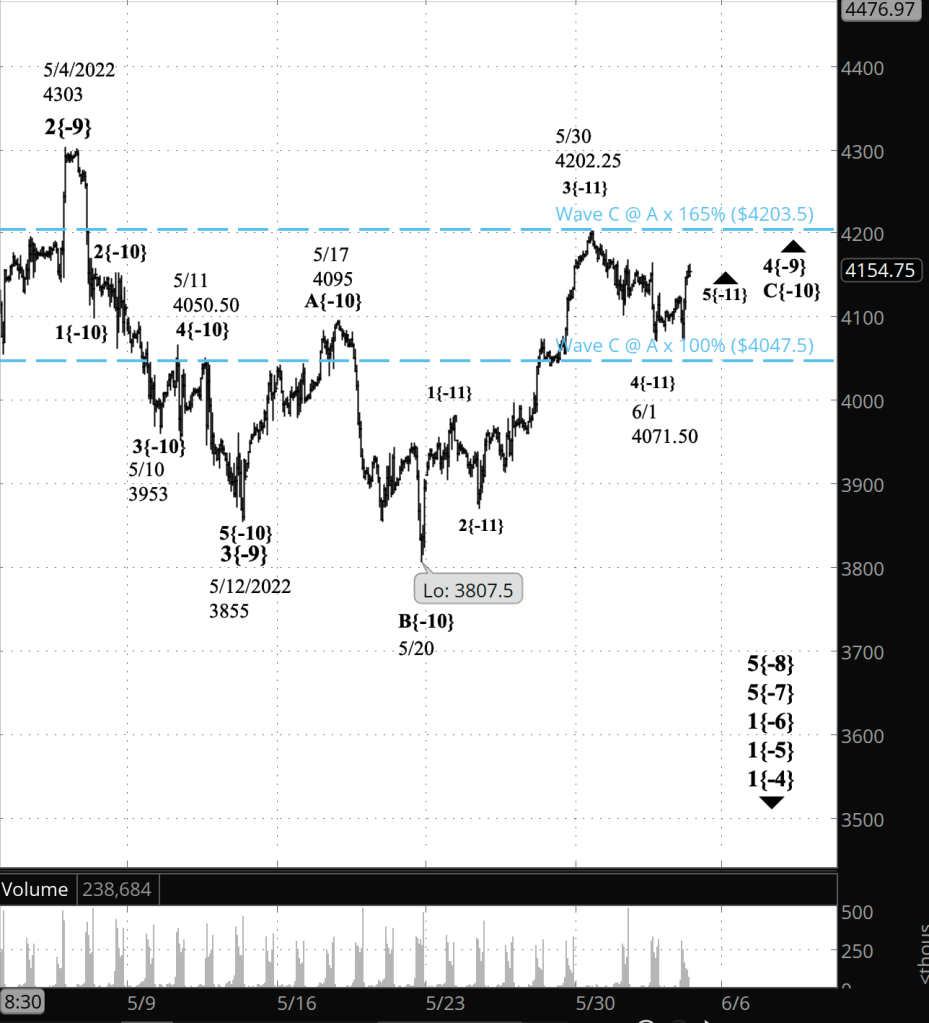
Half an hour before the closing bell. The S&P 500 reversed and is rising. I’ve labeled the June 1 low of 4071.50 as the end wave 4{-11} and the present rise as wave 5{-11}. When 5{-11} is complete, wave C{-10} will also be complete, and most likely, the upward correction that began on May 12 will also be complete.

An alternative analysis is that the June 1 low marked the end of the first wave within 4{-11}. If that’s the case, then there are most likeIy two more waves to go before wave 4{-11} is complete. As is often the case, the degree of each movement is somewhat ambiguous.

I’ve updated the chart.

9:35 a.m. New York time

What’s happening now? The S&P 500 E-mini futures rose slightly overnight but then fell slightly at the opening bell.

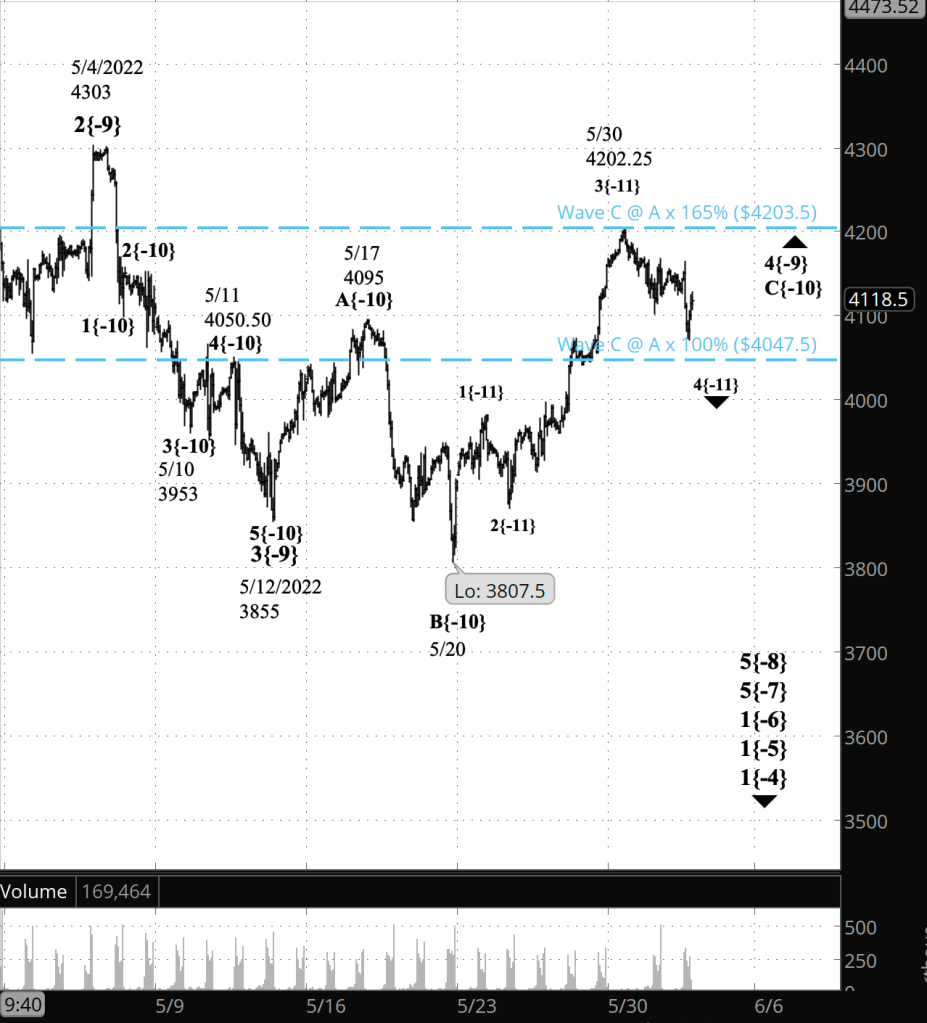
What does it mean? A low-level downward correction is underway, within a the final, rising leg of a larger upward correction, all happening in a downtrend that began on April 21. The downward correction will be followed by a push to the upside that will exceed the May 30 high, 4202.25, completing the larger upward correction and resume the downtrend.

What are the alternatives? There are three.

Alternative #1: The final leg of the larger, upward correction ended on May 30 at 4202.25, and the downtrend has resumed.

Alternative #2: The final push to the upside may be truncated, falling short of the May 30 high.

Alternative #3: The end of the final, rising leg of larger upward correction won’t be the final leg. Instead, the correction will take a compound structure, adding on a second corrective pattern.
[S&P 500 E-mini futures at 9:35 a.m., 70-minute bars, with volume]

What does Elliott wave theory say? Principal analysis: An upward correction, wave 4{-9}, is in its final wave internally, wave C{-10}. The C wave in turn is in its next-to-the-last movement, wave 4{-11}. When wave C{-10} reaches completion with the end of wave 5{-11}, most likely above the May 30 high of 4202.25, it will also be the end of wave 4{-9} and the beginning of wave 5{-9}, resuming the downtrend that began on April 21.

Alternative #1: Wave 4{-9} ended on May 30, and wave 5{-9} is underway.

Alternative #2: Wave C{-10} within wave 4{-9} will fall short of 4202.25, a pattern known as truncation in Elliott wave terminology.

Alternative #3: The end of wave C{-10} won’t be the end of wave 4{-9}. Instead, wave 4{-9} will form a compound structure, with wave C{-10} being followed by wave X{-10}, which in turn will be followed by a second corrective pattern.

We Are Here.

These are the waves currently in progress under my principal analysis. Each line on the list shows the wave number, with the subscript in curly brackets, the traditional degree name, the starting date, the starting price of the S&P 500 E-mini futures, and the direction of the wave.

  • S&P 500 Index:
  • 5{+3} Supercycle, 7/8/1932, 4.40 (up)
  • 5{+2} Cycle, 12/9/1974, 60.96 (up)
  • 5{+1} Primary, 3/6/2009, 666.79 (up)
  • 5{0} Intermediate, 12/26/2018, 2346.58 (up)
  • 4{-1} Minor, 1/4/2022 4818.62 (down)
  • 1{-2} Minute, 1/4/2022 4818.62 (down)
  • S&P 500 Futures and index:
  • 1{-3} Minuette, 1/4/2022, 4808.25 (down) (futures), 4818.62 (down) (index)
  • S&P 500 Futures:
  • 1{-4} Subminuette, 1/4/2022, 4808.25 (down)
  • 1{-5} Micro, 1/4/2022, 4808.25 (down)
  • 1{-6} Submicro, 1/4/2022, 4808.25 (down)
  • 5{-7} Minuscule, 3/29/2022, 4631 (down)
  • 5{-8} Subminuscule, 4/21/2022, 4509, (down)

Learning and other resources. Elliott wave analysis provides context, not prophecy. As the 20th century semanticist Alfred Korzybski put it in his book Science and Sanity (1933), “The map is not the territory … The only usefulness of a map depends on similarity of structure between the empirical world and the map.” And I would add, in the ever-changing markets, we can judge that similarity of structure only after the fact.

See the menu page Analytical Methods for a rundown on where to go for information on Elliott wave analysis.

By Tim Bovee, Portland, Oregon, June 2, 2022

Disclaimer

Tim Bovee, Private Trader tracks the analysis and trades of a private trader for his own accounts. Nothing in this blog constitutes a recommendation to buy or sell stocks, options or any other financial instrument. The only purpose of this blog is to provide education and entertainment.

No trader is ever 100 percent successful in his or her trades. Trading in the stock and option markets is risky and uncertain. Each trader must make trading decisions for his or her own account, and take responsibility for the consequences.

License
Creative Commons License

All content on Tim Bovee, Private Trader by Timothy K. Bovee is licensed under a Creative Commons Attribution-ShareAlike 4.0 International License.

Based on a work at www.timbovee.com.
Trader’s Notebook

3:30 p.m. New York time

Morning Trader’s Notebook disppeared. This morning’s Trader’s Notebook somehow never made it to the blog and is now wandering aimlessly around the Metaverse, a ghost of a post.

So, this post takes care of both this morning and this afternoon.

Half an hour before the closing bell. The S&P 500 E-mini futures fell in morning part of the session and then began to rise.

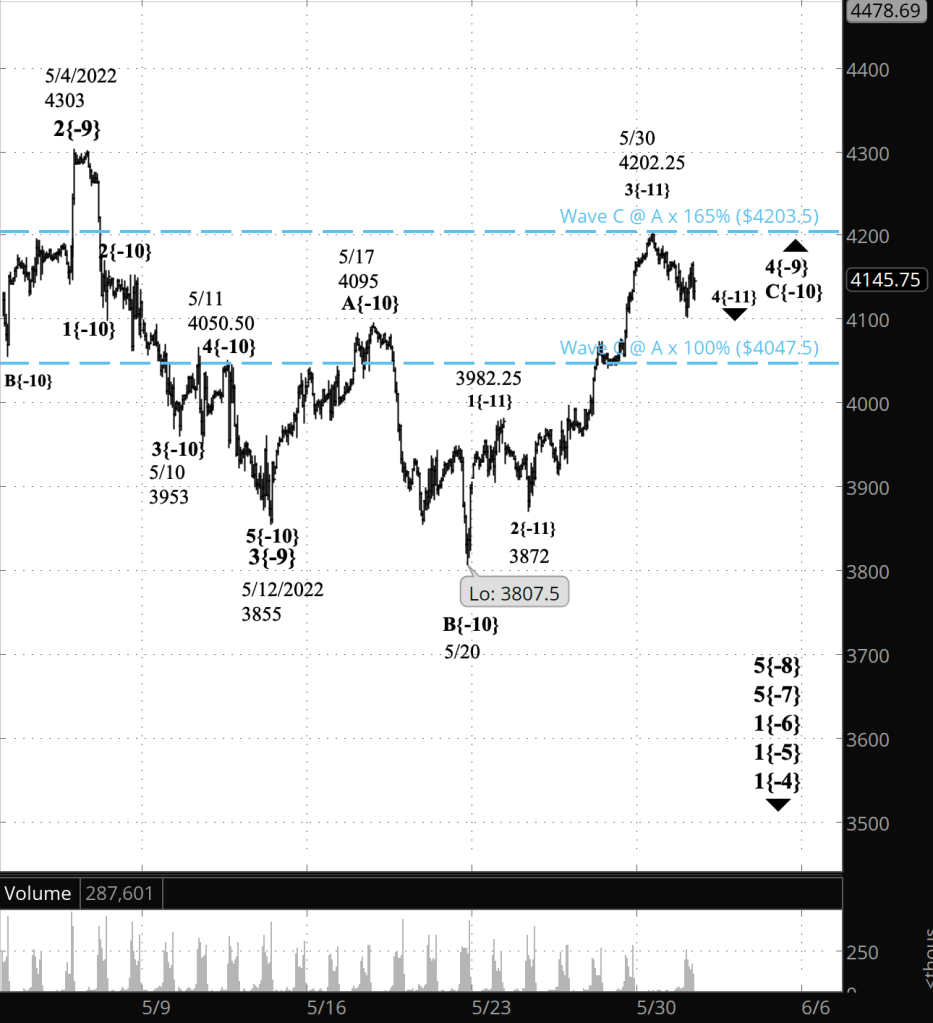
What does it mean? The decline from the May 30 high is a downward correction within the final leg of a larger upward correction within a still larger downtrend.

What are the alternatives? There are three, the same as those discussed yesterday.

Alternative #1: The May 30 peak marks the end of the larger upward correction and the downtrend that began on April 21 has resumed.

Alternative #2: The final move to the upside may fall short of the May 30 peak, a condition known as truncation.

Alternative #3: The correction could take a compound form, stringing several corrective patterns together.

[S&P 500 E-mini futures at 3:30 p.m., 70-minute bars, with volume]

What does Elliott wave theory say? Under my principal analysis, a upward correction, wave 4{-9} has been underway since May 12. It is now in the final wave, C{-10}, of a three-wave Flat corrective pattern. Within wave C, a downward correction, wave 4{-11}, began on May 30. It can be counted as being in its 4th of five waves internally. When complete, wave 4{-9} will be followed by wave 5{-9}, a continuation of the downtrend that began on April 21 from 4509.

Alternative #1: Wave 4{-9} ended at the May 30 peak, 4202.25.

Alternative #2: Although the 5th and final wave within wave C would normally move above the prior peak, it’s possible that wave 5{-10} will be truncated, coming in below 4202.25.

Alternative #3: Most of the time in a flat, the C wave marks the end of the correction. Sometimes, the correction forms a compound structure, stringing two or three corrective patterns together. If wave 4{-9} forms a compound structure, wave C{-10} will be followed by a connecting wave, X{-10}, and then another corrective pattern.

We Are Here.

These are the waves currently in progress under my principal analysis. Each line on the list shows the wave number, with the subscript in curly brackets, the traditional degree name, the starting date, the starting price of the S&P 500 E-mini futures, and the direction of the wave.

  • S&P 500 Index:
  • 5{+3} Supercycle, 7/8/1932, 4.40 (up)
  • 5{+2} Cycle, 12/9/1974, 60.96 (up)
  • 5{+1} Primary, 3/6/2009, 666.79 (up)
  • 5{0} Intermediate, 12/26/2018, 2346.58 (up)
  • 4{-1} Minor, 1/4/2022 4818.62 (down)
  • 1{-2} Minute, 1/4/2022 4818.62 (down)
  • S&P 500 Futures and index:
  • 1{-3} Minuette, 1/4/2022, 4808.25 (down) (futures), 4818.62 (down) (index)
  • S&P 500 Futures:
  • 1{-4} Subminuette, 1/4/2022, 4808.25 (down)
  • 1{-5} Micro, 1/4/2022, 4808.25 (down)
  • 1{-6} Submicro, 1/4/2022, 4808.25 (down)
  • 5{-7} Minuscule, 3/29/2022, 4631 (down)
  • 5{-8} Subminuscule, 4/21/2022, 4509, (down)

Learning and other resources. Elliott wave analysis provides context, not prophecy. As the 20th century semanticist Alfred Korzybski put it in his book Science and Sanity (1933), “The map is not the territory … The only usefulness of a map depends on similarity of structure between the empirical world and the map.” And I would add, in the ever-changing markets, we can judge that similarity of structure only after the fact.

See the menu page Analytical Methods for a rundown on where to go for information on Elliott wave analysis.

By Tim Bovee, Portland, Oregon, June 1, 2022

Disclaimer

Tim Bovee, Private Trader tracks the analysis and trades of a private trader for his own accounts. Nothing in this blog constitutes a recommendation to buy or sell stocks, options or any other financial instrument. The only purpose of this blog is to provide education and entertainment.

No trader is ever 100 percent successful in his or her trades. Trading in the stock and option markets is risky and uncertain. Each trader must make trading decisions for his or her own account, and take responsibility for the consequences.

License
Creative Commons License

All content on Tim Bovee, Private Trader by Timothy K. Bovee is licensed under a Creative Commons Attribution-ShareAlike 4.0 International License.

Based on a work at www.timbovee.com.
Trader’s Notebook

3:30 p.m. New York time

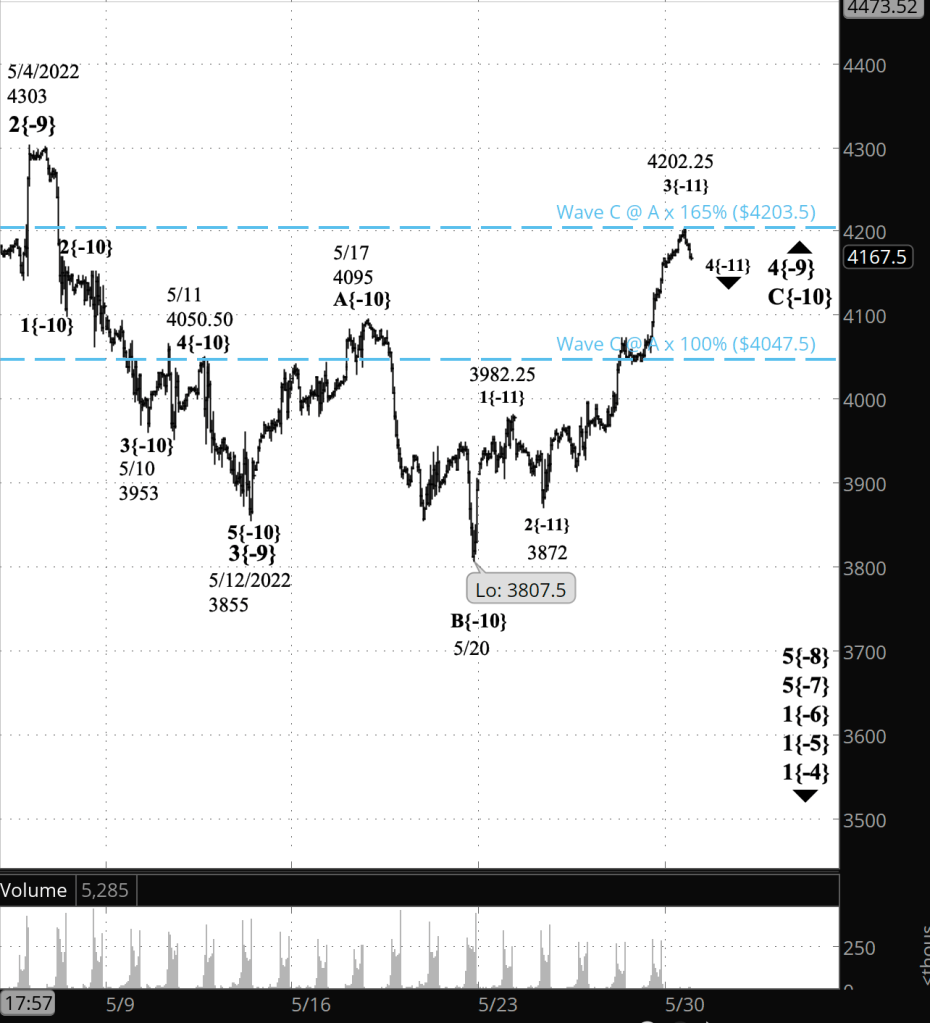
Half an hour before the closing bell. The S&P 500 reversed to the upside early in the session, remaining below the high, 4202.25, attained in overnight futures trading.

Under my principal count, the decline is wave A{-12} within wave 4{-11} within wave C{-10}, which is the third wave of an upward corrective pattern, wave 4{-9}, that began on May 12. the bounce up maybe the start of wave B{-12}, or perhaps a subwave within an ongoing wave A{-12}.

Under my Alternative #1 analysis, the decline during the session is part of wave 1{-10} within downtrending wave 5{-9}.

No change in the analysis. I’ve updated the chart.

9:35 a.m. New York time

What’s happening now? The S&P 500 E-mini futures continued to fall in overnight trading.

What does it mean? The decline is a downward correction within the final, upward leg of a larger upward correction. It will be followed by a final move to the upside that likely will move above the May 30 peak, 4303, and that will complete the larger upward correction, unless it takes a complex form. The end of the correction will be followed by a signifiant decline, a resumption of the downtrend that began on April 21 from 4509. The price has come within two points of reaching the upper boundary of the price target, 4203.51. The price target range is marked with blue dashed lines on the chart.

What are the alternatives? There are three:

Alternative #1: The May 30 peak marks the end of the larger upward correction and the downtrend that began on April 21 has resumed. I don’t think this alternative matches the internal wave count, but there is always a degree of uncertainty in any Elliott wave analysis.

Alternative #2: The final move to the upside may fall short of the May 30 peak, a condition known as truncation. Or it could move beyond the peak.

Alternative #3: Most corrections have three waves internally. Sometimes a correction will connect two or three corrective patterns together before reaching its end. The present corrective pattern is in its 19th day, and a compound correction could roughly double or triple the time until the S&P 500 resumes its downtrend.

The price target range (blue dashed lines on the chart) is calculated by using the length of wave A{-10} for the lower boundary and 1.65 times the length of wave A{-10} for the upper boundary, a common range for C waves within a 4th wave that is forming a Flat pattern. That price target range is a tendency, but not a firm rule. The price could move beyond the boundary before wave C{-10} is complete.

A firm rule of Elliott wave analysis is that a 4th wave can’t move beyond the start of the preceding 1st wave. Wave 1{-9} began on April 21 from 4509. So wave 4{-9}, whether it turns out to be simple or complex, can’t move beyond that price.

[S&P 500 E-mini futures at 3:30 p.m., hourly bars, with volume]

What does Elliott wave theory say? Under my principal analysis, the May 30 peak ended wave 3{-11} within wave C{-10} within the upward correction, wave 4{-9}. Wave 4{-11} is now underway, and it will be followed by rising wave 5{-11}, which will likely rise above the 4303 peak of May 30 and when complete will be the end of wave C{-10} and most likely the end of wave 4{-9}. When 4{-9} is complete, the downtrend will resume as wave 5{-9}, which will carry the price back down to the 3800s and perhaps below.

Under Alternative #1, wave C{-10} ended at the May 30 peak. I can’t find a wave count within wave C{-10} that, within the rules of Elliott wave analysis, would allow this interpretation, but I recognize the ambiguities in the count that make it a possibility.

Under Alternative #2, the upward wave 5{-11} that will follow the present wave 4{-11} pullback will fall short of 4303, the May 30 peak, in a truncated 5th.

Under Alternative #3, the end of wave C{-10} won’t be the end of its parent, wave 4{-9}. Instead, wave C{-10} will be followed by a downward connecting wave, X{-10} and then a second corrective pattern, which possibly will be followed by another connecting wave and then third corrective pattern.

We Are Here.

These are the waves currently in progress under my principal analysis. Each line on the list shows the wave number, with the subscript in curly brackets, the traditional degree name, the starting date, the starting price of the S&P 500 E-mini futures, and the direction of the wave.

  • S&P 500 Index:
  • 5{+3} Supercycle, 7/8/1932, 4.40 (up)
  • 5{+2} Cycle, 12/9/1974, 60.96 (up)
  • 5{+1} Primary, 3/6/2009, 666.79 (up)
  • 5{0} Intermediate, 12/26/2018, 2346.58 (up)
  • 4{-1} Minor, 1/4/2022 4818.62 (down)
  • 1{-2} Minute, 1/4/2022 4818.62 (down)
  • S&P 500 Futures and index:
  • 1{-3} Minuette, 1/4/2022, 4808.25 (down) (futures), 4818.62 (down) (index)
  • S&P 500 Futures:
  • 1{-4} Subminuette, 1/4/2022, 4808.25 (down)
  • 1{-5} Micro, 1/4/2022, 4808.25 (down)
  • 1{-6} Submicro, 1/4/2022, 4808.25 (down)
  • 5{-7} Minuscule, 3/29/2022, 4631 (down)
  • 5{-8} Subminuscule, 4/21/2022, 4509, (down)

Learning and other resources. Elliott wave analysis provides context, not prophecy. As the 20th century semanticist Alfred Korzybski put it in his book Science and Sanity (1933), “The map is not the territory … The only usefulness of a map depends on similarity of structure between the empirical world and the map.” And I would add, in the ever-changing markets, we can judge that similarity of structure only after the fact.

See the menu page Analytical Methods for a rundown on where to go for information on Elliott wave analysis.

By Tim Bovee, Portland, Oregon, May 31, 2022

Disclaimer

Tim Bovee, Private Trader tracks the analysis and trades of a private trader for his own accounts. Nothing in this blog constitutes a recommendation to buy or sell stocks, options or any other financial instrument. The only purpose of this blog is to provide education and entertainment.

No trader is ever 100 percent successful in his or her trades. Trading in the stock and option markets is risky and uncertain. Each trader must make trading decisions for his or her own account, and take responsibility for the consequences.

License
Creative Commons License

All content on Tim Bovee, Private Trader by Timothy K. Bovee is licensed under a Creative Commons Attribution-ShareAlike 4.0 International License.

Based on a work at www.timbovee.com.
Trader’s Notebook

10:17 a.m. New York time

What’s happening now? The U.S. markets were closed today — Monday — for the Memorial Day holiday. However, the S&P 500 E-mini futures resumed trading Sunday. The price reached 4802.25 in overnight trading and then fell.

What does it mean? The overnight peak was less than two points below the upper boundary of the likely price target for the final segment of the upward correction that began on May 12. The subsequent decline carried the price down more than 60 points.

By my count, the final segment internally has completed three subwaves and is now in its second correction. When that internal correction has ended, price will rise again, most likely exceeding the overnight high, ending the upward correction that began on May 12.

What’s the alternative? The likely price target was calculated according to a tendency identified in Elliott wave analysis regarding the final segment’s retracement of the first segment of a correction taking the Flat pattern. More on that calculation in the Elliott wave theory section, below. Long story short: The target range is a tendency, not a firm rule, and it’s possible that the final segment will end below the overnight low, or that it will move beyond the upper boundary of the range.

[S&P 500 E-mini futures at 10:17 a.m., 57-minute bars, with volume]

What does Elliott wave theory say? Wave C{-10} within an upward correction, wave 4{-9}, is nearing its end. Internally, wave 3{-11} ended at the overnight high, and wave 4{-11}, a downward correction, is now underway. Wave 5{-11} will follow and will complete wave C{-10}.

The wave 4{-9} correction is taking the form of a Flat, and C waves in Flats will often retrace 100% to 165% of the preceding A wave, giving a target price range of 4047.50 to 4203.50. I’ve marked those levels on the chart with blue dashed lines.

We Are Here.

These are the waves currently in progress under my principal analysis. Each line on the list shows the wave number, with the subscript in curly brackets, the traditional degree name, the starting date, the starting price of the S&P 500 E-mini futures, and the direction of the wave.

  • S&P 500 Index:
  • 5{+3} Supercycle, 7/8/1932, 4.40 (up)
  • 5{+2} Cycle, 12/9/1974, 60.96 (up)
  • 5{+1} Primary, 3/6/2009, 666.79 (up)
  • 5{0} Intermediate, 12/26/2018, 2346.58 (up)
  • 4{-1} Minor, 1/4/2022 4818.62 (down)
  • 1{-2} Minute, 1/4/2022 4818.62 (down)
  • S&P 500 Futures and index:
  • 1{-3} Minuette, 1/4/2022, 4808.25 (down) (futures), 4818.62 (down) (index)
  • S&P 500 Futures:
  • 1{-4} Subminuette, 1/4/2022, 4808.25 (down)
  • 1{-5} Micro, 1/4/2022, 4808.25 (down)
  • 1{-6} Submicro, 1/4/2022, 4808.25 (down)
  • 5{-7} Minuscule, 3/29/2022, 4631 (down)
  • 5{-8} Subminuscule, 4/21/2022, 4509, (down)

Learning and other resources. Elliott wave analysis provides context, not prophecy. As the 20th century semanticist Alfred Korzybski put it in his book Science and Sanity (1933), “The map is not the territory … The only usefulness of a map depends on similarity of structure between the empirical world and the map.” And I would add, in the ever-changing markets, we can judge that similarity of structure only after the fact.

See the menu page Analytical Methods for a rundown on where to go for information on Elliott wave analysis.

By Tim Bovee, Portland, Oregon, May 31, 2022

Disclaimer

Tim Bovee, Private Trader tracks the analysis and trades of a private trader for his own accounts. Nothing in this blog constitutes a recommendation to buy or sell stocks, options or any other financial instrument. The only purpose of this blog is to provide education and entertainment.

No trader is ever 100 percent successful in his or her trades. Trading in the stock and option markets is risky and uncertain. Each trader must make trading decisions for his or her own account, and take responsibility for the consequences.

License
Creative Commons License

All content on Tim Bovee, Private Trader by Timothy K. Bovee is licensed under a Creative Commons Attribution-ShareAlike 4.0 International License.

Based on a work at www.timbovee.com.
Trader’s Notebook

3:30 p.m. New York time

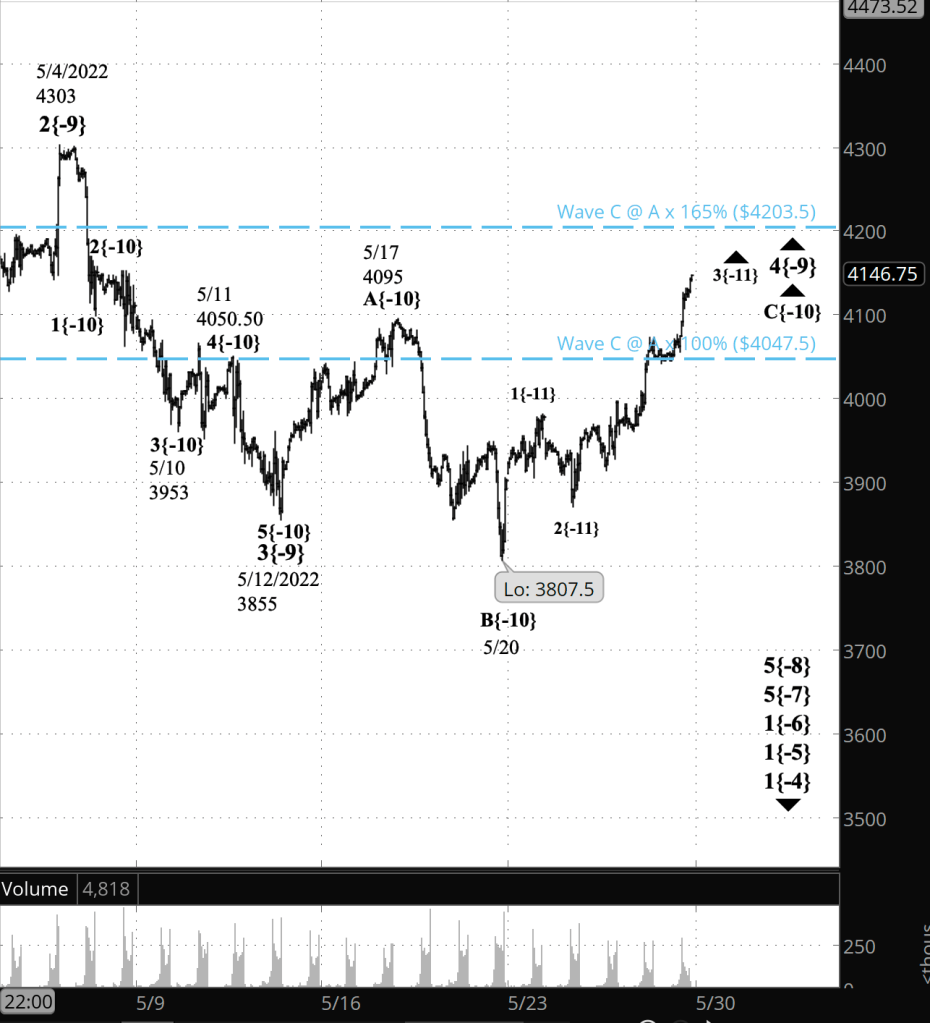
Half an hour before the closing bell. The S&P 500 rose to the mid-4100s on the futures, about halfway into the likely price range where the upward movement that began on May 20 will end (marked with blue dashed lines on the chart). The rise from that date is wave C{-10} within an upward correction that began on May 12, wave 4{-9}. I count C{-10} as being in its 5th and final internal wave. I’ve updated the chart.

10:35 a.m. New York time

MRVL earnings play exit. I’ve exited my short bull put vertical spread on MRVL for 30.3% of maximum potential profit and have updated the trade analysis with full results.

9:35 a.m. New York time

After the weekend. The U.S. markets will be closed on Monday for the Memorial Day holiday. Trading will resume on Tuesday.

What’s happening now? The S&P 500 E-mini futures traded in a narrow range overnight, staying close to the lower boundary of the anticipated price target for the rise that began on May 20.

What does it mean? The rising last segment of the upward corrective pattern that began on May 12 is still underway and has a bit more upside potential remaining. I expect the segment to end in a range between 4047.50 and 4203.50 (marked with blue dashed lines on the chart).

What’s the alternative? The present rise will most likely be the end of the upward correction, but it’s possible that the correction will take a compound form, connecting two or three corrective patterns together.

[S&P 500 E-mini futures at 3:30 p.m., 57-minute bars, with volume]

What does Elliott wave theory say? Under my principal analysis, wave C{-10}, the final wave of the three-wave Flat corrective pattern that is forming the upward correction that began on May 12, wave 4{-9}, is continuing. Wave C{-10} began on May 20. I see the C wave as being in its 4th wave correction internally, which will be followed by a final upward move, wave 5{-11} within C{-10}.

Normally, 4th waves have a single corrective pattern, usually consisting of three subwaves, within them, but sometimes they form a compound structure build from two or three corrective patterns, separated from each other by a connecting wave, which would be wave X{-10} in this case.

Whether wave 4{-9} is simple or compound, it will be followed by wave 5{-9}, a resumption of the downtrend, wave 5{-8}, that began on April 21.

We Are Here.

These are the waves currently in progress under my principal analysis. Each line on the list shows the wave number, with the subscript in curly brackets, the traditional degree name, the starting date, the starting price of the S&P 500 E-mini futures, and the direction of the wave.

  • S&P 500 Index:
  • 5{+3} Supercycle, 7/8/1932, 4.40 (up)
  • 5{+2} Cycle, 12/9/1974, 60.96 (up)
  • 5{+1} Primary, 3/6/2009, 666.79 (up)
  • 5{0} Intermediate, 12/26/2018, 2346.58 (up)
  • 4{-1} Minor, 1/4/2022 4818.62 (down)
  • 1{-2} Minute, 1/4/2022 4818.62 (down)
  • S&P 500 Futures and index:
  • 1{-3} Minuette, 1/4/2022, 4808.25 (down) (futures), 4818.62 (down) (index)
  • S&P 500 Futures:
  • 1{-4} Subminuette, 1/4/2022, 4808.25 (down)
  • 1{-5} Micro, 1/4/2022, 4808.25 (down)
  • 1{-6} Submicro, 1/4/2022, 4808.25 (down)
  • 5{-7} Minuscule, 3/29/2022, 4631 (down)
  • 5{-8} Subminuscule, 4/21/2022, 4509, (down)

Learning and other resources. Elliott wave analysis provides context, not prophecy. As the 20th century semanticist Alfred Korzybski put it in his book Science and Sanity (1933), “The map is not the territory … The only usefulness of a map depends on similarity of structure between the empirical world and the map.” And I would add, in the ever-changing markets, we can judge that similarity of structure only after the fact.

See the menu page Analytical Methods for a rundown on where to go for information on Elliott wave analysis.

By Tim Bovee, Portland, Oregon, May 27, 2022

Disclaimer

Tim Bovee, Private Trader tracks the analysis and trades of a private trader for his own accounts. Nothing in this blog constitutes a recommendation to buy or sell stocks, options or any other financial instrument. The only purpose of this blog is to provide education and entertainment.

No trader is ever 100 percent successful in his or her trades. Trading in the stock and option markets is risky and uncertain. Each trader must make trading decisions for his or her own account, and take responsibility for the consequences.

License
Creative Commons License

All content on Tim Bovee, Private Trader by Timothy K. Bovee is licensed under a Creative Commons Attribution-ShareAlike 4.0 International License.

Based on a work at www.timbovee.com.
MRVL Trade

Marvell Technology Inc. (MRVL)

Update 5/27/2022: I exited my short bull put vertical spread on MRVL, 21 days before expiration, for a $0.53 debit per contract/share, a profit before fees of $23 per contract. Shares were trading at $50.19, down $6.90 from the entry level.

The Implied Volatility Rank at exit was 73.9%, down 3.4 points from the entry level.

I exited on the day after entry because the position reached 30.3% of maximum potential profit, slightly above my normal exit point for earnings plays, 25% of max.

Shares declined by 6.9% over one day for a -4,412% annual rate. The options position produced a 43.4% return for a +15,840% annual rate.


I have entered a short bull put vertical spread on MRVL, using options that trade for the last time 22 days hence, on June 17. The premium is a $0.76 credit per contract share and the stock at the time of entry was priced at $57.09.

The Implied Volatility Ratio stood at 77.%.

Premium:$0.76Expire OTM
MRVL-bull put spreadStrikeOddsDelta
Puts
Long54.0059.0%34
Break-even56.7655.0%38
Short56.0051.0%42

The premium is 76% of the width of the position’s short/long spread. The profit zone covers a 0.6% move to the downside and an unlimited move to the upside.

The risk/reward ratio is 1.6:1, with maximum risk of $124 and maximum reward of $76 per contract.

How I chose the trade. The trade was placed to coincide with MRVL’s earnings announcement, after the closing bell on the day of entry. The short strikes were set to coincide with the expected move of $0.83 either way, based on options pricing, which gives a price range of $56.34 to $58. The Zacks Investment Research earnings surprise predictor was unavailable — sometimes analysts will withhold that information — but reporting in Zacks and SeekingAlpha suggested a positive outcome, and the Zacks rank is “2”, meaning “buy”, and on that basis I entered the position.

By Tim Bovee, Portland, Oregon, May 26, 2022

Disclaimer

Tim Bovee, Private Trader tracks the analysis and trades of a private trader for his own accounts. Nothing in this blog constitutes a recommendation to buy or sell stocks, options or any other financial instrument. The only purpose of this blog is to provide education and entertainment.

No trader is ever 100 percent successful in his or her trades. Trading in the stock and option markets is risky and uncertain. Each trader must make trading decisions for his or her own account, and take responsibility for the consequences.

License
Creative Commons License

All content on Tim Bovee, Private Trader by Timothy K. Bovee is licensed under a Creative Commons Attribution-ShareAlike 4.0 International License.

Based on a work at www.timbovee.com.
Trader’s Notebook

3:30 p.m. New York time

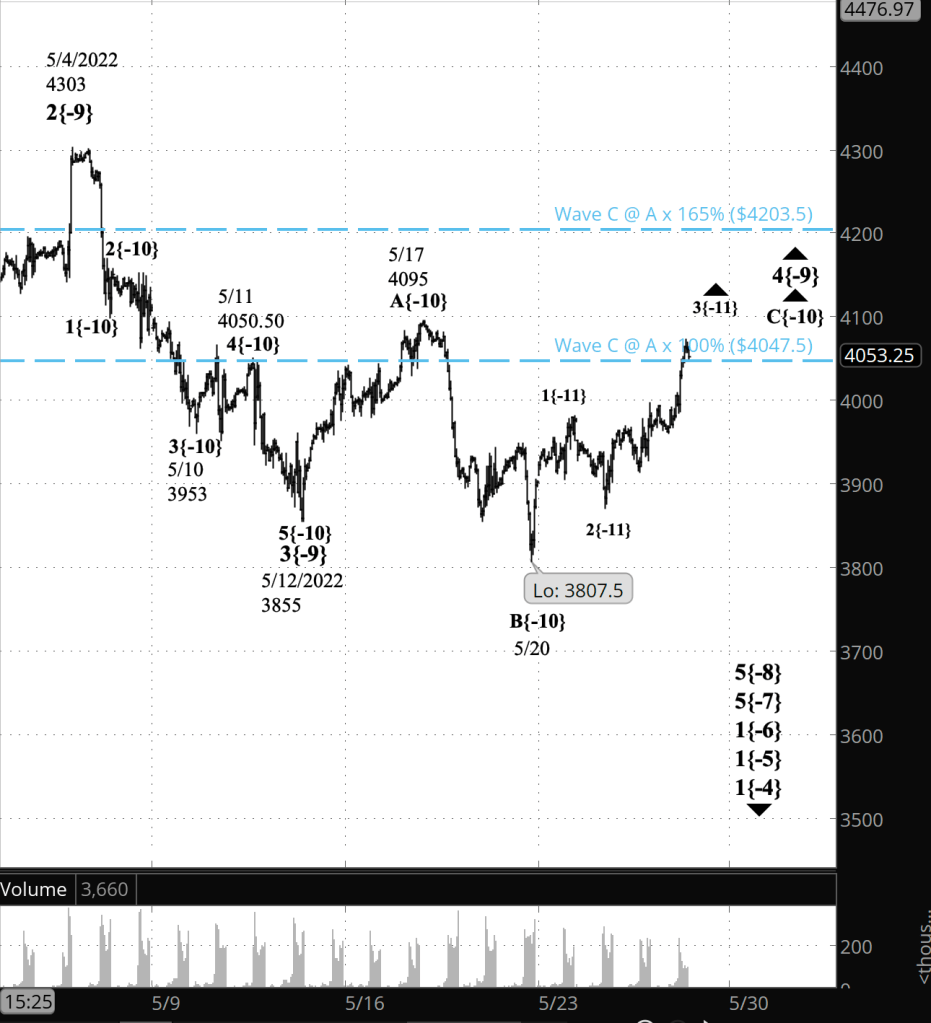
Half an hour before the closing bell. The S&P 500 rose during the session, entering the target price range on the futures. The rise is part of wave C{-10} within an upward correction, wave 4{-9}. As I count it, the C wave internally is in its middle subwave, wave 3{-11}.

When that 3rd subwave is complete, it will be followed by wave 4{-11}, which typically would take the form of a Flat correction, and then will finish off with a final rise, wave 5{-11}. That will be the end of wave C{-10} and of wave 4{-9} under my principal analysis, although 4{-9} will continue if it turns out to be a compound correction, discussed in the alternative analysis.

I’ve updated the vchart.

2:25 p.m. New York time

MRVL earnings play entry. I’ve entered a short bull put vertical spread on MRVL, using options that expire 22 days from now, and have posted a trade analysis.

11:05 a.m. New York time

DLTR earnings play exit. DLTR beat analysts’ earnings expectations, the share price rose by 18.8%, and I exited my short bear call vertical options spread for all of the maximum potential loss, plus some. I’ve updated the trade analysis with details.

OLLI earnings announcement date changed. The earnings announcement date listed for OLLI changed after I entered the position. The new earnings announcement date is listed as June 8 before the opening bell. I’ll hold on to the position, exit if it turns profitable before the announcement, and otherwise wait to see how the announcement goes. I posted a trade analysis at the time I entered the position.

9:35 a.m. New York time

What’s happening now? The S&P 500 E-mini futures rose above 4000 in overnight trading.

What does it mean? The final leg of an upward correction continues and is less than 50 points below the range that will likely mark the high point of the rise.

What’s the alternative? The present rise is the final segment of a three-wave correction. However, sometimes corrections take a compound form. if that happens, then the present rise won’t be the final leg of the correction.

[S&P 500 E-mini futures at 3:30 p.m., 55-minute bars, with volume]

What does Elliott wave theory say? Wave C{-10} within with 4{-9} is underway. Internally, the C wave will have five waves and is presently in wave 3{-11}.

Wave C is likely to end within the range marked with blue dashed lines on the chart, between 4047.50 and 4203.50.

If the alternative scenario plays out, then wave C{-10} will be followed by a connector, wave X{-10} and then a second corrective pattern, all within the wave 4{-9} upward correction.

We Are Here.

These are the waves currently in progress under my principal analysis. Each line on the list shows the wave number, with the subscript in curly brackets, the traditional degree name, the starting date, the starting price of the S&P 500 E-mini futures, and the direction of the wave.

  • S&P 500 Index:
  • 5{+3} Supercycle, 7/8/1932, 4.40 (up)
  • 5{+2} Cycle, 12/9/1974, 60.96 (up)
  • 5{+1} Primary, 3/6/2009, 666.79 (up)
  • 5{0} Intermediate, 12/26/2018, 2346.58 (up)
  • 4{-1} Minor, 1/4/2022 4818.62 (down)
  • 1{-2} Minute, 1/4/2022 4818.62 (down)
  • S&P 500 Futures and index:
  • 1{-3} Minuette, 1/4/2022, 4808.25 (down) (futures), 4818.62 (down) (index)
  • S&P 500 Futures:
  • 1{-4} Subminuette, 1/4/2022, 4808.25 (down)
  • 1{-5} Micro, 1/4/2022, 4808.25 (down)
  • 1{-6} Submicro, 1/4/2022, 4808.25 (down)
  • 5{-7} Minuscule, 3/29/2022, 4631 (down)
  • 5{-8} Subminuscule, 4/21/2022, 4509, (down)

Learning and other resources. Elliott wave analysis provides context, not prophecy. As the 20th century semanticist Alfred Korzybski put it in his book Science and Sanity (1933), “The map is not the territory … The only usefulness of a map depends on similarity of structure between the empirical world and the map.” And I would add, in the ever-changing markets, we can judge that similarity of structure only after the fact.

See the menu page Analytical Methods for a rundown on where to go for information on Elliott wave analysis.

By Tim Bovee, Portland, Oregon, May 26, 2022

Disclaimer

Tim Bovee, Private Trader tracks the analysis and trades of a private trader for his own accounts. Nothing in this blog constitutes a recommendation to buy or sell stocks, options or any other financial instrument. The only purpose of this blog is to provide education and entertainment.

No trader is ever 100 percent successful in his or her trades. Trading in the stock and option markets is risky and uncertain. Each trader must make trading decisions for his or her own account, and take responsibility for the consequences.

License
Creative Commons License

All content on Tim Bovee, Private Trader by Timothy K. Bovee is licensed under a Creative Commons Attribution-ShareAlike 4.0 International License.

Based on a work at www.timbovee.com.

OLLI Trade

Ollie’s Bargain Outlet (OLLI)

Update 6/8/2022: I exited my short bear call vertical spread on OLLI, nine days before expiration, for a $3.53 debit per contract/share, a loss before fees of $206 per contract. Shares were trading at $52.78, up $7.66 from the entry level.

The Implied Volatility Rank at exit was 33.3%, down 31.5 points from the entry level.

This was one of the stranger journeys for an earnings play. First, the listed date of the earnings announcement, in late May, was changed shortly before the expected event to June 8 — today — prior to the opening bell. Second, I had constructed the position as bearish, based on a Zacks Research negative earnings surprise predictor and a non-bullish Zacks rank.

At the time of the earnings announcement, those bearish metrics still held, and the company came through like a champ, missing its earnings estimate by a large percentage. Revenues also lagged expectations.

And it’s not like OLLI is a high performer that tends to fly in the face of negative expectations. It has a history of negative earnings reports.

And yet, after this negative report, the price rose, like a July 4 fireworks rocket. As a result, I exited 14 days after entry, for 100% of maximum potential loss. Honestly, I’m glad to have gotten out so easily, since the alternative, had the debit remained higher, would have to been to wait for the exit and exercise, and to have to deal with short shares placed in my account.

Zacks is up front about its earnings surprise predictor. It’s predicts accurately 70% of the time for a positive earnings surprise, and is quite erratic for negative surprises. Point taken. I’ll be trading positive surprises from here on out.

Shares rose by 17.0% over 14 days for a +443% annual rate. The options position produced a -58.4% loss for a -1,521% annual rate.


Update 5/26/2022. The listed earnings announcement date for OLLI changed after I entered the position. The new date is June 8 before the opening bell.


I have entered a short bear call vertical spread on OLLI, using options that trade for the last time 23 days hence, on June 17. The premium is a $1.47 credit per contract share and the stock at the time of entry was priced at $45.12.

The Implied Volatility Ratio stood at 64.8%.

Premium:$1.47Expire OTM
OLLI – bear call spreadStrikeOddsDelta
Calls
Long52.5079.0%28
Break-even48.9771.5%36.5
Short47.5064.0%45

The premium is 58.8% of the width of the position’s short/long spread. The profit zone covers an 8.5% move to the upside and an unlimited move to the downside.

The risk/reward ratio is 2.4:1, with maximum risk of $353 and maximum reward of $147 per contract.

How I chose the trade. The trade was placed to coincide with OLLI’s earnings announcement on the day of entry. The time of day has not yet been announced. The short strikes were set to coincide with the expected move of $6.80 either way, based on options pricing, which gives a price range of $35.24 to $48.84. I structured the position as a bear play because the Zacks Investment Research earnings surprise predictor was negative, at -3.04%, with a strong sell rank of 5.

By Tim Bovee, Portland, Oregon, May 25, 2022

Disclaimer

Tim Bovee, Private Trader tracks the analysis and trades of a private trader for his own accounts. Nothing in this blog constitutes a recommendation to buy or sell stocks, options or any other financial instrument. The only purpose of this blog is to provide education and entertainment.

No trader is ever 100 percent successful in his or her trades. Trading in the stock and option markets is risky and uncertain. Each trader must make trading decisions for his or her own account, and take responsibility for the consequences.

License
Creative Commons License

All content on Tim Bovee, Private Trader by Timothy K. Bovee is licensed under a Creative Commons Attribution-ShareAlike 4.0 International License.

Based on a work at www.timbovee.com.

DLTR Trade

Dollar Tree Inc. (DLTR)

Update 5/26/2022: I exited my short bear call vertical spread on DLTR, 22 days before expiration, for a $4.01 debit per contract/share, a loss before fees of $267 per contract. Shares were trading at $158.60, up $25.14 from the entry level.

The Implied Volatility Rank at exit was 69.8%, down 22.7 points from the entry level.

I exited on the day after entry because the stock price moved contrary to what analysts had expected. DLTR beat earnings expectations, the share price rose sharply, and the bearish options position moved into loss territory. I exited at 109.6% of maximum potential loss.

Shares rose by 18.8% over one day for a +3,186% annual rate. The options position produced a 66.6% loss for a -24,303% annual rate.


I have entered a short bear call vertical spread on DLTR, using options that trade for the last time 23 days hence, on June 17. The premium is a $1.34 credit per contract share and the stock at the time of entry was priced at $133.46.

The Implied Volatility Ratio stood at 92.5%.

Premium:$1.34Expire OTM
DLTR-bear call spreadStrikeOddsDelta
Calls
Long150.0080.0%25
Break-even146.3476.5%29
Short145.0073.0%33

The premium is 53.6% of the width of the position’s short/long spread. The profit zone covers a 9.7% move to the upside and an unlimited move to the downside.

The risk/reward ratio is 2.7:1, with maximum risk of $366 and maximum reward of $134 per contract.

How I chose the trade. The trade was placed to coincide with DLTR’s earnings announcement, before the opening bell on the day after entry. The short strikes were set to coincide with the expected move of $13.95 either way, based on options pricing, which gives a price range of $120.17 to $146.67. I entered a bearish trade based on the Zacks Investment Research earnings surprise predictor of -4.88% along with a sell rank of 4.

By Tim Bovee, Portland, Oregon, May 25, 2022

Disclaimer

Tim Bovee, Private Trader tracks the analysis and trades of a private trader for his own accounts. Nothing in this blog constitutes a recommendation to buy or sell stocks, options or any other financial instrument. The only purpose of this blog is to provide education and entertainment.

No trader is ever 100 percent successful in his or her trades. Trading in the stock and option markets is risky and uncertain. Each trader must make trading decisions for his or her own account, and take responsibility for the consequences.

License
Creative Commons License

All content on Tim Bovee, Private Trader by Timothy K. Bovee is licensed under a Creative Commons Attribution-ShareAlike 4.0 International License.

Based on a work at www.timbovee.com.

Trader’s Notebook

3:30 p.m. New York time

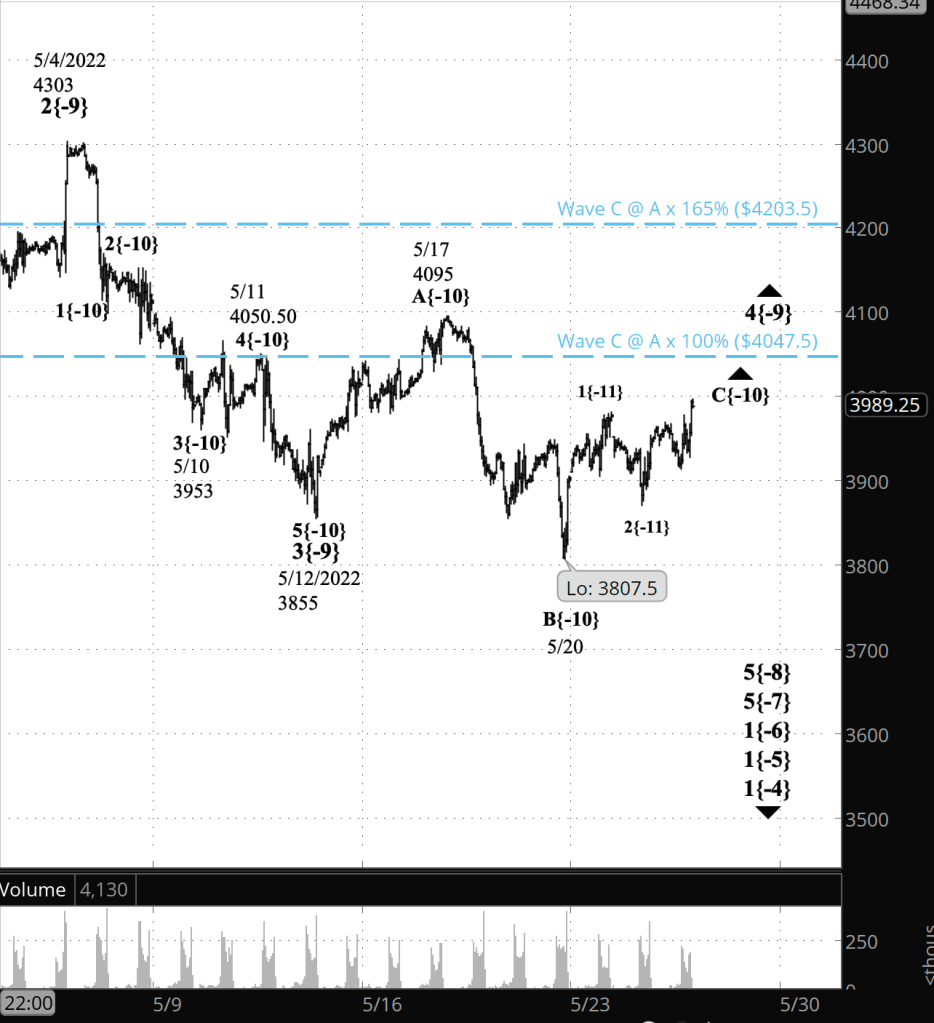
Half an hour before the closing bell. The S&P 500 rose during the session, reaching the 3990s on the futures. The higher it goes, the more likely it is that wave C{-10} within the wave 4{-9} upward correction is still underway. No change in the analysis. I’ve updated the chart.

2:50 p.m. New York time

OLLI earnings play entry. I’ve entered a short bear calls options spread on OLLI and have posted a trade analysis.

2:35 p.m. New York time

DLTR earnings play entry. I’ve entered a short bear call options spread on DLTR and have posted a trade analysis with details of the position’s structure and other details.

9:35 a.m. New York time

What’s happening now? The S&P 500 E-mini futures traded narrowly in the 3900s overnight.

What does it mean? The second of five segments within the final leg of an upward corrective pattern is now underway. When the corrective pattern is complete, it is most likely that the downtrend that began on April 21 from 4509 will resume. I’ve marked the probable ending range of the correction in blue on the chart.

What are the alternatives? There are two, and I consider both to be unlikely.

Alternative #1: The upward correction ended on May 17, and the downward correction has resumed. The severely truncated middle wave of the correction under this scenario makes the chart a poor fit for this analysis.

Alternative #2: The middle wave of the upward correction is still underway and the final wave has yet to begin. The longer the present sideways movement goes, without the price reaching down to the end point of the middle wave so far, the less likely this scenario appears.

[S&P 500 E-mini futures at 3:30 p.m., 50-minute bars, with volume]

What does Elliott wave theory say? Under the principal analysis, wave C{-10} within wave 4{-9} — the final wave in an upward corrective pattern — is now underway. The C wave will have five waves within it, and presently wave 2{-11} of that set is now underway. The end of wave C will mark the end of the parent wave 4, if the 4th is a simple correction. Sometimes 4th waves will string together two or three corrective patterns, and if that occurs, then wave C{-10} will be followed by a connecting wave X{-10} and then wave A{-10}, the first wave of a second corrective pattern.

As discussed in yesterday’s Trader’s Notebook, the various rules and tendencies of Elliott wave analysis allows analysts to infer a likely range within which the C wave will end. In this case, wave C{-10} will likely end between 4047.50 and 4203.50. That’s a tendency, not a sure thing.

Under alternative #1, May 17 marked the end of wave 4{-9} and the subsequent decline is wave 5{-9}, which internally is now working through wave 2{-10}, an upward correction within the downtrend.

Under alternative #2, wave B{-10} within wave 4{-9} is not yet complete.

We Are Here.

These are the waves currently in progress under my principal analysis. Each line on the list shows the wave number, with the subscript in curly brackets, the traditional degree name, the starting date, the starting price of the S&P 500 E-mini futures, and the direction of the wave.

  • S&P 500 Index:
  • 5{+3} Supercycle, 7/8/1932, 4.40 (up)
  • 5{+2} Cycle, 12/9/1974, 60.96 (up)
  • 5{+1} Primary, 3/6/2009, 666.79 (up)
  • 5{0} Intermediate, 12/26/2018, 2346.58 (up)
  • 4{-1} Minor, 1/4/2022 4818.62 (down)
  • 1{-2} Minute, 1/4/2022 4818.62 (down)
  • S&P 500 Futures and index:
  • 1{-3} Minuette, 1/4/2022, 4808.25 (down) (futures), 4818.62 (down) (index)
  • S&P 500 Futures:
  • 1{-4} Subminuette, 1/4/2022, 4808.25 (down)
  • 1{-5} Micro, 1/4/2022, 4808.25 (down)
  • 1{-6} Submicro, 1/4/2022, 4808.25 (down)
  • 5{-7} Minuscule, 3/29/2022, 4631 (down)
  • 5{-8} Subminuscule, 4/21/2022, 4509, (down)

Learning and other resources. Elliott wave analysis provides context, not prophecy. As the 20th century semanticist Alfred Korzybski put it in his book Science and Sanity (1933), “The map is not the territory … The only usefulness of a map depends on similarity of structure between the empirical world and the map.” And I would add, in the ever-changing markets, we can judge that similarity of structure only after the fact.

See the menu page Analytical Methods for a rundown on where to go for information on Elliott wave analysis.

By Tim Bovee, Portland, Oregon, May 25, 2022

Disclaimer

Tim Bovee, Private Trader tracks the analysis and trades of a private trader for his own accounts. Nothing in this blog constitutes a recommendation to buy or sell stocks, options or any other financial instrument. The only purpose of this blog is to provide education and entertainment.

No trader is ever 100 percent successful in his or her trades. Trading in the stock and option markets is risky and uncertain. Each trader must make trading decisions for his or her own account, and take responsibility for the consequences.

License
Creative Commons License

All content on Tim Bovee, Private Trader by Timothy K. Bovee is licensed under a Creative Commons Attribution-ShareAlike 4.0 International License.

Based on a work at www.timbovee.com.