Update 5/26/2022: I exited my short bear call vertical spread on DLTR, 22 days before expiration, for a $4.01 debit per contract/share, a loss before fees of $267 per contract. Shares were trading at $158.60, up $25.14 from the entry level.
The Implied Volatility Rank at exit was 69.8%, down 22.7 points from the entry level.
I exited on the day after entry because the stock price moved contrary to what analysts had expected. DLTR beat earnings expectations, the share price rose sharply, and the bearish options position moved into loss territory. I exited at 109.6% of maximum potential loss.
Shares rose by 18.8% over one day for a +3,186% annual rate. The options position produced a 66.6% loss for a -24,303% annual rate.
I have entered a short bear call vertical spread on DLTR, using options that trade for the last time 23 days hence, on June 17. The premium is a $1.34 credit per contract share and the stock at the time of entry was priced at $133.46.
The Implied Volatility Ratio stood at 92.5%.
Premium:
$1.34
Expire OTM
DLTR-bear call spread
Strike
Odds
Delta
Calls
Long
150.00
80.0%
25
Break-even
146.34
76.5%
29
Short
145.00
73.0%
33
The premium is 53.6% of the width of the position’s short/long spread. The profit zone covers a 9.7% move to the upside and an unlimited move to the downside.
The risk/reward ratio is 2.7:1, with maximum risk of $366 and maximum reward of $134 per contract.
How I chose the trade. The trade was placed to coincide with DLTR’s earnings announcement, before the opening bell on the day after entry. The short strikes were set to coincide with the expected move of $13.95 either way, based on options pricing, which gives a price range of $120.17 to $146.67. I entered a bearish trade based on the Zacks Investment Research earnings surprise predictor of -4.88% along with a sell rank of 4.
By Tim Bovee, Portland, Oregon, May 25, 2022
Disclaimer
Tim Bovee, Private Trader tracks the analysis and trades of a private trader for his own accounts. Nothing in this blog constitutes a recommendation to buy or sell stocks, options or any other financial instrument. The only purpose of this blog is to provide education and entertainment.
No trader is ever 100 percent successful in his or her trades. Trading in the stock and option markets is risky and uncertain. Each trader must make trading decisions for his or her own account, and take responsibility for the consequences.
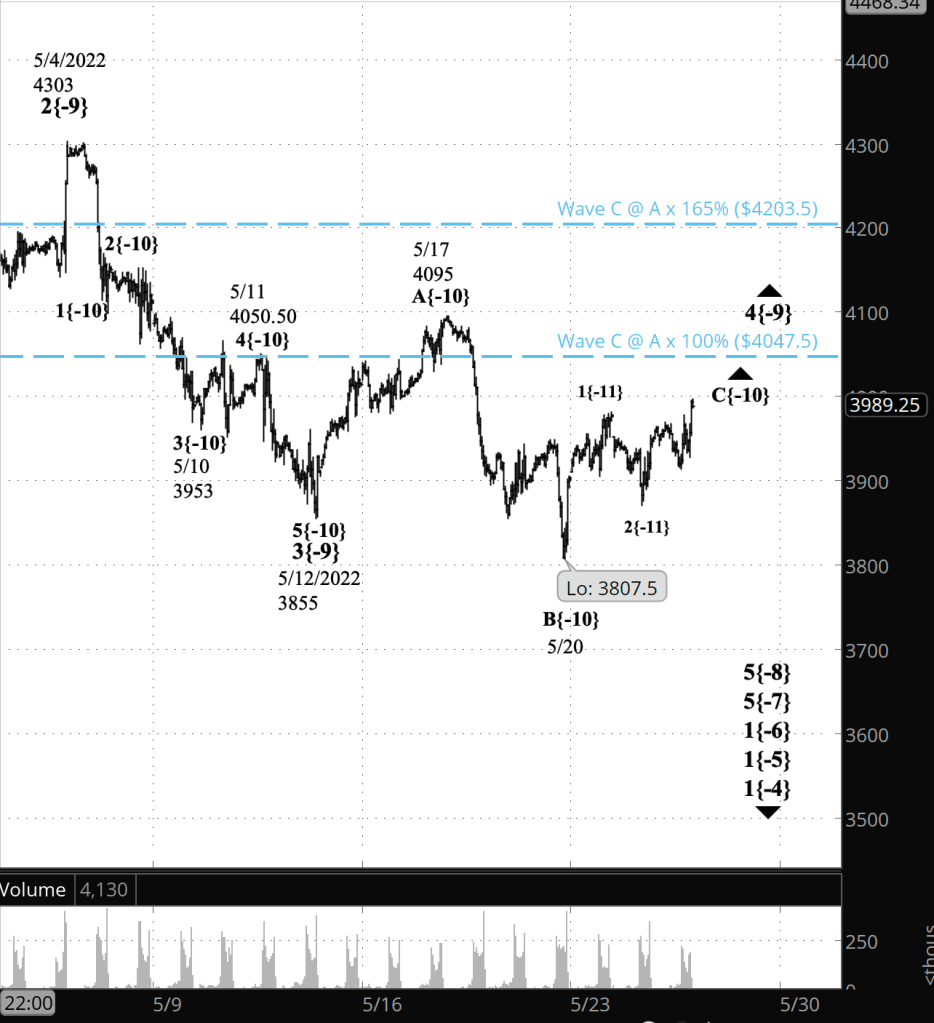
Half an hour before the closing bell. The S&P 500 rose during the session, reaching the 3990s on the futures. The higher it goes, the more likely it is that wave C{-10} within the wave 4{-9} upward correction is still underway. No change in the analysis. I’ve updated the chart.
2:50 p.m. New York time
OLLI earnings play entry. I’ve entered a short bear calls options spread on OLLI and have posted a trade analysis.
2:35 p.m. New York time
DLTR earnings play entry. I’ve entered a short bear call options spread on DLTR and have posted a trade analysis with details of the position’s structure and other details.
9:35 a.m. New York time
What’s happening now? The S&P 500 E-mini futures traded narrowly in the 3900s overnight.
What does it mean? The second of five segments within the final leg of an upward corrective pattern is now underway. When the corrective pattern is complete, it is most likely that the downtrend that began on April 21 from 4509 will resume. I’ve marked the probable ending range of the correction in blue on the chart.
What are the alternatives? There are two, and I consider both to be unlikely.
Alternative #1: The upward correction ended on May 17, and the downward correction has resumed. The severely truncated middle wave of the correction under this scenario makes the chart a poor fit for this analysis.
Alternative #2: The middle wave of the upward correction is still underway and the final wave has yet to begin. The longer the present sideways movement goes, without the price reaching down to the end point of the middle wave so far, the less likely this scenario appears.
[S&P 500 E-mini futures at 3:30 p.m., 50-minute bars, with volume]
What does Elliott wave theory say? Under the principal analysis, wave C{-10} within wave 4{-9} — the final wave in an upward corrective pattern — is now underway. The C wave will have five waves within it, and presently wave 2{-11} of that set is now underway. The end of wave C will mark the end of the parent wave 4, if the 4th is a simple correction. Sometimes 4th waves will string together two or three corrective patterns, and if that occurs, then wave C{-10} will be followed by a connecting wave X{-10} and then wave A{-10}, the first wave of a second corrective pattern.
As discussed in yesterday’s Trader’s Notebook, the various rules and tendencies of Elliott wave analysis allows analysts to infer a likely range within which the C wave will end. In this case, wave C{-10} will likely end between 4047.50 and 4203.50. That’s a tendency, not a sure thing.
Under alternative #1, May 17 marked the end of wave 4{-9} and the subsequent decline is wave 5{-9}, which internally is now working through wave 2{-10}, an upward correction within the downtrend.
Under alternative #2, wave B{-10} within wave 4{-9} is not yet complete.
We Are Here.
These are the waves currently in progress under my principal analysis. Each line on the list shows the wave number, with the subscript in curly brackets, the traditional degree name, the starting date, the starting price of the S&P 500 E-mini futures, and the direction of the wave.
Learning and other resources. Elliott wave analysis provides context, not prophecy. As the 20th century semanticist Alfred Korzybski put it in his book Science and Sanity (1933), “The map is not the territory … The only usefulness of a map depends on similarity of structure between the empirical world and the map.” And I would add, in the ever-changing markets, we can judge that similarity of structure only after the fact.
See the menu page Analytical Methods for a rundown on where to go for information on Elliott wave analysis.
By Tim Bovee, Portland, Oregon, May 25, 2022
Disclaimer
Tim Bovee, Private Trader tracks the analysis and trades of a private trader for his own accounts. Nothing in this blog constitutes a recommendation to buy or sell stocks, options or any other financial instrument. The only purpose of this blog is to provide education and entertainment.
No trader is ever 100 percent successful in his or her trades. Trading in the stock and option markets is risky and uncertain. Each trader must make trading decisions for his or her own account, and take responsibility for the consequences.
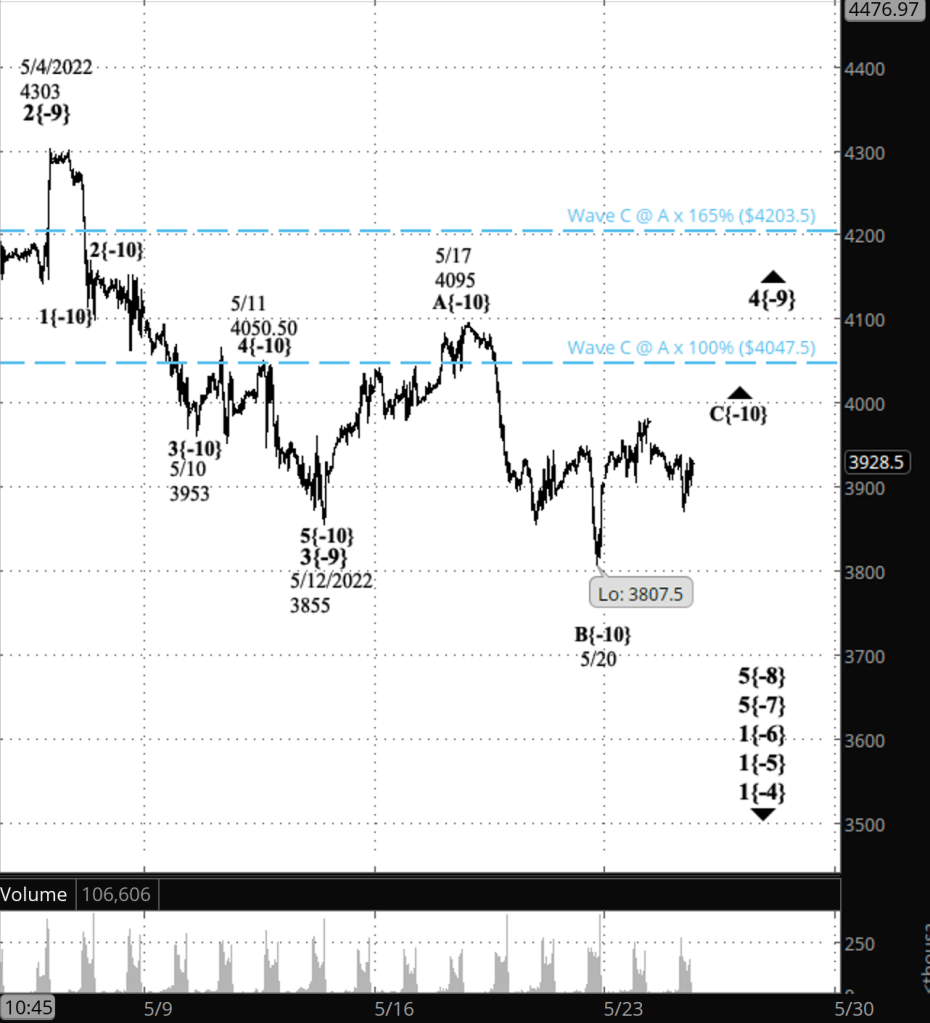
Half an hour before the closing bell. The final wave of the present upward corrective pattern in the S&P 500 continues. Wave C{-10} within wave 4{-9} will have five waves internally. The 1st wave is complete, a two-day drop from the 3900s in the futures into the 3800s was the 2nd wave, and a 3rd wave to upside may have begun, as the price returns to the 3900s. No change in the analysis. I’ve updated the upper chart.
9:35 a.m. New York time
What’s happening now? The S&P 500 E-mini futures continued to trade in the 3900s overnight, as it has since last Friday.
What does it mean? The upward correction that began May 12 continues, as does its third and likely final leg, which began on May 20.
What are the alternatives? Unchanged from yesterday.
Alternative #1: The second leg of the correction is still be underway. The price has reached the target price range and yet could have a bit more downside left.
Alternative #2: The upward correction ended on May 17, and the decline that followed is a resumption of the downtrend that began on April 21 from 4509.
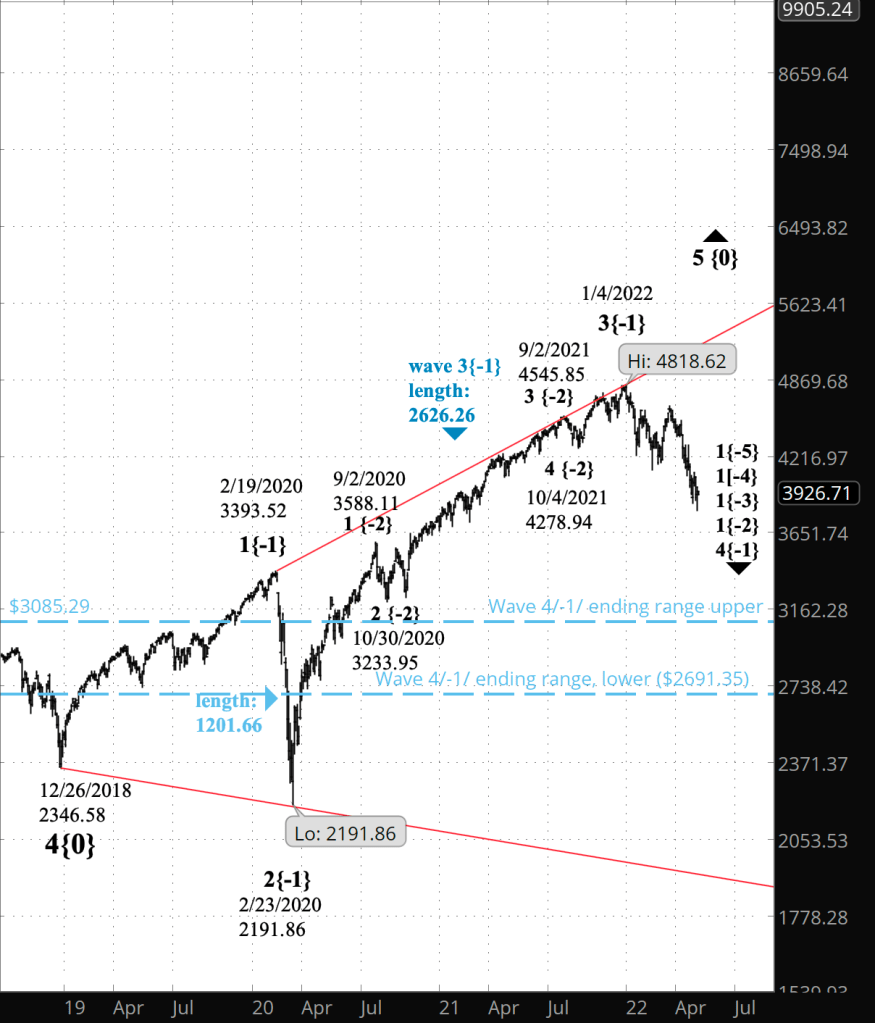
The Charts. The upper chart is a close-up view of the decline that began on May 4, covering 15 trading days. I’ll discuss it in the “What does Elliott wave theory say?” section. The lower chart covers the past three years and shows the present expanding Diagonal Triangle in its entirety. I’ll discuss it a section called “The Big Picture”, including setting some price targets for the decline that began on January 4.
[S&P 500 E-mini futures at 3:30 p.m., 45-minute bars, with volume]
[S&P 500 index at 9:34 a.m., 2-day bars]
What does Elliott wave theory say? Under the principal analysis, the upward correction, wave 4{-9} is in what most likely will be its final wave, C{-10}. The correction is taking the form of a Flat, and C waves in Flats will often retrace 100% to 165% of the preceding A wave, giving a target price range of 4047.50 to 4203.50. I’ve marked those levels on the chart with blue dashed lines.
I say the C wave is likely the final wave because 4th wave corrections commonly have three waves internally. Sometimes, however, 4th waves will connect two or three corrective patterns patterns together. It’s less common, but not uncommon.
Under Alternative #1, wave B{-10} within wave 4{-9} is nearing an end but has not yet reached completion. It will be followed by a resumption of the downtrend, wave 5{-9}.
Under Alternative #2, the upward correction, wave 4{-9}, ended on May 17 after completing three waves, with an overly short B wave in the middle. The decline the followed is downtrending wave 5{-9}.
The principal and the alternatives are all playing out within downtrending wave 5{-8}, which began on April 21 from 4509.
The Big Picture. The lower chart shows a view of the S&P 500 index since the beginning, on December 26, 2018, of the expanding Diagonal Triangle that has encompassed all of the ups and downs of the markets for more than three years.
The Triangle is wave 5{0} within the wave 5{+1} uptrend that began on March 6, 2009, from 666.79. We’ve come a long way since that middle year of the Great Recession.
A Diagonal Triangle has five waves within it, and the present decline is wave 4{-1}. My question is, how low can it go?
Elliott wave theory provides answers. There are two rules governing the 4th wave of a Diagonal Triangle. It never moves beyond the end of the preceding 1st wave, and must end within the price range of that 1st wave.
Wave 4{-1} can’t move below 2346.58, where wave 1{-1} began, and it must decline to at least 3393.52, the endpoint of wave 1{-1}.
There are also some tendencies relating to 4th waves within Diagonal Triangles.
The 4th wave is usually longer than the preceding 2nd wave. Wave 2{-1} was 1,201.66 points long, wave 4{-1} began at 4818.62, and subtraction gives us a 4th wave endpoint of at least 3616.46, around 350 points below the present level.
The 4th usually retraces between 66% and 81% of the preceding 3rd wave. Wave 3{-1}, which ended at 4818.62, is 2,626.26 in length. So 66% of that length is 1,733.33 and 81% is 2,127.27. Those lengths, subtracted from the endpoint, provide a price range of 2691.35 to 3085.29.
Put all the rules and the tendencies together, and the endpoint of the present wave 4{-1} downtrend is likely to be between 2691.35 and 3085.29, more or less. I’ve marked that range on the chart with blue dotted lines.
However, a caveat. That range describes tendencies. Under the strict rules, wave 4{-1} could end as high as 3393.52 and as low as 2346.58 — each about 300 points beyond the nearest retracement wave the 3rd wave..
We Are Here.
These are the waves currently in progress under my principal analysis. Each line on the list shows the wave number, with the subscript in curly brackets, the traditional degree name, the starting date, the starting price of the S&P 500 E-mini futures, and the direction of the wave.
Learning and other resources. Elliott wave analysis provides context, not prophecy. As the 20th century semanticist Alfred Korzybski put it in his book Science and Sanity (1933), “The map is not the territory … The only usefulness of a map depends on similarity of structure between the empirical world and the map.” And I would add, in the ever-changing markets, we can judge that similarity of structure only after the fact.
See the menu page Analytical Methods for a rundown on where to go for information on Elliott wave analysis.
By Tim Bovee, Portland, Oregon, May 24, 2022
Disclaimer
Tim Bovee, Private Trader tracks the analysis and trades of a private trader for his own accounts. Nothing in this blog constitutes a recommendation to buy or sell stocks, options or any other financial instrument. The only purpose of this blog is to provide education and entertainment.
No trader is ever 100 percent successful in his or her trades. Trading in the stock and option markets is risky and uncertain. Each trader must make trading decisions for his or her own account, and take responsibility for the consequences.
Correction. The price targets for Wave C{-10} in the Elliott Wave section were slightly off. I’ve corrected the calculation and the text, and have added red dashed lines to the chart that shows the likely range of the wave’s endpoint.
3:30 p.m. New York time
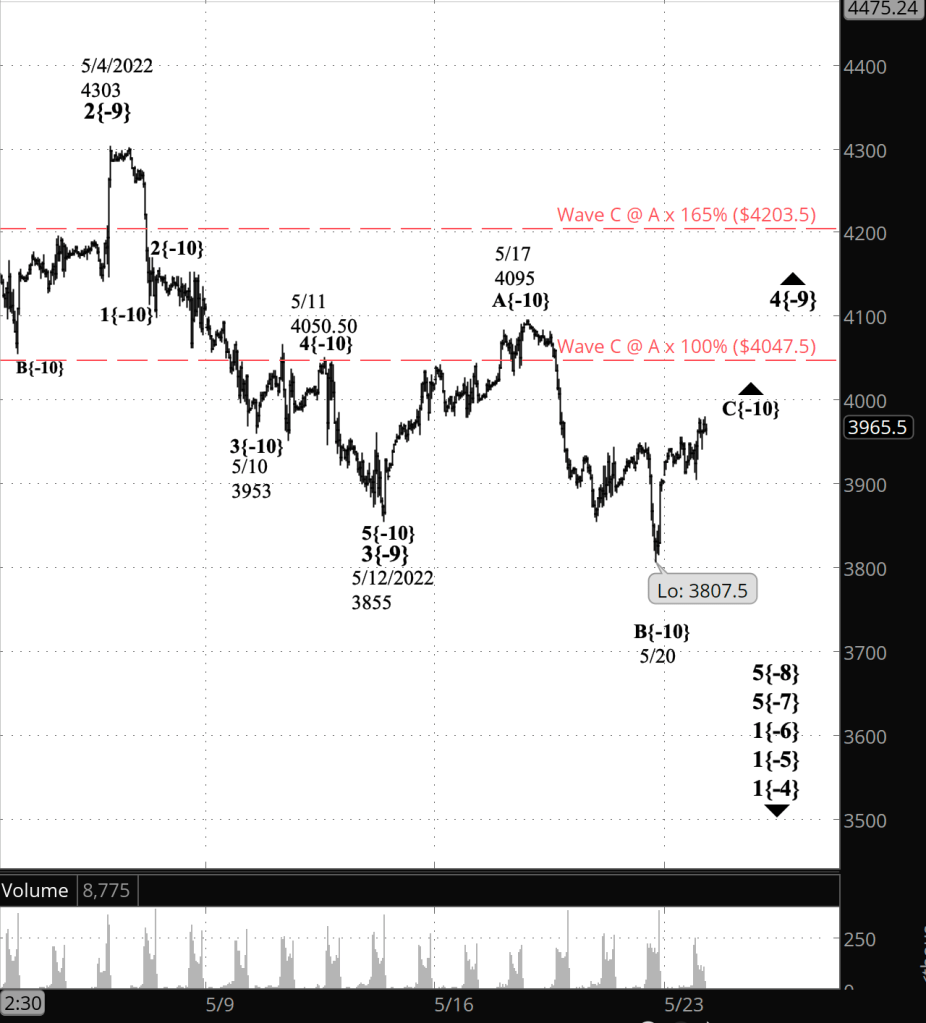
Half an hour before the closing bell. The S&P 500 moved slightly higher during the session, into the mid 3900s on the futures. No change in the analysis. I’ve updated the chart.
9:35 a.m. New York time
What’s happening now? The S&P 500 E-mini futures traded in a narrow range, in the low 3900s, after trading resumed overnight.
What does it mean? The upward correction that began on May 12 from 3855 is now in its third and likely final leg.
What are the alternatives? There are two:
Alternative #1: The second leg of the correction is still be underway. The price has reached the target price range and yet could have a bit more downside left.
Alternative #2: The upward correction ended on May 17, and the decline that followed is a resumption of the downtrend that began on April 21 from 4509.
[S&P 500 E-mini futures at 3:30 p.m., 45-minute bars, with volume]
What does Elliott wave theory say? Under my principal analysis, wave 4{-9}, which began on May 12, is now in its third wave, C{-10}. In a Flat corrective pattern, the C wave is usually 100% to 165% as long as the preceding wave A. In this case, wave A{-10} was 240 points long, wave C that is 100% of that length would reach 4047.50, and at 165% of that length would reach 4203.50.
Wave C{-10} ends the corrective pattern, but sometimes corrections, especially 4th waves, will take a compound form, connecting two or three corrective patterns together within a single parent wave. The patterns are separated by connecting waves.
Under Alternative #1, wave B{-10} — the middle wave of its parent wave 4{-9} — is still underway. Friday’s low, 3807.25, was within the target price range, and the pattern can be counted as having three waves internally. Yet the rise and pause after that low could be subwaves of the third subwave within B{-10}.
Under Alternative #2, wave 4{-9} ended on May 17 at 4095. The internal wave structure is a bit muddy — trending waves and corrections seem shallower than they ought to be. Nonetheless, it can be counted as being a complete 4th wave correction.
We Are Here.
These are the waves currently in progress under my principal analysis. Each line on the list shows the wave number, with the subscript in curly brackets, the traditional degree name, the starting date, the starting price of the S&P 500 E-mini futures, and the direction of the wave.
Learning and other resources. Elliott wave analysis provides context, not prophecy. As the 20th century semanticist Alfred Korzybski put it in his book Science and Sanity (1933), “The map is not the territory … The only usefulness of a map depends on similarity of structure between the empirical world and the map.” And I would add, in the ever-changing markets, we can judge that similarity of structure only after the fact.
See the menu page Analytical Methods for a rundown on where to go for information on Elliott wave analysis.
By Tim Bovee, Portland, Oregon, May 23, 2022
Disclaimer
Tim Bovee, Private Trader tracks the analysis and trades of a private trader for his own accounts. Nothing in this blog constitutes a recommendation to buy or sell stocks, options or any other financial instrument. The only purpose of this blog is to provide education and entertainment.
No trader is ever 100 percent successful in his or her trades. Trading in the stock and option markets is risky and uncertain. Each trader must make trading decisions for his or her own account, and take responsibility for the consequences.
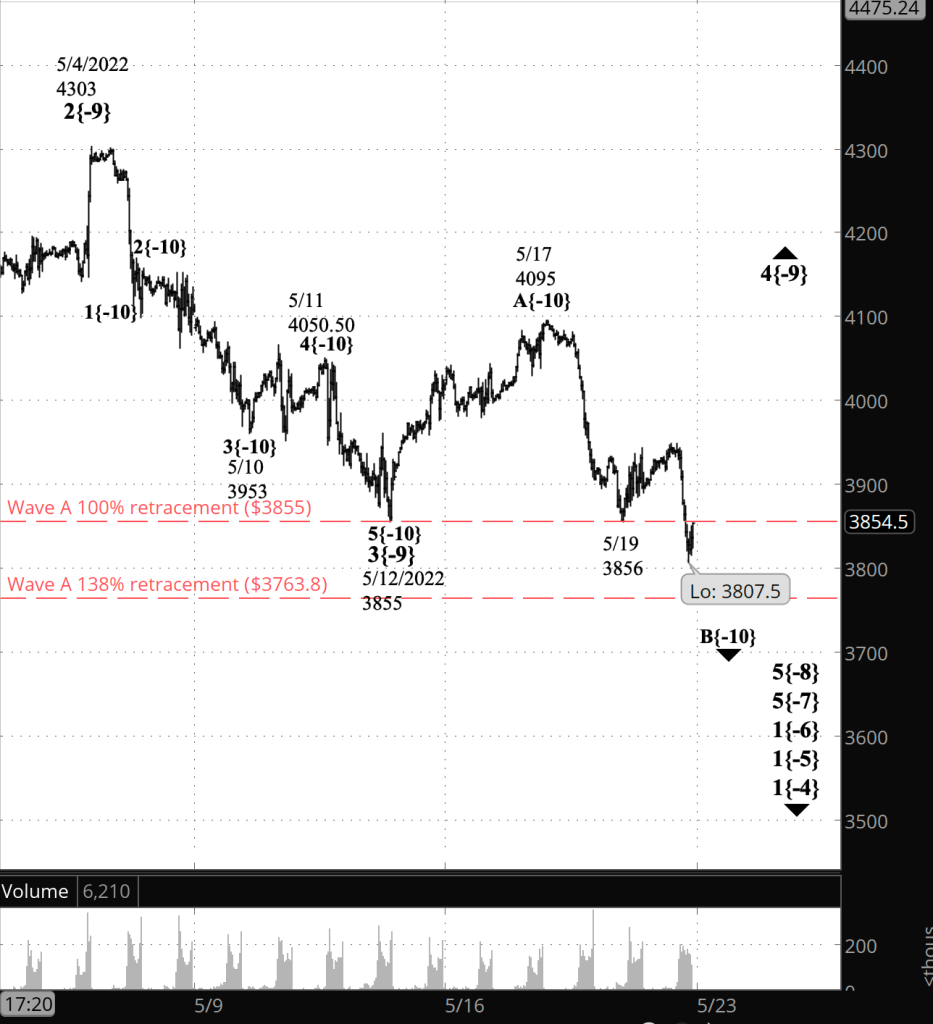
Half an hour before the closing bell. By falling below 3855, the starting point of the first leg of the present upward correction, the price decline during today’s session cleared up one ambiguity in the chart: The wave 4{-9} correction is taking the form of a Flat, which is the most common form taken by 4th waves. That Flat is in its middle segment, wave B{-10}.
Although a 138% maximum retracement of the A wave is a common outcome of the B wave in a Flat, it’s not a firm rule, just a tendency. So the price may well move below the present 3807.50 low of the day toward the 138% retracement level, 3763.80, and might even drop lower. Or, the low of the day might be the end of wave B{-10} and the start of upward wave C{-10}.
No change in the mid-day re-analysis. I’ve updated the upper chart.
1:10 p.m. New York time
A fresh analysis. The S&P 500 reversed and moved below the May 12 low, 3855. That invalidates the principal analysis from this morning and pushes things back to Thursday’s analysis. The middle wave of an upward correction that began on May 12 is still underway.
In Elliott wave terminology, the present wave is B{-10} within wave 4{-9}. The B wave began on May 17 from 4095. B waves often retrace between 100% and 138% of the preceding A wave. This B wave has already broken through the 100% retracement, 3855, and dropping toward the 138% retracement, 3763.80.
Once wave B{-10} is complete, then this morning’s principal analysis of wave C{-10} will kick in.
I’ve retained the old chart and added a new one, with red lines marking the 100% and 138% retracement levels.
[S&P 500 E-mini futures at 3:30 p.m., 40-minute bars, with volume]
10:15 a.m. New York time
FL earnings play exit. I’ve exited my short bull put options spread on FL for 58.5% of maximum potential profit and have updated the trade analysis with results.
9:35 a.m. New York time
What’s happening now? The S&P 500 E-mini futures rose overnight, retracing 38.2% of the rise from May 12 to May 17.
What does it mean? The overnight rise is the third leg of an upward correction within a larger downtrend that began on April 21. When the present rise is complete, it will be followed by a resumption of the downtrend that will carry the price below the May 12 low, 3855, and perhaps significantly lower.
What are the alternatives? There are two.
Alternative #1: The upward correction ended on May 17, and the subsequent decline was a resumption of the downtrend, the overnight rise being a smaller upward correction within that downtrend.
Alternative #2: The present corrective pattern will be followed by a second corrective pattern and perhaps a third, forming a compound correction.
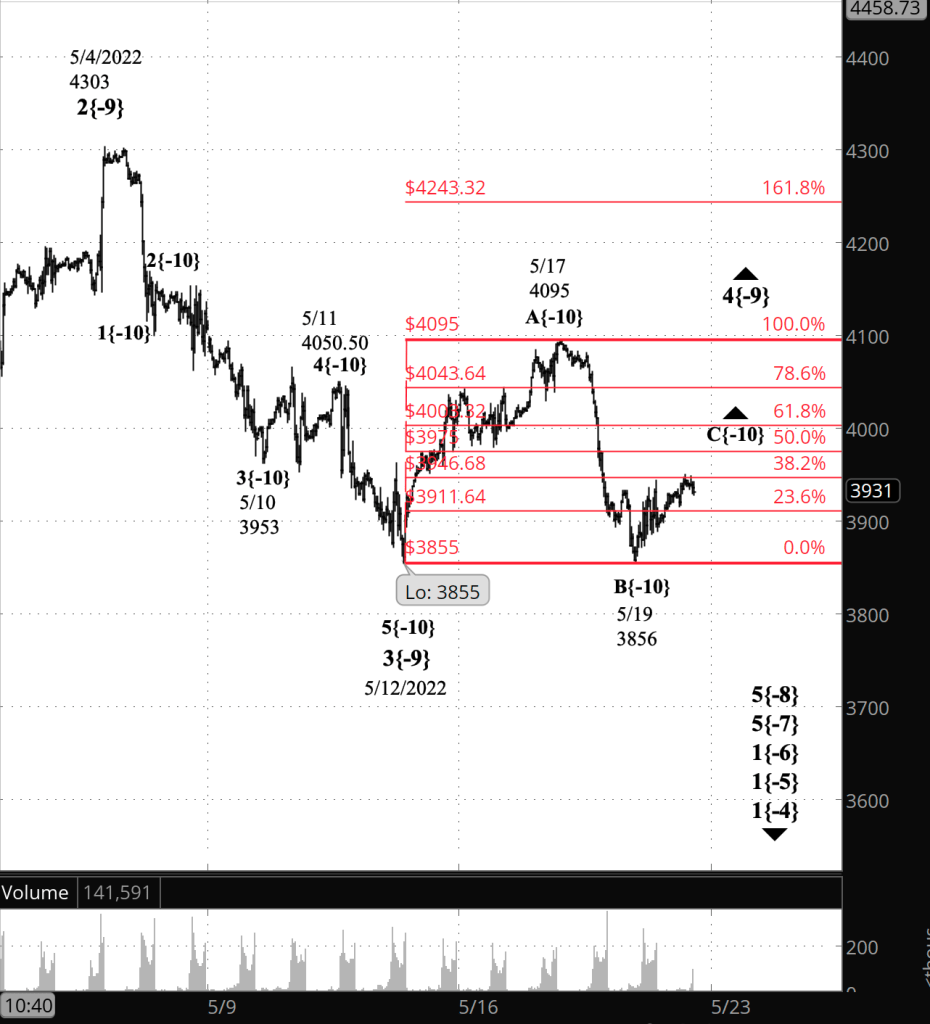
[OUTDATED: S&P 500 E-mini futures at 9:35 a.m., 40-minute bars, with volume]
What does Elliott wave theory say? Under the principal analysis, wave C{-10} within wave 4{-9} — the third leg within an upward correction — began on May 19.
The upward potential of this wave C depends upon the pattern of the three-wave correction.
If it’s a Zigzag (A: 5 waves internally, B: 3, C: 5), then it will often cover the same distance as the preceding A wave, which was 240 points long, giving a target of 4096.
If it’s a Flat (A: 3, B: 3, C: 5), then wave C will often retrace 100% to 165% of wave A, giving a target of 4095 to 4251.
Under Alternative #1, wave 4{-9} ended on May 17 at 4095. The subsequent decline was wave 1{-10} within downtrending wave 5{-9}, and the overnight rise was wave 2{-10}, an upward correction.
Under Alternative #2, the end of wave C{-10} won’t be the end of wave 4 {-9}. Instead, the C wave will be followed by a connecting wave, which I will label wave X{-10}, and then by a second three-wave pattern, and perhaps a third in a compound correction.
We Are Here.
These are the waves currently in progress under my principal analysis. Each line on the list shows the wave number, with the subscript in curly brackets, the traditional degree name, the starting date, the starting price of the S&P 500 E-mini futures, and the direction of the wave.
Learning and other resources. Elliott wave analysis provides context, not prophecy. As the 20th century semanticist Alfred Korzybski put it in his book Science and Sanity (1933), “The map is not the territory … The only usefulness of a map depends on similarity of structure between the empirical world and the map.” And I would add, in the ever-changing markets, we can judge that similarity of structure only after the fact.
See the menu page Analytical Methods for a rundown on where to go for information on Elliott wave analysis.
By Tim Bovee, Portland, Oregon, May 20, 2022
Disclaimer
Tim Bovee, Private Trader tracks the analysis and trades of a private trader for his own accounts. Nothing in this blog constitutes a recommendation to buy or sell stocks, options or any other financial instrument. The only purpose of this blog is to provide education and entertainment.
No trader is ever 100 percent successful in his or her trades. Trading in the stock and option markets is risky and uncertain. Each trader must make trading decisions for his or her own account, and take responsibility for the consequences.
Update 5/20/2022: I exited my short bull put vertical spread on FL, 28 days before expiration, for a $0.27 debit per contract/share, a profit before fees of $38 per contract. Shares were trading at $33.07, up $2.64 from the entry level.
The Implied Volatility Rank at exit was 90.8%, down 13.2 points from the entry level.
I exited on the day after entry at 58.5% of maximum potential profit, well above my normal exit point for earnings plays, 25% of max.
Shares rose by 8.7% over one day for a +3,167% annual rate. The options position produced a 140.7% return for a +51,370% annual rate.
I have entered a short bull put vertical spread on FL, using options that trade for the last time 29 days hence, on June 17. The premium is a $0.65 credit per contract share and the stock at the time of entry was priced at $30.43.
The Implied Volatility Ratio stood at 104.0%.
Premium:
$0.65
Expire OTM
FL-bull put spread
Strike
Odds
Delta
Puts
Long
25.00
71.0%
20
Break-even
28.15
65.0%
25.5
Short
27.50
59.0%
31
The premium is 52% of the width of the position’s short/long spread. The profit zone covers a 7.5% move to the downside and an unlimited move to the upside.
The risk/reward ratio is 2.8:1, with maximum risk of $185 and maximum reward of $65 per contract.
How I chose the trade. The trade was placed to coincide with FL’s earnings announcement, before the closing bell on the day after entry. The short strikes were set to coincide with the expected move of $4.59 either way, based on options pricing, which gives a price range of $25.92 to $34.94.
By Tim Bovee, Portland, Oregon, May 19, 2022
Disclaimer
Tim Bovee, Private Trader tracks the analysis and trades of a private trader for his own accounts. Nothing in this blog constitutes a recommendation to buy or sell stocks, options or any other financial instrument. The only purpose of this blog is to provide education and entertainment.
No trader is ever 100 percent successful in his or her trades. Trading in the stock and option markets is risky and uncertain. Each trader must make trading decisions for his or her own account, and take responsibility for the consequences.
Half an hour before the closing bell. The S&P 500 traded in a narrow range during the session, remaining fewer than 90 points above the overnight low on the futures. No change in the analysis. I’ve updated the chart.
2:05 p.m. New York time
FL earnings play entry. I’ve entered an earnings play on FL, using options that expire in 29 days, and have posted an analysis of the trade.
9:35 a.m. New York time
What’s happening now? The S&P 500 E-mini futures fell overnight to 3856, a point above the starting point of the upward correction that began on May 12, and then rose slightly.
What does it mean? The upward correction is in its second leg, and how much further the price can fall will depend upon what form the correction is taking. Under my principal analysis, the correction is a Flat and could reach as low as the 3760s.
What’s the alternative? Under my first alternative analysis, the correction taking the form of a Zigzag, which never moves below the start of the first leg of a correction. The downside potential is one point, to 3855.
Under a second alternative analysis, the entire upward correction ended on May 17 and there is no specified limit to the downside.
[S&P 500 E-mini futures at 3:30 p.m., 35-minute bars, with volume]
What does Elliott wave theory say? Wave 4{-9}, an upward correction, began May 12 from 3855. On that all three possible analyses agree.
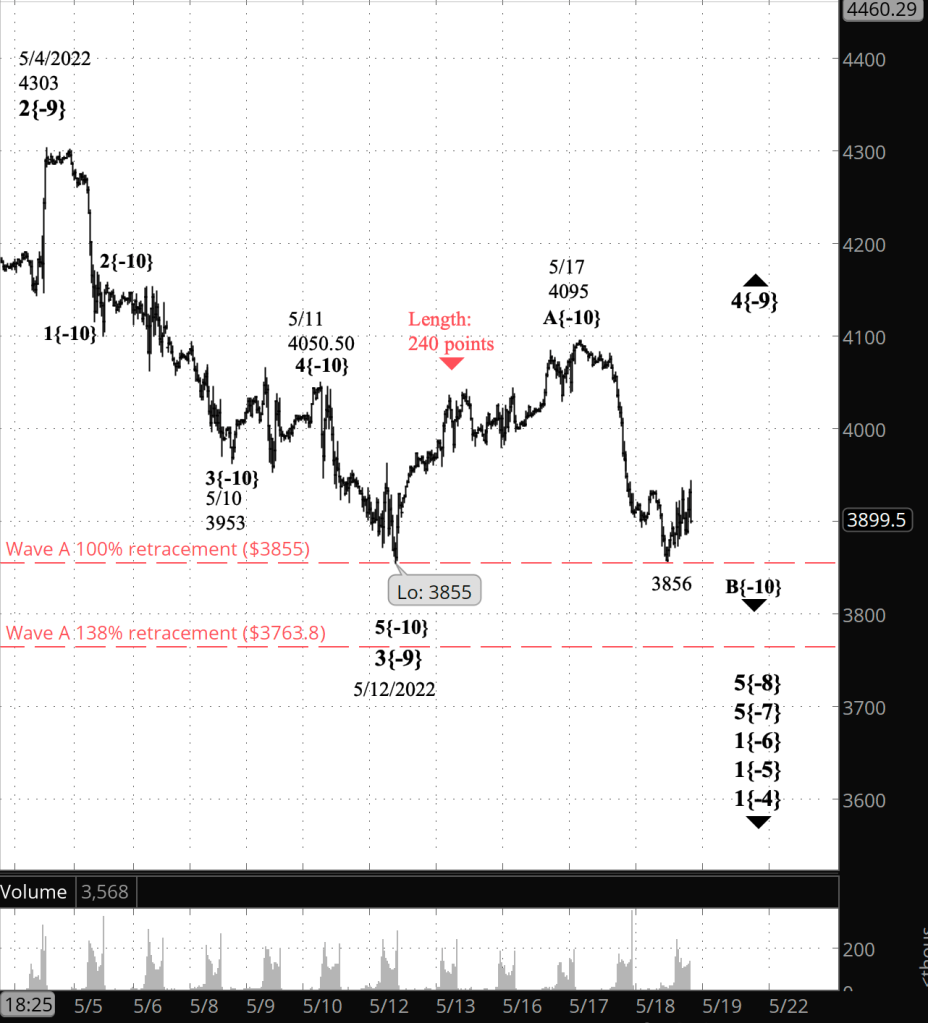
Under my principal analysis, the first wave within the correction, wave A{-10}, has three waves internally, meaning that the correction is taking the form of a Flat, with three subwaves within the A wave. This is the more common form of a 4th wave correction. The B wave of a Flat often will retrace 100% to 138% of the preceding A wave (the dotted red lines on the chart), bringing the price potentially as low as 3763.80. This is the scenario shown in the chart.
Under my first alternative analysis, wave A{-10} has five waves internally meaning that the correction is taking the form of a Zigzag. The A-wave count is a bit messy, and I can see it as five waves or three, depending upon how I define the degree of each movement within the wave. The B wave of a Zigzag never moves below the start of the preceding A wave. The B wave’s overnight low, 3856, is one point above the start of wave A (the top dotted red line on the chart).
Under my second alternative analysis, the rise from May 12 to May 17 is the entirety of wave 4{-9}, with three waves within it. Under this scenario, the decline now underway is wave 5{-9}, and there is no limit to how low it can go, beyond the need for waves of the same degree to be more or less proportionally similar to each other.
What the chart shows as wave B{-10} is consistent with both the principal and first alternative analyses, and with the second analysis, if the wave is renumbered to wave 5{-9}. A dip below 3855 would eliminate the first alternative — the Zigzag scenario. A move below 3763.80 would most likely eliminate the principal analysis — the Flat scenario. If both are eliminated, then the 5th wave scenario remains.
We Are Here.
These are the waves currently in progress under my principal analysis. Each line on the list shows the wave number, with the subscript in curly brackets, the traditional degree name, the starting date, the starting price of the S&P 500 E-mini futures, and the direction of the wave.
Learning and other resources. Elliott wave analysis provides context, not prophecy. As the 20th century semanticist Alfred Korzybski put it in his book Science and Sanity (1933), “The map is not the territory … The only usefulness of a map depends on similarity of structure between the empirical world and the map.” And I would add, in the ever-changing markets, we can judge that similarity of structure only after the fact.
See the menu page Analytical Methods for a rundown on where to go for information on Elliott wave analysis.
By Tim Bovee, Portland, Oregon, May 19, 2022
Disclaimer
Tim Bovee, Private Trader tracks the analysis and trades of a private trader for his own accounts. Nothing in this blog constitutes a recommendation to buy or sell stocks, options or any other financial instrument. The only purpose of this blog is to provide education and entertainment.
No trader is ever 100 percent successful in his or her trades. Trading in the stock and option markets is risky and uncertain. Each trader must make trading decisions for his or her own account, and take responsibility for the consequences.
Half an hour before the closing bell. The S&P 500 fell during the day in the downward middle wave of an upward correction that began on May 12. The correction is wave 4{-9}, and the middle wave is B{-10}. Fourth waves tend to be Flats,. and that’s how I count wave 4{-9}.
The B wave within a Flat tends to retrace from 100% to 138% of the preceding A wave. Wave A{-10} was 247 points long. If this B-wave retracement behaves normally, it will end between 3855 and 3763.80.
No change in the analysis. I’ve updated the chart, with red lines showing the 100% and 138% retracement levels.
2:20 p.m. New York time
LOW earnings play exit. I’ve exited my short bull put vertical spread on LOW, for 75.6% of maximum potential loss, and have updated the trade analysis with results.
9:35 a.m. New York time
What’s happening now? The S&P 500 E-mini futures stayed close to the 50% retracement mark in overnight trading, and then declined as the opening bell drew near.
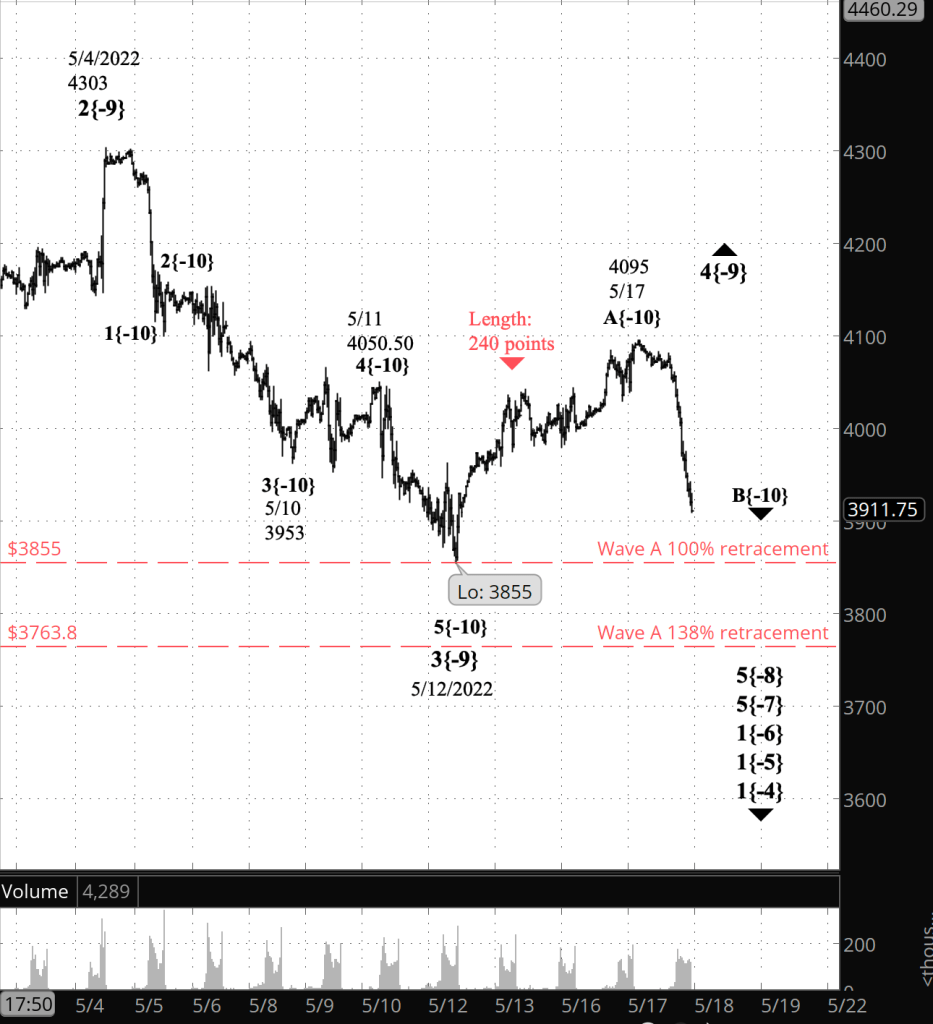
What does it mean? The first leg of the upward correction that began on May 12 ended at yesterday’s high, 4095. The second leg, a downward move, can be expected to retrace at least 90% of the first wave and perhaps as much as 138%.
What’s the alternative? Although the first leg appears to have met the requirements for completion — three subwaves within a Flat pattern — there’s enough ambiguity on the chart to suggest that the first leg may still be unfinished.
[S&P 500 E-mini futures at 3:30 p.m., 35-minute bars, with volume]
What does Elliott wave theory say? Under my principal analysis, wave A{-10} within wave 4{-9} ended at Tuesday’s peak, 4095, and wave B{-10} to the downside has begun. Fourth waves tend to take a Flat pattern — although not always — and Flats internally have three subwaves within the A wave, three within B and five within C. However, if wave 4{-9} turns out to be a Zigzag, then subwave A{-10} must have five waves internally and will rise ore before reaching completion. That possibility is my alternative analysis.
We Are Here.
These are the waves currently in progress under my principal analysis. Each line on the list shows the wave number, with the subscript in curly brackets, the traditional degree name, the starting date, the starting price of the S&P 500 E-mini futures, and the direction of the wave.
Learning and other resources. Elliott wave analysis provides context, not prophecy. As the 20th century semanticist Alfred Korzybski put it in his book Science and Sanity (1933), “The map is not the territory … The only usefulness of a map depends on similarity of structure between the empirical world and the map.” And I would add, in the ever-changing markets, we can judge that similarity of structure only after the fact.
See the menu page Analytical Methods for a rundown on where to go for information on Elliott wave analysis.
By Tim Bovee, Portland, Oregon, May 18, 2022
Disclaimer
Tim Bovee, Private Trader tracks the analysis and trades of a private trader for his own accounts. Nothing in this blog constitutes a recommendation to buy or sell stocks, options or any other financial instrument. The only purpose of this blog is to provide education and entertainment.
No trader is ever 100 percent successful in his or her trades. Trading in the stock and option markets is risky and uncertain. Each trader must make trading decisions for his or her own account, and take responsibility for the consequences.
Update 5/18/2022: I exited my short bull put vertical spread on LOW, 30 days before expiration, for a $257 debit per contract/share, a loss before fees of $97 per contract. Shares were trading at $180.15, down $11.25 from the entry level.
The Implied Volatility Rank at exit was 81.8%, down 11.2 points from the entry level.
I exited on the day after entry, for 76.6% of maximum potential loss, because the position moved against my trade and was unprofitable.
Shares fell by 5.9% over one day for a -2,145% annual rate. The options position produced a 37.7% loss for a -13,776% annual rate.
I have entered a short bull put vertical spread on LOW, using options that trade for the last time 31 days hence, on June 17. The premium is a $1.60 credit per contract share and the stock at the time of entry was priced at $191.40.
The Implied Volatility Ratio stood at 93.0%.
Premium:
$1.60
Expire OTM
LOW-bull put spread
Strike
Odds
Delta
Puts
Long
180.00
66.0%
29
Break-even
186.60
62.0%
32.5
Short
185.00
58.0%
36
The premium is 64% of the width of the position’s short/long spread. The profit zone covers a 5.1% move to the downside and an unlimited move to the upside.
The risk/reward ratio is 2.1:1, with maximum risk of $340 and maximum reward of $160 per contract.
How I chose the trade. The trade was placed to coincide with LOW’s earnings announcement, before the opening bell on the day after entry. The short strikes were set in consideration of the expected move of $10.62 either way, based on options pricing, which gives a price range of $180.78 to $202.20, balanced against the need for a low risk/reward ratio and a sufficiently high premium to make the trade worthwhile.
By Tim Bovee, Portland, Oregon, May 17, 2022
Disclaimer
Tim Bovee, Private Trader tracks the analysis and trades of a private trader for his own accounts. Nothing in this blog constitutes a recommendation to buy or sell stocks, options or any other financial instrument. The only purpose of this blog is to provide education and entertainment.
No trader is ever 100 percent successful in his or her trades. Trading in the stock and option markets is risky and uncertain. Each trader must make trading decisions for his or her own account, and take responsibility for the consequences.
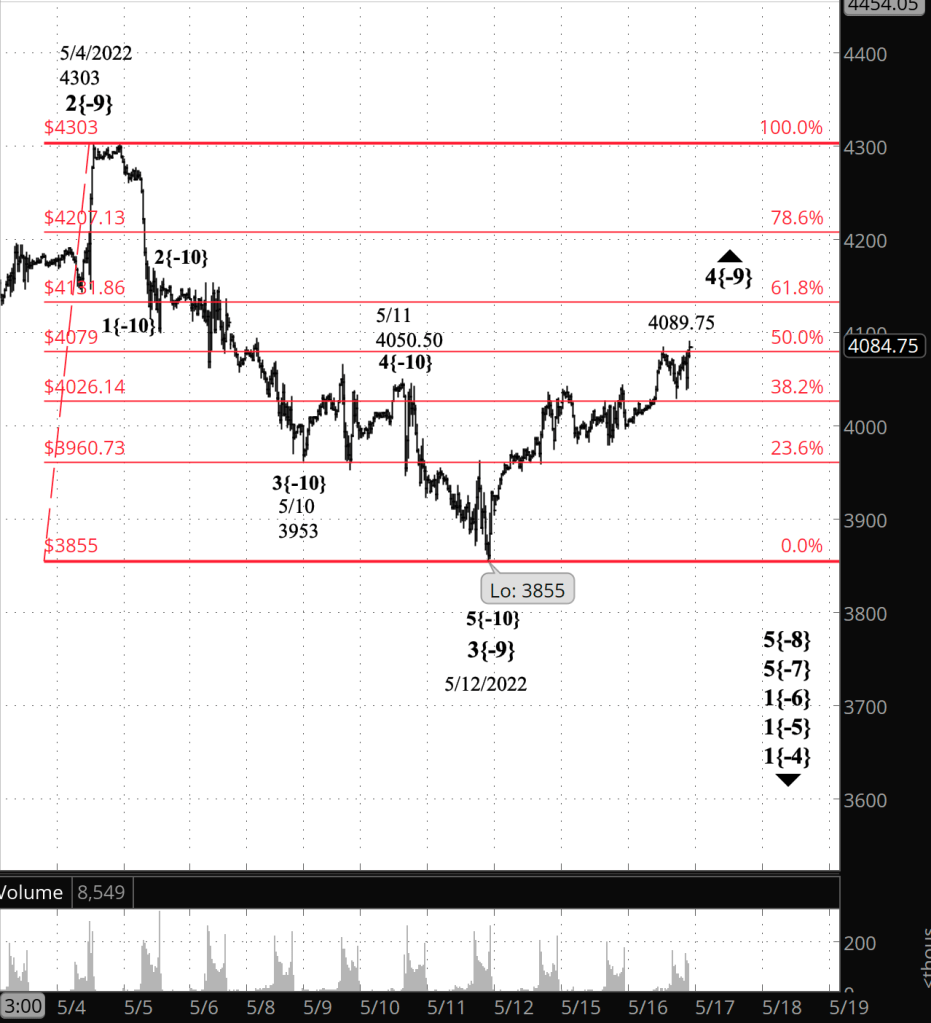
Half an hour before the closing bell. The S&P 500 rose six points above the overnight high, to 4089.75 on the futures. The price declined to a 38.2% retracement of the decline from May 4 to May 12 and then moved back up to a 50% retracement. The upward correction, wave 4{-9}, continues. No change in the analysis. I’ve updated the chart.
1:30 p.m. New York time
LOW earnings play entry. I’ve entered a short bull put vertical spread, using options that expire on June 17, and have posted an analysis of the trade.
12:55 p.m. New York time
HD earnings play exit. I’ve exited my short bull put options spread on HD for 64.9% of maximum potential profit and have updated the trade analysis with results.
9:35 a.m. New York time
What’s happening now? The S&P 500 E-mini futures continued to rise overnight, reaching into the 4080s.
What does it mean? I’ve revised the principal analysis to accommodate the length of the rise. The March 12 low marks the end of the downtrend that began on May 4 from 4303. The subsequent rise is an upward correction that has so far retraced 50% of the decline. I’ve placed a Fibonacci retracement grid over the chart.
What’s the alternative? If the price moves above 4303, the high of May 4, then the count may require a revision. I discuss the reasoning behind that conclusion in the Elliott wav theory section below.
[S&P 500 E-mini futures at 3:30 p.m., 30-minute bars, with volume]
What does Elliott wave theory say? The Elliott wave theory rule that required a reanalysis imposes a limitation on 4th waves: They never move beyond the end of the preceding 1st wave. Under my previous analysis (see yesterday’s Trader’s Notebook), the uptrend that began May 12 was labeled as wave 4{-11}. Its overnight move beyond the end of wave 1{-11} meant the labeling no longer matched the chart — the map no longer matched the territory.
Under the new analysis, I’ve raised the degree of waves within the decline that began on May 4 — wave 3{-9} — and labelled the low of May 12, at 3855, as the end of that decline. The subsequent rise is wave 4{-9}, an upward correction that will likely take the form of a Flat.
Wave 4{-9}, of course, has the same limitation as any 4th wave: It can’t move beyond the end of wave 1{-9}, which is 4303, attained on May 4.
One quirk of the labeling is the placement of waves 1{-10} and 2{-10}. That 2nd wave is extraordinarily small. It doesn’t mean it’s wrong, but it is unusual, perhaps showing the power of the bearish sentiment in early May. I chose that labeling to ensure that wave 3{-10} wouldn’t be shorter than both wave 1{-10} and 5{10}.
We Are Here.
These are the waves currently in progress under my principal analysis. Each line on the list shows the wave number, with the subscript in curly brackets, the traditional degree name, the starting date, the starting price of the S&P 500 E-mini futures, and the direction of the wave.
Learning and other resources. Elliott wave analysis provides context, not prophecy. As the 20th century semanticist Alfred Korzybski put it in his book Science and Sanity (1933), “The map is not the territory … The only usefulness of a map depends on similarity of structure between the empirical world and the map.” And I would add, in the ever-changing markets, we can judge that similarity of structure only after the fact.
See the menu page Analytical Methods for a rundown on where to go for information on Elliott wave analysis.
By Tim Bovee, Portland, Oregon, May 17, 2022
Disclaimer
Tim Bovee, Private Trader tracks the analysis and trades of a private trader for his own accounts. Nothing in this blog constitutes a recommendation to buy or sell stocks, options or any other financial instrument. The only purpose of this blog is to provide education and entertainment.
No trader is ever 100 percent successful in his or her trades. Trading in the stock and option markets is risky and uncertain. Each trader must make trading decisions for his or her own account, and take responsibility for the consequences.

 Tim Bovee, Private Trader
You must be logged in to post a comment.