Update. I’ve updated with results my entry analysis of my short bear call options spreads on XBI.
9:15 a.m. New York time
Options. I’ve exited short bear call options spreads on XBI for 54.8% of maximum potential profit. Under my rules, 50% of max profit or better triggers a sale. The position on Friday would have reached 21 days before expiration and so would have been exited if profitable to any degree. The next entry window, for the options expiring September 17, begins today and runs through August 10, with August 3, which is 45 days before expiration, being the midpoint.
I shall update my entry analysis with results later today.
Shares. I added to my NFLX and TSLA stock positions on Monday, and also opened positions on MDB, NVDA, TDOC and ZM. Positions added earlier, in addition to NFLX and TSLA, are AAPL, GLD and Bitcoin.
Methodology. For shares at this point I’m using traditional methods — glance at the fundamentals and the news, and buy on the drops. These holdings are meant for the long-term.
By Tim Bovee, Portland, Oregon, July 27, 2021
Disclaimer
Tim Bovee, Private Trader tracks the analysis and trades of a private trader for his own accounts. Nothing in this blog constitutes a recommendation to buy or sell stocks, options or any other financial instrument. The only purpose of this blog is to provide education and entertainment.
No trader is ever 100 percent successful in his or her trades. Trading in the stock and option markets is risky and uncertain. Each trader must make trading decisions for his or her own account, and take responsibility for the consequences.
Half an hour before the closing bell. The S&P 500 continued to work its way lower in a downward correction within uptrending wave 5 of Minuscule degree. The price so far has fallen to 4364.75 on the futures, 4372.51 on the index. I’ve updated the chart below.
9:45 a.m. New York time
What’s happening now? The S&P 500 E-mini futures in overnight trading stayed below Monday’s high of 4416.25.
What does it mean? The final wave of the rise that began July 19 is still underway. It will be followed by a correction.
What’s the alternative? It’s possible that Monday’s high marks the end of the rise from July 19. I consider this to be less likely, in part because the price is well below the upper boundary of the price channel that began on March 4.
[S&P 500 E-mini futures at 3:30 p.m., 6-hour bars, with volume]
What does Elliott wave theory say? By my principle count, the rise that began on July 19 is wave 5 of Minuscule degree within wave 5 of Submicro degree within wave 3 of Micro degree, which began on May 19. Micro 3 will be followed by a 4th wave correction that will stay above 4178.75, which is the end of wave 1 of Micro degree.
Under the alternative count, Monday’s high is the end of wave 3 of Micro degree and the 4th wave correction is underway.
Learning and other resources. See the menu page Analytical Methods for a rundown on where to go for information on Elliott wave analysis.
By Tim Bovee, Portland, Oregon, July 27, 2021
Disclaimer
Tim Bovee, Private Trader tracks the analysis and trades of a private trader for his own accounts. Nothing in this blog constitutes a recommendation to buy or sell stocks, options or any other financial instrument. The only purpose of this blog is to provide education and entertainment.
No trader is ever 100 percent successful in his or her trades. Trading in the stock and option markets is risky and uncertain. Each trader must make trading decisions for his or her own account, and take responsibility for the consequences.
Half an hour before the closing bell. The S&P 500 continued to rise during the day, to a high so far of 4413.25, surpassing last Friday’s high of 4408.25. Wave 4 of Minuscule degree continues its upward track.
9:40 a.m. New York time
What’s happening now? The S&P 500 E-mini futures declined when trading resumed over the weekend, reaching a low of 4375.50, nearly 33 points below Friday’s high of 4408.25. At the opening bell it resumed its rise.
What does it mean? My count views the Friday peak as the end of the middle leg within the uptrend that began July 21. The decline over the weekend was a correction, to be followed by a rise to new heights in the final leg of the uptrend.
What’s the alternative? It’s possible to view the Friday peak as the end of the final leg of the rise from July 21. If that’s the case, then it will be the end of the rise from July 19 and will be followed by a correction of the rise that began May 19.
[S&P 500 E-mini futures at 3:30 p.m., hourly bars, with volume]
What does Elliott wave theory say? Under my principle count, Friday’s peak ends wave 3 of Subminuscule degree within wave 5 of Minuscule degree, which began on July 21. Subminuscule wave 4 is now underway and will be followed by a rising wave 5 of Subminuscule degree. The completion of Subminuscule 5 will also mark the end of parent 5th of of Minuscule and Submicro degrees, and up one degree higher, the end of wave 3 of Micro degree, which began on May 19.
Under the alternative count, Friday’s peak ends wave 5 of Subminuscule degree and the parent degrees described above. The correction of the rise that began on May 19 under this scenario is now underway.
If the pride rises above 4408.25, then the principle analysis is correct.
Learning and other resources. See the menu page Analytical Methods for a rundown on where to go for information on Elliott wave analysis.
By Tim Bovee, Portland, Oregon, July 26, 2021
Disclaimer
Tim Bovee, Private Trader tracks the analysis and trades of a private trader for his own accounts. Nothing in this blog constitutes a recommendation to buy or sell stocks, options or any other financial instrument. The only purpose of this blog is to provide education and entertainment.
No trader is ever 100 percent successful in his or her trades. Trading in the stock and option markets is risky and uncertain. Each trader must make trading decisions for his or her own account, and take responsibility for the consequences.
Half an hour before the closing bell. The S&P 500 pushed past the June 14 peak to new highs, 4405.50 on the futures and 4412.81 on the index. The rise that began on February 23, 2020 — wave 5 of Minor degree — is still underway. At a smaller degree, the wave I’m tracking is wave 5 of Submicro degree. No change to the analysis. I’ve updated the chart.
9:50 a.m. New York time
What’s happening now? The S&P 500 E-mini futures continued to rise overnight, reaching a high of 4383 so far today. The price is a point and a half below the July 14 high.
What does it mean? The continuing rise shows that the uptrend that began on February 23, 2020 is still underway.
What’s the alternative? The primary uncertainty at this point is how high the price will go. A reasonable target is the upper boundary of the price channel tracking the rise that began March 4, presently in the 4530s. But a higher high of any amount will be sufficient to satisfy the requirements of Elliott wave theory.
[S&P 500 E-mini futures at 3:30 p.m., 6-hour bars, with volume]
What does Elliott wave theory say? The rise that began on July 19 from 4224 is wave 5 of Submicro degree. It’s completion will cascade up the degrees, marking an end of 5th waves of Micro, Subminuette, Minuette and Minor degrees, and up one more, the end of wave 3 Minor degree.
Learning and other resources. See the menu page Analytical Methods for a rundown on where to go for information on Elliott wave analysis.
By Tim Bovee, Portland, Oregon, July 23, 2021
Disclaimer
Tim Bovee, Private Trader tracks the analysis and trades of a private trader for his own accounts. Nothing in this blog constitutes a recommendation to buy or sell stocks, options or any other financial instrument. The only purpose of this blog is to provide education and entertainment.
No trader is ever 100 percent successful in his or her trades. Trading in the stock and option markets is risky and uncertain. Each trader must make trading decisions for his or her own account, and take responsibility for the consequences.
Half an hour before the closing bell. The S&P 500 barely budged during the day as the closing bell approached. The high on the futures so far has been 4361.25, and on the index, 4369.87. No change in the analysis. I’ve updated the chart.
9:35 a.m. New York time
What’s happening now? The S&P 500 E-mini futures continued to rise in overnight trading, reaching a high of 4361.25, within 25 points of the July 14 high, 4384.50.
What does it mean? The price on Wednesday violated a rule of Elliott wave analysis, requiring a re-analysis of the chart. The principle analysis had considered the July 14 peak to be the end of a major uptrend and the beginning of a downtrend. The new principle analysis (formerly the alternative) counts the uptrend as still underway.
Under the new analysis, I expect the price to move above 4384.50 and to eventually come close to the upper boundary of the price channel that began on March 17, which would bring it to the 4500s or higher.
What’s the alternative? The price could fail to reach the upper boundary of the price channel, which appeared to be the case before yesterday, ending the uptrend and beginning a major downtrend.
[S&P 500 E-mini futures at 3:30 p.m., 6-hour bars, with volume]
What does Elliott wave theory say? Under the old principle analysis, the July 14 peak was counted as the end of wave 5 of Submicro degree, ending an uptrend that had begun on July 20 and a larger-degree uptrend that had begun on February 23, 2020.
The new analysis labels the July 14 high as the end of wave 3 of Submicro degree, the subsequent decline as Submicro wave 4, and the rise that began July 19 and is still underway as Submicro wave 5.
The end of Submicro 5 will also be the end of the wave 3 of Micro degree and of the parent wave, Subminuette wave 5. Above that level, in ascending degrees, the end of Subminuette wave 5 will also mark the end of Minuette 5, Minute 5 and Minor 3.
The price channel on the chart tracks the Subminuette degree. The end of Subminuette wave 5, in an ideal form, would approach or throw itself over the upper boundary of the channel. But that’s an ideal, not a requirement. It could very well fall significantly short of that boundary. That scenario is my alternative analysis.
Learning and other resources. See the menu page Analytical Methods for a rundown on where to go for information on Elliott wave analysis.
By Tim Bovee, Portland, Oregon, July 22, 2021
Disclaimer
Tim Bovee, Private Trader tracks the analysis and trades of a private trader for his own accounts. Nothing in this blog constitutes a recommendation to buy or sell stocks, options or any other financial instrument. The only purpose of this blog is to provide education and entertainment.
No trader is ever 100 percent successful in his or her trades. Trading in the stock and option markets is risky and uncertain. Each trader must make trading decisions for his or her own account, and take responsibility for the consequences.
Half an hour before the closing bell. The S&P 500 has continued to rise during the day, but only slightly, reaching 4348.75 on the futures and 4356.94 on the index. So far it has retraced 78% of the decline from July 14. More importantly, this rise, labeled a 4th wave has moved beyond the end of the 1st wave, violating a firm rule of Elliott wave analysis.
I’ve updated the chart but left the labelling as it was this morning — time constraints — and will post a revised labeling on Thursday morning. At this point I’m not all sure what’s going on.
9:45 a.m. New York time
What’s happening now? The S&P 500 E-mini futures paused overnight, rising only slightly above its level at yesterday’s closing bell and peaking 46 points below the July 14 high.
What does it mean? The slowing of the rise suggests that the correction of the decline that ended on July 18 is nearing an end, or possibly that the first leg of that correction is ending.
What’s the alternative? If the price resumes its rise today, exceeding the July 14 high of 4384.50, then the subsequent decline has been a correction within the continuing rise that began on July 20, and at a larger scale, began in Februrary 2020.
[S&P 500 E-mini futures at 3:30 p.m., 45-minute bars, with volume]
What does Elliott wave theory say? I’ve counted the low of 4224 on July 19 as the end of wave 3 of Minuscule degree within wave 1 of Submicro degree, the first steps of a downtrend that will eventually reach below 2000. (See yesterday’s analysis for a big picture discussion of the chart.) The subsequent rise, up to a high of 4338.50 at today’s opening bell, is wave 2 of Minuscule degree, and 2nd wave correction. It is possible that the rise is the first wave, the A wave of Subminuscule degree, within Minuscule wave 2.
Were the price to exceed the July 14 peak of 4384.50, then wave 5 of Submicro degree, which began on June 20, would still be underway. The subsequent decline would be a correction within that 5th wave.
Learning and other resources. See the menu page Analytical Methods for a rundown on where to go for information on Elliott wave analysis.
By Tim Bovee, Portland, Oregon, July 21, 2021
Disclaimer
Tim Bovee, Private Trader tracks the analysis and trades of a private trader for his own accounts. Nothing in this blog constitutes a recommendation to buy or sell stocks, options or any other financial instrument. The only purpose of this blog is to provide education and entertainment.
No trader is ever 100 percent successful in his or her trades. Trading in the stock and option markets is risky and uncertain. Each trader must make trading decisions for his or her own account, and take responsibility for the consequences.
Half an hour before the closing bell. The S&P 500 rose during the day, reaching 4329 on the futures, 4336.84 on the index, remaining about 50 points or a little less below the July 14 peak of 4384.50. No change to the analysis. I’ve updated the chart.
9:45 a.m. New York time
What’s happening now? In overnight trading, the S&P 500 E-mini futures reversed from Monday’s low, 4224, in a small-degree correction within the downtrend that began July 14 from 4384.50.
What does it mean? The decline that began on July 14 is a first small step in a downtrend that will eventually fall by 2000 points and more. The July 14 high marks the end of an uptrend that began February 23, 2020.
What’s the alternative? If the price reversal continues to rise and exceeds the high of July 14 — 4384.50 on the futures, 4393.68 on the index — then the uptrend that began in February 2020 is still underway, and the entire decline since July 14 has been a correction within that uptrend.
[S&P 500 E-mini futures at 3:30 p.m., 250-minute bars, with volume]
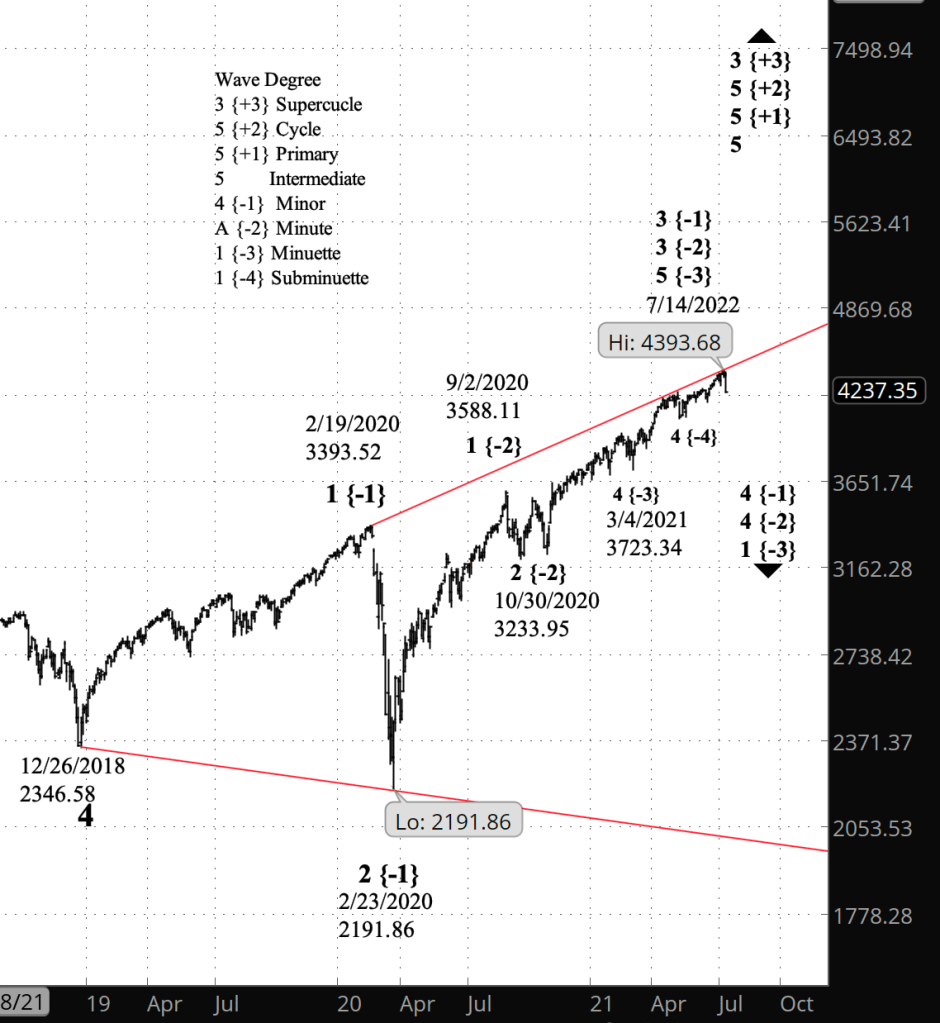
What does Elliott wave theory say? Under the principle analysis, the July 14 peak ended wave 3 of Minor degree, the 3rd leg of an expanding Diagonal Triangle that began on December 26, 2018 as wave 5 of Intermediate degree. Prices in diagonal triangles bounce between the boundaries of a price channel that grows wider every day. The channel low today is about 2030, and in the time it takes the price reach that level, the boundary will have moved further down. So it’s a chase, of sorts. At the lower boundary the price can be expected to to reverse and begin a trip back up to the upper boundary as wave 4 of Minor degree, and after that, wave 5 will chase back down to the lower boundary, bringing the Diagonal Triangle to an end.
Nearer term, the decline from the July 14 peak will take the form of sets of five waves, three in the direction of the trend, separated by two corrections. The waves in the direction of the trend will in turn contain five waves internally, and those contrary to the trend will have three internal waves. That’s ignoring for now the complexities that can make Elliott wave analysis a challenge. Presently, I count the decline as being in wave 4 of Minuscule degree within wave 1 of Submicro degree — the first baby steps of what will be a long process.
In the alternative analysis, if the price rises above the end of wave 3 of Minor degree, 4384.50 on the futures, then Minor wave 3 is still underway and the decline that began on July 14 is a correction within Minor 3.
Learning and other resources. See the menu page Analytical Methods for a rundown on where to go for information on Elliott wave analysis.
By Tim Bovee, Portland, Oregon, July 20, 2021
Disclaimer
Tim Bovee, Private Trader tracks the analysis and trades of a private trader for his own accounts. Nothing in this blog constitutes a recommendation to buy or sell stocks, options or any other financial instrument. The only purpose of this blog is to provide education and entertainment.
No trader is ever 100 percent successful in his or her trades. Trading in the stock and option markets is risky and uncertain. Each trader must make trading decisions for his or her own account, and take responsibility for the consequences.
Half an hour before the closing bell. The S&P 500 continued to decline during the day, the futures reaching 4224 and the index, 4233.13. I’ve updated the near-term chart from this morning, and have added a long-term chart showing the expanding triangle that began in 2018 and is continuing.
[S&P 500 index at 3:37 p.m., 2-day bars]
9:50 a.m. New York time
What’s happening now? The S&P 500 E-mini futures fell sharply overnight, reaching below the lower boundary of the price channel that began in March, to a low of 4262.50 at the opening bell.
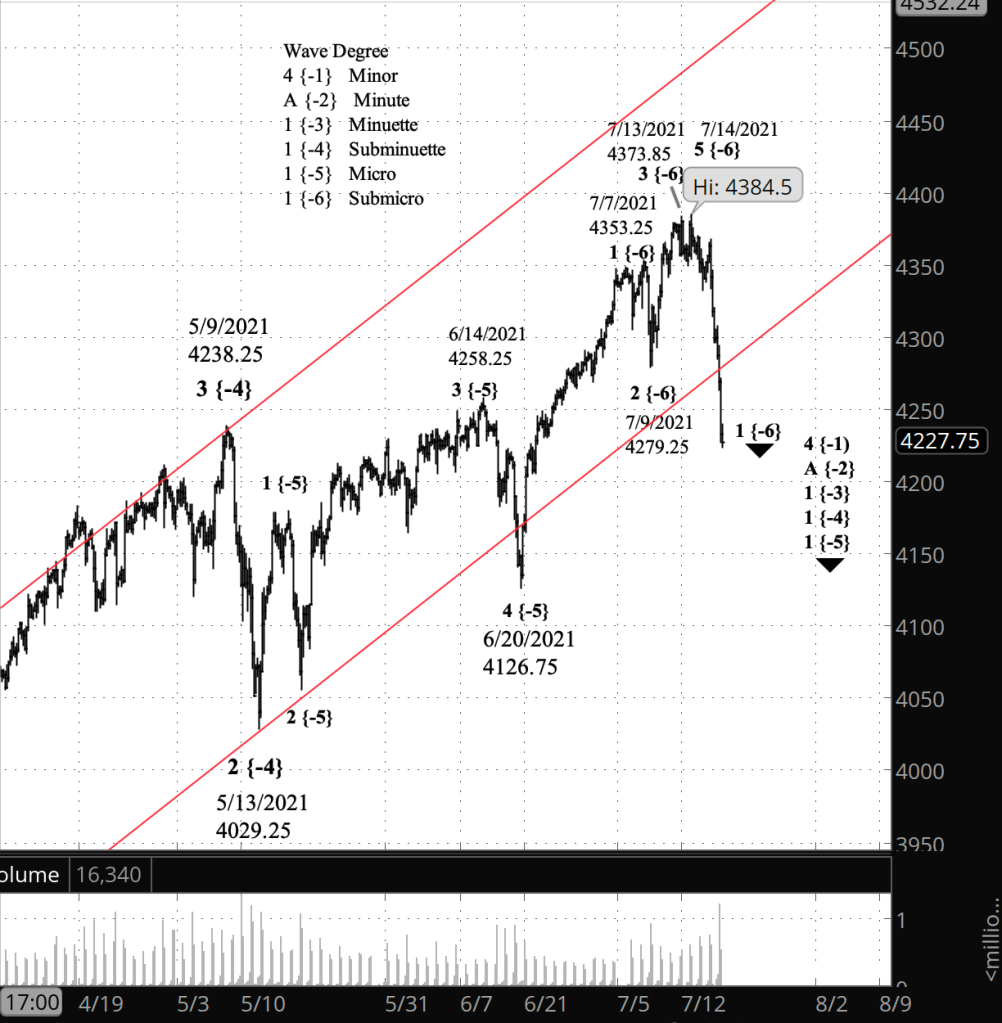
What does it mean? The power of the decline requires a re-analysis of the rise from June 20. Under my new principle count, the July 14 peak of 4384.50 marks the end of the uptrend that began on February 23, and the beginning of a significant downtrend.
What’s the alternative? If the price rises above 4384.50 then something else is going on, perhaps an expanding Diagonal Triangle.
[S&P 500 E-mini futures at 3:30 p.m., 4-hour bars, with volume]
What does Elliott wave theory say? In re-analyzing the rise from June 20, I’ve made the following changes to the labelling on the chart:
I’ve moved the end of wave 3 of Submicro degree to the July 13 high of 4373.85.
I’ve labelled the peak of July 14 at 4384.5 as the end of wave 5 of Submicro degree.
I’ve retained the unnaturally long wave 1 of Submicro degree, keeping its endpoint at 4353.25 on July 7.
See the prior labeling in the upper chart of Friday’s SP500 post. As I noted on Friday, the length of wave 1 is troubling because under the rules of Elliott wave analysis, the 3rd wave cannot be shorter than both wave 1 and wave 5. A long wave 1 suggests that there’s trouble down the road in finding a count that satisfies that rule.
The sharp decline suggests that the July 14 peak was the end of wave 5 of Submicro degree. That being the case, the best count that satisfies the Elliott wave rule on length is to end wave 1 on July 7, as with the earlier count. And to accept an unnaturally short wave 3 by ending it on July 13. And then to accept a very short 5th wave ending on July 14. That makes the 5th wave shorter than wave 3, satisfying the rule. Truncated 5th waves aren’t uncommon.
The end of wave 5 of Submicro degree cascades up the degrees, also marking the end of 5th waves of Micro, Minuette, Subminuette and Minute degrees, and also ending wave 3 of Minor degree, which began on February 23, 2020, the end of the early pandemic crash.
So the present decline, from July 14, becomes wave A of Minute degree within wave 4 of Minor degree, the beginning of a downtrend that will eventually reach an impressive scale. This 4th wave is part of an expanding Diagonal Triangle, and its target is the triangle’s lower boundary, now at 2038 and moving lower each day. (See the lower chart in Friday’s SP500 post.)
If the alternative analysis proves to be correct, then what we’re seeing is a smaller expanding Diagonal Triangle, at the Subminuette degree, beginning on July 20.
Learning and other resources. See the menu page Analytical Methods for a rundown on where to go for information on Elliott wave analysis.
By Tim Bovee, Portland, Oregon, July 19, 2021
Disclaimer
Tim Bovee, Private Trader tracks the analysis and trades of a private trader for his own accounts. Nothing in this blog constitutes a recommendation to buy or sell stocks, options or any other financial instrument. The only purpose of this blog is to provide education and entertainment.
No trader is ever 100 percent successful in his or her trades. Trading in the stock and option markets is risky and uncertain. Each trader must make trading decisions for his or her own account, and take responsibility for the consequences.
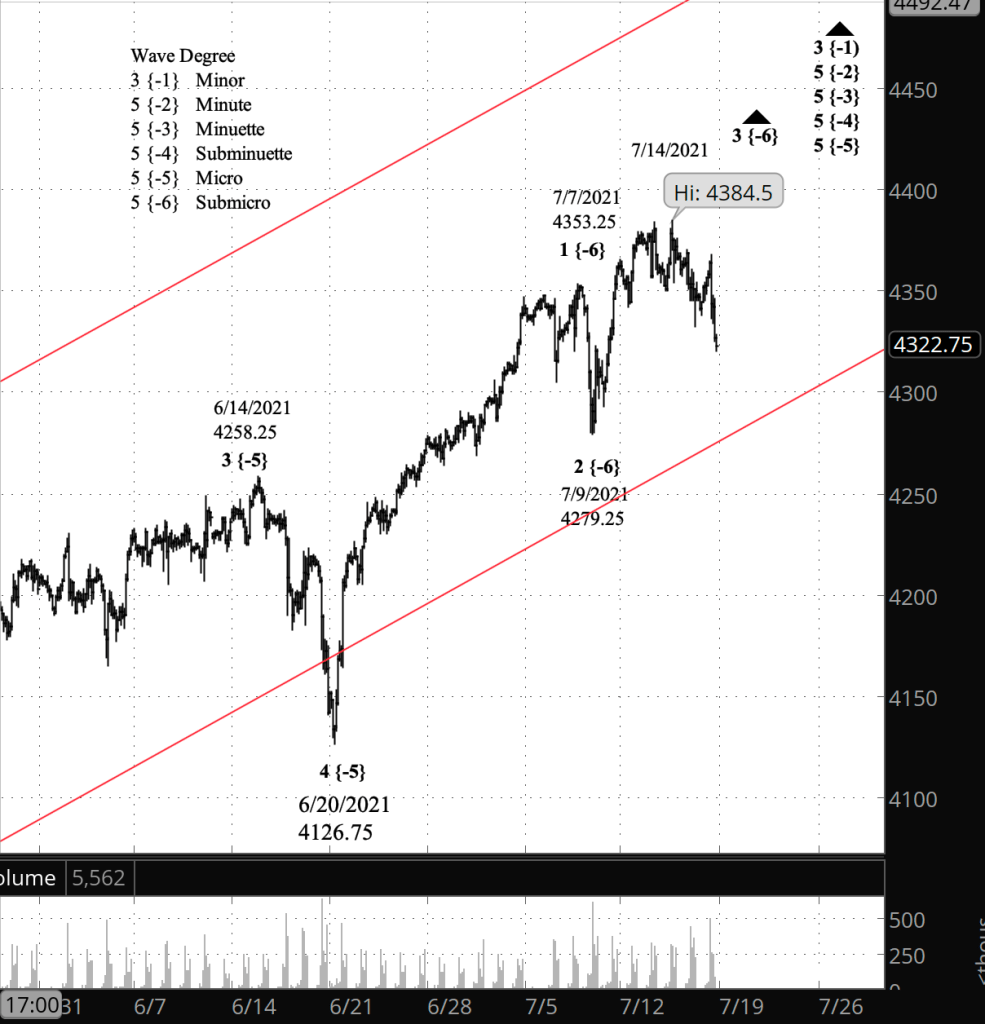
Half an hour before the closing bell. The S&P 500 fell throughout the day, reaching the low 4320s. I’m labeling the movements today as subwaves of a rising wave 3 of Submicro degree. One reason for considering Submicro 3 to still be underway is the brevity of that 3rd wave so far compared to the 1st wave that preceded it. Under Elliott wave theory, a 3rd wave can’t be shorter than both the 1st wave and the 5th wave of set, and indeed 3rds tend to be the longest of the three. But we’ll see what the chart does. This may be one of those atypical movements that make Elliott wave analysis interesting, and challenging.
I’ve updated the shorter-term (top) chart, below.
9:40 a.m. New York time
What’s happening now? The S&P 500 rose in the 4th leg of a small degree rise within a larger uptrend that began on June 20, which in turn is part of a far larger uptrend that began on February 23, 2020, with the price remaining below Wednesday’s high of 4384.50 on the E-mini futures, 4393.68 on the index.
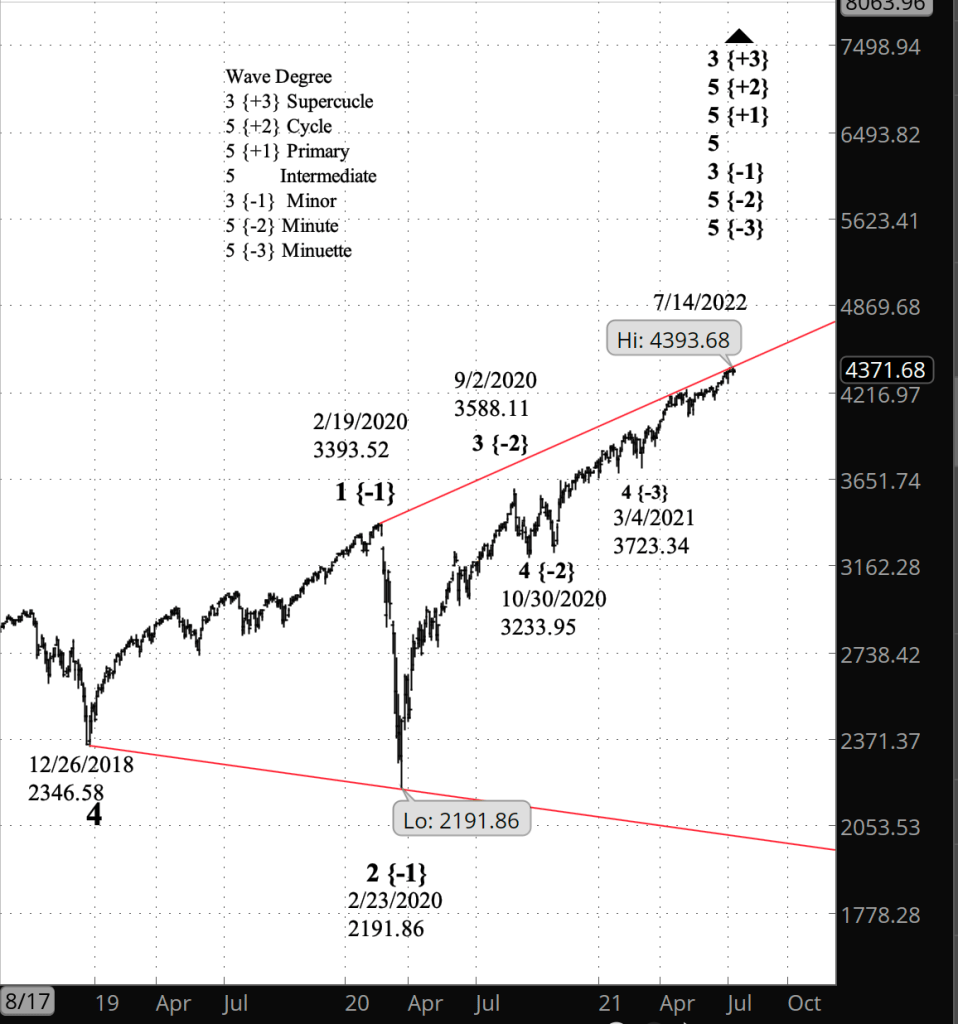
What does it mean? The uptrends, both the smaller and the larger, have since April have been scraping along the upper boundary of an expanding Diagonal Triangle pattern that began on December 26, 2018, suggesting that the market, while still rising, will soon will be pull away and begin a downward journey to the lower boundary of the triangle, presently about 50 points above the 2000 level and falling.
What’s the alternative? It’s possible to count Wednesday’s high as the end of the uptrend from June 20, meaning the present decline is a correction of that rise, or even as the end of the uptrend from February 2020, meaning that the downward journey has already begun. Based on my work in yesterday’s analysis, I consider these to be the less likely interpretations of the chart.
[S&P 500 E-mini futures at 3:30 p.m., 2-hour bars, with volume]
[S&P 500 index at 9:36 a.m., 2-day bars]
What does Elliott wave theory say? The upper boundary of the Diagonal Triangle, connecting the endpoints of waves 1 and 3 of Minor degree, gets bumped a bit higher and steeper with each new high of the S&P 500. In looking at the chart, I’m struck by the change in the angle of the price as it relates to the triangle boundary. Up until April the price was at an angle that brought it every closer to the triangle’s upper boundary. It was on the move. Since April, the price has mimicked the angle of the upper boundary — rising, to be sure, but doing little to push the 3rd wave endpoint of the boundary higher.
Intuitively, the chart looks like a rise that’s running out of steam, to use an old-fashioned phrase at one time much beloved by market commentators. In the terminology of Elliott wave analysis, my principle count has it that rising wave 3 of Submicro degree within wave of Micro degree is still underway. Submicro wave 3 will be followed by a shallow 4th wave correction, and then a final 5th wave push to the upside, completing the parent, Micro wave 5.
A rise to a new high will mean that Submicro 3 is still underway. A decline below the start of Submicro wave 3, from 4279.25 on the futures, will mean the completion of Subicro 3, which would in fact properly counted as Submicro wave 5, and would trigger a complete recount of the rise from June 20 and
The end of wave 5 of Micro degree, whenever it happens, will also mark the end of 5th waves up to Minute degree, four degrees larger, and of the 3rd wave of Minor degree (up one more degree).
Learning and other resources. See the menu page Analytical Methods for a rundown on where to go for information on Elliott wave analysis.
By Tim Bovee, Portland, Oregon, July 16, 2021
Disclaimer
Tim Bovee, Private Trader tracks the analysis and trades of a private trader for his own accounts. Nothing in this blog constitutes a recommendation to buy or sell stocks, options or any other financial instrument. The only purpose of this blog is to provide education and entertainment.
No trader is ever 100 percent successful in his or her trades. Trading in the stock and option markets is risky and uncertain. Each trader must make trading decisions for his or her own account, and take responsibility for the consequences.
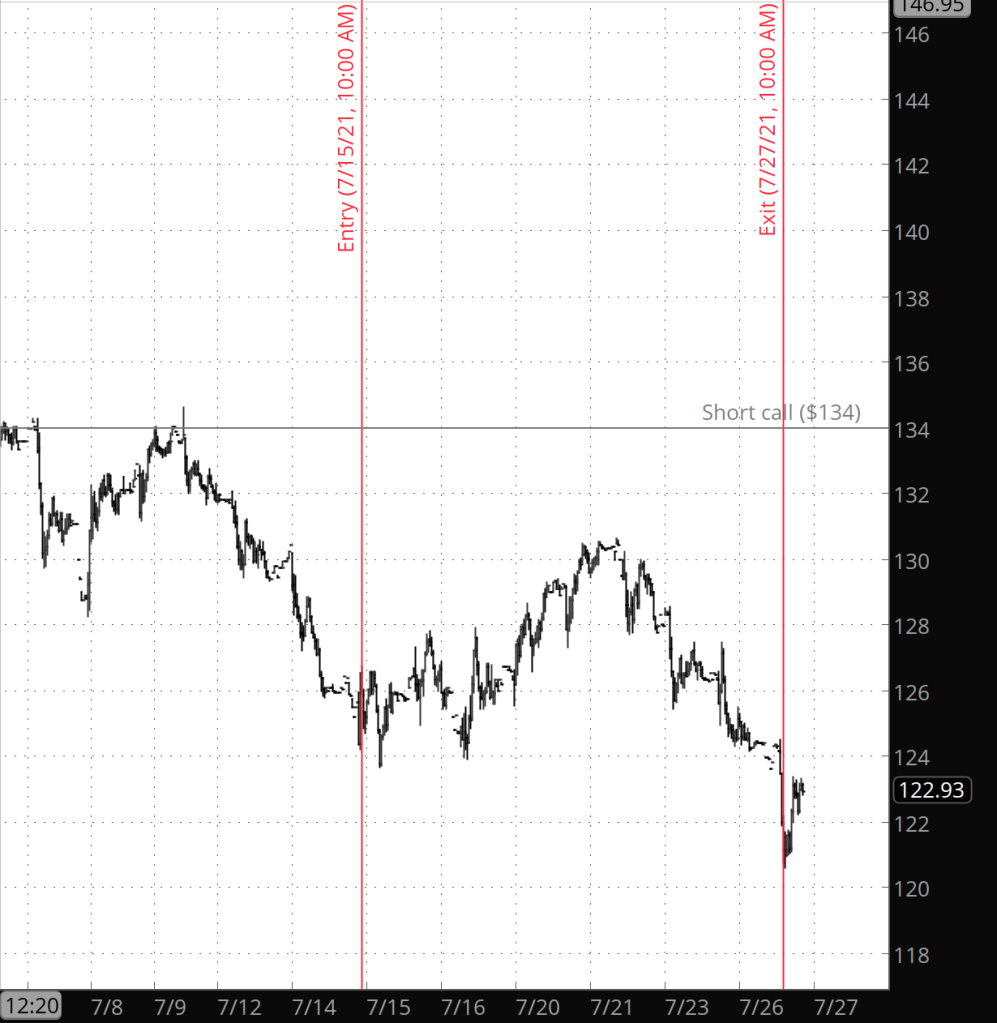
Update 7/27/2021: I exited my short bear call spread position on XBI 24 days before expiration, for a $0.38 debit per contract/share, a profit before fees of $0.92 per contract. Shares were trading at $122.05, down $2.70 from the entry level.
My decision to exit was based on the price reaching more than 50%.of maximum potential profit, as required by my trading rules. The price remained below my short call strike, $34, throughout the life of the position.The entry and exit dates are shown by vertical red lines on the chart, with a horizontal gray line marking short call strike price.
[XBI at 2:15 p.m., 20-minute bars]
Shares declined by 2.2% over nine days for a -65.8% annual rate. The options position produced a 121.1% return for a 3,682% annual rate.
I have entered a short bear call spread on XBI, using options that trade for the last time 36 days hence, on August 20. The premium is a $0.84 credit per contract share and the stock at the time of entry was priced at $124.75.
The implied volatility rank (IVR) stands at 30%.
Premium:
$0.84
Expire OTM
XBI-bear call spread
Strike
Odds
Delta
Puts
Long
140.00
91.0%
11
Break-even
133.16
86.0%
17
Short
134.00
81.0%
23
The premium is 28% of the width of the position’s wing. The profit zone covers a 6.7% move to the upside.
The risk/reward ratio is 6.1:1, with maximum risk of $516 and maximum reward of $84 per contract.
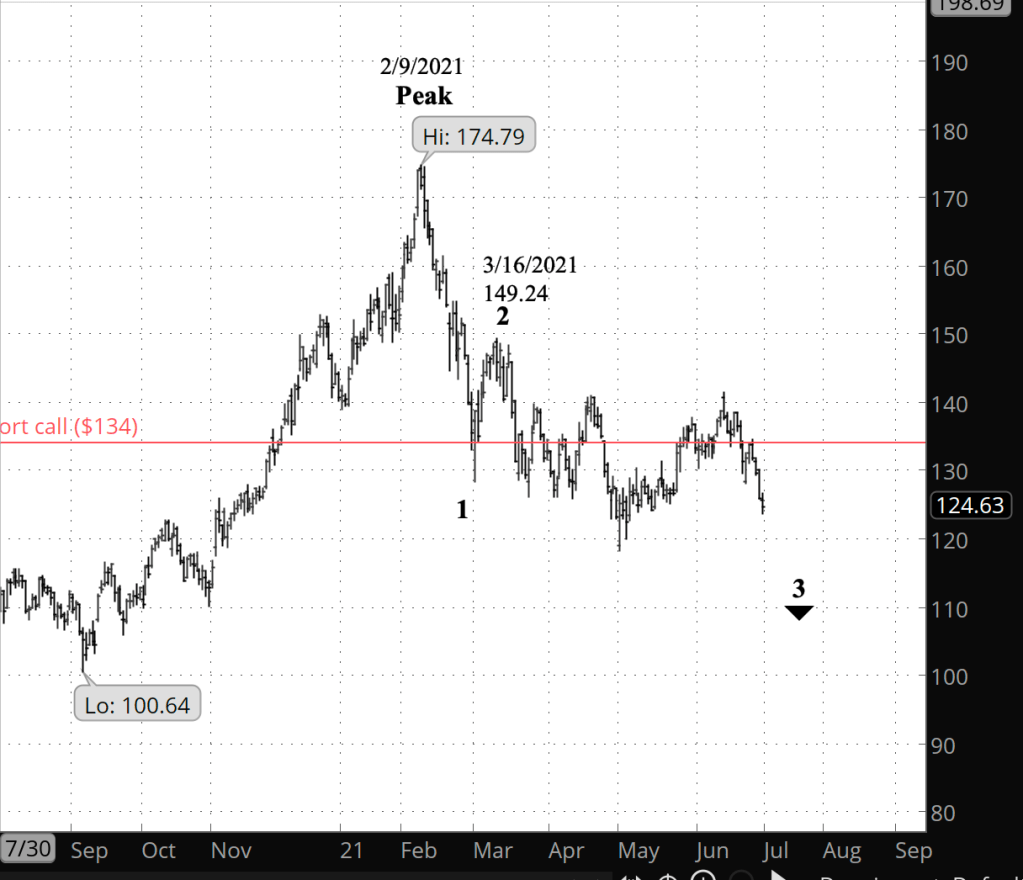
[XBI, daily bars]
Elliott wave analysis places XBI in a 3rd wave downtrend, and if that analysis holds up, then the price is unlikely to revisit the $134 level, which marks the top of my profit zone.
By Tim Bovee, Portland, Oregon, July 15, 2021
Disclaimer
Tim Bovee, Private Trader tracks the analysis and trades of a private trader for his own accounts. Nothing in this blog constitutes a recommendation to buy or sell stocks, options or any other financial instrument. The only purpose of this blog is to provide education and entertainment.
No trader is ever 100 percent successful in his or her trades. Trading in the stock and option markets is risky and uncertain. Each trader must make trading decisions for his or her own account, and take responsibility for the consequences.


 Tim Bovee, Private Trader
You must be logged in to post a comment.