SP500 Analysis

3:30 p.m. New York time

Half an hour before the closing bell. The S&P 500 continued to decline during the day, reach a low of 4332.50 on the futures and of 4340.70 on the index. No change to the analysis. I’ve updated the chart.

9:50 a.m. New York time

What’s happening now? The S&P 500 E-mini futures continued to decline from yesterday’s high, 4384.50.

What does it mean? There is some ambiguity. My principle analysis is that the uptrend is still underway. This will be confirmed by a higher high.

What’s the alternative? Or the uptrend could well have ended with yesterday’s high. At this point I consider both analyses to be almost equally likely.
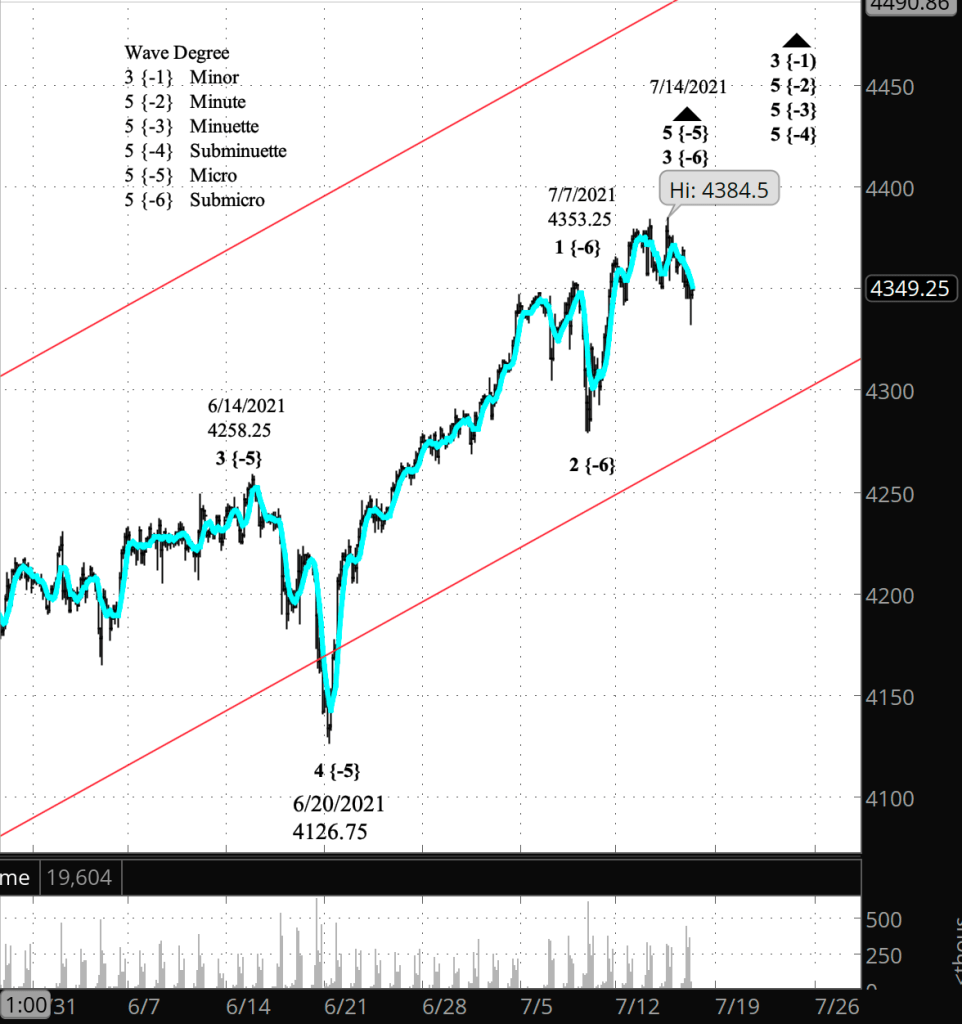
[S&P 500 E-mini futures at 3:29 p.m., 2-hour bars, with volume]

What does Elliott wave theory say? It struck me that it would be useful to pull the chart back to a broader view, so as to not lose sight of the forest for the trees. A difficulty in Elliott wave analysis is always to distinguish between degrees. What one analyst sees as a 2nd wave in the degree under analysis, another analyst sees as a wave of lower degree that can be safely be ignored.

One technique for separating the significant from the insignificant is to overlay the chart with a six-bar moving average — six two-hour bars on the chart above. The moving average is the bright blue line.

So the question is, how many waves can we count beginning with the June 20 low of 4126.75. The moving average shows no declines of significance until July 7, when the price reversed from from a peak of 4353.25. So by this method, the peak is the end of wave 1, and in the broader analytical framework I’ve used, it will be wave 1 of Submicro degree.

The difficulty is that wave 1 seems overly long for such a movement, and the following wave 2 seems two short. Second waves tend to retrace much of the ground covered by the preceding 1st wave. Even if the retracement seems truncated, it’s the largest retracement we have so far on the rise from June 20. And as long as the future wave 3 or wave 5 of Submicro degree is longer than wave 1, then the rules of Elliott wave analysis are satisfied.

Another consideration is that the price is some distance below the upper boundary of the price channel of the degree above Micro, the Subminuette degree. In theory, the price should come close to that upper boundary, which is presently just below 4500 and rising.

Bottom line: The peak of July 14 is within an ongoing wave 3 of Submicro degree within the parent, wave 5 of Micro degree. The uptrend that began on June 20 continues.

Learning and other resources. See the menu page Analytical Methods for a rundown on where to go for information on Elliott wave analysis.

By Tim Bovee, Portland, Oregon, July 15, 2021

Disclaimer

Tim Bovee, Private Trader tracks the analysis and trades of a private trader for his own accounts. Nothing in this blog constitutes a recommendation to buy or sell stocks, options or any other financial instrument. The only purpose of this blog is to provide education and entertainment.

No trader is ever 100 percent successful in his or her trades. Trading in the stock and option markets is risky and uncertain. Each trader must make trading decisions for his or her own account, and take responsibility for the consequences.

License
Creative Commons License

All content on Tim Bovee, Private Trader by Timothy K. Bovee is licensed under a Creative Commons Attribution-ShareAlike 4.0 International License.

Based on a work at www.timbovee.com.
SPCE Exit

2:20 p.m. New York time

I’ve exited my bear call options spread position on SPCE, two days before expiration, and have updated the entry post with results.

By Tim Bovee, Portland, Oregon, July 14, 2021

Disclaimer

Tim Bovee, Private Trader tracks the analysis and trades of a private trader for his own accounts. Nothing in this blog constitutes a recommendation to buy or sell stocks, options or any other financial instrument. The only purpose of this blog is to provide education and entertainment.

No trader is ever 100 percent successful in his or her trades. Trading in the stock and option markets is risky and uncertain. Each trader must make trading decisions for his or her own account, and take responsibility for the consequences.

License
Creative Commons License

All content on Tim Bovee, Private Trader by Timothy K. Bovee is licensed under a Creative Commons Attribution-ShareAlike 4.0 International License.

Based on a work at www.timbovee.com.
SP500 Analysis

3:30 p.m. New York time

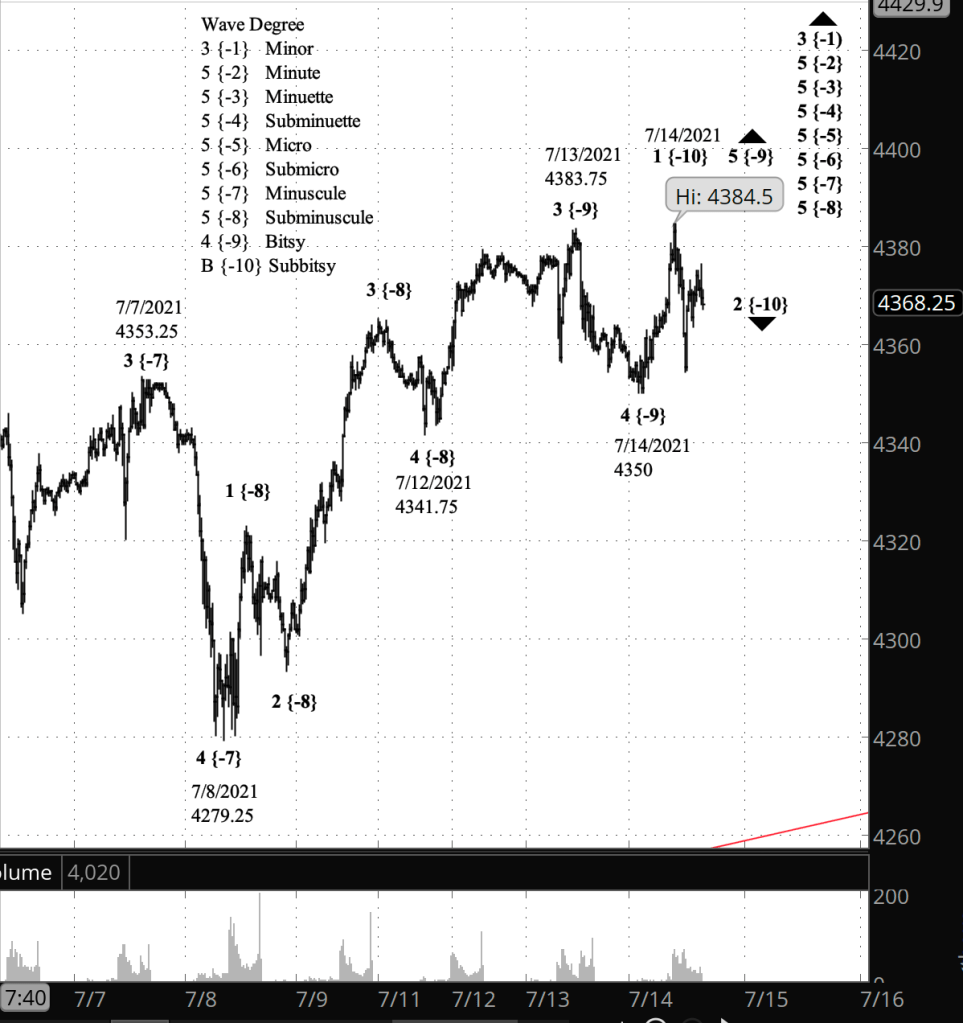
Half an hour before the closing bell. The S&P 500 declined from its overnight high, 4384.50, and then rose again, so far remaining below the high. By my count the decline is wave 2 of Subbitsy degree, and the subsequent rise is either wave B within Bitsy wave 2, which must remain below the high, or the start of wave 3 of Bitsy degree, which will move above the high. I’ve updated the chart.

9:40 a.m. New York time

What’s happening now? The S&P 500 E-mini futures fell overnight to a low of 4350 and then rose to a new high.

What does it mean? The rise continues the uptrend that began on July 12 within a much larger uptrend that began February 23, 2020.

What are the alternatives? The higher high removes the immediate ambiguities from the chart.

[S&P 500 E-mini futures at 3:30 p.m., 20-minute bars, with volume]

What does Elliott wave theory say? The move to a new high means that the 4th wave correction of Bitsy degree ended at last night’s low of 4350 and wave 5 of Bitsy degree is underway, with no limit on how high it can go, beyond the need that it remain proportional to other waves of that degree. The rise is part of an expanding diagonal triangle that began on December 26, 2018. The price is now at the upper boundary of the triangle.

Learning and other resources. See the menu page Analytical Methods for a rundown on where to go for information on Elliott wave analysis.

By Tim Bovee, Portland, Oregon, July 14, 2021

Disclaimer

Tim Bovee, Private Trader tracks the analysis and trades of a private trader for his own accounts. Nothing in this blog constitutes a recommendation to buy or sell stocks, options or any other financial instrument. The only purpose of this blog is to provide education and entertainment.

No trader is ever 100 percent successful in his or her trades. Trading in the stock and option markets is risky and uncertain. Each trader must make trading decisions for his or her own account, and take responsibility for the consequences.

License
Creative Commons License

All content on Tim Bovee, Private Trader by Timothy K. Bovee is licensed under a Creative Commons Attribution-ShareAlike 4.0 International License.

Based on a work at www.timbovee.com.
SP500 Analysis

3:30 p.m. New York time

Half an hour before the closing bell. The S&P 500, having set a new high in the morning, has drawn back, trading more than 20 points below the peak. No change in the analysis. I’ve updated the top chart.

10:55 a.m. New York time

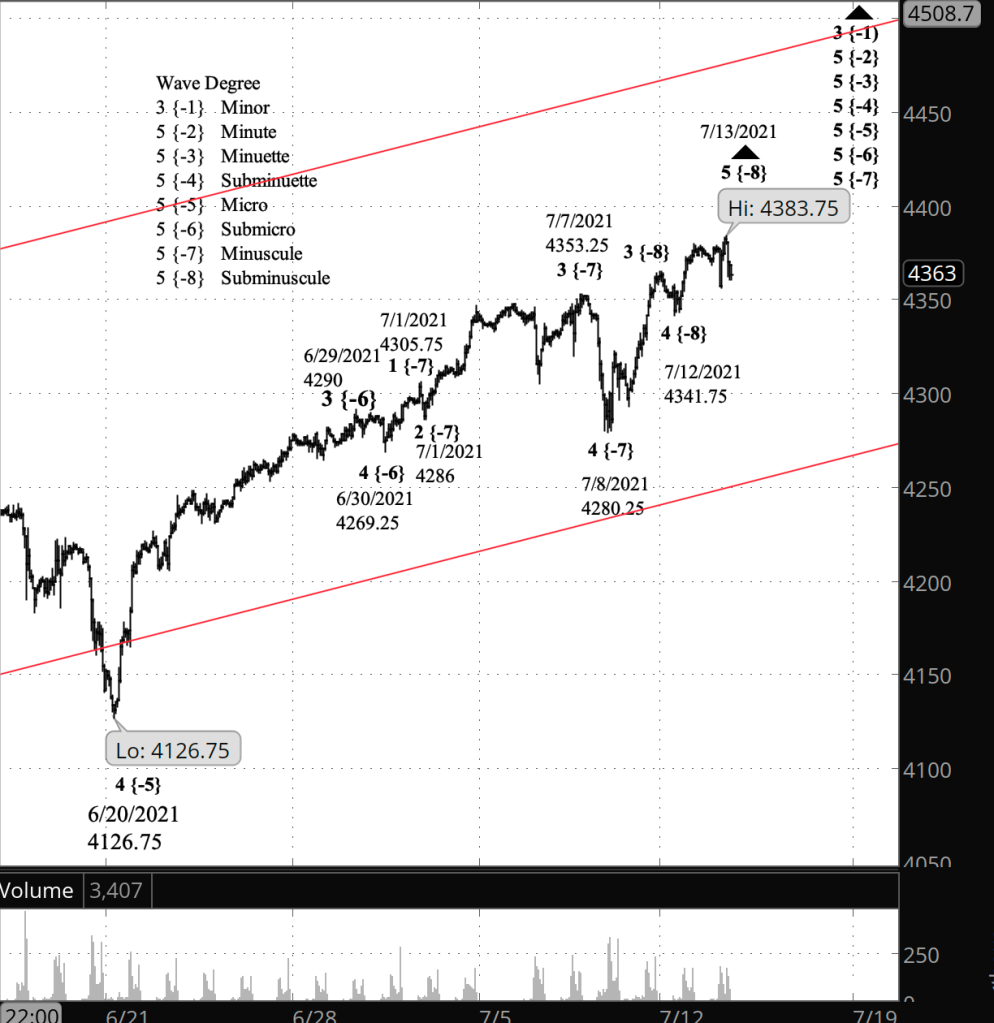
Alternative analysis wins. Well, that was fast. The S&P 500 E-mini futures reversed course and rose to a new high, meaning that the alternative analysis is the correct one. Wave 5 of Subminuscule degree and 5th waves up Minute degree are still underway, as is wave 3 of Minor degree.

[S&P 500 E-mini futures at 3:30 p.m., hourly bars, with volume]

9:55 a.m. New York time

What’s happening now? The S&P 500 E-mini futures sharply reversed from Monday’s high of 4379.25.

What does it mean? Same song different verse. If the price remains below Monday’s high, then that level marks the end of the rise from June 20 and indeed the end of the rise that began on February 23, 2020. If it moves below Monday’s low of 4341.75, then the odds strengthen that a major downtrend has begun.

What’s the alternative? If the price reverses and moves above Monday’s high to a still higher high, then the rise that began on June 20 and indeed in February of last year is still underway.

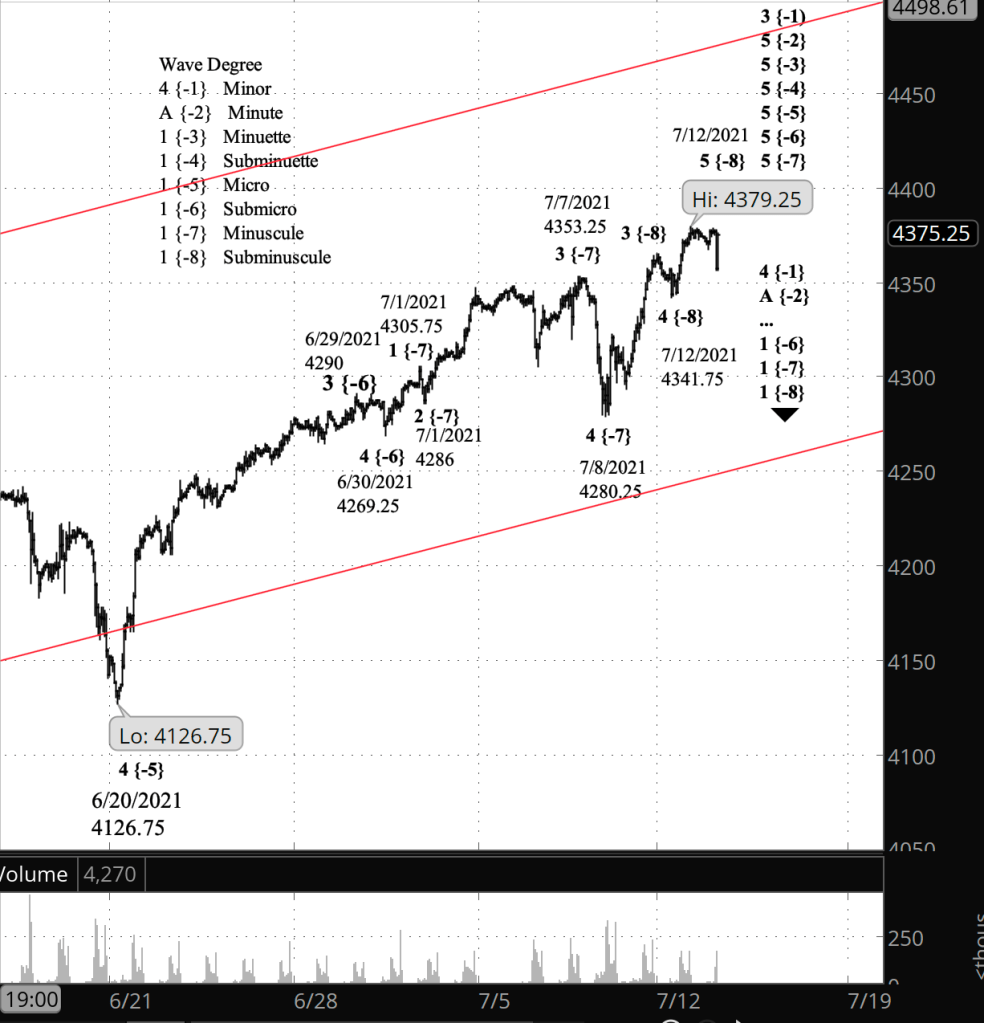
[S&P 500 E-mini futures at 9:55 a.m., hourly bars, with volume]

What does Elliott wave theory say? I’ve marked the chart according to the principle analysis, although at this point, I find it impossible to choose between it and the alternative analysis.

Under the principle analysis, Monday’s high of 4379.25 marks the end of wave 5 of Subminuscule degree, and indeed of parent 5th waves up six degrees to Minute degree. Up one degree further, the peak marks the end of wave 3 of Minor degree, which began on February 23, 2020 from 2191.86 on the index and somewhere close to that level on the futures.

The ensuing decline is the start of wave 4 of Minor degree, a shallow correction that commonly takes the form of a Flat, although there are other possibilities. Fourth waves typically end with the price range of wave 4 within the preceding wave 3; in this case, wave 4 of Minute degree within wave 3 of Minor degree. The price range on the index is from 3588.11 down to 3233.95, levels set in September and October of last year.

Under the alternative analysis, a move of the price above Monday’s high of 4379.25 means that wave 3 of Minor degree is still under way, as are its child waves — 5th waves down to Minuscule degree and lower. See the top chart in yesterday’s analysis for a sense of what that labeling would look like.

Under the alternative analysis, there is no limit on how high the price can rise; fifth waves have a tendency to extend, sometimes to an extraordinary length.

Bottom line, we are back in ambiguity and won’t know which analysis turns out to be correct until the price tells us.

Learning and other resources. See the menu page Analytical Methods for a rundown on where to go for information on Elliott wave analysis.

By Tim Bovee, Portland, Oregon, July 13, 2021

Disclaimer

Tim Bovee, Private Trader tracks the analysis and trades of a private trader for his own accounts. Nothing in this blog constitutes a recommendation to buy or sell stocks, options or any other financial instrument. The only purpose of this blog is to provide education and entertainment.

No trader is ever 100 percent successful in his or her trades. Trading in the stock and option markets is risky and uncertain. Each trader must make trading decisions for his or her own account, and take responsibility for the consequences.

License
Creative Commons License

All content on Tim Bovee, Private Trader by Timothy K. Bovee is licensed under a Creative Commons Attribution-ShareAlike 4.0 International License.

Based on a work at www.timbovee.com.
SP500 Analysis

3:30 p.m. New York time

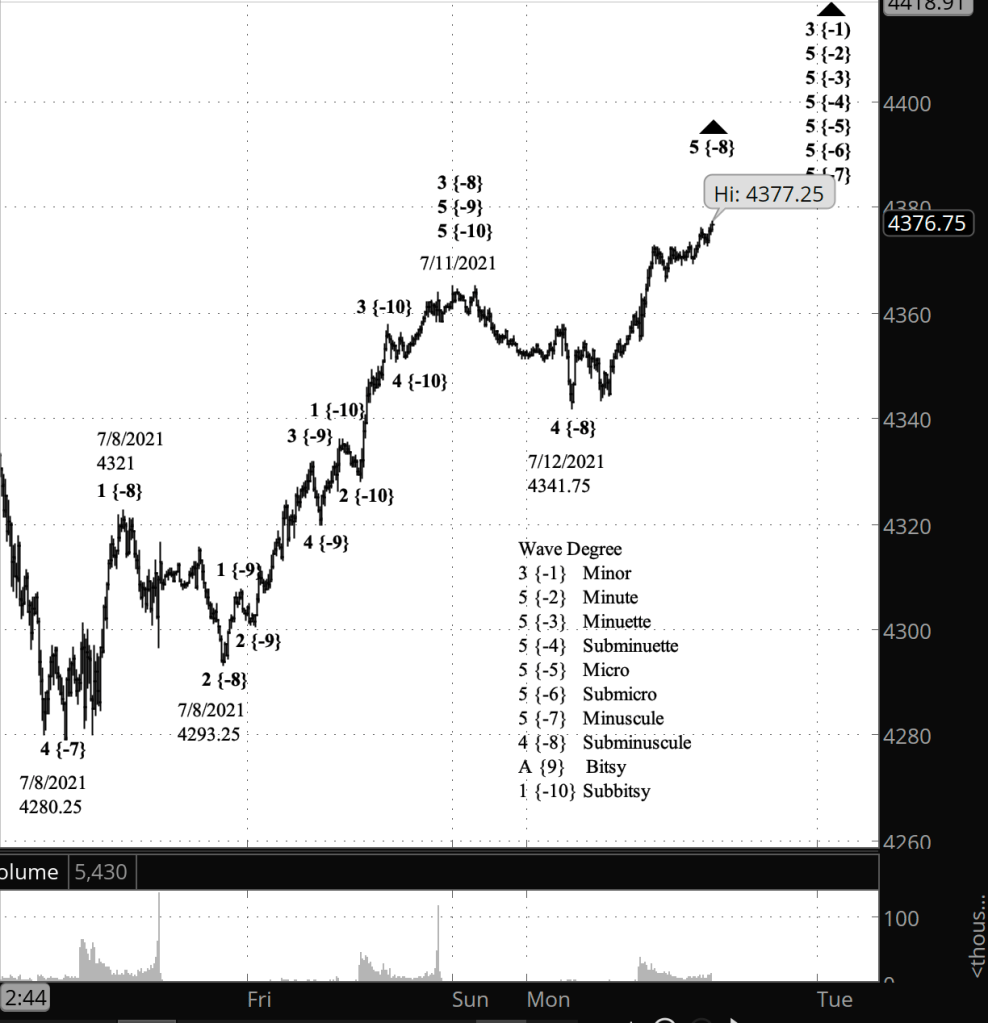
Half an hour before the closing bell. The S&P 500 continued to rise, reaching a high of 4377.25 on the futures and 4385.57 on the index. Afterward it continued to trade just below the highs. Wave 5 of Subminuscule degree is still underway. I’ve updated the top chart of the two posted earlier today.

11:10 a.m. New York time

Price follows alternative path. My alternative analysis has proven correct, as the price moved to a new high after the opening bell. Wave 5 of Subminuscule degree is underway. Here’s a chart with the revised count. I’ve retained the chart I posted this morning so that the changes are apparent.

[S&P 500 E-mini futures at 3:30 p.m., 8-minute bars, with volume]

9:45 a.m. New York time

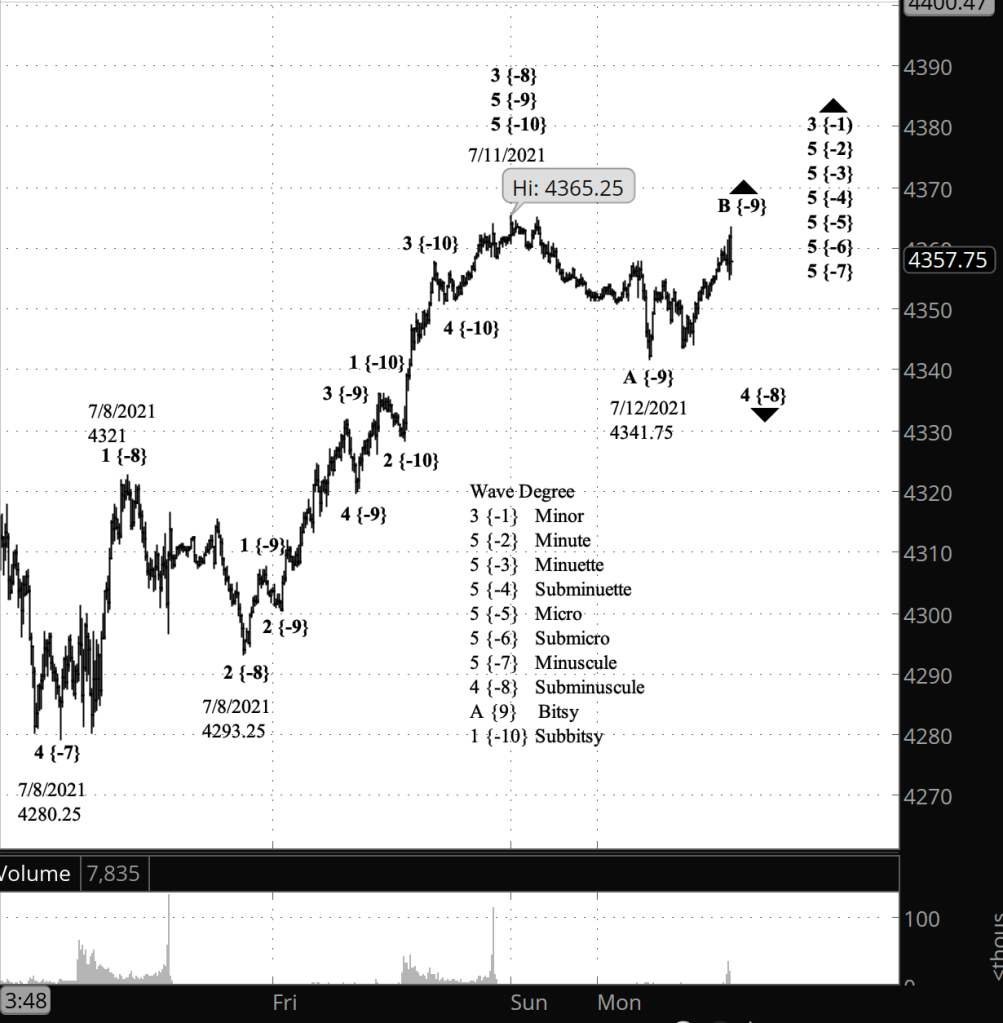
What’s happening now? The S&P 500 E-mini futures moved to a new high of 4365.25 after trading resumed on Sunday, and then reversed, reaching a low of 4341.75. The price then reversed to the upside but remained below Sunday’s peak.

What does it mean? The decline from Sunday’s peak is a shallow correction within the small rise that began on July 8 from 4280.25, the last leg of a very large rise that began in February 2020. The present rise within the correction will be followed by a further decline, possibly completing the correction, which will be followed by a push up to new highs. I say “possibly” because the correction could prove to be a complex pattern, pasting several simple corrective patterns together.

What’s the alternative? If the present rise moves above Sunday’s high, then the early morning low of 4341.75 marks the end of the correction, and the push to higher highs has already begun.

[S&P 500 E-mini futures at 9:42 a.m., 7-minute bars, with volume]

What does Elliott wave theory say? In the chart I’ve moved in close to see the detailed wave count within wave 5 of Minuscule degree, which began on July 8 from 4280.25. Within Minuscule 5, Sunday’s peak, 4365.25, marked the end of wave 3 of Subminuscule degree and the beginning of Subminuscule wave 4, a correction that appears to be taking a Flat pattern. One common occurrence in 4th waves is that they extend into complex patterns. The basic corrective pattern is three waves, and a complex correction consists of a basic pattern, a connector wave, and then another basic pattern. Sometimes the correction will go on to a third corrective pattern.

Within Subminuscule 4, the A wave of Bitsy degree, to the downside, ended at 4341.75 and the B wave of Bitsy degree, to the upside, is still underway. Bitsy wave B must remain below the beginning of the parent 4th wave’s starting point of 4365.25.

If the price in fact moves above the 4th wave’s starting point, then the alternative analysis kicks in; what I have labeled as wave A becomes the end of wave 4 of Subminuscule degree, and the rise from that point is an ongoing wave 5 of Subminuscule degree. I consider this alternative to be less likely.

Learning and other resources. See the menu page Analytical Methods for a rundown on where to go for information on Elliott wave analysis.

By Tim Bovee, Portland, Oregon, July 12, 2021

Disclaimer

Tim Bovee, Private Trader tracks the analysis and trades of a private trader for his own accounts. Nothing in this blog constitutes a recommendation to buy or sell stocks, options or any other financial instrument. The only purpose of this blog is to provide education and entertainment.

No trader is ever 100 percent successful in his or her trades. Trading in the stock and option markets is risky and uncertain. Each trader must make trading decisions for his or her own account, and take responsibility for the consequences.

License
Creative Commons License

All content on Tim Bovee, Private Trader by Timothy K. Bovee is licensed under a Creative Commons Attribution-ShareAlike 4.0 International License.

Based on a work at www.timbovee.com.
SP500 Analysis

3:30 p.m. New York time

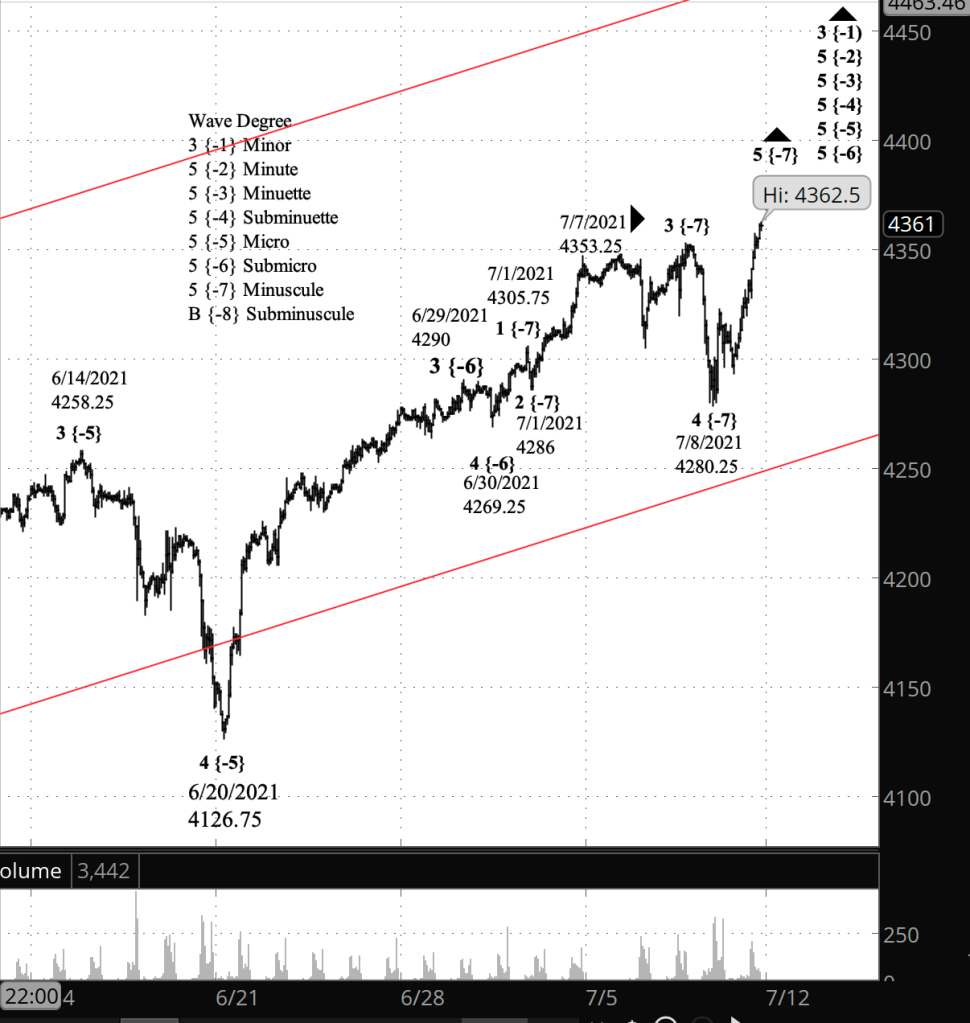
Half an hour before the closing bell. The S&P 500 traded slightly below its peak of the day as wave 5 of Minuscule degree resumed its rise. It is the final wave of that relatively small degree within a much larger uptrend, wave 3 of Minor degree, that began on February 23, 2020, at the floor of the crash that marked the early weeks of the pandemic. Minor 3 will be followed by a significant correction that will remain above that February 2020 low, 2191.86 on the index, and will followed by still higher highs months or perhaps more than a year down the road. The high so far today on the futures so far is 4362.50, and on the index, 4370.52. I’ve updated the top chart of this post.

12:45 p.m. New York time

Midday updated. And the ambiguity on the chart has been resolved. The S&P 500 moved to a new high, meaning that the decline from the July 7 high, ending wave 3 of Minuscule degree, was a 4th wave correction, down to 4280.25. The price subsequently rose to a high so far today of 4357.75 on the futures, and 4365.89 on the index. Long story short: The uptrend that began on June 20 is still underway, as is the larger uptrend that began on February 23, 2020.

[S&P 500 E-mini futures at 3:30 p.m., hourly bars, with volume]

10:05 a.m. New York time

What’s happening now? The S&P 500 E-mini futures continued to rise in overnight trading, having remained below the July 7 high of 4353.25 and above the June 30 low of 4269.25.

What does it mean? By remaining within the range defined by those two prices, the meaning of the track set by the price remains ambiguous.

A move above the July 7 high would mean that the decline that followed the peak is a correction within an ongoing rise.

What’s the alternative? A move below the June 30 low would mean that the decline from July 7 is the beginning of a downtrend that will reach significant proportions.

[S&P 500 E-mini futures at 10:04 a.m., 30-minute bars, with volume]

What does Elliott wave theory say? On the chart I’ve analyzed the movements from July 7 to match the first alternative, with the expectation that the price will move above the July 7 high, which marked the end of wave 3 of Minuscule degree. The Minuscule wave 4 correction to the downside is now underway.

Under the second alternative, the July 7 high would mark the end of wave 5 of Minuscule degree, and also of increasingly larger 5th waves up five levels to Minute degree, and above that, wave 3 of Minor degree. The subsequent decline is wave 1 of Minuscule degree, a small step in what will be a major downtrend.

As long as the price remains between the July 7 high of 4353.25 and the June 30 low of 4269.25, I can’t choose between those alternatives.

See yesterday’s analysis for a discussion of why the 4269.25 level is important.

Learning and other resources. See the menu page Analytical Methods for a rundown on where to go for information on Elliott wave analysis.

By Tim Bovee, Portland, Oregon, July 9, 2021

Disclaimer

Tim Bovee, Private Trader tracks the analysis and trades of a private trader for his own accounts. Nothing in this blog constitutes a recommendation to buy or sell stocks, options or any other financial instrument. The only purpose of this blog is to provide education and entertainment.

No trader is ever 100 percent successful in his or her trades. Trading in the stock and option markets is risky and uncertain. Each trader must make trading decisions for his or her own account, and take responsibility for the consequences.

License
Creative Commons License

All content on Tim Bovee, Private Trader by Timothy K. Bovee is licensed under a Creative Commons Attribution-ShareAlike 4.0 International License.

Based on a work at www.timbovee.com.
SP500 Analysis

3:30 p.m. New York time

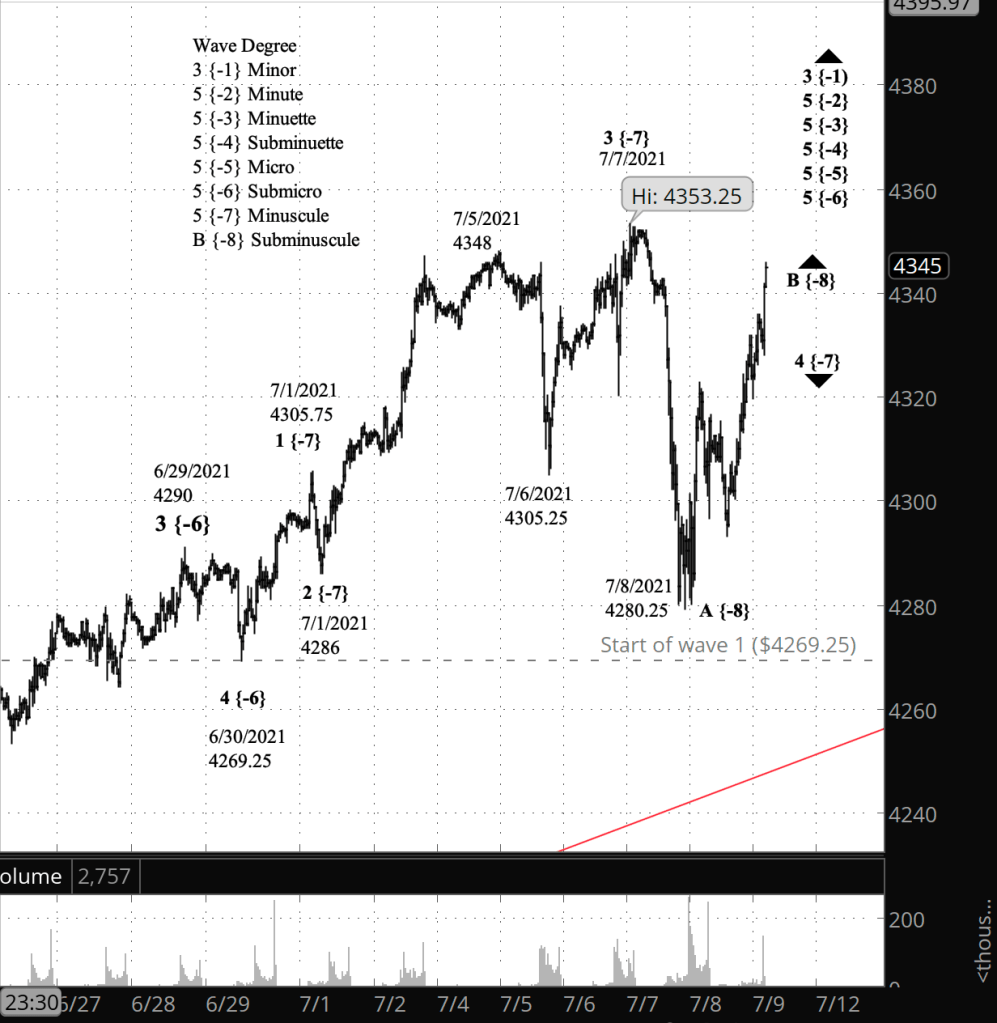
Half an hour before the closing bell. The S&P 500 rose from its overnight low, remaining above the start of wave 1 of Minuscule degree and below yesterday’s high. That positioning keeps alive the two equally likely alternatives discussed in this morning’s post. I’ve updated the chart, in the process correcting a labelling error. The wave number immediately above the price label for yesterday’s high, 4353.25, should read 3 {-7} rather than 4 {-7}.

9:55 a.m. New York time

What’s happening now? The S&P 500 E-mini futures dropped sharply in overnight trading from yesterday’s high of 4353.25, reaching a low so far of 4279.25.

What does it mean? If the price moves below 4269.25 — another 10 points lower — then the rise that began June 20 is complete, and the decline is the first step in what will become a major downtrend.

What’s the alternative? If the price remains above 4269.25 and reverses to rise above 4353.25, then the rise that began June 20 is still underway, and the price can be expected to reach still higher levels.

I consider both alternatives to be a equal likelihood. I can’t choose between them.

[S&P 500 E-mini futures at 3:30 p.m., 45-minute bars, with volume]

What does Elliott wave theory say? A rule of Elliott wave analysis says that a 4th wave cannot move beyond the start of the preceding 1st wave. That rule is the key to understanding the chart at this point.

Wave 1 of Minuscule degree began on June 30 from 4269.25. If Minuscule wave 3 is still underway (the count shown on the chart), then the overnight decline must be a 4th wave following the end of Minuscule 3. If the decline moves below 4279.25, then Minuscule 4 will have moved below the start of Minuscule 1, breaking the rule cited above.

Should that rule be broken under the present count, then the count must be revised as follows: The July 7 peak at 4353.25 becomes the end of wave 5 of Minuscule degree, and also the end of the rise that began June 20. The July 5 high of 4348 becomes the end of wave 3, and the June 6 low of 4305.25 becomes the end of wave 4.

The end of Minuscule wave 5 also means the end of parent 5th waves up to Minute degree, and also, one more degree larger, the end of wave 3 of Minor degree, which began on February 23, 2020.

Learning and other resources. See the menu page Analytical Methods for a rundown on where to go for information on Elliott wave analysis.

By Tim Bovee, Portland, Oregon, July 8, 2021

Disclaimer

Tim Bovee, Private Trader tracks the analysis and trades of a private trader for his own accounts. Nothing in this blog constitutes a recommendation to buy or sell stocks, options or any other financial instrument. The only purpose of this blog is to provide education and entertainment.

No trader is ever 100 percent successful in his or her trades. Trading in the stock and option markets is risky and uncertain. Each trader must make trading decisions for his or her own account, and take responsibility for the consequences.

License
Creative Commons License

All content on Tim Bovee, Private Trader by Timothy K. Bovee is licensed under a Creative Commons Attribution-ShareAlike 4.0 International License.

Based on a work at www.timbovee.com.
SP500 Analysis

3:30 p.m. New York time

Half an hour before the closing bell. The S&P 500 E-mini futures moved to a new high in trading today, bringing itself back in line with the index. The high on the futures so far is 4323.55, and on the index, 4361.71. Long story short: Wave 3 of Minuscule degree within wave 5 of Submicro degree within 5th waves all the up to Minute degree, with wave 3 of minor degree, is still underway.

[S&P 500 E-mini futures at 3:30 p.m., 40-minute bars, with volume]

9:50 a.m. New York time

What’s happening now? The S&P 500 E-mini futures continued to rise overnight, reaching 4345.50, less than three points below the July 5 high of 4348. The index set a new high at the opening bell, 4356.46, and continued rising.

What does it mean? The new high on the index creates a divergence between the index and the futures. The principle analysis for the index is that the rise that began June 20 is still underway. The futures, in contrast, are in an upward correction within a larger downward correction that began on June 20.

Which analysis is right? Elliott wave doctrine says each analysis is right for its specific product, but I find that to be absurd. In this case, I consider the index to be the correct analysis — the rise from June 20 is still underway. See further discussion in the Elliott wave theory section below.

[S&P 500 E-mini futures at 9:50 a.m. , 40-minute bars, with volume]

What does Elliott wave theory say? The rise from June 20 is wave 5 of Micro degree. The high of July 5 on the futures ended wave 3 of Submicro degree within the rise, and the ensuing decline and rise are waves A and B within wave 4 of Submicro degree. The index doesn’t trade overnight, so all we can say of it is that the index set a high on July 2, another high on July 6 and yet another today. So why is the index correct? The higher high on this chart is unambiguous — the rise that began June 20 is still underway, and will be confirmed as underway with each new high. The futures set a high on July 5, dropped while the index wasn’t trading and remains below that July 5 high. Since the index can’t be rolled back and since the two products must eventually get back in sync, I expect the futures to reach a higher high, perhaps today, resolving the discrepancy.

The chart labeling reflects the index analysis, showing that the rise from June 20 is still underway.

Learning and other resources. See the menu page Analytical Methods for a rundown on where to go for information on Elliott wave analysis.

By Tim Bovee, Portland, Oregon, July 7, 2021

Disclaimer

Tim Bovee, Private Trader tracks the analysis and trades of a private trader for his own accounts. Nothing in this blog constitutes a recommendation to buy or sell stocks, options or any other financial instrument. The only purpose of this blog is to provide education and entertainment.

No trader is ever 100 percent successful in his or her trades. Trading in the stock and option markets is risky and uncertain. Each trader must make trading decisions for his or her own account, and take responsibility for the consequences.

License
Creative Commons License

All content on Tim Bovee, Private Trader by Timothy K. Bovee is licensed under a Creative Commons Attribution-ShareAlike 4.0 International License.

Based on a work at www.timbovee.com.
SP500 Analysis

3:30 p.m. New York time

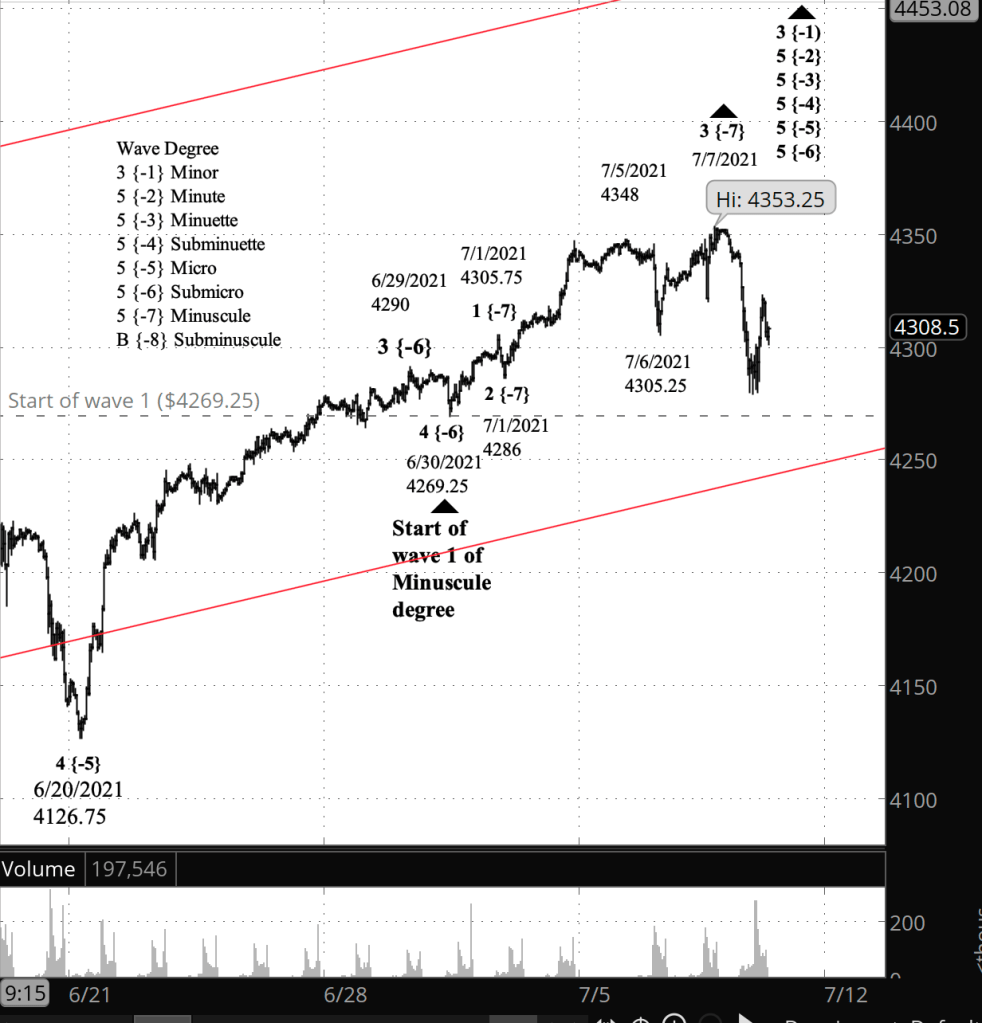
Half an hour before the closing bell. The S&P 500 futures declined sharply from the overnight peak, 4348, and the index decline from its high at the start of the session, 4356.46. The drop is the largest to occur since the uptrend began on June 20.

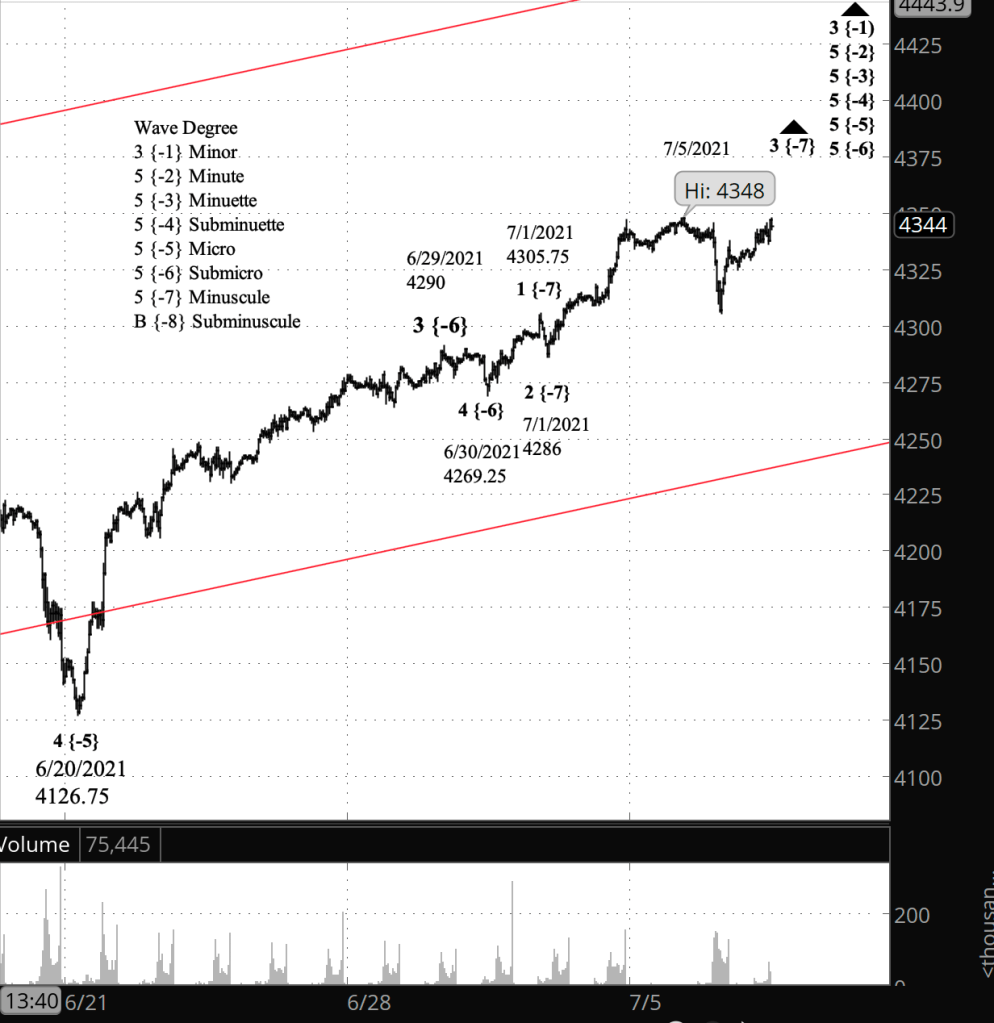
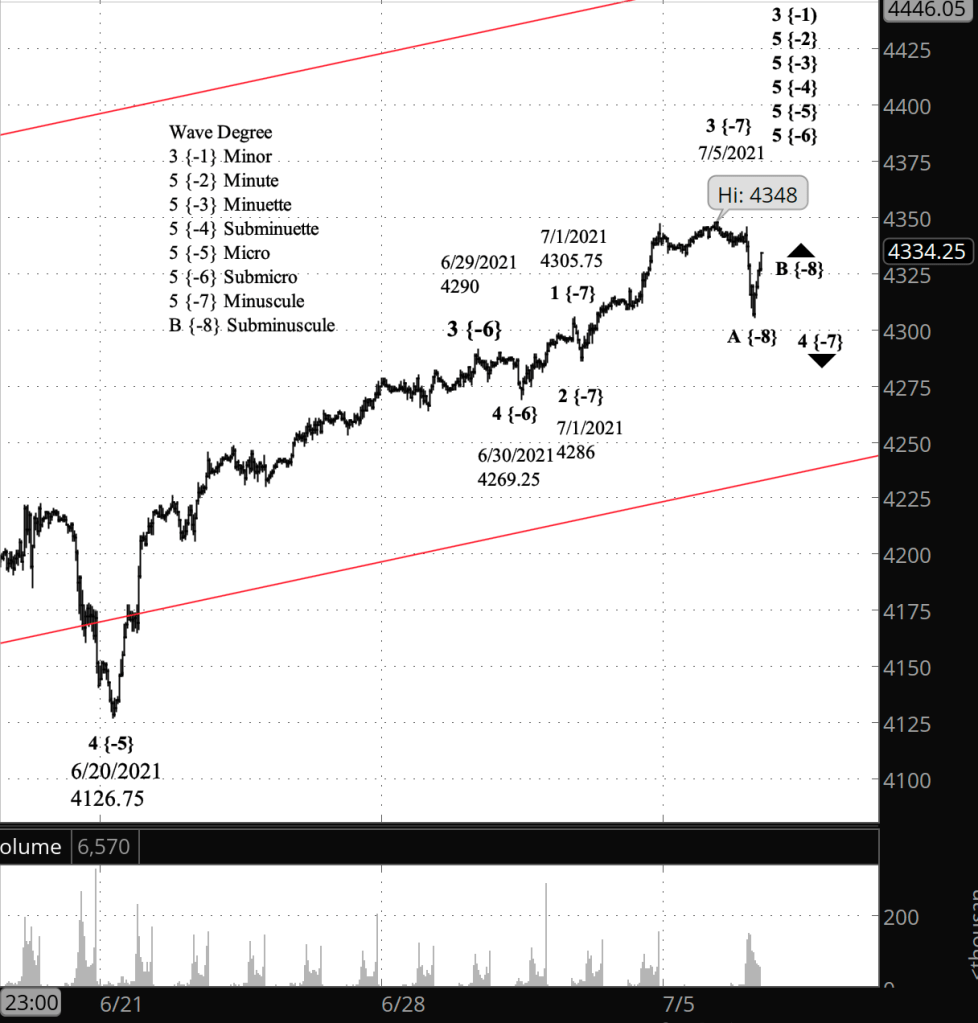
My new principle analysis places the end of wave 3 of Minuscule degree at the high, and the subsequent decline during the day as wave A of Subminuscule degree within wave 4 of Minuscule degree.

If the rise that followed today’s decline rises above the peak, then this morning’s analysis, stated below, was correct and wave 3 of Minuscule degree is still rising. If today’s rise following the decline reverses into a new decline decline before reaching the peak, then my present principle analysis, stated above, is correct.

[S&P 500 E-mini futures at 3:30 p.m., 40-minute bars, with volume]

9:45 a.m. New York time

What’s happening now? The S&P 500 E-mini futures pushed to a higher high, 4348, in overnight trading and then retreated by a few points. The S&P 500 index at the opening bell gapped to high of 4356.46, slightly above its high of July 2.

What does it mean? The uptrend that began on June 20 continues its final leg. When it is complete, the price will begin a significant move to the downside.

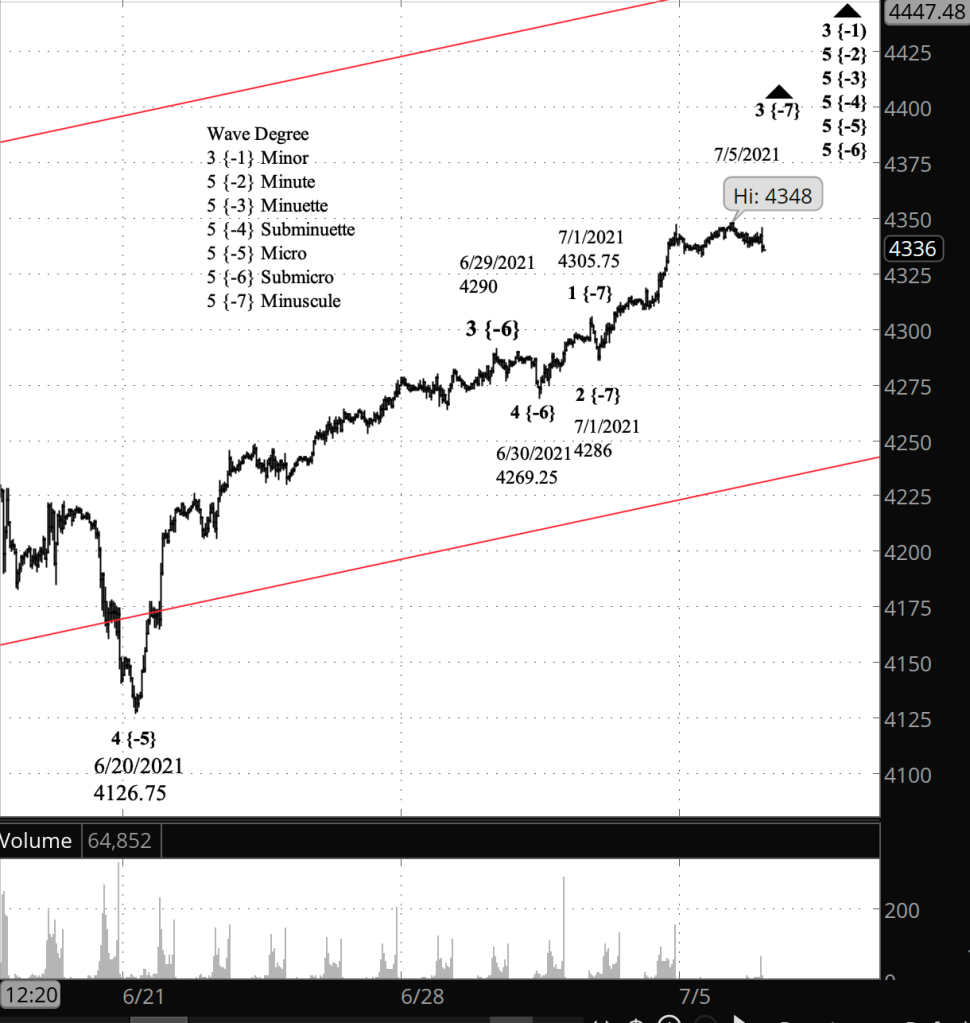
What’s the alternative? The question at this point is whether a new high marks the end of the rise. At this point, I think, the uptrend has a bit longer to run, for reasons I discuss in the Elliott wave theory section below.

[S&P 500 E-mini futures at 9:43 a.m., 40-minute bars, with volume]

What does Elliott wave theory say? As wave of 5 of Submicro degree lengthened, it became clear that the count within that wave needed revision. Submicro 5 began on June 30. I had labelled the high of July 1 as the end of wave 3. I’ve now labelled that high as the end of wave 1, with the low that same day as the end of wave 2, and a lengthening wave 3 still underway, all at Minuscule degree. What comes next within within Submicro 5 will be a sideways correction after Minuscule 3 is complete, and then a final upward push as Minuscule 5 completes its parent wave.

The end of wave 5 of Minuscule degree will also mark the end of 5th waves up to Minute degree, five degrees higher, and also the end of the wave above Minute degree, wave 3 of Minor degree.

Learning and other resources. See the menu page Analytical Methods for a rundown on where to go for information on Elliott wave analysis.

By Tim Bovee, Portland, Oregon, July 6, 2021

Disclaimer

Tim Bovee, Private Trader tracks the analysis and trades of a private trader for his own accounts. Nothing in this blog constitutes a recommendation to buy or sell stocks, options or any other financial instrument. The only purpose of this blog is to provide education and entertainment.

No trader is ever 100 percent successful in his or her trades. Trading in the stock and option markets is risky and uncertain. Each trader must make trading decisions for his or her own account, and take responsibility for the consequences.

License
Creative Commons License

All content on Tim Bovee, Private Trader by Timothy K. Bovee is licensed under a Creative Commons Attribution-ShareAlike 4.0 International License.

Based on a work at www.timbovee.com.
SP500 Analysis

10:10 a.m. New York time

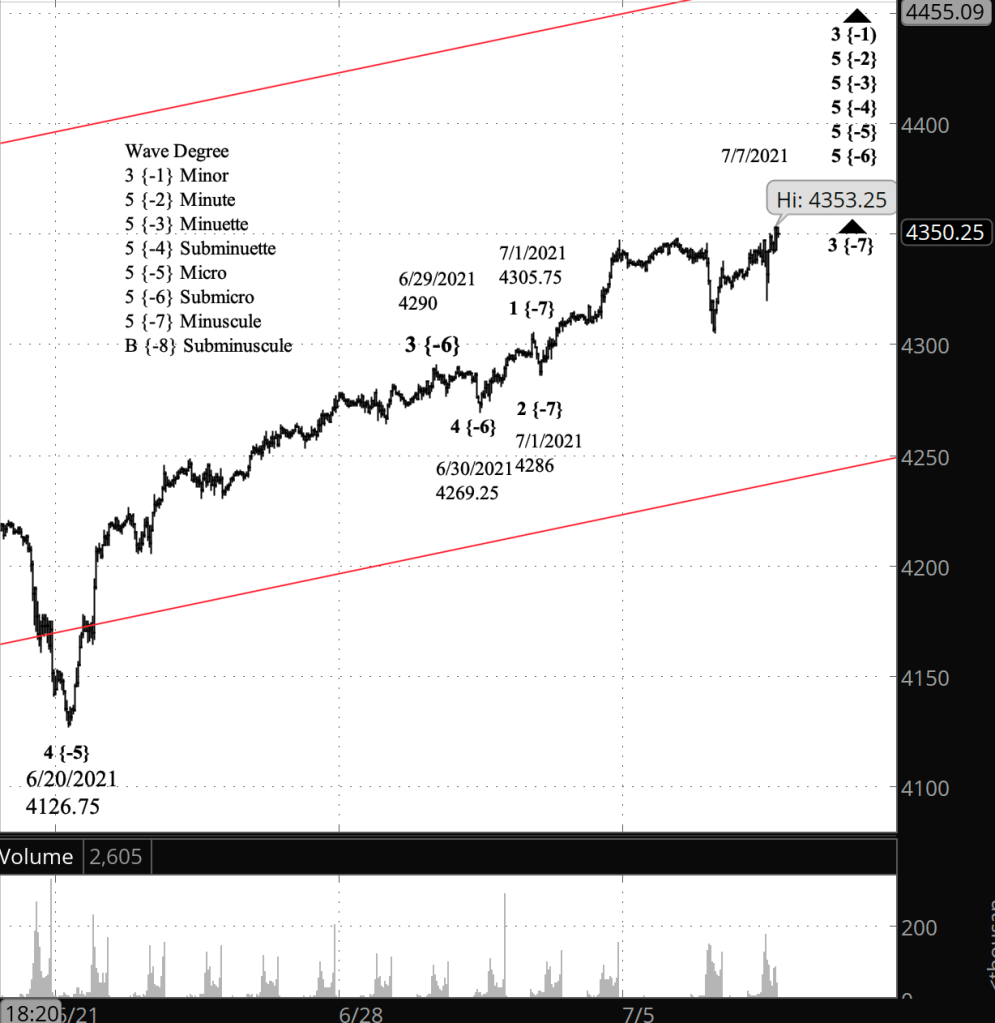
What’s happening now? The U.S. markets are closed in observance of the Independence Day. The S&P 500 E-mini futures are trading in an abbreviated global session, and overnight remained about 4 points below the high of 4347 attained Friday shortly before the closing bell.

What does it mean? The uptrend that began on June 20 remains underway.

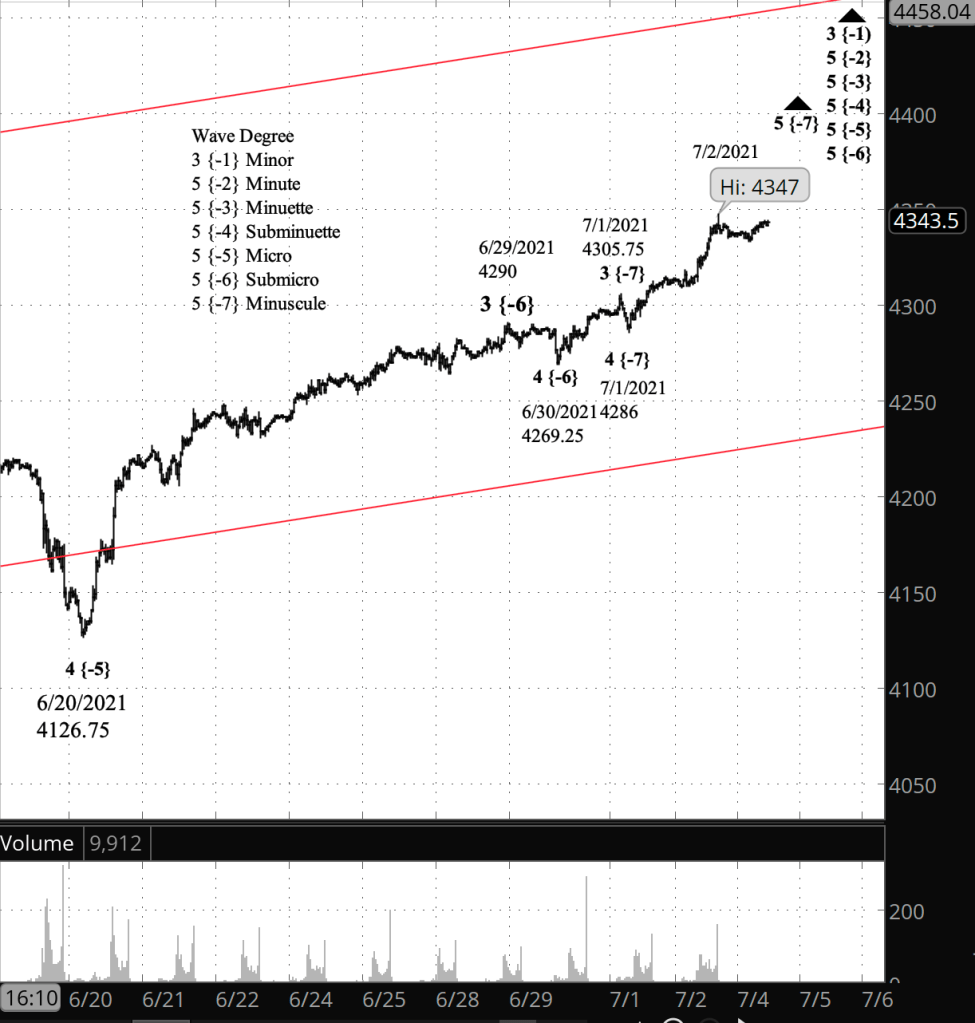
What’s the alternative? The difficulty is figuring out when the end has arrived, since late-stage small declines from a high can be interpreted as either the normal jaggedness of a price movement or as the early stages of a decline. I’ve labeled the chart showing that the trend is underway. It just as well could have ended with Friday’s peak.

[S&P 500 E-mini futures at 10:07 a.m., 35-minute bars, with volume]

What does Elliott wave theory say? The rise from June 20 is wave 5 of Micro degree, and it is in its 5th subwave down two levels to Minuscule degree. Completion of Micro 5 will also mark the end of 5th waves up three levels to Minute degree, and also the completion one degree higher of wave 3 of Minor degree.

Learning and other resources. See the menu page Analytical Methods for a rundown on where to go for information on Elliott wave analysis.

By Tim Bovee, Portland, Oregon, July 5, 2021

Disclaimer

Tim Bovee, Private Trader tracks the analysis and trades of a private trader for his own accounts. Nothing in this blog constitutes a recommendation to buy or sell stocks, options or any other financial instrument. The only purpose of this blog is to provide education and entertainment.

No trader is ever 100 percent successful in his or her trades. Trading in the stock and option markets is risky and uncertain. Each trader must make trading decisions for his or her own account, and take responsibility for the consequences.

License
Creative Commons License

All content on Tim Bovee, Private Trader by Timothy K. Bovee is licensed under a Creative Commons Attribution-ShareAlike 4.0 International License.

Based on a work at www.timbovee.com.