Wednesday, October 7, 2020

10:50 a.m. New York time

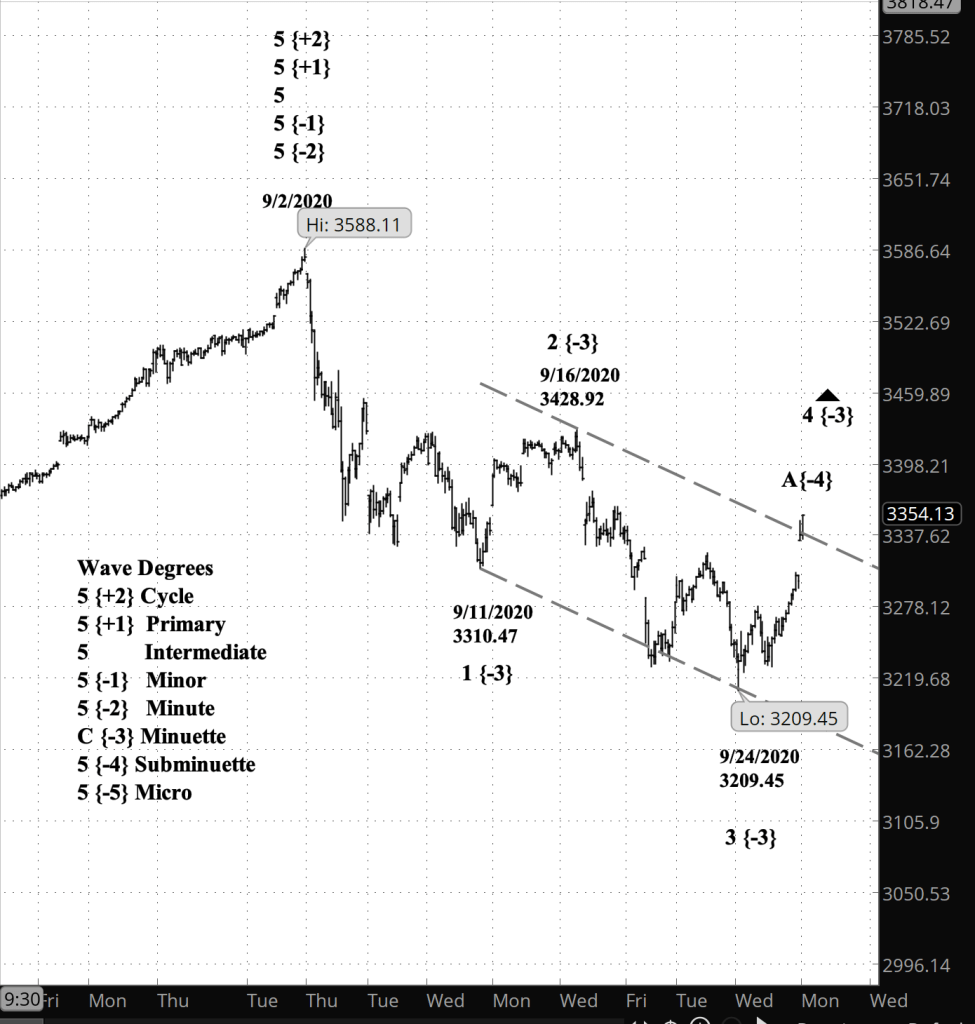
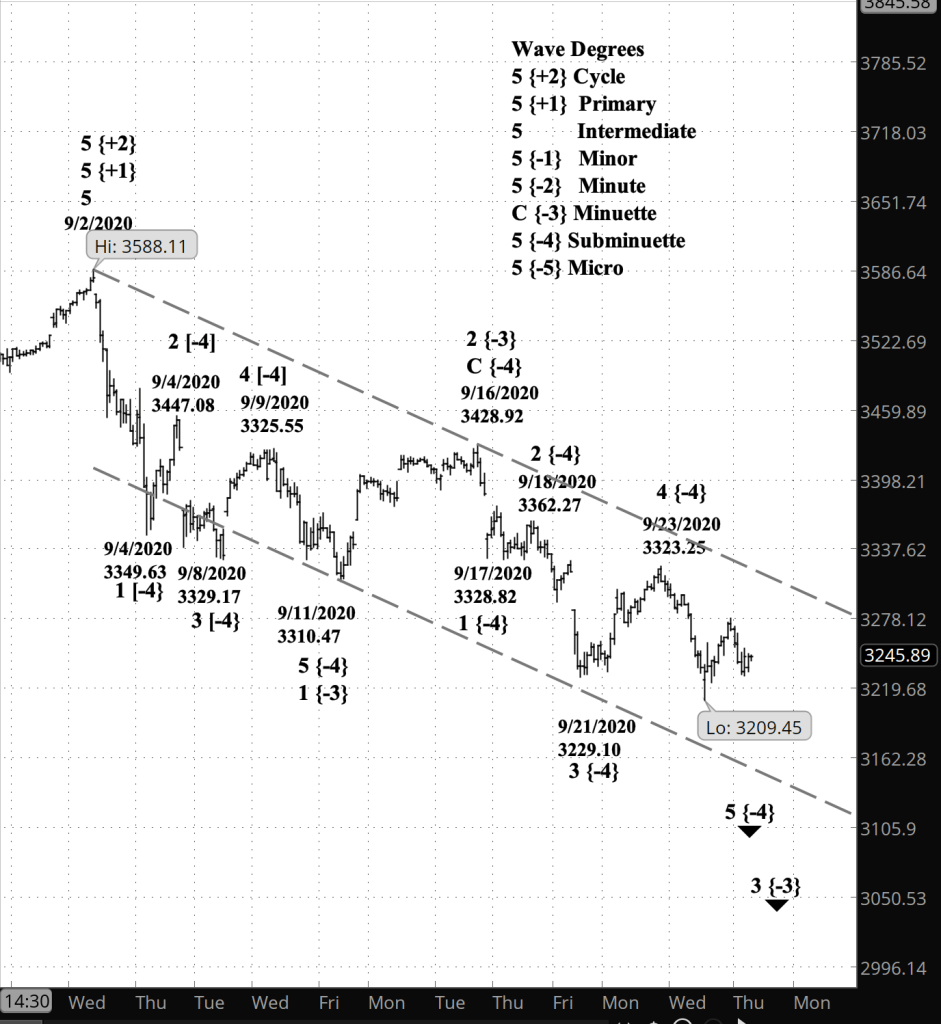
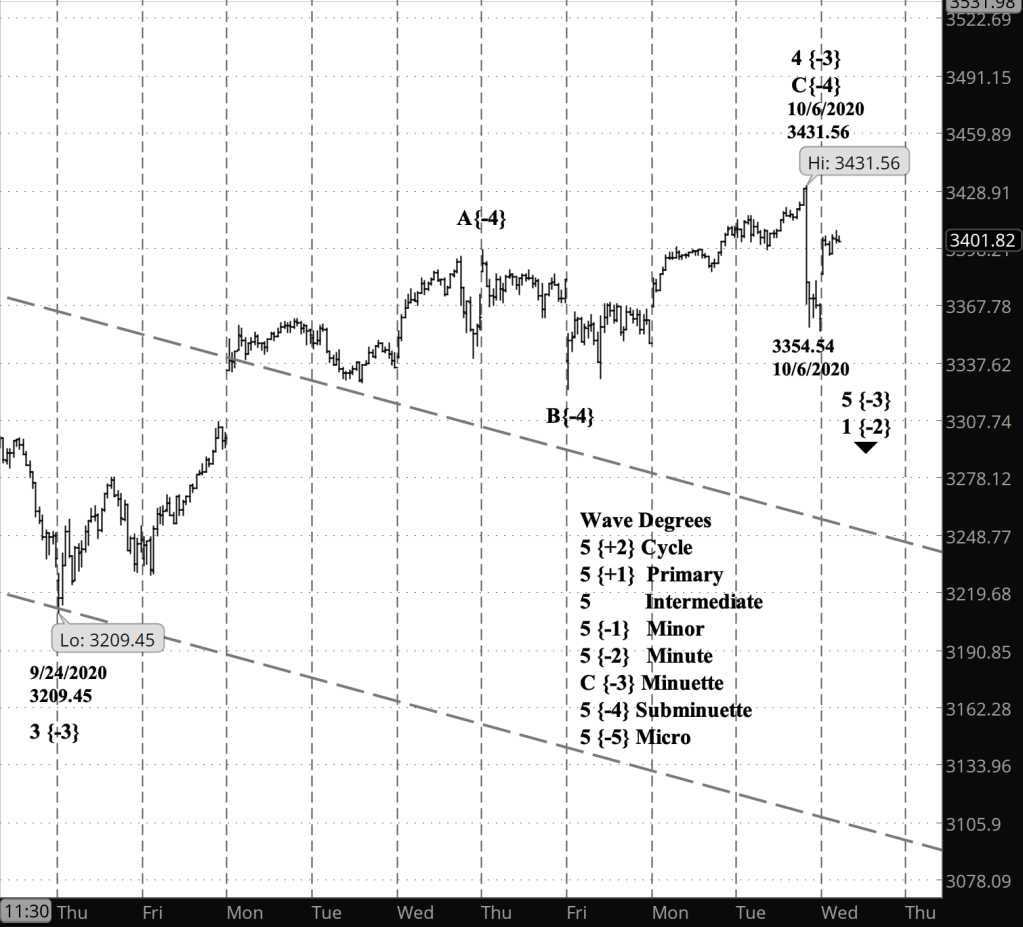
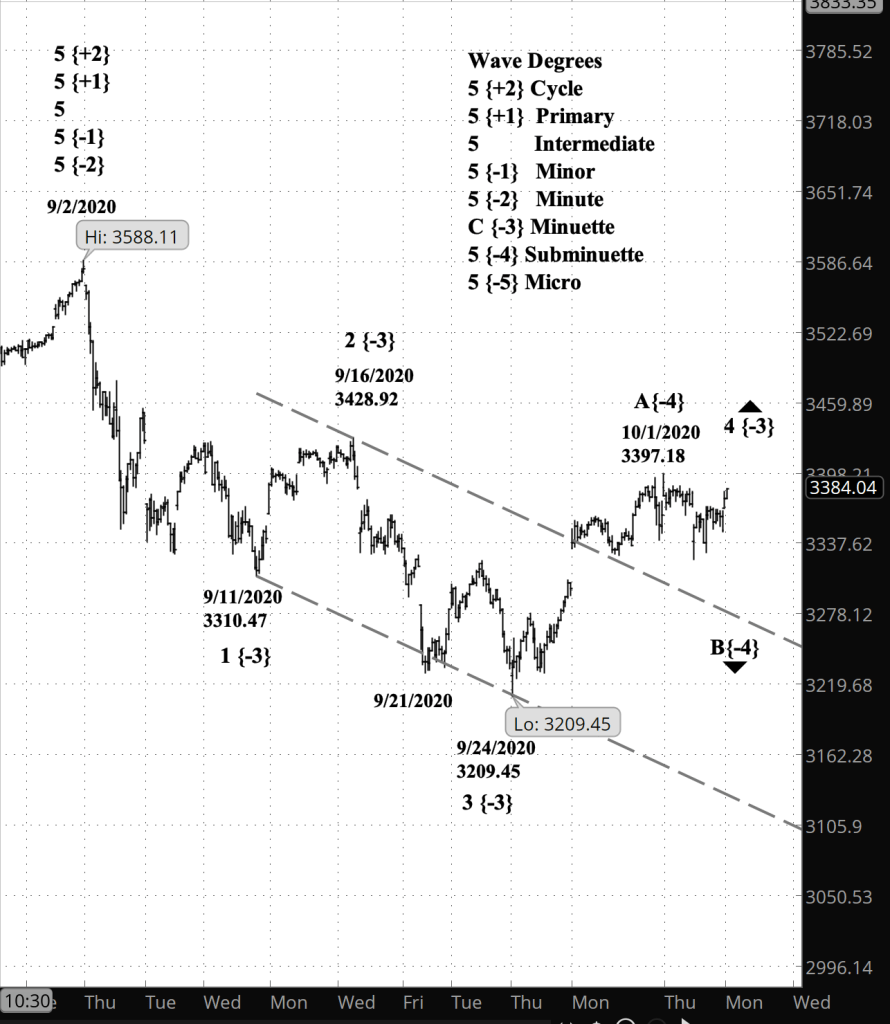
What’s happening now? The S&P 500 index his a low 3354.54 on Tuesday after falling from its a peak of 3431.56 set earlier in the day. At the end the day it reversed and so far has retraced about two-thirds of the decline.

What does it mean? I interpret the decline to be the end of the correction that began on September 24 and the beginning of a resumption of the downward trend that will carry the price to the 3100s or below.

What is the alternative? The decline could instead be a continuation of what would prove to be a more complex correction pattern.
[S&P 500 index, 15-minute bars]

What does Elliott wave theory say? The correction that ended on Tuesday is Minuette wave 4, and has been followed by the beginning of Minuette wave 5 to the downside. Within that downward movement it appears that Subminuette wave 1 may be complete, and the rise today is a Subminuette wave 2 correction. All of this is happening within downtrending Minor wave 1, which began on September 2 from 3588.11. A 2nd wave, such as the one we’re in presently at the Subminuette degree, often retraces a substantial portion of the 1st wave decline. It will be followed by a 3rd wave decline to lower lows.

If, instead, the wave 4 correction is tracing a more complex pattern, then wave 5 has not yet begun, and we’re seeing either an X-wave separator to the downside or a wave within a developing triangle.

My trading strategy. I continue to hold my bear call spread options position on IWM, an ETF that tracks the Russell 2000 and has a chart that closely resembles that of the S&P 500. Management day, when I exit if the position is profitable, is October 30. Before that, if the position reaches 50% of maximum potential profit, then I’ll exit immediately. If it’s unprofitable on management day, then I’ll assess the risks and either hold it a bit longer or exit for a loss.

I hold stock positions on SDS, and ETF that moves inversely to the S&P 500. When the index falls, SDS makes money.

Read More »
IWM Analysis

iShares Russell 2000 ETF (IWM)

Lot 2020-1

Update 10/30/2020: I exited my bear call spread position on IWM 21 days before expiration, for a $0.98 credit per contract/share, a profit before fees of $0.64 per contract. Shares were trading at $155.08, down $2.30 from the entry level.

My decision to exit was based on prospects derived from Elliott wave analysis. By my count, the market at exit was in a B wave of Subminuette degree within a 4th wave of Minuette degree, all within a larger 3rd wave of Minute degree. The 21-day to expiration mark signals that profitable positions be sold, although the rules can be bent if the Elliott wave analysis is strong enough. The analysis pattern, suggesting a likelihood of a near-term rise. Rather than accept that risk, I took my profit.

Shares declined by 1.4% over  days for a -15% annual rate. The options position produced a 65.3% return for a 993% annual rate.


I have entered a short bear call spread on SPY, using options that trade for the last time 45 days hence, on November 20. The premium is a $1.62 credit per contract share and the stock at the time of entry was priced at $157.36.

The implied volatility rank (IVR) stands at 32.

Premium: $1.62 Expire OTM
IWM-bear call spread Strike Odds Delta
Calls
Long 172.00 86.0% 18
Break-even 164.38 84.0% 20
Short 166.00 82.0% 22

The premium is 54% of the width of the position’s wing.
The profit zone covers a 4.5% move to the upside and unlimited to the downside.

The risk/reward ratio is 2.7:1, with maximum risk of $438 and maximum reward of $162 per contract.

Elliott wave analysis: At the time entry IWM appeared to have completed a  Minuette wave 4 upward correction within downtrending Minute wave 1. If in fact wave 4 is complete, the price is in for a drop down to the vicinity of the $130s. If it is instead embarking on an extension of wave 4, then the trade’s structure provides ample upside protection to allow for a minimally profitable exit.

By Tim Bovee, Portland, Oregon, October 6, 2020

Read More »

Tuesday, October 6, 2020

3:35 p.m. New York time

I’ve added a graf to the bottom of the IWM analysis giving the Elliott wave situation at entry.

3 p.m. New York time

I’ve entered a bear call options spread position on IWM and have posted an analysis.

10:10 a.m. New York time

What’s happening now? The S&P 500 index continues to rise, as it nears completion of an upward correction within a larger downward trend.

What does it mean? After the correction is complete, the downtrend will resume, perhaps reaching 3100.

What is the alternative? The correction could continue, forming a complex pattern. More on that in the Elliott wave section, below.

[S&P 500 index, 10-minute bars]

What does Elliott wave theory say? I’ve redone my count and now place the present moment in Subminuette wave C (it was A), which is in its 5th wave in the Micro degree. That’s a long way of saying it’s almost over. The end of Subminuette C may also ends Minuette wave 4, which began September 24. I used the hedge word, “may” because 4th waves often tend to form complex combinations, such as a Zigzag followed by a Flat. Or perhaps, a triangle, with its widening swings. This guarantees some ambiguity when the present wave C reaches its end.

In any case, once Minuette wave 4 is complete, what follows is Minuette wave 5, whose downward course could reach the lower boundary of the price channel, presently around 3113. The end of Minuette 5 also marks the end of Minute wave 1 to the downside, which began on September 2.

My trading strategy. For people like me who are trading the bear side, the end of Minuette wave 4 creates an options trading opportunity. The ambiguity at the end of wave 4 also also creates the chance of a head fake, since maybe the end wave C is a 5th wave, or maybe its more of the 4th wave. I prefer to trade in the direction of the parent wave’s trend, and the parent of this Minuette wave 4 is Minute wave 1, decided to the downside. That’s what underlies my bearish preference.

For my shares in SDS, which profits from a declining S&P 500, I’m trading larger-scale trends, with a goal of getting a tax break by holding the positions for a year, making them long-term profits.

Read More »

Monday, October 5, 2020

3:05 a.m. New York time

The S&P 500 index has pushed up to a new high in the rise that began September 24, to 3401.99 about an hour before the closing bell. Otherwise, no change to the analysis.

10:15 a.m. New York time

What’s happening now? The S&P 500 index continues to work through the early stages of a downward move.

What does it mean? The decline follows a rise from September 24 to October 1, and will be followed by another upward movement.

[S&P 500 index, 30-minute bars]

What does Elliott wave theory say? The decline that began October 1 is Subminuette wave B within Minuette wave 4. So far, the 4th wave has retraced 86% of the preceding 3rd wave of the same degree, a few points greater than the usual range.

My trading strategy. The optimal date for entering the November monthly options is October 6, tomorrow. So, sometime, today through Wednesday, I’d to place trade, if the analysis supports it. As my vehicle, I’m looking at the exchange-traded fund IWM, which tracks the Russell 2000 index. It has a higher implied volatility rank, above 30, and that gives a better return than something lower, such as SPY, which tracks the S&P 500. I’ll most likely structure any position as a short bear call spread, and I’ll post a full analysis when I make the trade.

Equities: I continue to hold my shares in the exchange-traded fund SDS, which profits when the S&P 500 falls.

Read More »

Friday, October 2, 2020

9:55 a.m. New York time

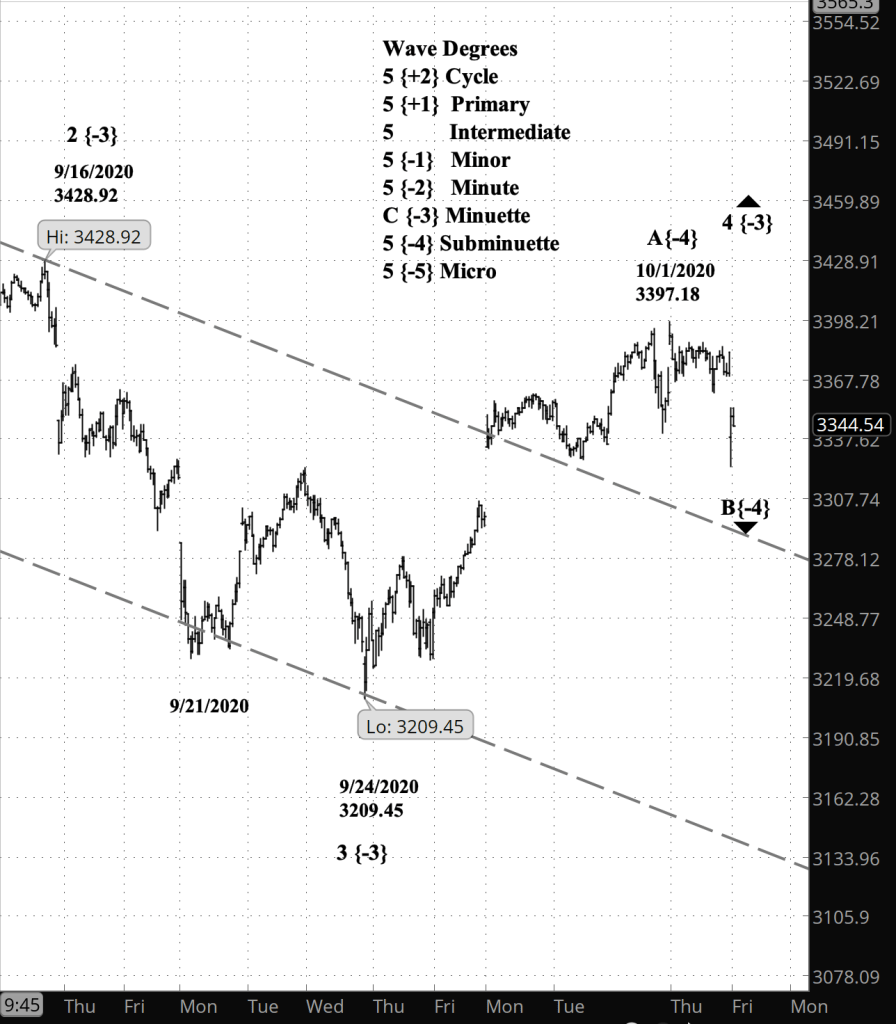
What’s happening now? The S&P 500 index opened with a 25-point descent below the October 1 high of 3397.18.

What does it mean? The magnitude of the fall gives greater certainty to my conclusion that yesterday’s high marks the start of the second, downward leg of the upward correction that began September 24.

[S&P 500 index, 15-minute bars]

What does Elliott wave theory say? Subminuette wave A rose 187.73 in 7 days, or 5.8%. What follows is Subminuette B, the second wave of the Minuette wave 4 correction within downtrending Minute wave 1.

B waves, by their nature, can be shallow or deep, and in fact can move beyond the starting point of the preceding wave A, which in this case was 3209.45. Elliott’s rules give very little guidance as to the magnitude of the fall.

My trading strategy. I won’t trade options on a B wave. There’s way too much uncertainty. I shall continue to hold my positions in SDS, an inverse fund based on the S&P 500.

Read More »

Thursday, October 1, 2020

10:15 a.m. New York time

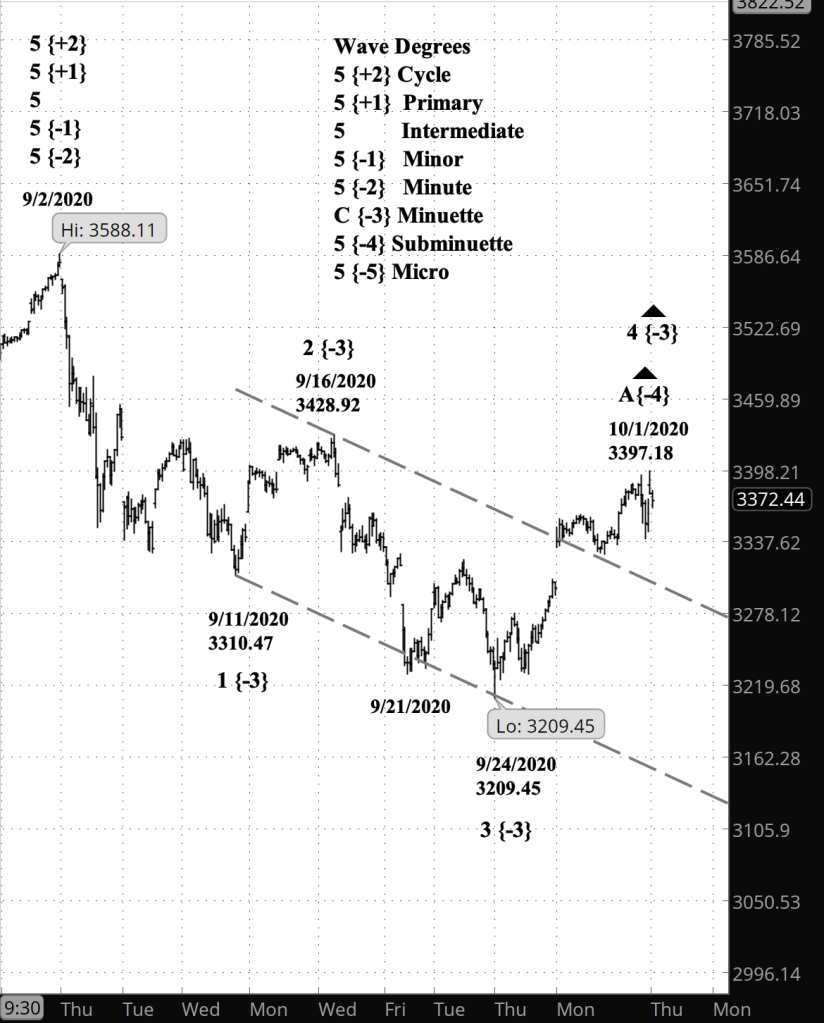
What’s happening now? The S&P 500 index moved a bit higher in overnight trading, to a high so far today of 3397.18. The upward correction that began September 24 has so far covered 187.73 points, or 5.8%.

What does it mean? The correction continues to trade above the upper boundary of the price channel and has met the formal requirements of completion. However, there is nothing that stops it from rising further.

What is the alternative? The correction could also take on a more complex form. See the Elliott wave discussion, below.

[S&P 500 index, 30-minute bars]

What does Elliott wave theory say? Fourth waves tend to be the most varied of the subcomponents of motive waves, and the most likely to extend into compound patterns. What we’ve seen so far with this 4th wave of Subminuette degree is a Zigzag, which in itself is unusual in that it is the same pattern as wave 4. Almost always the 2nd and 4th waves have different patterns. It’s possible that Subminuette 4 will continue with an X-wave separator, and then trace out another pattern, such as a Flat or another Zigzag. It’s also possible that what we’re seeing is a Horizontal Triangle in the making.

All of this is happening within a corrective subwave within Minuette wave 3, which in turn is a component of Minor wave 1.

My trading strategy. Given the ambiguities, I’ll be cautious about entering new options positions and will continue to hold my shares in the bearish exchange-traded fund SDS.

Read More »

Wednesday, September 30, 2020

3:40 p.m. New York time

The S&P 500 index peaked at 3393.56 and reversed to the downside, potentially completing wave A of Subminuette degree to the upside and beginning the Subminuette B decline. We’ll see what happens overnight.

10:25 a.m. New York time

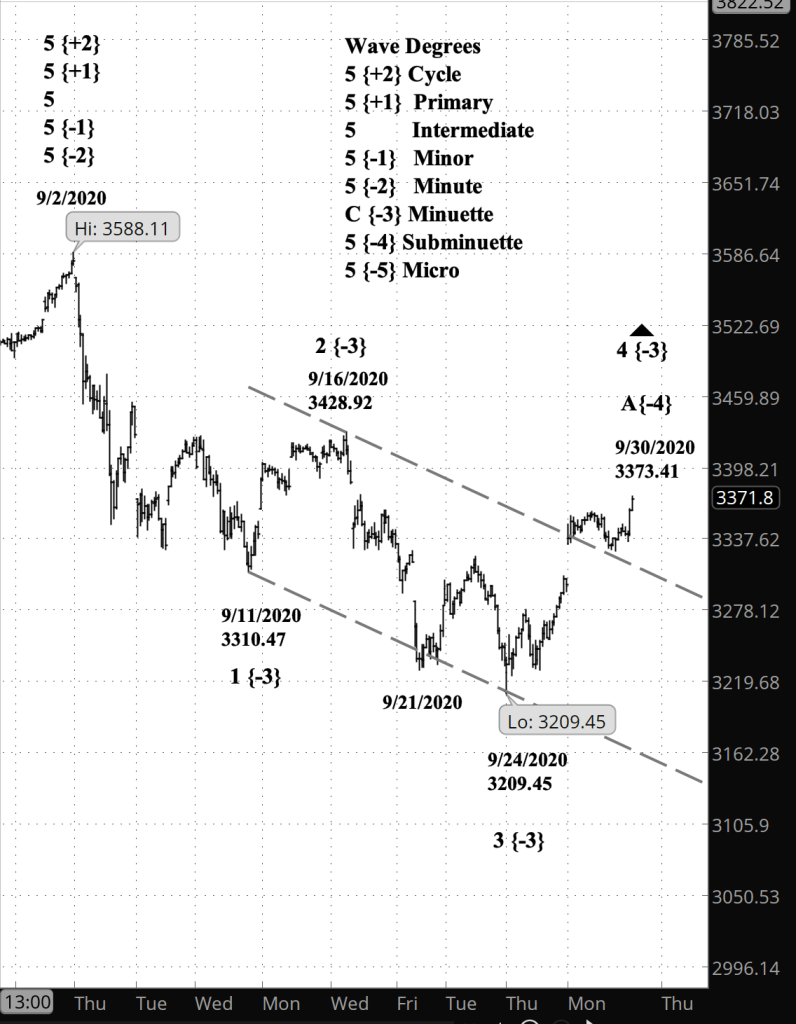
What’s happening now? The S&P 500 index has continued to rise in an upward correction within a larger-scale downtrend, remaining above the upper boundary of the price channel. The high so far is 3373.41.

What does it mean? My alternative count of yesterday turns out to be where the index is going. The move above the channel continues to suggest that the present rise is nearing its end.

What is the alternative? Yesterday’s principle count becomes today’s alternative: Today’s high could mark the end of the upward correction.

[S&P 500 index, 30-minute bars]

What does Elliott wave theory say? The rise since September 24, from 3,209.45, is wave A of Subminuette degree within wave 4 of the Minute degree, which is within wave 1 of the minute degree.

Internally, wave A now breaks into five subwaves of the Micro degree, with today’s rise being the 5th wave. The five-wave breakdown of wave A means that the parent wave 4 correction is tracing out a Zigzag pattern, a Combination, or a Triangle. If it were a Flat, then wave A would have broken down into three subwaves.

My trading strategy. A combination or a triangle will stretch out the time wave 4 will take to do its work, and that will make it difficult to catch the current entry window for an options position, which began yesterday and ends October 13. I’ll continue to hold my shares of SDS, which gain value as the S&P 500 loses value.

Read More »

Tuesday, September 29, 2020

1:10 p.m. New York time

Note: At the opening bell I was away from my trading desk for an early morning appointment. Upon my return, I have updated the analysis and chart based on the S&P 500 index.

What’s happening now? The S&P 500 index reversed in overnight trading and broke above the upper boundary of the price channel, likely marking the start of a downward movement within an upward correction that began on September 24.

What does it mean? The downward correction within a larger scale uptrending correction means that there is another upward movement, perhaps to a higher level, to be expected in the near future.

What’s the alternative? The downward flip could be a smaller scale correction within a continuing uptrend.

[S&P 500 index, 30-minute bars]

What does Elliott wave theory say? A breakout in Elliott usually denotes a turning point and, on this chart, strengthens the case that Subminuette wave A has reached an end.

The larger upward correction is wave 4 of the Minuette degree within downtrending wave 1 of the Minor degree. The downward loop could be the beginning of wave B of Subminuette degree. Alternatively, it could be a Micro-degree correction with in an ongoing Subminuette B.

My trading strategy. Unchanged. I’m waiting for a 5th wave at Subminuette degree before considering new options positions. I’m holding my bear-oriented shares of SDS.

Read More »

Monday, September 28, 2020

10:25 a.m. New York time

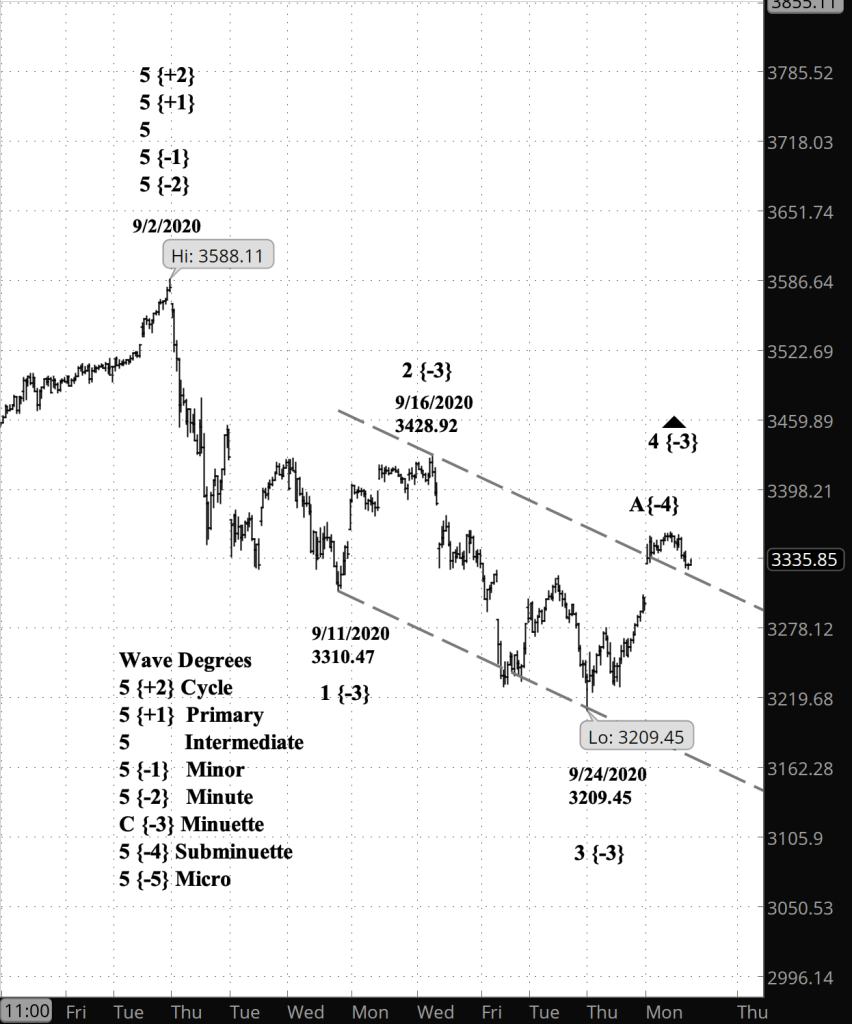
What’s happening now? The S&P 500 index rose to the upper boundary of the price channel in the second — and last — upward correction of the decline that began September 2. The high so far is 3351.92.

What does it mean? Once the correction is complete, the next move will be to a downside, with the price reaching into the 3100s.

[S&P 500 index, 30-minute bars]

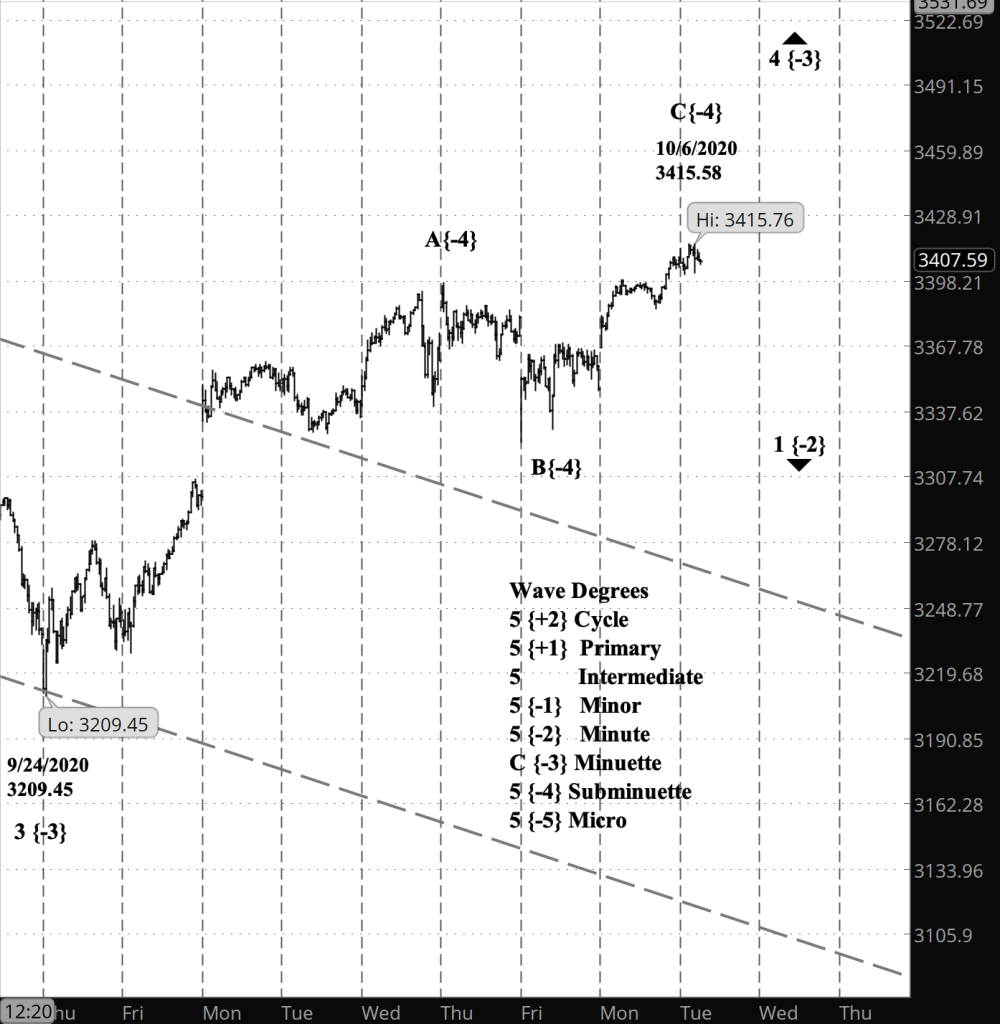
What does Elliott wave theory say? The rise that began September 24, from 3209.45, is Subminuette wave A within Minuette wave 4 within Minute wave 1. The rise to the channel’s upper boundary has come in three waves, the pattern within the A wave of a Flat pattern. That accords with Elliott wave theory, which says that waves two and four tend to be different patters. Minuette wave 2 was a Zigzag, with five waves within Subminuette wave A, and Minuette wave 4 is looking like a Flat.

My trading strategy. I’m looking at IWM as my next options play, since it has a higher implied volatility rank than SPY does. Their Elliott wave counts are the same. I’ll enter once Minuette wave 4 is complete and wave 5 of that degree has begun. I’m continuing to hold my bear-profitable shares in SDS.

Read More »

Friday, September 25, 2020

3:50 p.m. New York time

As it turns out the alternative count is correct. The S&P 500 index is in Micro wave C of Subminuette wave 4.

11:20 a.m. New York time

I’ve updated SPY Analysis with results.

10:25 a.m. New York time

I’ve exited my short iron condor position on SPY for 14.8% of maximum potential profit and shall update the entry analysis with the exit info later today.

9:05 a.m. New York time

What’s happening now? The final push to the downside by the S&P 500 index, now underway, will complete the decline that began September 16, approaching the lower boundary of the price channel at around 3100.

What does it mean? The end of the decline will be the starting point of an upward correction that will carry the price toward the upper boundary of the price channel, which is presently around 3278.

What is the alternative? Another interpretation of the chart has the upward correction that began September 21 continuing, with the final push to the downside not yet having begun.

[S&P 500 index, 30-minute bars]

What does Elliott wave theory say? By my principle count, wave 5 of Subminuette degree began on September 23 from 3323.25. The 1st wave of Micro degree within Subminuette 5 perhaps ended September 24 at 3209.45, or perhaps is continuing. There are ambiguities.

By my alternative count, the September 23 high was the end of wave A of Micro degree within Subminuette wave 4, and the low of September 24 was the end of Micro B, the the Micro C wave now underway.

My trading strategy. My short iron condor position on SPY is 21 day before expiration, the day I manage profitable trades. My SPY position is profitable, at 14.8% of maximum potential profit. If my principle count is correct, then I should exit now. Any further decline will erode that profit. If my alternative count is correct, then I should hold on to the position in the expectation of further rise, which will bump up my profit by a bit. I’ll make a decision as the day progresses.

I continue to hold my SDS shares.

Read More »