Update 10/19/2022: I exited my short bull put vertical spread on UAL, 24 days before expiration, for a $0.47 debit per contract/share, a profit before fees of $29 per contract. Shares were trading at $33.43, up $1.75 from the entry level.
The Implied Volatility Rank at exit was 62.4%, down 5.4 points from the entry level.
I exited on the day after entry because the position exceeded 25% of maximum potential profit, my normal exit point for earnings plays, reaching 38.2% of max.
Shares rose by 6.8% over one day for a +2,479% annual rate. The options position produced a 31.6% return for a +3,848% annual rate.
I have entered a short bull put vertical spread on UAL, using options that trade for the last time 31 days hence, on November 18. The premium is a $0.76 credit per contract share and the stock at the time of entry was priced at $36.52.
The Implied Volatility Ratio stood at 55.6%.
Premium:
$0.76
Expire OTM
UAL-bull put spread
Strike
Odds
Delta
Puts
Long
34.00
64.0%
30
Break-even
36.76
57.5%
36
Short
36.00
51.0%
42
The premium is 76% of the width of the position’s short/long spread. The profit zone covers a 0.7% move to the downside and an unlimited move to the upside.
The risk/reward ratio is 1.6:1, with maximum risk of $124 and maximum reward of $76 per contract.
How I chose the trade. The trade was placed to coincide with UAL’s earnings announcement, after the closing bell on the day of entry. The short strikes were set to coincide with the expected move of $2.04 either way, based on options pricing, which gives a price range of $34.84 to $38.56. The Zacks Investment Research earnings surprise predictor gave UAL a score of 5.22%, with a rank of Hold (3). The analysts’ consensus is that UAL will announce earnings of $2.21 per share.
By Tim Bovee, Portland, Oregon, October 18, 2022
Disclaimer
Tim Bovee, Private Trader tracks the analysis and trades of a private trader for his own accounts. Nothing in this blog constitutes a recommendation to buy or sell stocks, options or any other financial instrument. The only purpose of this blog is to provide education and entertainment.
No trader is ever 100 percent successful in his or her trades. Trading in the stock and option markets is risky and uncertain. Each trader must make trading decisions for his or her own account, and take responsibility for the consequences.
Half an hour before the closing bell. The S&P 500 reached 3746.50 on the futures during the session and then reversed, returning to the 23.6% retracement level, 50 points below.
The analysis from this morning is unchanged. The upward correction that began on October 13, wave 2{-7}, is still underway and is in its initial phase, rising wave A{-8}.
I’ve updated the chart.
2:35 p.m. New York time
ABT earnings play entry. I’ve entered a bull put spread on ABT, using options that trade for the last time on November 18, and have posted an analysis of the trade.
2:05 p.m. New York time
UAL earnings play entry. I’ve entered a bull put spread on UAL, using options that trade for the last time on November 18, and have posted an analysis of the trade.
9:35 a.m. New York time
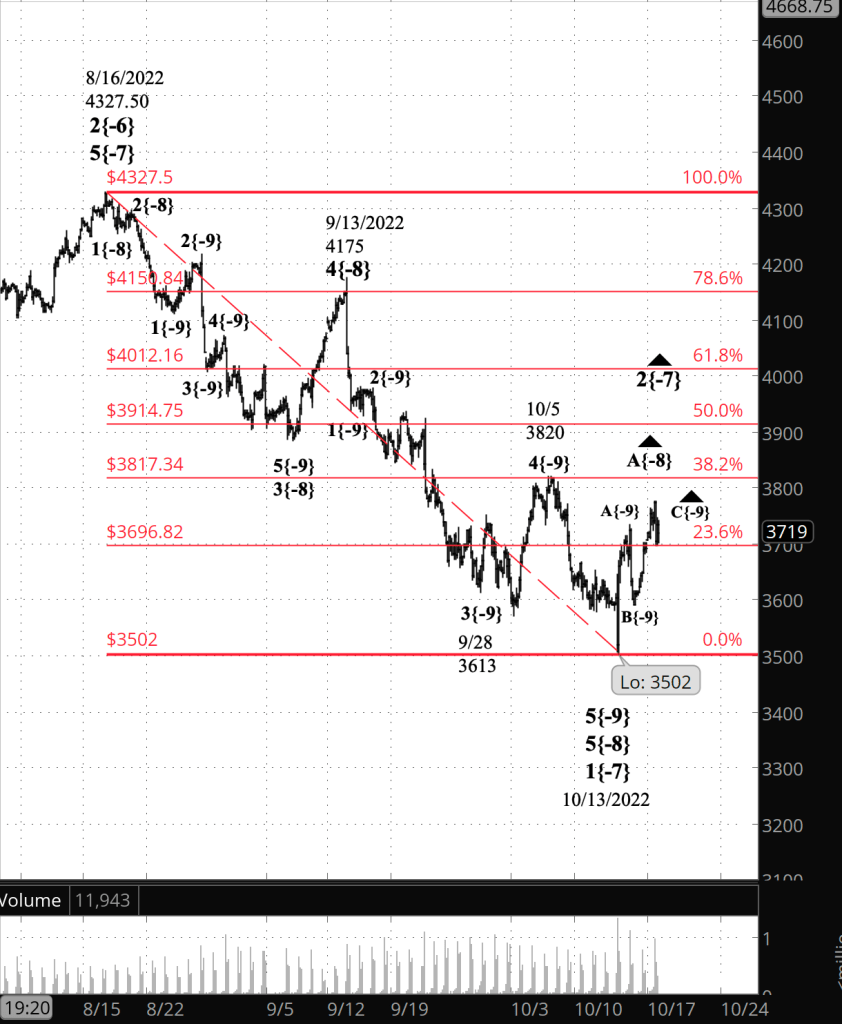
What’s happening now? The S&P 500 E-mini futures broke free from its stall in the 3690s, rising to the 3770s.
What does it mean? The third segment within the first leg of an upward correction that began on October 13 continues, carrying to price more than halfway toward the 38.2% Fibonacci retracement level. (I’ve placed a Fibonacci retracement ladder on the chart, in red.) The present rise, which began on October 16, will be followed by a decline and then a further rise to complete the correction’s first leg.
What are the alternatives? The ambiguity on the chart is whether the present rise will be the end of the first, rising portion of the upward correction, or whether there will be another decline and rise after it is complete. If the correction as a whole takes the form of a Zigzag, it will have five segments within its initial rise, as in the principal anaysis. Under the alternative analysis, it will take the from of a Flat, with three segments within the initial leg., and the end of the present rise will also be the end of the first leg of the correction.
[S&P 500 E-mini futures at 3:30 p.m., 160-minute bars, with volume]
What does Elliott wave theory say? Wave 2{-7}, an upward correction, began on October, and is now in its first part, wave A{-8}. Within wave A{-8}, wave C{-9} is underway.
Under the principal analysis, wave 2{-7} is taking the form of a Zigzag, with five waves within its initial rise, wave A{-8}. Wave C{-9} will be followed by two more waves, D{-9} and E{-9}, to bring wave A{-8} to an end.
Under the alternative analysis, wave 2{-7} is taking the from of a Flat, with three waves internally. Wave C{-9} will bring wave A{-8} to close.
Under either scenario, wave A{-8} will be followed by a decline, wave B{-8}, and then a rise, wave C{-8}, which likely will bring wave 2{-7} to completion. That is, unless wave 2{-7} takes the form of a compound correction. In that case, the first corrective pattern will be followed by a second one and perhaps a third.
This is all happening within a downtrend, wave 3{-6}, which began on August 16 from 4327.50.
We Are Here.
These are the waves currently in progress under my principal analysis. Each line on the list shows the wave number, with the subscript in curly brackets, the traditional degree name, the starting date, the starting price of the S&P 500 E-mini futures, and the direction of the wave.
Learning and other resources. Elliott wave analysis provides context, not prophecy. As the 20th century semanticist Alfred Korzybski put it in his book Science and Sanity (1933), “The map is not the territory … The only usefulness of a map depends on similarity of structure between the empirical world and the map.” And I would add, in the ever-changing markets, we can judge that similarity of structure only after the fact.
See the menu page Analytical Methods for a rundown on where to go for information on Elliott wave analysis.
By Tim Bovee, Portland, Oregon, October 18, 2022
Disclaimer
Tim Bovee, Private Trader tracks the analysis and trades of a private trader for his own accounts. Nothing in this blog constitutes a recommendation to buy or sell stocks, options or any other financial instrument. The only purpose of this blog is to provide education and entertainment.
No trader is ever 100 percent successful in his or her trades. Trading in the stock and option markets is risky and uncertain. Each trader must make trading decisions for his or her own account, and take responsibility for the consequences.
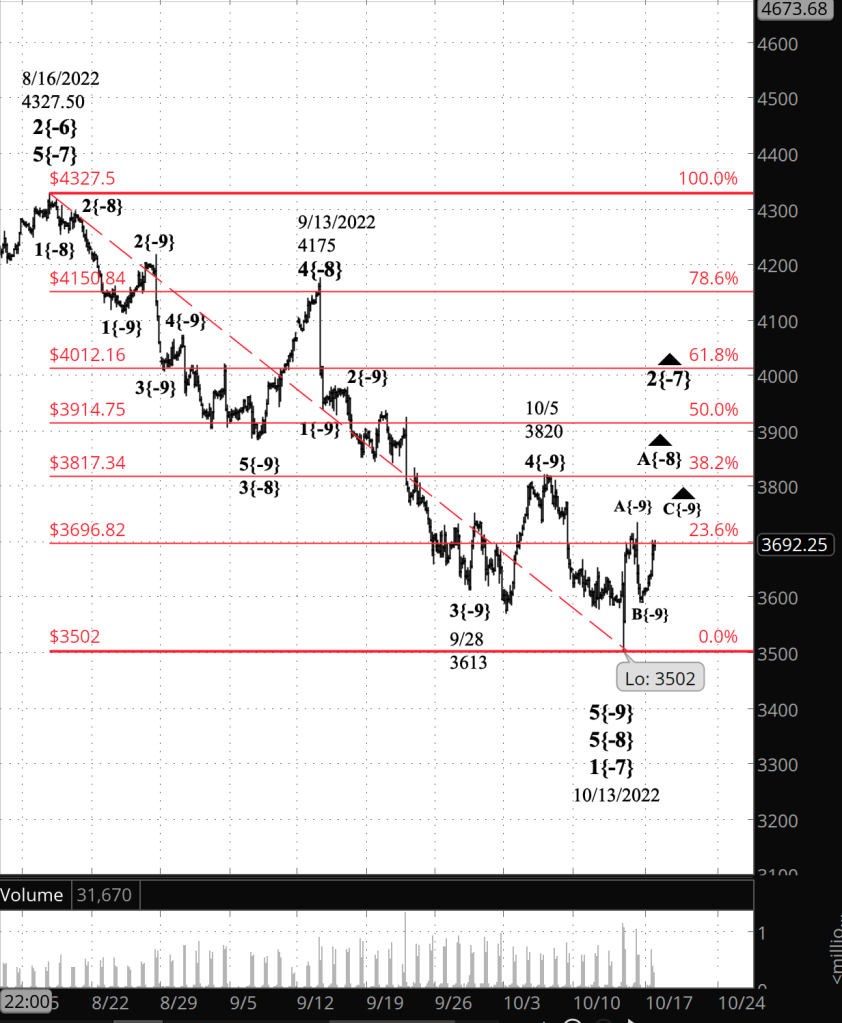
Half an hour before the closing bell. The S&P 500 rose during the session, reaching a high so far of 3702.50 on the futures. It then paused, fluctuating sideways along the 23.6% Fibonacci retracement level. No change in the analysis, but chart has added an ambiguity.
If the upward correction, wave 2{-7}, is taking the the from of a Zigzag, then the pause is wave C{-9} within wave A{-8}, with waves D and E at the {-9} level remaining. If wave 2{-7} is taking the form of a Flat, then the peak may have marked the end of wave A{-8} and the subsequent pause would be the early stages of wave B{-8}. Or, possibly, wave C{-9} within A{-8} still has further to rise.
I have no opinion on whether wave C{-9} is complete. However, I think the Zigzag scenario is more likely, for two reasons:
(1) Zigzags are a more common pattern than Flats for 2nd waves
(2) Second waves typically cover a lot of ground in the direction of the correction, and the first wave of the correction hasn’t gone very far yet.
11:05 a.m. New York time
BAC earnings play exit. I’ve exited my short bull put options spread on BAC for 97.5% of maximum potential loss and have updated the trade analysis with results.
9:35 a.m. New York time
What’s happening now? In overnight trading, the S&P 500 E-mini futures reversed from Friday’s low, 3590.50, rising into the 3670s.
What does it mean? An upward correction that began on October 13 is in its first leg, which can be expected to have five segments internally, if the correction takes the form of a Zigzag, or three segments, if the correction takes the form of a Flat. The correction’s first leg is presently in its third internal segment.
The correction is part the downtrend that began on August 16 from 4327.50. This is the first correction iwithin the downtrend and can be expected to retrace a significant portion of the preceding decline.
I’ve placed a Fibonacci retracement ladder on the chart, in red, making it easier to see how much of the decline has been retraced by the correction. The first segment within the first leg of the correction carried the price up to the 23.6% Fibonaci level. For the correction as a whole, a retracement up to the 61.8% or 78.6% Fibonacci levels would not be unusual.
What are the alternatives? As always in the early stages of a market movement, the labeling of the ups and downs compared to larger or smaller movements is a best guess. I’ve placed the correction in its entirety at one level smaller than the downtrend, which seems proportional in size and time to what has occurred before. Nonetheless, the chart could play out in such a way as to require a change in the labeling.
[S&P 500 E-mini futures at 3:30 p.m., 150-minute bars, with volume]
What does Elliott wave theory say? The upward correction is wave 2{-7] within a downtrend, wave 3{-6}. As noted a above, 2nd waves tend to take retrace much of the distance covered by the preceding 1st wave. Also, 3rd waves tend to be the longest wave within a trend. So there is energy both to the upside and the downside.
Internally, wave 2{-7} is in its initial wave, wave A{-8}, which in turn is in its third segment, wave C{-9}, the latter being an uptrending wave that began from Friday’s low.
Wave A{-8} will be followed by downtrending wave B{-8} and then a final push to the upside with wave C{-8}, which will complete the corrective pattern. Although not necessarily the correction, which could be extended in a compound structure.
We Are Here.
These are the waves currently in progress under my principal analysis. Each line on the list shows the wave number, with the subscript in curly brackets, the traditional degree name, the starting date, the starting price of the S&P 500 E-mini futures, and the direction of the wave.
Learning and other resources. Elliott wave analysis provides context, not prophecy. As the 20th century semanticist Alfred Korzybski put it in his book Science and Sanity (1933), “The map is not the territory … The only usefulness of a map depends on similarity of structure between the empirical world and the map.” And I would add, in the ever-changing markets, we can judge that similarity of structure only after the fact.
See the menu page Analytical Methods for a rundown on where to go for information on Elliott wave analysis.
By Tim Bovee, Portland, Oregon, October 17, 2022
Disclaimer
Tim Bovee, Private Trader tracks the analysis and trades of a private trader for his own accounts. Nothing in this blog constitutes a recommendation to buy or sell stocks, options or any other financial instrument. The only purpose of this blog is to provide education and entertainment.
No trader is ever 100 percent successful in his or her trades. Trading in the stock and option markets is risky and uncertain. Each trader must make trading decisions for his or her own account, and take responsibility for the consequences.
Update 10/17/2022: I exited my short bear call vertical spread on BAC, 32 days before expiration, for a $1.17 debit per contract/share, a loss before fees of $37 per contract. Shares were trading at $33.43, up $1.75 from the entry level.
The Implied Volatility Rank at exit was 62.4%, down 5.4 points from the entry level.
Since this was an earnings play, I exited on the day after entry, regardless of the outcome. In this exiting came at 97.5% of maximum loss. The trade was based on expectations of a decline; the price moved in the opposite direction after earnings came in at 81 cents per share, slightly above analysts’ consensus of 94.4 cents per share.
Shares rose by 5.5% over three days (including a weekend) for a 672.1% annual rate. The options position produced a 31.6% loss for a -3,848% annual rate.
I have entered a short bear call vertical spread on BAC, using options that trade for the last time 35 days hence, on November 18. The premium is a $0.80 credit per contract share and the stock at the time of entry was priced at $31.68.
The Implied Volatility Ratio stood at 67.89%.
Premium:
$0.80
Expire OTM
BAC-bear call spread
Strike
Odds
Delta
Calls
Long
34.00
74.0%
31
Break-even
32.80
65.0%
40.5
Short
32.00
56.0%
50
The premium is 80% of the width of the position’s short/long spread. The profit zone covers a 3.5% move to the upside and an unlimited move to the downside.
The risk/reward ratio is 1.5:1, with maximum risk of $120 and maximum reward of $80 per contract.
How I chose the trade. The trade was placed to coincide with BAC’s earnings announcement, before the closing bell on the day after entry. The short strike was set to coincide with the expected move of $1.05 either way, based on options pricing, which gives a price range of $30.63 to $32.73. The Zacks Investment Research earnings surprise predictor gave BAC a score of -1.76%, with a rank of 3. The analysts’ consensus is that BAC will announce earnings of $0.79 per share.
By Tim Bovee, Portland, Oregon, October 14, 2022
Disclaimer
Tim Bovee, Private Trader tracks the analysis and trades of a private trader for his own accounts. Nothing in this blog constitutes a recommendation to buy or sell stocks, options or any other financial instrument. The only purpose of this blog is to provide education and entertainment.
No trader is ever 100 percent successful in his or her trades. Trading in the stock and option markets is risky and uncertain. Each trader must make trading decisions for his or her own account, and take responsibility for the consequences.
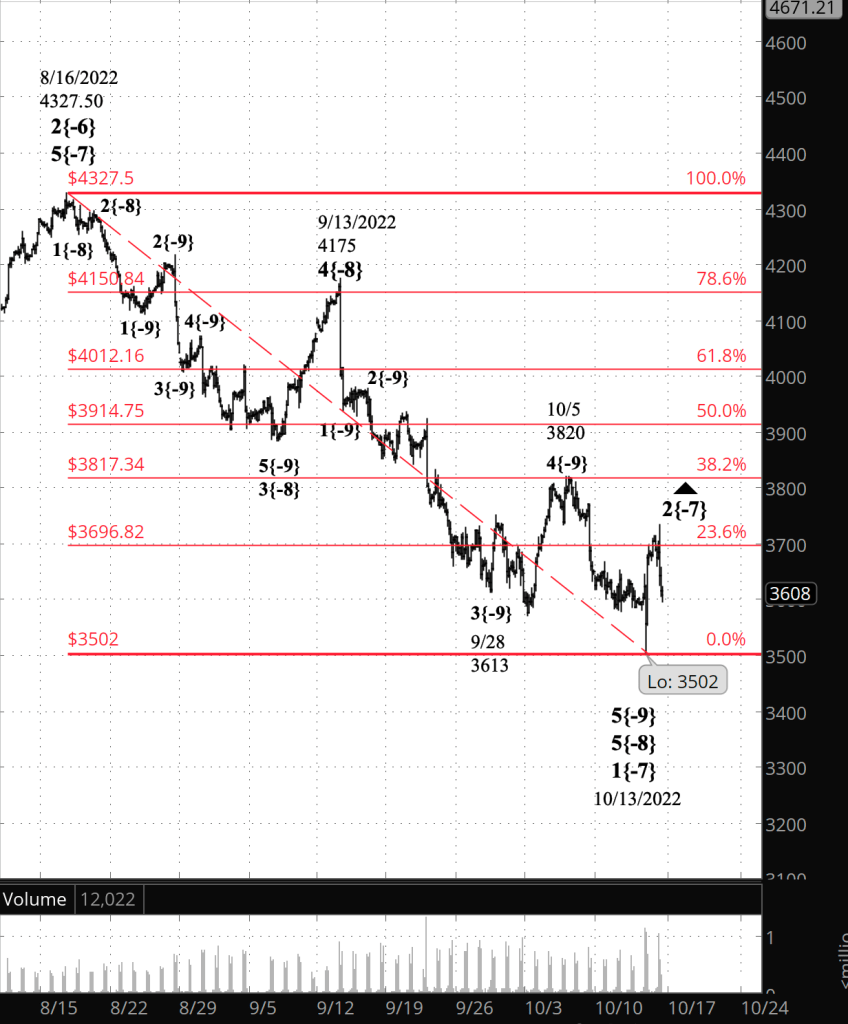
Half an hour before the closing bell. The S&P 500 has drawn back from the day’s high, 3733.75 on the futures, into the low 3600s. The pullback is a wave within the early phases of the first leg of an upward correction that began on October 13. In Elliott wave terms, an upward correction, wave 2{-7}, began on October 13. It is now in its first wave, rising wave A{-8}, and A{-8}’s second internal segment, declining wave 2{-9}, is presently underway. It could also possibly be one degree lower. No change in the analysis. I’ve updated the chart.
3:25 p.m. New York time
Earnings play BAC entry. I’ve entered a short bear call spread earnings play on BAC, using options that expire on November 18, and have posted an analysis of the trade.
1:35 p.m. New York time
Earnings plays JPM and MS exits. I’ve exited my short bear call options spreads on two symbols, JPM for 94% of maximum potential loss and MS for 24.1% of maximum potential profit. I’ve updated both trade analyses with full results, for JPM and MS.
9:35 a.m. New York time
What’s happening now? The S&P 500 E-mini futures traded sideways overnight, ranging from the 3660s to the 3730s, and then rose higher at the opening bell.
What does it mean? An upward correction that began yesterday, October 13, has reached its first pausing point, near the 23.6% Fibonacci retracement level. I’ve placed a Fibonacci retracement ladder on the chart in red to better track the progress of the correction.
The correction is the first within the downtrend that began on August 16 from 4327.50. The first correction in a trend tends to take back much of the ground covered by the first leg of the trend. However, it can’t move beyond the start of the trend, setting a firm upper boundary on this correction at 4327.50.
The major Fibonacci retracement levels are often end points of a correction and of subwaves within a correction. Three likely end points that satisfy the tendency to retrace a great deal of the preceding trend are around the 78.6% Fibonacci retracement level (4150.84), the 61.8% level (4012.16), or the 50% level (3914.75). Those potential endpoints represent tendencies, not certainties.
What are the alternatives?
Alternative #1: It’s possible, although I don’t consider it to be likely, that the upward movement that began yesterday is part of a smaller upward correction that began on September 28 from 3613. If this proves to be the case, then the rise would be the third and final wave of the correction.
Alternative #2: Also an unlikely possibility in my view. Under this scenario, the October 5 peak was indeed the end of a corrective pattern, but the upward correction is taking a compound form. The subsequent decline was a wave connecting the first corrective pattern with a second corrective pattern, and the rise that began yesterday is the first leg of that second corrective pattern.
[S&P 500 E-mini futures at 3:30 p.m., 150-minute bars, with volume]
What does Elliott wave theory say? Under the principal analysis, wave 2{-7} began yesterday from 3502 and is retracing the preceding downtrend, wave 1{-7}, which began on August 16 from 4327.50. A 2nd wave never moves beyond the starting point of the preceding 1st wave, which was 4327.50 for wave 1{-7}. That price is a firm limit for wave 2{-7}.
A 2nd wave almost always will take a Zigzag pattern. Wave 2{-7} is presently within its first leg, rising wave A{-8}, which will have five waves internally. Falling wave B{-8} will follow, with three internal aves, and rising wave C{-8} will complete the corrective pattern, with five waves internally.
The Zigzag pattern in a tendency, not a rule. Sometimes 2nd waves will take other forms. Also, rarely, they’ll take a compound structure.
The fact that the price reversed strongly from the lower boundary of wave 1{-7} gives me a great deal of confidence that the principal analysis is correct: Wave 2{-7} is underway. However, in market analysis, there are always ambiguities and alternatives. Elliott wave analysis, unlike many other methods, openly acknowledges and analyzes those other ways of interpreting a chart.
Under the first alternative analysis, wave 4{-9}, an upward correction that began on September 28, is still underway. The rise that began yesterday is its third wave internally, wave C{-10}, which will complete the correction.
Under the second alternative analysis, wave 4{-9} has taken a compound structure. The October 5 peak was the end of wave C{-10} and of the first corrective pattern. The subsequent decline to 3502 is a connector, wave X{-10}, and the rise that followed is wave A{-10}, the first wave of the second corrective pattern, which is still progress is wave. Compound corrections can have up to three corrective patterns.
We Are Here.
These are the waves currently in progress under my principal analysis. Each line on the list shows the wave number, with the subscript in curly brackets, the traditional degree name, the starting date, the starting price of the S&P 500 E-mini futures, and the direction of the wave.
Learning and other resources. Elliott wave analysis provides context, not prophecy. As the 20th century semanticist Alfred Korzybski put it in his book Science and Sanity (1933), “The map is not the territory … The only usefulness of a map depends on similarity of structure between the empirical world and the map.” And I would add, in the ever-changing markets, we can judge that similarity of structure only after the fact.
See the menu page Analytical Methods for a rundown on where to go for information on Elliott wave analysis.
By Tim Bovee, Portland, Oregon, October 14, 2022
Disclaimer
Tim Bovee, Private Trader tracks the analysis and trades of a private trader for his own accounts. Nothing in this blog constitutes a recommendation to buy or sell stocks, options or any other financial instrument. The only purpose of this blog is to provide education and entertainment.
No trader is ever 100 percent successful in his or her trades. Trading in the stock and option markets is risky and uncertain. Each trader must make trading decisions for his or her own account, and take responsibility for the consequences.
Update 10/14/2022: I exited my short bull put vertical spread on MS, 35 days before expiration, for a $0.82 debit per contract/share, a profit before fees of $26 per contract. Shares were trading at $76.52, down $2.75 from the entry level.
The Implied Volatility Rank at exit was 71.8%, down 8.6 points from the entry level.
I exited on the day after entry because the position reached 24.1% of maximum potential profit, close to my normal 25% exit point for earnings plays.
Shares fell by 3.5% over one day for a -1,266% annual rate. The options position produced a 31.7% return for a +11,573% annual rate.
I have entered a short bear call vertical spread on MS, using options that trade for the last time 36 days hence, on November 18. The premium is a $1.09 credit per contract share and the stock at the time of entry was priced at $79.27.
The Implied Volatility Ratio stood at 80.4%.
Premium:
$1.08
Expire OTM
MS-bear call spread
Strike
Odds
Delta
Calls
Long
82.50
65.0%
41
Break-even
81.08
60.0%
46
Short
80.00
55.0%
51
The premium is 86.4% of the width of the position’s short/long spread. The profit zone covers a 2.3% move to the upside and an unlimited move to the downside.
The risk/reward ratio is 1.3:1, with maximum risk of $142 and maximum reward of $1098 per contract.
How I chose the trade. The trade was placed to coincide with MS’s earnings announcement, before the opening bell on the day before entry. The short strikes were set to coincide with the expected move of $3.05 either way, based on options pricing, which gives a price range of $76.22 to $82.32. The Zacks Investment Research earnings surprise predictor gave MS a score of -2.84%, with a rank of 3. The analysts’ consensus is that MSwill announce earnings of $1.51 per share.
By Tim Bovee, Portland, Oregon, October 13, 2022
Disclaimer
Tim Bovee, Private Trader tracks the analysis and trades of a private trader for his own accounts. Nothing in this blog constitutes a recommendation to buy or sell stocks, options or any other financial instrument. The only purpose of this blog is to provide education and entertainment.
No trader is ever 100 percent successful in his or her trades. Trading in the stock and option markets is risky and uncertain. Each trader must make trading decisions for his or her own account, and take responsibility for the consequences.
Update 10/14/2022: I exited my short bull put vertical spread on JPM, 35 days before expiration, for a $2.65 debit per contract/share, a loss before fees of $47 per contract. Shares were trading at $112.03, up $2.96 from the entry level.
The Implied Volatility Rank at exit was 65.1%, down 10.9 points from the entry level.
I exited on the day after entry because the position became unprofitable. The position ended with 94% of maximum potential loss.
Shares rose by 2.8% over one day for a +991% annual rate. The options position produced a 17.7% loss for a -6,474% annual rate.
I have entered a short bear call vertical spread on JPM, using options that trade for the last time 36 days hence, on November 18. The premium is a $2.18 credit per contract share and the stock at the time of entry was priced at $109.07.
The Implied Volatility Ratio stood at 76%.
Premium:
$2.18
Expire OTM
JPM-bear call spread
Strike
Odds
Delta
Calls
Long
115.00
70.0%
35
Break-even
112.18
63.0%
42.5
Short
110.00
56.0%
50
The premium is 87.2% of the width of the position’s short/long spread. The profit zone covers a 2.9% move to the upside and an unlimited move to the downside.
The risk/reward ratio is 1.3:1, with maximum risk of $292 and maximum reward of $218 per contract.
How I chose the trade. The trade was placed to coincide with JPM’s earnings announcement, before the opening bell on the day after entry. The short strikes were set to coincide with the expected move of $1.55 either way, based on options pricing, which gives a price range of $107.59 to $10.55. The analysts’ consensus is that (sym) will announce earnings of $2.97 per share.
By Tim Bovee, Portland, Oregon, October 13, 2022
Disclaimer
Tim Bovee, Private Trader tracks the analysis and trades of a private trader for his own accounts. Nothing in this blog constitutes a recommendation to buy or sell stocks, options or any other financial instrument. The only purpose of this blog is to provide education and entertainment.
No trader is ever 100 percent successful in his or her trades. Trading in the stock and option markets is risky and uncertain. Each trader must make trading decisions for his or her own account, and take responsibility for the consequences.
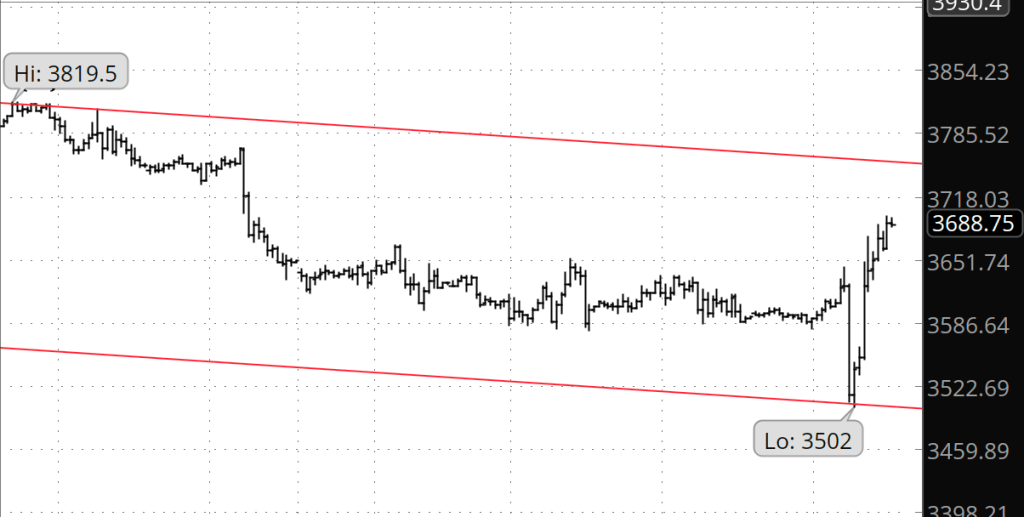
Half an hour before the closing bell. The S&P 500 rose sharply during the session after a sharp fall before the opening bell when new inflation numbers were released. The way I count it at that low degree, the decline to 3502 was the final wave within wave 5{-9}, which also completed waves 5{-8} and 1{-7}, and the subsequent rise was the begining wave wave 2{-7}, a large upawrd correction.
I’ve added a chart of the S&P 500 futures with 45-minute bars showing the fall and rise, and I’ve updated the upper chart further down.
[S&P 500 E-mini futures at 3:22 p.m., 45-minute bars]
3:15 p.m. New York time
MS earnings play entry. I’ve entered a short bear call spread on MS, using options that trade for the last time on November 18, and have posted an analysis of the trade.
3:05 p.m. New York time
JPM earnings play entry. I’ve entered a short bear call spread on JPM, using options that trade for the last time on November 18, and have posted an analysis of the trade.
10:05 a.m. New York time
DAL earnings play exit. I’ve exited a short bear call options spread on DAL for a wash — neither a profit nor loss — as the stock price seesawed wildly in the minutes after the opening bell. I’ve updated the trade analysis with the outcome
9:35 a.m. New York time
What’s happening now? The S&P 500 E-mini futures traded within a narrow range overnight until the release of the latest U.S. inflation numbers an hour before the opening bell. At that point, the price dropped 116.75 points in one minute, a decline of 3.2%.
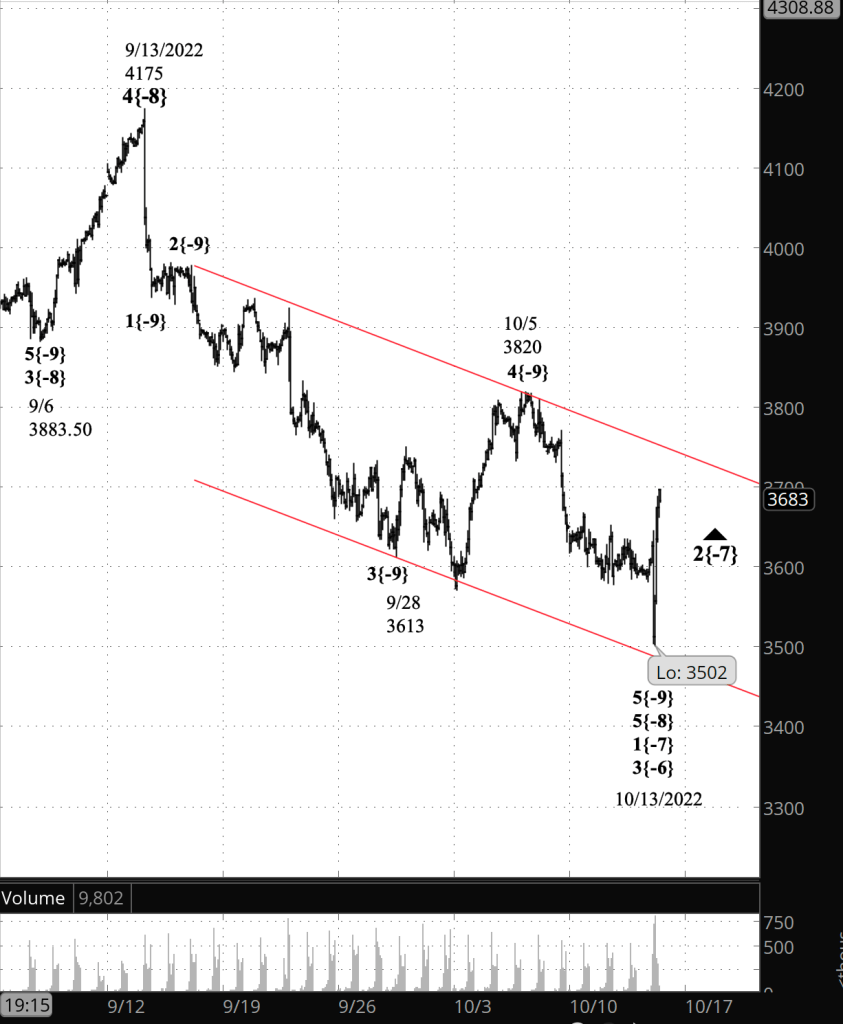
What does it mean? Markets respond to changes in the public mood, and whether the changes are rapid or slow, the prices traced on the charts match the patterns discovered by R.N. Elliott in the 1930s. In this case, the rapid decline is the final leg of a downtrend that began on October 5 from 3820, and that is itself the final leg of a larger downtrend that began on October 13 from 4175.
The sudden overnight drop brought the price to within a few points of the lower boundary of the price channel for the decline from October 5, marked in red on the upper chart.
The final leg of a trend often lacks respect for the targets implied by price channels, coming up short, moving far beyond, or hitting the target precisely. It’s like the porridge in “Goldilocks and the Three Bears” — too cold, too hot or just right.
That’s a long way of saying that while the final leg of the downtrend could be ending right where the price is, there’s no guarantee that it won’t decline further, perhaps by a significant distance.
What are the alternatives? The present ambiguities arise from the Goldilocks conundrum described above: Has the downtrended ended yet? What is the state of the porridge? And the answer at present is that the porridge seems just right — the final leg of the downtrend will end close to the price channel — but we can’t know that for sure.
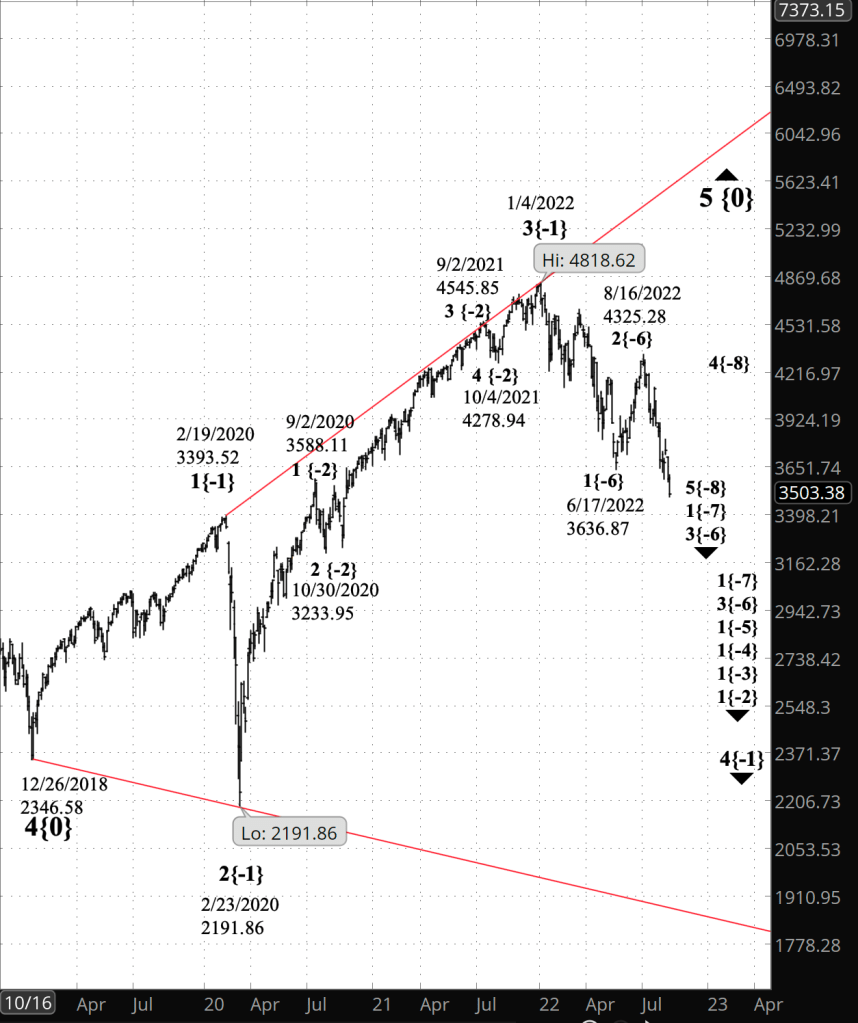
The charts. The upper chart, of the S&P 500 futures, shows the downtrend that began on September 13. The lower chart, of the S&P 500 index, shows the entirely of the expanding Diagonal Triangle that began in December 2018.
[S&P 500 E-mini futures at 3:30 p.m., 85-minute bars, with volume]
[S&P 500 index at 9:34 a.m., 3-day bars]
What does Elliott wave theory say? The overnight decline is wave 5{-10} within the larger wave 5{-9}, which began on October 5. The whole structure is contained within a series of nested waves of increasing size: Wave 5{-8}, which began on September 13, within wave 1{-7} within wave 3{-6}, both of which which began on August 16 from 4327.50 — and so forth, up to wave 4{-1}, which began on January 4 and is the next to the last component of wave 5{0}, an expanding Diagonal Triangle that began on December 26, 2018.
All of the waves in this structure, up through wave 4{-1}, are downtrending. Wave 5{0} is an uptrending wave, although the expanding Diagonal Triangle pattern means that the prices swing from highest to lowest and back to an even higher highest and then to a lower lowest. The Diagonal Triangle price channel is shown in red on the lower chart.
Given the fractal nature of price levels — “degrees” in Elliott wave parlance — the end of a smaller wave can also be the end of a larger wave. So the end of wave 5{-10} will also be the end of wave 5{-9} and also of 5{-8} and 1{-7}.
Wave 1{-7} will be followed by an upward correction larger than those we’ve seen this autumn, and then by a decline, also larger than those of recent memory.
We Are Here.
These are the waves currently in progress under my principal analysis. Each line on the list shows the wave number, with the subscript in curly brackets, the traditional degree name, the starting date, the starting price of the S&P 500 E-mini futures, and the direction of the wave.
Learning and other resources. Elliott wave analysis provides context, not prophecy. As the 20th century semanticist Alfred Korzybski put it in his book Science and Sanity (1933), “The map is not the territory … The only usefulness of a map depends on similarity of structure between the empirical world and the map.” And I would add, in the ever-changing markets, we can judge that similarity of structure only after the fact.
See the menu page Analytical Methods for a rundown on where to go for information on Elliott wave analysis.
By Tim Bovee, Portland, Oregon, October 13, 2022
Disclaimer
Tim Bovee, Private Trader tracks the analysis and trades of a private trader for his own accounts. Nothing in this blog constitutes a recommendation to buy or sell stocks, options or any other financial instrument. The only purpose of this blog is to provide education and entertainment.
No trader is ever 100 percent successful in his or her trades. Trading in the stock and option markets is risky and uncertain. Each trader must make trading decisions for his or her own account, and take responsibility for the consequences.
Update 10/13/2022: I exited my short bear call vertical spread on October 13, 36 days before expiration, for a $1.03 debit per contract/share, for neither a profit nor a loss.Shares were trading at $29.05, down $0.10 from the entry level.
The Implied Volatility Rank at exit was 63%, down 7.5 points from the entry level.
I exited on the day after entry because the position was an earnings play, and my rules is to get out quickly, win or lose. In this case at the opening bell, the shares declined rapidly and then rose. i exited during the decline.
Shares fell by 0.3% over one day for a -125.2% annual rate. The options position produced a no return.
I have entered a short bear call vertical spread on DAL, using options that trade for the last time 37 days hence, on November 18. The premium is a $1.03 credit per contract share and the stock at the time of entry was priced at $29.15.
The Implied Volatility Ratio stood at 70.5%.
Premium:
$1.03
Expire OTM
DAL-bear call spread
Strike
Odds
Delta
Calls
Long
33.00
78.0%
26
Break-even
31.03
69.0%
37
Short
30.00
60.0%
48
The premium is 68.7% of the width of the position’s short/long spread. The profit zone covers a 6.4% move to the upside and an unlimited move to the downside.
The risk/reward ratio is 1.9:1, with maximum risk of $394 and maximum reward of $206 per contract.
How I chose the trade. The trade was placed to coincide with DAL’s earnings announcement, beofre the closing bell on the day after entry. The short strikes were set to coincide with the expected move of $1.55 either way, based on options pricing, which gives a price range of $27.61 to $30.71. The Zacks Investment Research earnings surprise predictor gave DAL a score of -2.41% — a negative surprise — with a rank of 3 — hold. The analysts’ consensus is that DAL will announce earnings of $1.56 per share.
By Tim Bovee, Portland, Oregon, October 12, 2022
Disclaimer
Tim Bovee, Private Trader tracks the analysis and trades of a private trader for his own accounts. Nothing in this blog constitutes a recommendation to buy or sell stocks, options or any other financial instrument. The only purpose of this blog is to provide education and entertainment.
No trader is ever 100 percent successful in his or her trades. Trading in the stock and option markets is risky and uncertain. Each trader must make trading decisions for his or her own account, and take responsibility for the consequences.
Half an hour before the closing bell. The S&P 500 futures have continued to trade narrowly during the session, centering on 3600. No change in the analysis. I’ve updated the chart.
1:55 p.m. New York time
DAL earnings play entry. I’ve entered a bear call spread on DAL, using options that trade for the last time on November 18, and have posted an analysis of the trade.
9:35 a.m. New York time
What’s happening now? The S&P 500 E-mini futures traded sideways in a narrow range overnight.
What does it mean? A low-level upward correction within a downtrend continues.
What are the alternatives? The upward correction ended yesterday and the final decline within the downtrend has begun.
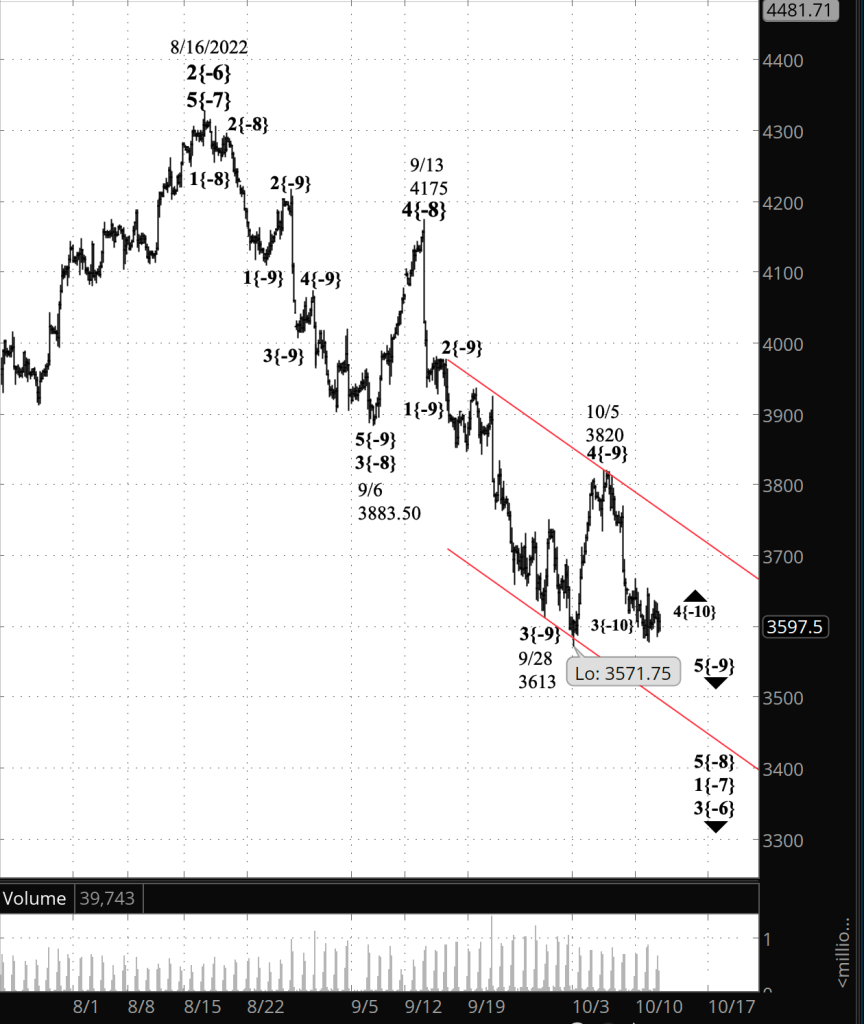
[S&P 500 E-mini futures at 3:30 p.m., 3-hour bars, with volume]
What does Elliott wave theory say? The upward correction is wave 4{-10} within wave 5{-9}, a downtrend that began on October 5 from 3820. At this point analysts are playing “Where’s Waldo” with the endpoint of wave 4{-10}. Is the correction over already or does it still underway? The difference between the principal analysis and the alternative analysis focuses on that question.
Ultimately, the question is fairly unimportant to trader’s. Wave 4{-10} is of a low degree. What we do know is that it will end soon and will be followed by a resumption of the downtrend: Wave 5{-10}, the final wave within downtrending wave 5{-9}.
When wave 5{-10} is complete, it will also be the end of its parent, wave 5{-9}, and also of two larger encompassing declines: Wave 5{-8}, which began on September 13 from 4175, and wave 1{-7}, which began on August 16 from 4327.50.
I’ve widened the view on the chart to show the entirety of the wave 1{-7} decline from August 16.
The price channel suggests that wave 5{-9} will decline to the lower boundary, a goal that is at 3500 this morning and which continually declines further. The channel is marked in red on the chart. It provides an estimate of the downside potential of wave 5{-9}, along with waves 5{-8} and 1{-7}.
Of course, 5th waves are like stubborn mules. Sometimes they come to a sudden halt before reaching the goal, and sometimes they leap forward beyond the goal.
What is certain is that waves 5{-9}, 5{-8} and 1{-7}, upon reaching their simultaneous end, will be followed by wave 2{-7}, an upward correction of far larger size than the present wave 4{-10} that, if it behaves typically in the degree of retracement, could carry the price back up to a range between 3900 and 4020, more or less. No guarantees, of course. Waves don’t always behave typically.
Wave 2{-7}, when complete, will be followed by a powerful decline, wave 3{-7}, which will carry the price well below 3500.
Wave 1{-7} began about two months ago, and wave 3{-7}, following the upward correction, may well last twice that amount of time, given the power of 3rd waves. So while the wave 2{-7} upward correction may provide some short-term bullish trading opportunities, for my own trading I plan to focus intently on the larger downtrend that will follow.
We Are Here.
These are the waves currently in progress under my principal analysis. Each line on the list shows the wave number, with the subscript in curly brackets, the traditional degree name, the starting date, the starting price of the S&P 500 E-mini futures, and the direction of the wave.
Learning and other resources. Elliott wave analysis provides context, not prophecy. As the 20th century semanticist Alfred Korzybski put it in his book Science and Sanity (1933), “The map is not the territory … The only usefulness of a map depends on similarity of structure between the empirical world and the map.” And I would add, in the ever-changing markets, we can judge that similarity of structure only after the fact.
See the menu page Analytical Methods for a rundown on where to go for information on Elliott wave analysis.
By Tim Bovee, Portland, Oregon, October 12, 2022
Disclaimer
Tim Bovee, Private Trader tracks the analysis and trades of a private trader for his own accounts. Nothing in this blog constitutes a recommendation to buy or sell stocks, options or any other financial instrument. The only purpose of this blog is to provide education and entertainment.
No trader is ever 100 percent successful in his or her trades. Trading in the stock and option markets is risky and uncertain. Each trader must make trading decisions for his or her own account, and take responsibility for the consequences.

 Tim Bovee, Private Trader
You must be logged in to post a comment.