SP500 Analysis

3:30 p.m. New York time

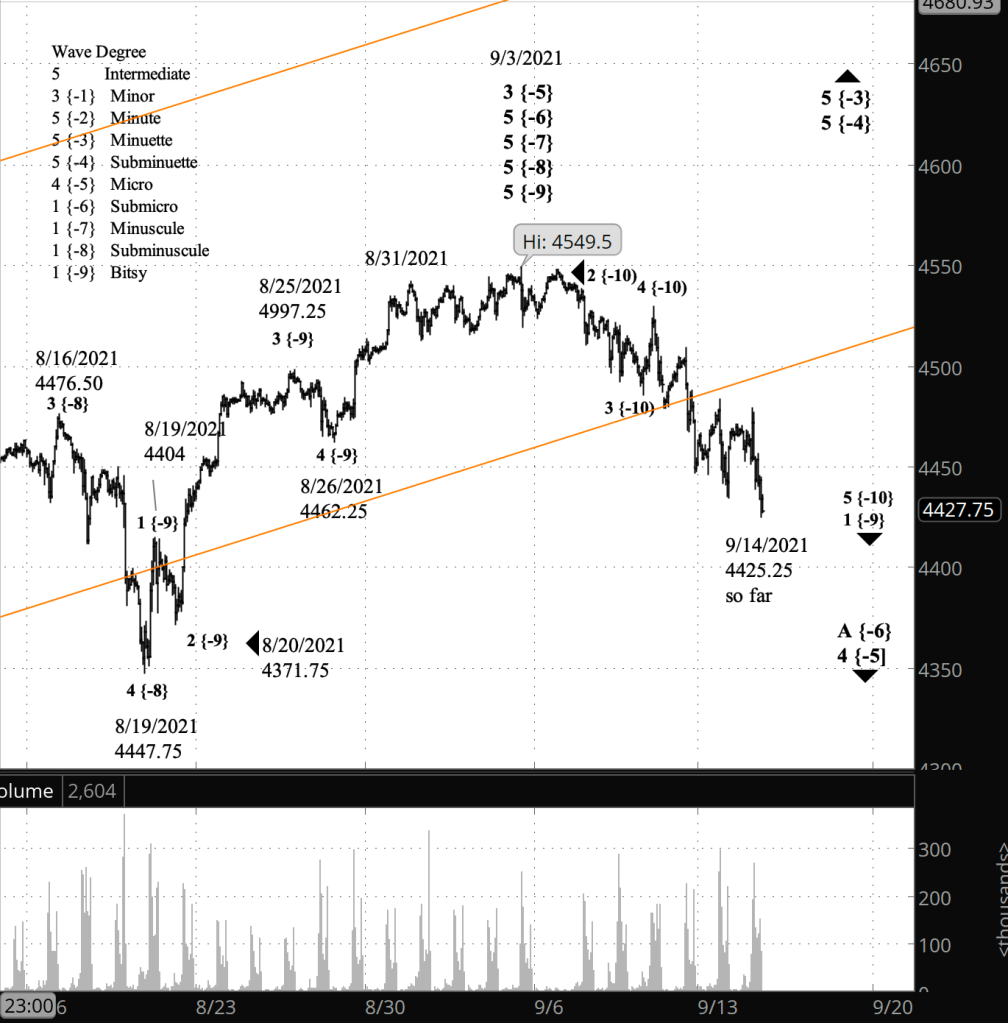
Half an hour before the closing bell. The S&P 500 E-mini futures rose slightly during the day and then resumed its downward course, reaching new lows. No change in the analysis. I’ve updated the chart.

11:35 a.m. New York time

My positions. I have exited my bear call options spread position on BABA and updated the entry analysis with results.

9:35 a.m. New York time

What’s happening now? The S&P 500 E-mini futures in overnight trading stayed above the low of 4434.50 set late in yesterday’s session.

What does it mean? The early steps in a downward correction of the rise that began May 19 from 4059.50 on the index continues. The preceding uptrend peaked on September 3.

What’s the alternative? A correction within the rise that began on May 19 is still underway. The September 3 peak was a turning point within that larger rise.
[S&P 500 E-mini futures at 3:30 p.m., hourly bars, with volume]

What does Elliott wave theory say? Under my principal analysis, wave 3 of Micro degree, which began on May 19, peaked on September 3, and wave 4 of Micro degree is now underway.

Under my alternate analysis, wave 3 of Micro degree is still underway, with the decline since September 3 being a correction within that wave. Wave 4 still lies in the future.

A price rise above the September 3 peak, 4549.50 on the futures and 4545.85 on the index, would mean that the alternate count is correct: wave 3 of Micro degree is not yet complete. Such an event would invalidate my present principal analysis and would promote the alternate count to principal count.

Learning and other resources. Elliott wave analysis provides context, not prophecy. As the 20th century semanticist Alfred Korzybski put it in his book Science and Sanity (1933), “The map is not the territory … The only usefulness of a map depends on similarity of structure between the empirical world and the map.” And I would add, we can judge that similarity of structure only after the fact.

See the menu page Analytical Methods for a rundown on where to go for information on Elliott wave analysis.

By Tim Bovee, Portland, Oregon, September 14, 2021

Disclaimer

Tim Bovee, Private Trader tracks the analysis and trades of a private trader for his own accounts. Nothing in this blog constitutes a recommendation to buy or sell stocks, options or any other financial instrument. The only purpose of this blog is to provide education and entertainment.

No trader is ever 100 percent successful in his or her trades. Trading in the stock and option markets is risky and uncertain. Each trader must make trading decisions for his or her own account, and take responsibility for the consequences.

License
Creative Commons License

All content on Tim Bovee, Private Trader by Timothy K. Bovee is licensed under a Creative Commons Attribution-ShareAlike 4.0 International License.

Based on a work at www.timbovee.com.
SP500 Analysis

3:30 p.m. New York time

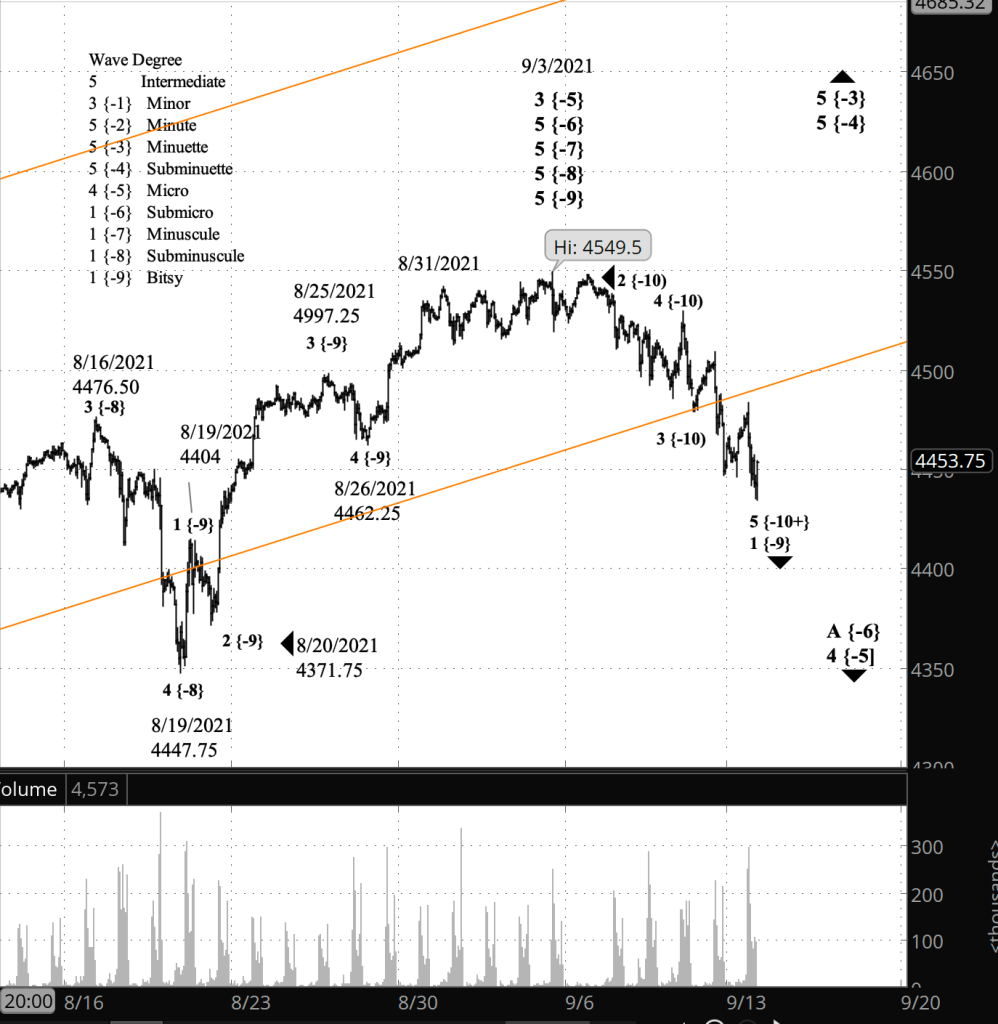
Half an hour before the closing bell. TheS&P 500 made a small upward correction from this morning’s low and then pressed downward again, reaching 4434.50 so far. The rapid resumption of the downward movement adds additional weight in favor of my principal analysis, that the 3rd wave of Micro degree peaked on September 3, and what follows has been a 4th wave correction within wave 5 of Subminuette degree, one level higher. No change in the analysis. I’ve updated the chart.

10:20 a.m. New York time

What’s happening now? The S&P 500 fell in early morning trading, reaching a new low of 4446.50 and then rising again as the opening bell approached.

What does it mean? My principal analysis would identify the peak of September 3, at 4549.50, as the end of the rise that began on May 19 and the beginning of a decline.

What’s the alternative? Another analysis, one that I’ve preferred up to now, sees the decline from September 3 as an expanding triangle in a rise that began on August 31.

The chart. I’ve reworked the labeling to show the first, principal analysis. For a view of the now-alternative analysis, see Friday’s chart.

[S&P 500 E-mini futures at 3:30 p.m., hourly bars, with volume]

What does Elliott wave theory say? I’ve promoted the former alternative analysis to principal analysis for two reasons: 1) The decline from September 3 shows a clear five-wave pattern. If it were part of an expanding triangle, it would be three waves, and 2) the power of the downside suggests a decline rather than a 4th-wave triangle, which would be more measured in either direction.

It is possible that the alternative analysis will prove to be correct. It seems to me that the preponderance of evidence favors the principal analysis.

And what sort of decline are we seeing?

In prior analysis I’ve described a scenario in which the end of wave 5 of Subbitsy degree marks the end of a series of 5th waves up four levels to Submicro degree, and the end of wave 3 of Micro degree, one level up. In my principal analysis, the high of September 3 was the end of wave 3 of Submicro degree, triggering all of the endings up the fractal ladder. This is all happening within wave 5 of Subminuette degree.

Wave 3 of Submicro degree began on May 19, and its end is the start of Submicro wave 4, now underway. As a 4th wave it is more likely to trace a Flat pattern. Submicro 3 began from around 4060, and the endpoint was around 4550, a distance of 490 points. A Fibonacci 38.6% retracement — not uncommon in 4th waves — would move the price down to the 4360s, about 100 points below where it is today.

Learning and other resources. Elliott wave analysis provides context, not prophecy. As the 20th century semanticist Alfred Korzybski put it in his book Science and Sanity (1933), “The map is not the territory … The only usefulness of a map depends on similarity of structure between the empirical world and the map.” And I would add, we can judge that similarity of structure only after the fact.

See the menu page Analytical Methods for a rundown on where to go for information on Elliott wave analysis.

By Tim Bovee, Portland, Oregon, September 13, 2021

Disclaimer

Tim Bovee, Private Trader tracks the analysis and trades of a private trader for his own accounts. Nothing in this blog constitutes a recommendation to buy or sell stocks, options or any other financial instrument. The only purpose of this blog is to provide education and entertainment.

No trader is ever 100 percent successful in his or her trades. Trading in the stock and option markets is risky and uncertain. Each trader must make trading decisions for his or her own account, and take responsibility for the consequences.

License
Creative Commons License

All content on Tim Bovee, Private Trader by Timothy K. Bovee is licensed under a Creative Commons Attribution-ShareAlike 4.0 International License.

Based on a work at www.timbovee.com.
SP500 Analysis

3:30 p.m. New York time

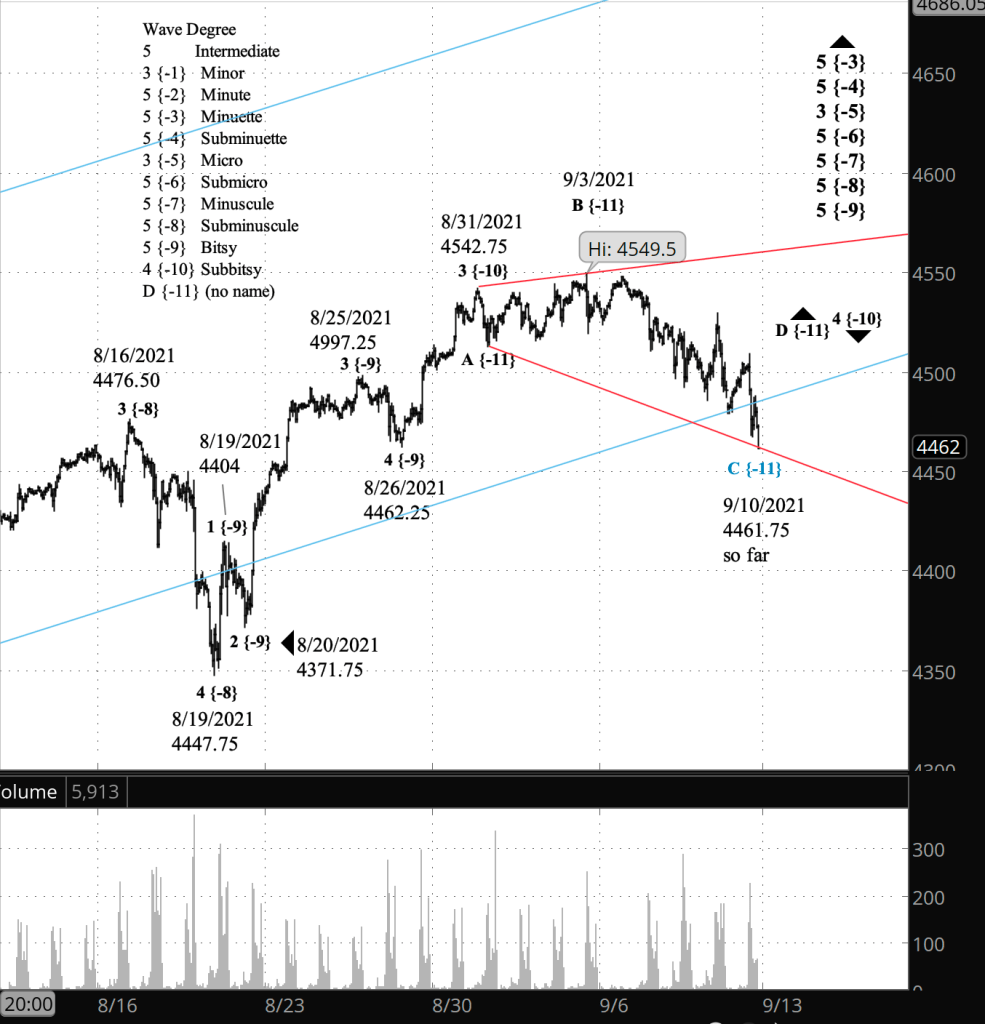
Half an hour before the closing bell. The S&P 500 continued to fall during the day, reversing and then falling back to a still lower level, touching the lower boundary of the expanding triangle. No change in the analysis. I’ve updated the chart.

10 a.m. New York time

What’s happening now? Three hours after yesterday’s closing bell, the S&P 500 E-mini futures dropped to a new low, 4479.25, pushing down the lower boundary of an expanding triangle (marked in red on the chart) that began on August 31. This has happened repeatedly in recent days. What differs this time is that the price drop touched the lower boundary of the price channel of the rise that began March 4 (marked in blue). In theory this strengthens the idea that the series of lower lows is over. However, prices routinely pierce the boundaries of price channels, so nothing is guaranteed. It does signify that the end is near.

What does it mean? As with the past lower lows on the triangle boundary, my principal analysis has marked the low as the end of the decline that began September 3 and the beginning of a new rise back to the upper boundary of the triangle.

What’s the alternative? A new lower low means that the decline is still underway.

[S&P 500 E-mini futures at 3:30 p.m., hourly bars, with volume]

What does Elliott wave theory say? First micro, then macro. At the small degrees, the low from last night marks the end of wave C within wave 4 of Subbitsy degree, and the beginning of wave D, which will carry the price back to the upper boundary of the expanding triangle (red on the chart), which is presently around 4560. Expanding triangles have five waves internally, so the wave E that follows will bring the price back down to the triangle’s lower boundary, ending the Subbitsy wave 4. Since the lower boundary moves further down each day, wave E will travel further than the preceding wave D to meet its end.

At the larger degrees, the rise since March 4, wave 5 of Minuette degree has been encompassed by a price channel marked in blue on the chart. The end of Minuette wave 5 will also mark the end of 5th waves of increasing degree all the way up to the Supercycle level, which is a very big deal indeed, since it will mark the start of a downtrend of epic proportions.

From small to large, with subscripts:

  • Wave 4 of Subbitsy degree {-10} (the expanding triangle, in red), when complete,
  • will mark the start ofWave 5 of Bitsy degree {-9} within
  • within wave 5 of Subminuscule degree {-8}
  • within wave 5 of Minuscule degree {-7}
  • within wave 5 of Submicro degree {-6}
  • within wave 3 of Micro degree {-5}, which will be followed by a correction, wave 4 of Micro degree, and then a 5th wave pushing up to mark the end of
  • the parent wave, 5 of Subminuette {-4} degree
  • within wave 5 of Minuette degree {-3} (the price channel, in blue)
  • within wave 5 of Minute {-2} degree
  • within wave 3 of Minor degree {-1}, whose completion will be followed by a signifiant 4th wave correction and then a 5th wave movement to higher highs,
  • which will complete wave 5 of Intermediate degree {no subscript}
  • within wave 5 of Primary degree {+1}
  • within wave 5 of Cycle degree {+2}
  • within wave 5 of Supercycle degree {+3}, which began in 1932.

Learning and other resources. Elliott wave analysis provides context, not prophecy. As the 20th century semanticist Alfred Korzybski put it in his book Science and Sanity (1933), “The map is not the territory … The only usefulness of a map depends on similarity of structure between the empirical world and the map.” And I would add, we can judge that similarity of structure only after the fact.

See the menu page Analytical Methods for a rundown on where to go for information on Elliott wave analysis.

By Tim Bovee, Portland, Oregon, September 10, 2021

Disclaimer

Tim Bovee, Private Trader tracks the analysis and trades of a private trader for his own accounts. Nothing in this blog constitutes a recommendation to buy or sell stocks, options or any other financial instrument. The only purpose of this blog is to provide education and entertainment.

No trader is ever 100 percent successful in his or her trades. Trading in the stock and option markets is risky and uncertain. Each trader must make trading decisions for his or her own account, and take responsibility for the consequences.

License
Creative Commons License

All content on Tim Bovee, Private Trader by Timothy K. Bovee is licensed under a Creative Commons Attribution-ShareAlike 4.0 International License.

Based on a work at www.timbovee.com.
SP500 Analysis

3:30 p.m. New York time

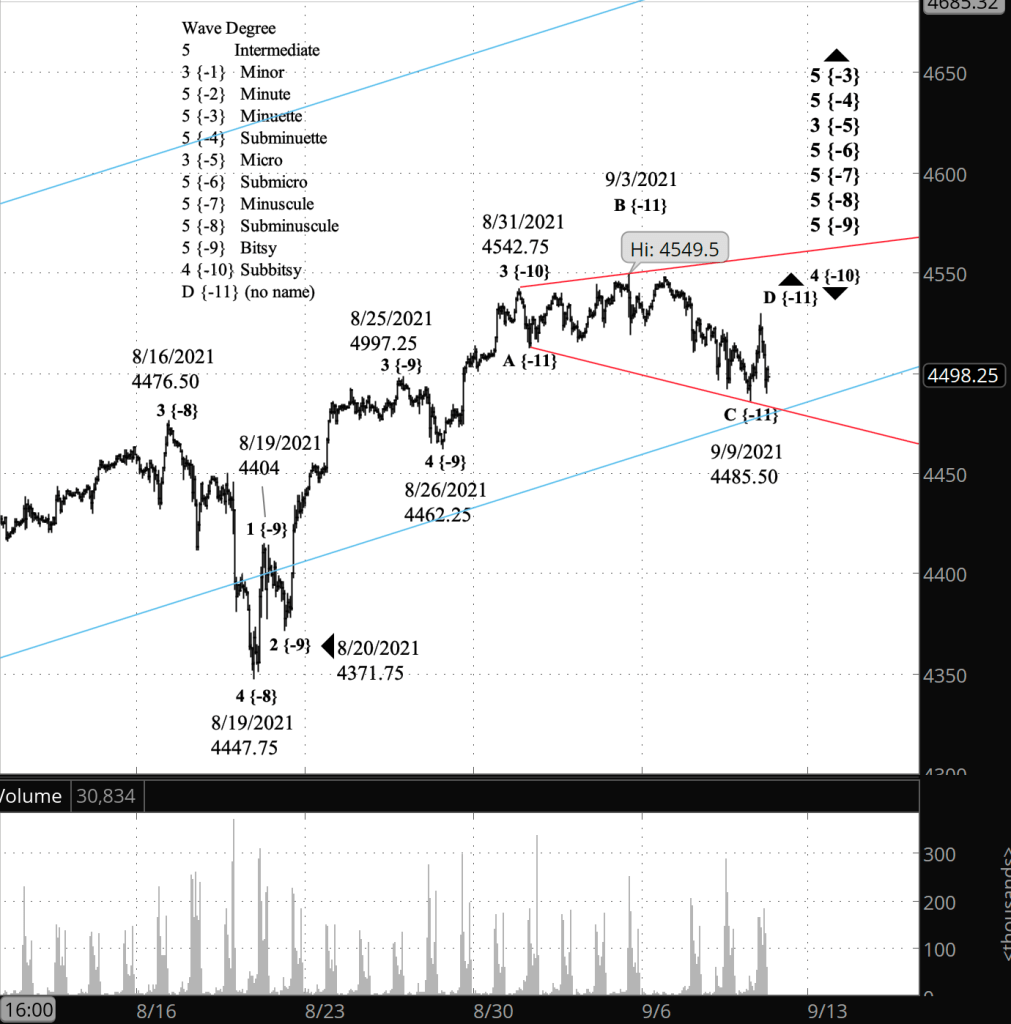
Half an hour before the closing bell. The S&P 500 ended its rise early in the trading day and then took back much of that distance, while remaining above the overnight low of 4485.50 — so far. No change in my analysis, except to reemphasize the possibility that the price will move to a new low, requiring that the endpoint of wave C be repositioned. I’ve updated the chart.

10 a.m. New York time

What’s happening now? Same song different verse. The S&P 500 E-mini futures declined a few points lower in overnight trading, pushing the lower boundary of the expanding triangle pattern lower, and then reversed to the upside. (The triangle is marked in red on the chart.)

What does it mean? The reversal brought the price above the preceding downward reversal for the first time three days, strengthening the likelihood that the 4th leg of the triangle was underway. I expect it to reach the area of the upper boundary of the triangle, presently around 4960. The decline that ended overnight brought the price close to the lower boundary of the price channel of the rise that began March 4 (marked i blue on the chart).

What’s the alternative? It’s possible that the price will reverse and move still lower, meaning that the uptrending 4th leg of the triangle has not yet begun.

[S&P 500 E-mini futures at 3:30 p.m., hourly bars, with volume]

What does Elliott wave theory say? The expanding triangle, which began August 31, will have five waves. The first three — A to the downside, B upside and C downside — are complete, according to my principle analysis. Uptrending wave D is now underway. The triangle in its entirely is wave 4 of Subbitsy degree, a downward correction that will be followed by an upward push wave 5 of Subbitsy degree. The end of Subbitsy 5 will also mark the end of a series of 5th waves of increasingly higher degree, up four levels to Submicro degree, which in turn will mark the end of the parent, wave 3 of Submicro degree. The following wave at that degree will be a 4th wave correction.

Learning and other resources. Elliott wave analysis provides context, not prophecy. As the 20th century semanticist Alfred Korzybski put it in his book Science and Sanity (1933), “The map is not the territory … The only usefulness of a map depends on similarity of structure between the empirical world and the map.” And I would add, we can judge that similarity of structure only after the fact.

Under the alternative analysis, wave C within wave 4 of Subbitsy degree is still underway, and wave D with all of its implications lies in the future. A move to a lower low, below 4485.50, would mean that the alternative analysis is correct.

See the menu page Analytical Methods for a rundown on where to go for information on Elliott wave analysis.

By Tim Bovee, Portland, Oregon, September 9, 2021

Disclaimer

Tim Bovee, Private Trader tracks the analysis and trades of a private trader for his own accounts. Nothing in this blog constitutes a recommendation to buy or sell stocks, options or any other financial instrument. The only purpose of this blog is to provide education and entertainment.

No trader is ever 100 percent successful in his or her trades. Trading in the stock and option markets is risky and uncertain. Each trader must make trading decisions for his or her own account, and take responsibility for the consequences.

License
Creative Commons License

All content on Tim Bovee, Private Trader by Timothy K. Bovee is licensed under a Creative Commons Attribution-ShareAlike 4.0 International License.

Based on a work at www.timbovee.com.
Bitcoin Analysis

9:05 a.m. New York time

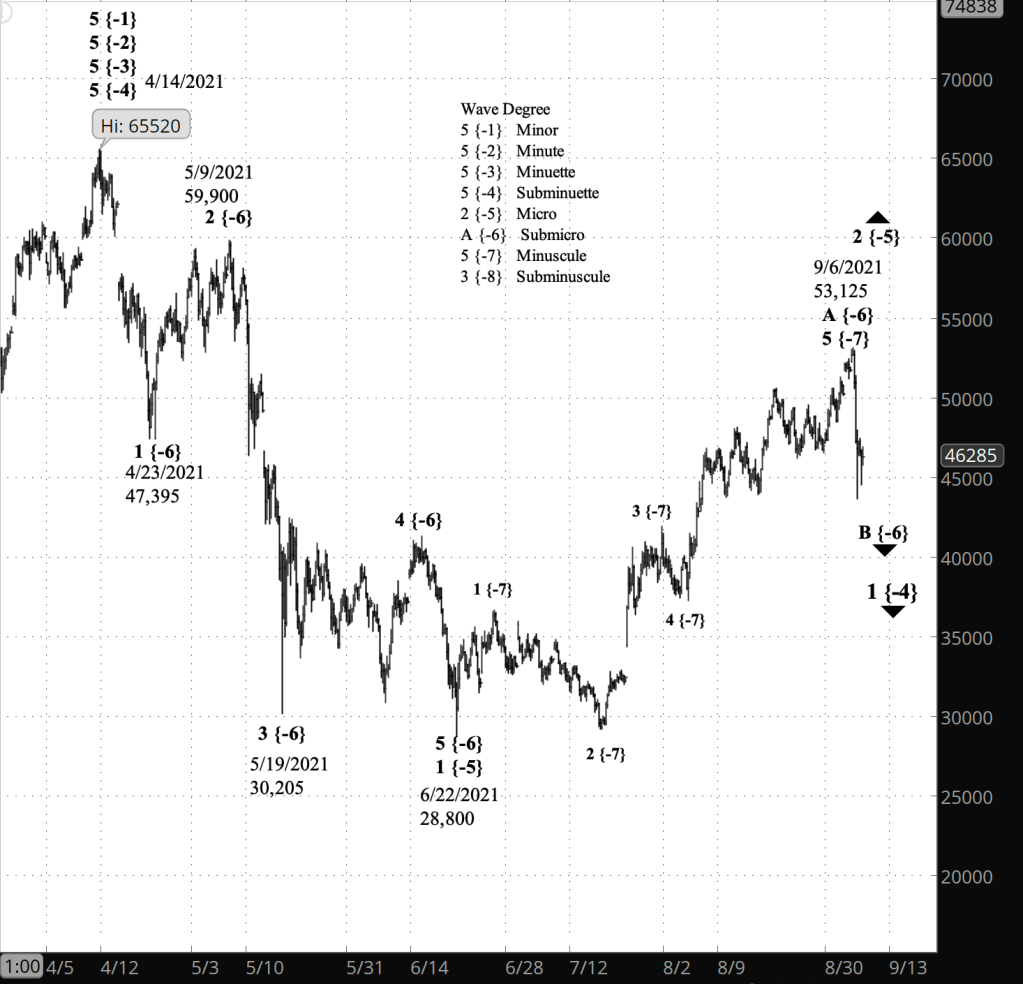
What’s happening now? Bitcoin ended the first leg of an upward correction and has now begun the downward second leg.

What does it mean? I expect the present decline to remain above the June 22 low of 28,800 and to be followed by a significant rise in the third leg of the correction.

What’s the alternative? It’s possible that the September 6 peak was the end of the correction and that the downtrend that began on April 14 has resumed. If that’s the case, then I expect significant new lows.

[Bitcoin futures at 9:04 a.m., 5-hour bars]

What does Elliott wave theory say? The September 6 peak marked the end of wave A of Submicro degree within wave 2 of Micro degree, an upward correction within wave 1 of Subminuette degree, the early steps in a major downtrend that began on April 14 with the end of a series of 5th waves of increasingly higher degree, up to Minor degree.

The decline after Submicro wave A is wave B, the middle wave in a three-wave corrective pattern. It will be followed by Submicro C, whose completion will end Micro 2 upward correction and begin wave 3 of Micro degree, which will carry the price to significant new lows.

Learning and other resources. Elliott wave analysis provides context, not prophecy. As the 20th century semanticist Alfred Korzybski put it in his book Science and Sanity (1933), “The map is not the territory … The only usefulness of a map depends on similarity of structure between the empirical world and the map.” And I would add, we can judge that similarity of structure only after the fact.

See the menu page Analytical Methods for a rundown on where to go for information on Elliott wave analysis.

By Tim Bovee, Portland, Oregon, September 8, 2021

Disclaimer

Tim Bovee, Private Trader tracks the analysis and trades of a private trader for his own accounts. Nothing in this blog constitutes a recommendation to buy or sell stocks, options or any other financial instrument. The only purpose of this blog is to provide education and entertainment.

No trader is ever 100 percent successful in his or her trades. Trading in the stock and option markets is risky and uncertain. Each trader must make trading decisions for his or her own account, and take responsibility for the consequences.

License
Creative Commons License

All content on Tim Bovee, Private Trader by Timothy K. Bovee is licensed under a Creative Commons Attribution-ShareAlike 4.0 International License.

Based on a work at www.timbovee.com.
SP500 Analysis

3:30 p.m. New York time

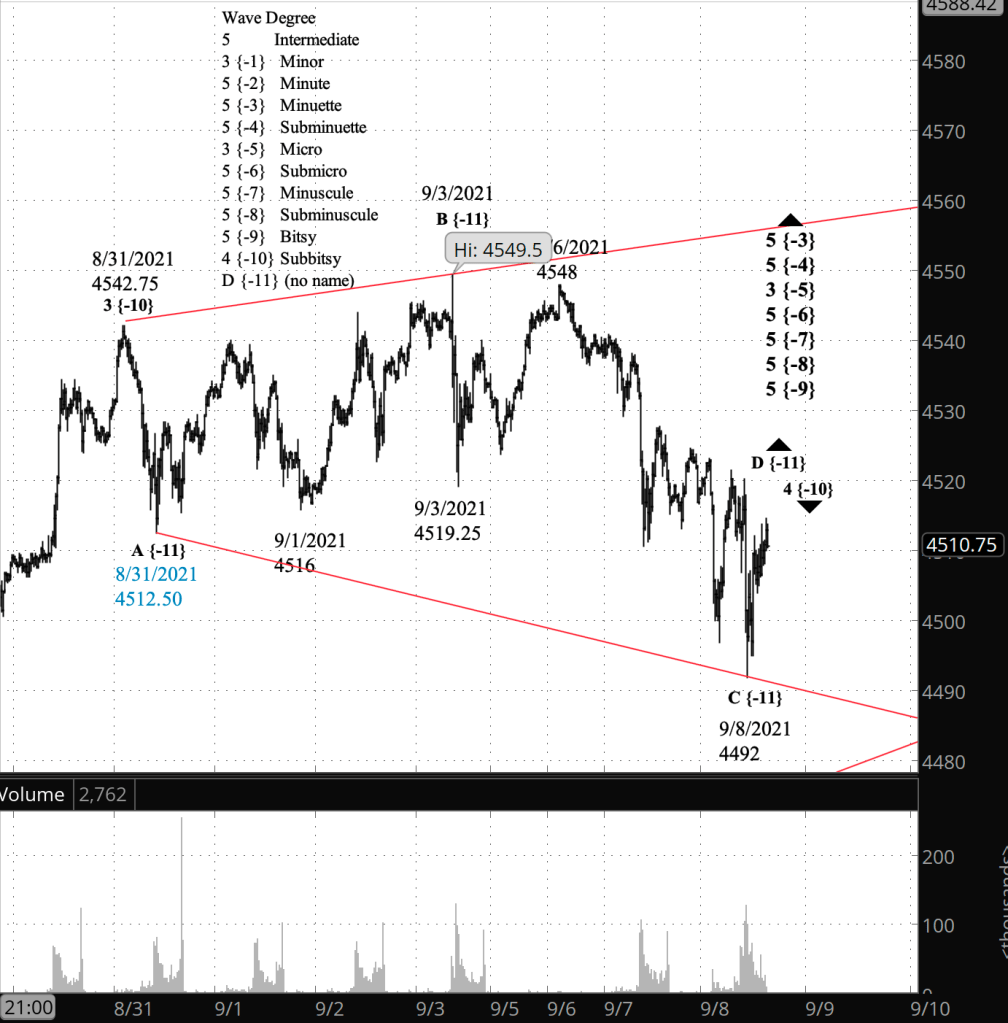
Half an hour before the closing bell. The price hit the lower boundary of the expanding triangle that began on August 31, pushing it lower, and then reversed. I’ve marked the chart with a principal analysis that says that the new low, 4492, is the end of wave C and the subsequent rise is wave D. If the price moves below 4492, then wave C is still underway. I’ve updated the chart.

9:35 a.m. New York time

What’s happening now? The S&P 500 E-mini futures declined sharply in overnight trading, reaching a low of 4497 before reversing. The decline redefined downward the lower boundary of the expanding triangle that began on August 31.

What does it mean? The overnight low marked the end of the third leg of the triangle and the beginning of the fourth leg, which will carry the price into the region of the upper boundary, which is present around 4555. It will be followed by a decline back to the lower boundary, the 5th and final leg of the triangle. After that end of the correction, the price will rise to new highs as the uptrend resumes.

What’s the alternative? The third leg might not be finished, and in that case, the price will reverse again and push lower, again redefining the triangle’s lower boundary.

[S&P 500 E-mini futures at 3:30 p.m., 20-minute bars, with volume]

What does Elliott wave theory say? The expanding triangle’s boundaries — the price channel — are defined by drawing lines connecting the peaks for the upper boundary and the lows for the lower one. The upper boundary connects the beginnings of waves A and C. Those waves are complete and the upper boundary won’t change. The lower boundary connects the end of wave A and the end of wave C. As we learned last night, wave C was not yet complete at yesterday’s closing bell; the price pushed lower, as did the end of wave C and the more recent definition price of the lower boundary.

Under my principal analysis, I’ve marked the overnight low as the end of wave C {-11} within wave 4 of Subbitsy {-10} degree. (The numbers within the curly brackets are subscripts. See the chart or the menu page Analytical Methods  for a list and names and subscripts.)

Wave D {-11} to the upside is now underway. It’s completion near the upper boundary will be followed by wave E {-11} back to the lower boundary, whose completion will mark the end of Subbitsy wave 4 and the beginning of Subbitsy wave 5. The end of Subbitsy wave 5 will also be the end of a series of 5th waves of increasingly large degree, up four levels to Submicro degree. Up one more degree, it will be the end of wave 3 of Micro degree, began on May 19. The 3rd wave will be followed by a 4th wave correction.

Under my alternative analysis, wave C {-11} is still underway, as is its parent wave, the 4th of Subbitsy degree. This analysis will come into play if the price declines below 4497 — the overnight low — before reaching the region of the expanding triangle’s upper boundary.

Learning and other resources. Elliott wave analysis provides context, not prophecy. As the 20th century semanticist Alfred Korzybski put it in his book Science and Sanity (1933), “The map is not the territory … The only usefulness of a map depends on similarity of structure between the empirical world and the map.” And I would add, we can judge that similarity of structure only after the fact.

See the menu page Analytical Methods for a rundown on where to go for information on Elliott wave analysis.

By Tim Bovee, Portland, Oregon, September 8, 2021

Disclaimer

Tim Bovee, Private Trader tracks the analysis and trades of a private trader for his own accounts. Nothing in this blog constitutes a recommendation to buy or sell stocks, options or any other financial instrument. The only purpose of this blog is to provide education and entertainment.

No trader is ever 100 percent successful in his or her trades. Trading in the stock and option markets is risky and uncertain. Each trader must make trading decisions for his or her own account, and take responsibility for the consequences.

License
Creative Commons License

All content on Tim Bovee, Private Trader by Timothy K. Bovee is licensed under a Creative Commons Attribution-ShareAlike 4.0 International License.

Based on a work at www.timbovee.com.
SP500 Analysis

3:30 p.m. New York time

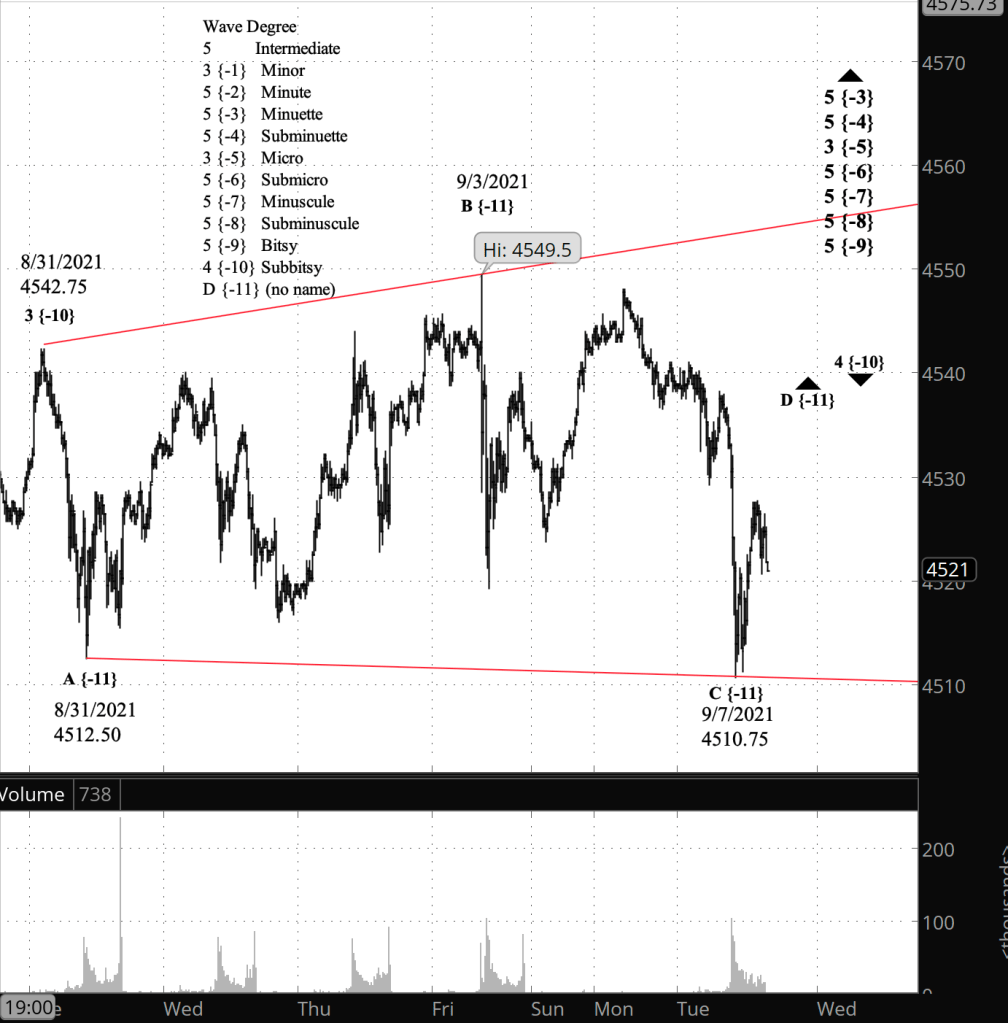
Half an hour before the closing bell. The sharp decline during the day brought clarity to the chart. I’ve promoted my alternate analysis from this morning to principal analysis. The present movement is wave 4 of Subbitsy degree, a correction within the parent, wave 5 of Bitsy degree. These are small degrees, and the chart includes waves with a subscript — {11} — so small that I haven’t named it. The red lines, a price channel for Subbitsy wave 4, clearly shows an expanding triangle as the structure of the correction.

I’ve added a close-up chart of Subbitsy wave 4 and have left this morning’s chart as it was just after the opening bell.

[S&P 500 E-mini futures at 3:30 p.m., 15-minute bars, with volume]

9:35 a.m. New York time

What’s happening now? The S&P 500 E-mini futures continued their decline that began yesterday within a larger uptrend that began on September 1.

What does it mean? The decline is part of the early price movements within the rising final leg of the September uptrend.

What’s the alternative? The correction may have still be underway, taking the form of an expanding triangle.

[S&P 500 E-mini futures at 9:33 a.m., 45-minute bars, with volume]

What does Elliott wave theory say? The alternative analysis — the continuing correction — remains possible because the price remains below the September 3 high of 4549.50. Under my principal count, wave 5 of Subbitsy degree began on September 1. But the pattern within wave 5 that has emerged bears little resemblance to a move in the direction of the trend — a Motive Wave in the terminology of Elliott wave theory. In a Motive Wave, the 3rd wave takes off like rocket as the market accepts the trend as real. The 3rd internal wave of Subbitsy 5 is more of a shrug and a “Meh!” than a rocket.

The reason I’ve stuck to my principal analysis — the correction ended on September 5 — is because the high of September 3 exceeds the end of wave 3 of Subbitsy degree, on August 31. That doesn’t happen with the common corrective patterns — a Zigzag or a Flat — and so that high is likely to be a resumption of the trend.

However, there is a way to count the chart so that the correction is still underway. If the decline that began on August 31 was an expanding triangle, then the higher high on September 3 is within the rules of Elliott wave analysis. Under this scenario, the triangle’s 4th wave ended at the September 3 low of 4519.25, and the final 5th wave of the triangle is underway. When it is complete, then either wave 5 of Subbitsy degree begins, or there is an X-wave that creates a compound correction, with a second corrective pattern within Subbitsy wave 4.

That’s a long way of saying that this chart is messy, filled with ambiguity that will no doubt be resolved in the next few days of trading.

Learning and other resources. Elliott wave analysis provides context, not prophecy. As the 20th century semanticist Alfred Korzybski put it in his book Science and Sanity (1933), “The map is not the territory … The only usefulness of a map depends on similarity of structure between the empirical world and the map.” And I would add, we can judge that similarity of structure only after the fact.

See the menu page Analytical Methods for a rundown on where to go for information on Elliott wave analysis.

By Tim Bovee, Portland, Oregon, September 7, 2021

Disclaimer

Tim Bovee, Private Trader tracks the analysis and trades of a private trader for his own accounts. Nothing in this blog constitutes a recommendation to buy or sell stocks, options or any other financial instrument. The only purpose of this blog is to provide education and entertainment.

No trader is ever 100 percent successful in his or her trades. Trading in the stock and option markets is risky and uncertain. Each trader must make trading decisions for his or her own account, and take responsibility for the consequences.

License
Creative Commons License

All content on Tim Bovee, Private Trader by Timothy K. Bovee is licensed under a Creative Commons Attribution-ShareAlike 4.0 International License.

Based on a work at www.timbovee.com.
SP500 Analysis

9:30 a.m. New York time

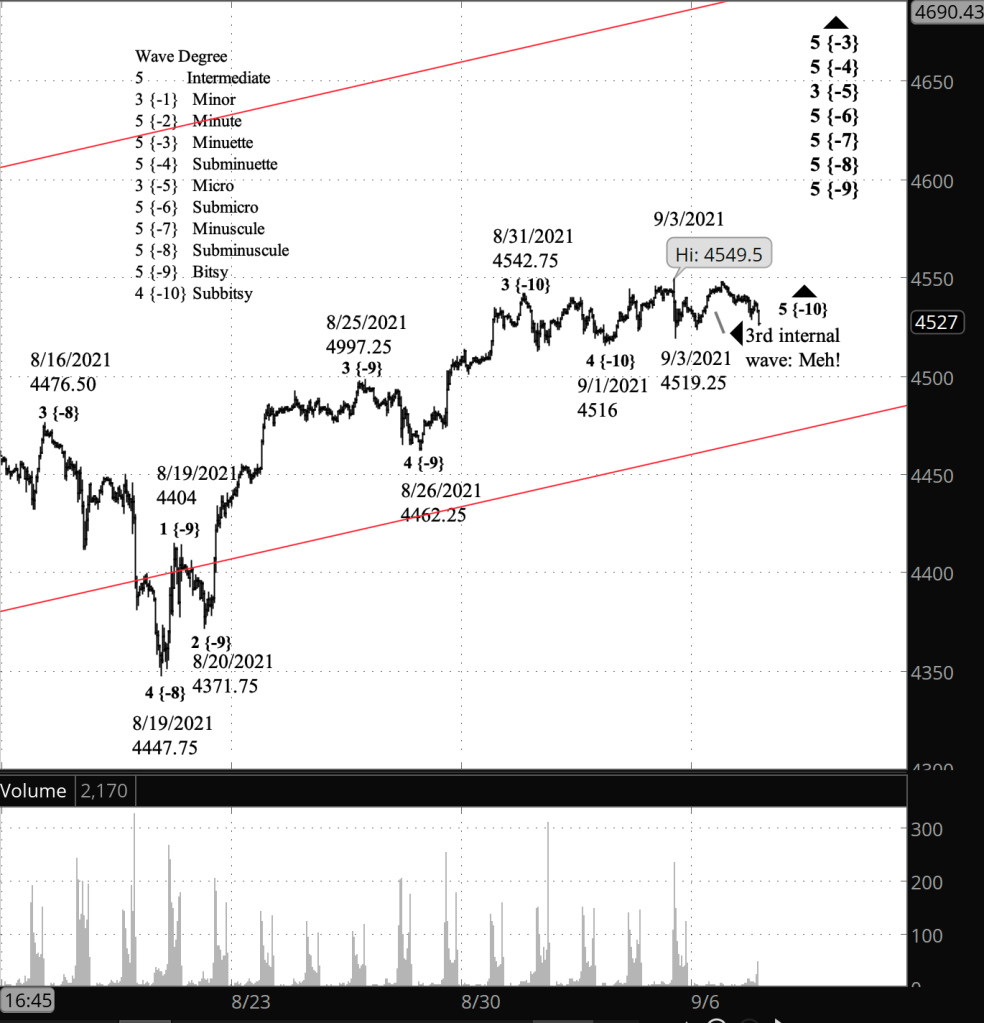
What’s happening now? The S&P 500 E-mini futures initially declined slightly in overnight trading and then rose, to a high so far of 4545.75, within four points of Friday’s peak. The U.S. markets be closed today for the Labor Day holiday.

What does it mean? The price is in the very early stages of the middle portion of the rise that began on September 1, following the end of of a two-day correction. A rise above Friday’s high, 4549.50, will confirm this scenario.

What’s the alternative? The correction is still underway, having extended in a compound pattern.

[S&P 500 E-mini futures at 9:30 a.m., 45-minute bars, with volume]

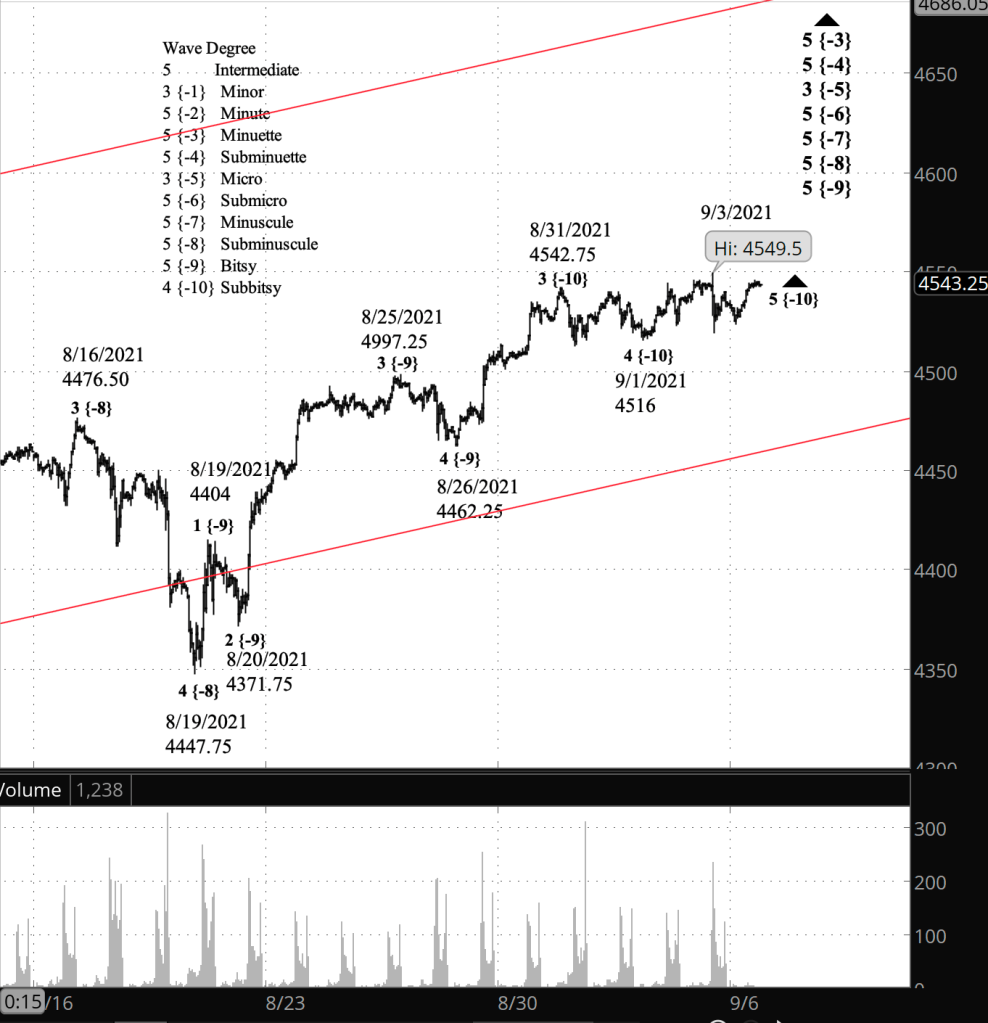
What does Elliott wave theory say? By my principal analysis wave 5 of Subbitsy degree began on September 1, at the end of Subbitsy wave 4, which began on August 31. This is all happening within wave 5 of Bitsy degree, which began on August 26. Completion of Bitsy wave 5 will also mark the end of 5th waves of increasingly large degree, up three levels to wave 5 of Submicro degree, which in turn will mark the end of Micro wave 3, which began on May 19.

My alternative analysis considers wave 4 of Subbitsy degree to still be underway. Having completed its first corrective pattern, Subbitsy 4 under this scenario is now working through a second corrective pattern in a compound structure.

Learning and other resources. Elliott wave analysis provides context, not prophecy. As the 20th century semanticist Alfred Korzybski put it in his book Science and Sanity (1933), “The map is not the territory … The only usefulness of a map depends on similarity of structure between the empirical world and the map.” And I would add, we can judge that similarity of structure only after the fact.

See the menu page Analytical Methods for a rundown on where to go for information on Elliott wave analysis.

By Tim Bovee, Portland, Oregon, September 6, 2021

Disclaimer

Tim Bovee, Private Trader tracks the analysis and trades of a private trader for his own accounts. Nothing in this blog constitutes a recommendation to buy or sell stocks, options or any other financial instrument. The only purpose of this blog is to provide education and entertainment.

No trader is ever 100 percent successful in his or her trades. Trading in the stock and option markets is risky and uncertain. Each trader must make trading decisions for his or her own account, and take responsibility for the consequences.

License
Creative Commons License

All content on Tim Bovee, Private Trader by Timothy K. Bovee is licensed under a Creative Commons Attribution-ShareAlike 4.0 International License.

Based on a work at www.timbovee.com.
BABA Trade

Alibaba Group Holding Ltd. (BABA)

Lot 2

Update 9/14/2021: I exited my bear call spread position on BABA 31 days before expiration, for a $0.99 debit per contract/share, a profit before fees of $138 per contract. Shares were trading at $162.31, down $8.61 from the entry level. The Implied Volatility Rank stood at 47.0% at exit, up 8.9 points from the entry level.

My decision to exit was based on the credit falling to greater than 50% of maximum potential profit.

Shares declined by 5.0% over 11 days for a -167% annual rate. The options position produced a 139.4% return for a 4,625% annual rate.


I have entered a short bear call spread on BABA, using options that trade for the last time 42 days hence, on October 15.

The premium is a $2.37 credit per contract share and the stock at the time of entry was priced at $170.92.

The implied volatility rank (IVR) stands at 38.1%.

Premium: $2.37 Expire OTM  
BABA-bear call spread Strike Odds Delta
Calls      
Long 200.00 90.0% 13
Break-even 187.37 83.0% 21
Short 185.00 76.0% 29

The premium is 31.6% of the width of the position’s wing.

The profit zone covers a 9.6% move to the upside.

The risk/reward ratio is 5.3:1, with maximum risk of $1,263 and maximum reward of $237 per contract.

By Tim Bovee, Portland, Oregon, September 3, 2021

Read More »

FXI Trade

iShares China Large-Cap ETF (FXI)

Lot 2

Update 9/15/2021: I exited my bear call spread position on FXI 30 days before expiration, for a $0.28 debit per contract/share, a profit before fees of $54.00 per contract. Shares were trading at $40.06, down $1.44 from the entry level. 

The Implied Volatility Rank at exit was 27.1, down 13.9 points from the entry level.

My decision to exit was based on the debit on the contracts having reached about half of maximum potential profit.

Shares declined by 3.5% over 12 days for a 106% annual rate. The options position produced a 96.4% return for a 2,933% annual rate.


I have entered a short bear call spread on FXI, using options that trade for the last time 42 days hence, on October 15. The premium is a $0.55 credit per contract share and the stock at the time of entry was priced at $41.50.

The implied volatility rank (IVR) stands at 41.0%.

Premium: $0.55 Expire OTM  
FXI-bear call spread Strike Odds Delta
Calls      
Long 46.00 92.0% 10
Break-even 43.55 81.0% 21.5
Short 43.00 70.0% 33

The premium is 36.7% of the width of the position’s wing.

The profit zone covers a 4.9% move to the upside.

The risk/reward ratio is 4.5:1, with maximum risk of $245 and maximum reward of $55 per contract.

By Tim Bovee, Portland, Oregon, September 3, 2021

Read More »