SP500 Analysis

Half an hour before the closing bell. The S&P 500 traded below the morning high throughout the day. No change in the analysis. I’ve updated the close-up chart.

11:45 a.m. New York time

My trades. I’ve sold a put against GDX in one of my rare forays into trading naked options, without the benefit of an offsetting purchase to limit my loss. I’ve posted an analysis of the trade. Chart to come.

9:40 a.m. New York time

What’s happening now? The S&P 500 E-mini futures pushed higher in overnight trading, reaching 4433.25 shortly after the opening bell. The index shortly after the opening bell reached a new high of 4440.82, eliminating the divergence between the futures and the index described in yesterday’s post after the closing bell.

What does it mean? The uptrend that began on August 3 has resumed its rise after a correction, the first of two that will interrupt the trend.

What’s the alternative? None apparent at this point. The open question is how high the price will go before a significant correction. See the Elliott wave theory section for a discussion.
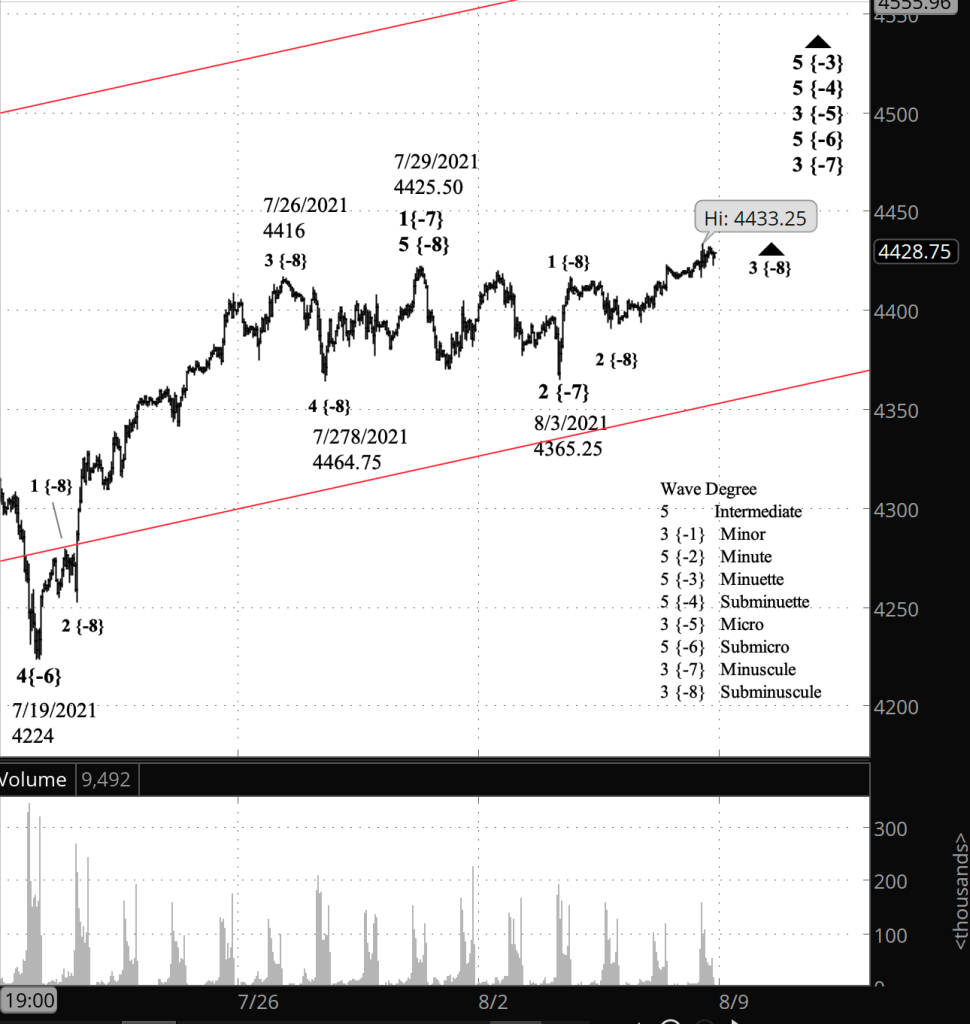
[Close-up: S&P 500 E-mini futures at 3:30 p.m., 45-minute bars, with volume]
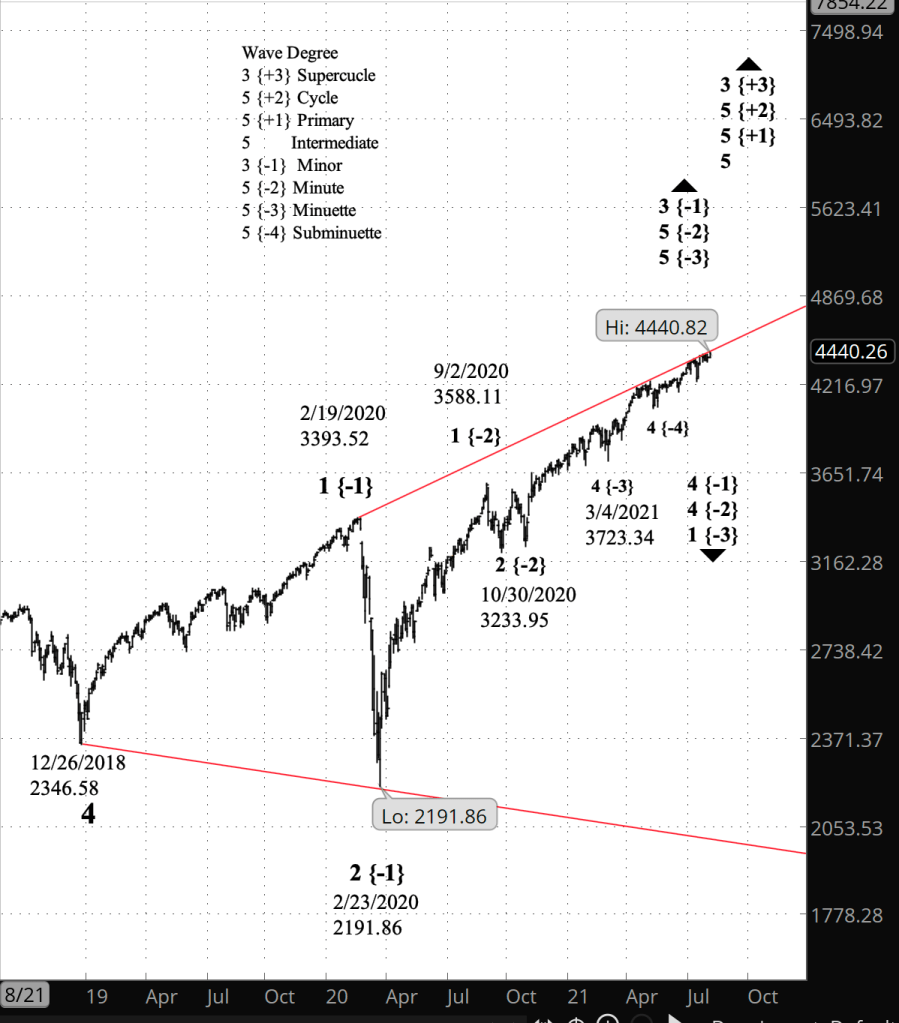
[Big picture: S&P 500 index at 9:35 a.m., 2-day bars]

What does Elliott wave theory say? The present uptrend from August 3 is wave 3 of Minuscule degree. Internally, wave 3 of Subminuscule degree began on August 4. That structure in turn contained within wave 5 of Submicro degree within wave 3 of Micro degree within wave 5 of Subminuette degree, which began on May 13 from 4029.25. The price channel I’ve drawn encompasses the price movement one degree higher, wave 5 of Minuette degree, which began on April 3 from 3720.50.

In setting a target, I’m asking how high Subminuette 5 will travel. The end of its journey will also mark the end of Minuette 5 and its parent, wave 5 of Minute degree, and grandparent, wave 3 of Minor degree. Minor wave 3 began on February 23, 2020 from 2191.86.

The Minor degree brings us to another price channel, this one an expanding diagonal triangle, wave 5 of Intermediate degree, which began on December 26, 2018.

Subminuette 5 is really important. When finished, it will consist of five waves, each wave hitting a higher high or lower low than the prior wave in each direction. That’s the expanding part. The end of Minor wave 3 at the upper boundary will be the beginning of Minor wave 4, which will move down to the lower boundary of the triangle.

So, some targets. The upper boundary of the Minuette degree price channel is in the 4570s and rising. The longer it takes Subminuette 5 to reach the boundary, the higher the target high will be. Subminuette degree is three levels above Minuscule, so under the Elliott wave rule of proportionality, we have some time to go before that boundary is approached. On the diagonal triangle at Intermediate degree, the lower boundary is presently in the 2010s and will have sunk much lower by the time Minor wave 4 reaches it. So the long ride up we’ve experienced since the pandemic crash will be followed by a longer ride down, with the usual corrections in the opposite direction.

Learning and other resources. Elliott wave analysis provides context, not prophecy. As the 20th century semanticist Alfred Korzybski put it in his book Science and Sanity (1933), “The map is not the territory … The only usefulness of a map depends on similarity of structure between the empirical world and the map.” And I would add, we can judge that similarity of structure only after the fact.

See the menu page Analytical Methods for a rundown on where to go for information on Elliott wave analysis.

By Tim Bovee, Portland, Oregon, August 6, 2021

Disclaimer

Tim Bovee, Private Trader tracks the analysis and trades of a private trader for his own accounts. Nothing in this blog constitutes a recommendation to buy or sell stocks, options or any other financial instrument. The only purpose of this blog is to provide education and entertainment.

No trader is ever 100 percent successful in his or her trades. Trading in the stock and option markets is risky and uncertain. Each trader must make trading decisions for his or her own account, and take responsibility for the consequences.

License
Creative Commons License

All content on Tim Bovee, Private Trader by Timothy K. Bovee is licensed under a Creative Commons Attribution-ShareAlike 4.0 International License.

Based on a work at www.timbovee.com.
SP500 Analysis

4:15 p.m. New York time

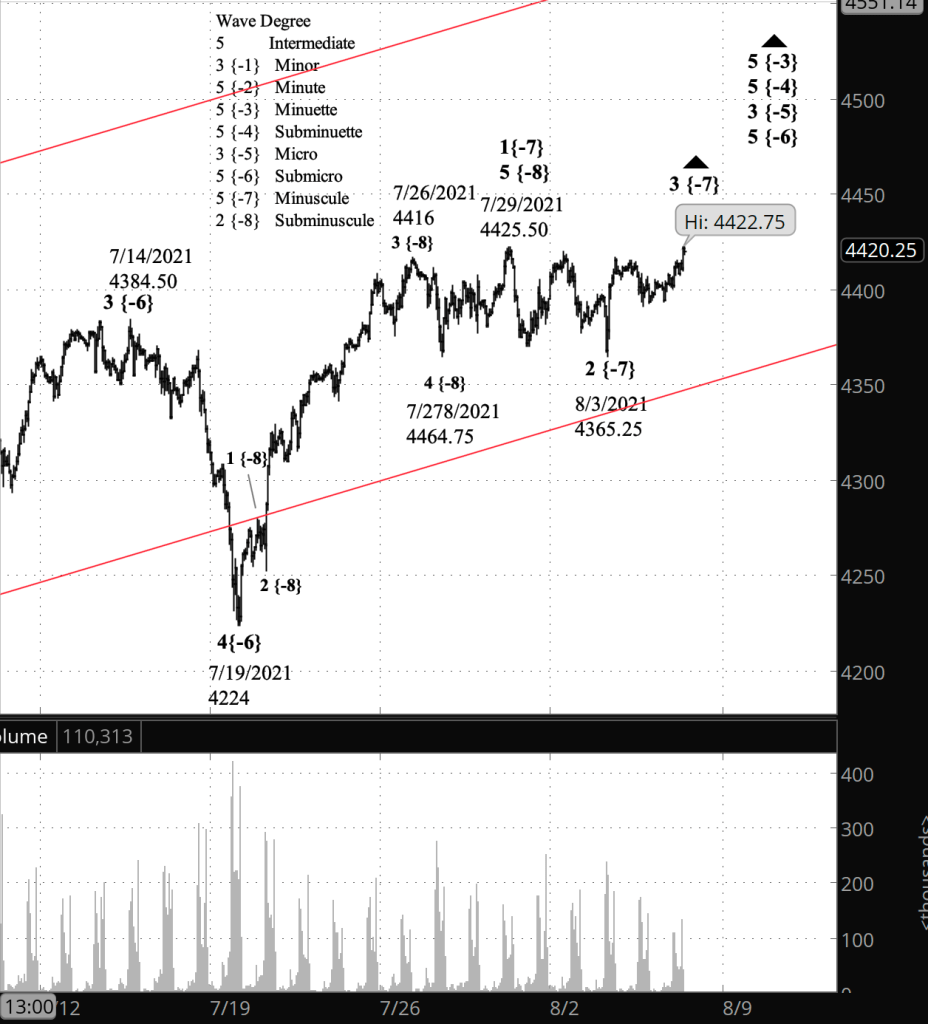
After the closing bell. In last 5 minutes of the trading session, the S&P 500 futures moved above the July 29 high of 4422.50 by a quarter point, to 4422.75. The index, however, stayed 29 points below its July 29 high of 4429.97.

Under the rules of Elliott wave analysis, this creates a divergence in the analyses. The futures, by reaching a higher high, confirmed the principle analysis that sees wave 3 of Minuscule degree on the rise. The index, by failing to reach a new high, gave no such confirmation.

The futures trade in 25-cent increments, so I’m fairly sure that the divergence is a rounding error on the futures side. If the index fails to reach a new high on Friday, then that will create an interesting question: Do I follow the futures and continue to analyze the rise as Minuscule 3? Or do I follow the more precise index and consider the principle analysis for both to not yet be confirmed.

I’ve updated the futures chart again.

3:30 p.m. New York time

Half an hour before the closing bell. The S&P 500 continued to trade within a narrow range, about 15 points on the index and similar on the futures. No change in the analysis. Chart updated.

9:45 a.m. New York time

What’s happening now? The S&P 500 E-mini futures traded sideways for the second night in a row.

What does it mean? The price has done nothing the resolve the question of which analysis is correct. The principle analysis from yesterday’s post: “The August 3 low marked the end of a shallow correction and the subsequent rise the first small step in what will eventually become a rise that could reach into the 4500s.”

What’s the alternative? The alternative analysis from yesterday: “The rise after August 3 could be a separator in a complex correction made up of two corrective patterns. Under the alternative, either the sideways movement will continue, or a more directional pattern will begin.”

[S&P 500 E-mini futures at 4:15 p.m., hourly bars, with volume]

What does Elliott wave theory say? Under my principle analysis, the S&P 500 is in a wave 2 downward correction of Subminuscule degree within a rising wave 3 of Minuscule degree within wave 5 of Submicro degree, which in turn is within wave 3 of Micro degree, which began on May 19.

Under the alternative analysis, the corretive wave 2 of Minuscule degree is still underway.

Learning and other resources. Elliott wave analysis provides context, not prophecy. As the 20th century semanticist Alfred Korzybski put it in his book Science and Sanity (1933), “The map is not the territory … The only usefulness of a map depends on similarity of structure between the empirical world and the map.” And I would add, we can judge that similarity of structure only after the fact.

See the menu page Analytical Methods for a rundown on where to go for information on Elliott wave analysis.

By Tim Bovee, Portland, Oregon, August 5, 2021

Disclaimer

Tim Bovee, Private Trader tracks the analysis and trades of a private trader for his own accounts. Nothing in this blog constitutes a recommendation to buy or sell stocks, options or any other financial instrument. The only purpose of this blog is to provide education and entertainment.

No trader is ever 100 percent successful in his or her trades. Trading in the stock and option markets is risky and uncertain. Each trader must make trading decisions for his or her own account, and take responsibility for the consequences.

License
Creative Commons License

All content on Tim Bovee, Private Trader by Timothy K. Bovee is licensed under a Creative Commons Attribution-ShareAlike 4.0 International License.

Based on a work at www.timbovee.com.
SP500 Analysis

3:30 p.m. New York time

Half an hour before the closing bell. The S&P 500 has barely budged today. No change in the analysis. Chart updated.

My analyses. I analyzed BABA and LVS as potential vertical options spread plays today, but found them lacking for technical reasons. BABA had a greater risk/reward ratio than I’m comfortable with, and LVS has strike prices $5 apart, which made it impossible to fine-tune the trade structure to my liking. I passed on both.

10:10 a.m. New York time

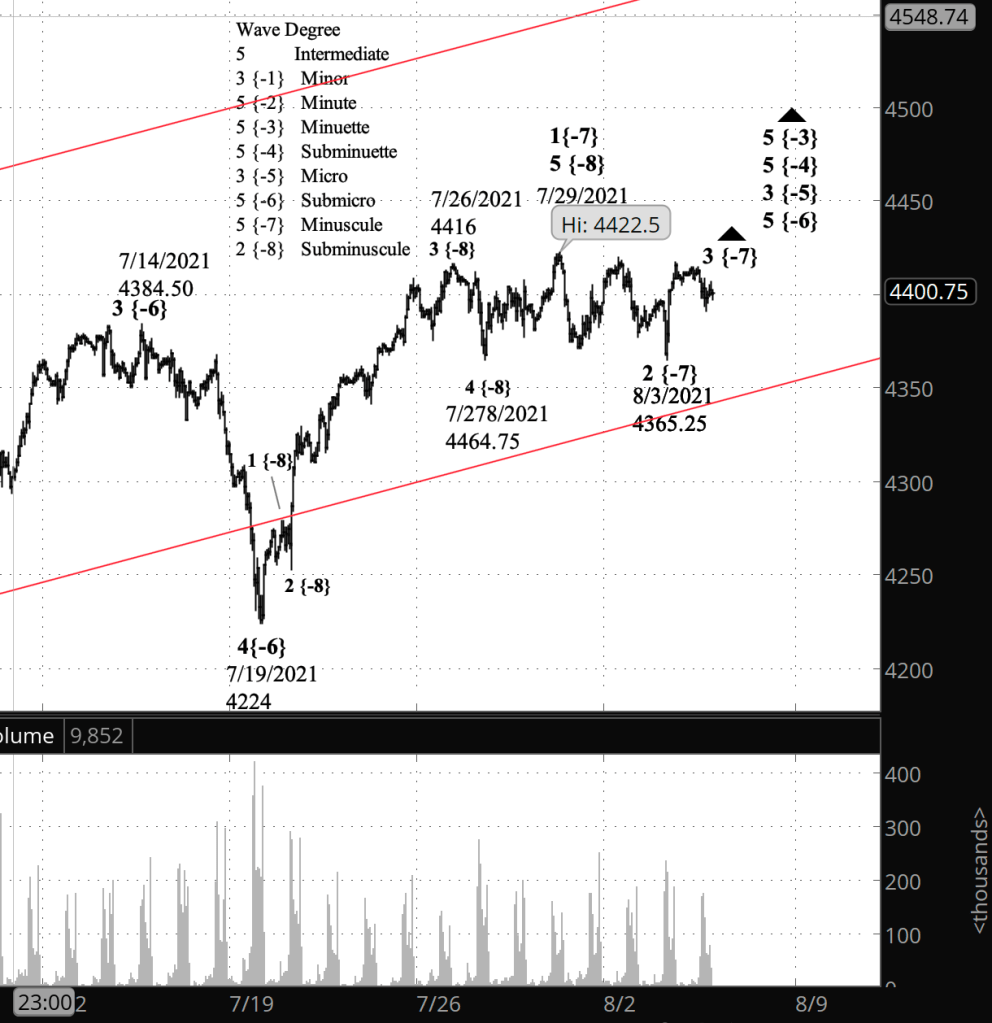
What’s happening now? Overnight, the S&P 500 E-mini futures continued to trade in a narrow range, remaining within the July 29 high of 4422.50 and the August 3 low of 4365.25.

What does it mean? The August 3 low marked the end of a shallow correction and the subsequent rise the first small step in what will eventually become a rise that could reach into the 4500s.

What’s the alternative? The rise after August 3 could be a separator in a complex correction made up of two corrective patterns. Under the alternative, either the sideways movement will continue, or a more directional pattern will begin.

[S&P 500 E-mini futures at 3:30 p.m., hourly bars, with volume]

What does Elliott wave theory say? On the chart I’ve made an attempt at labeling the subwaves of wave 5 of Submicro degree, which began on July 19 from 4224. I don’t have a lot confidence in the analysis at Minuscule and Subminuscule degrees. My confidence at the Submicro degree and larger is high.

In detail. The rise from July 19 to July 26 is clear, although it is difficult to make a count that respects the rules of proportionality. The count I’ve done on the chart is in line with the rules of Elliott wave analysis. The subsequent 4th wave of Subminuscule degree is quite clear. The Subminuscule 5th wave that follows has the scribbly quality common in indecisive markets that makes any analysis below Subminuscule problematic.

The July 29 high marking the end of wave 1 of Minuscule degree is clear, although it’s a very short 5th wave at the Subminuscule degree. Under the rules, I couldn’t count the July 29 high as part of a 4th wave correction because it moved above the end of the preceding 3rd wave.

Afterward, wave 2 of Minuscule degree is clearly delineated, but wait: It’s a very unusual wave. Second waves are almost always of the Zigzag pattern and retrace a large proportion of the preceding 1st wave. That’s not what’s happening here. The pattern is a Flat, of the sort typical of 4th waves. It has retraced very little of the 1st wave rise.

As second waves go, this one is very strange.

Under my principle analysis, I’ve counted the August 3 low as the end of wave 2 of Minuscule degree and the subsequent rise as the start of wave 3 of Minuscule degree. However, under the alternative analysis, it’s possible that the low marks the end of the first pattern within a compound wave 2 and the subsequent rise as an X wave separating the first pattern from a second pattern. The second pattern can be another Flat, a Zigzag that will carry the price down further, or a Triangle of some sort.

Time, as always, will tell.

Remember this. Elliott wave analysis provides context, not prophecy. As the 20th century semanticist Alfred Korzybski put it in his book Science and Sanity (1933), “The map is not the territory … The only usefulness of a map depends on similarity of structure between the empirical world and the map.” And I would add, we can judge that similarity of structure only after the fact.

Learning and other resources. See the menu page Analytical Methods for a rundown on where to go for information on Elliott wave analysis

By Tim Bovee, Portland, Oregon, August 4, 2021

Disclaimer

Tim Bovee, Private Trader tracks the analysis and trades of a private trader for his own accounts. Nothing in this blog constitutes a recommendation to buy or sell stocks, options or any other financial instrument. The only purpose of this blog is to provide education and entertainment.

No trader is ever 100 percent successful in his or her trades. Trading in the stock and option markets is risky and uncertain. Each trader must make trading decisions for his or her own account, and take responsibility for the consequences.

License
Creative Commons License

All content on Tim Bovee, Private Trader by Timothy K. Bovee is licensed under a Creative Commons Attribution-ShareAlike 4.0 International License.

Based on a work at www.timbovee.com.
FXI Trade

iShares China Large-Cap ETF (FXI)

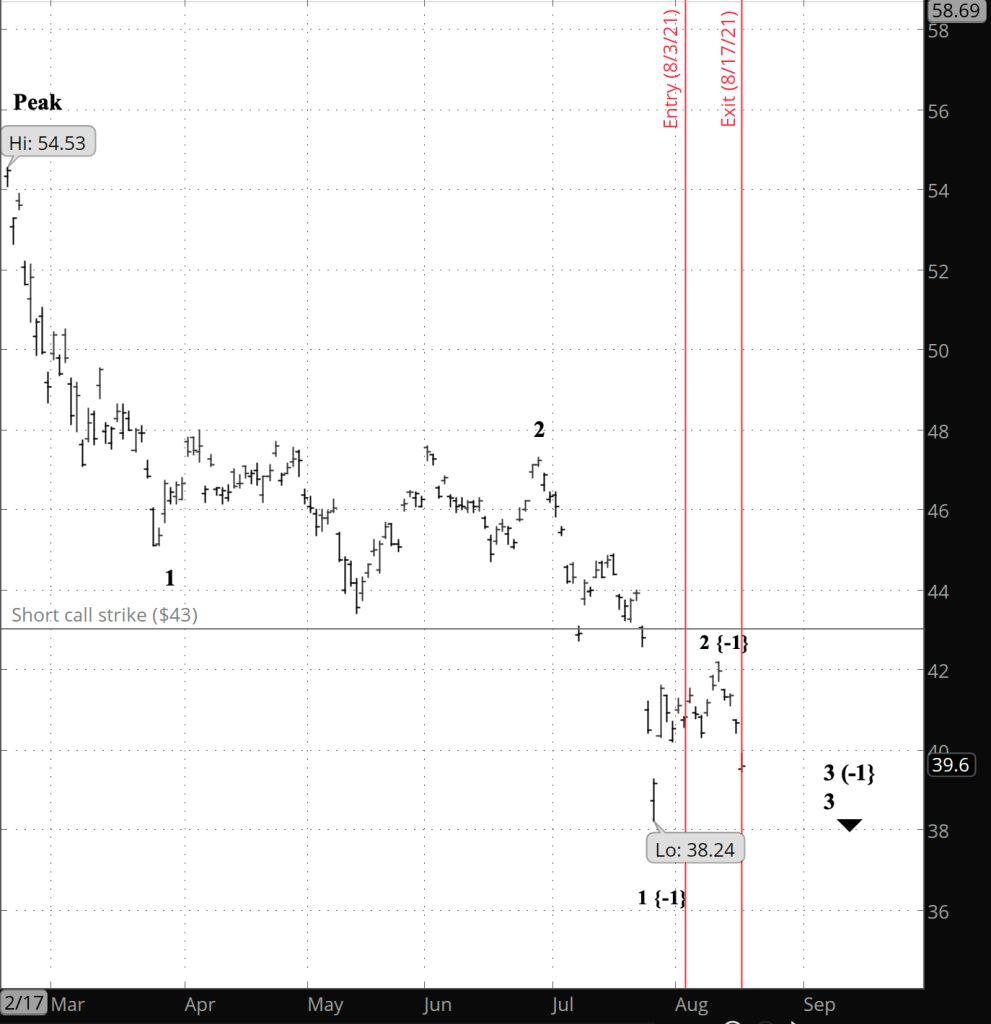
Update 8/17/2021: I exited my bear call spread position on FXI 31 days before expiration, for a $0.17 debit per contract/share, a profit before fees of $0.62 per contract. Shares were trading at $39.89, down $0.87 from the entry level. The Implied Volatility Rank at exit was 37.4%, down 12 points from the entry level.

My decision to exit was based on the profit exceeding 50% of its maximum potential.

Shares declined by 2.1% over 14 days for a -56% annual rate. The options position produced a 182.4% return for a 4,754% annual rate.


I have entered a short bear call spread on FXI, using options that trade for the last time 45 days hence, on September 17. The premium is a $0.48 credit per contract share and the stock at the time of entry was priced at $40.76.

The implied volatility rank (IVR) stands at 49.4%.

Premium:$0.48Expire OTM 
FXI-bear call spreadStrikeOddsDelta
Calls   
Long47.0097.0%4
Break-even42.5287.0%2
Short43.0077.0%0.27

The premium is 24% of the width of the position’s wing.
The profit zone covers a 4.4% move to the upside.

The risk/reward ratio is 7.3:1, with maximum risk of $352 and maximum reward of $48 per contract.

In constructing the position, I relied on Elliott wave analysis, using wave labels that are relative to each other and that don’t refer to named degrees. The short strike is placed just above the end of wave 1 {-1}. The present wave is 3 {-1}, and any subsequent 4th wave correction at the same degree will likely remain below that strike level.

[FXI at 2:18 p.m. 8/17/2021, daily bars]

By Tim Bovee, Portland, Oregon, August 3, 2021

Disclaimer

Tim Bovee, Private Trader tracks the analysis and trades of a private trader for his own accounts. Nothing in this blog constitutes a recommendation to buy or sell stocks, options or any other financial instrument. The only purpose of this blog is to provide education and entertainment.

No trader is ever 100 percent successful in his or her trades. Trading in the stock and option markets is risky and uncertain. Each trader must make trading decisions for his or her own account, and take responsibility for the consequences.

License

All content on Tim Bovee, Private Trader by Timothy K. Bovee is licensed under a Creative Commons Attribution-ShareAlike 4.0 International License.

Based on a work at www.timbovee.com.
AMD Trade

Advanced Micro Devices Inc. (AMD)


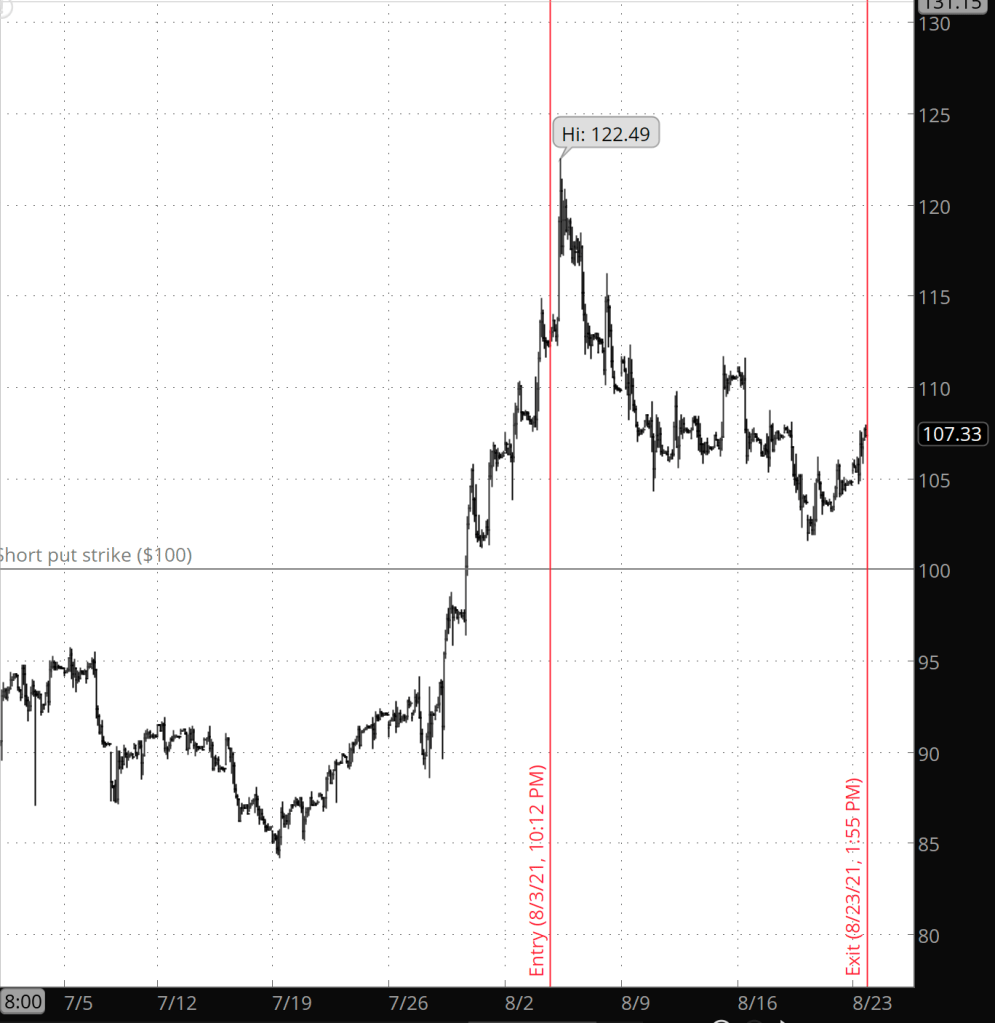
Update 8/23/2021: I exited my bull put spread position on AMD 25 days before expiration, for a $1.12 debit per contract/share, the same before fees of my entry credit.. Shares were trading at $107.55, down $5.59 from the entry level.

My decision to exit was based on a reading of the chart. The price had reached a resistance point that had been touched twice before declining. With only four days to go before the day I manage positions — 21 days before expiration — I judged it best to get out of the position a touch early rather than risk another retreat from resistance. Exiting ensures the funds will be available for trading on August 31, the beginning of the next entry period, for the October monthlies.

Shares declined by 4.9% over 13 days for a -139% annual rate. The options position produced neither a return nor a loss — it was a wash, except for a few dollars in fees.

I’ve updated the chart, below.


I have entered a short bull put spread on AMD, using options that trade for the last time 45 days hence, on September 17. The premium is a $1.12 credit per contract share and the stock at the time of entry was priced at $113.14.

The implied volatility rank (IVR) stands at 40.5.

Premium: $1.12 Expire OTM  
AMD-bull put spread Strike Odds Delta
Puts      
Long 92.50 88.0% 10
Break-even 98.88 82.5% 15
Short 100.00 77.0% 19

The premium is 29.9% of the width of the position’s wing.
The profit zone covers a 12.6% move to the downside.

The risk/reward ratio is 5.7:1, with maximum risk of $638 and maximum reward of $112 per contract.

I chose to entered a bull play based on an Elliott wave analysis of the chart. Using relative wave levels (rather than named degrees), the strike price of $100 is about 15 points above the start of wave 3 and about 15 points below the present high in that 3rd wave. The strike price, above which it’s all profit, is shown on the chart as a horizontal grey line.

[AMD at 1:35 p.m. 8/23/2021, hourly bars]

By Tim Bovee, Portland, Oregon, August 3, 2021

Disclaimer

Tim Bovee, Private Trader tracks the analysis and trades of a private trader for his own accounts. Nothing in this blog constitutes a recommendation to buy or sell stocks, options or any other financial instrument. The only purpose of this blog is to provide education and entertainment.

No trader is ever 100 percent successful in his or her trades. Trading in the stock and option markets is risky and uncertain. Each trader must make trading decisions for his or her own account, and take responsibility for the consequences.

License

All content on Tim Bovee, Private Trader by Timothy K. Bovee is licensed under a Creative Commons Attribution-ShareAlike 4.0 International License.

Based on a work at www.timbovee.com.
SP500 Analysis

3:30 p.m. New York time

Half an hour before the closing bell. The S&P 500 E-mini futures continued to trade within a narrow range, staying above this morning’s low of 4365.25 and above the July 298 high of 4422.50.

My Trades. I entered two options positions today, expiring on September 17. They are on AMD and FXI.

Also, yesterday, I entered share positions on VB, ZBRA and ZM.

10:30 a.m. New York time

What’s happening now? The S&P 500 E-mini futures continued to draw back in overnight trading, reaching a low of 4367.25 today.

What does it mean? The rise that began on July 19 continues and since July 29 has been in an internal correction, after which the price will reach new highs.

What’s the alternative? The high of July 29 marked the end of the uptrend and a downtrend of a larger proportion has begun.

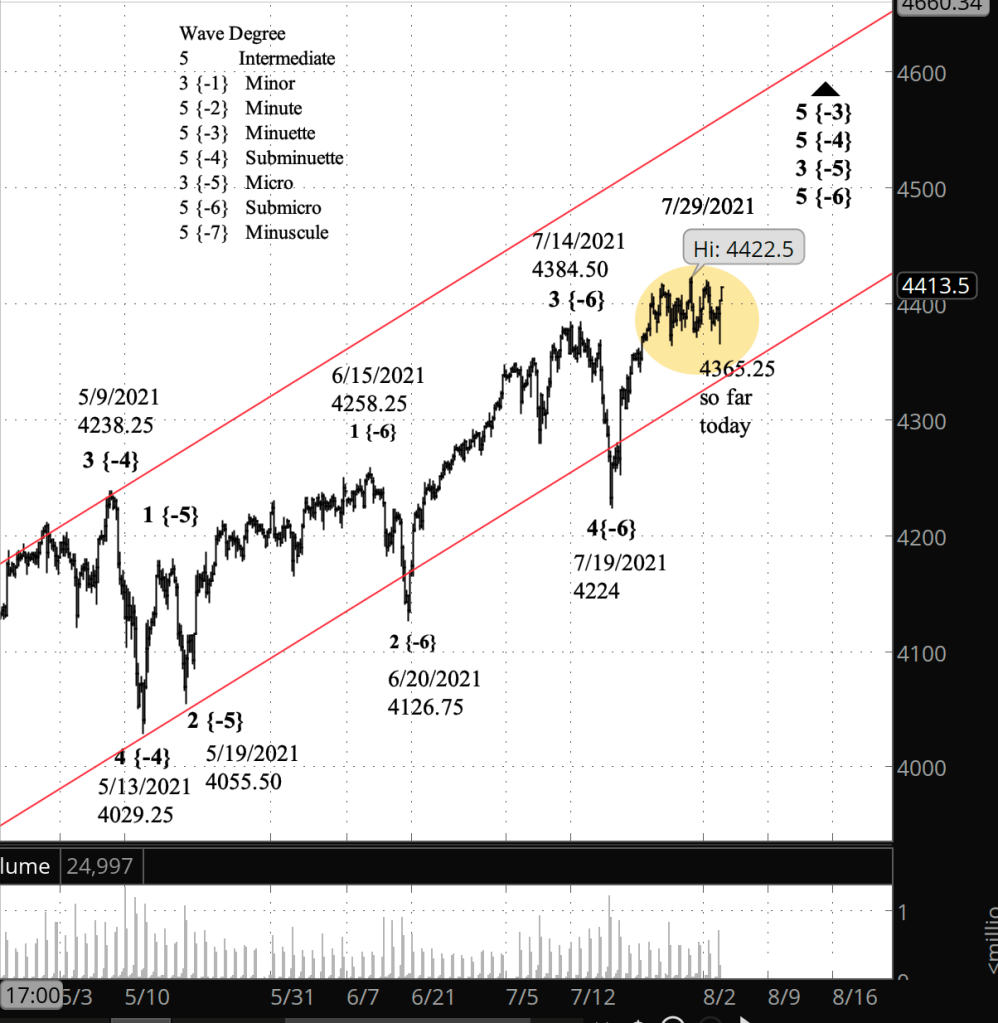
[S&P 500 E-mini futurues at 3:30 p.m., 4-hour bars, with volume]

What does Elliott wave theory say? The rise from July 19 is wave 5 of Submicro degree within wave 3 of Micro degree. The end of Submicro 5 will mark the beginning of wave 4 of Micro degree, likely a sideways correction.

The July 29 peak came in the midst of a sideways movement that began a few days earlier (marked on the chart with a yellow oval). Normally, a 5th wave ends with a distinctively directional push in the direction of the trend. This high was a shrug and a muttered, “Meh”. Because of that, I’ve relegated the 5th wave peak theory to my alternative count.

Another problem. The form of the sideways structure that includes the peak is that of a 4th wave, which generally are Flat structures or a series of Flats that are the very picture of indecisiveness. And yet, this is the first significant correction since the uptrend began on July 29 and so should be a 2nd wave internal to the uptrend. It doesn’t break any rules of Elliott wave analysis to have a Flat 2nd wave, but I haven’t seen it very often.

Look as hard as might at the rise from July 19 to July 29, I can’t find a correction of similar proportion. So I’m left with a huge ambiguity that makes it impossible for me to judge the progress within wave 5 of Submicro degree.

Judging from the position of the price within the channel for wave 5 of Minuette degree, the sideways correction must surely be a 2nd wave, because the rise typically will end close to the upper boundary of the channel, about 200 points high as of this moment. So the count within Submicro 5 after the correction should, if it’s typical, have a long 3rd wave, a Zigzag 4th wave correction (under the rule of alternation), and then a 5th wave up to the vicinity of the upper boundary of the channel.

I’ve often said that Elliott wave analysis provides context, not prophecy. Today’s chart is a good illustration of that maxim.

Learning and other resources. See the menu page Analytical Methods for a rundown on where to go for information on Elliott wave analysis.

By Tim Bovee, Portland, Oregon, August 3, 2021

Disclaimer

Tim Bovee, Private Trader tracks the analysis and trades of a private trader for his own accounts. Nothing in this blog constitutes a recommendation to buy or sell stocks, options or any other financial instrument. The only purpose of this blog is to provide education and entertainment.

No trader is ever 100 percent successful in his or her trades. Trading in the stock and option markets is risky and uncertain. Each trader must make trading decisions for his or her own account, and take responsibility for the consequences.

License
Creative Commons License

All content on Tim Bovee, Private Trader by Timothy K. Bovee is licensed under a Creative Commons Attribution-ShareAlike 4.0 International License.

Based on a work at www.timbovee.com.
SP500 Analysis

3:30 p.m. New York time

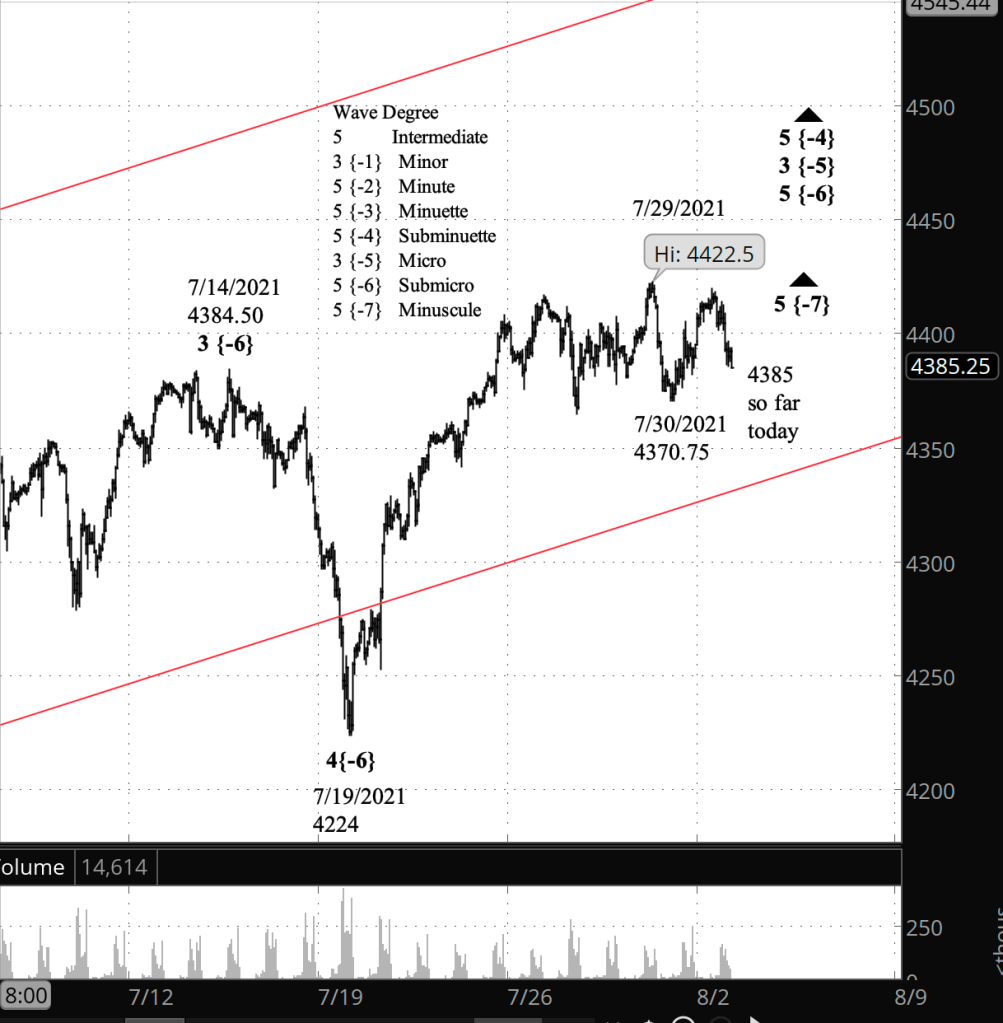
Half an hour before the closing bell. The S&P 500 continued to fall during the day, reaching a low so far of 4385 on the futures and 4392.83 on the index. No change in the analysis. Chart updated.

9:40 a.m. New York time

What’s happening now? The S&P 500 E-mini futures rose slightly in overnight trading and then fell back by a bit, at the remaining about five points below the 4422.50 high of July 29.

What does it mean? The uptrend that began on July 19 from 4224 continues.

What’s the alternative? The July 29 peak can be seen as the end of the uptrend and subsequent decline the beginning of a larger-scale correction.

[S&P 500 E-mini futures at 3:30 p.m., hourly bars, with volume]

What does Elliott wave theory say? Under my principle analysis,. the present rise is wave 5 of Minuscule degree within wave 5 of Submicro degree within wave 3 of Micro degree, which began on May 13 from lower boundary of the Subminuette degree price channel, which was at 4029.25 at the time and has since risen higher.

The price in the present uptrend remains below the upper boundary of the channel, now at around 4960, and that is one reason why I think the uptrend is still underway.

Under the alternative analysis, the June 29 high marks the end of Micro wave 3, and the subsequent decline is the beginning movements of wave A of Submicro degree within wave 4 of Micro degree.

Learning and other resources. See the menu page Analytical Methods for a rundown on where to go for information on Elliott wave analysis.

By Tim Bovee, Portland, Oregon, August 2, 2021

Disclaimer

Tim Bovee, Private Trader tracks the analysis and trades of a private trader for his own accounts. Nothing in this blog constitutes a recommendation to buy or sell stocks, options or any other financial instrument. The only purpose of this blog is to provide education and entertainment.

No trader is ever 100 percent successful in his or her trades. Trading in the stock and option markets is risky and uncertain. Each trader must make trading decisions for his or her own account, and take responsibility for the consequences.

License
Creative Commons License

All content on Tim Bovee, Private Trader by Timothy K. Bovee is licensed under a Creative Commons Attribution-ShareAlike 4.0 International License.

Based on a work at www.timbovee.com.

SP500 Analysis

4:35 p.m. New York time

After the closing bell. The S&P 500 traded in a narrow range during the day, staying with 23 points on the futures and 14 points on the index. No change in the analysis. I’ve updated the chart.

10:10 a.m. New York time

What’s happening now? The S&P 500 E-mini futures fell overnight to 4370.75 in a small correction within the final leg of an uptrend that began on July 19.

What does it mean? The uptrend, typically, will end close to the boundary of the price channel that began in March, presently in the 4360s and rising.

What’s the alternative? Uptrends sometimes fall short of the boundary by a large measure, a condition called “truncation” in Elliott wave theory. So it’s possible that yesterday’s high, 4422.50, was the end of the uptrend, and the overnight decline was a first step in a significant downtrend.

[S&P 500 E-mini futures at 4:35 p.m., 6-hour bars, with volume]

What does Elliott wave theory say? By my principle count, the overnight decline was a correction within rising wave 5 of Minuscule degree within wave 5 of Submicro degree. The simultaneous completion of those waves, near the upper boundary of the price channel, will mark the end of wave 3 of Micro degree within wave 5 of Subminuette degree. Micro 3 will be followed by a 4th wave correction — probably a sideways-trending Flat pattern — and then a 5th wave push to new highs.

Under my alternative count, wave 5 of Minuscule degree up to wave 3 of Micro degree ended well short of the channel boundary, at yesterday’s high of 4422.50. Under this scenario, the overnight decline was a first step in wave A of Submicro degree within wave 4 of Micro degree.

Learning and other resources. See the menu page Analytical Methods for a rundown on where to go for information on Elliott wave analysis.

By Tim Bovee, Portland, Oregon, July 30, 2021

Disclaimer

Tim Bovee, Private Trader tracks the analysis and trades of a private trader for his own accounts. Nothing in this blog constitutes a recommendation to buy or sell stocks, options or any other financial instrument. The only purpose of this blog is to provide education and entertainment.

No trader is ever 100 percent successful in his or her trades. Trading in the stock and option markets is risky and uncertain. Each trader must make trading decisions for his or her own account, and take responsibility for the consequences.

License
Creative Commons License

All content on Tim Bovee, Private Trader by Timothy K. Bovee is licensed under a Creative Commons Attribution-ShareAlike 4.0 International License.

Based on a work at www.timbovee.com.

SP500 Analysis

3:30 p.m.

Half an hour before the closing bell. The highs so far in the resumed uptrend are 4422.50 on the futures, 4429.97 on the index. I’ve updated the chart, indicating which labels have changed from this morning’s analysis.

11:30 a.m.

New high. So much for intuition. The S&P 500 moved above last Friday’s high, to 4421.75 on the futures, 4429.27 on the index. So my the alternative analysis proves to be the right one. The July 27 low is the end of wave 4 of Minuscule degree, and the subsequent price movement is wave 5 of Minuscule degree. More to come in my afternoon wrap.

9:35 a.m. New York time

What’s happening now? The S&P 500 E-mini futures rose slightly in overnight trading, remaining below the July 26 high.

What does it mean? The lack of directional enthusiasm suggests to me that the correction that began on July 26 is still underway. This was yesterday’s alternative analysis, and I’ve promoted it to the principle analysis today.

What’s the alternative? Under this count, the correction ended at yesterday’s low, 4364.75, and the subsequent rise is a resumption of the uptrend and will soon produce new highs.

[S&P 500 E-mini futures at 3:31 p.m., 30-minute bars, with volume]

What does Elliott wave theory say? Under the principle analysis, yesterday’s low, 4364.75, marked the end of wave A of Subminuscule degree within wave 4 of Minuscule degree within wave 5 of Submicro degree, which began on July 19 from 4224.

Under the alternative analysis, yesterday’s low marked the end of wave 4 of Minuscule degree.

Elliott wave analysis has an intuitive aspect, a right “look and feel”. The resumption of an uptrend looks very directional, like a line on the chart. The rise from Friday is very different, like a scribble by a bored child, with no clear sense of direction. That intuitive reasoning is why I’ve concluded that the 4th wave correction is still underway.

A move above the July 26 high, 4416.75, will confirm the alternative count as correct. While the price remains below that level, the principle analysis appears to be the most likely.

Learning and other resources. See the menu page Analytical Methods for a rundown on where to go for information on Elliott wave analysis.

By Tim Bovee, Portland, Oregon, July 29, 2021

Disclaimer

Tim Bovee, Private Trader tracks the analysis and trades of a private trader for his own accounts. Nothing in this blog constitutes a recommendation to buy or sell stocks, options or any other financial instrument. The only purpose of this blog is to provide education and entertainment.

No trader is ever 100 percent successful in his or her trades. Trading in the stock and option markets is risky and uncertain. Each trader must make trading decisions for his or her own account, and take responsibility for the consequences.

License
Creative Commons License

All content on Tim Bovee, Private Trader by Timothy K. Bovee is licensed under a Creative Commons Attribution-ShareAlike 4.0 International License.

Based on a work at www.timbovee.com.

SP500 Analysis

3:30 p.m. New York time

Half an hour before the closing bell. The S&P 500 rose during the trading day, reaching 4407.75 on the futures, 4415.47 on the index, in the early stages of a Minuscule degree 5th wave rise to new heights, or, in the alternative analysis, a B-wave rise within a Minuscule 4th wave correction to the downside. There was nothing in today’s trading to resolve the choice. I’ve updated the chart.

9:35 a.m. New York time

What’s happening now? The S&P 500 rose in overnight trading from Thursday’s low of 4364.75, reaching 4404.50 as the opening bell approached.

What does it mean? In my principle analysis, the decline from the high of 4416.75 on July 26 was a correction within the uptrend that began on July 19, and the subsequent rise suggests that the final leg of the uptrend is underway.

What’s the alternative? It’s possible to view the decline and rise a two stages within the correction, with a decline following this morning’s rise. If the price moves above 4416.75, then the principle analysis is correct. If the price returns to a decline without rising above that level, then the alternative count is correct.

[S&P 500 E-mini futures at 3:30 p.m., hourly bars, with volume]

What does Elliott wave theory say? The rise that began July 19 is wave 5 of Submicro degree. Internally, it is nearing completion of its 5th and final wave, of Minuscule degree. The end of Submicro 5 will also be the end of wave 3 of Micro degree, which began on May 19. The price in the 4th wave Micro degree correction that will follow must remain above the end of the preceding 1st wave, at 4179.50, in order to satisfy a rule of Elliott wave analysis.

Learning and other resources. See the menu page Analytical Methods for a rundown on where to go for information on Elliott wave analysis.

By Tim Bovee, Portland, Oregon, July 28, 2021

Disclaimer

Tim Bovee, Private Trader tracks the analysis and trades of a private trader for his own accounts. Nothing in this blog constitutes a recommendation to buy or sell stocks, options or any other financial instrument. The only purpose of this blog is to provide education and entertainment.

No trader is ever 100 percent successful in his or her trades. Trading in the stock and option markets is risky and uncertain. Each trader must make trading decisions for his or her own account, and take responsibility for the consequences.

License
Creative Commons License

All content on Tim Bovee, Private Trader by Timothy K. Bovee is licensed under a Creative Commons Attribution-ShareAlike 4.0 International License.

Based on a work at www.timbovee.com.