Friday, February 19, 2021

3:30 p.m. New York time

Half an hour before the closing bell. The S&P 500 completed the first leg, wave A of Bitsy degree, of the upward correction that began on February 18 and has embarked on the second leg, wave B of Bitsy degree. I expected the second wave to end above the start of the correction, 3880.50.

I’ve posted a Bitcoin futures analysis.

10:15 a.m. New York time

What’s happening now? The S&P 500 E-mini futures continues to rise in the first leg of a small scale upward correction within a larger downtrend that began on February 15.

What does it mean? The correction will remain below the February 15 peak of 3959.25 on the futures, 3950.43 on the index, and will be followed by further moves to the downside, of increasing significance.

What are the alternatives? If the price moves above the February 15 high, then the decline that followed is a correction within an ongoing uptrend.
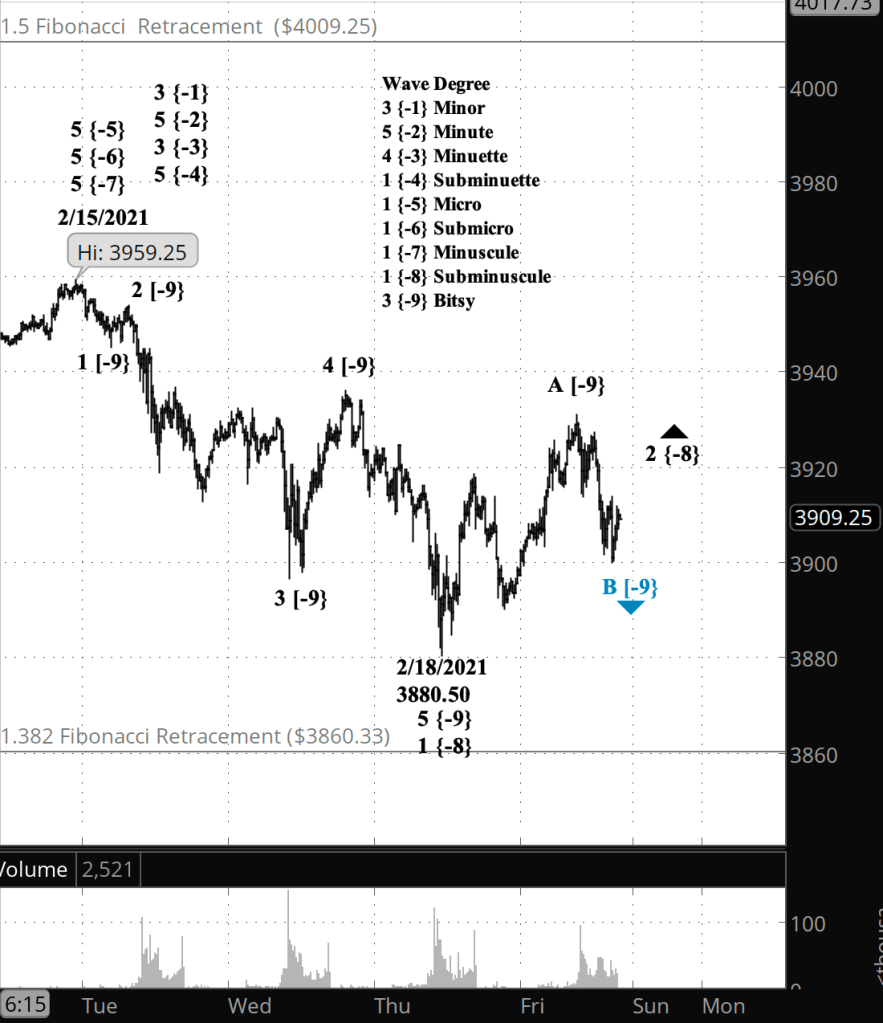
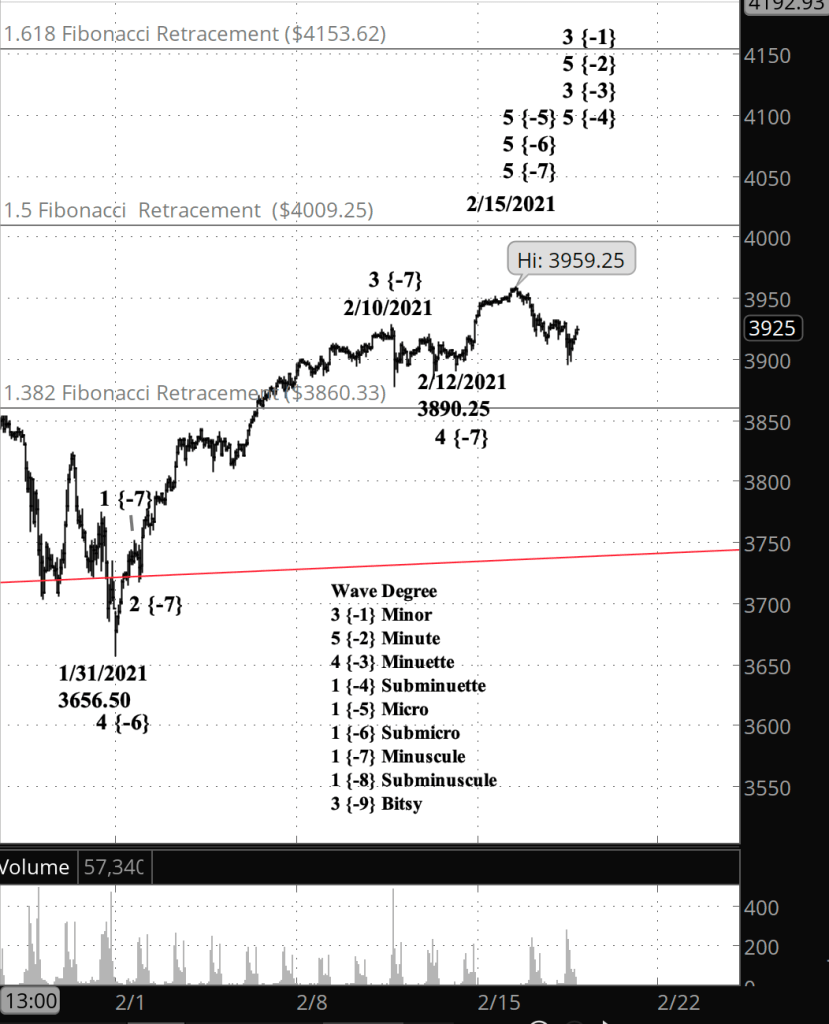
[S&P 500 E-mini futures at 3:30 p.m., 15-minute bars, with volume]

What does Elliott wave theory say? Wave A of Bitsy degree has completed it’s 3rd wave internally and is correcting with wave 4. A final push upward will complete the 5th wave within Bitsy and begin declining Bitsy B, which will remain above the start of A, 3880.50 on the futures. A final wave C of Bitsy degree will push still higher while remaining below the February 15 high and will complete wave 2 of Subminuscule degree. The next move after Subminuscule 2 will be Subminuscule 3, a comparatively powerful wave at this small degree that will push below 3880.50, perhaps by quite a bit.

Read More »
Thursday, February 18, 2021

3:30 a.m. New York time

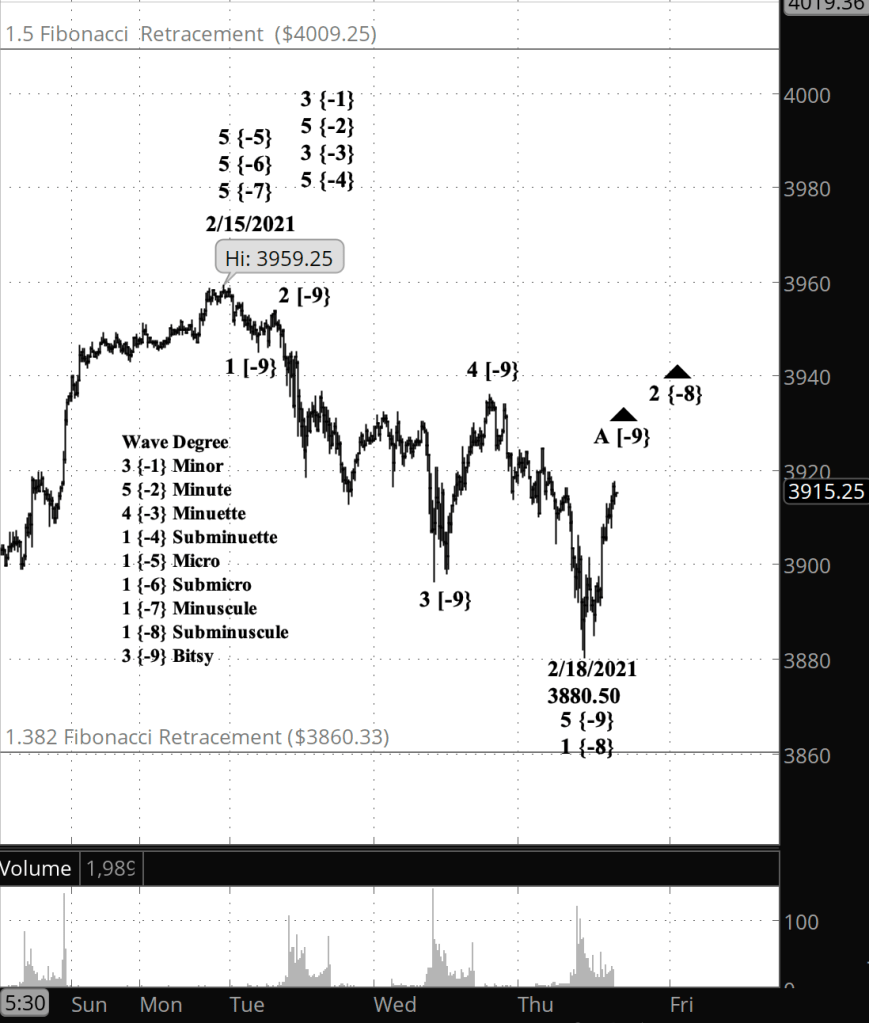
Half an hour before the closing bell. The S&P 500 completed the declining wave 1 of Subminuscule degree, at 3880.50 on the futures and 3885.03 on the index, and then reversed to the upside as it began a 2nd wave correction. Second waves tend to retrace much of the distance traveled by the preceding 1st wave, which began its decline from 3959.25. I’ve updated the chart.

10 a.m. New York time

What’s happening now? The S&P 500 E-mini futures continued their decline from the February 15 high, 3959.25, entering the final phase before an upward correction that, if it’s typical, will retrace much of that decline while remaining below the peak.

What does it mean? Under my principle analysis, the fall that began on February 15 is the beginning of a major decline. Declines begin small and expand their reach, except during panics, such as the rapid decline of a year ago. (See the long-term chart posted yesterday.) So after the present decline and the retracement that will follow, the price will resume its decline, following the same pattern we’ve seen so far: A five-wave decline, an upward correction, and another five-wave decline, with each decline wave internally showing a similar five-wave pattern. Ultimately, the price will reach into the 2000s.

What are the alternatives? It is possible to reach the chart to mean that the decline from February 15 is a correction and not the beginning of a downtrend. If that’s the case, the next move will likely be to the upside, just as with the principle analysis, but it will exceed the February 15 peak.

[S&P 500 E-mini futures at 3:30 p.m., 15-minute bars, with volume]

What does Elliott wave theory say? Under the principle analysis, the S&P 500 is in wave 1 of Subminuscule degree and within it, wave 5 of Bitsy degree, very small degrees indeed. Walking upward, Subminuscule 1 is a subwave nested within a series of 1st wave of increasingly higher degree. On the chart I’ve labeled the Bitsy degree with numbers, 1 through 5, as is the convention for movements in the direction of the direction of the trend.

Under the alternative count, the wave Bitsy wave 3 (labelled 3 {-9}) becomes Bitsy wave A of a downward correction, Bitsy 4 is wave B, and the present decline, labelled wave 5, is wave C, the final wave of the correction. The next move up under this scenario would resume the upward movement with five numbered waves to the upside.

The decision point is the peak, 3959.25 on the futures, 3950.43 on the index. The price will rise under both the principle and alternative scenarios. If the coming rise is a correction, the price will remain below the peak. If it’s a resumption of the uptrend, it will break above the peak.

Read More »

Bitcoin Analysis

3:40 p.m. New York time

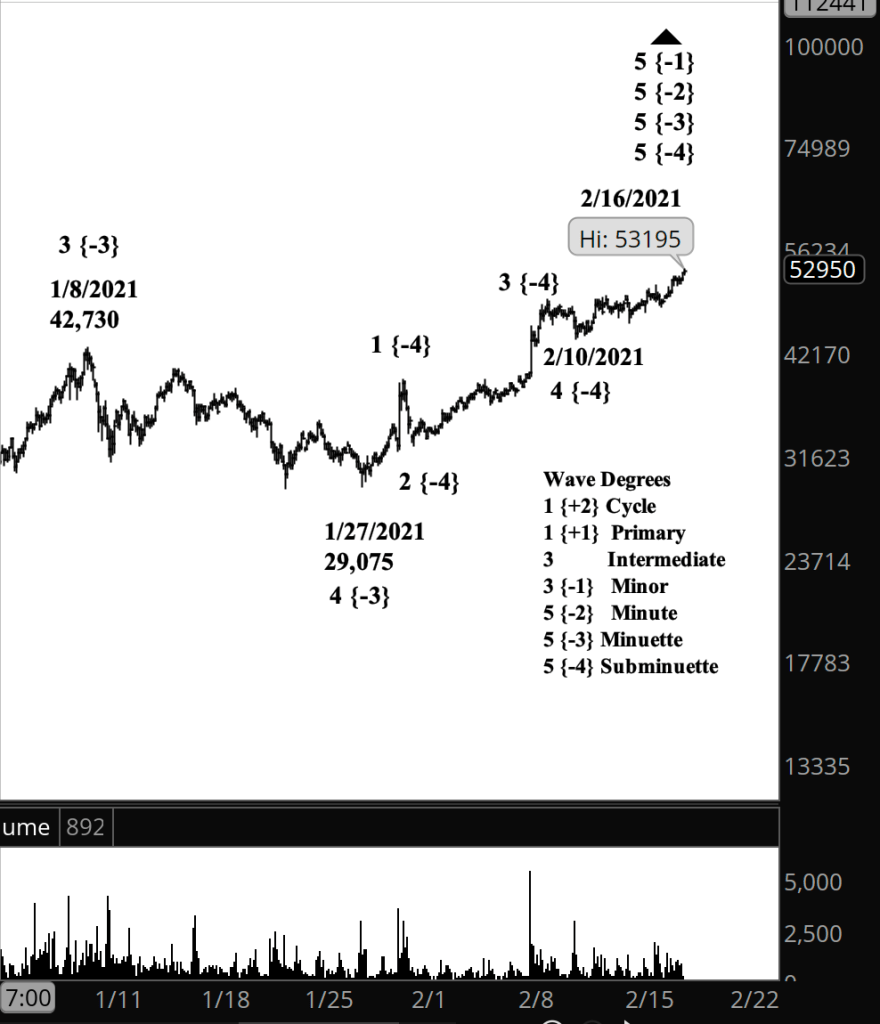
What’s happening now? Bitcoin futures reached a new high today, 53,195.

What does it mean? The price is in the last phase of the rise from January 27, from 29,075. I count that rise as being in its middle phase internally, so Bitcoin has more upside potential.

[Bitcoin futures at 3:38 p.m., 2-hour bars, with volume]

What does Elliott wave theory say? The rise since January 27 is wave 5 of Minuette degree, and the push up since February 10 is wave 5 of Subminuette degrees. Fifth waves have five waves internally. I count Subminuette 5 as being in its 3rd wave, which will be followed by a shallow downward correction, and a final push to the upside as the final wave within Subminuette 5.

Read More »

Wednesday, February 17, 2021

3:30 p.m. New York time

Half an hour before the closing bell. The S&P 500 traded in a narrow range during the day, remaining above its morning low of 3896.50. I’ve updated the short-term chart below.

10:25 a.m. New York time

What’s happening now? The S&P 500 E-mini futures continued to decline from their February 15 peak of 3959.25 and had fallen nearly 63 points by the opening bell, to 3896.50.

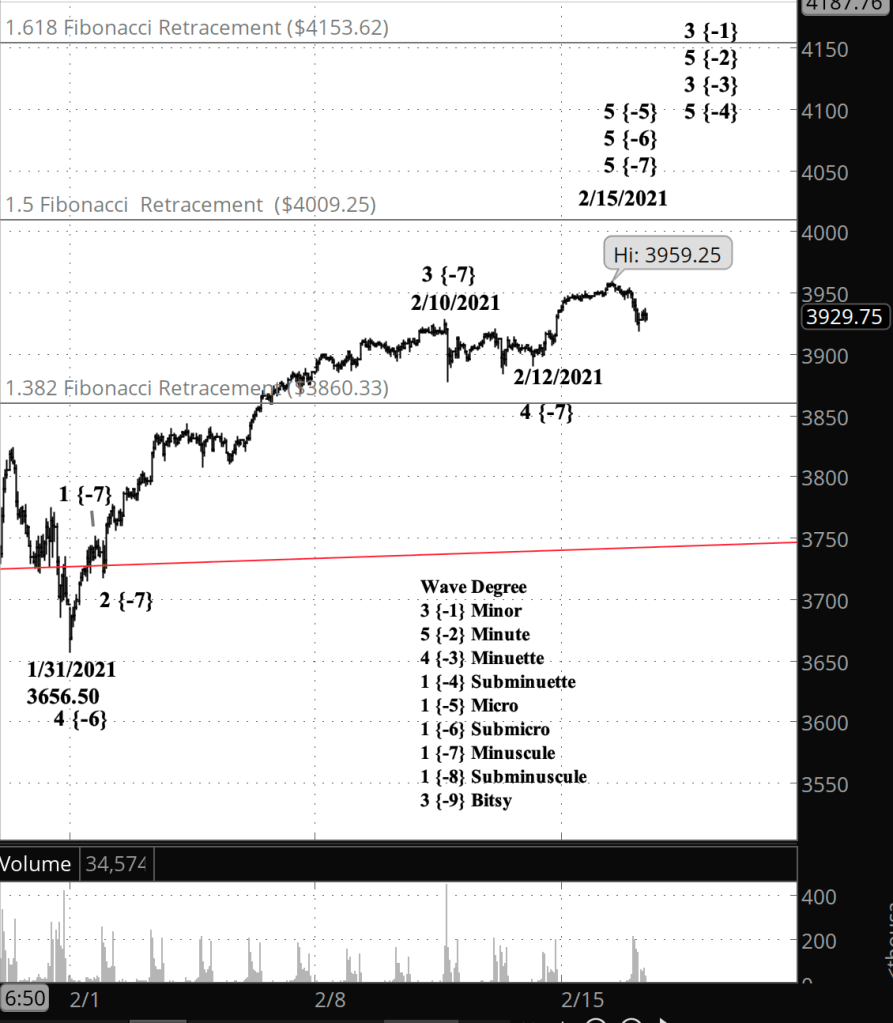
What does it mean? The decline reinforces the conclusion that the rise that January 31, from 3656.50, ended with the February 15 peak. A move below 3890.25, the February 12 low from which the final rise within the larger rise began, would further reinforce that conclusion. If the rise from January 31 has indeed ended, then a major uptrend that began in February 2020, from 2191,86, has ended, and we can expect prices eventually to work their way down to the 2100s and below.

What are the alternatives? Although the rise from late January has met all of the requirements for completion, it’s possible that the current decline is a temporary pullback before the price resumes its rise, to higher highs.

[S&P 500 E-mini futures at 3:30 p.m., hourly bars, with volume]

What does Elliott wave theory say? The decline from February 15 is in a very early, very low degree 1st wave, perhaps Subminuscule, perhaps even lower. It will be impossible to define the degree until there’s more context. It’s still very early days, as the long-term chart below of the S&P 500 index shows. At this scale, the decline since Monday isn’t even visible.

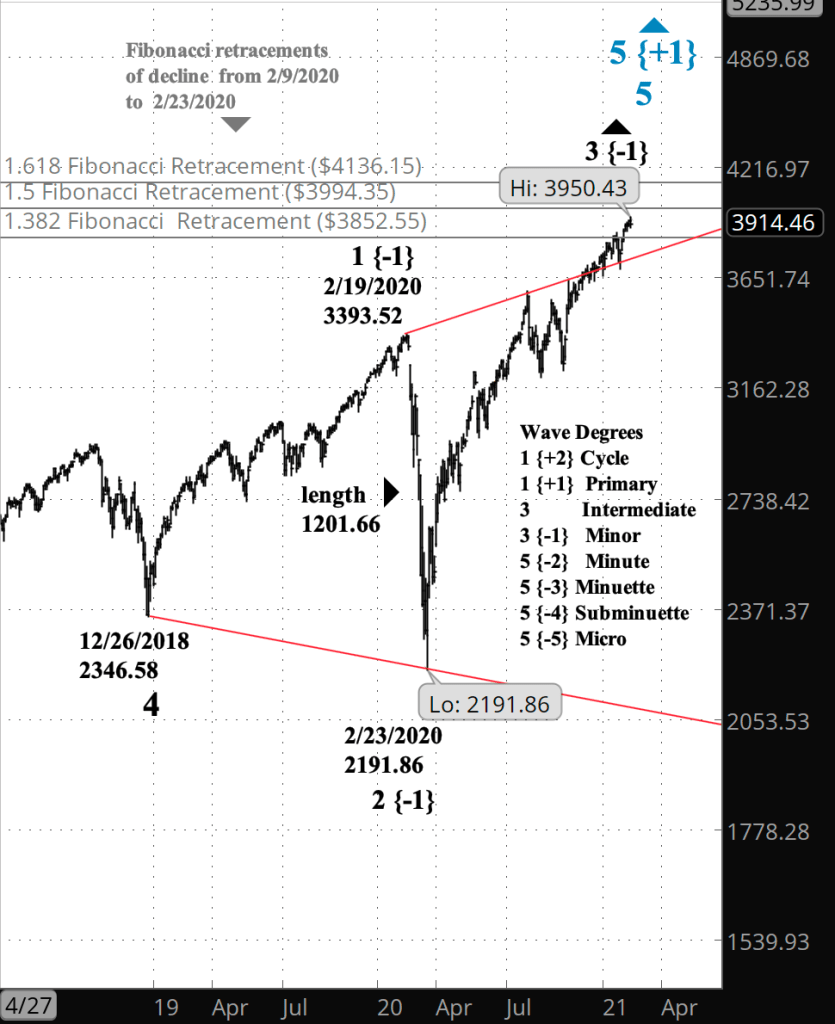
[S&P 500 index at 10:47 a.m., 2-day bars]

The large scale chart of the S&P 500 index shows that the peak of February 15 had pushed above the upper boundary of an expanding triangle that began in December 2018 from 2346.58. The “expanding” means that the boundaries of the triangle grow further apart over time, so the price can be expected to move below the prior low, 2191.86.

The February 15 high, wave 3 of primary degree, will be followed by the 4th wave decline of the same degree down to the lower boundary of the triangle, and then by a large rise back to the upper boundary, the triangle’s 5th and final wave at the Primary degree. It is when the 5th wave ends a new highs that we can mark the end of the triangle and the end of the rise that began in December 2018. The downtrend that will follow the end of Primary 5 will carry significantly below the 2300s.

Read More »

Bitcoin Analysis

3 p.m. New York time

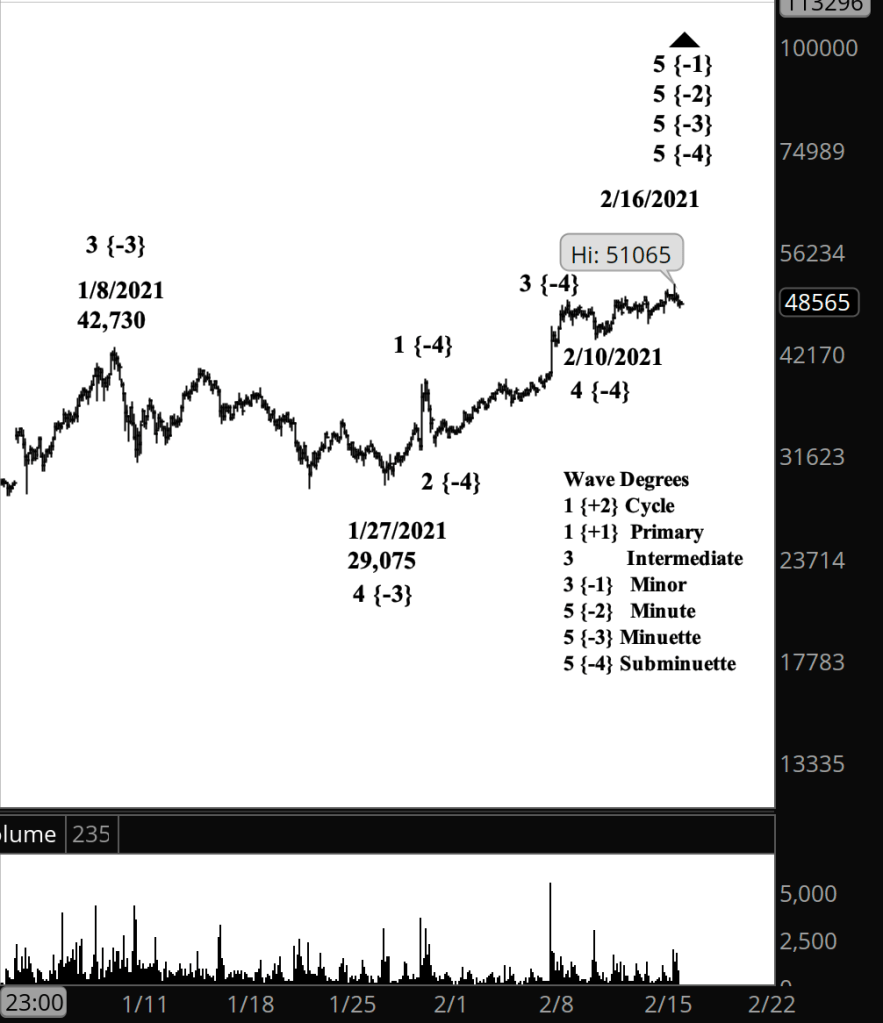
What’s happening now? Bitcoin futures hit a higher high of 51,065 in trading today, continuing the rise that began on January 27 from 29,9075.

What does it mean? The crypto currency is in its final upward push. One that movement is complete, it will begin a decline that is the early stage of a significant decline that will take back much of the rise from March 13, 2020, when the price bottomed out at 4210.

What are the alternatives? The final upward push could continue for a significant distance. It is unrestricted by any rule of Elliott wave analysis. As the baseball great Yogi Berra said, “It ain’t over ’til it’s over.”

[Bitcoin futures at 3:01 p.m., 2-hour bars, with volume]

What does Elliott wave theory say? The rise since January 27, beginning at 29,075, is wave 5 of Minuette degree. Within it, the futures are tracing out wave 5 of Subminuette degree, which began on January 10. The completion of Minuette 5 will also market the completion of wave 5 of a series of parent waves, up to Minor degree, the wave that began on March 13.

The trading history of Bitcoin doesn’t go back far enough to allow for a characterization of the coming decline. Is it the beginning of a new downtrend of Minor degree and its parent Primary degree? Or is it a downward correction within a continuing Primary degree rise? To reach that conclusion we’ll need to understand the pattern of the decline, as set out in the rules of Elliott wave analysis.

Read More »

Tuesday, February 16, 2021

3:30 p.m. New York time

Half an hour before the closing bell. The S&P 500 spent the day trading at about the same level it had reached at the opening bell. I’ve updated the chart below.

10:50 a.m. New York time

What’s happening now? The S&P 500 E-mini futures his a peak of 3959.25 in late trading Monday night and then began to fall, reaching 27 points below that high in the first hour after the opening bell. The peak on the index is 3950.43.

What does it mean? The decline, slight thought it is, meets the requirements for the first steps down after the rise from 3656.50 beginning January 31. If this principle scenario proves out, the price will decline significantly in the coming weeks and months, eventually reaching into the low 2000s.

What are the alternatives? But, we’ve seen this before with the S&P 500 in recent weeks: A high that has met all of the requirements for the end of the rise since January, a pullback, and then resumption of the rise to higher high. I’ve marked the chart according to the principle analysis, but I take this alternate scenario quite seriously. If the alternate proves out, then we’ll have a slight pullback, and then a push upward to a new high. What both scenarios agree on is that the rise from January 31, and indeed from February 23 of last year, when the price reversed from its low of 2191.86 on the index, and then carried up to where we are today, is in its last leg up and will be followed by a significant decline.

[S&P 500 E-mini futures at 3:30 p.m., 50-minute bars, with volume]

What does Elliott wave theory say? The rise from January 31 is wave 5 of Minuscule degree. I find 5th waves to be among the most ambiguous. It’s hard to call the end until the next wave is well underway. One reason is because 5th waves can extend for quite a distance before completion. Another is that a 5th wave can take a the form of a triangle rather than the standard five-wave pattern. A third reason is that if the preceding 3rd wave is longer than the 1st wave, as is normally the case, then the 5th wave has no limit in Elliott on how far it go, nor on how short it can be.

There’s a lot at stake with the end of this very low level 5th wave at the Minuscule degree, because its completion marks the end of 5th wave of larger degree, all the way up to Subminuette, the end of the 3rd wave of Minuette degree, and the end of the 3rd wave of Minor degree, that last degree having begun a year ago.

Read More »

Bitcoin Analysis

1:40 p.m. New York time

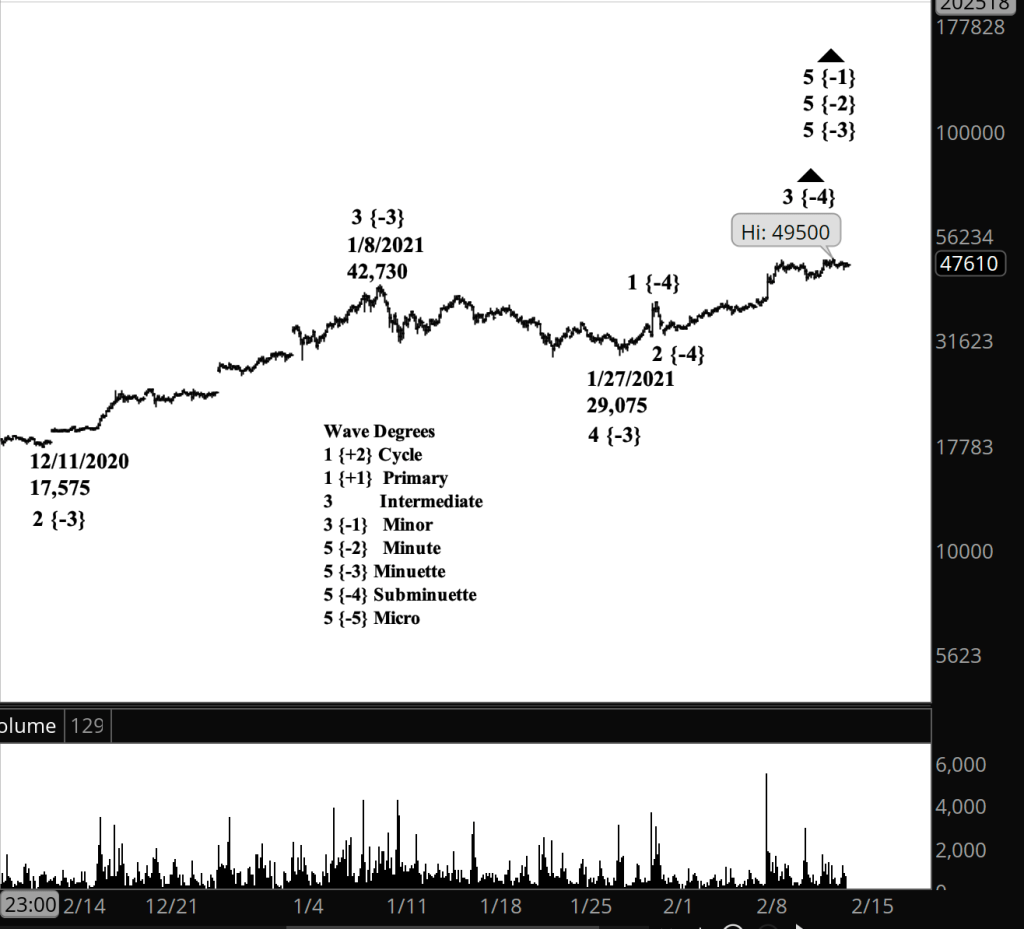
What’s happening now? U.S. markets are closed for the President’s Day holiday. However, Bitcoin futures traded overnight within a narrow range that has not yet challenged Thursday’s high of 49,500.

What does it mean? The middle wave of the rise since January 27 continues, internally tracing a shallow correction before rising to a new high.

What are the alternatives? The correction under Elliott’s rules could have ended on February 9. If so, Thursday’s high is an interim spot in a final push to the upside. Given the form of the chart, I think the alternative is less likely.

[Bitcoin futures at 1:37 p.m., 2-hour bars, with volulme]

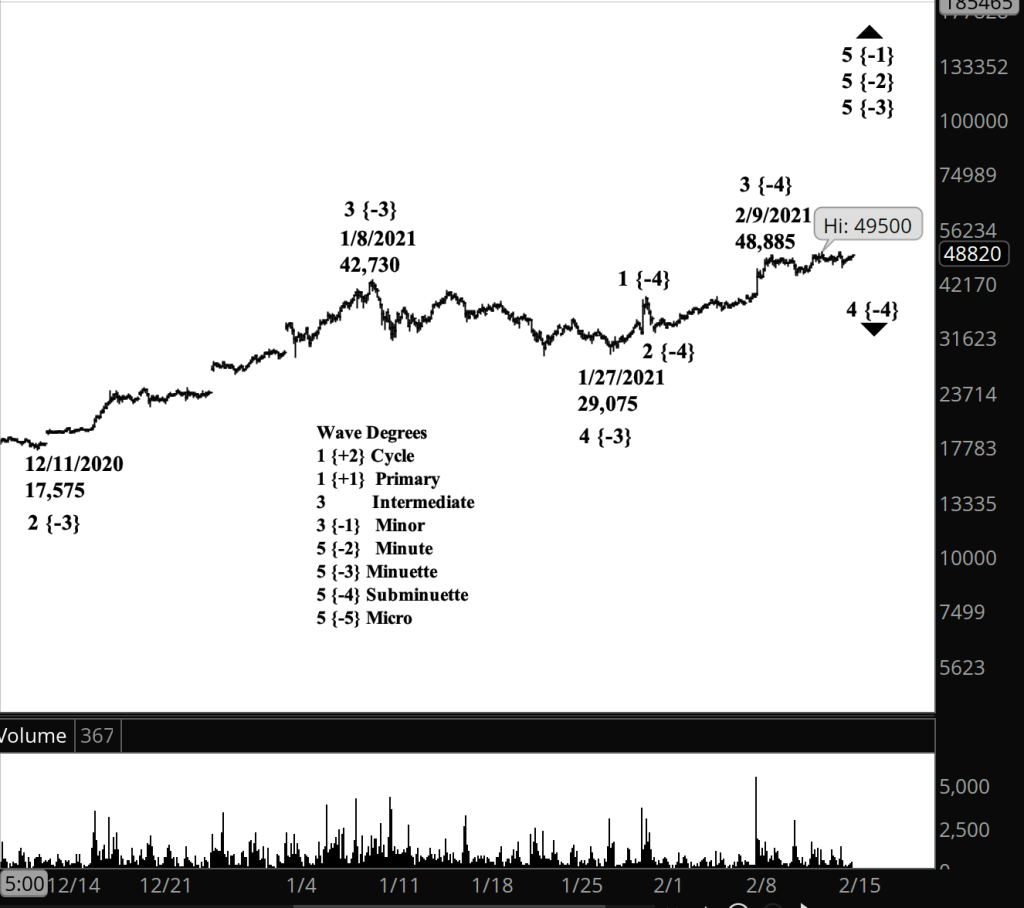
What does Elliott wave theory say? The rise since January 27 is wave 5 of Minuette degree, and internally, my principal count is that the high of February 9 is the end of wave 3 of Subminuette degree and the beginning of a Subminuette 4th wave correction.

Read More »

Monday, February 15, 2021

10:25 a.m. New York time

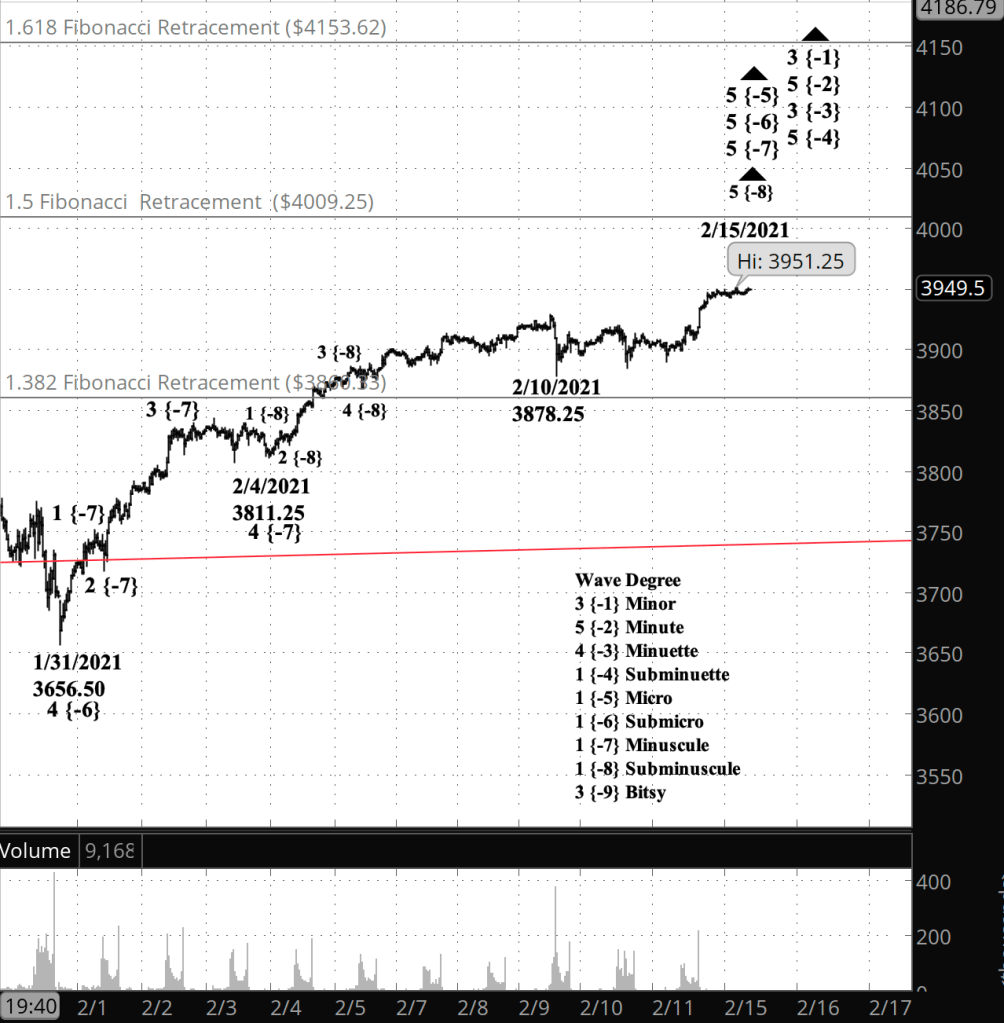
What’s happening now? U.S. markets are closed for the President’s Day holiday. However, the S&P 500 E-mini futures are trading and moved to a new high overnight, 3951.25, which is 16 points above Friday’s high. The holiday session traded in a very narrow range after rising to that higher level.

What does it mean? The uptrend that began on January 31, from 3656.50, is still underway. The most recent high is 58 points below the next Fibonacci level retracing the large decline of February 2020. That 1.50 Fibonacci level is a not-entirely-reliable price target for the end of the uptrend Once the uptrend is complete, it will reverse in to the early stages of a significant downtrend.

What are the alternatives? The uptrend is in its final stage, but it could very well extend to well beyond the Fibonacci target level. Or it could reverse tomorrow and start the downward journey. At this point there’s no sure to way to tell.

[S&P 500 E-mini futures at 10:22 a.m., 35-minute bars, with volume]

What does Elliott wave theory say? The final wave of a movement in the direction of a trend is the 5th wave. In this case, the 5th wave of Subminuscule degree is nested within a series increasingly larger 5th wave degrees stretching up four levels to wave 5 of Subminuette degree. So the end of Subminuscule 5 will trigger an avalanche of wave 5 completions. This illustrates the fractal nature of the markets.

Read More »

Bitcoin Analysis

3:20 p.m. New York time

What’s happening now? Bitcoin remained below yesterday’s high, 49,500, staying within 3000 points of that peak.

What does it mean? The high is part of the middle wave of a rise that began January 27 from 29,075. The middle wave will be followed by a shallow pullback, and then a push to a new high. The middle wave will be followed by a shallow pullback and then a final push to the upside.

What are the alternatives? The middle wave could be complete at 29,075, although nothing in my analysis requires that the price won’t continue to rise before the middle wave is complete.

[Bitcoin futures at 3:30 p.m., 2-hour bars, with volume]

What does Elliott wave theory say? The present rise is wave 3 of Subminuette degree. Elliott’s rules require that the 3rd wave not be the short of three waves in the direction of the trend. Subminuette 3 is already longer than it’s 1st wave counterpart, and so there are nothing in Elliott that requires the wave to continue rising, nor anything that precludes a continued rise.

Subminuette 3 will be followed by a correction, wave 4 of Subminuette degree, and then a final 5th wave to the upside. Fifth waves can be short, over quickly, or can extend for a significant distance to the upside. It’s impossible to say at this point which scenario will play out.

Read More »

Friday, February 12, 2021

4:30 p.m. New York time

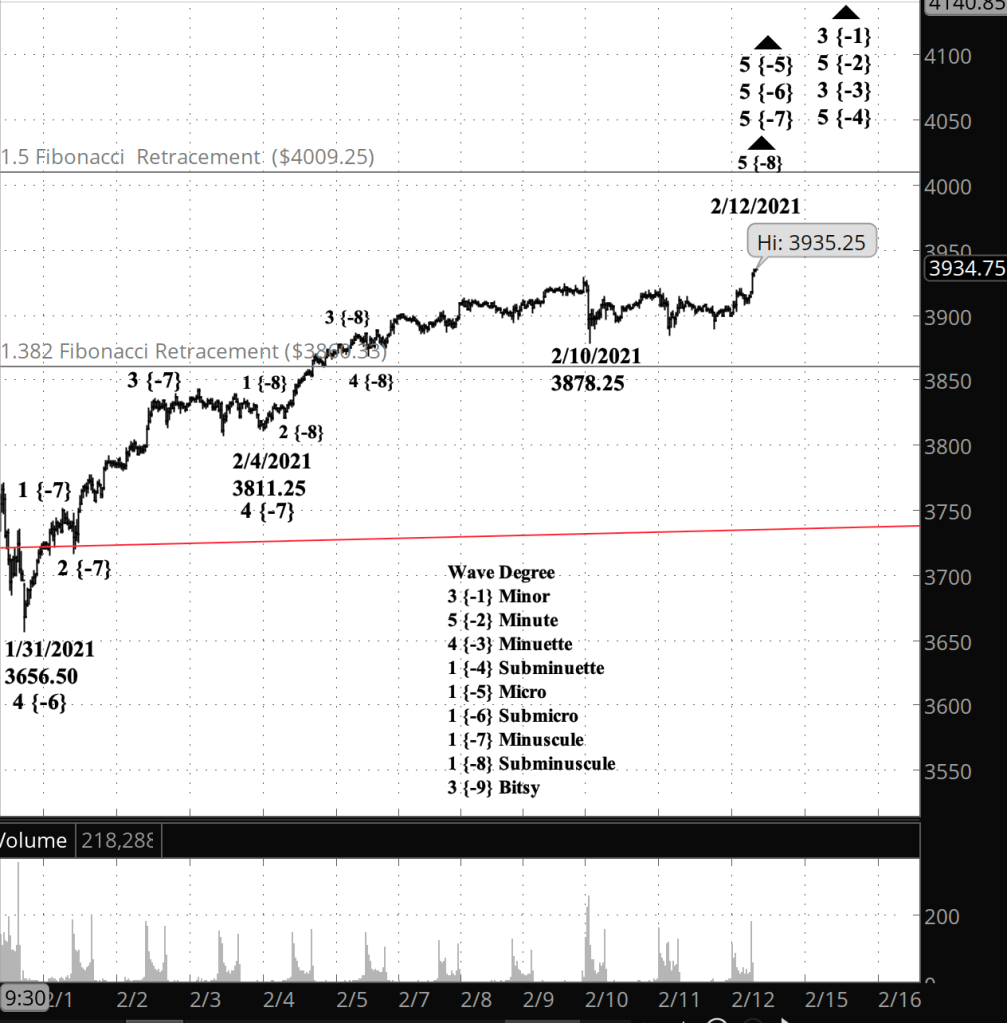
After the closing bell. A rapid rise in the last 20 minutes of trading carried the S&P 500 to a new high, 3935.25 on the futures and 3937.23 on the index, refuting my principle analysis and confirming the alternative. The rise that began January 31 is still underway. I’ve updated the chart.

3:30 p.m. New York time

Half an hour before the closing bell. The S&P 500 traded close to its opening price throughout the day. I’ve updated the chart.

9:35 a.m. New York time

What’s happening now? The S&P 500 E-mini futures continued to trade around 25-30 points below the high of 3928.50 attained on February 10. The equivalent high on the index is 3931.50.

What does it mean? My analysis is unchanged from yesterday. The February 10 peak was the end of the rise from January 31, and subsequent so-far-shallow decline is the first steps toward what will turn into a significant downtrend.

What are the alternatives? Although the February 10 peak satisfies all requirements in Elliott for completion of the rise, it is possible that there will be a final bump upward before the downtrend begins.

[S&P 500 E-mini futures at 4:30 p.m., 30-minute bars, with volume]

What does Elliott wave theory say? The decline so far is wave 1 of Subminuette degree, perhaps. I always find it impossible in the early stages of a trend change to determine precisely which degree I’m tracking. The decline so far lacks context.

The high of February 10 marked the endpoint of wave 5 of Submicro degree and cascades up the parent waves to wave 5 of Subminuette degree, which began December 21, 2020 from 3596. Up one degree, it is the end of wave 3 of Minuette degree, which began November 12, 2020 from 3525.50.

Read More »