What’s happening now? The S&P 500 index begins the day little changed as it traces out the very early steps in what will become a significant decline.
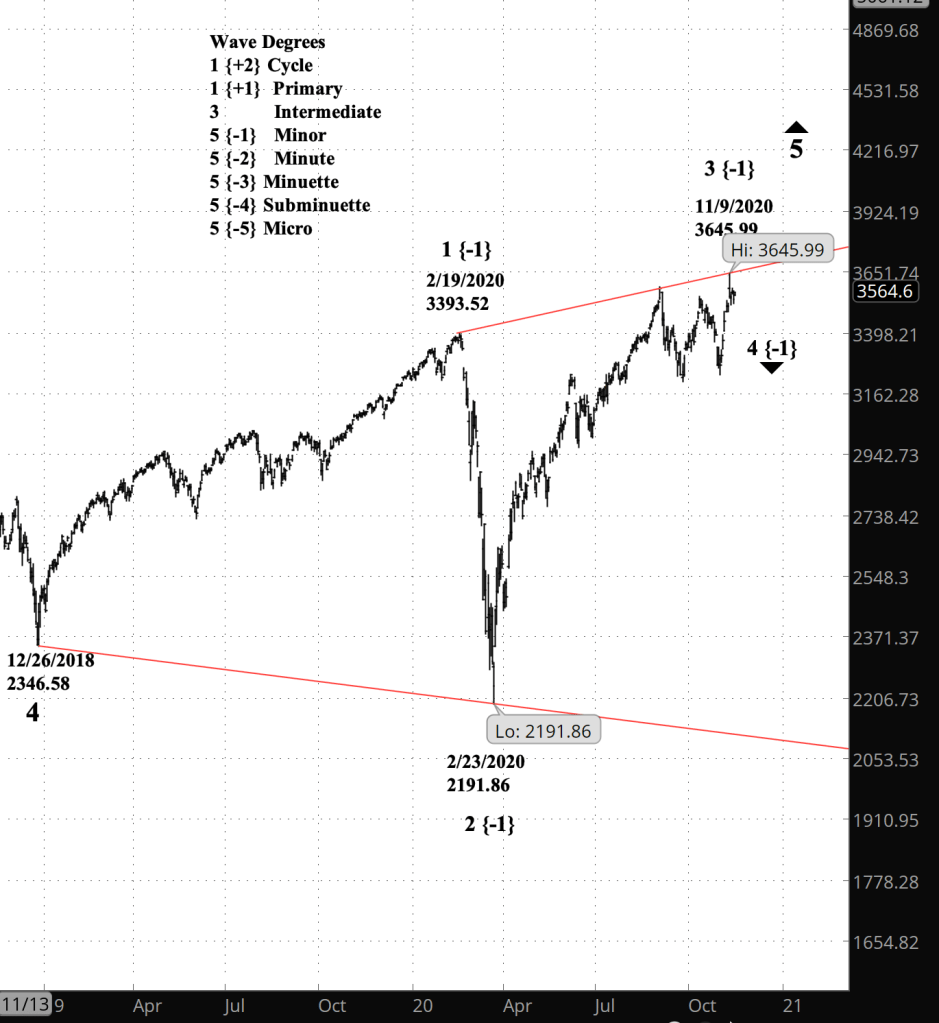
What does it mean? The decline will carry the price down to the lower boundary of the expanding Diagonal Triangle (red lines) that began in December 2018. The lower boundary is presently at 2131 and is declining by about $3 per day. The longer the journey down, the lower the boundary.
[S&P 500, daily bars]
What does Elliott wave theory say? The triangle is presently beginning wave 4 of Minor degree. The preceding Minor wave 3 began at 2191.86 on February 23 and ended at 3645.99 on November 9. This is gives some idea of the magnitudes of time and distance that lie ahead.
The downtrending Minor wave 4 will be followed by an uptrending Minor wave 5, which will carry back to the upper boundary, marking the end of the parent wave, Intermediate wave 5. The upper boundary is moving higher each day — such is the nature of an expanding triangle — and so wave 5 will move to higher levels than we’ve seen this year.
My trading strategy. I’m waiting for a good entry point for options, with a bear call vertical spread as my strategy. I’m holding on to my bearish shares in the inverse fund SDS.
I’ve updated the chart below at 30 minutes before the closing bell. The small scale wave 5 to the downside has begun in the early stages of wave 4 of Minor degree.
10 a.m. New York time
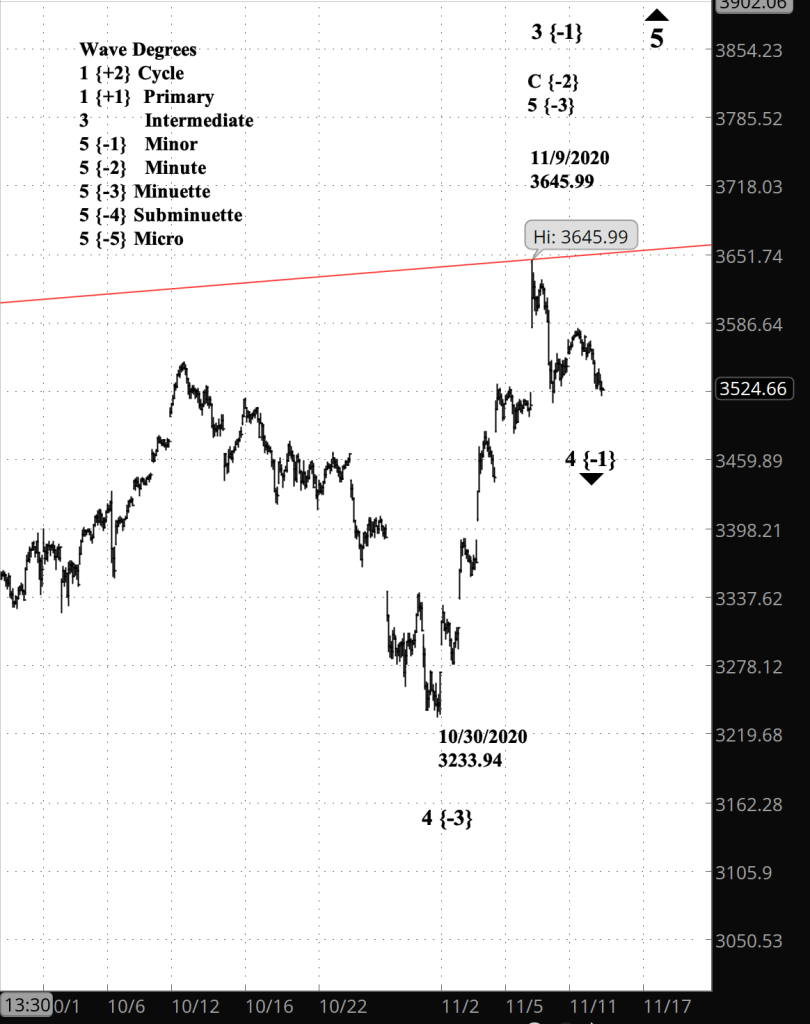
What’s happening now? The S&P 500 index has completed a four-move pattern to the downside as it begins its journey south to the lower boundary of the expanding Diagonal Triangle that began in December 2018.
What does it mean? It’s still early steps, but the decline that began on November 9 will carry the price from the peak 3645.99 down to the 2150s or below. That downward movement will be followed by an upward push to a new high.
[S&P 500 index, 45-minute bars]
What does Elliott wave theory say? The Diagonal Triangle is the conclusion of uptrending Primary wave 5. The present decline down toward the lower boundary is Minor wave 4, and the subsequent rise will be Minor 5, the final wave within Primary wave 5. I wouldn’t hazard a guess at this point identifying the degree of the four-wave decline from the peak.
My trading strategy. Shares: continue to hold bear positions with an eye to possibly selling at the low end of Minor wave 4. Options: My next entry window for spreads is November 24 to December 8, centering on 21 days before the January options expire.
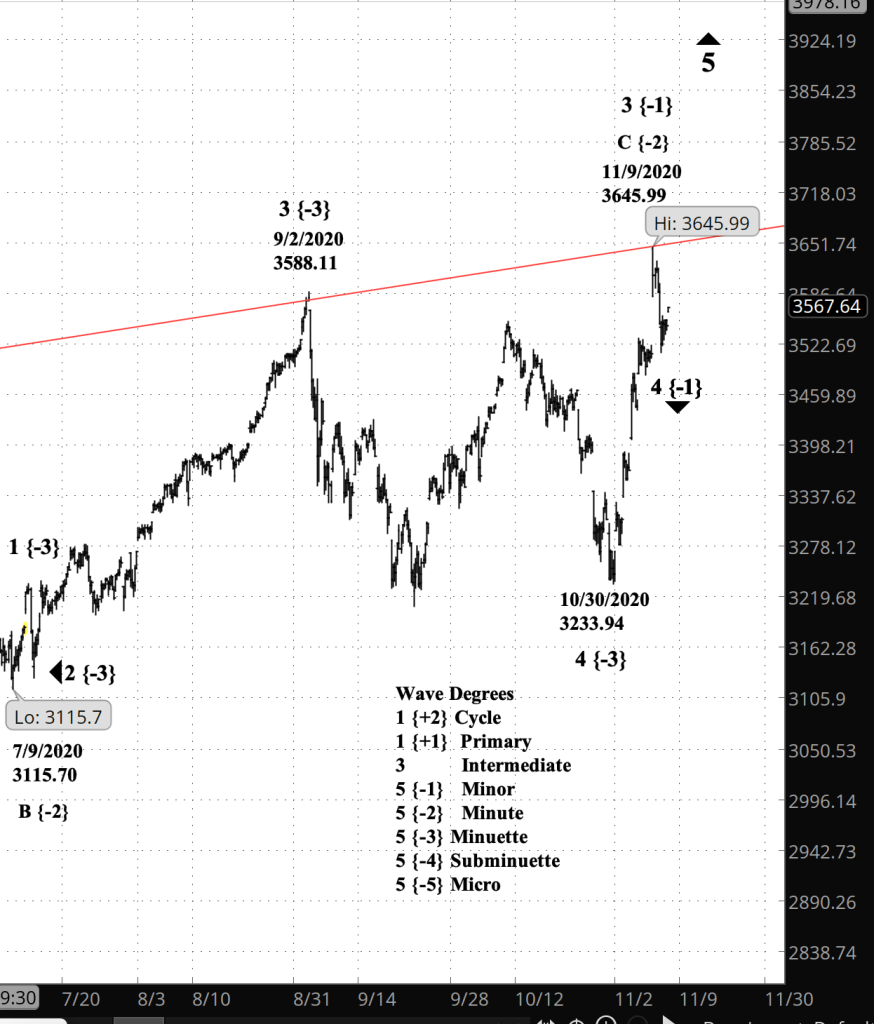
What’s happening now? The S&P 500 index continues its initial steps downward in the 4th leg of a Diagonal Triangle pattern that began in December 2018.
What does it mean? The downward movement is headed for the lower boundary of the Triangle, which is now in the 2100s. The slower the decline, the lower the boundary.
[S&P 500, 90-minute bars]
What does Elliott wave theory say? Minor wave 4 to the downside within Primary wave 5 to the upside is underway. Minor 4 will ultimately have three subwaves of Minuette degree. Minor 4 will be complete when it touches, or at least comes near to, the lower boundary of the Diagonal Triangle. After wave 4 is complete, Minor wave 5 will rise again to the upper boundary, completing Primary wave 5.
My trading strategy. Still in flux. Wave 4 might be a trading opportunity for options and an exit opportunity for my shares of SDS, an inverse fund based on the S&P 500. My goal now is to be sure that wave 4 is indeed complete.
The S&P 500 price moved above a significant level yesterday, requiring a rethinking of the Elliott wave analysis that had been in place for several months. See the analysis here.
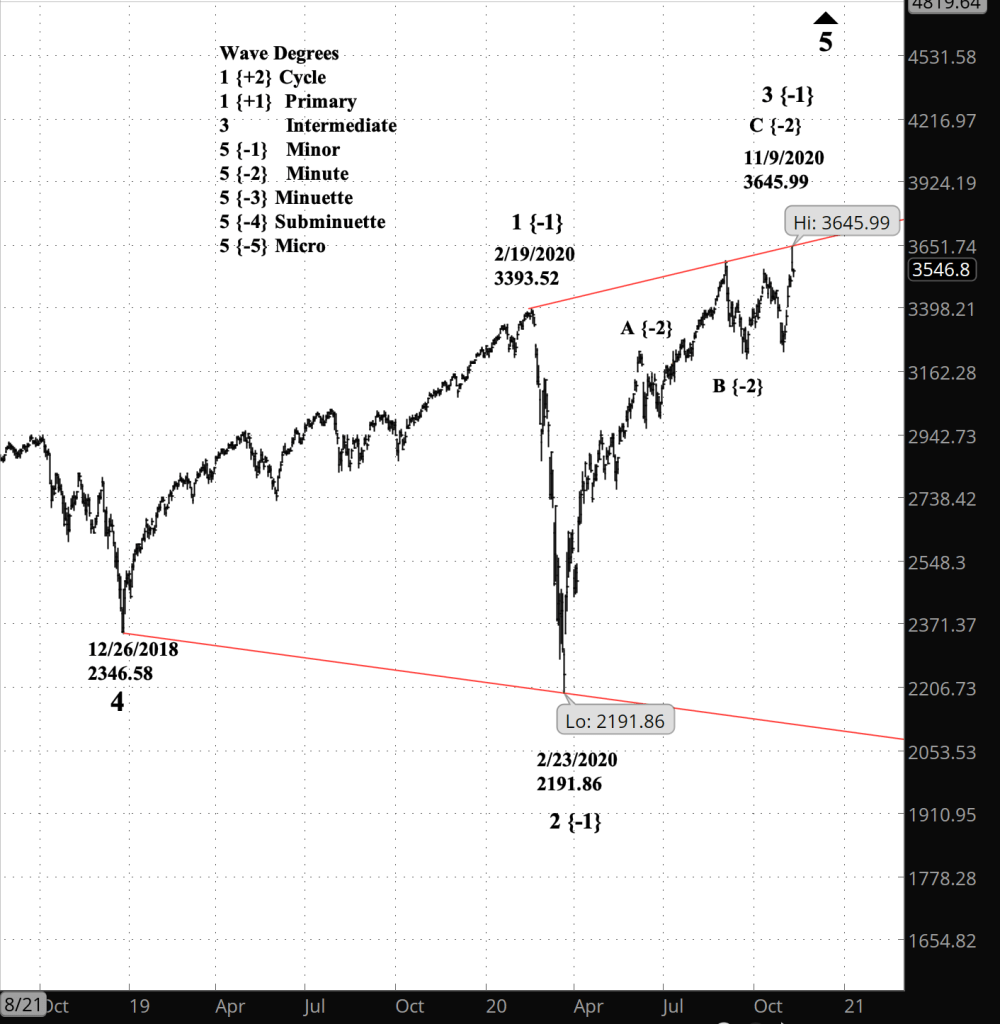
What’s happening now? The S&P 500 index this morning continued to linger slightly below the upper boundary of the triangle that began on December 26, 2018.
What does it mean? The third wave of the five-wave triangle is complete and will soon start to decline to the lower boundary, presently in the low 2000s or even lower.
[S&P 500 index, daily bars]
What does Elliott wave theory say? The structure that began in December 2018, from 2346.58, is an expanding Diagonal Triangle within the 5th wave of Intermediate degree.
Each wave within an expanding Diagonal Triangle is longer than the one before, bounding between boundaries that grow farther apart. So wave 4 of the triangle, just beginning, drops beyond the triangles starting point down to the low 2000s, if it moves swiftly, and even lower if it moves slowly. Minor wave 5 which follows will rise back to the 3700s, the upper boundary of the triangle next week, and even higher if it is a slow rise.
Each wave within the triangle has three subwaves, labelled A, B and C.
My trading strategy. The 4th wave decline will provide an opportunity to exit my shares in SDS, an inverse exchange-traded fund that profits when the S&P 500 falls. Whether I actually take profits depends upon the timing, since long-term capital gains (on stocks held for a year or longer) get a tax break in the U.S. I’m still looking at whether wave 4 would be a reasonable options play. Given the distances involved it seems reasonable at first glance, and if I decide to play it I’ll use a bear call spread structure for the options.
The markets gave traders a major head-fake, beginning with futures trading on Sunday and continuing today with all blue-chip indexes and funds after the opening bell.
It was the second major head-fake of the year. Both were of a magnitude that ripped my previous analysis to shreds. With this post, I shall try to sweep away remains of the old analysis and put in its place a new analysis that will show where the markets stand, in light of their rise today.
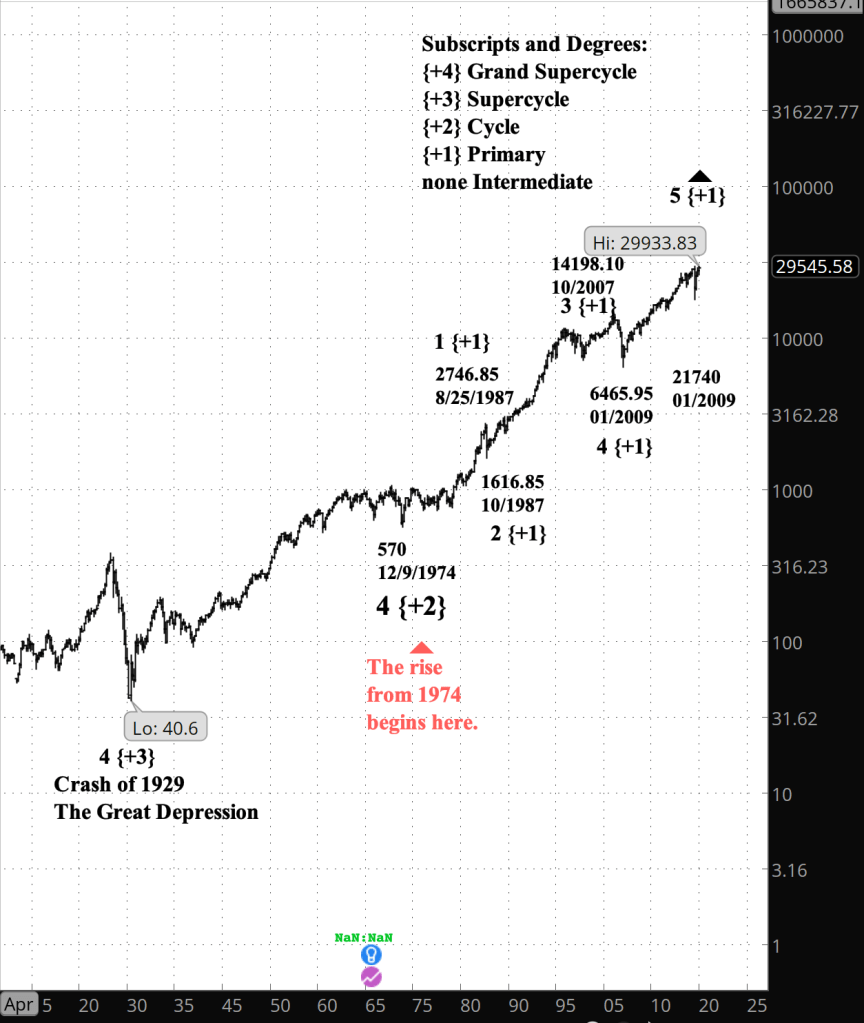
I shall use a long-term Dow Jones Industrial Average chart for the big-picture analysis, stretching back from the present to before the Great Crash of ’29.
[Dow Jones Industrial Average, quarterly bars]
The rise from 1974 is wave 5 of Cycle degree within wave 5 of Supercycle degree, the latter having begun with the Great Crash of 1929. Cycle 5 began on December 9, 1974 at 570 on the Dow. It’s parent, Supercycle 5, began on in July 8, 1932 at 40.6. The peak so far today is 29,933.83. The markets have come a long way in the past 88 years.
Within Cycle wave 5, I count the indexes as being in wave 5 of Primary degree, which began in January at 6465.95 on the Dow. The answer to the head-fake highs this year lie within Primary wave 5.
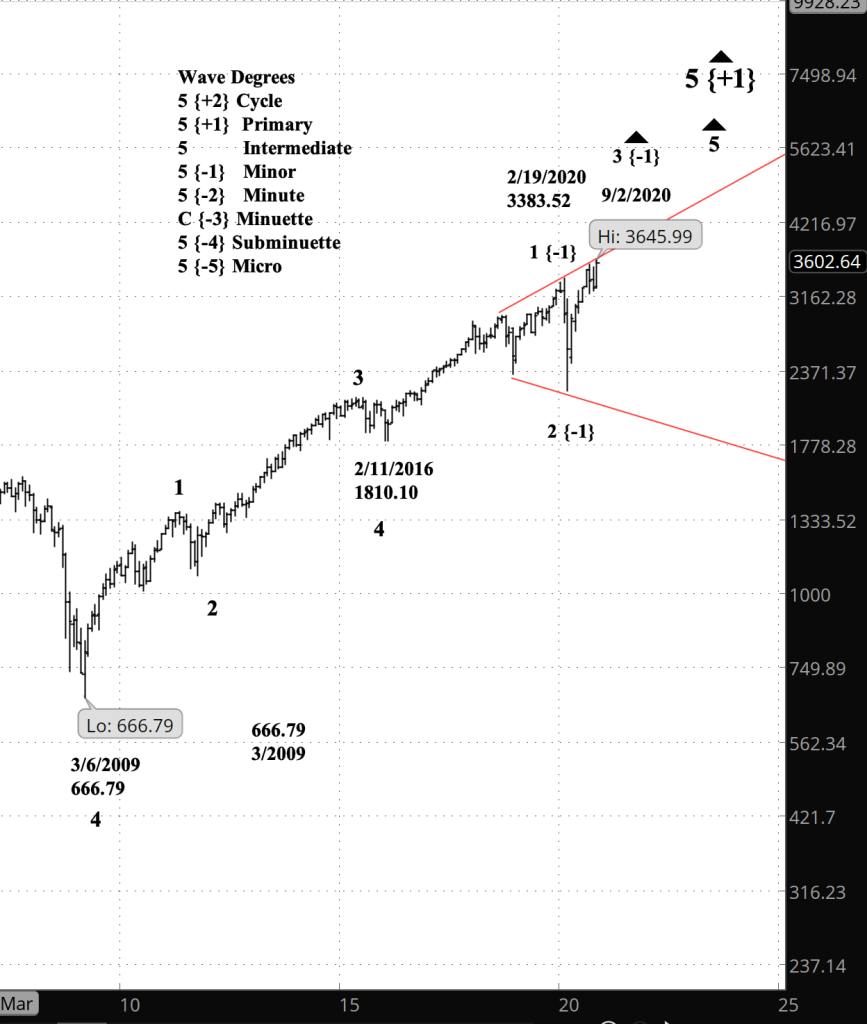
For a closer look at Primary wave 5, I turn to a chart of the S&P 500 index.
[S&P 500 index, monthly bars]
Primary wave 5 is presently in its 5th and final wave, wave 5 of Minor degree. Minor 5 as it turns out is taking the form of a Diagonal Triangle. In this case, it is an expanding version of the structure, delimited by the red lines.
Internally, a Diagonal Triangle has five waves, each built by three waves of a lower degree. By my count the Triangle is in wave 3 of Minor degree, which is rising, and it will be followed by a falling Minor 4 reaching below 2191.80, and then a rising Minor 5 that will reach a new high.
Each wave of a Diagonal Triangle has three waves within it, in this case of Minute degree.
So what happens after the Diagonal Triangle is complete? By my reading of the chart, that final high will mark the end of the Great Bull Market that began in 1974, and a major, years long decline will begin.
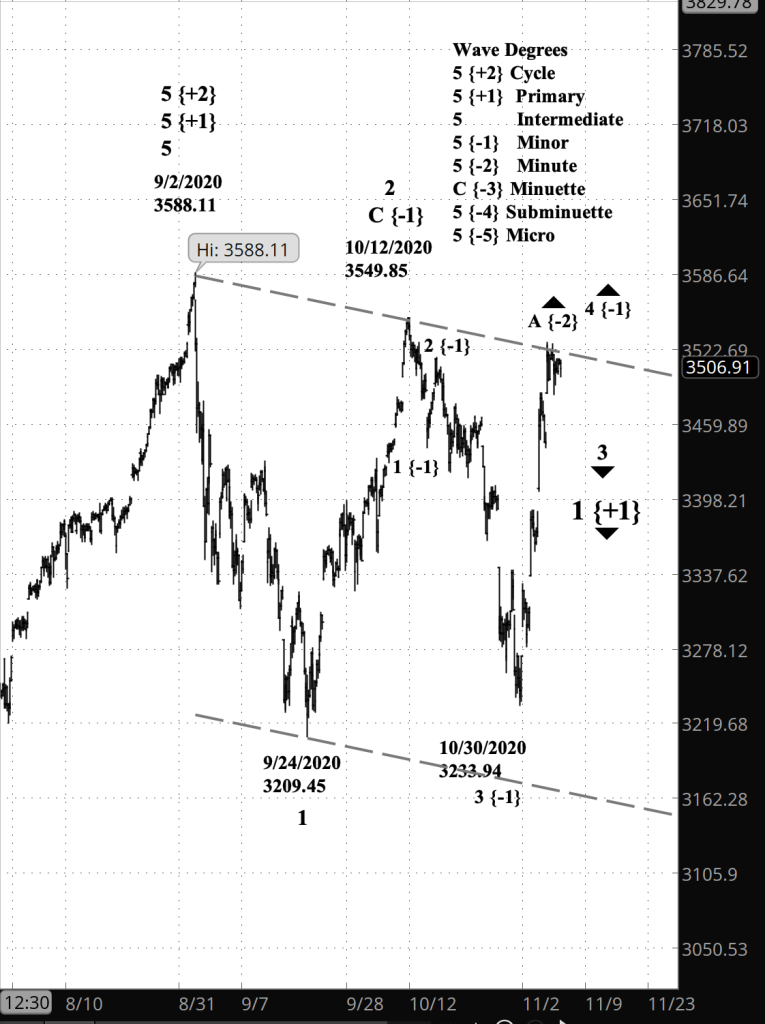
However, that would be the second time this year I’ve said that, only to be hit by a head-fake. I’m not yet signing on to that interpretation. Both declines this year, beginning in February and in September, proved to be false signal of a major bear market when the 2nd wave moved above the start of the preceding 1st wave.
Lesson learned: I don’t plan to call a major decline until I have a clear 3rd wave to the downside.
My trading strategy: Minor wave 4 within the diagonal triangle ought be a trading opportunity with options. Wave 5 as well. Insofar as my bear-oriented shares in SDS are concerned, I’ll be looking for an exit opportunity was wave 4 reaches its low point.
The S&P 500 has barely budged since peaking this morning after a rise that began overnight with the futures. The rise forced a reworking of my analysis See the new analysis here.
9:50 a.m. New York time
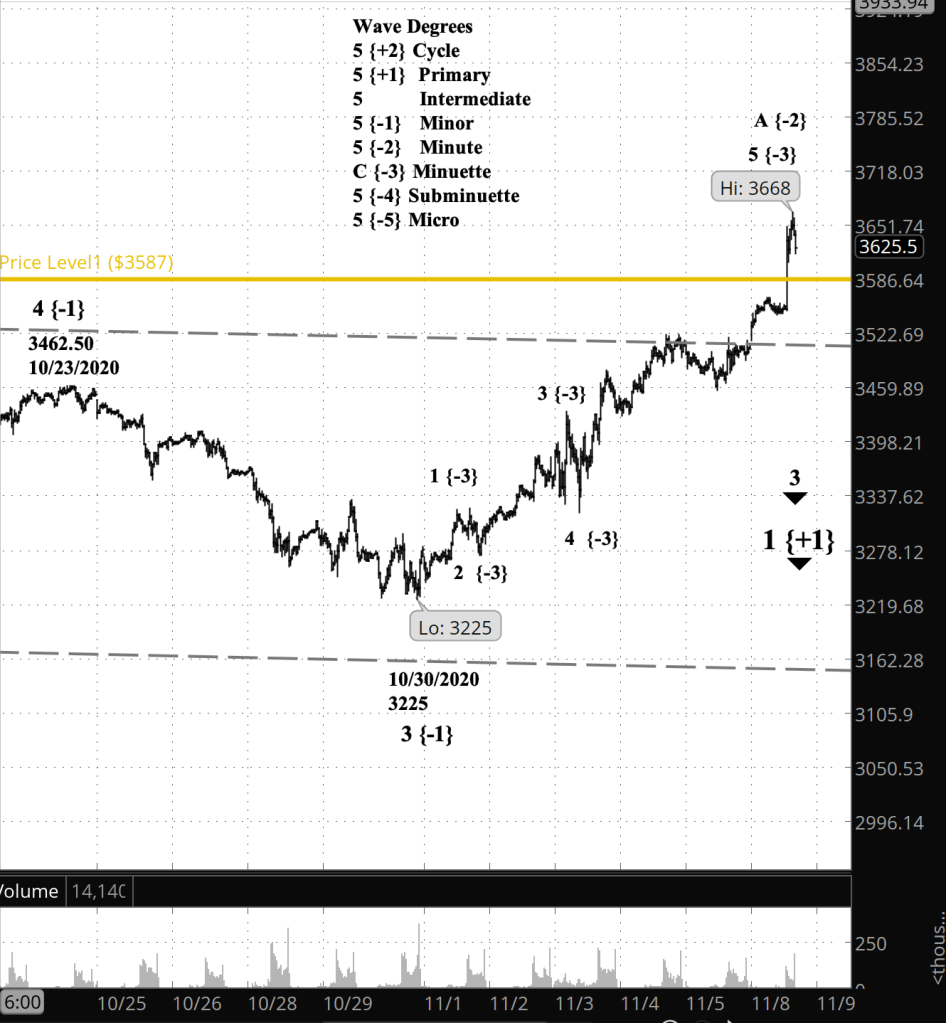
What’s happening now? The S&P 500 E-mini futures beginning Sunday rose higher above the upper boundary of the trend channel. The index on Monday opened with a price gap to the upside, reflecting the futures trading. The price moved above the high of September 2 (golden line) — 3588.11 on the index and 3587 on the futures — the beginning of what Elliott wave analysis suggested would be a significant, years-long downtrend.
What does it mean? The rise since October 30 is the first portion of a correction to the upside. It will be followed by a downward movement, and then a push to a higher level.
What is the alternative? The corrective wave’s push above the start of the major downtrend raises a signal in Elliott wave analysis that could mean that the September 2 high was not the end of the rise that began in 1974 and not the beginning of a significant downtrend. See the Elliott wave theory section, below.
[S&P 500 E-mini futures, 30-minute bars]
What does Elliott wave theory say? The movement of Primary wave 2 above the start of Primary wave 1 violates a rule of Elliott wave theory. If the chart shows it happening, then the count is wrong and must be redone. I don’t yet know what will replace the count shown on the chart above. I’ll post the revision after I’ve done the work and thought it through.
11:25 a.m. New York time. And I’ve completed the reanalysis. See today’s second post, “The Great Bull Market, 1974-????”.
My trading strategy. I’m hanging on to what I have and not entering into anything new.
I’ve updated the chart to show the S&P 500 half an hour before the closing bell. The price has barely budged as it scrapes along the upper boundary of the trend channel.
6:35 a.m. New York time
What’s happening now? The S&P 500 index continued to dawdle at the upper boundary of the decline that began on September 2.
What does it mean? Nothing significant has changed since yesterday, November 5. I count the rise from October 30 as an initial step in upward correction, to be followed by a downward movement and then a final upward movement, potentially ending the correction and beginning a significant decline in the direction of the main trend.
[S&P 500 index, hourly bars]
What does Elliott wave theory say? Wave A of Minute degree is nearing its end. It is the first wave of a three-wave correction, subwaves of wave 4 of Minor degree within downtrending wave 3 of Intermediate degree.
My trading strategy. I’m declining to open options positions at this point, as I wait for the Minor degree downtrend to resume. I continue to hold shares in the inverse exchange-traded fund SDS.
Half an hour before the closing bell, the S&P 500 has moved beyond the upper boundary of the price channel, a signal that Minute wave A, which began on September 30, is nearing completion. (No afternoon chart update today.)
9:45 a.m. New York time
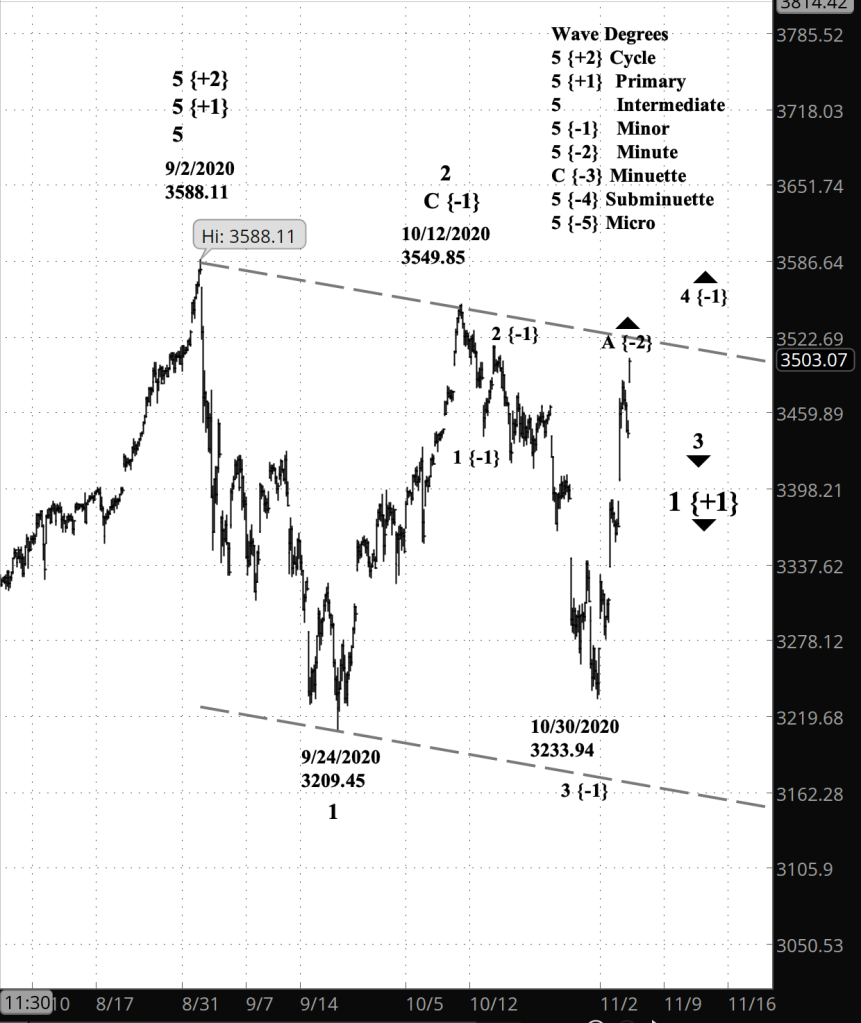
What’s happening now? The S&P 500 index took another step to the upside, drawing near to the upper boundary of the price channel that began on September 2, when the index peaked at 3588.11
What does it mean? The rise that began on October 30, from 3233.94, is nearing its end.
What are the alternatives? The price could move briefly above the upper boundary — an action called an overthrow — and that would signal an end the rise and a resumption of the decline. An overthrow isn’t mandatory and the price could reverse while still below the boundary.
[S&P 500 index, hourly bars]
What does Elliott wave theory say? By my count the index is completing wave A of Minute degree within wave 4 of Minor degree, an upward correction that began on October 30. All of this is happening within wave 3 of Intermediate degree, which in turn is a subwave of wave 1 of Primary degree. Primary 1 began on September 2, ending a rise that began in 1974 and beginning a declining dominant trend that will be with set the direction of the market for years.
Minute wave A will be followed by a decline, Minute B, and then by a final upward movement, Minute C. The end of wave C will either mark the completion of Minor wave 4, ushering in a Minor 5th wave decline down to the 3100s, or wave C will be followed by an X wave, a separator of two corrective patterns that are parts of a combination correction.
My trading strategy. I won’t enter a new options position until Minor wave 5 has begun. I suspect that the December options are off the table, since it will take a bit of time for waves B and C to complete their work. I shall continue to hold my bear-oriented shares of the exchange-traded fund SDS.
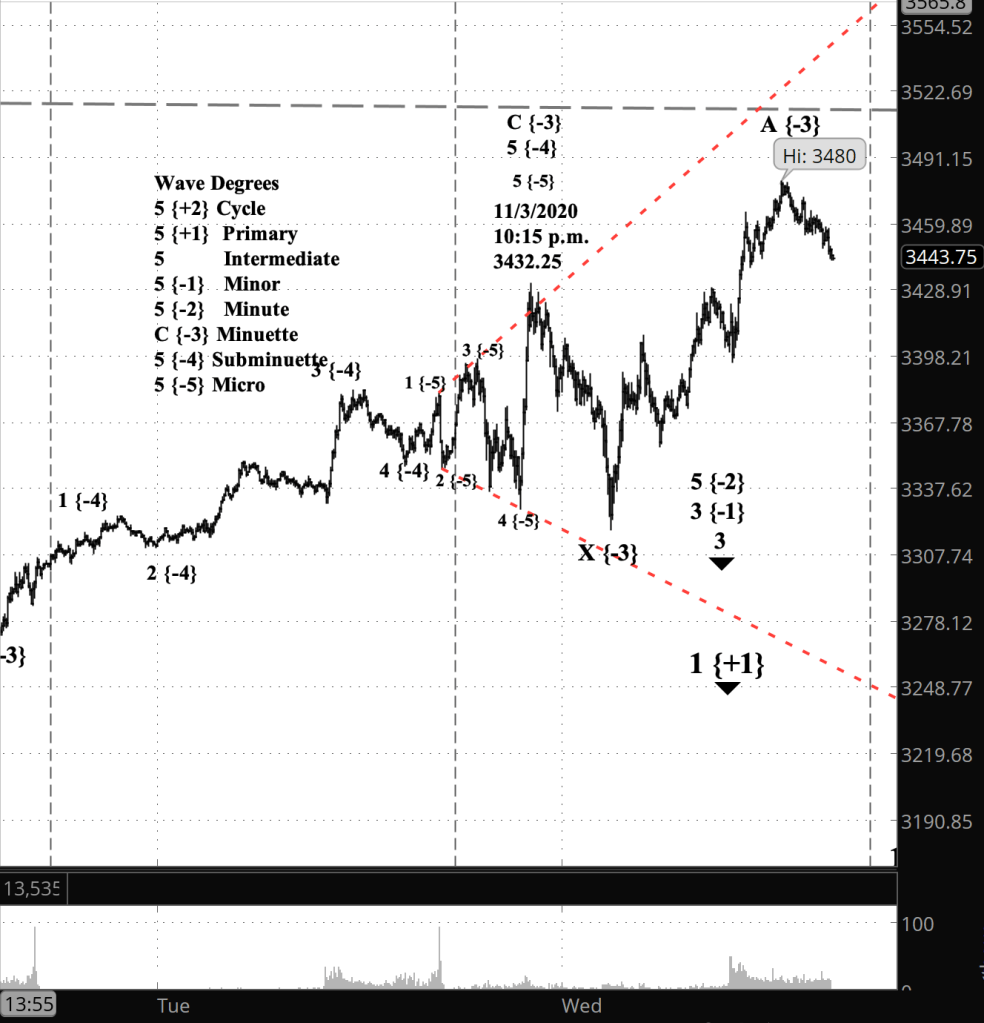
As it turned out, the X-wave alternative proved to be the S&P 500’s pattern. I’ve updated the count, showing today’s rise being an A wave of Minuette degree within a second corrective pattern connected to the first corrective pattern by the overnight decline (X wave of Minuette degree). All of this is happening with a 4th wave of Minute degree.
9:40 a.m. New York time
The futures markets on the major indexes had a dramatic night that commentators excitedly credited to the vast uncertainties in the American presidential election vote count. Elliott wave analysts, on the other hand, calmly marked up their charts, concluding that the drama was nothing more than typical 5th wave triangle pattern, setting up a resumption of the decline that began in February.
What’s happening now? The S&P 500 E-mini futures beginning at 9:30 p.m. underwent a rapid swing that in a couple of hours covered about 100 points each way.
What does it mean? The pattern is typical of the concluding movement in the direction of a larger movement. The swing occurred in an upward movement within an upward correction.
What is the alternative? On the chart I marked last night’s high as the end of the pattern. It’s possible to count the pattern so that an additional high will in fact be the end.
[S&P 500 E-mini futures, 5-minute bars]
What does Elliott wave theory say? The horizontal triangle, marked in red, is the 5th wave of Subminuette degree within the C wave of Minuette degree, both within and marking the end of the 4th wave correction of Minute degree. The ensuing decline will either be the 5th and final wave, of Minute degree, within the declining 3rd wave of Minor degree. Or it could be an X wave of Minute degree, a boundary between two corrective pattern within a compound structure.
My trading strategy. I’m staying away from any new options position until I understand the present decline: Minute 5 is a trade; Minute X is a warning to stay away.
I’ve updated the chart with half an hour before the closing bell.
9:45 a.m. New York time
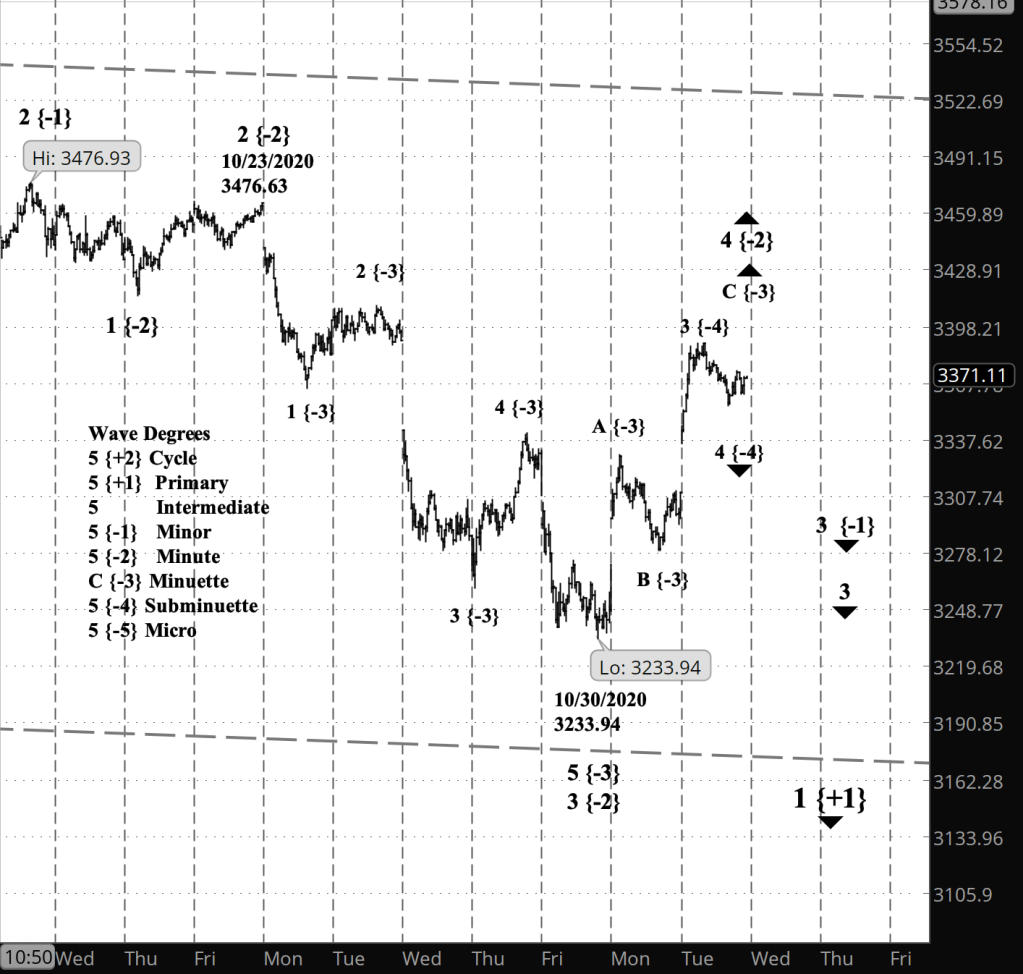
What’s happening now? The S&P 500 index is tracing the third step, an upward movement within a low level upward correction.
What does it mean? Two possibilities. 1) The correction will end with the third step and will resume its downward path. 2) The index will trace a downward boundary movement and then will begin another pattern in a compound correction that will be on the shallow side.
[S&P 500 index, 10-minute bars]
What does Elliott wave theory say? The uptrending correction, wave 4 of Minute degree, has completed two internal waves, A and B of Minuete degree, and has begun rising in wave C.
If the C wave completes the correction, then it we followed by wave 1 of Minuette degree within wave 5 of Minute degree, the fifth wave being the final downward push of the 3rd wave correction of Minor degree.
If the correction turns into a compound movement, stringing several corrective together, then the decline following wave C will be an X wave of Minuette degree, a boundary between two patterns.
The difficulty is that the X wave (= correction continuing) and the 1st wave (= correction over) will initially exactly the same. The X wave will have three internal waves, and the 1st wave will have five internal waves. The truth of which we’re seeing will unfold over time.
My trading strategy. I’m looking to enter a new bear call spread position on one of the funds the tracks the S&P 500 closely, using the options that expire December 18. My preferred entry date for that series is today, November 3. It’s not going to happen. I’ll need to see some indication that the Minute 5th wave decline has begun.
 Tim Bovee, Private Trader
You must be logged in to post a comment.