Trader’s Notebook

3:30 p.m. New York time

Half an hour before the closing bell. The S&P 500 moved slightly higher during the trading sessions, so far reaching 4626 on the futures, 4631.92 on the index. No change in the analysis. I’ve updated the chart.

1:05 p.m. New York time

MU earnings play entry. I’ve entered a short bull put spread on MU, using options expiring on May 20, and have posted an analysis of the trade.

10:45 a.m. New York time

PVH earnings play entry. I’ve entered a short bear call spread on PVH, using options expiring on May 20, and have posted an analysis of the trade.

9:40 a.m. New York time

What’s happening now? The S&P 500 E-mini futures continued to rise in overnight trading, reaching a high so far of 4623.

What does it mean? The upward correction that began on February 24 continues.

What are the alternatives? There are two, unchanged from yesterday

Alternative #1: The correction has met all of the requirements set out by Elliott wave theory, and so any peak, including today’s, could be the end of the correction. The end of the correction will be followed by a significant decline as the downtrend that began on January 4 resumes.

Alternative #2: The present corrective pattern could be followed by a second corrective pattern and possibly a third. In such a compound correction, the first pattern is followed by a connecting wave — a decline in this case — and if the correction extends to three waves, the second wave is also followed by a downward connecting wave. When complete, the downtrend from January 4 will resume.
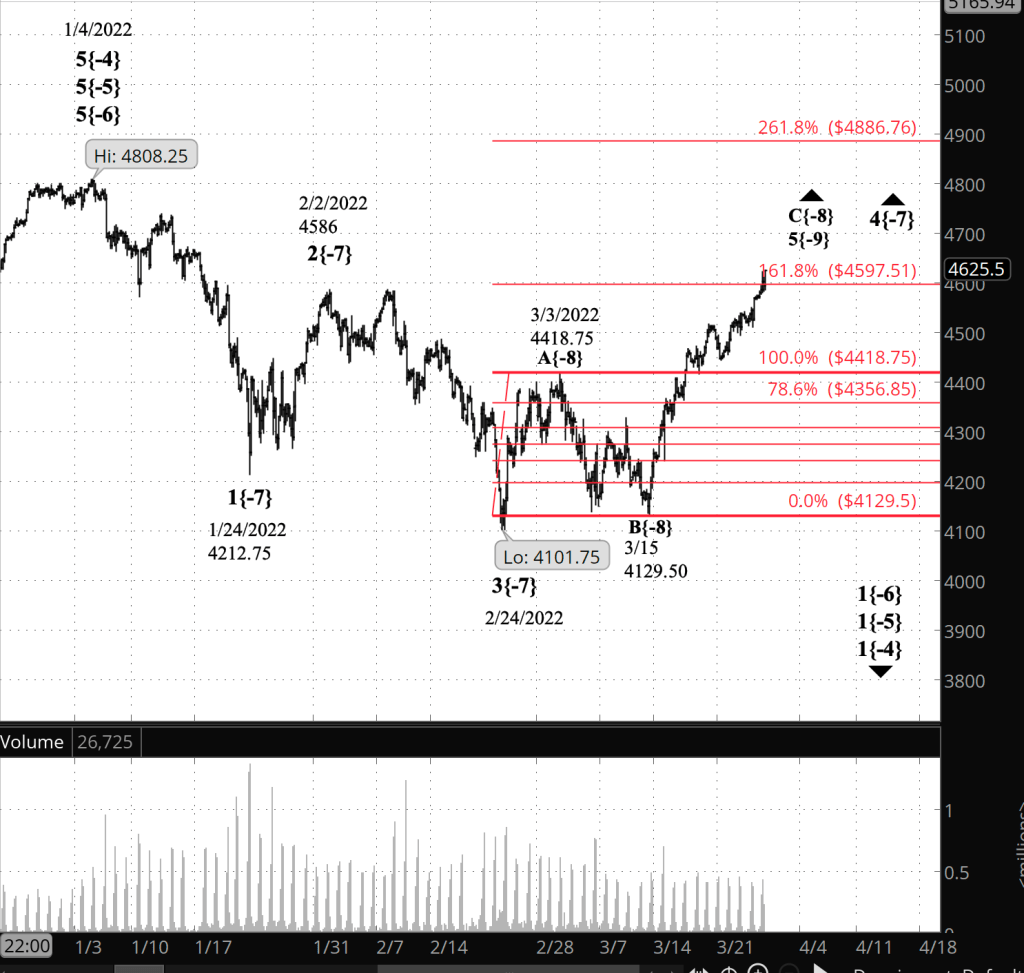
[S&P 500 E-mini futures at 3:30 p.m., 180-minute bars, with volume]

What does Elliott wave theory say? The question with the upward correction, wave 4{-7}, at this point is boundaries. The wave’s overnight high retraced 100% of the preceding wave 3{-7} — the 4586 mark.

There is an Elliott wave guideline that governs how far wave 4{-7} can go. If the parent structure is a Flat, which this 4th wave appears to be, then the C wave within the 4th wave will typically retrace 100% and 165% of wave A. The retracement so far is a Fibonacci level, 161.8%, so this C wave is well within the guidelines. I’ve placed the Fibonacci grid on the chart to show the wave C{-8} retracement of wave B{-8}.

Wave C{-8} has moved beyond the maximum retracement according to the guideline. But since it’s a guideline and not a rule, it won’t break the Elliott wave model if it goes still higher.

We Are Here.

These are the waves currently in progress under my principal analysis. Each line on the list shows the wave number, with the subscript in curly brackets, the traditional degree name, the starting date, the starting price of the S&P 500 E-mini futures, and the direction of the wave.

  • Index:
  • 5{0} Intermediate, 12/26/2018, 2346.58 (up)
  • 4{-1} Minor, 1/4/2022 4818.62 (down)
  • 1{-2} Minute, 1/4/2022 4818.62 (down)
  • Futures and index:
  • 1{-3} Minuette, 1/4/2022, 4808.25 (down) (futures), 4818.62 (down) (index)
  • Futures:
  • 1{-4} Subminuette, 1/4/2022, 4808.25 (down)
  • 1{-5} Micro, 1/4/2022, 4808.25 (down)
  • 1{-6} Submicro, 1/4/2022, 4808.25 (down)
  • 4{-7} Minuscule, 3/3/2022, 4101.75 (up)
  • C{-8} Subminuscule, 3/15/2022, 4129.50 (up}

Learning and other resources. Elliott wave analysis provides context, not prophecy. As the 20th century semanticist Alfred Korzybski put it in his book Science and Sanity (1933), “The map is not the territory … The only usefulness of a map depends on similarity of structure between the empirical world and the map.” And I would add, in the ever-changing markets, we can judge that similarity of structure only after the fact.

See the menu page Analytical Methods for a rundown on where to go for information on Elliott wave analysis.

By Tim Bovee, Portland, Oregon, March 29, 2022

Disclaimer

Tim Bovee, Private Trader tracks the analysis and trades of a private trader for his own accounts. Nothing in this blog constitutes a recommendation to buy or sell stocks, options or any other financial instrument. The only purpose of this blog is to provide education and entertainment.

No trader is ever 100 percent successful in his or her trades. Trading in the stock and option markets is risky and uncertain. Each trader must make trading decisions for his or her own account, and take responsibility for the consequences.

License
Creative Commons License

All content on Tim Bovee, Private Trader by Timothy K. Bovee is licensed under a Creative Commons Attribution-ShareAlike 4.0 International License.

Based on a work at www.timbovee.com.
MKC Trade

McCormick & Co. Inc. (MKC)

Update 3/31/2022: I exited my short bull put vertical options spread on MKC, 50 days before expiration, for a $1.09 debit per contract/share, a profit before fees of $36 per contract. Shares were trading at $97.10, down $0.12 from the entry level.

The Implied Volatility Rank at exit was 25.8, down 25.3 points from the entry level.

I exited because the position reached 25% of maximum potential profit, my normal exit point for earnings plays.

Shares declined by 0.1% over three days for a -15% annual rate. The options position produced a 33.0% return for a +4,018% annual rate.


I have entered a short bull put options spread on MKC, using options that trade for the last time 53 days hence, on May 20. The premium is a $1.45 credit per contract share and the stock at the time of entry was priced at $97.22.

The Implied Volatility Ratio stood at 51.1%.

Premium:$1.45Expire OTM
MKC-bull put spreadStrikeOddsDelta
Calls/Puts
Long90.0078.0%20
Break-even96.4568.0%28.5
Short95.0058.0%37

The premium is 58% of the width of the position’s short/long spread. The profit zone is fairly constrained on the downside, covering a 0.8% move in that direction, and covers an unlimited move to the upside.

The risk/reward ratio is 2.4:1, with maximum risk of $355 and maximum reward of $145 per contract.

How I chose the trade. The trade was placed to coincide with MKC’s earnings announcement, before the opening bell on the day after entry. The short strikes were set to coincide with the expected move of $0.81 either way, based on options pricing, which gives a price range of $96.41 to $98.03, with adjustments for the options being 17 days out before expiration. An unadjusted expectation gives a range of $93.17 to $101.27

By Tim Bovee, Portland, Oregon, March 28, 2022

Disclaimer

Tim Bovee, Private Trader tracks the analysis and trades of a private trader for his own accounts. Nothing in this blog constitutes a recommendation to buy or sell stocks, options or any other financial instrument. The only purpose of this blog is to provide education and entertainment.

No trader is ever 100 percent successful in his or her trades. Trading in the stock and option markets is risky and uncertain. Each trader must make trading decisions for his or her own account, and take responsibility for the consequences.

License
Creative Commons License

All content on Tim Bovee, Private Trader by Timothy K. Bovee is licensed under a Creative Commons Attribution-ShareAlike 4.0 International License.

Based on a work at www.timbovee.com.
Trader’s Notebook

3:30 p.m. New York time

Half an hour before the closing bell. The S&P 500 rose during the trading session, reaching 4555.75, slightly above the the overnight low. No change in the analysis. I’ve updated the chart below.

11:20 a.m. New York time

MKC earnings play entry. I’ve entered a short bull put options spread on MKC and have posted an analysis of the trade.

9:35 a.m. New York time

What’s happening now? The S&P 500 E-mini futures continued to rise after trading resumed overnight, reaching a high so far today of 4548.50.

What does it mean? The upward correction that began on February 24 continues and is in its final phase, both at its top degree and at least two degrees smaller. Bottom line: It will be over soon.

What are the alternatives? There are two:

Alternative #1: The correction has met all of the requirements set out by Elliott wave theory, and so any peak, including today’s, could be the end of the correction. The end of the correction will be followed by a significant decline as the downtrend that began on January 4 resumes. Bottom line: It’s over.

Alternative #2: The present corrective pattern could be followed by a second corrective pattern and possibly a third. In such a compound correction, the first pattern is followed by a connecting wave — a decline in this case — and if the correction extends to three waves, the second wave is also followed by a downward connecting wave. When complete, the downtrendd from January 4 will resume. Bottom line: It’s not going to be over as quickly as we expected.

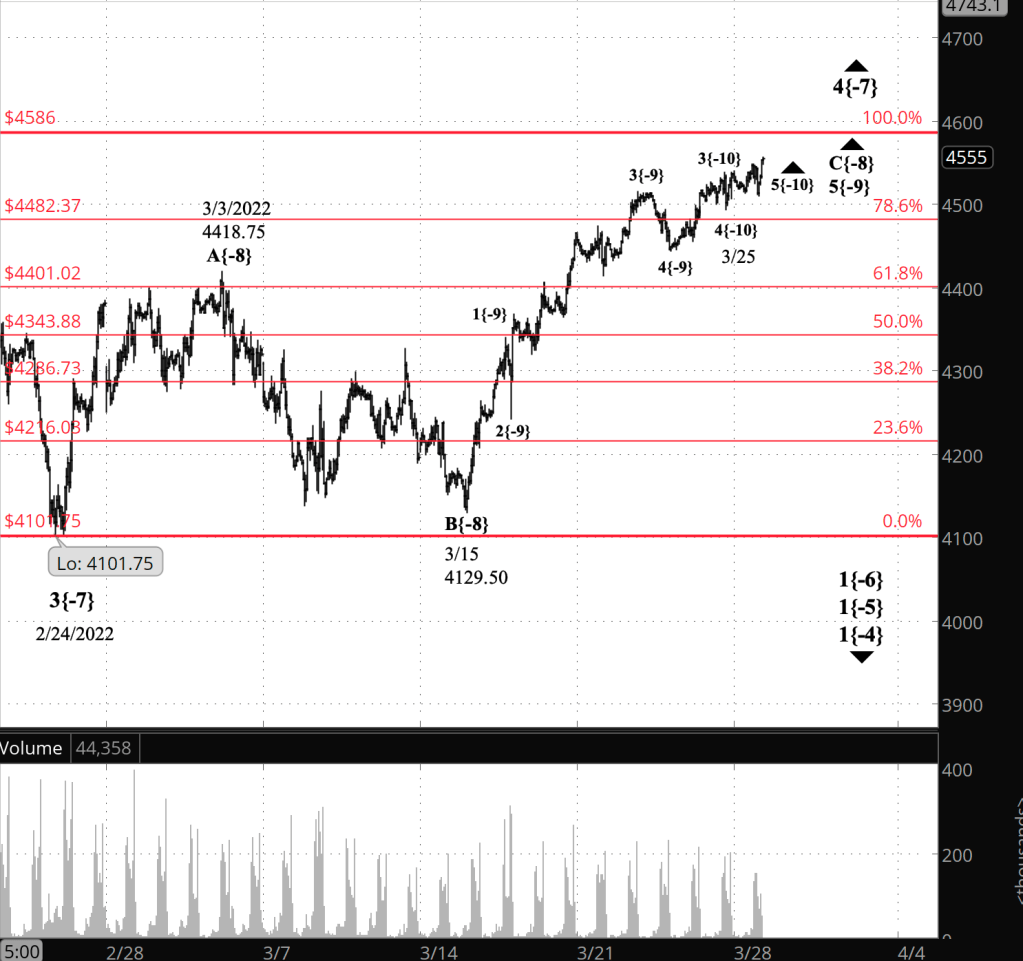
Chart. For today’s chart, I’ve moved in closer to focus on the upward correction, with the goal of seeing more clearly how far advanced it is.

[S&P 500 E-mini futures at 3:30 p.m., hourly bars, with volume]

What does Elliott wave theory say? Under my principal analysis, wave 4{-7}, the upward correction that began on February 24, is underway. Internally, it is in its final wave, C{-8}, if it is structured as a simple correction. C waves in both Flats and Zigzags have five waves internally, and in this case, rising wave 5{-9} is underway, having begun on March 25.

Wave 4{-7} is constrained in that it cannot move above 4808.25, the starting point of wave 1{-7} on January 4.

When wave 4{-7} is complete, it will be followed by wave 5{-7}, a resumption of the downtrend that began on January 4 that will most likely carry the price below 4101.75, the wave 4{-7} starting point, perhaps significantly lower.

Under Alternative #1, the overnight high, 4548.50, is the end of wave 4{-7} and its internal waves. The subsequent decline is the small beginning of what will turn out to be a significant wave 5{-7} decline to 4101.75 and lower.

Under Alternative #2, the end of the present wave C{-8} will be followed by downward wave X{-8}, a connecting wave that will in turn be followed by a second corrective pattern in a compound correction. Such compound structures can have up to three corrective patterns, each separated from the prior pattern by an X wave. When the final pattern is complete, the downtrend will resume as wave 5{-7}.

We Are Here.

These are the waves currently in progress under my principal analysis. Each line on the list shows the wave number, with the subscript in curly brackets, the traditional degree name, the starting date, the starting price of the S&P 500 E-mini futures, and the direction of the wave.

  • Index:
  • 5{0} Intermediate, 12/26/2018, 2346.58 (up)
  • 4{-1} Minor, 1/4/2022 4818.62 (down)
  • 1{-2} Minute, 1/4/2022 4818.62 (down)
  • Futures and index:
  • 1{-3} Minuette, 1/4/2022, 4808.25 (down) (futures), 4818.62 (down) (index)
  • Futures:
  • 1{-4} Subminuette, 1/4/2022, 4808.25 (down)
  • 1{-5} Micro, 1/4/2022, 4808.25 (down)
  • 1{-6} Submicro, 1/4/2022, 4808.25 (down)
  • 4{-7} Minuscule, 3/3/2022, 4101.75 (up)
  • C{-8} Subminuscule, 3/15/2022, 4129.50 (up}

Learning and other resources. Elliott wave analysis provides context, not prophecy. As the 20th century semanticist Alfred Korzybski put it in his book Science and Sanity (1933), “The map is not the territory … The only usefulness of a map depends on similarity of structure between the empirical world and the map.” And I would add, in the ever-changing markets, we can judge that similarity of structure only after the fact.

See the menu page Analytical Methods for a rundown on where to go for information on Elliott wave analysis.

By Tim Bovee, Portland, Oregon, March 28, 2022

Disclaimer

Tim Bovee, Private Trader tracks the analysis and trades of a private trader for his own accounts. Nothing in this blog constitutes a recommendation to buy or sell stocks, options or any other financial instrument. The only purpose of this blog is to provide education and entertainment.

No trader is ever 100 percent successful in his or her trades. Trading in the stock and option markets is risky and uncertain. Each trader must make trading decisions for his or her own account, and take responsibility for the consequences.

License
Creative Commons License

All content on Tim Bovee, Private Trader by Timothy K. Bovee is licensed under a Creative Commons Attribution-ShareAlike 4.0 International License.

Based on a work at www.timbovee.com.
Trader’s Notebook

3:30 p.m. New York time

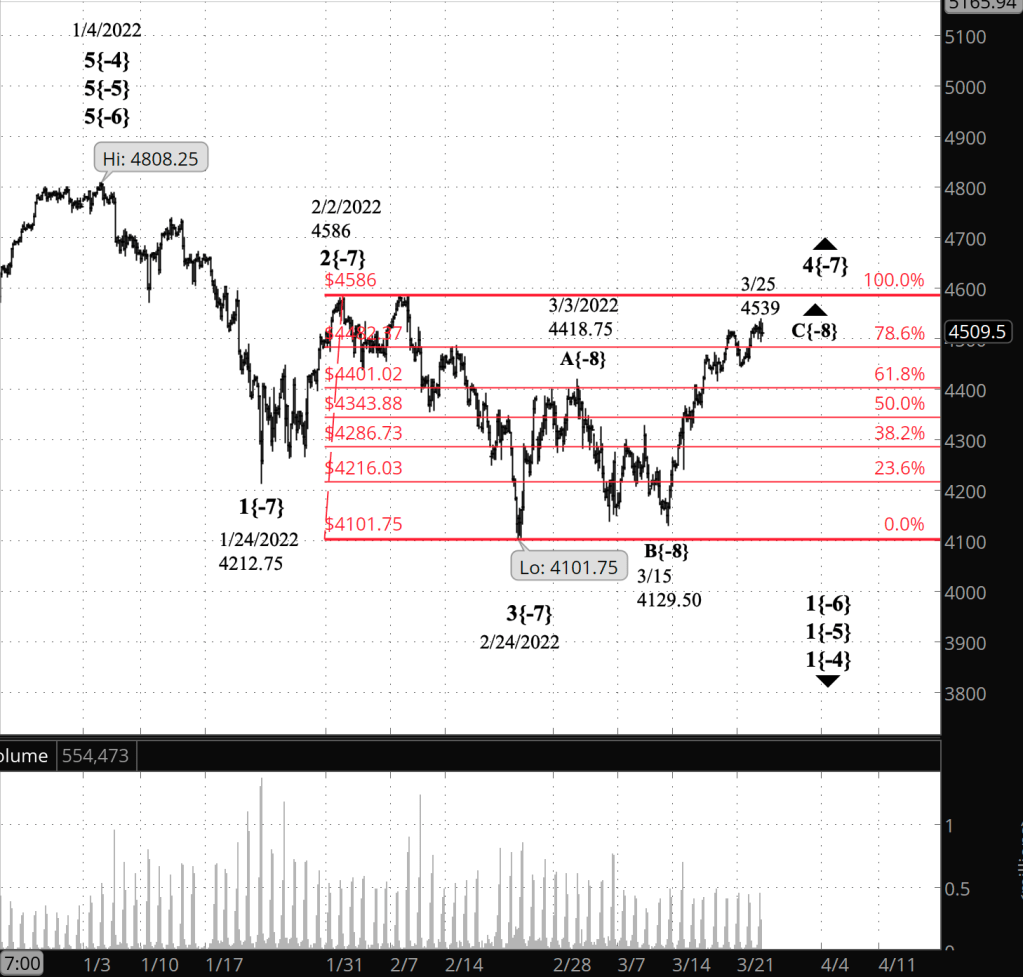
Half an hour before the closing bell. The S&P 500 peaked early in the session, at 4539 on the futures, 4546.03 on the index and then dropped sharply within the next 45 minutes, on average shaving off a point each minute. It’s very low level so far, but the sharp decline feels like the opening move of a reversal.

However, given the small degree, that’s not yet enough to support changing the analysis, although it does give added credibility to the first alternative analysis from this morning.

So, either the upward correction, wave 4{-7}, is still underway, or the downtrend resumed, as wave 5{-8} began from 4539 on the futures. There is no way to choose between those two alternatives, at this point. The further the drop, the more likely it is wave wave 5{-7} has begun. A technical problem that kept me from updating the chart has been resolved, and the chart has been updated.

9:35 a.m. New York time

What’s happening now? The S&P 500 E-mini futures continued to rise overnight, reaching a high of 4531.75, which beats the March 22 high by nearly 20 points.

What does it mean? The analysis and the alternatives are a replay of yesterday’s. The upward correction that began on February 24 continues.

What’s the alternative? There are two:

Alternative #1: The overnight high, 4531.75, is the end of the upward correction, and the downtrend that began on January 4 from 4808.25 has resumed and likely will fall below the starting point of the correction, 4101.75.

Alternative #2: The correction is forming a compound structure containing two or three corrective patterns. When the first pattern, now underway, reaches its end, then the price will decline in a connecting movement that will be followed by a second corrective pattern. The connecting movement will end above the starting point of the correction, 4101.75.

Alternative #1 — the correction has ended — has the same likelihood as the principal analysis. Alternative #2 — a compound correction — while not uncommon, is less common than the principal analysis or the first alternative.

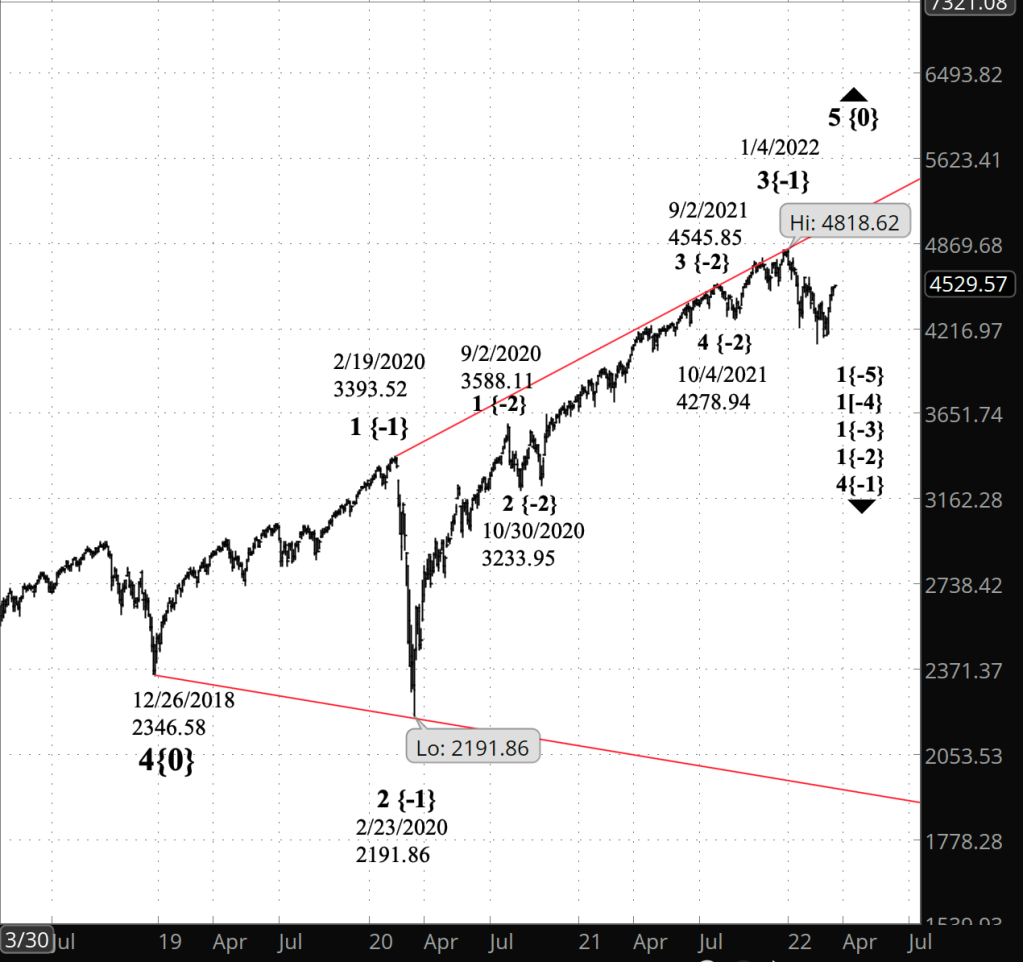
Charts. The upper chart is a closer-in view showing the January 4 peak and the subsequent decline of the S&P 500 futures. The lower chart is a longer view showing the price structure since December 2018 of the S&P 500 index. That structure is an expanding Diagonal Triangle, and I’ll discuss it in the Elliott wave analysis section below.

[S&P 500 E-mini futures at 3:30 p.m., 3-hour bars, with volume]
[S&P 500 index at 9:32 a.m., 2-day bars]

What does Elliott wave theory say? The upward correction, wave 4{-7}, has fulfilled all of the requirements of Elliott wave analysis. It has traced three subwaves — A, B and C at the {-8} degree — and wave C{-8} internally has five waves. The question now is whether wave 5{-9} within wave C{-8} within wave 4{-7} is yet complete.

When wave 4{-7} reaches its end, it will be followed by wave 5{-7}, which will most likely carry the price below the end of wave 3{-7} and the start of wave 4{-7} — 4101.75 — and perhaps significantly below that level. I’m hedging with “most likely” because sometimes 5th waves fail to move beyond the end of the preceding wave 3{-7}. Almost always, however, they do move beyond that end point.

This is all happening within wave 1{-6}, the first wave of a large downtrend that began on January 4.

As shown in the lower chart, wave {-6} is the smallest of five 1st waves, each of increasing degree, that began on the 4th of January. Their parent is wave 4{-1}, the next-to-the-last wave within wave 5{0}, the final wave in an expanding Diagonal Triangle that began on December 26, 2018 from 2346.58.

The price-channel boundaries of the Triangle grow further apart each day — that’s the “expanding” part” — and wave 4{-1} will eventually approach the lower boundary and perhaps overshoot it by a little. The lower boundary is presently in the low 1900s, and it will be noticeably lower by the time wave 4{-1} reaches that level.

Wave 4{-1} will be followed by rising wave 5{-1}, which again will eventually carry the price to the region upper boundary, perhaps overshooting it by a little, or perhaps falling short. The upper boundary at present is approaching 5100, and it will be noticeably higher by the time the price completes its journey from the lower boundary.

Wave 5{-1}, when complete, will be the end of the Triangle, wave 5{0}. It will be followed by a downward correction that will be built from subwaves lasting for years, with the usual ups and downs that form the consistent patterns of the market.

We Are Here.

These are the waves currently in progress under my principal analysis. Each line on the list shows the wave number, with the subscript in curly brackets, the traditional degree name, the starting date, the starting price of the S&P 500 E-mini futures, and the direction of the wave.

  • Index:
  • 5{0} Intermediate, 12/26/2018, 2346.58 (up)
  • 4{-1} Minor, 1/4/2022 4818.62 (down)
  • A{-2} Minute, 1/4/2022 4818.62 (down)
  • Futures and index:
  • 1{-3} Minuette, 1/4/2022, 4808.25 (down) (futures), 4818.62 (down) (index)
  • Futures:
  • 1{-4} Subminuette, 1/4/2022, 4808.25 (down)
  • 1{-5} Micro, 1/4/2022, 4808.25 (down)
  • 1{-6} Submicro, 1/4/2022, 4808.25 (down)
  • 4{-7} Minuscule, 3/3/2022, 4101.75 (up)
  • C{-8} Subminuscule, 3/15/2022, 4129.50 (up}

Learning and other resources. Elliott wave analysis provides context, not prophecy. As the 20th century semanticist Alfred Korzybski put it in his book Science and Sanity (1933), “The map is not the territory … The only usefulness of a map depends on similarity of structure between the empirical world and the map.” And I would add, in the ever-changing markets, we can judge that similarity of structure only after the fact.

See the menu page Analytical Methods for a rundown on where to go for information on Elliott wave analysis.

By Tim Bovee, Portland, Oregon, March 25, 2022

Disclaimer

Tim Bovee, Private Trader tracks the analysis and trades of a private trader for his own accounts. Nothing in this blog constitutes a recommendation to buy or sell stocks, options or any other financial instrument. The only purpose of this blog is to provide education and entertainment.

No trader is ever 100 percent successful in his or her trades. Trading in the stock and option markets is risky and uncertain. Each trader must make trading decisions for his or her own account, and take responsibility for the consequences.

License
Creative Commons License

All content on Tim Bovee, Private Trader by Timothy K. Bovee is licensed under a Creative Commons Attribution-ShareAlike 4.0 International License.

Based on a work at www.timbovee.com.
Trader’s Notebook

3:30 p.m. New York time

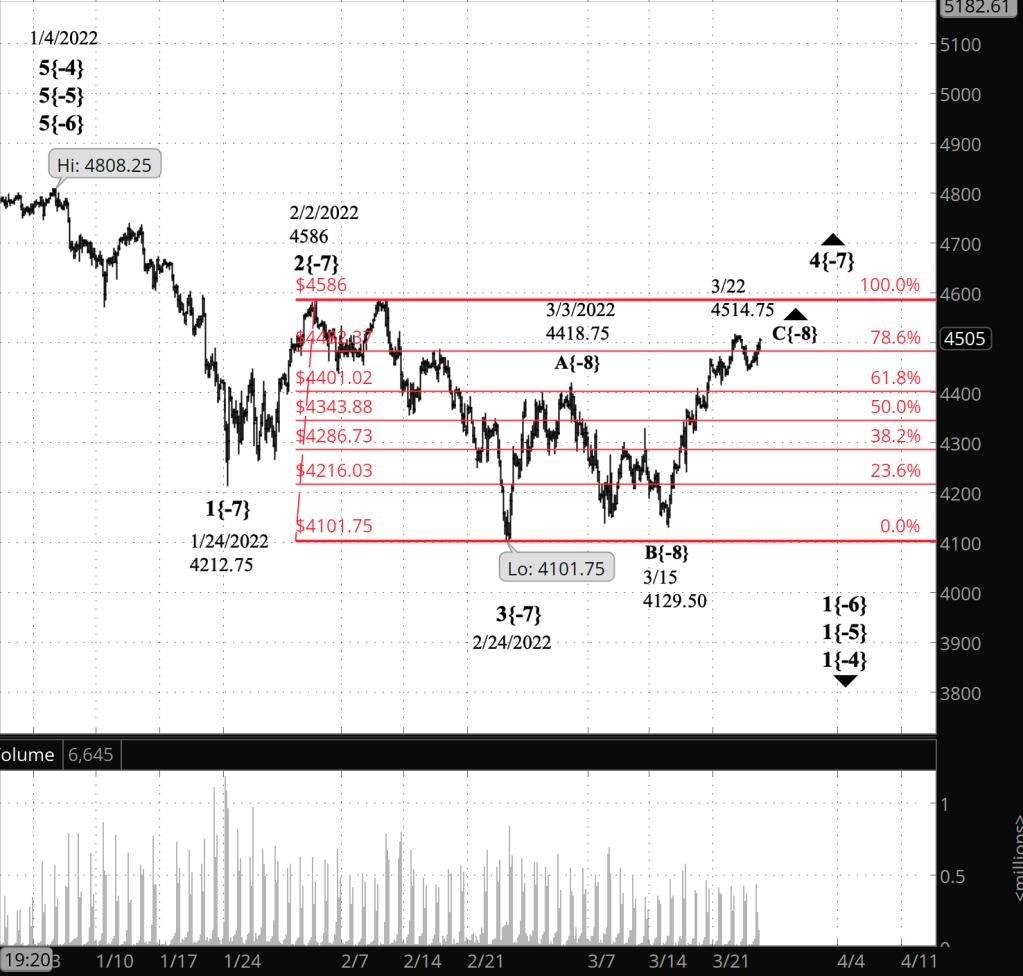
Half an hour before the closing bell. The S&P 500 has risen during the trading session but so far has remained below the upward correction’s March 22 high, 4514.75. No change in the analysis. Wave 4{-7} continues and is in its last wave internally, wave C{-8}. When complete, wave 4{-7} will be followed by a resumption of the downtrend, wave 5{-7}, that will carry the price below 4101.75, where the correction began on February 24. I’ve updated the chart.

10 a.m. New York time

DRI earnings play exit. I’ve exited my short bear call options spread on DRI at 25% of maximum potential profit and have updated the trade analysis with full results.

9:35 a.m. New York time

What’s happening now? The S&P 500 E-mini futures rose in overnight trading, remaining below the March 22 high, 4514.75.

What does it mean? The upward correction that began on February 24 is still underway and is in its final phase.

What are the alternatives? There are two.

Alternative #1: The correction might well have ended at the May 22 high. If so, then the subsequent decline and rise are the early stages of a resumption of the downtrend that began on January 4. The principal analysis and this alternative have an equal likelihood of being an accurate description of the S&P 500’s future course.

Alternative #2: It’s also possible that the correction is forming a compound structure, connecting two or three corrective patterns together. If so, then the decline since May 22 is the start of a connecting movement, and it will be followed by a second corrective pattern.

[S&P 500 E-mini futures at 3:30 p.m., 160-minute bars, with volume]

What does Elliott wave theory say? Under my principal analysis, wave C{-8} within wave 4{-7} is in its 5th and final wave internally. When it is complete, ending the upward correction, the downtrend will resume as wave 1{-8} within wave 5{-7}.

Under the first alternative, wave C{-8} and wave 4{-7} ended on May 22 at 4514.75, and wave 1{-8} within wave 5{-7} has begun.

Under the second alternative, the May 22 high completed the first corrective pattern within waver 4{-7}, and the subsequent decline is a connector, wave X{-8}. It will be followed by a second corrective pattern of three waves within wave 4{-7}. It’s also possible that a Triangle pattern could form, with five wavers internally.

There’s no way in the analysis to choose between the principal analysis — wave 4{-7} is underway — and the first alternative — wave 5{-7} is underway. In choosing the ongoing wave 4{-7} scenario as my principal analysis, I’m making a conservative decision. An ongoing wave 4{-7} requires no change in how I trade — a transitioning from bullish to bearish. On the other hand, a new beginning, wave 5{-7}, requires a switch to an aggressively bearish posture.

We Are Here.

These are the waves currently in progress under my principal analysis. Each line on the list shows the wave number, with the subscript in curly brackets, the traditional degree name, the starting date, the starting price of the S&P 500 E-mini futures, and the direction of the wave.

  • Index:
  • 5{0} Intermediate, 12/26/2018, 2346.58 (up)
  • 4{-1} Minor, 1/4/2022 4818.62 (down)
  • 1{-2} Minute, 1/4/2022 4818.62 (down)
  • Futures and index:
  • 1{-3} Minuette, 1/4/2022, 4808.25 (down) (futures), 4818.62 (down) (index)
  • Futures:
  • 1{-4} Subminuette, 1/4/2022, 4808.25 (down)
  • 1{-5} Micro, 1/4/2022, 4808.25 (down)
  • 1{-6} Submicro, 1/4/2022, 4808.25 (down)
  • 4{-7} Minuscule, 3/3/2022, 4101.75 (up)
  • C{-8} Subminuscule, 3/15/2022, 4129.50 (up}

Learning and other resources. Elliott wave analysis provides context, not prophecy. As the 20th century semanticist Alfred Korzybski put it in his book Science and Sanity (1933), “The map is not the territory … The only usefulness of a map depends on similarity of structure between the empirical world and the map.” And I would add, in the ever-changing markets, we can judge that similarity of structure only after the fact.

See the menu page Analytical Methods for a rundown on where to go for information on Elliott wave analysis.

By Tim Bovee, Portland, Oregon, March 24, 2022

Disclaimer

Tim Bovee, Private Trader tracks the analysis and trades of a private trader for his own accounts. Nothing in this blog constitutes a recommendation to buy or sell stocks, options or any other financial instrument. The only purpose of this blog is to provide education and entertainment.

No trader is ever 100 percent successful in his or her trades. Trading in the stock and option markets is risky and uncertain. Each trader must make trading decisions for his or her own account, and take responsibility for the consequences.

License
Creative Commons License

All content on Tim Bovee, Private Trader by Timothy K. Bovee is licensed under a Creative Commons Attribution-ShareAlike 4.0 International License.

Based on a work at www.timbovee.com.
DRI Trade

Darden Restaurants Inc. (DRI)

Update 3/24/2022: I exited my bear call vertical options spread on DRI, 57 days before expiration, for a $0.70 debit per contract/share, a profit before fees of $25 per contract. Shares were trading at $130.30, $2.15 from the entry level.

The Implied Volatility Rank at exit was 47.5, down 13.2 points from the entry level.

I exited because the position reached 25% of maximum potential profit, my normal exit point for earnings plays.

Shares fell by 1.6% over one day for a -593% annual rate. The options position produced a 32.5% return for a +11,851% annual rate.


I have entered a short bear call options spread on DRI, using options that trade for the last time 58 days hence, on May 20. The premium is a $1.02 credit per contract share and the stock at the time of entry was priced at $132.45.

The Implied Volatility Ratio stood at 60.7%.

Premium:$1.02Expire OTM
DRI-bear call spreadStrikeOddsDelta
Calls/Puts
Long150.0096.0%18
Break-even146.0287.5%22
Short145.0079.0%26

The premium is 40.8% of the width of the position’s short/long spread. The profit zone covers a 10.2% move to the upside and an unlimited move to the upside.

The risk/reward ratio is 3.9:1, with maximum risk of $398 and maximum reward of $102 per contract.

How I chose the trade. The trade was placed to coincide with DRI’s earnings announcement, before the opening bell on the day after entry. The short strikes were set to coincide with the expected move of $10.25 either way, based on options pricing, which gives a range of $122.70 to $142.70. The options series used for estimated the movement was 22 days prior to expiration, which with adjustment for the time period gave an unusable range estimate (low price higher than the high price). So I removed the adjustment and set up the trade based on the unadjusted range. The strike price for DRI are $5 apart, further limiting my ability to match the price range estimate.

By Tim Bovee, Portland, Oregon, March 23, 2022

Disclaimer

Tim Bovee, Private Trader tracks the analysis and trades of a private trader for his own accounts. Nothing in this blog constitutes a recommendation to buy or sell stocks, options or any other financial instrument. The only purpose of this blog is to provide education and entertainment.

No trader is ever 100 percent successful in his or her trades. Trading in the stock and option markets is risky and uncertain. Each trader must make trading decisions for his or her own account, and take responsibility for the consequences.

License
Creative Commons License

All content on Tim Bovee, Private Trader by Timothy K. Bovee is licensed under a Creative Commons Attribution-ShareAlike 4.0 International License.

Based on a work at www.timbovee.com.
Trader’s Notebook

3:30 p.m. New York time

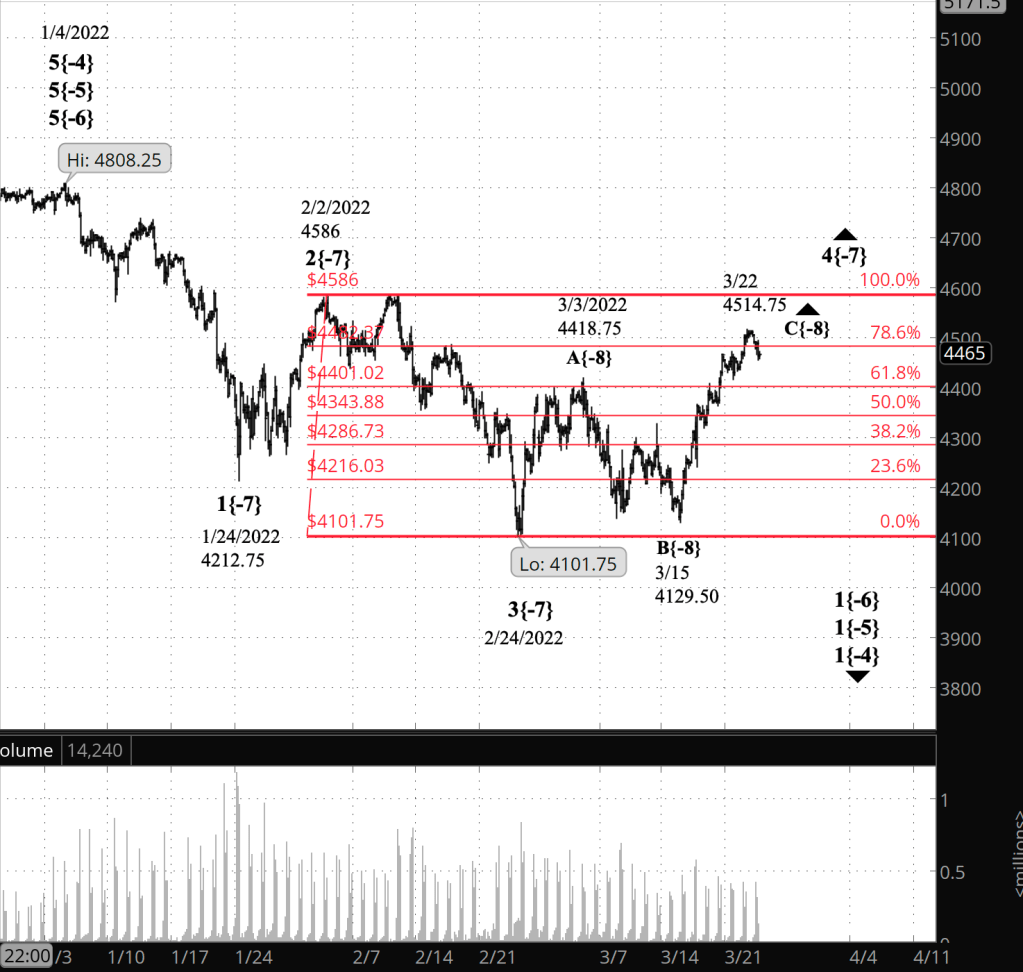
Half an hour before the closing bell. The S&P 500 has fallen throughout the session, with futures reaching 4465.75 at the lowest point, remaining below yesterday’s high, 4514.75. No change in the analysis. I’ve updated the chart.

10:55 a.m. New York time

DRI earnings play entry. I’ve entered a bear call vertical spread on DRI, using options that expire on May 20, and have posted an analysis of the trade.

9:35 a.m. New York time

What’s happening now? The S&P 500 E-mini futures declined in overnight trading, reversing from yesterday’s high, 4517.75, attained in the last half hour of the session.

What does it mean? The upward correction that began on February 24 from 4101.75 is still underway, having risen more than 500 points from the low to the high. It is in its final phase.

What are the alternatives? Yesterday’s high may have been the end the correction. The further down the pullback from that high travels, the more likely it is that the downtrend that began on January 4 has resumed, carrying the price below 4101.75, perhaps quite a bit lower.

It’s possible that the correction is forming a compound structure, connecting two or three corrective patterns together. If that’s the case, then the price will pull back in a connecting move and then swing into a second corrective pattern within a compound correction.

[S&P 500 E-mini futures at 3:30 p.m., 160-minute bars, with volume]

What does Elliott wave theory say? Wave 4{-7}, the upward correction that began on February 24, is in its last internal segment, wave C{-8}. The C wave will have five waves internally, and that’s the wave count I see, with the usual ambiguities built into analog structures.

So the question we face with wave 4{-7} is straight out of Shakespeare’s Hamlet: “To be or not to be”. If the price reverses from its present level, at the 78.6% Fibonacci mark, and rises further, then wave 4{-7} is underway — the principal analysis. If the price continues to decline, then downtrending wave 5{-7} began on March 22 and will carry the price down into the 4100s and most likely lower.

If the price declines but stays above the start of the correction, 4101.75, and then rises again, then wave 4{-7} is forming a compound correction. The decline after the first corrective pattern will be wave X{-8} and will be followed by a second corrective pattern, most likely formed by three waves internally (unless it’s a Triangle of some sort).

In any case, once wave 5{-7} reaches an end, it will also be the end of the parent, downtrending wave 1{-6}, which began on January 4 from 4808.75. It will be followed by a 2nd wave correction that will carry price up significantly, perhaps into the price range we saw yesterday.

We Are Here.

These are the waves currently in progress under my principal analysis. Each line on the list shows the wave number, with the subscript in curly brackets, the traditional degree name, the starting date, the starting price of the S&P 500 E-mini futures, and the direction of the wave.

  • Index:
  • 5{0} Intermediate, 12/26/2018, 2346.58 (up)
  • 4{-1} Minor, 1/4/2022 4818.62 (down)
  • 1{-2} Minute, 1/4/2022 4818.62 (down)
  • Futures and index:
  • 1{-3} Minuette, 1/4/2022, 4808.25 (down) (futures), 4818.62 (down) (index)
  • Futures:
  • 1{-4} Subminuette, 1/4/2022, 4808.25 (down)
  • 1{-5} Micro, 1/4/2022, 4808.25 (down)
  • 1{-6} Submicro, 1/4/2022, 4808.25 (down)
  • 4{-7} Minuscule, 3/3/2022, 4101.75 (up)
  • C{-8} Subminuscule, 3/15/2022, 4129.50 (up}

Learning and other resources. Elliott wave analysis provides context, not prophecy. As the 20th century semanticist Alfred Korzybski put it in his book Science and Sanity (1933), “The map is not the territory … The only usefulness of a map depends on similarity of structure between the empirical world and the map.” And I would add, in the ever-changing markets, we can judge that similarity of structure only after the fact.

See the menu page Analytical Methods for a rundown on where to go for information on Elliott wave analysis.

By Tim Bovee, Portland, Oregon, March 23, 2022

Disclaimer

Tim Bovee, Private Trader tracks the analysis and trades of a private trader for his own accounts. Nothing in this blog constitutes a recommendation to buy or sell stocks, options or any other financial instrument. The only purpose of this blog is to provide education and entertainment.

No trader is ever 100 percent successful in his or her trades. Trading in the stock and option markets is risky and uncertain. Each trader must make trading decisions for his or her own account, and take responsibility for the consequences.

License
Creative Commons License

All content on Tim Bovee, Private Trader by Timothy K. Bovee is licensed under a Creative Commons Attribution-ShareAlike 4.0 International License.

Based on a work at www.timbovee.com.
Trader’s Notebook

3:30 p.m. New York time

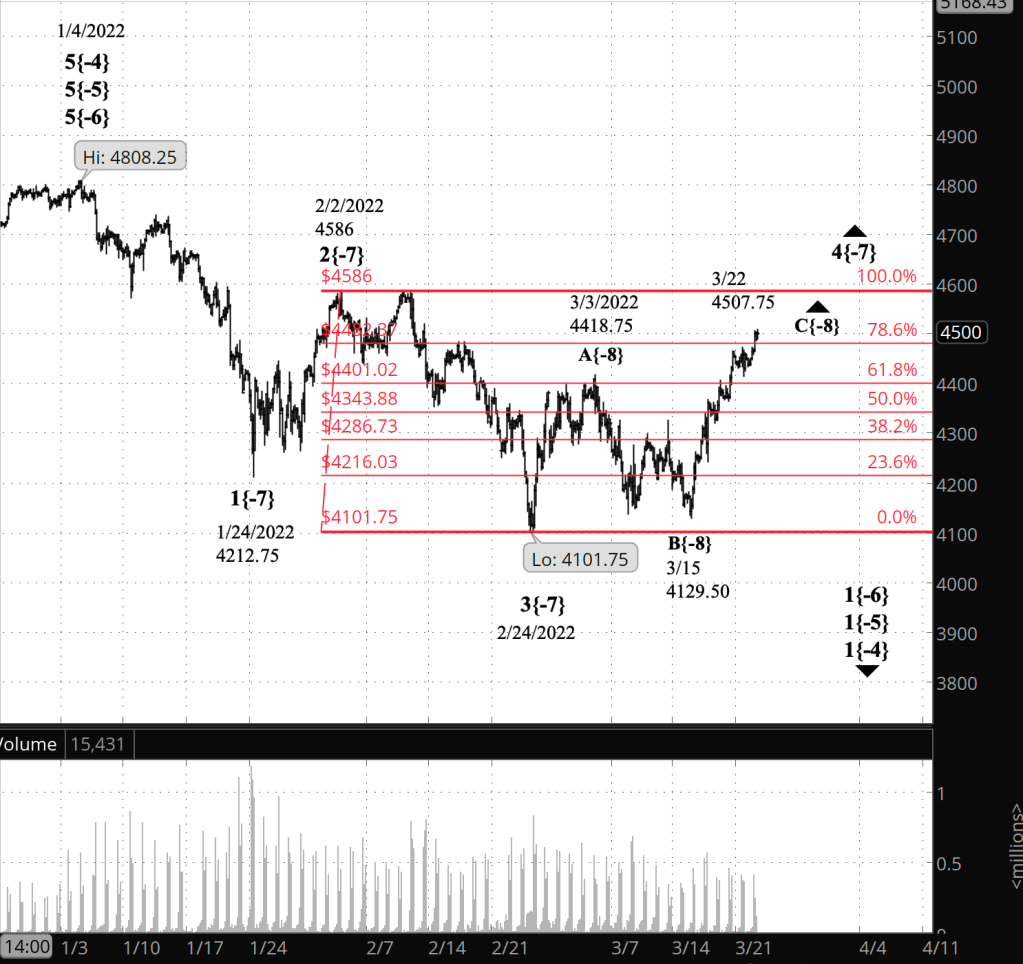
Half an hour before the closing bell. The S&P 500 has reached a high of 4507.75 so far today during an upward correction that began on February 24. The correction, wave 4{-7}, internally is in its third leg, wave C{-8}. The C wave will most likely complete the 4th wave rise, although the correction could prove to be a compound structure, connecting several corrective patterns together, as discussed this morning.

I’ve superimposed a Fibonacci retracement grid over the chart, to better understand the extent of the rising 4th wave’s retracement of the declining 3rd that came before it. In today’s session the price moved slightly above the 78.6% Fibonacci retracement level. Fib levels are often the regions where waves reverse direction. It’s a tendency, not a guarantee.

No change in the analysis. I’ve updated the chart.

9:40 a.m. New York time

What’s happening now? The S&P 500 E-mini futures traded in a narrow range overnight, edging up to a new high, above 4479, after the opening bell..

What does it mean? The upward correction that began on February 24 continues and is in its last phase. Upon its completion, the downtrend that began on January 4 will resume, bringing the price below 4101.75, and perhaps significantly below that level.

What are the alternatives? There are two:

Alternative #1: The correction has met its minimum criteria and may have ended at today’s high.

Alternative #2: The correction will follow its initial corrective pattern with a second corrective pattern and perhaps a third in a compound correction, delaying resumption of the downtrend.

[S&P 500 E-mini futures at 3:30 p.m., 160-minute bars, with volume]

What does Elliott wave theory say? Under my principal analysis, wave C{-8}, the final wave within a rising correction, wave 4{-7}, is still underway.

Under alternative #1, wave 4{-7} ended at today’s high, and the subsequent decline is the first tentative step in a resumption of the downtrend as wave 5{-7}..

Under alternative #2, wave C{-8} within wave 4{-7} will be followed by a downward connector wave, X{-8}, which in turn will be followed by a second corrective patterns. Up to three patterns can be strung together in a compound correction.

Both the principal and the alternatives are occurring within wave 1{-6}, a downtrend that began on January 4 from 4808.25. The end of wave 5{-7} will also be the end of wave 1{-6}, and afterward it will begin an upward correction, wave 2{-6}, in a Flat pattern that may well retrace a large portion of the preceding decline. As a Flat, however, wave 2{-6} must remain below 4808.25, the starting point of wave 1{-6}.

We Are Here.

These are the waves currently in progress under my principal analysis. Each line on the list shows the wave number, with the subscript in curly brackets, the traditional degree name, the starting date, the starting price of the S&P 500 E-mini futures, and the direction of the wave.

  • Index:
  • 5{0} Intermediate, 12/26/2018, 2346.58 (up)
  • 4{-1} Minor, 1/4/2022 4818.62 (down)
  • 1{-2} Minute, 1/4/2022 4818.62 (down)
  • Futures and index:
  • 1{-3} Minuette, 1/4/2022, 4808.25 (down) (futures), 4818.62 (down) (index)
  • Futures:
  • 1{-4} Subminuette, 1/4/2022, 4808.25 (down)
  • 1{-5} Micro, 1/4/2022, 4808.25 (down)
  • 1{-6} Submicro, 1/4/2022, 4808.25 (down)
  • 4{-7} Minuscule, 3/3/2022, 4101.75 (up)
  • C{-8} Subminuscule, 3/15/2022, 4129.50 (up}

Learning and other resources. Elliott wave analysis provides context, not prophecy. As the 20th century semanticist Alfred Korzybski put it in his book Science and Sanity (1933), “The map is not the territory … The only usefulness of a map depends on similarity of structure between the empirical world and the map.” And I would add, in the ever-changing markets, we can judge that similarity of structure only after the fact.

See the menu page Analytical Methods for a rundown on where to go for information on Elliott wave analysis.

By Tim Bovee, Portland, Oregon, March 22, 2022

Disclaimer

Tim Bovee, Private Trader tracks the analysis and trades of a private trader for his own accounts. Nothing in this blog constitutes a recommendation to buy or sell stocks, options or any other financial instrument. The only purpose of this blog is to provide education and entertainment.

No trader is ever 100 percent successful in his or her trades. Trading in the stock and option markets is risky and uncertain. Each trader must make trading decisions for his or her own account, and take responsibility for the consequences.

License
Creative Commons License

All content on Tim Bovee, Private Trader by Timothy K. Bovee is licensed under a Creative Commons Attribution-ShareAlike 4.0 International License.

Based on a work at www.timbovee.com.
Trader’s Notebook

3:30 p.m. New York time

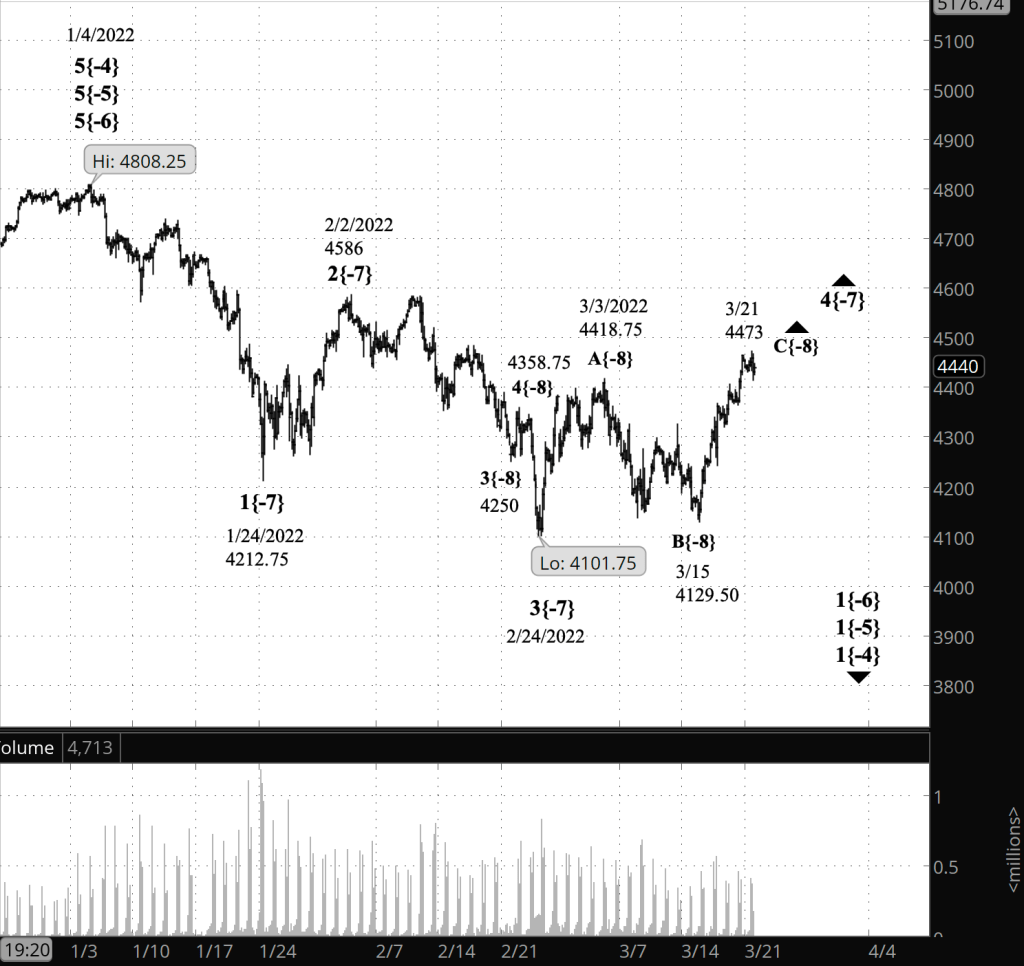
Half an hour before the closing bell. The S&P 500 peaked shortly after the opening bell, at 4473 on the futures, and then declined slightly. The upward correction, wave 4{-7} has taken the form of a Flat, and within that form, wave C will have five waves within it. Wave C{-8} is in its fifth wave internally, wave 5{-9}. It’s very short so far, which is allowed under the rules of Elliott wave analysis — a truncated 5th. So today’s high could be the end of wave C{-8} and its parent, wave 4{-7}. But not necessarily. The lower the price falls, the more likely it is that the upward correction has ended and 5{-7} to the downside has begun.

No change in the analysis. I’ve updated the chart.

9:40 a.m. New York time

NFLX earnings play expires. My final position built from the March options, a short iron condor earnings play on NFLX, expired for a loss after the closing bell on Friday. I’ve updated the trade analysis with full results.

9:35 a.m. New York time

What’s happening now? The S&P 500 E-mini futures stayed in a narrow range after trading resumed overnight, remaining below Friday’s peak, 4465.75.

What does it mean? The upward correction that began on February 24 continues and in its last phase. It will be followed by a resumption of the downtrend that began on January 4, which will carry the price below 4101.75, perhaps significantly so.

What’s the alternative? It’s possible that the correction is forming a compound correction, linking two or three corrective patterns together, and in doing so delaying the resumption of the downtrend.

[S&P 500 E-mini futures at 3:30 p.m., 160-minute bars, with volume]

What does Elliott wave theory say? I worked with the chart Friday evening and over the weekend and have again re-analyzed the wave labels. The length of the rise from March 15 makes it imperative to change the count that showed unusually short wave 3{-8} that ended on March 15 at 4129.50.

As discussed in the March 15 Trader’s Notebook, a 3rd wave cannot be shorter than both waves 1 and 5 in a five-wave trending pattern. That firm rule of Elliott wave analysis limited the downward reach of the future wave 5{-8} so that it would be shorter than the preceding wave 3{-8}. The higher wave 4{-8} went, the less likely that count became.

In re-analyzing the count, I’ve changed the ending of the parent wave 4{-7} from March 3 at 4418.75 to some future point. The wave is still underway. What had been labeled the end of wave 4{-7} is now the end of wave A{-8} within 4{-7}, followed by wave B{-8} ending on March 15 at 4129.50. Wave C{-8} is underway.

That analysis solves the problem of the overly short 3rd wave by pushing wave 5{-8} into the future, as the final wave of wave 5{-7}, which has not yet begun.

A 4th wave often ends in the range of the smaller 4th wave within the preceding 3rd wave, in this case, within wave 4{-8} within wave 3{-7}. which I’ve labeled on the chart. That range runs from 4250 to 4358.75. Friday’s high, 4465.75, exceeds that target by seven points. That’s a long way of saying that wave 4{-7} may be nearing its end. Although it’s not guaranteed; the target range is a tendency, not a rule.

Under the alternative count, the present wave C{-8} within wave 4{-7} will be followed by a connecting wave X{-8} and then by a second three-wave corrective pattern, such as a Flat or a Zigzag. That second pattern could, when complete, be the end of wave 4{-7}, or it a could be followed by a third corrective pattern, the largest number allowed by the Elliott wave rules in a compound correction.

In any case, whether under the principal analysis or the alternative, the final corrective pattern ending wave 4{-7} will be followed by wave 5{-7}, a resumption of the downtrend that opened the year when it began on January 4. All of this is happening within the parent, downtrending wave 1{-6}, which also began on January 4.

We Are Here.

These are the waves currently in progress under my principal analysis. Each line on the list shows the wave number, with the subscript in curly brackets, the traditional degree name, the starting date, the starting price of the S&P 500 E-mini futures, and the direction of the wave.

  • Index:
  • 5{0} Intermediate, 12/26/2018, 2346.58 (up)
  • 4{-1} Minor, 1/4/2022 4818.62 (down)
  • 1{-2} Minute, 1/4/2022 4818.62 (down)
  • Futures and index:
  • 1{-3} Minuette, 1/4/2022, 4808.25 (down) (futures), 4818.62 (down) (index)
  • Futures:
  • 1{-4} Subminuette, 1/4/2022, 4808.25 (down)
  • 1{-5} Micro, 1/4/2022, 4808.25 (down)
  • 1{-6} Submicro, 1/4/2022, 4808.25 (down)
  • 4{-7} Minuscule, 3/3/2022, 4101.75 (up)
  • C{-8} Subminuscule, 3/15/2022, 4129.50 (up}

Learning and other resources. Elliott wave analysis provides context, not prophecy. As the 20th century semanticist Alfred Korzybski put it in his book Science and Sanity (1933), “The map is not the territory … The only usefulness of a map depends on similarity of structure between the empirical world and the map.” And I would add, in the ever-changing markets, we can judge that similarity of structure only after the fact.

See the menu page Analytical Methods for a rundown on where to go for information on Elliott wave analysis.

By Tim Bovee, Portland, Oregon, March 21, 2022

Disclaimer

Tim Bovee, Private Trader tracks the analysis and trades of a private trader for his own accounts. Nothing in this blog constitutes a recommendation to buy or sell stocks, options or any other financial instrument. The only purpose of this blog is to provide education and entertainment.

No trader is ever 100 percent successful in his or her trades. Trading in the stock and option markets is risky and uncertain. Each trader must make trading decisions for his or her own account, and take responsibility for the consequences.

License
Creative Commons License

All content on Tim Bovee, Private Trader by Timothy K. Bovee is licensed under a Creative Commons Attribution-ShareAlike 4.0 International License.

Based on a work at www.timbovee.com.

Trader’s Notebook

3:30 p.m. New York time

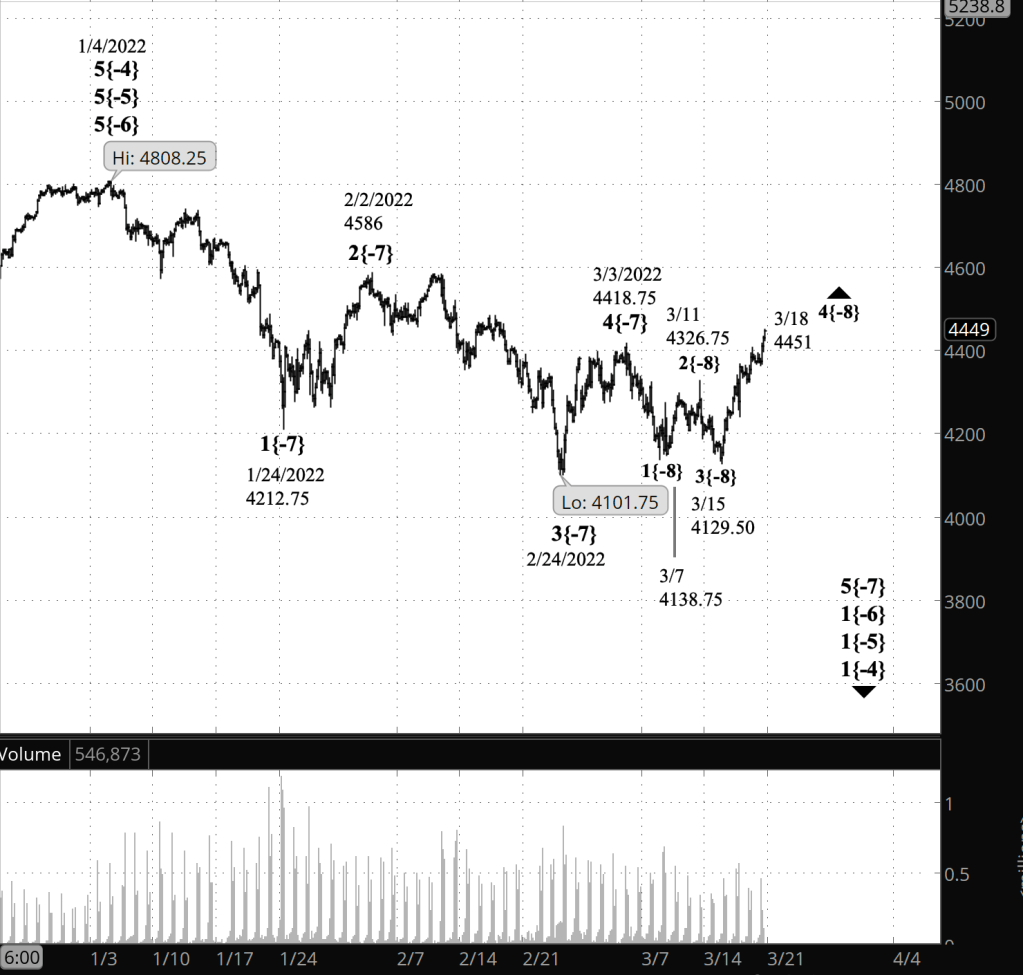
Half an hour before the closing bell. The S&P 500 continued to rise during the session, reaching a peak so far of 4451 on the futures. In Elliott wave terms, wave 4{-8} to the upside has moved beyond the start of the preceding wave 1{-8} to the downside. And that’s OK. There’s no rule or guideline that prohibits it. Given the wide swing, wave 4{-7}, which began on February 24, is still under way and is forming a Triangle of some sort, but I’m not yet willing to go with that as the principal analysis. Bottom line: No change in the analysis from this morning. I’ve updated the chart.

10:25 a.m. New York time

FDX earnings play exit. I’ve exited my short bull put options spread on FDX for 41% of maximum potential loss. Analysts expectations, as consolidated by Zacks, anticipated a 70% of an earnings surprise to the upside. Earnings came in below estimates and the stock price fell sharply. I’ve updated the trade analysis with results.

9:40 a.m. New York time

What’s happening now? The S&P 500 E-mini futures traded slightly below yesterday’s high in overnight trading.

What does it mean? The upward correction that began on March 15 from 4129.50 is still underway

What’s the alternative? The correction could have ended at yesterday’s high. The rise can be seen as having completed its minimum requirements, but there are ambiguities.

[S&P 500 E-mini futures at 3:30 p.m., 160-minute bars, with volume]

What does Elliott wave theory say? The upward correction is wave 4{-8}. By my count it is ni its 5th and final wave internally. However, the structure is a bit messy, so other counts are also plausible.

Wave 4{-8} may have ended at yesterday’s high, 4393.25. The subsequent decline is wave 5{-8}, which will complete the parent wave 5{-7}, which in turn will be followed by a larger correction, wave 2{-6} to the upside.

The preceding wave 3{-8} was exceptionally short, at 197.25 points. A third wave can’t be shorter than both its 1st and 5th wave companions in the trend, and wave 5{-8} cant be longer than that length, setting an end point of 4196 or higher.

We Are Here.

These are the waves currently in progress under my principal analysis. Each line on the list shows the wave number, with the subscript in curly brackets, the traditional degree name, the starting date, the starting price of the S&P 500 E-mini futures, and the direction of the wave.

  • Index:
  • 5{0} Intermediate, 12/26/2018, 2346.58 (up)
  • 4{-1} Minor, 1/4/2022 4818.62 (down)
  • 1{-2} Minute, 1/4/2022 4818.62 (down)
  • Futures and index:
  • 1{-3} Minuette, 1/4/2022, 4808.25 (down) (futures), 4818.62 (down) (index)
  • Futures:
  • 1{-4} Subminuette, 1/4/2022, 4808.25 (down)
  • 1{-5} Micro, 1/4/2022, 4808.25 (down)
  • 1{-6} Submicro, 1/4/2022, 4808.25 (down)
  • 5{-7} Minuscule, 3/3/2022, 4101.75 (down)
  • 4{-8} Subminuscule, 3/3/2022, 4129.50 (up}

Learning and other resources. Elliott wave analysis provides context, not prophecy. As the 20th century semanticist Alfred Korzybski put it in his book Science and Sanity (1933), “The map is not the territory … The only usefulness of a map depends on similarity of structure between the empirical world and the map.” And I would add, in the ever-changing markets, we can judge that similarity of structure only after the fact.

See the menu page Analytical Methods for a rundown on where to go for information on Elliott wave analysis.

By Tim Bovee, Portland, Oregon, March 18, 2022

Disclaimer

Tim Bovee, Private Trader tracks the analysis and trades of a private trader for his own accounts. Nothing in this blog constitutes a recommendation to buy or sell stocks, options or any other financial instrument. The only purpose of this blog is to provide education and entertainment.

No trader is ever 100 percent successful in his or her trades. Trading in the stock and option markets is risky and uncertain. Each trader must make trading decisions for his or her own account, and take responsibility for the consequences.

License
Creative Commons License

All content on Tim Bovee, Private Trader by Timothy K. Bovee is licensed under a Creative Commons Attribution-ShareAlike 4.0 International License.

Based on a work at www.timbovee.com.