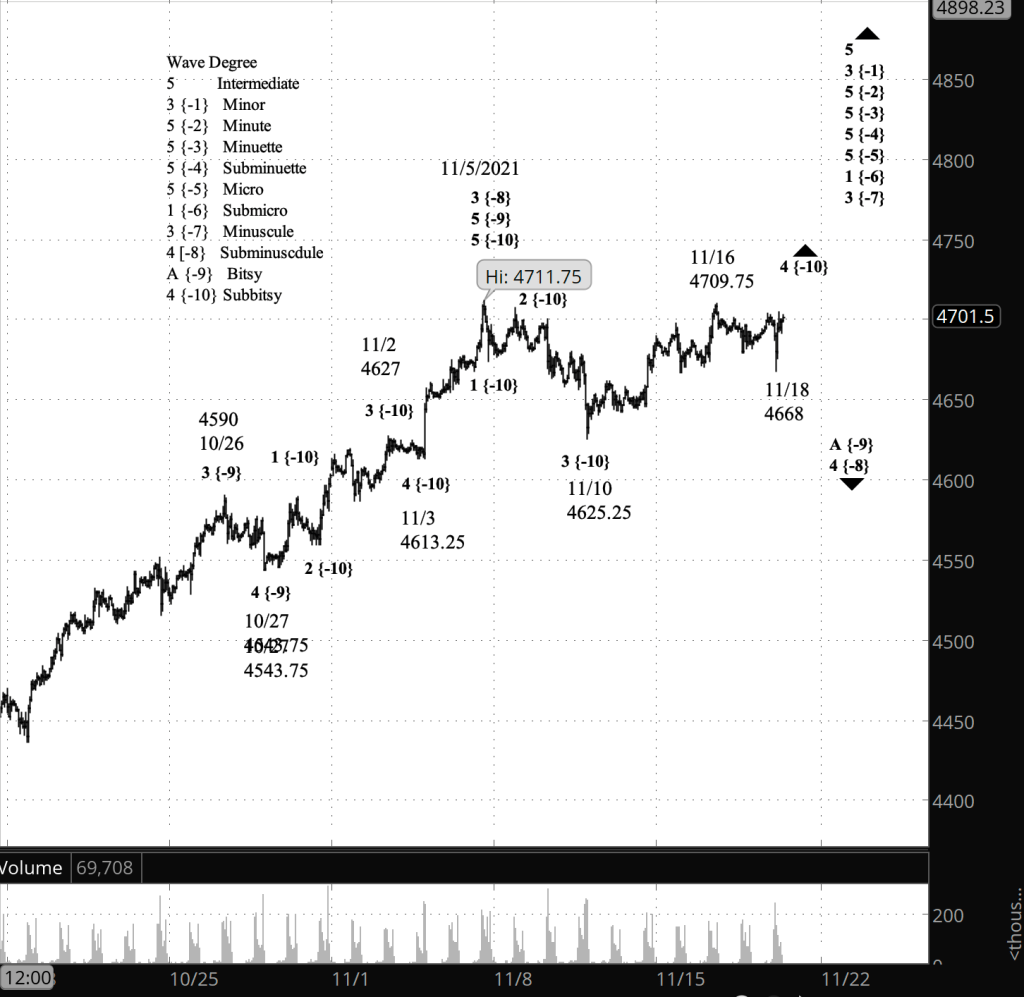
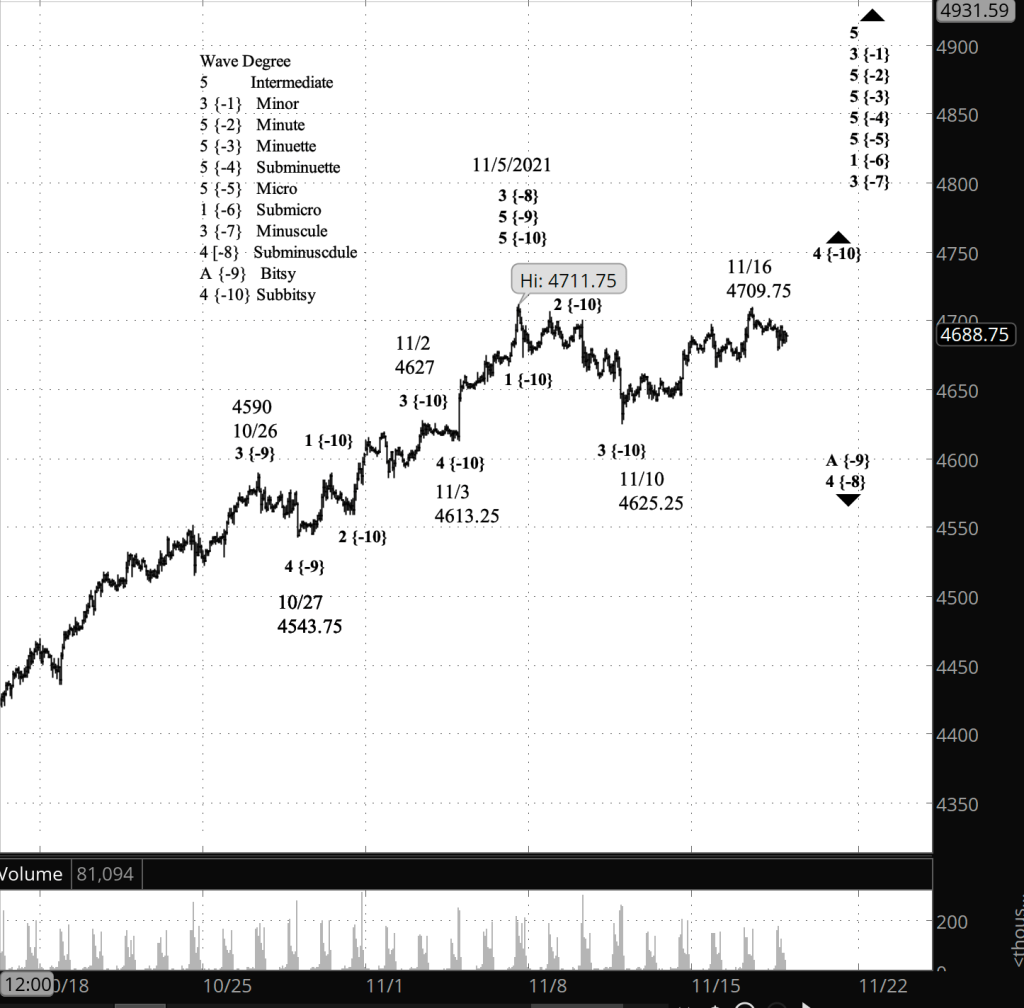
SP500 Analysis

3:30 p.m. New York time

Half an hour before the closing bell. The futures completed a small rise from today’s low and then retreated slightly, staying above the low point, 4562. No change in the analysis at this point. A drop below 4562 would most likely indicate that wave B was still underway, although it would trigger a critical look at the entire structure of the decline that began on November 25. I’ve updated the chart.

2:25 p.m. New York time

A change in the principal analysis. The price of the S&P 500 E-mini futures rose this morning to a 50% retracement of the decline that ended earlier in the day, and then reversed, falling below the November 26 low. In Elliott wave analysis, we have a rule and two tendencies that govern a Flat, the pattern on today’s chart.

Rule #1: Wave B always retraces at least 90% of wave A. Check. That’s what the chart shows.

Tendency #1: Wave B usually retraces between 100% and 138% of wave A. That’s not the case if wave B ended where I marked it in this morning’s analysis, at 4582.

Tendencies #2 and #3: Wave C usually is longer than wave A, by as much as 65%. And wave C almost always ends beyond the endpoint of wave A. Neither of these tendencies is seen on the chart if the rise from 4582 was wave C; it only retraced about half of wave A.

So here’s how I have reanalyzed the chart so that it confirms to the rules and tendencies set forth by R.N. Elliott: Move the end of wave B to the 4562 low reached this afternoon. That satisfies tendency 1 by making wave B longer than wave A, and creates space so that wave C can move above the end of wave A, 4669.75, making C longer than A.

I’ve marked the chart to conform.

9:40 a.m. New York time

What’s happening now? The S&P 500 E-mini futures, having peaked yesterday at 4669.75 and then turned to a decline, reaching 4582, five points above the correction’s starting point. It next began a second rise. The rise ended close to a 61.8% retracement of the prior rise, a Fibonacci level that often is where reversals occur.

What does it mean? The upward correction that began on November 26 is now in its third leg. It’s completion could be the end of the correction, or the correction to extend into a complex structure, adding a second corrective pattern. The end of the present rise should be at about the level that the first rise attained

What’s the alternative? I have labelled the decline that began on November 22 as the first steps in a larger downward move, but it’s possible to analyze the decline as a correction within an ongoing upward move that began on October 6.
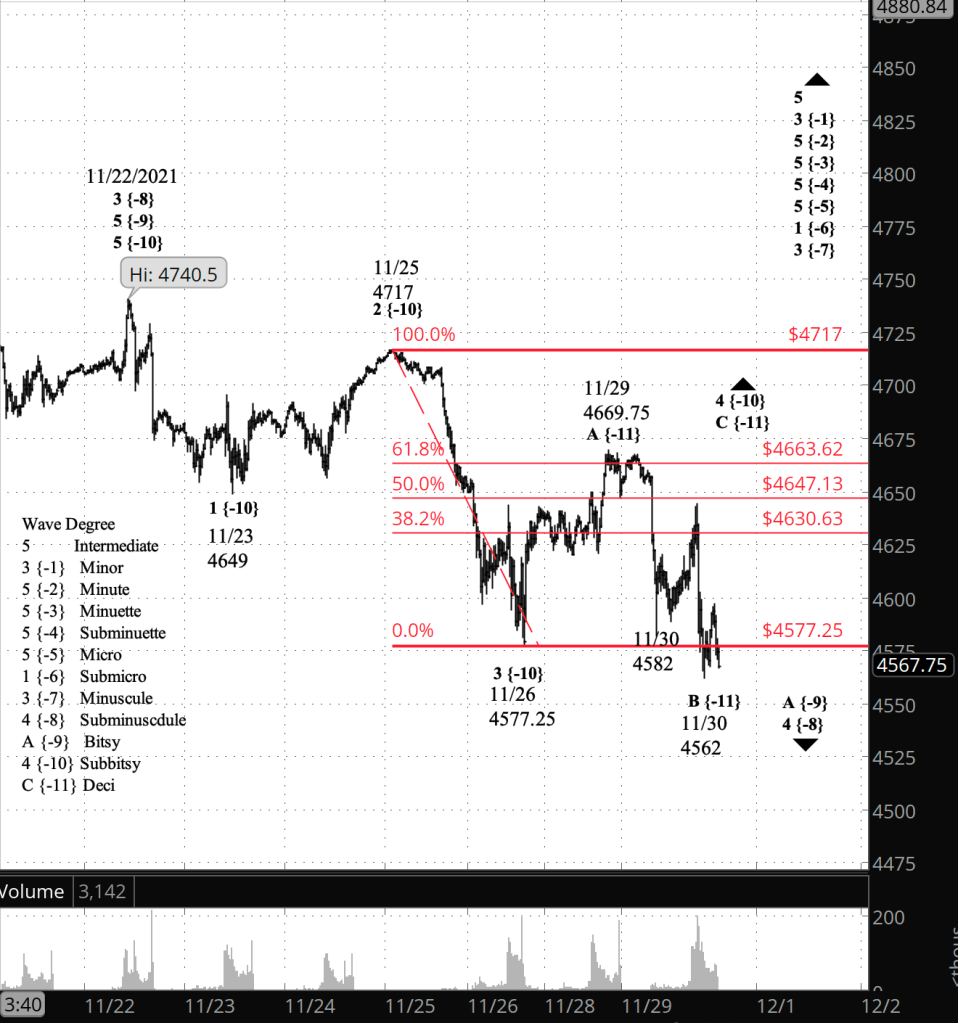
[S&P 500 E-mini futures at 3:30 p.m., 20-minute bars, with volume]

What does Elliott wave theory say? Under my principal anaysis, the present rise is uptrending wave C of Deci degree — subscript {-11} — within uptrending wave 4 of Subbitsy degree {-10} within downtrending wave A of Bitsy degree {-9} within downtrending wave 4 of Subminuscule degree. Long story short: It’s an upward correction within a downward correction. That’s all happening within an uptrending wave 3 of Minuscule degree {-7}.

My principal analysis marks the November 22 peak, 4740.50, as the end of wave 3 of Subminuscule degree, but the price hasn’t declined a large distance below that level — only to 4577.25, or 3.5% — and so the alternative analysis is that the decline from that peak is a correction within an ongoing uptrend, wave 3 of Subminuscule degree.

Learning and other resources. Elliott wave analysis provides context, not prophecy. As the 20th century semanticist Alfred Korzybski put it in his book Science and Sanity (1933), “The map is not the territory … The only usefulness of a map depends on similarity of structure between the empirical world and the map.” And I would add, in the ever-changing markets, we can judge that similarity of structure only after the fact.

See the menu page Analytical Methods for a rundown on where to go for information on Elliott wave analysis.

By Tim Bovee, Portland, Oregon, November 30, 2021

Disclaimer

Tim Bovee, Private Trader tracks the analysis and trades of a private trader for his own accounts. Nothing in this blog constitutes a recommendation to buy or sell stocks, options or any other financial instrument. The only purpose of this blog is to provide education and entertainment.

No trader is ever 100 percent successful in his or her trades. Trading in the stock and option markets is risky and uncertain. Each trader must make trading decisions for his or her own account, and take responsibility for the consequences.

License
Creative Commons License

All content on Tim Bovee, Private Trader by Timothy K. Bovee is licensed under a Creative Commons Attribution-ShareAlike 4.0 International License.

Based on a work at www.timbovee.com.
SP500 Analysis

3:30 p.m. New York time

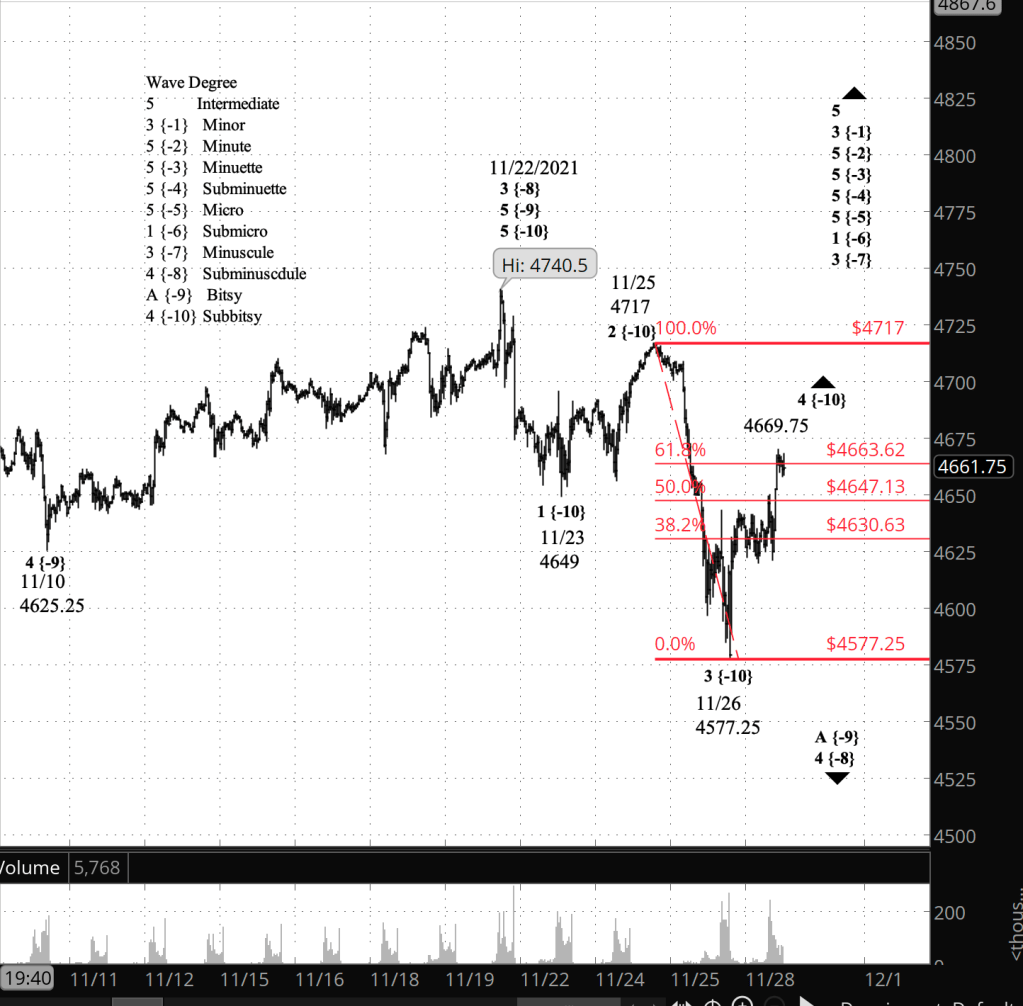
Half an hour before the closing bell. The S&P 500 has risen during the day to 4669.75 so far on the futures, 4672.95 on the index, a price level slightly above a 61.8% retracement of the preceding decline that began on November 25. In Elliott wave terms, wave 4 of Subbitsy degree {-10} continued to rise. Internally, it is in its C wave (the 3rd and final wave in both a Flat and a Zigzag pattern). No change in the analysis. I’ve updated the chart.

9:35 a.m. New York time

What’s happening now? The S&P 500 E-mini futures continued Friday’s rise when trading resumed on Sunday, so far retracing 50% of the of preceding decline.

What does it mean? The movement clarifies that the decline that began November 25 ended on November 26 at 4577.25, and that an upward correction began from that point. Most likely, the correction will be shallow. All of this is happening within the larger downtrend that began on November 22 from 4717, which is the endpoint of a rise that began on October 6 from 4273.75.

What’s the alternative? The rise of October 6 may still be underway, and the decline from November 25 may be a downward correction within that ongoing rise. Another ambiguity, at a smaller level: Even if the decline is still underway, what I’m showing as the second upward correction within the early part of the decline may in fact be the first correction. See more in the Elliott wave theory discussion below.

[S&P 500 E-mini futures at 3:30 p.m., 35-minute bars, with volume]

What does Elliott wave theory say? The present rise is wave 4 of Subbitsy degree — subscript {-10} — and I’ve added a Fibonacci ladder to measure the retracement by wave 4 of the preceding decline, wave 3 of Subbitsy degree. A 4th wave tends to be shallow — a Flat pattern — if the preceding 2nd wave was directional, such as a Zigzag pattern. I expect this Subbitsy 4th wave to be shallow, and for such a wave, a 50% retracement is a common upper boundary.

The problem with all of this is that internally, wave 3 of Subbitsy degree lacks a clear 2nd wave one degree lower. So it’s possible that what I’ve labeled as the end of wave 3 of Subbitsy degree is in fact the end of the 1st wave, and what I’ve called wave 4 of Subbitsy degree is in fact the beginning of Subbitsy wave 2. A shallow retracement, such as 50%, would indicate that the 4th wave label is correct. A rise that approaches the beginning of Subbitsy wave 1, from 4740.50, while remaining below that level would indicate that a more directional 2nd wave correction is underway.

At larger degrees, my principal analysis marks November 22 as the end of wave 3 of Subminuscule degree {-8}, and everything since has been a larger 4th wave. Working up from the lowest level I’m tracking, a downtrending wave 4 of Subbitsy degree is within downtrending wave A of Bitsy degree {-9} within downtrending wave 4 of Subminuscule degree.

All of that is happening within wave 3 of Minuscule degree {-7}, which began on October 1 and is trending upward.

Under my alternative analysis, at the higher levels, the November 22 high didn’t mark the end of wave 3 of Subminuscule degree, but instead kicked off a lower degree correction which will be followed by a continuation of Subminuscule wave 3’s ongoing rise.

Learning and other resources. Elliott wave analysis provides context, not prophecy. As the 20th century semanticist Alfred Korzybski put it in his book Science and Sanity (1933), “The map is not the territory … The only usefulness of a map depends on similarity of structure between the empirical world and the map.” And I would add, in the ever-changing markets, we can judge that similarity of structure only after the fact.

See the menu page Analytical Methods for a rundown on where to go for information on Elliott wave analysis.

By Tim Bovee, Portland, Oregon, November 29, 2021

Disclaimer

Tim Bovee, Private Trader tracks the analysis and trades of a private trader for his own accounts. Nothing in this blog constitutes a recommendation to buy or sell stocks, options or any other financial instrument. The only purpose of this blog is to provide education and entertainment.

No trader is ever 100 percent successful in his or her trades. Trading in the stock and option markets is risky and uncertain. Each trader must make trading decisions for his or her own account, and take responsibility for the consequences.

License
Creative Commons License

All content on Tim Bovee, Private Trader by Timothy K. Bovee is licensed under a Creative Commons Attribution-ShareAlike 4.0 International License.

Based on a work at www.timbovee.com.
SP500 Analysis

12:30 p.m. New York time

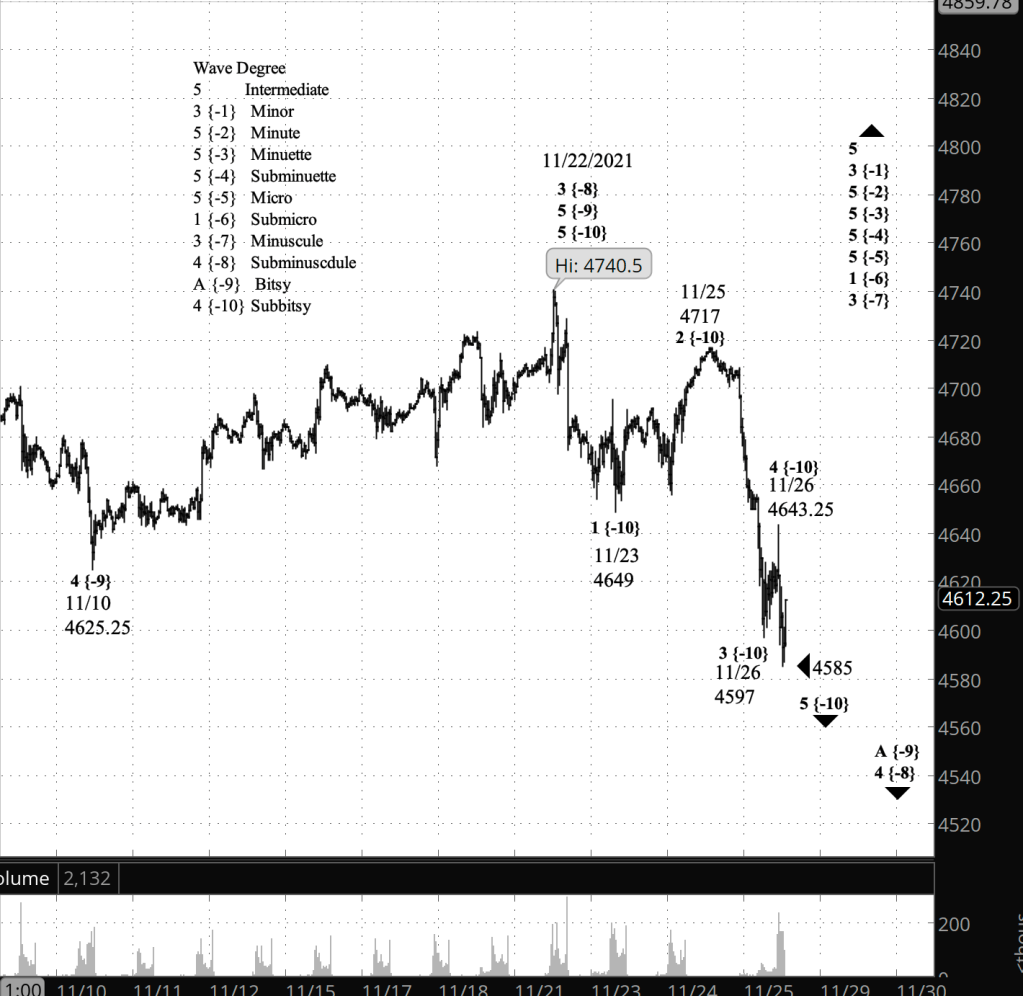
Half an hour before the closing bell. The S&P 500 reversed from its rise that began before the opening bell, falling to 4585 on the futures before reversing slightly. Under my principal analysis, I’m counting the fall from the November 25 high of 4717 as the start of wave 3 of Subbitsy degree — subscript {-10} — the rise this morning from 4597 to 4643.25 as Subbitsy 4, and the decline to 4585 as Subbitsy 5, which may still be underway. Or not. There’s no way to tell. The end of Subbitsy 5 will also be the of its parent wave A of Bitsy degree {-9}, which will be followed by a wave B rise that will take back a portion of the fall since yesterday. I’ve updated the upper chart.

9:35 a.m. New York time

Short session. The post-holiday trading session will end early today, at 1 p.m. New York time.

What’s happening now? The S&P 500 E-mini futures picked up momentum in their decline from yesterday’s peak of 4717, rapidly falling to 4597 in overnight trading.

What does it mean? The low-level upward correction that began on November 23 is complete, and the middle portion of the downtrend from November 22 has begun. The November 22 peak marked the end of the uptrend that began on November 10 within a larger uptrend that began October 6 from 4273.75.

What’s the alternative? The price moved below the low of November 10, weakening my prior alternative analysis concluding that the uptrend from that date could still be underway. At this point, I have no alternative to replace it.

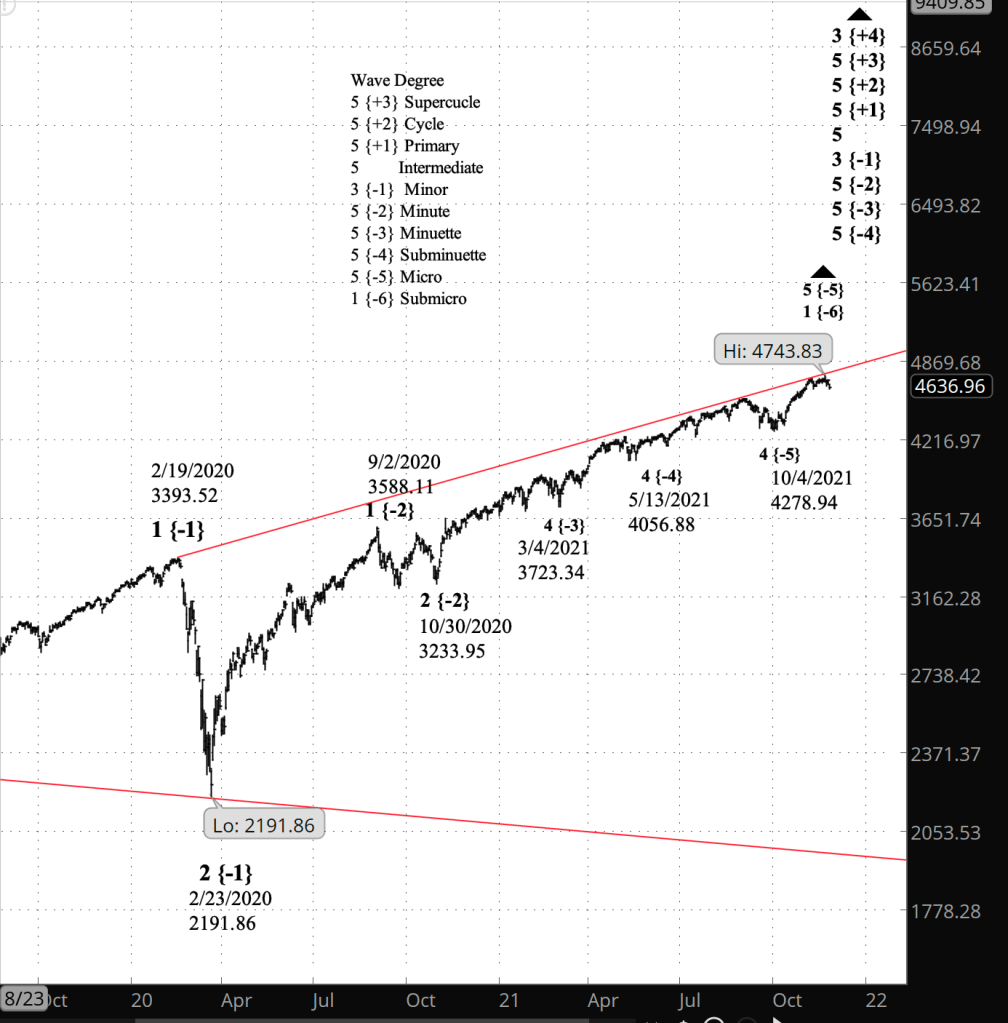
Charts. The upper chart is a close-up view tracking the futures back to November 8. The lower chart is the S&P 500 index tracking the price back to August 22, 2019.

[S&P 500 E-mini futures at 12:30 p.m., 35-minute bars, with volume]
[S&P 500 index at 9:32 a.m., daily bars]

What does Elliott wave theory say? The decline from the November 25 high to today’s the overnight low is wave 3 of Subbitsy degree — subscript {-10} — and the subsequent bounce, still underway, is Subbitsy wave 4. This is all happening within wave A of Bitsy degree {-9} within wave 4 of Subminuscule degree {-8} within wave 3 of Minuscule degree {-7}.

Subbitsy 4’s rise will be followed by further decline, wave 5 of Subbitsy degree, which will mark the end of wave A of Bitsy degree. Bitsy wave A will be followed by an uptrending B wave and then a downtrendng C wave, completing wave 4 of Subminuscule degree.

Learning and other resources. Elliott wave analysis provides context, not prophecy. As the 20th century semanticist Alfred Korzybski put it in his book Science and Sanity (1933), “The map is not the territory … The only usefulness of a map depends on similarity of structure between the empirical world and the map.” And I would add, in the ever-changing markets, we can judge that similarity of structure only after the fact.

See the menu page Analytical Methods for a rundown on where to go for information on Elliott wave analysis.

By Tim Bovee, Portland, Oregon, November 26, 2021

Disclaimer

Tim Bovee, Private Trader tracks the analysis and trades of a private trader for his own accounts. Nothing in this blog constitutes a recommendation to buy or sell stocks, options or any other financial instrument. The only purpose of this blog is to provide education and entertainment.

No trader is ever 100 percent successful in his or her trades. Trading in the stock and option markets is risky and uncertain. Each trader must make trading decisions for his or her own account, and take responsibility for the consequences.

License
Creative Commons License

All content on Tim Bovee, Private Trader by Timothy K. Bovee is licensed under a Creative Commons Attribution-ShareAlike 4.0 International License.

Based on a work at www.timbovee.com.
SP500 Analysis

3 p.m. New York time

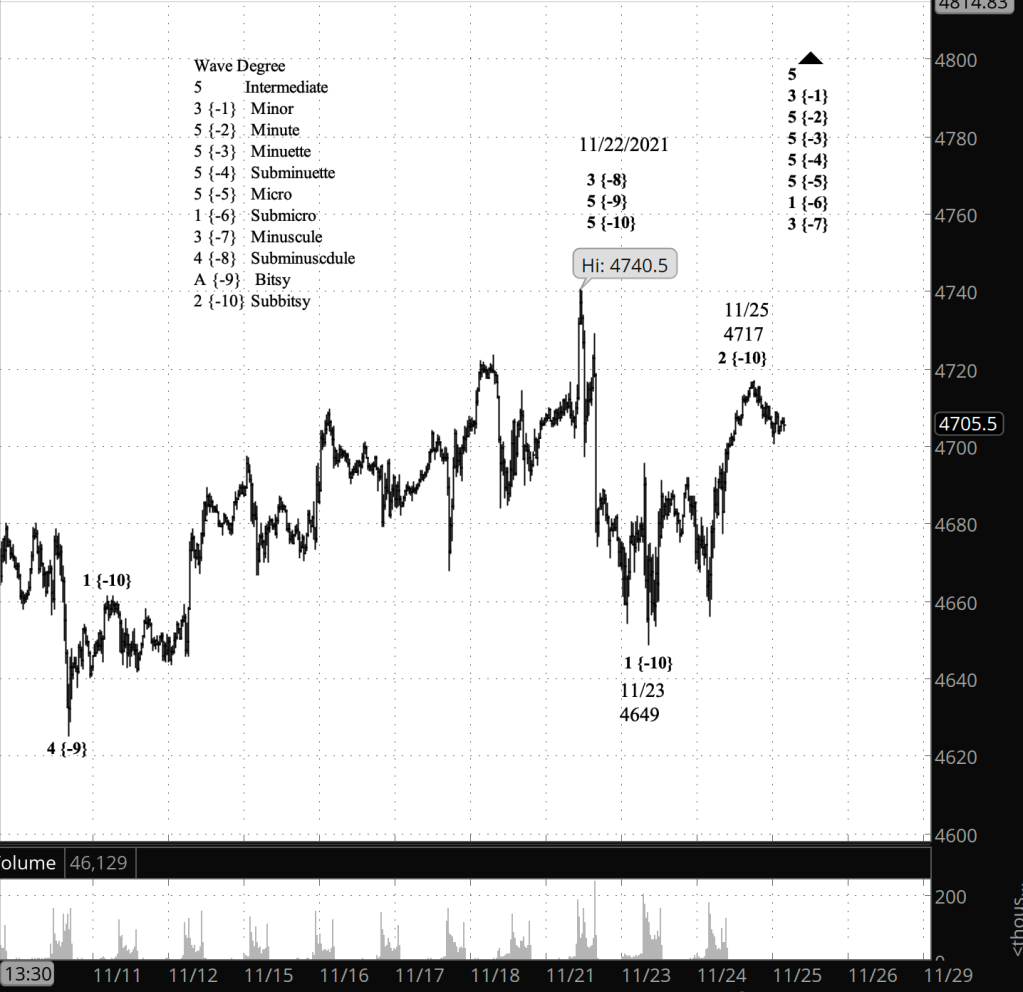
What’s happening now? Although U.S. markets were closed today for the Thanksgiving holiday, the S&P 500 E-mini futures traded in markets elsewhere. The futures rose in overnight trading to 4717 and then declined by 12 points, staying well bellow the November 22 peak of 4740.50 and above the November 23 low of 4649.

What does it mean? The rise can be counted as completing the second leg within the first portion of an upward correction that began on November 23, within a downtrend that began on November 22. I’ve used this labelling on the chart.

What’s the alternative? The rise from November 23 can be seen as the first leg of the correction, to be followed by a downward move and then another move up. A second alternative would have the decline from November 22 as a correction within a still ongoing uptrend.

[S&P 500 E-mini futures at 3 p.m., 30-minute bars, with volume]

What does Elliott wave theory say? Under the principal analysis, the November 22 peak marked the end of wave 3 of Subminuscule degree — subscript {-8} — and the subsequent decline is Subminuscule wave 4, which is still underway. Within the 4th wave, I count wave 1 of Subbitsy degree {-10} as having ended on November 23, and Subbitsy wave 2 as having ended today in overnight trading, all within wave A of Bitsy degree {-9}.

Under the first secondary analysis, wave 2 of Subbitsy degree is still underway.

Under the second secondary analysis, the November 22 peak doesn’t mark the end of wave 3 of Subminuscule degree. The the decline from that date is a low level correction within that wave as it continues its rise.

Learning and other resources. Elliott wave analysis provides context, not prophecy. As the 20th century semanticist Alfred Korzybski put it in his book Science and Sanity (1933), “The map is not the territory … The only usefulness of a map depends on similarity of structure between the empirical world and the map.” And I would add, in the ever-changing markets, we can judge that similarity of structure only after the fact.

See the menu page Analytical Methods for a rundown on where to go for information on Elliott wave analysis.

By Tim Bovee, Portland, Oregon, November 25, 2021

Disclaimer

Tim Bovee, Private Trader tracks the analysis and trades of a private trader for his own accounts. Nothing in this blog constitutes a recommendation to buy or sell stocks, options or any other financial instrument. The only purpose of this blog is to provide education and entertainment.

No trader is ever 100 percent successful in his or her trades. Trading in the stock and option markets is risky and uncertain. Each trader must make trading decisions for his or her own account, and take responsibility for the consequences.

License
Creative Commons License

All content on Tim Bovee, Private Trader by Timothy K. Bovee is licensed under a Creative Commons Attribution-ShareAlike 4.0 International License.

Based on a work at www.timbovee.com.
SP500 Analysis

3:30 p.m. New York time

Thursday and Friday. The U.S. markets will be closed on Thursday for the Thanksgiving Day holiday. They will re-open on Friday for a shortened session, closing at 1 p.m. New York time.

Half an hour before the closing bell. The S&P 500 has traded within a narrow range so far in the session. No change in the analysis. I’ve updated the chart.

9:35 a.m. New York time

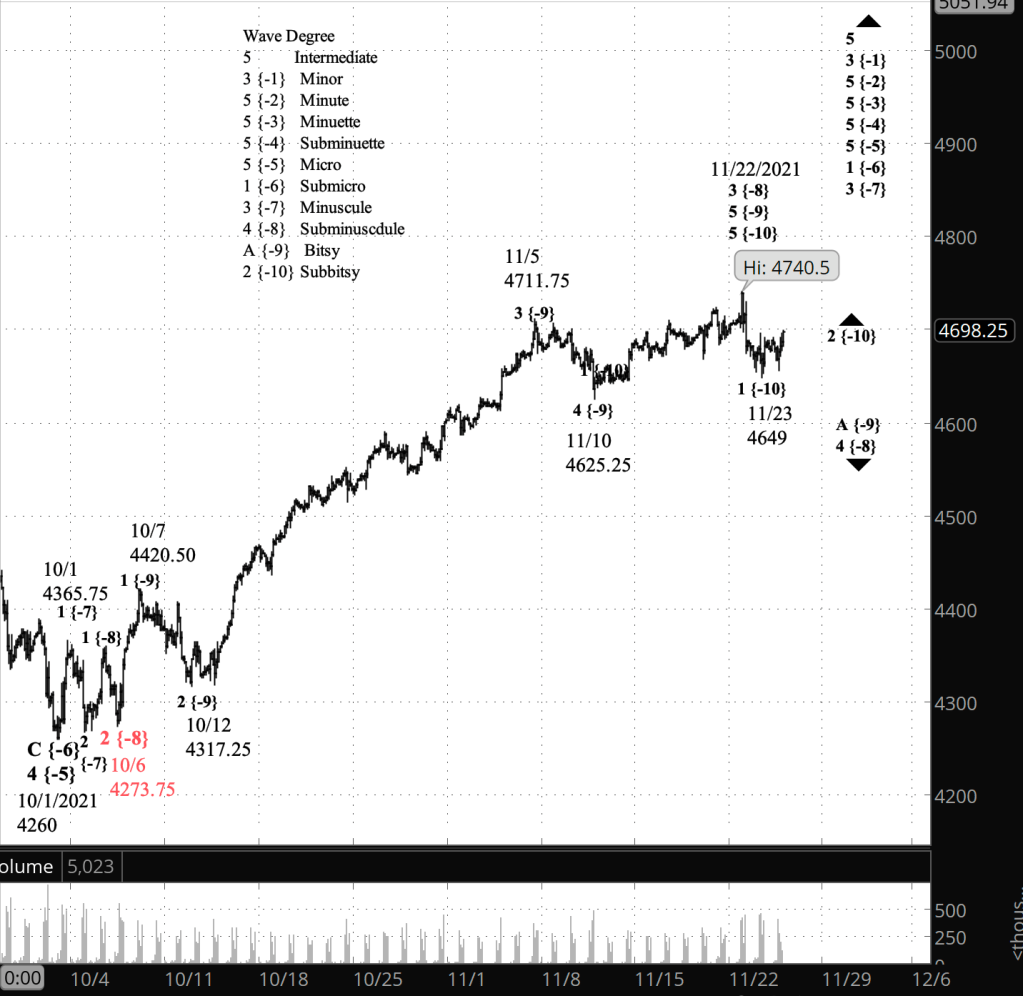
What’s happening now? The S&P 500 E-mini futures fell in overnight trading, remaining well above the November 23 low, 4649.

What does it mean? A upward correction that began from that low continues, within a downtrend that began from the November 22 peak, 4740.50.

What’s the alternative? The downtrend is itself a correction within an ongoing uptrend that began on October 6 (marked on the chart in red).

[S&P 500 E-mini futues at 3:30 p.m., 115-minute bars, with volume]

What does Elliott wave theory say? Under my principal analysis, the present location is wave 2 of Subbitsy degree within wave A of Bitsy degree within wave 4 of Subminuscule degree, which began on November 23. When Subminuscule wave 4 is complete, the price will move to new highs as wave 5 of Subminuscule degree.

Under my alternative analysis, wave 3 of Subminuscule degree, which began on October 6, is still underway and will soon resume its upward course to new highs.

Learning and other resources. Elliott wave analysis provides context, not prophecy. As the 20th century semanticist Alfred Korzybski put it in his book Science and Sanity (1933), “The map is not the territory … The only usefulness of a map depends on similarity of structure between the empirical world and the map.” And I would add, in the ever-changing markets, we can judge that similarity of structure only after the fact.

See the menu page Analytical Methods for a rundown on where to go for information on Elliott wave analysis.

By Tim Bovee, Portland, Oregon, November 24, 2021

Disclaimer

Tim Bovee, Private Trader tracks the analysis and trades of a private trader for his own accounts. Nothing in this blog constitutes a recommendation to buy or sell stocks, options or any other financial instrument. The only purpose of this blog is to provide education and entertainment.

No trader is ever 100 percent successful in his or her trades. Trading in the stock and option markets is risky and uncertain. Each trader must make trading decisions for his or her own account, and take responsibility for the consequences.

License
Creative Commons License

All content on Tim Bovee, Private Trader by Timothy K. Bovee is licensed under a Creative Commons Attribution-ShareAlike 4.0 International License.

Based on a work at www.timbovee.com.
SP500 Analysis

3:30 p.m. New York time

Half an hour before the closing bell. The S&P 500 fell slightly lower during the day, to 4649 on the futures, and then rose slightly, remaining below the high point of the morning, 4695.50. The day’s highs and lows on the index were 4690.39 and 4652.66. No change in the analysis. I’ve updated the chart.

9:35 a.m. New York time

What’s happening now? The S&P 500 fell in overnight trading, to 4654.50, and then rose slightly.

What does it mean? The November 22 peak, 4740.50, marked the end of a rise that began October 6 and the beginning of a downward correction.

What’s the alternative? The decline from the November 22 peak is a low-level correction within a continuing uptrend that began October 6.

At this point, honestly, I can’t choose between the two, but the sharpness of the decline suggests that my principal analysis is the more likely interpretation of the market’s movement.

[S&P 500 E-mini futures at 3:30 p.m., 40-minute bars, with volume]

What does Elliott wave theory say? Under my principal analysis, wave 4 of Subminuscule degree — subscript {-8} — is now underway, having begun with the decline from the November 22 high. Internally, the 4th wave is in its initial decline — wave A of Bitsy degree {-9} — which in turn is in an upward correction, wave 2 of Subbitsy degree {-10}.

Under my alternative analysis, wave 3 of Subminuscule degree, which began October 6, is still underway. Within it, the price is tracing wave 5 of Bitsy degree, and one step further down, wave 5 of Subbitsy degree.

In either case, the 4th wave that follows wave 3 of Subminuscule degree will be followed by a 5th-wave rise to a new peak, and then by a 2nd-wave correction of Submicro degree {-6}

Learning and other resources. Elliott wave analysis provides context, not prophecy. As the 20th century semanticist Alfred Korzybski put it in his book Science and Sanity (1933), “The map is not the territory … The only usefulness of a map depends on similarity of structure between the empirical world and the map.” And I would add, in the ever-changing markets, we can judge that similarity of structure only after the fact.

See the menu page Analytical Methods for a rundown on where to go for information on Elliott wave analysis.

By Tim Bovee, Portland, Oregon, November 23, 2021

Disclaimer

Tim Bovee, Private Trader tracks the analysis and trades of a private trader for his own accounts. Nothing in this blog constitutes a recommendation to buy or sell stocks, options or any other financial instrument. The only purpose of this blog is to provide education and entertainment.

No trader is ever 100 percent successful in his or her trades. Trading in the stock and option markets is risky and uncertain. Each trader must make trading decisions for his or her own account, and take responsibility for the consequences.

License
Creative Commons License

All content on Tim Bovee, Private Trader by Timothy K. Bovee is licensed under a Creative Commons Attribution-ShareAlike 4.0 International License.

Based on a work at www.timbovee.com.
SP500 Analysis

3:30 p.m. New York time

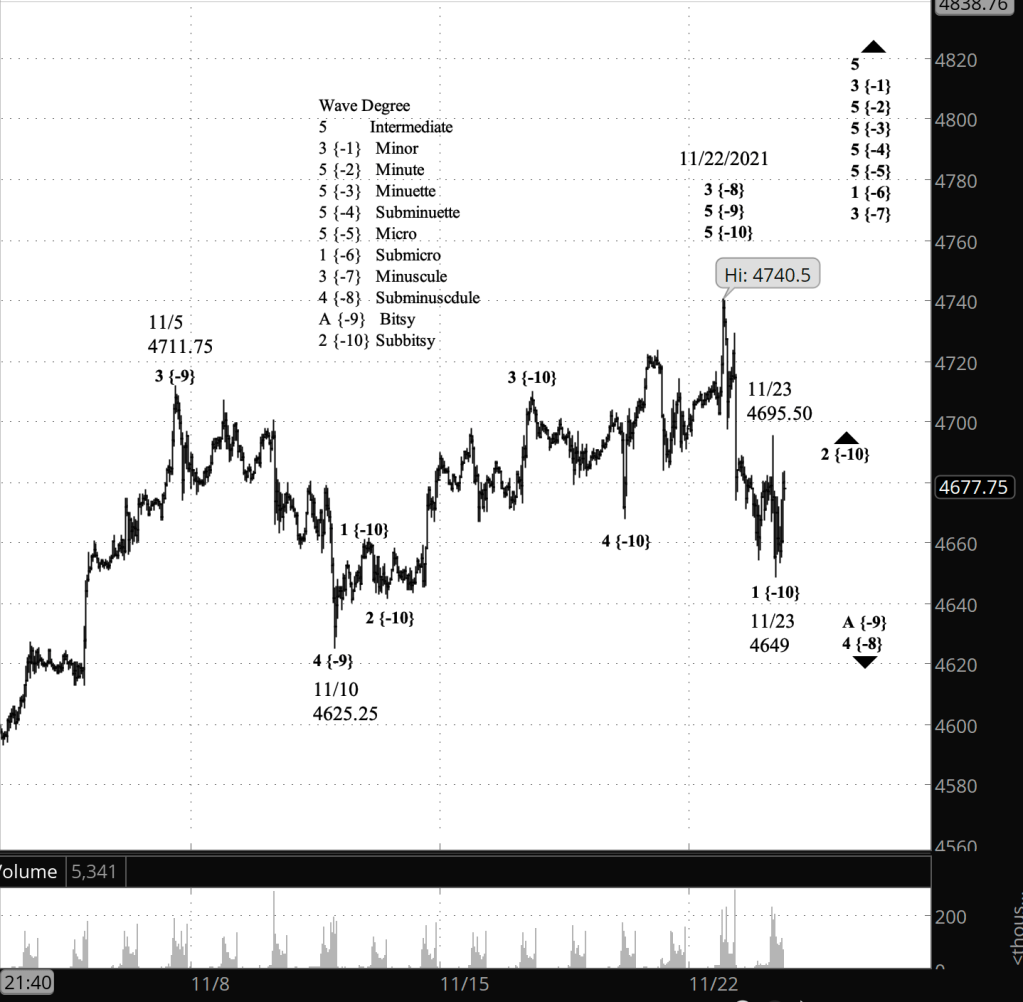
Half an hour before the closing bell. The S&P 500 peaked at 4740.50 on the futures, 4743.83 on the index, after President Biden’s announcement on the retention of Jerome Powell as Fed chair. The price then declined sharply and rose again, sharply.

I attributed the market movement to the Powell announcement. Elliott wave theory would have it that the nature of the market’s reaction is a reflection of the public mood, the Zeitgeist of the moment. Had the public mood been negative, the theory goes, then the price might well have declined after the same announcement.

No change in the analysis. I’ve updated the chart.

10:20 a.m. New York time

New peak. The S&P 500 shot up to a new peak after President Biden said he would retain Jerome Powell as Fed chair. Up to 4740.50 so far on the futures, 4743.83 on the index. The move adds credence to my principal analysis earlier this morning. Chart updated.

9:35 a.m. New York time

What’s happening now? The S&P 500 E-mini futures rose in overnight trading, remaining below the November 19 peak, 4723.50.

What does it mean? The rise that began on November 10 from 4625.25 is continuing.

What’s the alternative? The November 14 peak was the end of the rise that began on November 10, and a low-level sideways correction has begun.

[S&P 500 E-mini futures at 3:30 p.m., 30-minute bars, with volume]

What does Elliott wave theory say? By my principal count, wave 5 of Subbitsy degree — subscript {-10} — within wave 5 of Bitsy degree {-9} within wave 3 of Subminuscule degree {-8} is underway. The completion of Subbitsy 5 and its parent, Bitsy 5, will also be the end of Subminuscule 3 and the beginning of the 4th wave of Subminuscule degree, which most likely will take the from of a Flat, although that’s not a certainty.

Although the futures peaked on November 19 — last Friday — the S&P 500 index did not, creating a discrepancy between two symbols that in theory should follow each other very closely. One thing to look for today was whether the index exceeds Friday’s high, 4718.50, and indeed, it did, reaching 4725.78 at the opening bell.

Learning and other resources. Elliott wave analysis provides context, not prophecy. As the 20th century semanticist Alfred Korzybski put it in his book Science and Sanity (1933), “The map is not the territory … The only usefulness of a map depends on similarity of structure between the empirical world and the map.” And I would add, in the ever-changing markets, we can judge that similarity of structure only after the fact.

See the menu page Analytical Methods for a rundown on where to go for information on Elliott wave analysis.

By Tim Bovee, Portland, Oregon, November 22, 2021

Disclaimer

Tim Bovee, Private Trader tracks the analysis and trades of a private trader for his own accounts. Nothing in this blog constitutes a recommendation to buy or sell stocks, options or any other financial instrument. The only purpose of this blog is to provide education and entertainment.

No trader is ever 100 percent successful in his or her trades. Trading in the stock and option markets is risky and uncertain. Each trader must make trading decisions for his or her own account, and take responsibility for the consequences.

License
Creative Commons License

All content on Tim Bovee, Private Trader by Timothy K. Bovee is licensed under a Creative Commons Attribution-ShareAlike 4.0 International License.

Based on a work at www.timbovee.com.
SP500 Analysis

3:30 p.m. New York time

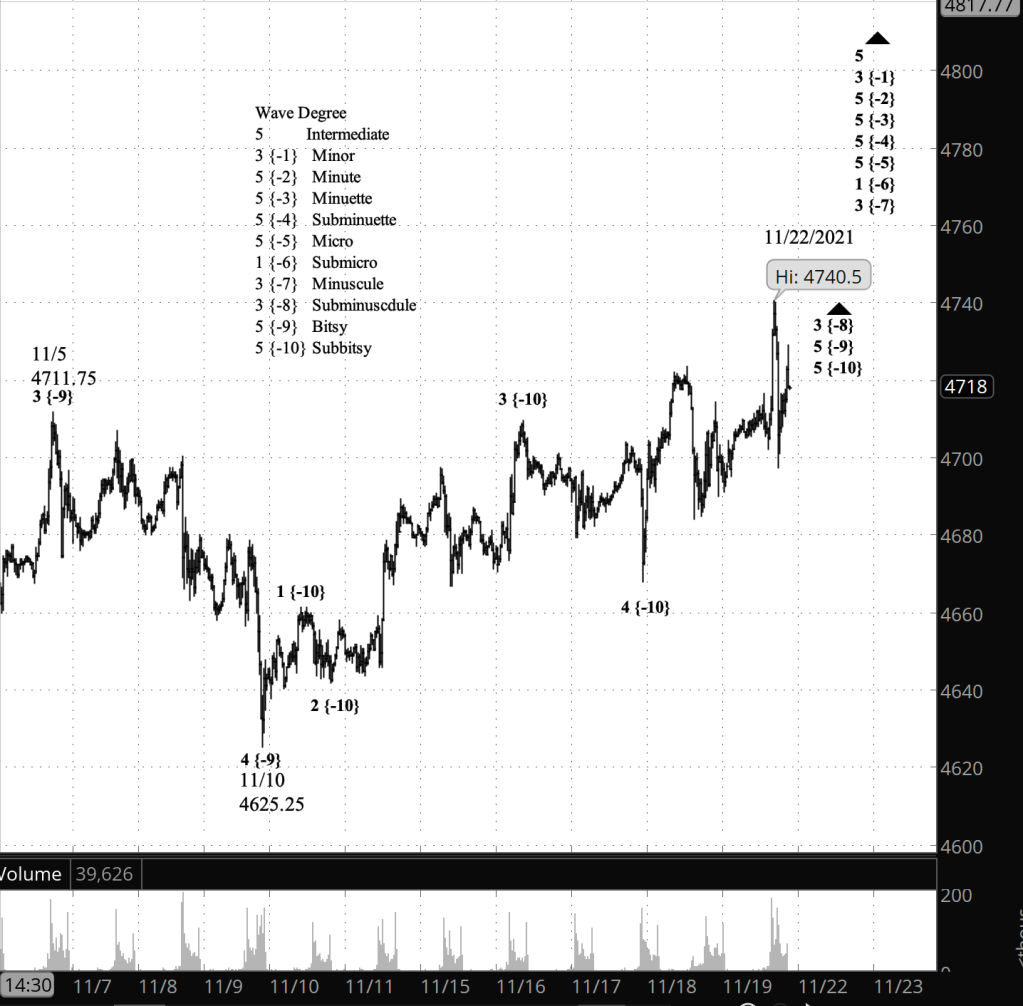
Half an hour before the closing bell. The S&P 500 traded within a narrow range throughout the day, remaining below the future’s overnight high. The index remained below the November 5 high of 4718.50. No change in the analysis. I’ve updated the upper chart.

10:05 a.m. New York time

What’s happening now? The S&P 500 E-mini futures reached a new all-time high, 4723.50, in overnight trading and then pulled back slightly. The S&P 500 index, which doesn’t trade overnight, opened with its November 5 peak, 4718.50, still intact.

What does it mean? Assuming that the index will soon follow the futures in reaching a new high, the fresh peak means that the rise that began on October 12 is still underway, and the decline from November 5 was a shallow correction within the ongoing rise.

What’s the alternative? The details of the count on the upper chart may change. The correction that began November 5 seems disproportionally shallow, creating a degree of uncertainty

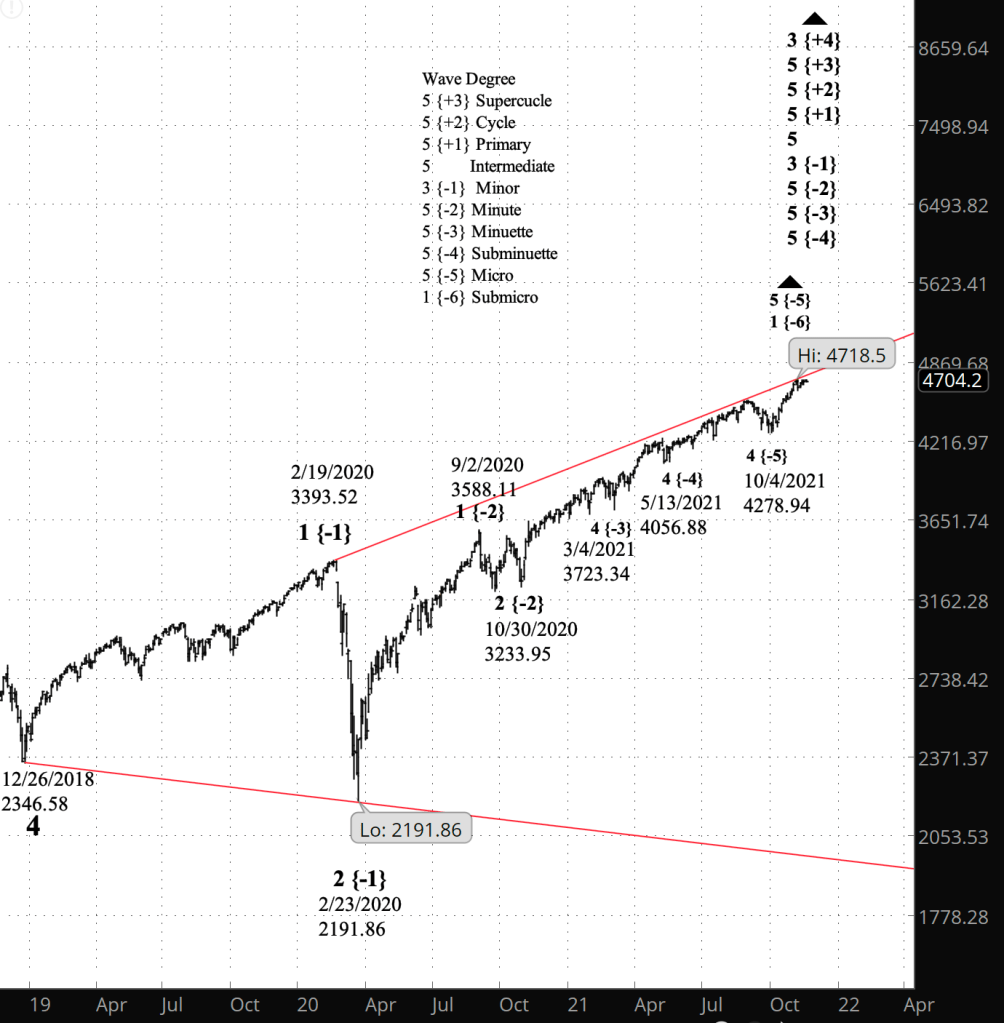
Charts. The upper chart is a closer view showing the futures from mid-October to the present. The lower chart is a broader view showing the index from late December 2018, the beginning of a large expanding Diagonal Triangle.

[S&P 500 E-mini futures at 3:30 p.m., 2-hour bars, with volume]
[S&P 500 index at 9:46 a.m., 2-day bars]

What does Elliott wave theory say? Under the new principal count, wave 5 of Bitsy degree — subscript {-9} — within wave 3 of Subminuette degree {-8}. Basically, the waves that the prior counts had seen as ending on November 5 did not end on that date and are still ongoing. The decline that began November 5 is wave 4 of Subminuette degree.

That wave 4 is extremely shallow even by 4th-wave standards. A standard target for 4th waves in Elliott wave analysis is the 4th wave within the preceding 3rd wave, which would be 4590 to 4548. The 4th wave under the new principal analysis ended at 4625.25. It doesn’t break any of the Elliott rules, but it is unusual.

The shallowness of the correction leaves the details of the count uncertain. They’ll start to make sense as the price continues on its way.

What is certain is that wave 3 of Minor degree {-1}, the third leg of the expanding Diagonal Triangle, has reached its end, Minor wave 4 will work its way down to the lower boundary of the Triangle, presently in the 1970s and declining further each day. The 4th wave will be followed by wave 5 of Minor degree, returning to continually rising upper boundary and ending the Triangle, which in its entirety is is wave 5 of Intermediate degree (no subscript). An extremely large decline will follow.

Wave 1 of Minor degree took a year a two months to reach completion. I wouldn’t be surprised if Minor wave 5 took that longer and possibly longer, and so we may be looking at 2023 or later for the Triangle to reach its end.

Learning and other resources. Elliott wave analysis provides context, not prophecy. As the 20th century semanticist Alfred Korzybski put it in his book Science and Sanity (1933), “The map is not the territory … The only usefulness of a map depends on similarity of structure between the empirical world and the map.” And I would add, in the ever-changing markets, we can judge that similarity of structure only after the fact.

See the menu page Analytical Methods for a rundown on where to go for information on Elliott wave analysis.

By Tim Bovee, Portland, Oregon, November 19, 2021

Disclaimer

Tim Bovee, Private Trader tracks the analysis and trades of a private trader for his own accounts. Nothing in this blog constitutes a recommendation to buy or sell stocks, options or any other financial instrument. The only purpose of this blog is to provide education and entertainment.

No trader is ever 100 percent successful in his or her trades. Trading in the stock and option markets is risky and uncertain. Each trader must make trading decisions for his or her own account, and take responsibility for the consequences.

License
Creative Commons License

All content on Tim Bovee, Private Trader by Timothy K. Bovee is licensed under a Creative Commons Attribution-ShareAlike 4.0 International License.

Based on a work at www.timbovee.com.
SP500 Analysis

3:30 p.m. New York time

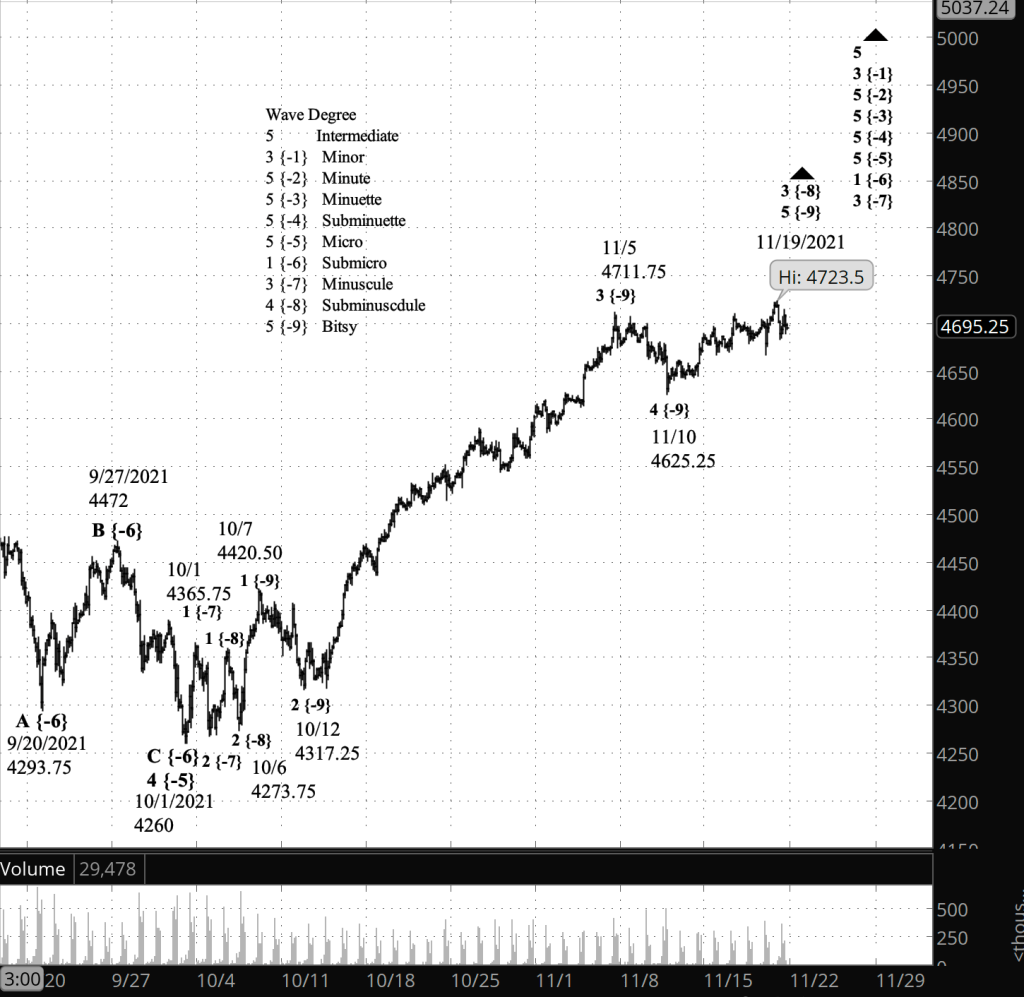
Half an hour before the closing bell. The S&P 500 futures launched into a 32-point decline spanning an hour this morning and then a recovery to just below the original level in the two hours that followed. No change in the analysis. I’ve updated the chart.

9:35 a.m. New York time

What’s happening now? The S&P 500 E-mini futures rose in overnight trading, remaining below Tuesday’s high, 4709.75.

What does it mean? The upward correction that began on November 10 is still underway, within a downward correction that began on November 5.

What’s the alternative? It’s possible that the correction from November 10 ended at yesterday’s high. Another alternative: If the price moves above the November 5 high of 4711.75, then the uptrend that began on October 27, and several larger uptrends that began before that, are still on the rise.

[S&P 500 E-mini futures at 3:30 p.m., hourly bars, with volume]

What does Elliott wave theory say? Under my principal analysis, the lowest degree that I’m tracking is wave 4 of Subbitsy degree — subscript {-10}. It is a subwave of wave A of Bitsy degree {-9} within wave 4 of Subminuscule degree {-8}. All of that comes within the parent, wave 3 of Minuscule degree {-7}, which began on October 4.

It’s possible that Tuesday’s peak ended wave 4 of Subbitsy degree. If that is so, then downtrending wave 5 of Subbitsy degree has begun.

If the price moves above the November 5 high, then wave 3 of Subminuscule degree is still underway.

Learning and other resources. Elliott wave analysis provides context, not prophecy. As the 20th century semanticist Alfred Korzybski put it in his book Science and Sanity (1933), “The map is not the territory … The only usefulness of a map depends on similarity of structure between the empirical world and the map.” And I would add, in the ever-changing markets, we can judge that similarity of structure only after the fact.

See the menu page Analytical Methods for a rundown on where to go for information on Elliott wave analysis.

By Tim Bovee, Portland, Oregon, November 18, 2021

Disclaimer

Tim Bovee, Private Trader tracks the analysis and trades of a private trader for his own accounts. Nothing in this blog constitutes a recommendation to buy or sell stocks, options or any other financial instrument. The only purpose of this blog is to provide education and entertainment.

No trader is ever 100 percent successful in his or her trades. Trading in the stock and option markets is risky and uncertain. Each trader must make trading decisions for his or her own account, and take responsibility for the consequences.

License
Creative Commons License

All content on Tim Bovee, Private Trader by Timothy K. Bovee is licensed under a Creative Commons Attribution-ShareAlike 4.0 International License.

Based on a work at www.timbovee.com.
SP500 Analysis

3:30 p.m. New York time

Half an hour before the closing bell. The S&P 500 continued its slow decline during the day, remaining below yesterday’s high, 4709.75. No change in the analysis. I’ve updated the chart.

9:35 a.m. New York time

What’s happening now? The S&P 500 E-mini futures rose to 4709.75 within two points of the November 5 peak and then declined slightly

What does it mean? The pattern leaves uncertainty over whether the upward correction that began on November 10 is still underway, or whether the next movement, to the downside, has begun. I’ve marked the chart to reflect the first scenario: The upward correction is ongoing,

What’s the alternative? If the price continues to rise and moves above 4711.75, the November 5 peak, then that peak is likely just a stopping point on the the rise that began October 6 and that is still underway.

[S&P 500 E-mini futures at 3:30 p.m., hourly bars, with volume]

What does Elliott wave theory say? By my principal analysis, wave 4 of Subbitsy degree — subscript {-10} — is underway, an upward movement within wave A of Bitsy degree {-9}, which is the first portion of a three-wave corrective pattern, wave 4 of Subminuscule degree {-8}. Subminuscule 4 began on November 5 from 4711.75.

Last night’s high is the highest high point since Subbitsy wave 4 began. It could be that it marks the end of that upward correction, or there could be a bit more upside remaining. If Subbitsy wave 4 is a Flat pattern or a Zigzag, then it cannot move above the November 5 high, 4711.75. If it does move above that level, then it is either a Triangle of some sort, forming Subminuscule wave 4, or the November 5 peak didn’t mark the end of Subminuscule wave 3, which under this scenario is still underway.

It’s also possible that what I’ve treated as Subbitsy degree is really Bitsy degree, waves A and B, leaving only wave C to the downside to reach completion, marking the end of wave 4 of Subminuscule degree and the start of a rise to new heights as wave 5 of Subminuscule degree.

Time will provide us with evidence to sort these questions out.

Learning and other resources. Elliott wave analysis provides context, not prophecy. As the 20th century semanticist Alfred Korzybski put it in his book Science and Sanity (1933), “The map is not the territory … The only usefulness of a map depends on similarity of structure between the empirical world and the map.” And I would add, in the ever-changing markets, we can judge that similarity of structure only after the fact.

See the menu page Analytical Methods for a rundown on where to go for information on Elliott wave analysis.

By Tim Bovee, Portland, Oregon, November 17, 2021

Disclaimer

Tim Bovee, Private Trader tracks the analysis and trades of a private trader for his own accounts. Nothing in this blog constitutes a recommendation to buy or sell stocks, options or any other financial instrument. The only purpose of this blog is to provide education and entertainment.

No trader is ever 100 percent successful in his or her trades. Trading in the stock and option markets is risky and uncertain. Each trader must make trading decisions for his or her own account, and take responsibility for the consequences.

License
Creative Commons License

All content on Tim Bovee, Private Trader by Timothy K. Bovee is licensed under a Creative Commons Attribution-ShareAlike 4.0 International License.

Based on a work at www.timbovee.com.