GME has continued its decline from a high of 470 on January 29 and has hit a low of 74.22 so far today. If the price continues to decline, without a significant upward bump, then GME is on a new downtrend. If the price reverses, then either the correction has ended and GME will move to new highs, or the correction is taking a compound form and the net trend will be sideways.
I think the new downtrend scenario is the most likely, given the power of the decline. But there’s nothing in the Elliott wave analysis so far that would make it a certainty.
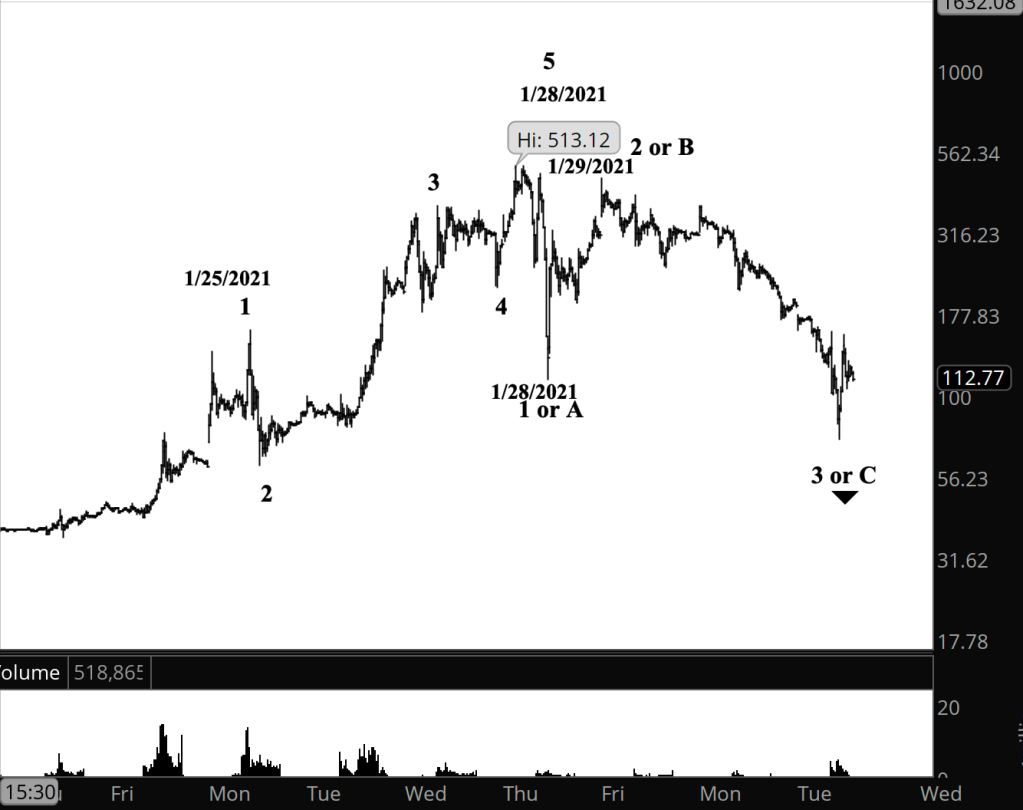
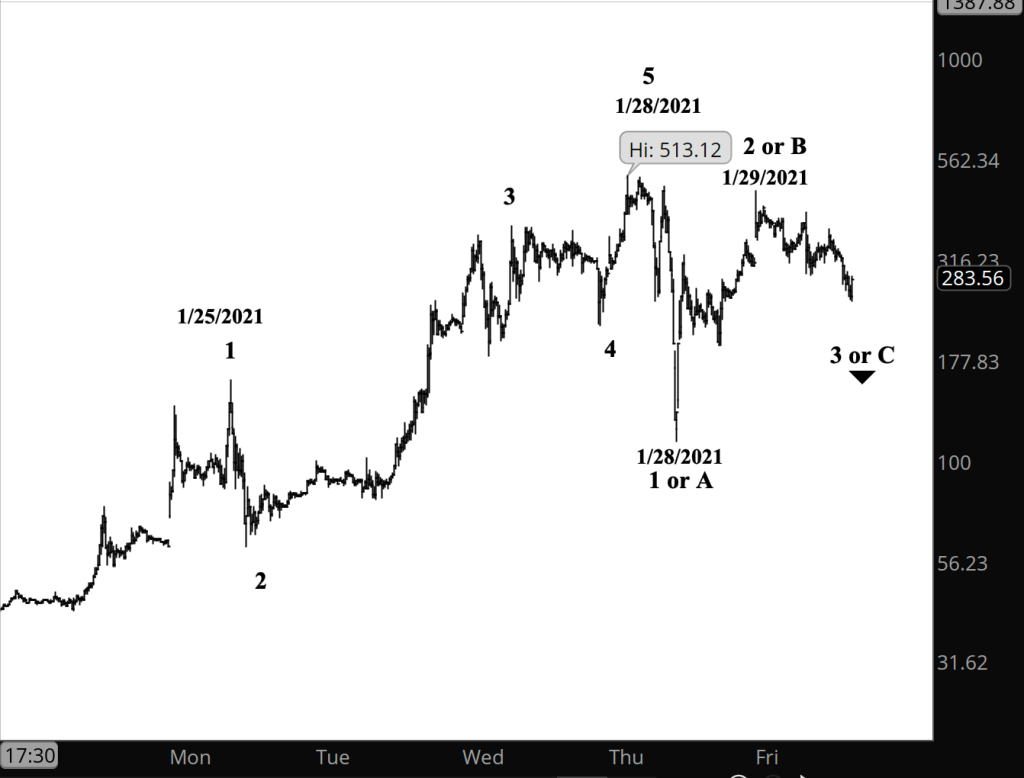
The Elliott wave analysis shows that GME is in the 3rd wave of its downward movement from its January 28 peak of 513.12. That peak was wave 5 (of indeterminate degree; I haven’t done the degree analysis). The decline that followed is in its 3rd wave, which is either wave 3 of a new decline or wave C of a correction.
The price remains above the previous low, which was 17.05 on January 11.
Half an hour before the closing bell. The S&P 500 hit a high for the day at midday, of 3835.75 on the E-mini futures, and has remained at close to that level up to the present. I’ve updated the chart below.
1:10 p.m.New York time
I’ve posted an Elliott wave analysis of GME. Fun while it lasted.
11 a.m. New York time
What’s happening now? The S&P 500 E-mini futures continued to rise in overnight trading, exceeding the high of January 28 as it continues an upward correction within the downtrend that began on January 26.
What does it mean? The move above the January 28 high eliminates any probability that the correction has been completed. The present rise is most likely the final wave of the correction. It will be followed by a powerful push to the downside.
What are the alternatives? If the price pushes above 3862.25, the high of January 26, then the downtrend is in fact a correction within the uptrend that began on February 23, 2020.
[S&P 500 E-mini futures at 3:30 p.m., 2-hour bars, with volume]
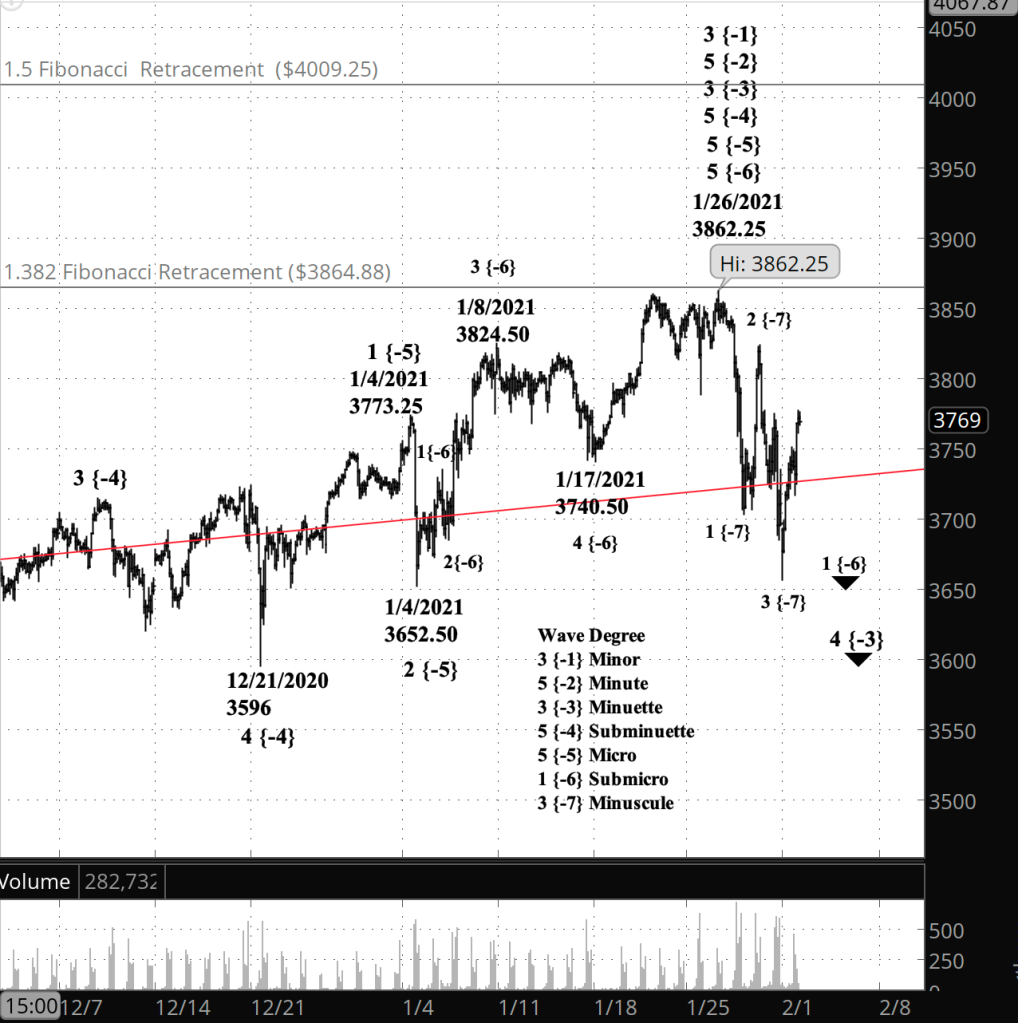
What does Elliott wave theory say? The higher high set in overnight trading is wave C of Subminuscule degree within wave 2 of Minuscule degree. We’re talking very small patterns here, yet in Elliott wave analysis, large patterns are built from increasingly smaller patterns, with all degrees following the same rules.
The end of Minuscule wave 2 will be followed by Minuscule 3 to the downside, which will be powerful enough at that small degree to leave no doubt that the trend is down. This is all happening within Submicro wave 1 and is a part of the much larger wave 4 of Minuette degree.
Half an hour before the closing bell. The S&P 500 continued to work through a rising counter-trend correction within the first Submicro degree wave of a downward move that began on January 26. I’ve updated the charts below.
9:50 a.m. New York time
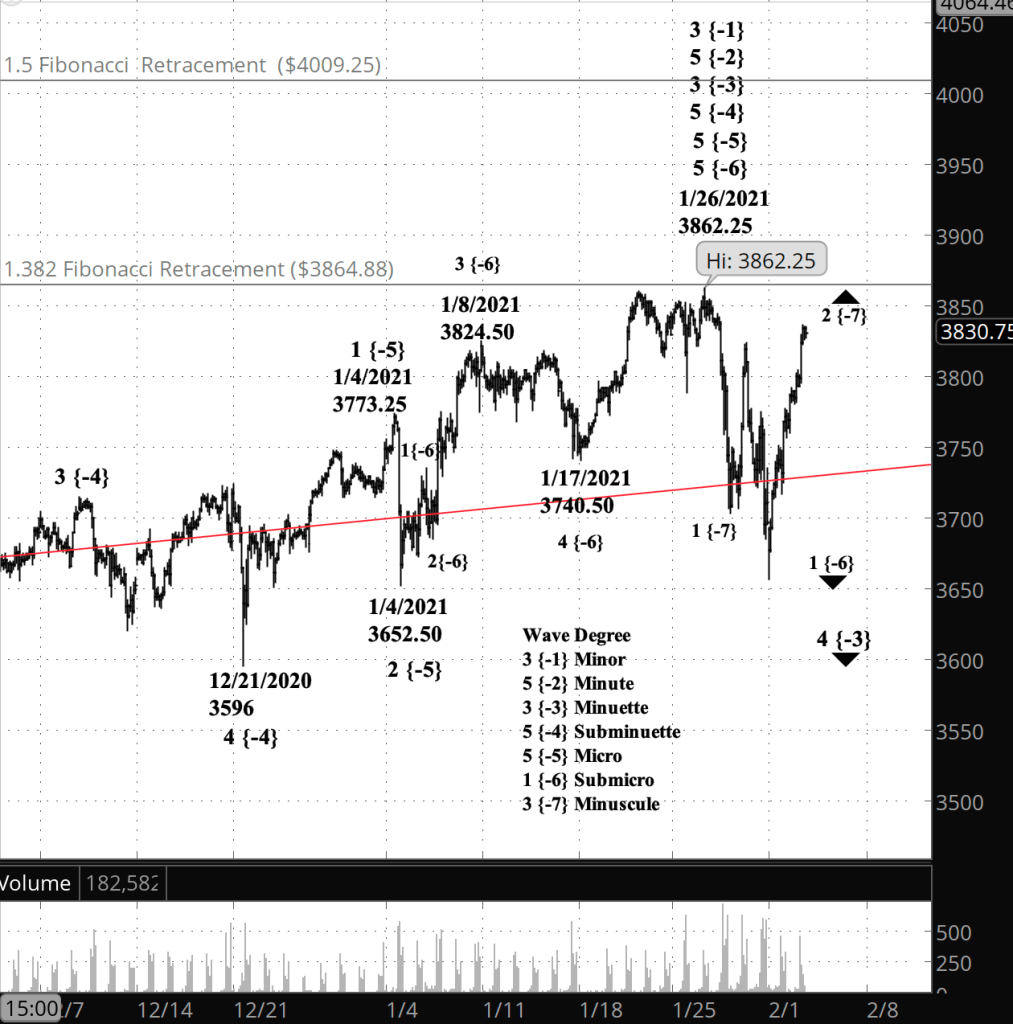
What’s happening now? The S&P 500 E-mini futures continued to work their way lower, in a series of lower highs and lower lows — the classic definition of a downtrend. After reaching a low of 3656.50 in overnight trading, the price retraced upward by 95 points. The decline began on January 26 from 3862.25, which is 5% above the the low so far.
What does it mean? The decline is the beginning of a large-scale downtrend that will eventually work its way down around 2000. But there will be much drama to be seen between now and then.
[S&P 500 E-mini futures at 3:30 p.m., 2-hour bars, with volume]
What does Elliott wave theory say? The downtrend that began on January 26 is wave 1 of Submicro degree. Within Subicro 1, wave 3 of Minuscule degree appears ready to begin its decline after a 2nd wave retracement to the upside.
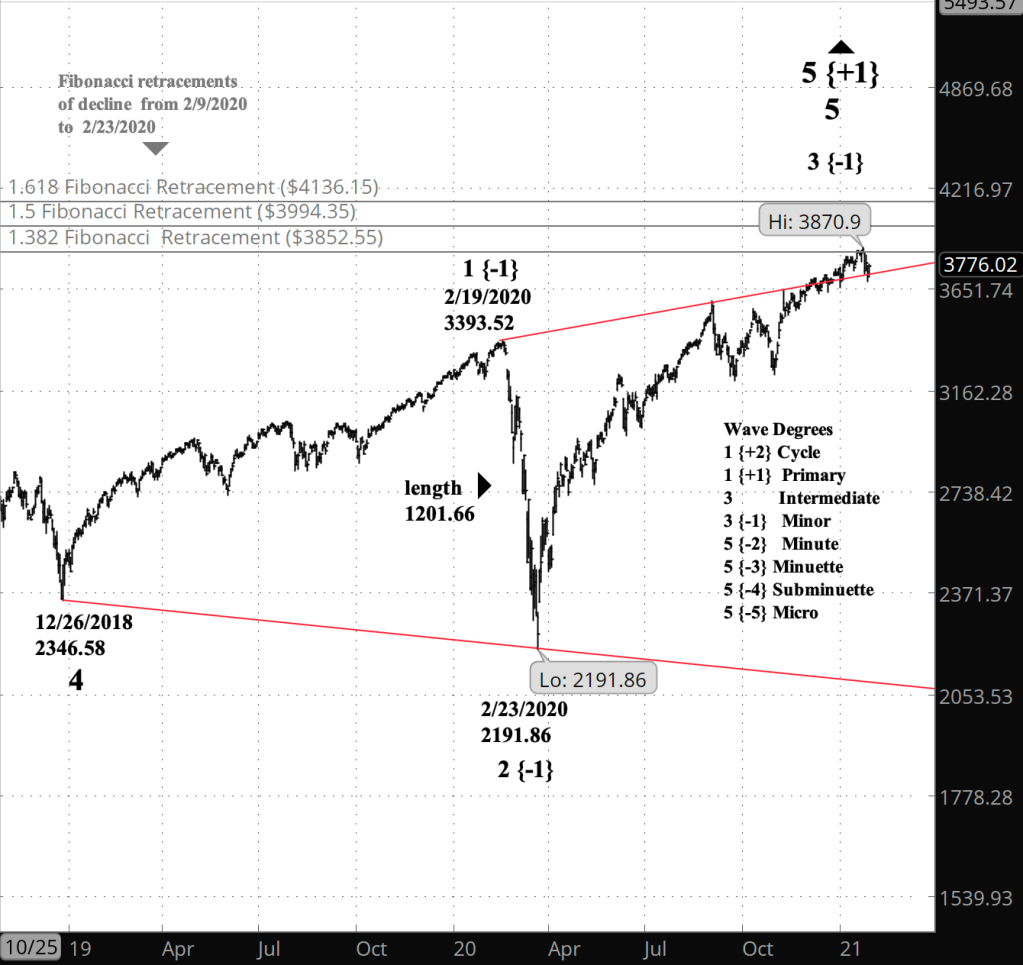
The price has hit the 1.382 Fibonacci retracement of the decline that began on February 19, 2020 and ended four days later, 1,202 points lower. The decline was part of a Diagonal Triangle pattern that began in December 2018. The red line on the chart is the upper boundary of that triangle, and the lower boundary at present is at about 2100.
The rise since February 23, 2020 has been wave 3 of Minor degree, and the decline that began January 26, 2021 is wave 4 of Minor degree. Fourth wave correction tend to be shall in a normal five-wave trend. However, in triangles the price bounces between boundaries set at the beginning of waves 1 and 3 and the beginning of wave 2. The 4th wave in this instance will carry the price a great distance so that reaches or comes close to the lower boundary of the Diagonal Triangle. Here’s a big-view chart that shows the entire S&P 500 index triangle so far.
What’s happening now? GME continues to conform to Elliott wave analysis, having completed two waves of what will prove to be a three-wave pattern if the decline is a correction within a larger uptrend, or a five-wave pattern if the decline is the beginning of a downtrend.
What does it mean? The price began its 3rd wave down early in the trading session. If the decline is a correction, then the wave is wave C. Once it’s complete, then the next move should be up to new highs. If the decline is a new downtrend, then the wave is wave 3. One it is complete, then the path down will be a long one, and the price might never again see its January 28 peak.
I’ve done a couple of analyses of GME, which has proven to be the subject of an epic street action, and one with far reaching consequences. Today’s analysis may be read here. And yesterday’s is here.
The consequences, I suspect, will come in the form of new regulations. People speak of free markets, but the American stock, options and futures exchanges aren’t among them. They are highly regulated components of the country’s economy. So what form would new regulations take? One will probably be to take the index trading halts on falling indexes that came from the Crash of 1987 and apply them to individual stocks, limiting intra-day movements in both directions. Another might be some limits on short-selling, although as much as Elon Musk might wish it, short selling will surely not be abolished outright.
In any case, as reminiscent of Les Miserables as the /r/WallStreetBets Rebellion of 2021 was, the outcome will surely be the same. The Powers That Be will keep control. We can bet on that with 100% certainty.
2:25 p.m. New York time
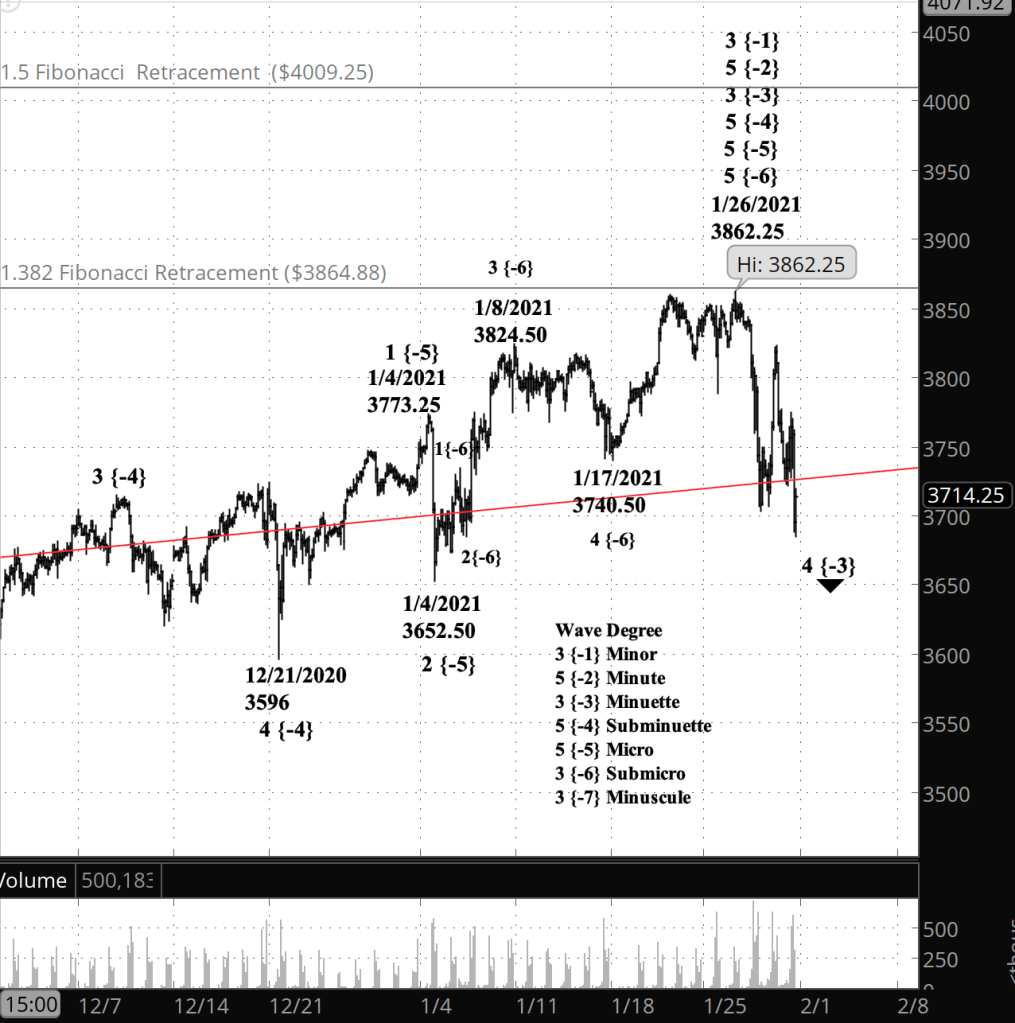
Revision of the count. Given the degree of decline today, I’ve done a complete reworking of the count. It pushes the Micro degree labels for waves 3 and 4 down to Submicro degree, treating the high of January 8 as the end of Submicro wave 3, the low of January 17 as the end of Submicro wave 4, and the high of January 26 as the end of Submicro wave 5.
That small-wave completion also cascades up to higher degrees, marking the end of (from smaller degree to larger) of Micro wave 5 within Subminuette wave 5 within Minuette wave 3. The decline from the January 26 high — 3862.25 on the E-mini futures and 3870.09 on the index — is the early stages of wave 4 of Minuette degree, a correction that, if it followed the typical 4th wave pattern, will be shallow rather than steep.
Here’s the revised chart.
[S&P 500 E-mini futures at 2:23 a.m., 2-hour bars, with volume]
10:10 a.m. New York time
What’s happening now? The S&P 500 E-mini futures continued to work their way upward in overnight trading in the middle stage of an uptrend that began December 21.
What does it mean? Completion of the middle stage, which began January 27, will be followed by a correction — most likely a shallow one — and then a push up to a new high. The end of that may be at one of the Fibonacci levels retracing the powerful February to March fall of last year. The 131.8% level, at 3864.88, has been touched, and the next one up is the 150.0% level at 4009.25
[S&P 500 E-mini futures at 10:10 a.m., 2-hour bars, with volume]
What does Elliott wave theory say? The present rise is wave 3 of Submicro degree, and internally I see it as being in having completed a subwave, 3 of Minuscule degree, in overnight trading and embarked on a corrective subwave, Minuscule 4. This is all within wave 5 of Micro, whose completion will cascade up the degrees and also mark the end of wave 3 of Minuette degree, which began November 12, 2020 from 3525.20
My trading strategy. The window is open for entering a position built from options expiring March 19. Under my rules I have until February 9 to enter, with February 2 — Tuesday of next week — being the ideal entry point.
Honestly, there are not a lot of great choices. My rules require an implied volatility rank (IVR) — a comparison of a stock’s implied volatility to its previous levels — of 25 or greater. I also tend to prefer exchange-traded funds (ETF) rather than having to navigate the drama of earnings announcements.
My ETF choices meeting that IVR requirement are SLV 66.2, IWM 33.1 and QQQ 30.7, GLD 28.0. The S&P 500 ETF, SPY, is below my minimum, at 24.0.
Elliott wave analysis is based on the premise that stock prices represent the thinking of groups of people, which in turn mirrors the public mood. The pattern of a stock chart represents the stereotypical ways in which that mood fluctuates. The great practitioner of Elliott wave analysis, Robert Prechter, has characterized it as herding behavior.
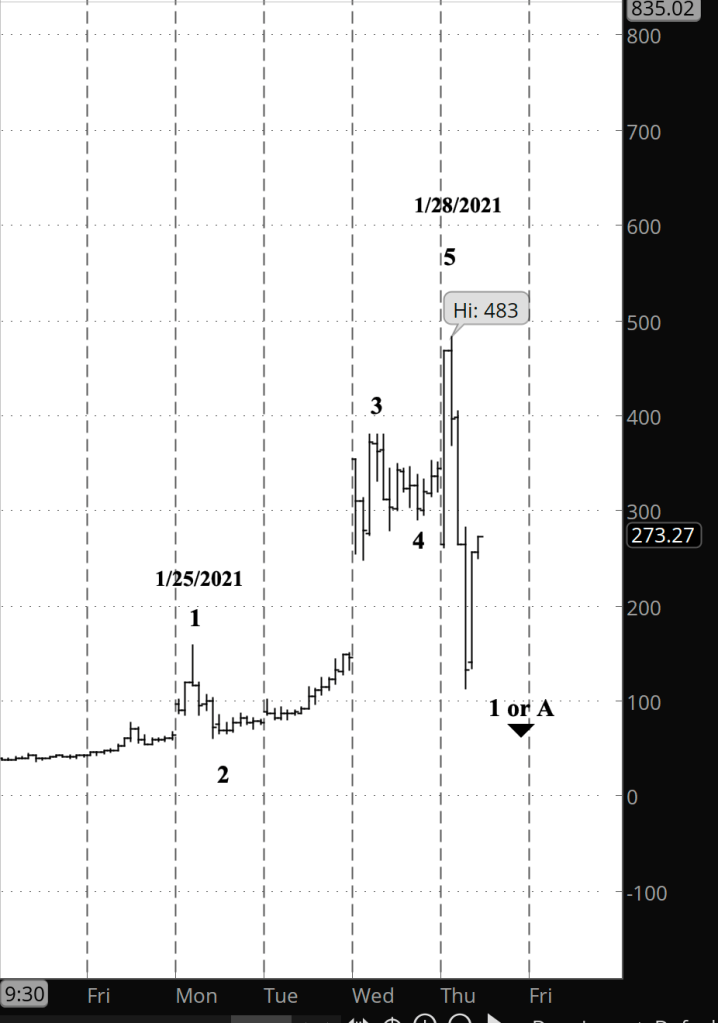
The Great /r WallStreetBets Short Squeeze on GME, which sent the gaming company stock soaring by orders of magnitude, has reversed. The pattern of the rise fits perfectly into an uptrending Elliott wave pattern. Wave 5, of course, is the end of the rise. The ensuing movement to the downside is either the beginning of a new downtrend, or a correction within a continuing uptrend. An article on what happened may be found here. And here’s a chart showing the analysis. (I have no idea what the degree of the waves are, so I’ve used the wave numbers without a subscript.)
[GME at 12:04 p.m., 30-minute bars]
I’m fascinated by normality of the chart. This rise was the equivalent of a street action, group protest against the short-seller of hedge funds. It has been aptly described as a popular rebellion of private traders against the rich and powerful. And yet, this revolutionary act followed the same rules as a rise in AAPL, TSLA or the S&P 500: Three waves in the direction of the trend, with the middle wave — the 3rd wave — not being the shortest of the three, and two counter-trend corrections. It all played out in six days, with the price rising to 11 times the starting price before dropping after financial companies blocked GME stock purchases. And despite the rebellious motives behind the rise and the regulatory stomping on the brakes that end it, the chart followed the rules discovered in the 1930s by R.N. Elliott.
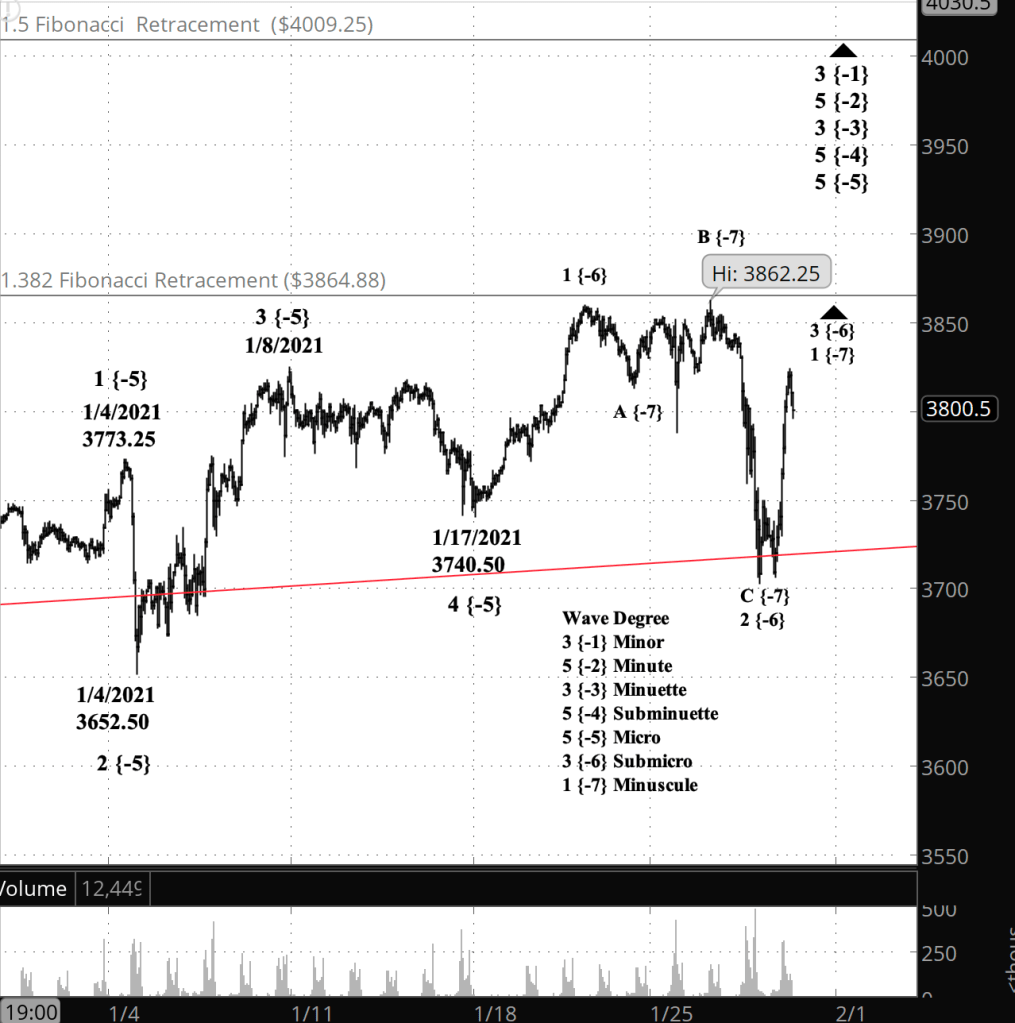
Half an hour before the closing bell. The S&P 500 E-mini futures peaked at 3823.50 and then reversed. I count that long rise as wave 3 of Subminuscule degree within wave 1 of Minuscule degree. The very low level correction, a 4th wave, that has begun will be shallow, and then the rise will resume in a 5th and final wave. I’ve updated the chart below.
9:45 a.m. New York time
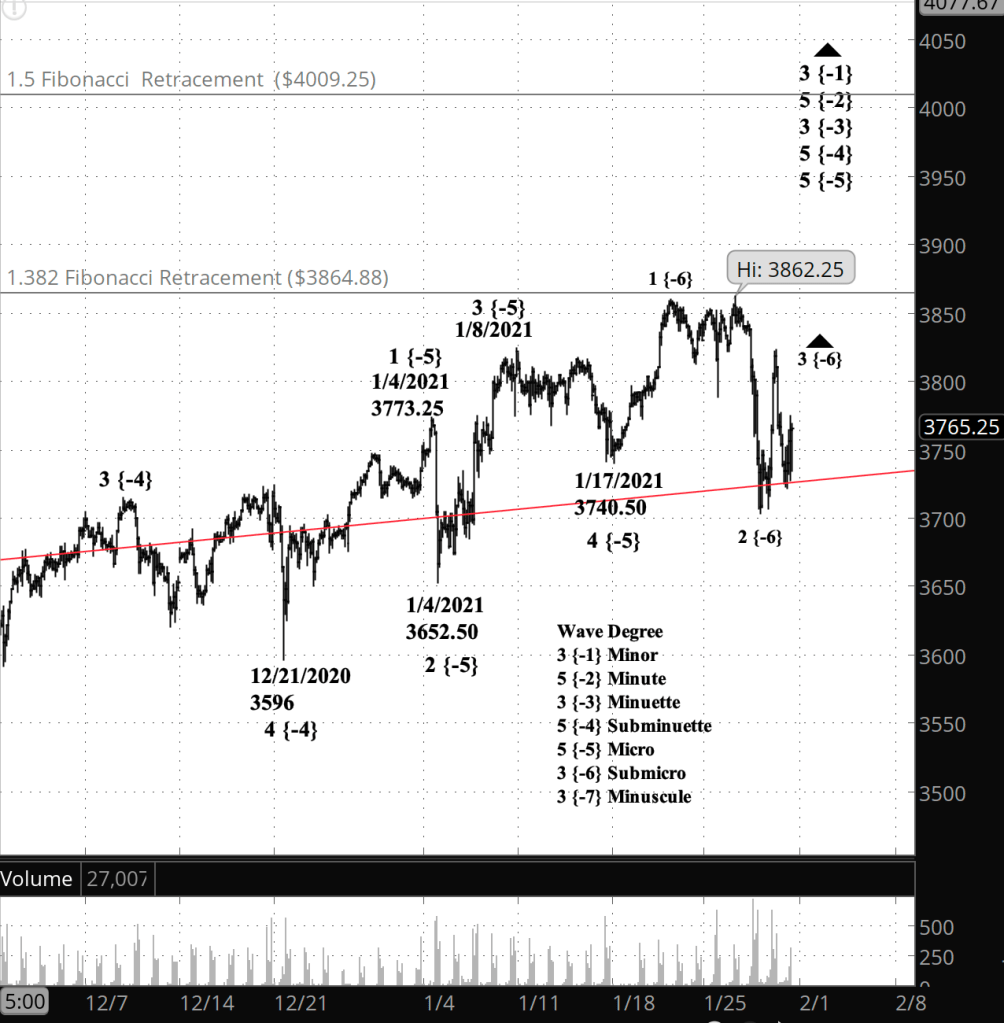
What’s happening now? The S&P 500 E-mini futures declined after the closing bell yesterday to 3703.50 and then reversed, climbing back to the 3775 at the opening bell today and then continuing to rise.
What does it mean? Yesterday’s low marks the end of the downward correction that began January 26 from a 3862.25 high. The subsequent rise will exceed that high, perhaps reaching the region of 4009.25, which is the 50% retracement level of the decline that ended February 23, 2020.
[S&P 500 E-mini futures at 3:30 p.m., hourly bars, with volume]
What does Elliott wave theory say? The January 27 low marks the end of wave C of Minuscule degree and its parent, wave 2 of Submicro degree. Wave 3 of Submicro degree, rising in the direction of the trend, is now underway and appears to be in the 3rd subwave of Submicro 3.
Within ascending order of degree, all of this is happening within wave 5 of Micro degree within wave 5 of Subminuete degree within wave 3 of Minuette degree within wave 5 of Minute degree within wave 3 of Minor degree. Minor 3 began on February 23, 2020.
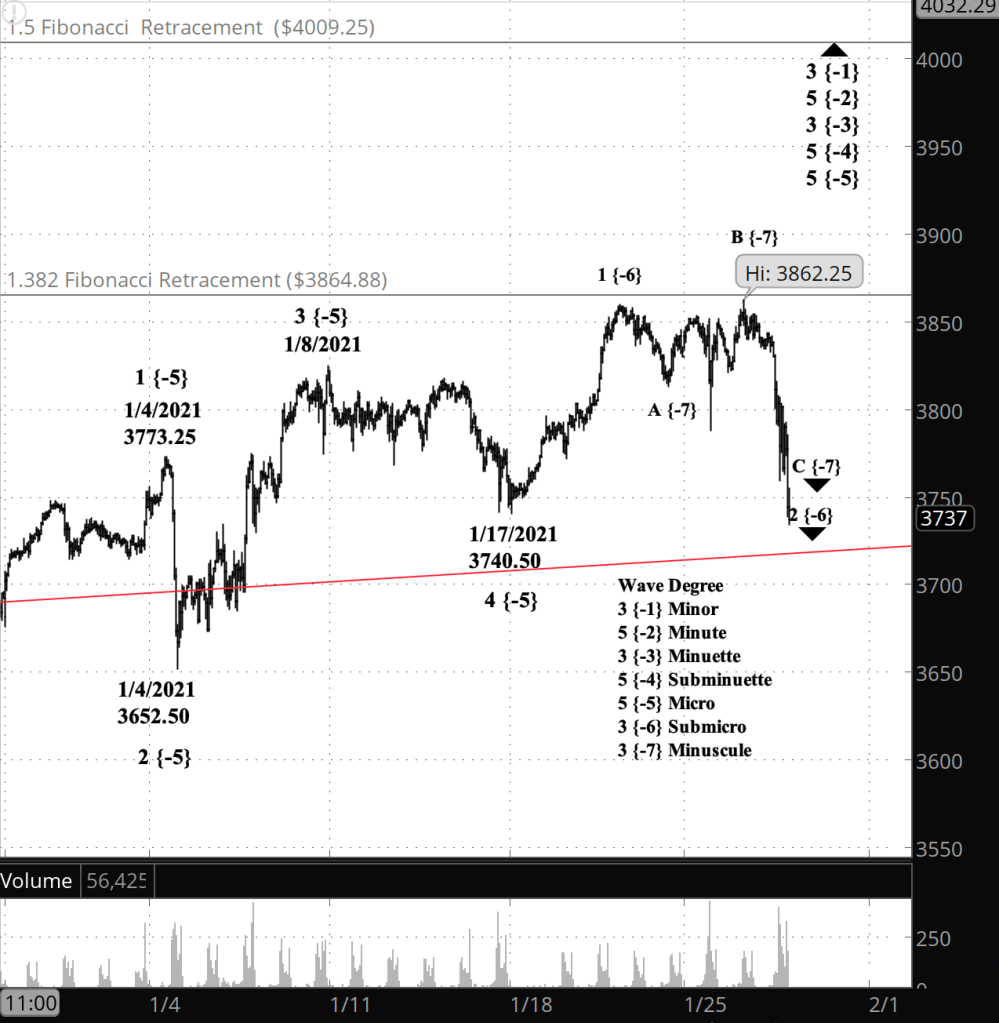
Half an hour before the closing bell. The S&P 500 E-mini futures from last night set lower highs for 10 hours, set one (barely) higher high in the next hour, and then resumed lower highs for the next three hours, another higher high in one hour, and then two hours of lower highs to the present moment. Which, all-in-all, could be seen as a weakening of the decline, perhaps signaling that a reversal is near. I’ve updated the chart below.
9:45 a.m. New York time
What’s happening now? The S&P 500 E-mini futures dropped sharply from yesterday’s high of 3862.25, reach 3775.25 in early trading.
What does it mean? The decline forces a reassessment of yesterday’s analysis. Under the new labelling, the correction that began January 17 is still underway. I set out my reasoning in the Elliott wave theory section below.
[S&P 500 E-mini futures at 3:30 p.m., hourly bars, with volume]
What does Elliott wave theory say? The reassessment suggests that the A-B-C waves described yesterday as being of the Minuscule degree are in fact one degree lower, at the Subminuscule level, and that the parent form — wave 2 of Subminuette degree — is still underway. The rest of the analysis remains unchanged: The end of Minuscule wave C will be followed by one of two options: 1) Wave C will concluded wave 2 of Subminuette degree and will be followed by a rise to new highs as Subminuette wave 3. Or, 2) wave C will be followed rise that will fall short of new highs, a separator wave between two correction patterns in a compound structure as Subminuette wave 2 continues. I consider the second options to be unlikely; compound structures are more often seen in 4th waves.
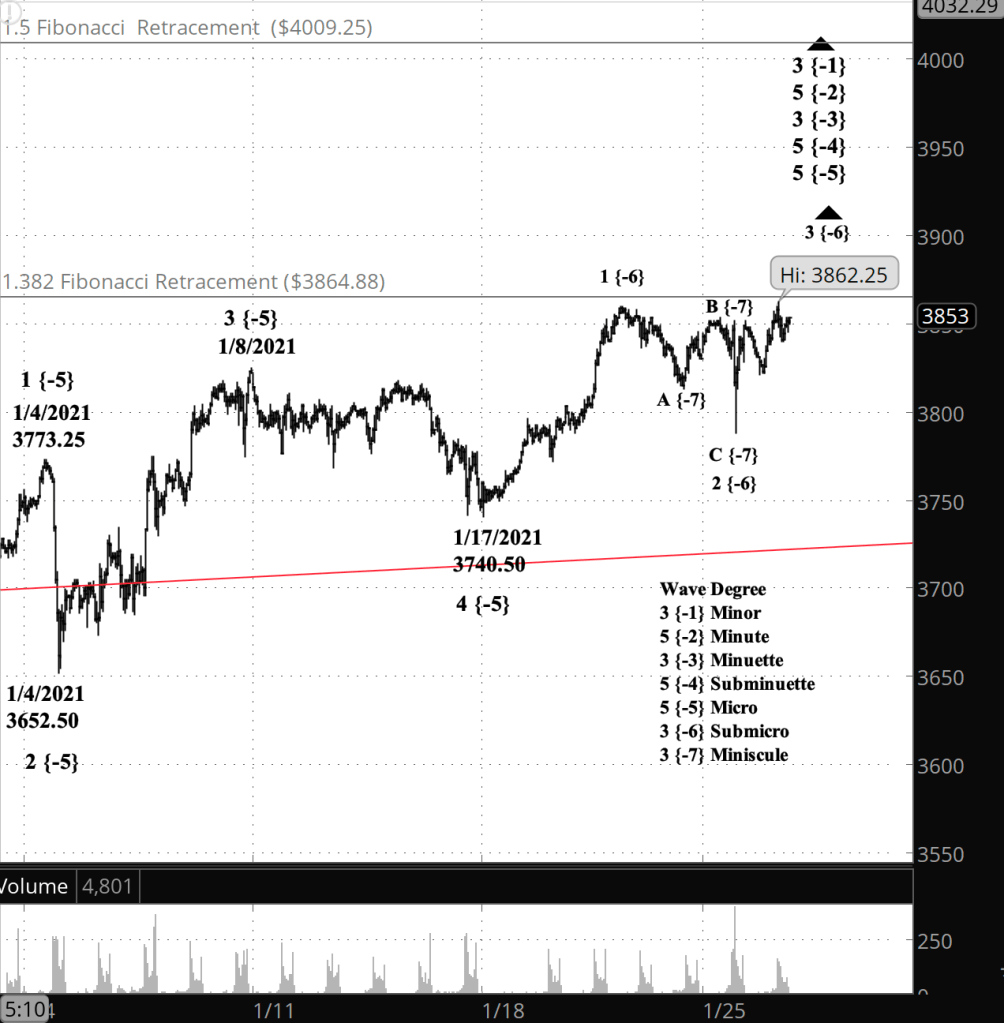
Half an hour before the closing bell. The S&P 500 remains close the the 1.382 retracement level of the rise since February 23. On the E-mini futures chart I count the upward movement as being in a 3rd wave internal to wave 3 of Submicro degree. Here’s a big-picture chart showing three Fibonacci retracement price targets. The red lines are a long-running Diagonal Triangle I’ve also updated the near-term chart, below, with the red line showing the upper boundary of the triangle.
[S&P 500 index at 3:25 p.m., daily bars]
9:40 a.m. New York time
What’s happening now? The S&P 500 E-mini futures before the opening bell came with half a point of the high set of 3859.75 set on January 20. As the bell rang, the price moved above that level to a new high.
What does it mean? The move above the January 20 high confirms that the low-level correction ended on January 25 and a new movement to the upside is underway. It has hit the lowest Fibonacci target.
[S&P 500 E-mini futures at 3:30 p.m., 50-minute bars, with volume]
What does Elliott wave theory say? My principle count sees the rise as wave 3 of Submicro degree. Internally, Submicro 3 appears to be in its 3rd wave of Minuscule degree. Third waves are usually the strongest of the three waves that move in the direction of a trend. This is all happening, from smaller movements to larger, within wave 5 of Micro degree within wave 5 of Subminuette degree within wave 3 of Minuette degree within wave 5 of Minute degree within wave 3 of Minor degree.
My trading strategy. Today is the first day for entering positions using options that expire March 19. The enter period will run through February 9, within the midpoint — the ideal entry date — being February 2.
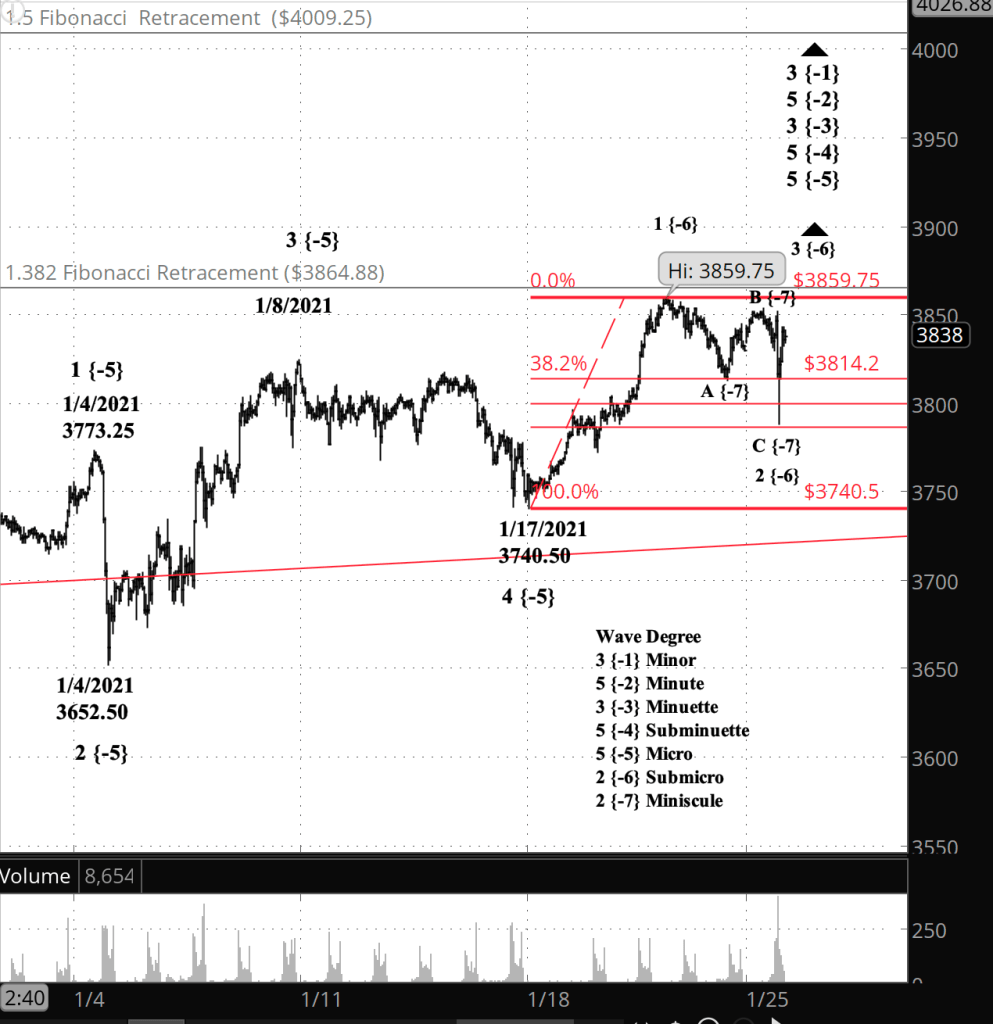
An hour before the market close. The S&P 500 rapidly dropped during the day to the 61.8% Fibonacci retracement level and then reversed. I’ve updated the chart below, marking the day’s decline as wave C of Miniscule degree, possibly culminating the 2nd wave correction of Submicro degree. Cautionary note: The rise following Miniscule wave C has yet to set a higher high and so cannot yet be labeled as the beginning of wave 3 of Submicro degree.
10:05 a.m. New York time
What’s happening now? The S&P 500 E-mini futures rose overnight but remained below the January 21 peak of 3859.75 in the middle wave of a three-wave a correction of the rise since January 17.
What does it mean? Prior to the rise, the price declined from the peak to a Fibonacci level, 38.2%. The rise retraced nearly all of the decline. It will be followed by another decline, perhaps down to the Fibonacci 50% or 68.8% retracement levels, the two lines below 31.8% on the red Fibonacci grid.
[S&P 500 E-mini futures at 3 p.m., 50-minute bars, with volume]
What does Elliott wave theory say? The price movement since last week’s peak has taken the form of a Zigzag, a corrective wave: wave A of Miniscule degree with five subwaves and wave B with three subwaves. The subsequent decline, Miniscule wave C, will have five subwaves. All of this is happening within wave 2 of Submicro degree. We’re looking at very small movements here.
Once wave C is complete, there are two alternatives. Usually for 2nd waves, a Zigzag will complete the correction and the market will rise to a new high, in this case as wave 3 of Submicro degree. A correction can also take a compound form, with two corrective patterns back to back separated by an X wave, which would be rising in this case. My opinion is that compounding is unlikely, but that’s not the same as impossible. If the future rise after Miniscule C reaches a new high, then it’s part of Submicro wave 3. If it reverses without reaching a new high, then it’s a Miniscule degree X wave.
The two gray Fibonacci levels on the chart are possible price targets for Submicro wave 3. No guarantees, but waves often reverse at Fibonacci levels.
The small movements discussed above are part of an upward movement that began February 23, 2020. The full positioning of Miniuscule wave C would be that it is a subwave of wave 2 of Submicro degree within Micro wave 5 within Subminuette 5 within Minuette 3 within Minute 5 within Minor 3.
My trading strategy. My next options trading window begins Tuesday, January 26 (that’s tomorrow) and will remain open until February 9.

 Tim Bovee, Private Trader
You must be logged in to post a comment.