SP500 Analysis

3:30 p.m. New York time

Half an hour before the closing bell. The S&P 500 pushed higher during the day, to 4342.75 so far on the futures (4351 on the index), as wave 5 of Micro degree, which began on June 20, continued its upward course. The principle analysis at the end of the day is that the Minor wave 3 uptrend that began in February 2020 is still underway and is in its last stages. The alternative analysis, as the peak-fishing continues, is that any fresh high can be the end of Minor wave 3 and its smaller child wave, Micro wave 5, since both have met the requirements for completion laid out by Elliott wave theory.

Rather than overwrite this morning’s chart, I’ve added a late-day look at the futures.
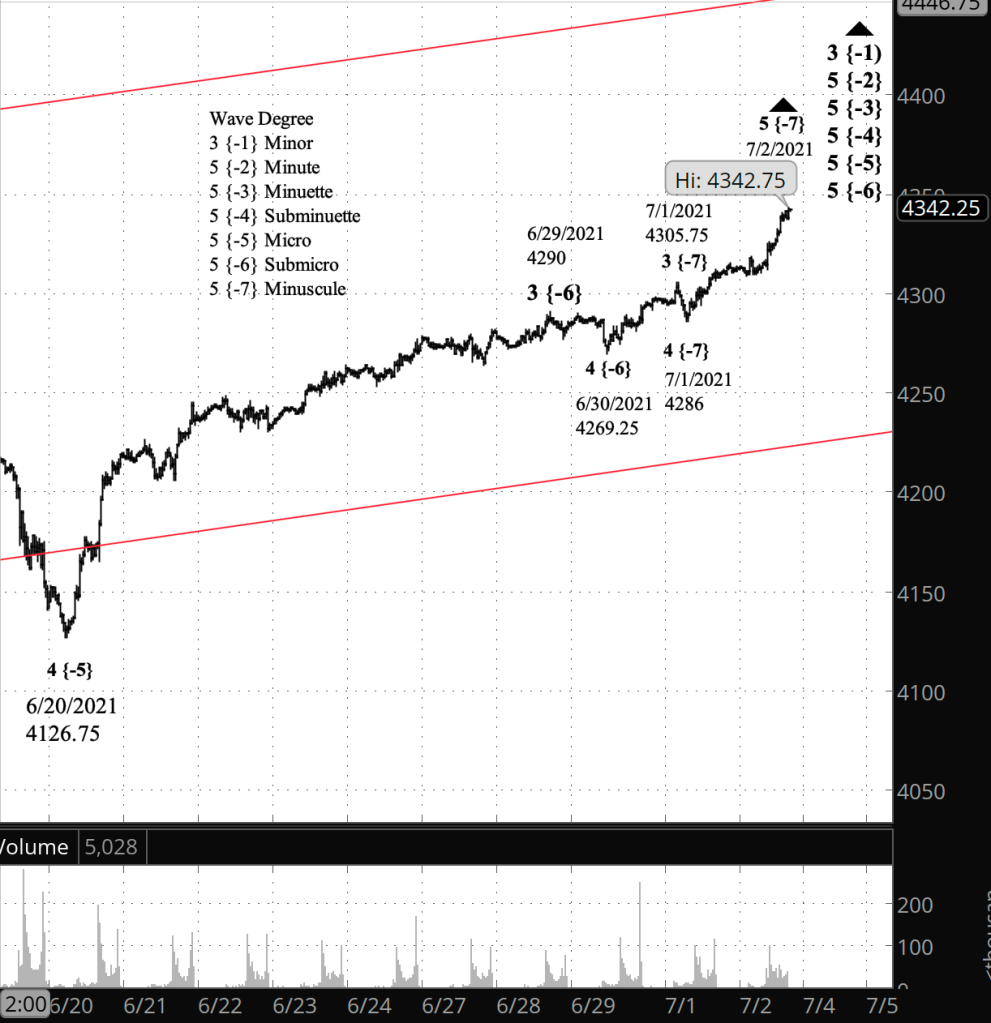
[S&P 500 E-mini futures at 3:30 p.m., 30-minute bars, with volume]

12:10 p.m. New York time

Fishing for a high. And the S&P 500 moved higher, meaning that my alternative analysis was correct. The index and it’s derivatives are fishing for higher highs. Wave 3 of Minor degree is still underway, as is its internal wave six levels down, wave 5 of Minuscule degree.

9:25 a.m. New York time

What’s happening now? The S&P 500 reached a higher high of 4325.75 on the E-mini futures shortly before the opening bell, and then reversed to the downside. Trading on the index opened a few minutes later and it quickly moved to a high of 4334.16.

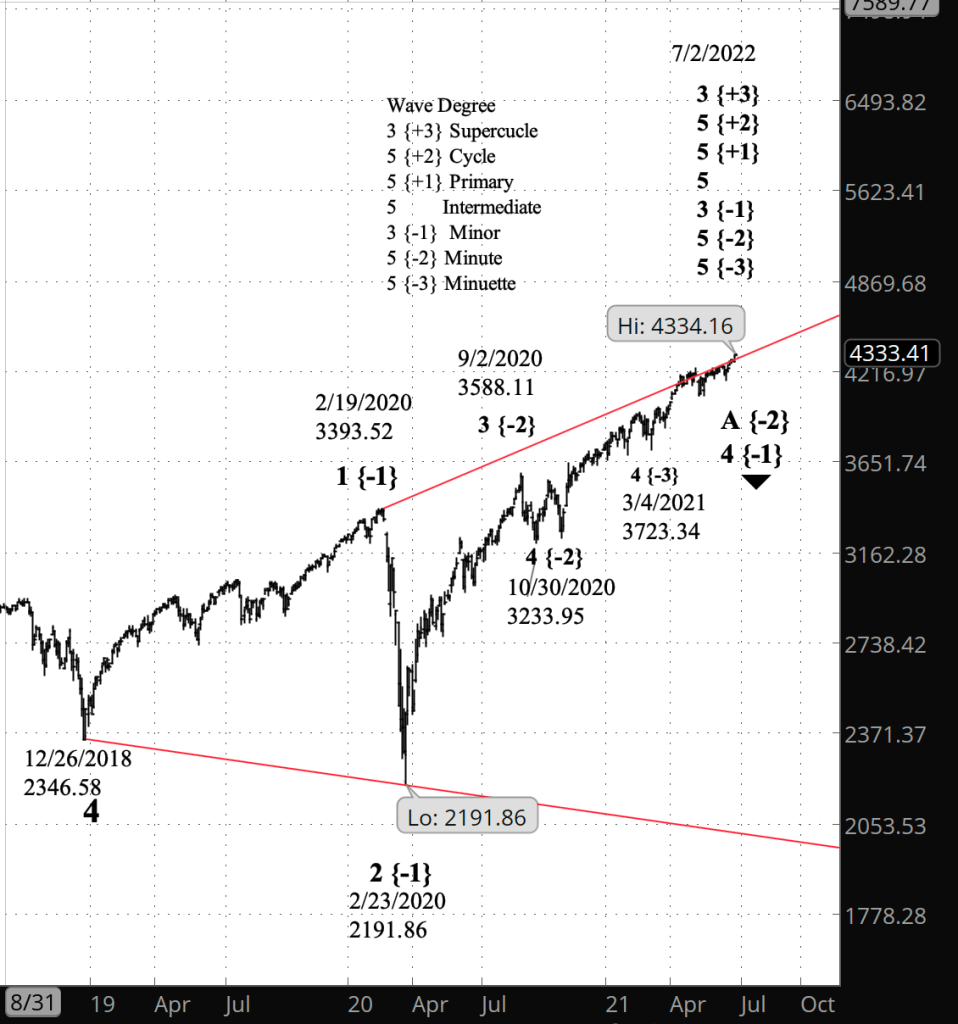
What does it mean? In analyzing the charts below, I’ve treated the morning peak as the end of the rise that began on February 23, 2020. The decline from the peak, although of a very small scale, was dramatic, with none of the wishy washy dawdling that we see when traders are uncertain whether to bid higher. If this principle analysis is indeed correct, then the 16-month rise that began in February of last year, is complete, and a major movement to the downside has begun. It will eventually carry the price down to below 2000, the lower boundary of an expanding triangle that began in December 2018.

What’s the alternative? If the price moves above 4325.75, then we’re back to a game of where’s the top, which we’ve been playing for the past few days. In this alternative analysis, the rise is still underway, and the principle analysis will be shelved as we await the start of the next downward movement in triangle.
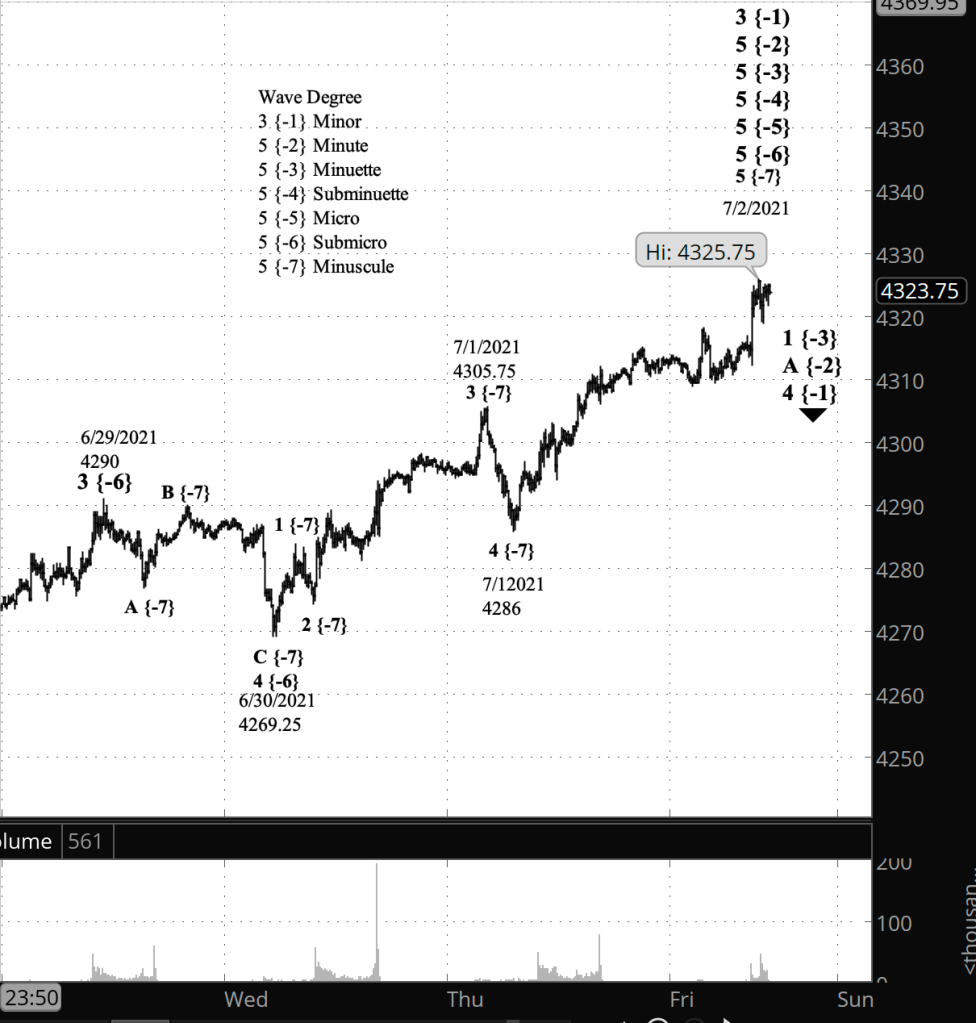
[Close-up: S&P 500 E-mini futures at 9:34 a.m., 10-minute bars, with volume]
[Big view: S&P 500 index at 9:25 a.m., 2-day bars]

What does Elliott wave theory say? The large downward movement that began modestly after this morning’s high is wave 4 of Minor degree with an expanding diagonal triangle that is wave 5 of Intermediate degree, having begun on December 26, 2018. Diagonal triangles have five waves altogether, bouncing between two boundaries that over time grow further apart from one another. How low can it go? That’s a function of time; the longer it takes the price to reach the lower boundary, presently around 2020, the lower that boundary will have dropped.

Whether this principle analysis is indeed valid at this time depends upon the price remaining below this morning’s high, 4325.75 on the futures and 4334.16 on the index. If the price moves above those levels, then the alternative analysis kicks in: Minor wave 3 is still in progress, as it has been since it began on February 23, 2020, and the subsequent progress of the chart described in the present principle analysis will be deferred until Minor 3 ends.

Learning and other resources. See the menu page Analytical Methods for a rundown on where to go for information on Elliott wave analysis.

By Tim Bovee, Portland, Oregon, July 2, 2021

Disclaimer

Tim Bovee, Private Trader tracks the analysis and trades of a private trader for his own accounts. Nothing in this blog constitutes a recommendation to buy or sell stocks, options or any other financial instrument. The only purpose of this blog is to provide education and entertainment.

No trader is ever 100 percent successful in his or her trades. Trading in the stock and option markets is risky and uncertain. Each trader must make trading decisions for his or her own account, and take responsibility for the consequences.

License
Creative Commons License

All content on Tim Bovee, Private Trader by Timothy K. Bovee is licensed under a Creative Commons Attribution-ShareAlike 4.0 International License.

Based on a work at www.timbovee.com.
SP500 Analysis

3:30 p.m. New York time

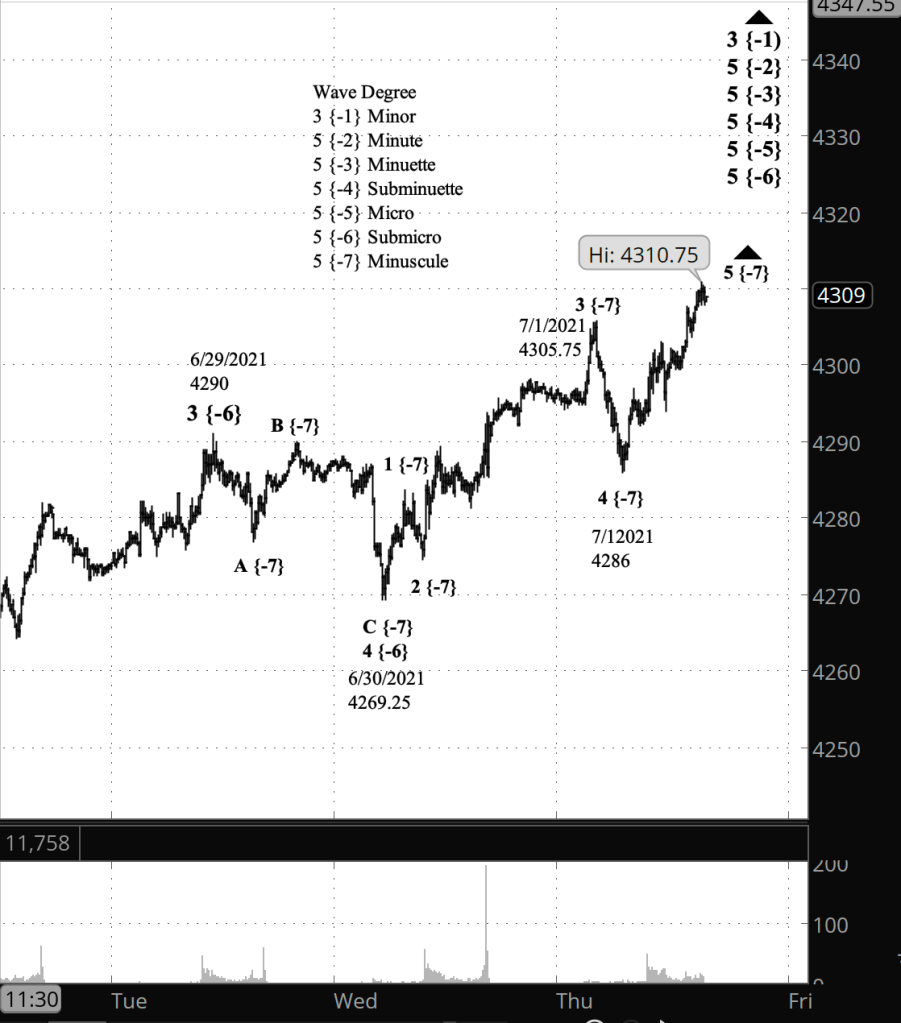
Half an hour before the closing bell. The S&P 500 continued to rise during the day, exceeding the high set before the opening bell, to a peak of 4310.75 on the futures (4319.96 on the index. Because of the rise to new high, I’ve changed my analysis to show the July 1 low of 4286 on the futures (4300.73 on the index) as the end of wave 4 of Minuscule degree, and the subsequent rise to a new high as wave 5 of Minuscule degree, which is still underway. Minuscule 5 is the final wave of Submicro degree, and its completion will also be the completion of five 5th waves of increasingly higher degree, to Minute wave 5, and up one, the completion of wave 3 of Minor degree.

9:50 a.m. New York time

What’s happening now? The S&P 500 E-mini futures rose to a new high, 4305.75, in overnight trading

What does it mean? The uptrend that began June 20 is still underway but nearing an end.

What’s the alternative? If the present rise fails to top 4305.75, then the uptrend ended at that point.

[S&P 500 E-mini futures at 3:30 p.m., 10-minute bars, with volume]

What does Elliott wave theory say? In the chart today I drill down to a close-up to see in detail what’s happening within wave 5 of Micro degree, which began on June 20.

One degree down, wave 3 of Submicro degree ended on June 29 at 4290. It was followed by a 4th wave downward correction containing three waves of Minuscule degree and ending on June 30 at 4269.25.

The final wave of the uptrend follows, wave 5 of Submicro degree. By my count, the overnight high of 4305.75 ends wave 3 of Minuscule degree within wave 5 of Submicro degree. The fall from that endpoint is a 4th wave correction of Minuscule degree, and it has been followed by a three-wave rise which is an ongoing wave B of Subminuscule degree.

The B wave will be followed by Subminuscule C, which may complete the correction, although often 4th waves will extend in compounds patterns.

At any rate, Minuscule wave 4 will be followed by Minuscule wave 5 to the upside, which will rise above 4305.75 and when complete, will mark the end of wave 5 of Micro degree and of 5th waves all the way up to Minute degree, and also that Minute degree’s parent, wave 3 of Minor degree, which began on February 23, 2020 from 2191.86 on the S&P 500 index.

Learning and other resources. See the menu page Analytical Methods for a rundown on where to go for information on Elliott wave analysis.

By Tim Bovee, Portland, Oregon, July 1, 2021

Disclaimer

Tim Bovee, Private Trader tracks the analysis and trades of a private trader for his own accounts. Nothing in this blog constitutes a recommendation to buy or sell stocks, options or any other financial instrument. The only purpose of this blog is to provide education and entertainment.

No trader is ever 100 percent successful in his or her trades. Trading in the stock and option markets is risky and uncertain. Each trader must make trading decisions for his or her own account, and take responsibility for the consequences.

License
Creative Commons License

All content on Tim Bovee, Private Trader by Timothy K. Bovee is licensed under a Creative Commons Attribution-ShareAlike 4.0 International License.

Based on a work at www.timbovee.com.
SP500 Analysis

3:30 p.m. New York time

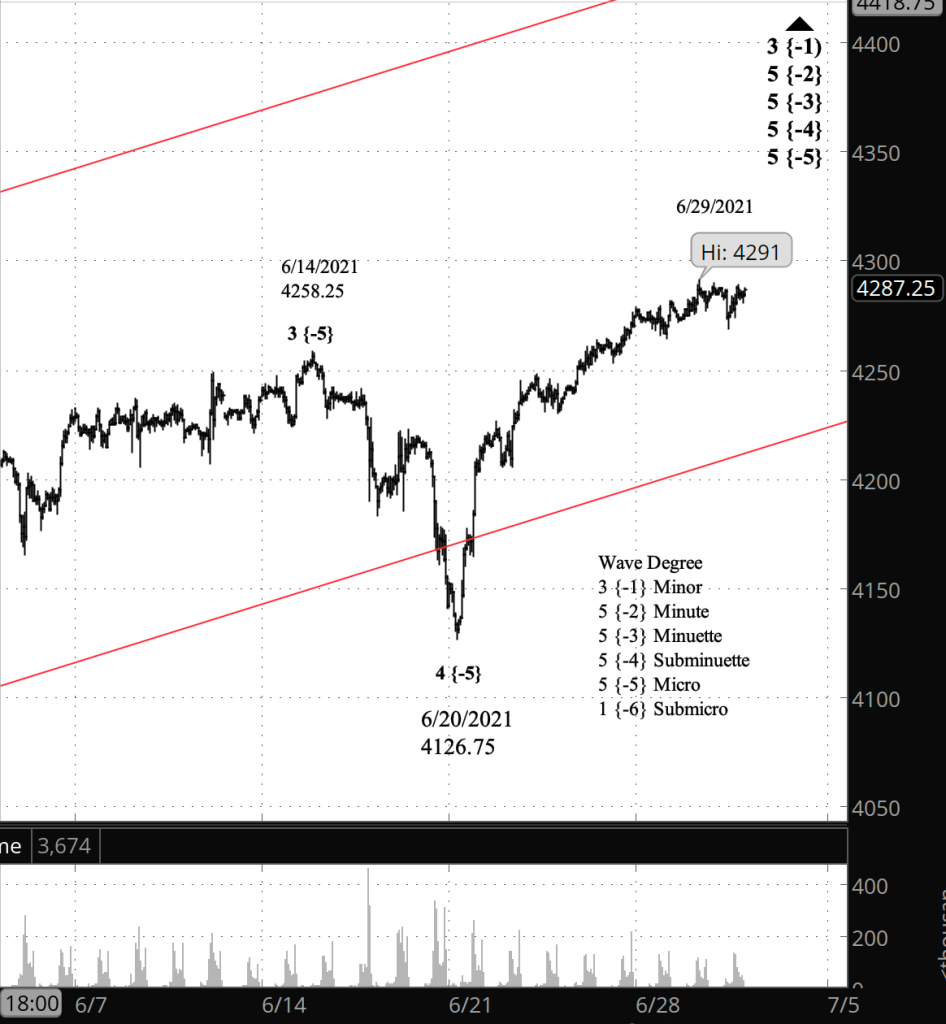
Half an hour before the closing bell. The S&P 500 futures dropped nearly 22 points below the high of the day before and then rose, coming to within less than 2 points of that peak. A move above the June 29 high of 4291 on the futures would mean that wave 5 of Micro degree is still underway and rising. As long as the price remains below that level, it is possible, although not certain, that the Micro 5th wave is complete and that the trend is down. I’ve updated the chart below.

9:40 a.m. New York time

What’s happening now? The S&P 500 E-mini futures dawdled overnight below yesterday’s peak, 4291, in overnight trading.

What does it mean? The rise from June 20 has met the requirements for a complete uptrend, and so 4291 could mark the end of that rise, to be followed by a significant movement to the downside.

What’s the alternative? Nothing on the chart precludes the rise from June 20 from extending higher.

[S&P 500 E-mini futures at 3:30 p.m., hourly bars, with volume]

What does Elliott wave theory say? The rise from June 20 is wave 5 of Micro degree. Internally, I can count the high of June 29 as being the end of the wave, but I see room for one more push to the upside, with the June 29 peak being the end of wave 3 of Submicro degree. There’s a bit of ambiguity on the chart.

The completion of Micro 5 will also mark the completion of three parent 5th waves, up to Minute degree, and above that the completion of wave 3 of Minor degree, setting up a signifiant correction to the downside. Minor wave 3 began more than a year ago, in February 2020, and so I would expect the Minor 4th wave correction to last a comparable length of time — maybe shorter, maybe longer, but still a movement best viewed on a one- or two-year chart.

Learning and other resources. See the menu page Analytical Methods for a rundown on where to go for information on Elliott wave analysis.

By Tim Bovee, Portland, Oregon, June 30, 2021

Disclaimer

Tim Bovee, Private Trader tracks the analysis and trades of a private trader for his own accounts. Nothing in this blog constitutes a recommendation to buy or sell stocks, options or any other financial instrument. The only purpose of this blog is to provide education and entertainment.

No trader is ever 100 percent successful in his or her trades. Trading in the stock and option markets is risky and uncertain. Each trader must make trading decisions for his or her own account, and take responsibility for the consequences.

License
Creative Commons License

All content on Tim Bovee, Private Trader by Timothy K. Bovee is licensed under a Creative Commons Attribution-ShareAlike 4.0 International License.

Based on a work at www.timbovee.com.
SP500 Analysis

3:30 p.m. New York time

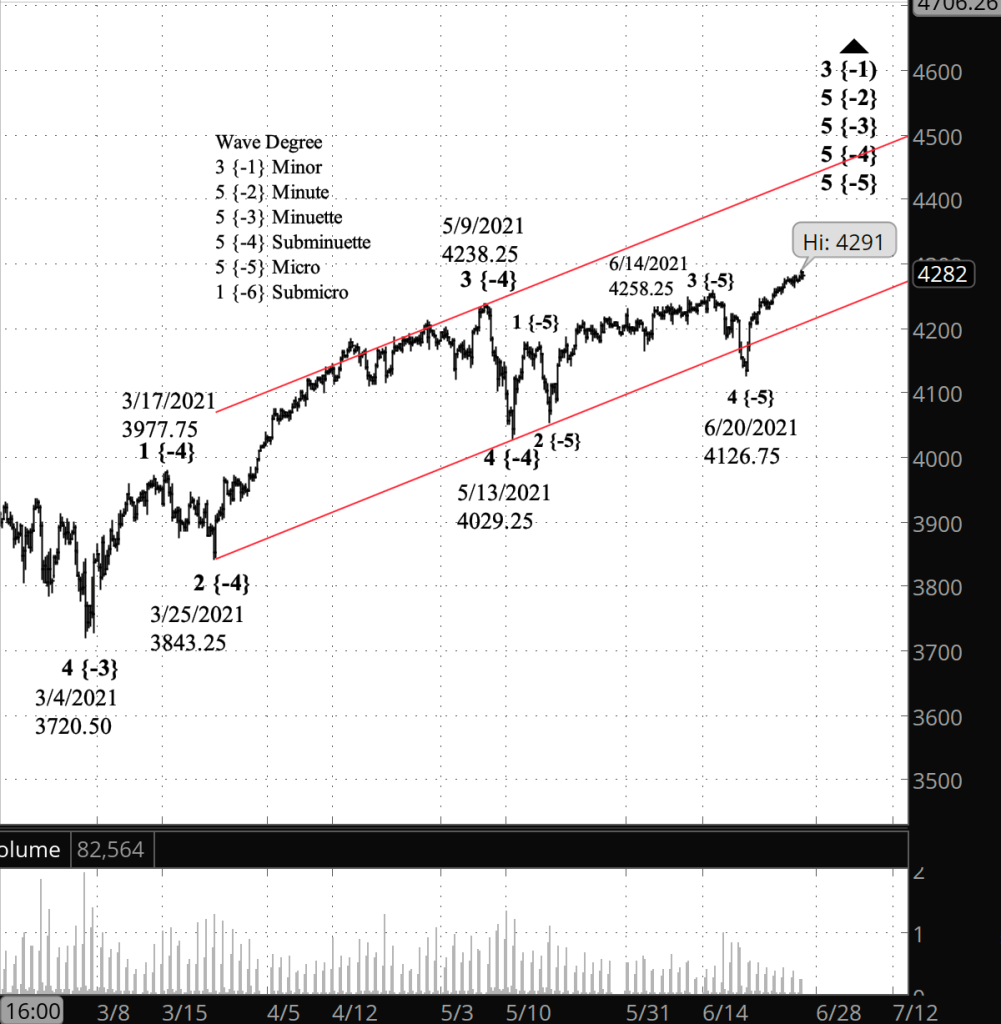
Half an hour before the closing bell. The S&P 500 continued nudging higher, reaching 4291 on the futures and 4300.52 on the index. No change in the analysis. Chart updated.

9:40 a.m. New York time

What’s happening now? Another day, another high on the S&P 500, which inched upward shortly after the opening bell to 4289 on the E-mini futures, 4299.80 on the index

What does it mean? The uptrend that began June 20 continues. It’s completion will mark the end not only of the near-term rise but of the uptrend that began after the crash early in the pandemic, in February 2020.

What’s the alternative? The price channel, racking the rise that began on March 4, provides target for the present uptrend, but there’s no guarantee that the price will reach that point, or even come close. And it good move well beyond that point. Price channels provide some analytical structure to a chart, but I treat them with a great deal of skepticism.

[S&P 500 E-mini futures at 3:30 p.m., 5-hour bars, with volume]

What does Elliott wave theory say? The rise from June 20 is wave 5 of Micro degree. The price channel tracks one degree higher, wave 5 of Subminuette degree. The rise that began in February 2020 is wave 3 of Minor degree, which is three degrees higher than Subminuette. Minor 3 is part of an expanding triangle that began in December 2018. The subsequent 4th wave in theory should approach the lower boundary of the triangle, presently in the low 2000s. And the Minor 5th wave after that will bring the price back up to highs at the upper boundary. Given that Minor wave 3 has lasted a year and four months so far, we’re talking about events that will take some time to unfold.

Learning and other resources. See the menu page Analytical Methods for a rundown on where to go for information on Elliott wave analysis.

By Tim Bovee, Portland, Oregon, June 29, 2021

Disclaimer

Tim Bovee, Private Trader tracks the analysis and trades of a private trader for his own accounts. Nothing in this blog constitutes a recommendation to buy or sell stocks, options or any other financial instrument. The only purpose of this blog is to provide education and entertainment.

No trader is ever 100 percent successful in his or her trades. Trading in the stock and option markets is risky and uncertain. Each trader must make trading decisions for his or her own account, and take responsibility for the consequences.

License
Creative Commons License

All content on Tim Bovee, Private Trader by Timothy K. Bovee is licensed under a Creative Commons Attribution-ShareAlike 4.0 International License.

Based on a work at www.timbovee.com.
SP500 Analysis

2:30 p.m. New York time

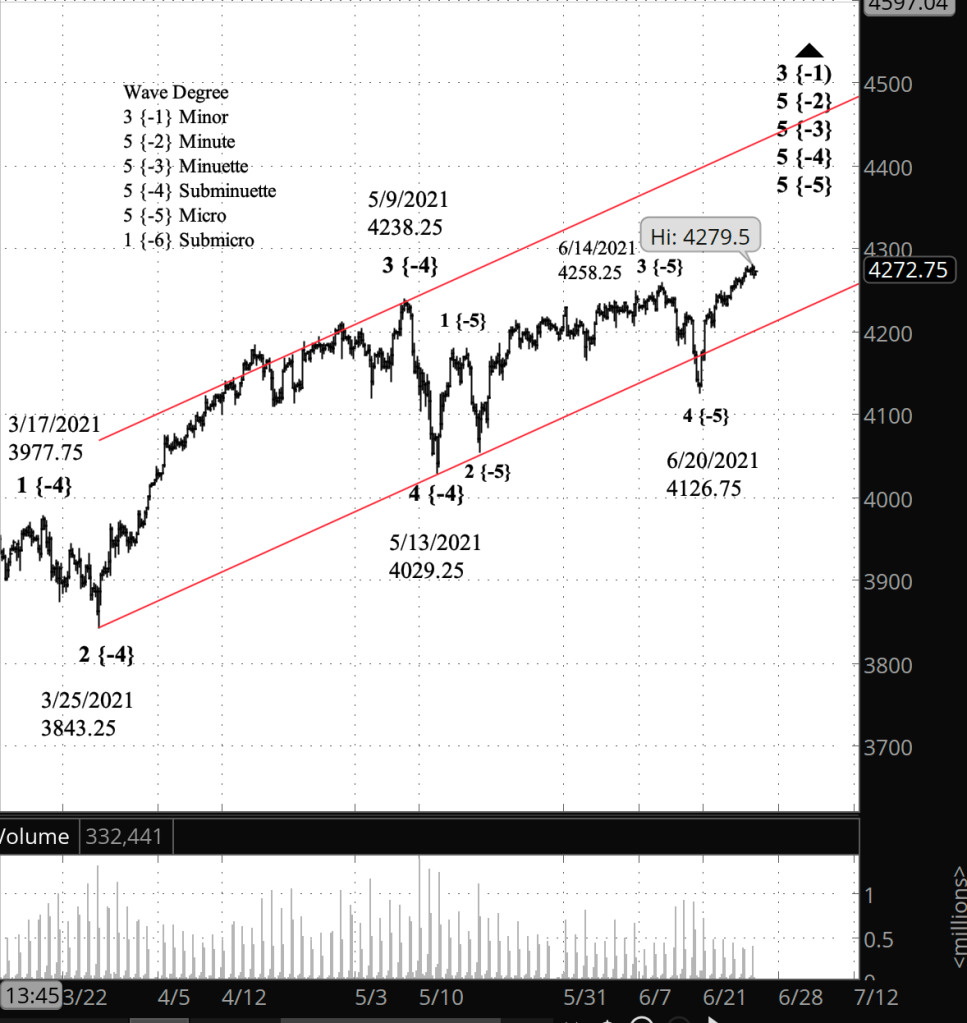
Ninety minutes before the closing bell. The S&P 500 has spent the day so far trading slightly below the early morning high, 4279.50 on the futures and 4288.41 on the index. No change in the analysis. I’ve update the chart.

9:40 a.m. New York time

What’s happening now? The S&P 500 E-mini futures rose overnight and shortly after the opening bell reached a new high, 4279.50.

What does it mean? The upward movement that began June 20 continues, within the large-scale rise that began February 23, 2020. The near-term target is 4500 or so.

What’s the alternative? Although I expect the rise from June 20 to end around the upper boundary of the price channel shown on the chart, there’s no guarantee that it won’t fall short of that target, and it could well move significantly beyond it. I treat price channels as guidance but not as certainties.

[S&P 500 E-mini futures at 2:30 p.m., 255-minute bars, with volume]

What does Elliott wave theory say? The rise from June 20 is wave 5 of Micro degree within wave 5 of Subminuette degree, which began on May 13. Micro 5 appears to be in its 5th and final wave internally, which means it could reverse at any point into a wave 1 downtrend within a larger downward correction.

At larger degrees, the market is in an uptrend, wave 3 of Minor degree, that began with the February 23, 2020 completion of a corrective wave early in the pandemic, wave 2 of Minor degree. This is all happening within wave 5 of Intermediate degree, which began on December 26, 2018 and is taking the form of an expanding triangle.

For the price channel, I’ve chosen to track wave 5 of Minuette degree, which began May 4 from 3723.34. The upper boundary that provides a price target for Subminuette wave 5 presently is in the 4420s and will reach 4500 by mid-July.

Learning and other resources. See the menu page Analytical Methods for a rundown on where to go for information on Elliott wave analysis.

By Tim Bovee, Portland, Oregon, June 28, 2021

Disclaimer

Tim Bovee, Private Trader tracks the analysis and trades of a private trader for his own accounts. Nothing in this blog constitutes a recommendation to buy or sell stocks, options or any other financial instrument. The only purpose of this blog is to provide education and entertainment.

No trader is ever 100 percent successful in his or her trades. Trading in the stock and option markets is risky and uncertain. Each trader must make trading decisions for his or her own account, and take responsibility for the consequences.

License
Creative Commons License

All content on Tim Bovee, Private Trader by Timothy K. Bovee is licensed under a Creative Commons Attribution-ShareAlike 4.0 International License.

Based on a work at www.timbovee.com.
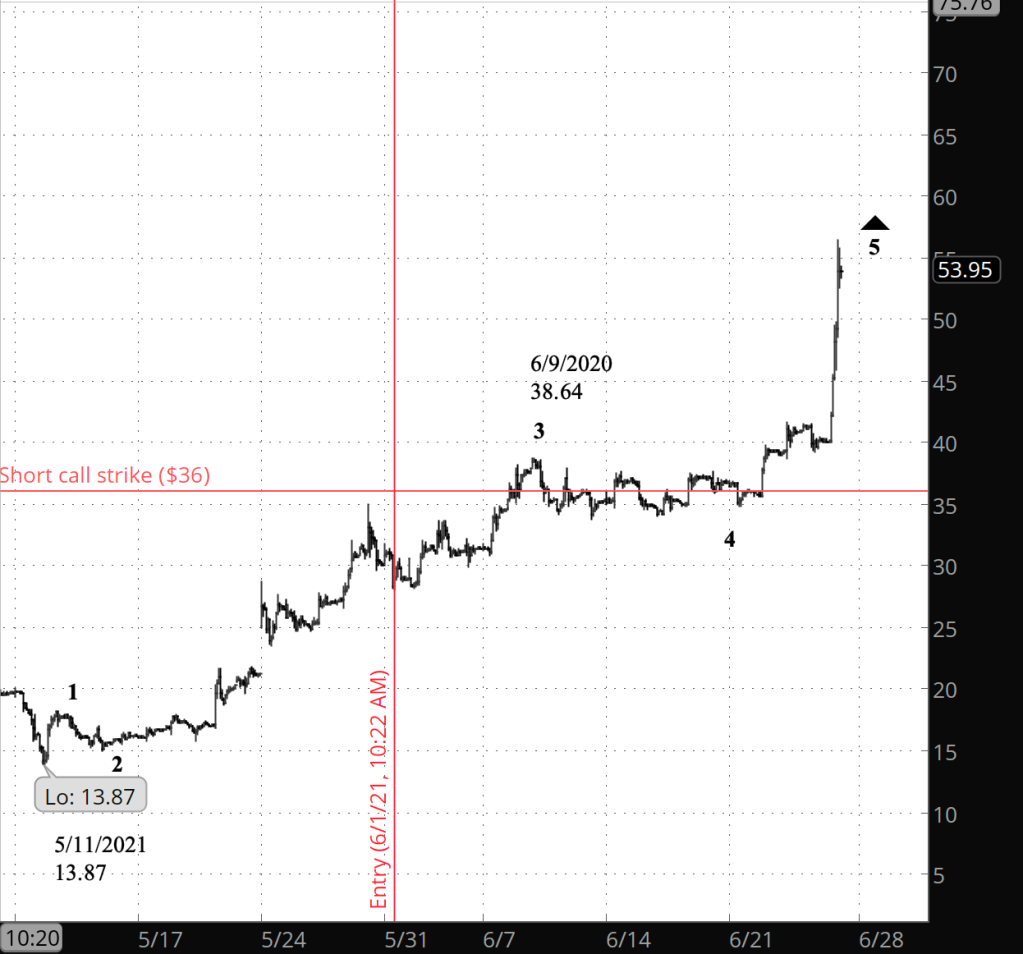
SPCE Trade: 21 Days

Virgin Galactic Holdings Inc. (SPCE)

1:30 p.m. New York time

Today is 21 days before expiration of my short bear call spread options position on SPCE, which I entered on June 1 for a $70 premium per contract. The position expires on July 16.

Under my rules for such trades, the 21-day mark is when I manage the position, closing the winners no matter how small the profit. I hold on to the unprofitable positions, usually, playing the odds that the position will return to profitability.

And the chance of a return is significant. The smaller the loss the greater the odds of a profit. Research done by the TastyTrade — the best source I’ve found of information about options — found a 7-0% chance of a return to profitability if the loss at 21 days is one or two times the premium, when the initial short leg of the spread had a 16% delta, which is is the standard delta for placing the short leg under my rules. (The full video discussion of the research can be found here.)

So what about my SPCE position?

The analysis of the position posted at the time put the odds of the price remaining below the upper boundary of full profitability — $36 — at 78%. But I fudged my rules in positioning the short call in the position. Rather than putting it at the 16 delta mark, I put it at delta 39%.

My reasoning went like this. Context: It’s a low volatility market, and SPCE is the only liquid symbol that met my Implied Volatility Rank (IVR) requirements. Even with all of that, the premium at 16 delta was low. My Elliott wave analysis (see the chart on the entry analysis post) suggested little chance that the price would be above the $36 mark, and so I accepted the increased risk

And the analysis proved to be accurate, with the price making a few small forays above $36, until June 22, when the price began to rise, exceeding $40 the next day. And then today, on June 25, the price shot up, reaching a high so far of $56.40.

[SPCE at 1:06 p.m., 70-minute bars]

I’ve often said in my daily analyses of the S&P 500 that Elliott wave analysis provides context, not prophecy. It will tell us the implications of what we see on the chart right now, but if the chart changes, then so does our analysis of the implications. So it is with this chart.

The rise that began June 25 is a 5th wave, and probably a 3rd wave within it, which means that there’s significant upside left. At present, the share price is at 53.48 and the cost of exiting is $3.78 per contract share. The present loss is approximately five times the premium, which places the odds of a reversal to profitability as very unlikely indeed.

And so the question becomes, what’s the best exit strategy? First off, rolling the short call up isn’t really an option. The long call in the position has a strike price of $41, which is still in massive loss territory.

But of course, that $41 long strike is my insurance policy for the position, limiting my loss. If I hold the position through expiration, I’ll pay no more than $41 each for the shares dumped into my account.

And of course, we’ve had a very large rise today, and every rise I’ve seen is followed by a partial retracement. So I have 21 days to wait for that to happen, limiting my loss.

So here’s my decision: I’ll continue to hold the position, keeping a close watch on it, as always, and preparing to exit when the price is right. The “right” price will be a profit, of course, if it happens. And if it doesn’t, then the “right” price will be one that lessens the pain the of the loss.

Learning and other resources. See the menu page Analytical Methods for a rundown on where to go for information on Elliott wave analysis.

By Tim Bovee, Portland, Oregon, June 25, 2021

Disclaimer

Tim Bovee, Private Trader tracks the analysis and trades of a private trader for his own accounts. Nothing in this blog constitutes a recommendation to buy or sell stocks, options or any other financial instrument. The only purpose of this blog is to provide education and entertainment.

No trader is ever 100 percent successful in his or her trades. Trading in the stock and option markets is risky and uncertain. Each trader must make trading decisions for his or her own account, and take responsibility for the consequences.

License
Creative Commons License

All content on Tim Bovee, Private Trader by Timothy K. Bovee is licensed under a Creative Commons Attribution-ShareAlike 4.0 International License.

Based on a work at www.timbovee.com.
SP500 Analysis

3:30 p.m. New York time

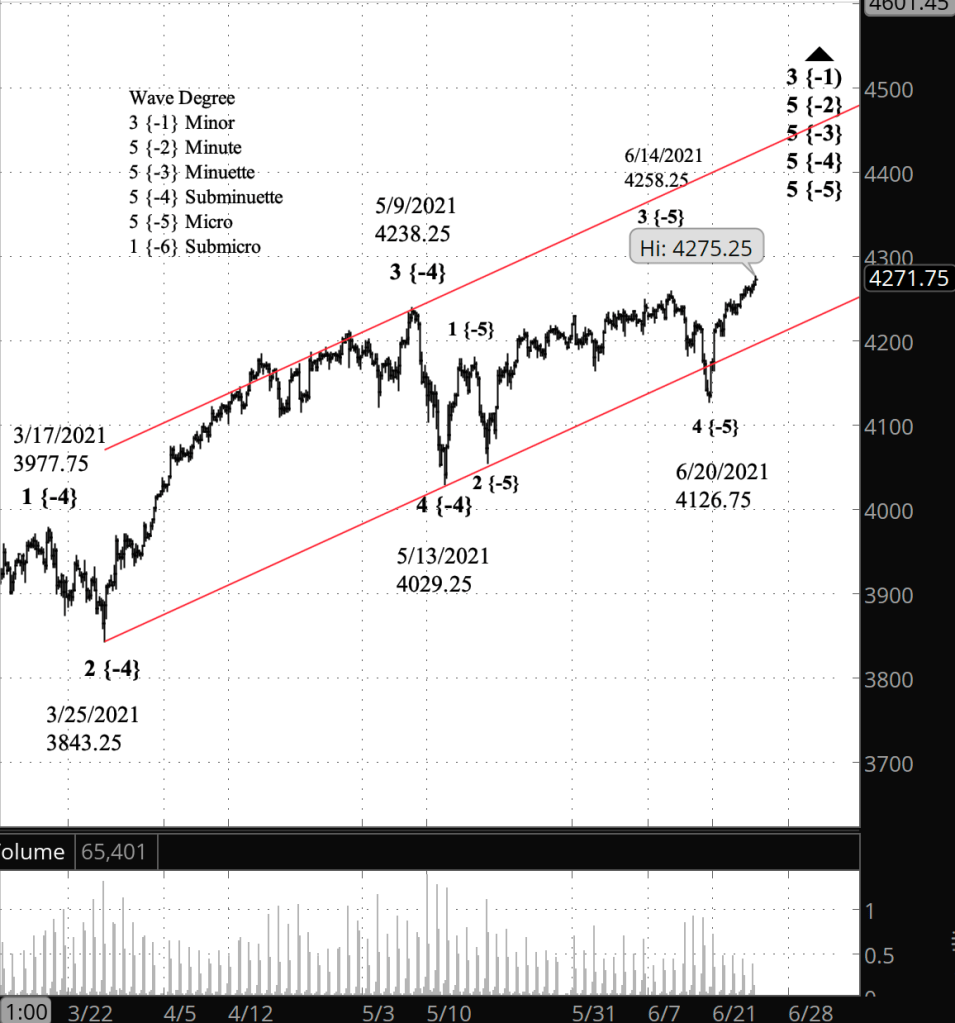
Half an hour before the closing bell. The S&P 500 continue to move higher, reaching 4275.25 on the futures, 4284.94 on the index. No change in the analysis, and I’ve updated the chart.

9:35 a.m. New York time

What’s happening now? The S&P 500 E-mini futures rose slightly in overnight trading and at the opening bell had reached a high of 4266.25.

What does it mean? The rise that began on March 20 continues, part of a larger uptrend that has been underway for 16 months. The present uptrend is the final leg in a much larger uptrend, and its completion will be followed by a significant decline.

What’s the alternative? As the price continually reaches new highs, it’s important to remember that each latest high point is potentially the end of the rise and the beginning of a new downtrend. Or not. The rules of my analysis set no upper boundary.

[S&P 500 E-mini futures at 3:30 p.m., 255-minute bars, with volume]

What does Elliott wave theory say? The rise from June 20 is wave 5 of Micro degree, the final upward push in the rise that began May 13, labelled wave 5 of Subminuette degree. And indeed, the end of the present five-day-old rise will cascade three degrees up the fractal structure to mark the end of wave 5 of Minute degree and, one degree higher, wave 3 of Minor degree, which began on February 23, 2020 from 2191.86.

There is no certain way to set a target for wave 5 of Micro degree, nor can we do more than guess how long it may take for wave 5 to reach its end. The upper boundary of the parent degree’s price channel — wave 5 of Subminuette degree — suggests a possible target in the 4400s if the price reaches the upper boundary around July 5. The longer it takes to reach the boundary, the higher the possible target.

The one certainty is that the present wave internally will contain five waves — up, down, up, down, up — in a rising sequence. Presently, Micro 5’s child wave is wave 1 of Submicro degree. So based on form, Micro 5 has a ways to go.

Learning and other resources. See the menu page Analytical Methods for a rundown on where to go for information on Elliott wave analysis25

By Tim Bovee, Portland, Oregon, June 25, 2021

Disclaimer

Tim Bovee, Private Trader tracks the analysis and trades of a private trader for his own accounts. Nothing in this blog constitutes a recommendation to buy or sell stocks, options or any other financial instrument. The only purpose of this blog is to provide education and entertainment.

No trader is ever 100 percent successful in his or her trades. Trading in the stock and option markets is risky and uncertain. Each trader must make trading decisions for his or her own account, and take responsibility for the consequences.

License
Creative Commons License

All content on Tim Bovee, Private Trader by Timothy K. Bovee is licensed under a Creative Commons Attribution-ShareAlike 4.0 International License.

Based on a work at www.timbovee.com.
SP500 Analysis

3:30 p.m. New York time

Half an hour before the closing bell. The S&P 500 rose slightly from this morning’s high, to 4260.75 on the futures.

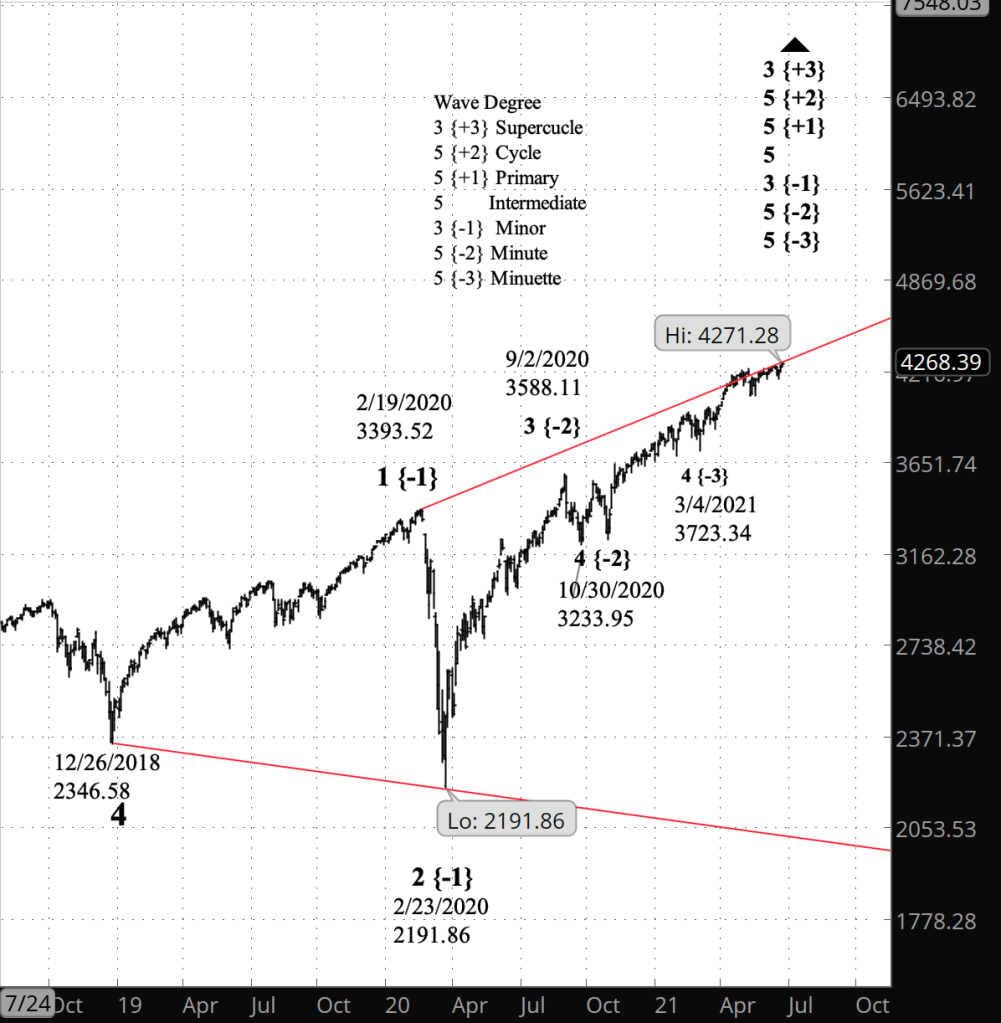
For perspective, here is a longer-term chart, tracing the entirety of the expanding diagonal triangle that marks the form taken by the S&P 500 during wave 5 of Intermediate degree since it began on December 26, 2018 from 2346.58.

The present rise, wave 3 of Minor degree, began on February 23, 2020 from 2191.86, the end of the 2nd wave crash early in the pandemic. Within Minor 3, wave 5 of Minuette degree — two degrees below Minor — began its rise on March 4, 2021 from 3723.40.

With an expanding triangle, we can expect a significant decline after the present wave 3 of Minor degree completes its rise. The decline ideally will reach the lower boundary of the triangle, which is presently around 2040 and declining further each day.

[Longer view: S&P 500 index at 3:19 p.m., 2-day bars]

10:30 a.m. New York time

Note: This replaces the analysis posted at 9:45 a.m., which was outdated by events shortly after the opening bell.

What’s happening now? The S&P 500 index moved above its high of June 14, to a new all-time high of 4270.53, extending the rise that began in February 2020, after the crash early in the pandemic. The E-mini futures exceeded its high of Juen 14, reaching a higher high of 4260.25 so far.

What does it mean? The index high means that the prior principle analysis gets tossed out the window and is replaced by the former alternative analysis.

The new principle analysis: The rise of May 13 to June 14 was the middle movement within a larger uptrend that began on May 13. It was followed by a correction, and the final movement within the larger uptrend has begun. I expect it to continue to rise into the 4400s, perhaps, and it could go higher. See the “Elliott wave theory” section below for a discussion.

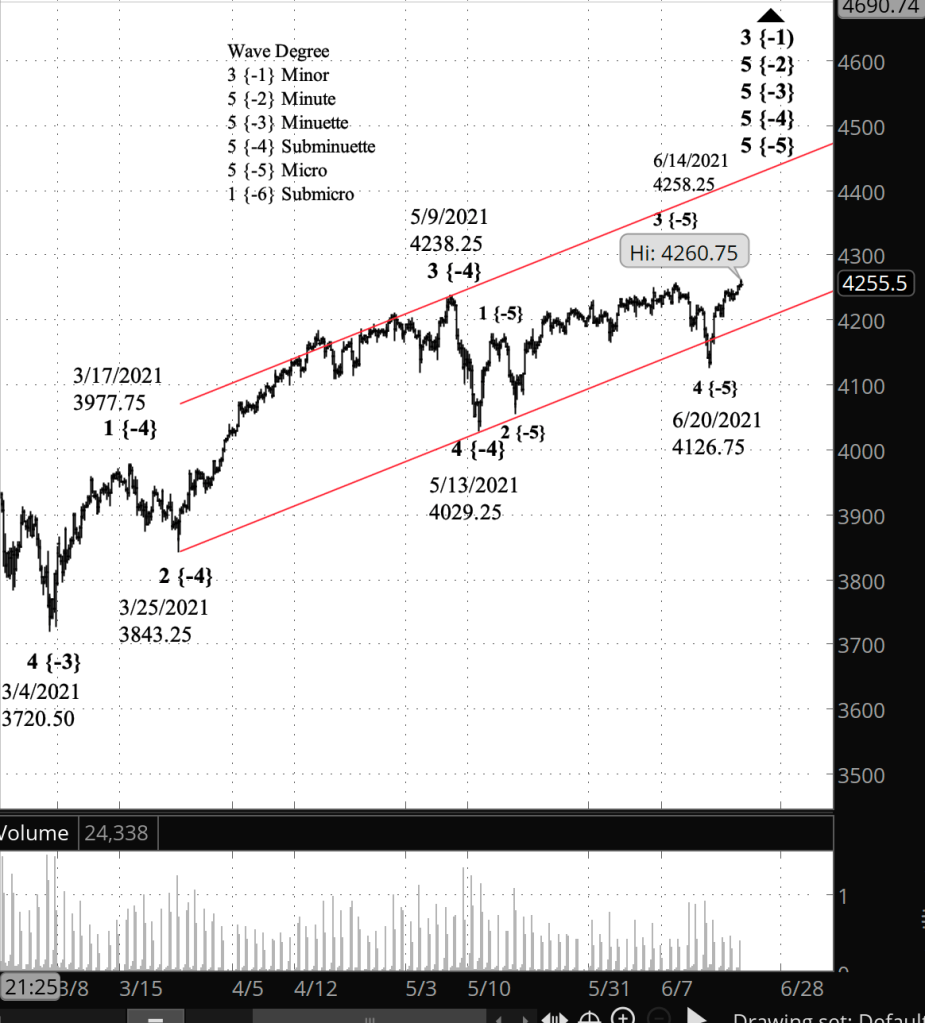
[Shorter view: S&P 500 E-mini futures at 3:30 p.m., 245-minute bars, with volume]

What does Elliott wave theory say? Wave 5 of Subminuette degree began on May 13 from 4029.25, and the present rise, from June 20, is the wave 5 of Micro degree, a child wave of the Subminuette. The decline from June 14 to June 20 was wave 4 of Micro degree. This is all happening within the parent, wave 5 of Minuette degree, which began on March 4 from 3720.50

So how much upside is there in the present Micro 5 rise? Elliott wave theory has few rules the how far a 5th wave can go. Some are short. Some extend far beyond all reasonable expectations. A price channel for the parent wave 5 of Minuette degree can provide some guidance. I’ve drawn it to connect the beginnings of waves 3 and 5 of Subminuette degree, with a parallel wave touching the end of wave 1 of Subminuette degree. If the rise reached the upper boundary on July 5, for example, the price would be in the 4460s. The sooner the price reaches the boundary, the lower the target. The longer it takes to get there, the higher the target.

Learning and other resources. See the menu page Analytical Methods for a rundown on where to go for information on Elliott wave analysis.

By Tim Bovee, Portland, Oregon, June 24, 2021

Disclaimer

Tim Bovee, Private Trader tracks the analysis and trades of a private trader for his own accounts. Nothing in this blog constitutes a recommendation to buy or sell stocks, options or any other financial instrument. The only purpose of this blog is to provide education and entertainment.

No trader is ever 100 percent successful in his or her trades. Trading in the stock and option markets is risky and uncertain. Each trader must make trading decisions for his or her own account, and take responsibility for the consequences.

License
Creative Commons License

All content on Tim Bovee, Private Trader by Timothy K. Bovee is licensed under a Creative Commons Attribution-ShareAlike 4.0 International License.

Based on a work at www.timbovee.com.
SP500 Analysis

Note: Just as I posted the price of the index moved above the June 14 high. I reworked analysis entirely and posted a new analysis. This analysis is no longer valid, having been overtaken by events. I’m leaving it up for comparison with the new analysis.

9:45 a.m. New York time

What’s happening now? The S&P 500 E-mini futures, in the rise that began on June 20, reached a new high shortly after the opening bell.. That level is at the all-time high of 4258.25, set on June 14. The S&P 500 index exceeded the June 14 high, creating a discrepancy between the two products.

What does it mean, #1? As long as the price remains at or below the June 14 high, my principle analysis is that the S&P 500 futures in an upward correction within a larger downtrend. The longer term expectation is for prices to fall significantly. Talk about hanging by a thread! This analysis is one penny away from being replaced by the alternative.

What does it mean, #2? If the price moves above the June 14 high, then the decline that began on June 14 was a correction within an ongoing uptrend, and the rise that began on June 20 is a resumption of the uptrend after the correction. The longer term expectation is for prices to rise, with no way to tell how high they hight go.

[S&P 500 E-mini futures at 9:46 a.m., 40-minute bars, with volume]

What does Elliott wave theory say? Principle analysis: Wave 2 of Micro degree is underway. I had counted it internally as wave A of Submicro degree within wave 2, but with no room between the wave 2 high and the June 14 peak, I don’t see how the A label can be correct. There’s just not enough space for a future C wave. Under this analysis, the June 14 peak ended a long-running uptrend all the way up to Minute degree.

If the price moves above the June 14 peak, then the rise from June 20 cannot be wave 2, because under the rules of Elliott wave theory, a 2nd wave cannot move beyond the start of the preceding wave 1. A move beyond that peak would mean that the June 14 peak was the start of a small correction within wave 5 of Minute degree and its child waves.

Learning and other resources. See the menu page Analytical Methods for a rundown on where to go for information on Elliott wave analysis.

By Tim Bovee, Portland, Oregon, June 24, 2021

Disclaimer

Tim Bovee, Private Trader tracks the analysis and trades of a private trader for his own accounts. Nothing in this blog constitutes a recommendation to buy or sell stocks, options or any other financial instrument. The only purpose of this blog is to provide education and entertainment.

No trader is ever 100 percent successful in his or her trades. Trading in the stock and option markets is risky and uncertain. Each trader must make trading decisions for his or her own account, and take responsibility for the consequences.

License
Creative Commons License

All content on Tim Bovee, Private Trader by Timothy K. Bovee is licensed under a Creative Commons Attribution-ShareAlike 4.0 International License.

Based on a work at www.timbovee.com.
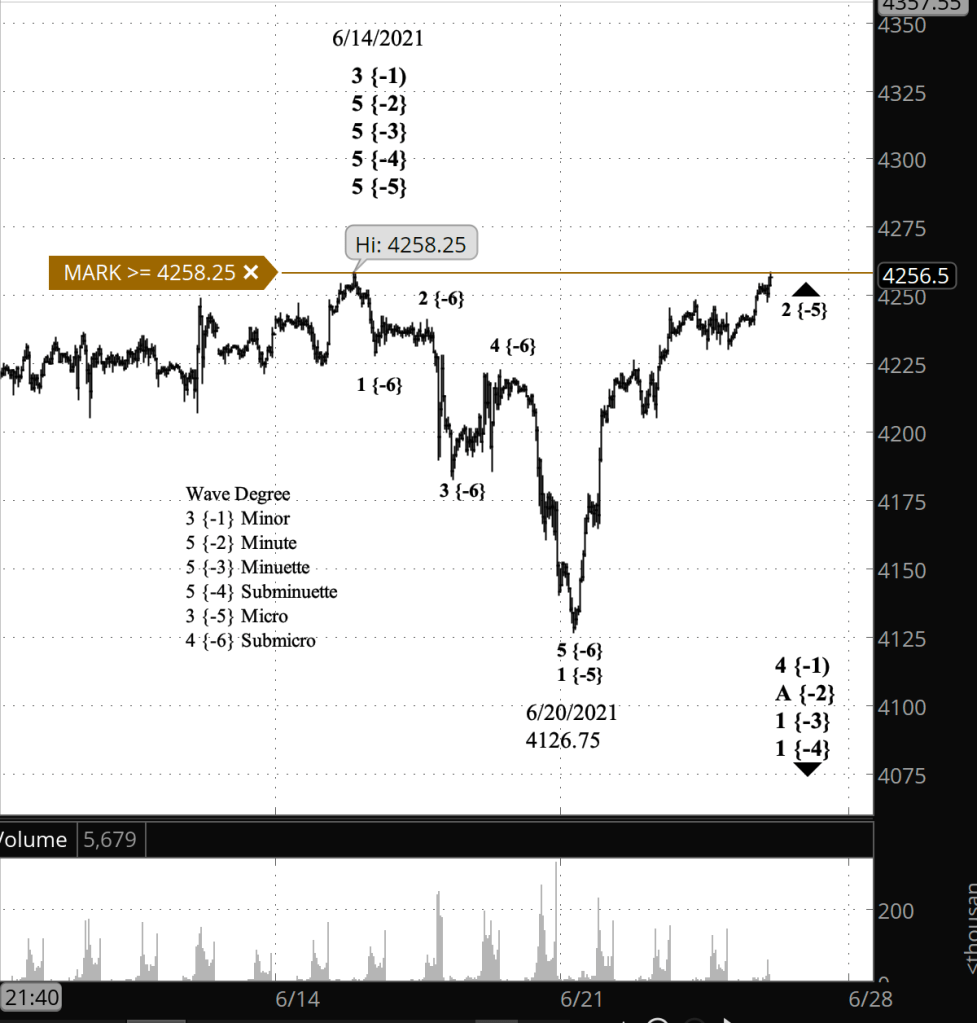
SP500 Analysis

3:30 p.m. New York time

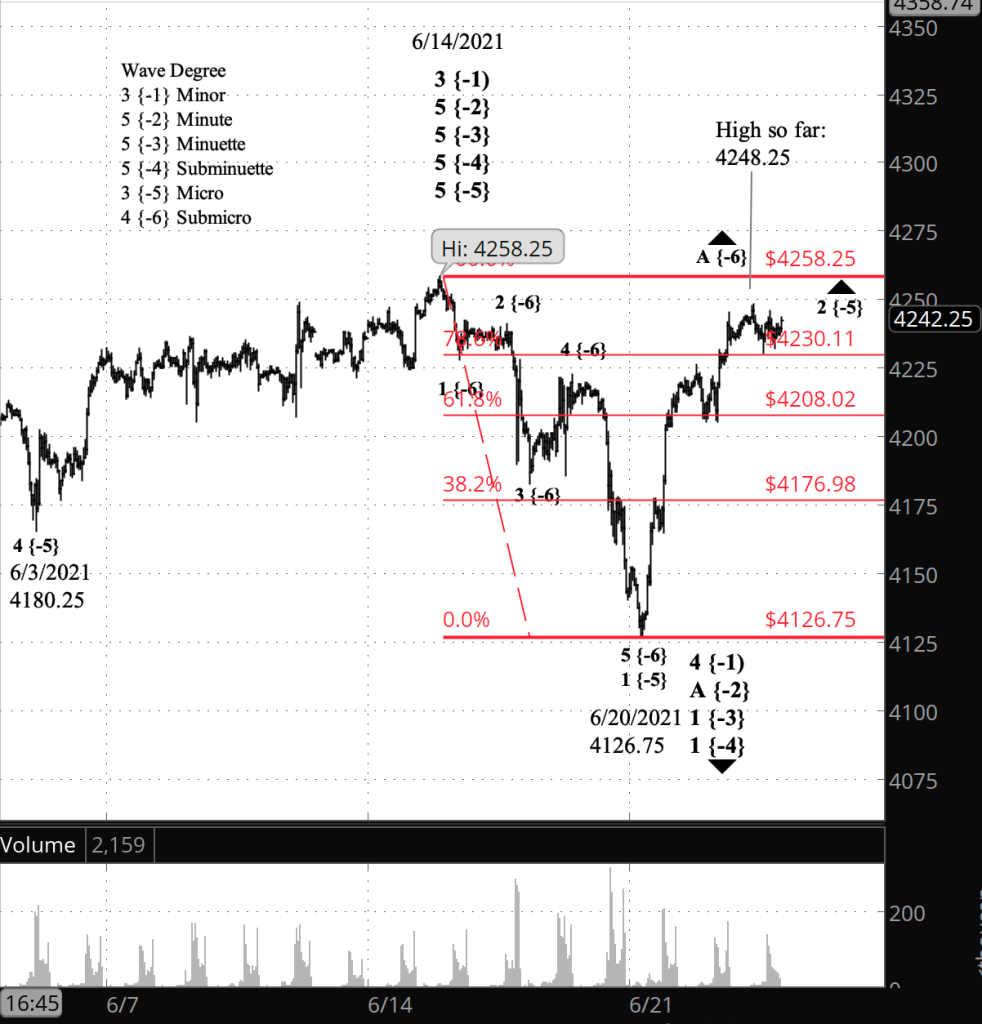
Half an hour before the closing bell. The S&P 500 stayed below its early high today of 4248.25 on the futures, 4256.60 on the index, which kept the price below the June 14 high of 4258.25 on the futures, 4257.16 on the index. The analysis is unchanged. I’ve updated the chart.

9:40 a.m. New York time

What’s happening now? The S&P 500 E-mini futures in overnight trading rose to 4248.25 and then reversed slightly.

What does it mean? The overnight high is 10 points below the June 14 peak of 4258.25. By my principle analysis, the rise from June 20 is the middle portion of an upward correction that will be followed by a resumption of the larger downtrend, as long as the price remains at or below the June 14 peak.

What’s the alternative? If the price exceeds the June 14 peak, then the uptrend that began in February 2020, after the early pandemic crash, is still underway, and the decline from that date to June 20 was a correction within that uptrend.

[S&P 500 E-mini futures at 3:30 p.m., 45-minute bars, with volume]

What does Elliott wave theory say? Following the overnight high, which is wave A of Submicro degree within wave 2 of Micro degree under the principle analysis, the price reversed, dropping back to the 78.6% Fibonacci retracement level. Under the Elliott rules, a 2nd wave can’t move beyond the start of the preceding 1st wave, and a move above the June 14 high would violate that rule, requiring a re-analysis.

That being the case, wave A has only 10 more points of upward potential and will be followed by a B wave to the downside and then a final C wave to the upside, which will be the completion of the parent wave 2 and the beginning of an energetic wave 3 to the downside, which will reach below the June 20 minimum of 4126.75, and perhaps significantly below.

If the price exceeds 4258.25, the June 14 peak, then the alternative count kicks in. Under the alternative, the decline from June 14 to June 20 is a corrective wave with three subwaves, and the rise since June 20 is a subwave of wave 5 of Micro degree, which began on June 3 from 4180.25. This scenario has an unknown amount of upward potential. It could be quite a bit, or maybe not so much.

Learning and other resources. See the menu page Analytical Methods for a rundown on where to go for information on Elliott wave analysis.

By Tim Bovee, Portland, Oregon, June 23, 2021

Disclaimer

Tim Bovee, Private Trader tracks the analysis and trades of a private trader for his own accounts. Nothing in this blog constitutes a recommendation to buy or sell stocks, options or any other financial instrument. The only purpose of this blog is to provide education and entertainment.

No trader is ever 100 percent successful in his or her trades. Trading in the stock and option markets is risky and uncertain. Each trader must make trading decisions for his or her own account, and take responsibility for the consequences.

License
Creative Commons License

All content on Tim Bovee, Private Trader by Timothy K. Bovee is licensed under a Creative Commons Attribution-ShareAlike 4.0 International License.

Based on a work at www.timbovee.com.