SP500 Analysis

3:30 p.m. New York time

Half an hour before the closing bell. The S&P 500 rose to a new high within an upward correction within a larger downward correction that began on November 5. The new high and so far reached 4709.75 on the futures and has eclipsed yesterday’s high of 4697.50. If the price moves above the November 5 peak of 4711.75, then that will mean that the rise that began on October 6 — wave 3 of Subminuette degree — subscript {-8} — is still underway, and the downward/sideways movement from November 5 was of a lower degree. The start of wave 3 of Subminuette degree is shown on the chart in red.

Today’s high validates the alternative analysis from this morning, and it becomes the new principal analysis. The new alternative would be a push above the November 5 high.

So, a You Are Here listing: Under the principal analysis, the S&P 500 is within uptrending wave 4 of Subbitsy degree {-10} within downtrending wave A of Bitsy degree {-9} within downtrending wave 4 of Subminuette degree.

9:35 a.m. New York time

What’s happening now? The S&P 500 E-mini futures traded within a narrow range overnight, remaining below Monday’s high of 4697,50.

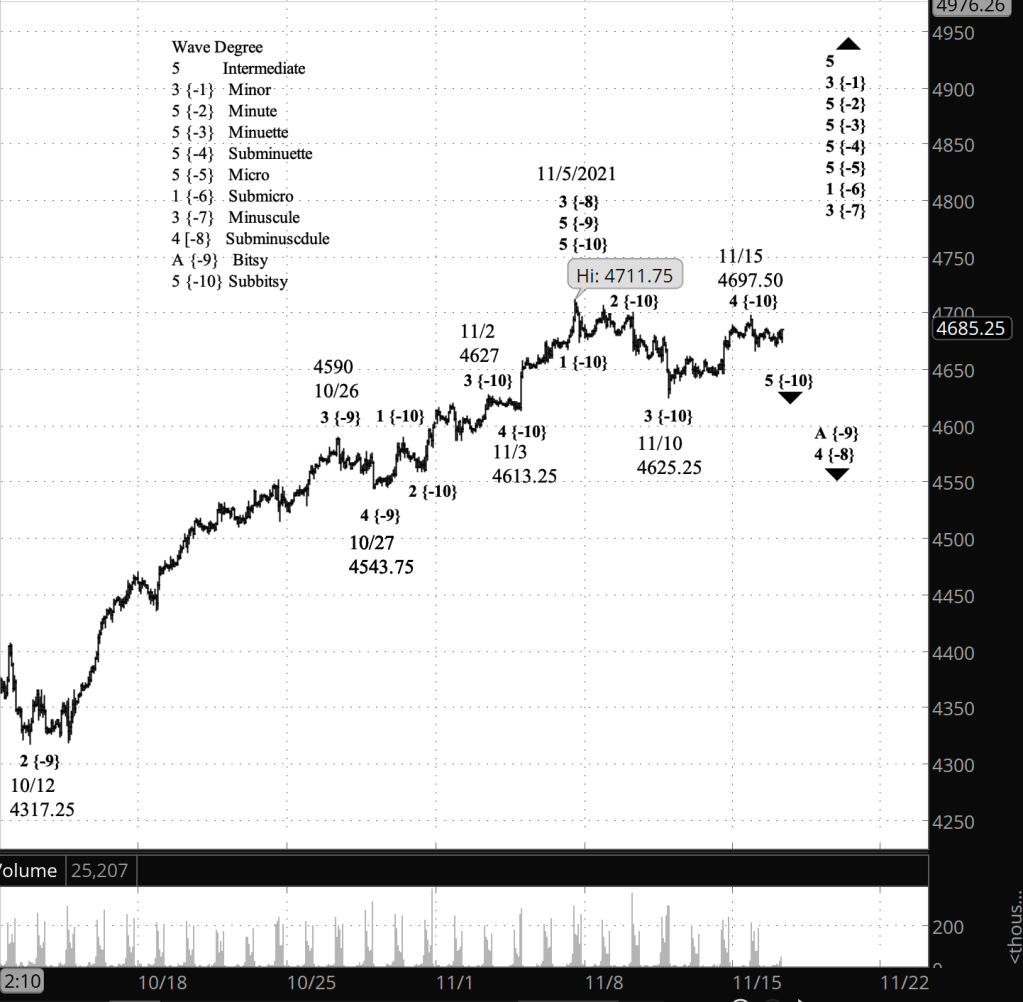
What does it mean? My principal analysis sees a complex of nested movements: The non-committal move is an early stage within the final low-level decline within the first downward leg of a three-part sideways correction that began November 5 from 4711.75.

What’s the alternative? My alternative analysis places that final low-level decline in the futures, as the price continues to trace a small correction before the decline. When that small correction is over, the final decline that will bring the first part of the larger correction to an end.

Charts. The upper chart is half an hour before the closing bell, showing the alternative analysis, which was verified. The lower chart is shortly after the opening bell and shows this morning’s principal analysis, which has now been discarded.
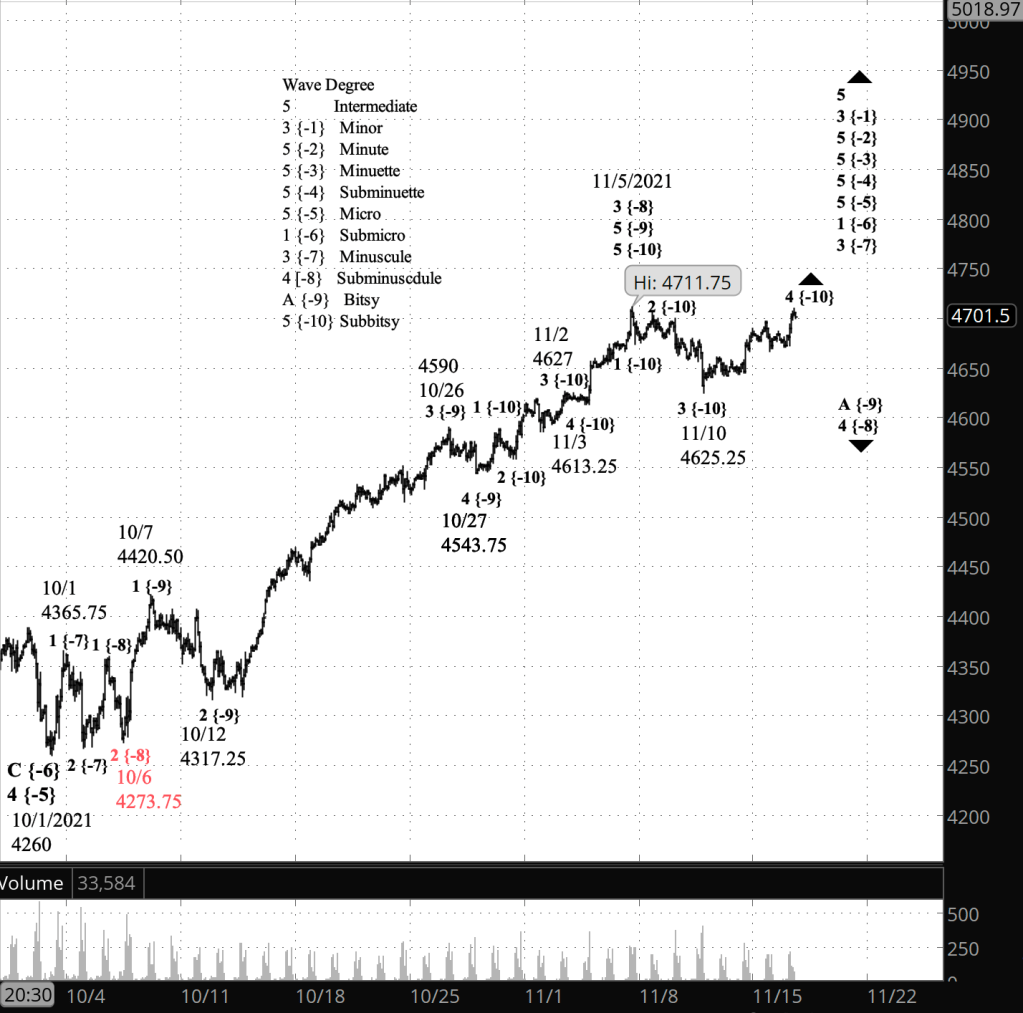
[S&P 500 E-mini futures at 3:30 p.m., 90-minute bars, with volume]
[S&P 500 E-mini futures at 9:35 a.m., 70-minute bars, with volume]

What does Elliott wave theory say? Under my principal analysis, the sideways movement is an early stage of wave 5 of Subbitsy degree — a {-10} subscript on the chart — which is the final, declining portion of wave A of Bitsy degree {-9} within a wave 4 correction of Subminuscule degree {-8}. Bitsy wave A will be followed by a rising B wave that may again reach into the 4690s, and then by declining C wave that will complete Subminuscule wave 4. That 4th wave will be followed by Subminuscule wave 5, which will push above the November 5 peak to new heights.

Under my alternative analysis, the sideways movement is a subwave of wave 4 of Subbitsy degree, a rising correction that will be followed by Subbitsy wave 5. This analysis pushes Subbitsy wave 5 into the future, and when it is complete, the market will progress as described in my principal analysis.

Bottom line: The price will break out above the November 5 peak of 4711.75, the end of wave 3 of Subminuscule degree. The difference between the two analyses is about the timing of that breakout. Under the principal scenario, that breakout will happen sooner; under the alternative, later.

Learning and other resources. Elliott wave analysis provides context, not prophecy. As the 20th century semanticist Alfred Korzybski put it in his book Science and Sanity (1933), “The map is not the territory … The only usefulness of a map depends on similarity of structure between the empirical world and the map.” And I would add, in the ever-changing markets, we can judge that similarity of structure only after the fact.

See the menu page Analytical Methods for a rundown on where to go for information on Elliott wave analysis.

By Tim Bovee, Portland, Oregon, November 16, 2021

Disclaimer

Tim Bovee, Private Trader tracks the analysis and trades of a private trader for his own accounts. Nothing in this blog constitutes a recommendation to buy or sell stocks, options or any other financial instrument. The only purpose of this blog is to provide education and entertainment.

No trader is ever 100 percent successful in his or her trades. Trading in the stock and option markets is risky and uncertain. Each trader must make trading decisions for his or her own account, and take responsibility for the consequences.

License
Creative Commons License

All content on Tim Bovee, Private Trader by Timothy K. Bovee is licensed under a Creative Commons Attribution-ShareAlike 4.0 International License.

Based on a work at www.timbovee.com.
SP500 Analysis

3:30 p.m. New York time

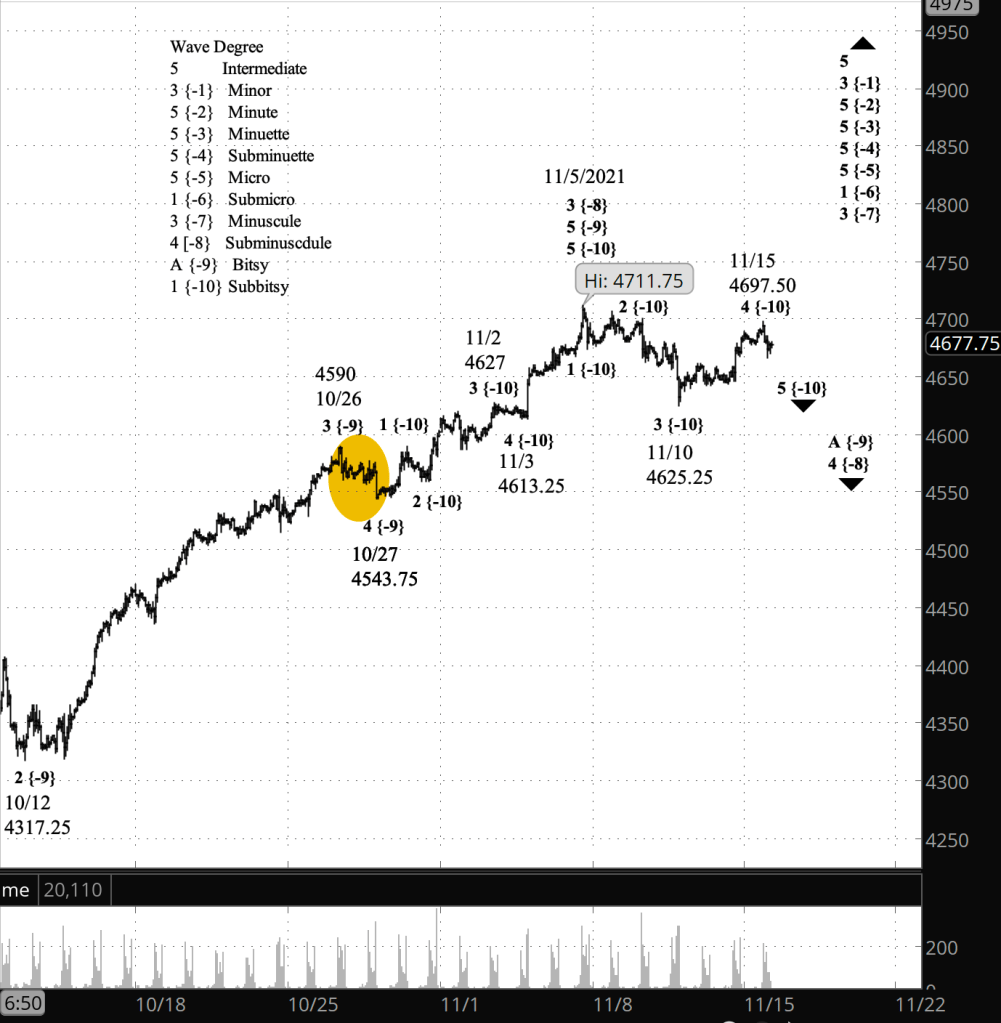
Half an hour before the closing bell. The S&P 500 began to decline during the morning in what may be the final leg within the first segment of a downward correction that began on November 5. In Elliott wave terms, my principal analysis sees the day’s decline as wave 5 of Subbitsy degree — subscript {-10} — within wave A of Bitsy degree {-9} within wave 4 of Subminuscule degree {-8}. The alternative analysis sees wave 4 of Subbitsy degree as still underway. I consider the alternative to be of lower probability because wave 4 of Subminuscule degree and its internal waves must remain below the November 5 peak of 4711.75, and there’s just not that much upside remaining above today’s peak of 4697.50. I’ve updated the chart.

9:35 a.m. New York time

What’s happening now? The S&P 500 E-mini futures rose into the 4690s in overnight trading as the downward correction following the November 5 peak, 4711.75, continues. Within that correction, a smaller, upward correction has been underway since November 10, and the chart can be interpreted to mean that the smaller correction is in its last leg.

What does it mean? The end of the smaller correction will be followed by a decline into the low 4600s and perhaps lower. The end of the decline will also mark the end of the first leg of the larger correction that is underway.

What’s the alternative? The overnight high has come within 15 points of the November 5 peak. If the price exceeds the peak — 4711.75 — then that will trigger a reworking of my principal analysis.

[S&P 500 E-mini futures at 3:30 p.m., 70-minute bars, with volume]

What does Elliott wave theory say? The price is in rising wave 4 of Subbitsy degree — subscript {-10} — within wave A of Bitsy degree {-9} within declining wave 4 of Subminuscule degree {-8}. When Subminuscule 4 is complete, the subsequent wave Subminuscule 5 will carry the price above the November 5 peak.

Although Subbitsy wave 4 appears to be in its 3rd and final wave, it is possible that it will form a compound correction, adding on a second corrective pattern.

The Subminuscule wave 4, if it behaves typically, will end in the 4th wave of the 3rd wave one degree lower. I’ve marked that range with a tan circle on the chart.

Learning and other resources. Elliott wave analysis provides context, not prophecy. As the 20th century semanticist Alfred Korzybski put it in his book Science and Sanity (1933), “The map is not the territory … The only usefulness of a map depends on similarity of structure between the empirical world and the map.” And I would add, in the ever-changing markets, we can judge that similarity of structure only after the fact.

See the menu page Analytical Methods for a rundown on where to go for information on Elliott wave analysis.

By Tim Bovee, Portland, Oregon, November 15, 2021

Disclaimer

Tim Bovee, Private Trader tracks the analysis and trades of a private trader for his own accounts. Nothing in this blog constitutes a recommendation to buy or sell stocks, options or any other financial instrument. The only purpose of this blog is to provide education and entertainment.

No trader is ever 100 percent successful in his or her trades. Trading in the stock and option markets is risky and uncertain. Each trader must make trading decisions for his or her own account, and take responsibility for the consequences.

License
Creative Commons License

All content on Tim Bovee, Private Trader by Timothy K. Bovee is licensed under a Creative Commons Attribution-ShareAlike 4.0 International License.

Based on a work at www.timbovee.com.
SP500 Analysis

3:30 p.m. New York time

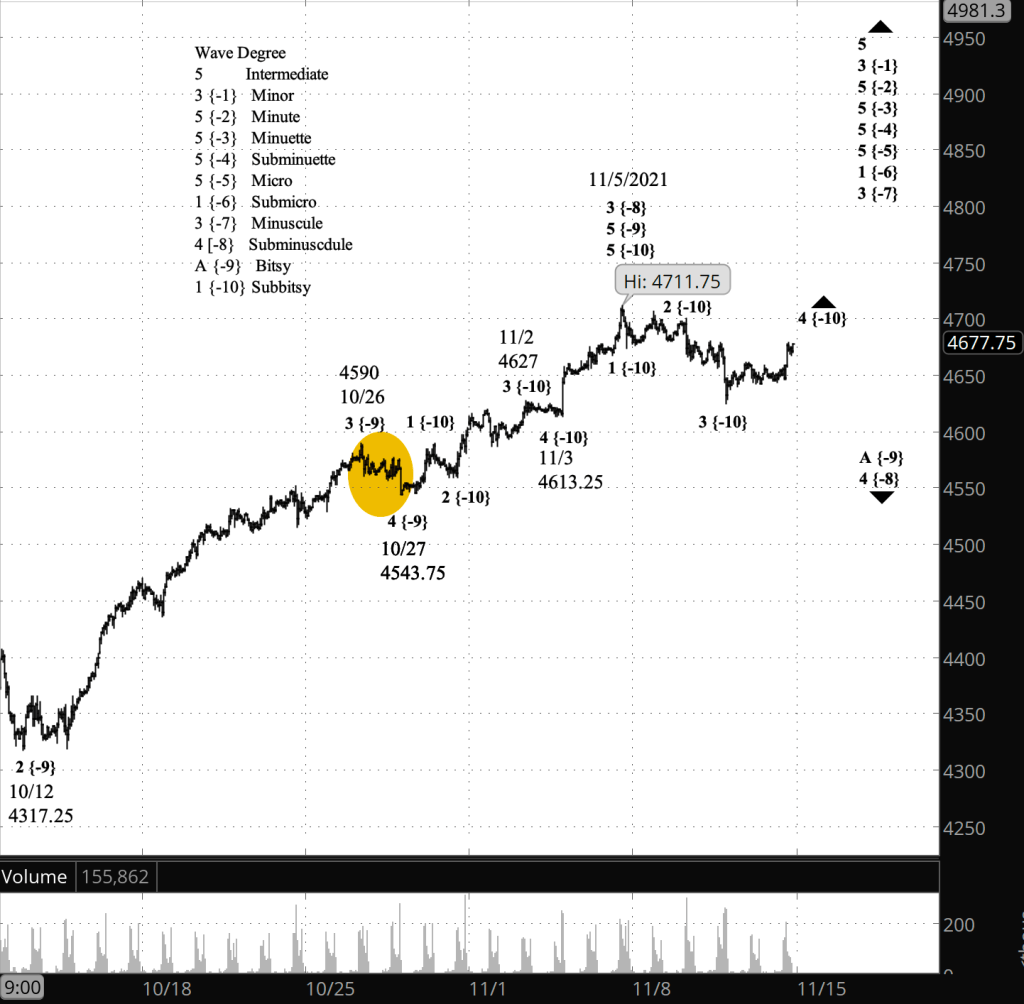
Half an hour before the closing bell. The S&P 500 rose slightly during the day, remaining well below the November 5 peak. No change in the analysis. The upward correction, wave 4 of Subbitsy degree within wave A of Bitsy degree within Wave 4 of Subminuscule degree, continues. I’ve updated the upper chart.

9:35 a.m. New York time

What’s happening now? The S&P 500 E-mini futures traded within a narrow range overnight.

What does it mean? The price continues to trace out a low-level upward correction within a higher level downward correction that began on November 5.

What’s the alternative? The main ambiguity has been how low of a level describes the present smaller correction. At this point it looks like the chart is labelled correctly. More on the subject in the Elliott wave theory section, below.

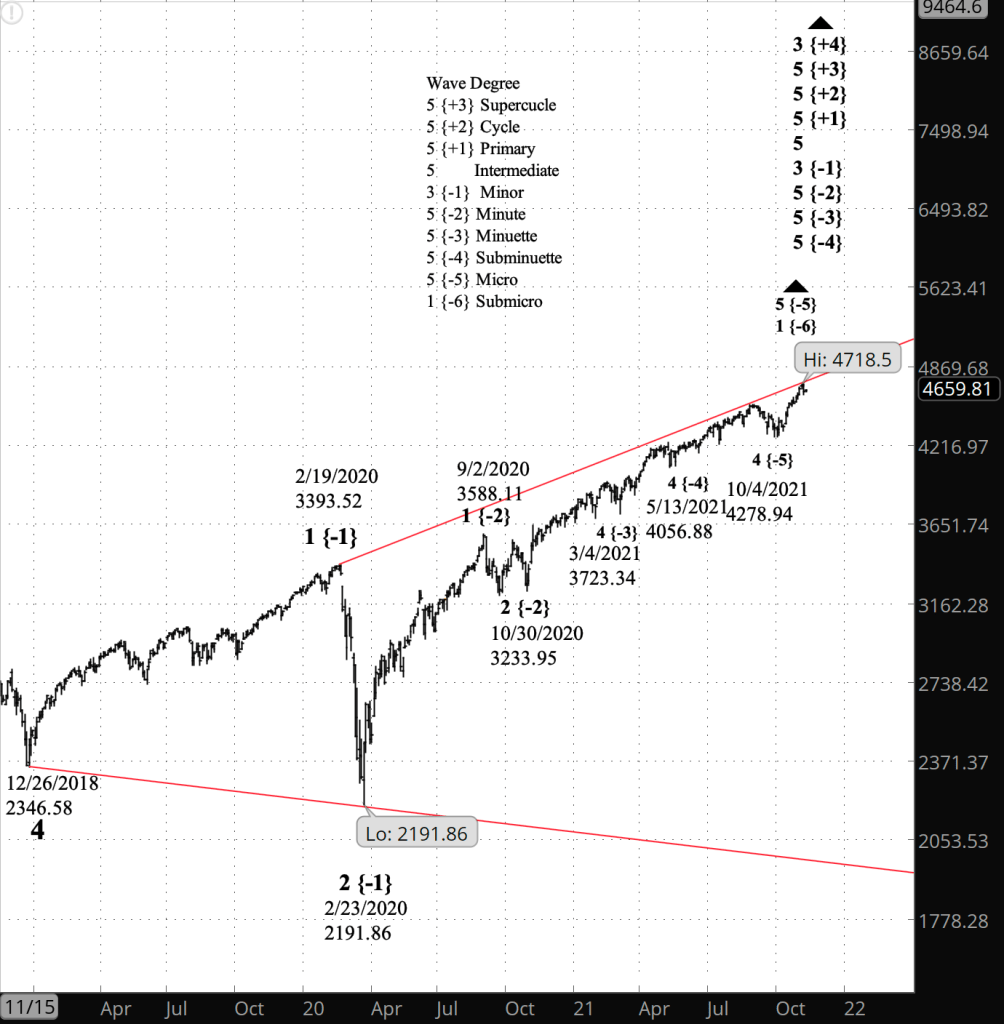
Charts. The lower chart shows a closer view of the S&P 500 E-mini futures stretching back to mid-October. The upper chart shows a broader view, of the S&P 500 index back to December 2018.

[S&P 500 E-mini futures at 3:30 p.m., hourly bars, with volume]
[S&P 500 index at 9:33 a.m., 2-day bars]

What does Elliott wave theory say? The low-level upward correction is wave 4 of Subbitsy degree — subscript {-10} — within wave A of Bitsy degree (-9} within the larger wave 4 of Subminuscule degree {-8}, a downward correction that began from the November 5 peak. (I use the subscripts for degree-labelling on the charts.)

As always in the early stages of a market movement, I’ve seen some ambiguity about the degree labelling. One degree down from Bitsy degree is Subbitsy, but it’s impossible to know wether or not the waves I labelled as Subbitsy actually are at the subscript {-10} level, or perhaps at {-11} or {-12}. It matters, because the smaller degree labelling impacts how I label the larger degrees.

At this point I’m comfortable with using the Subbitsy degree as the label for the smallest degree I’m tracking on this chart.

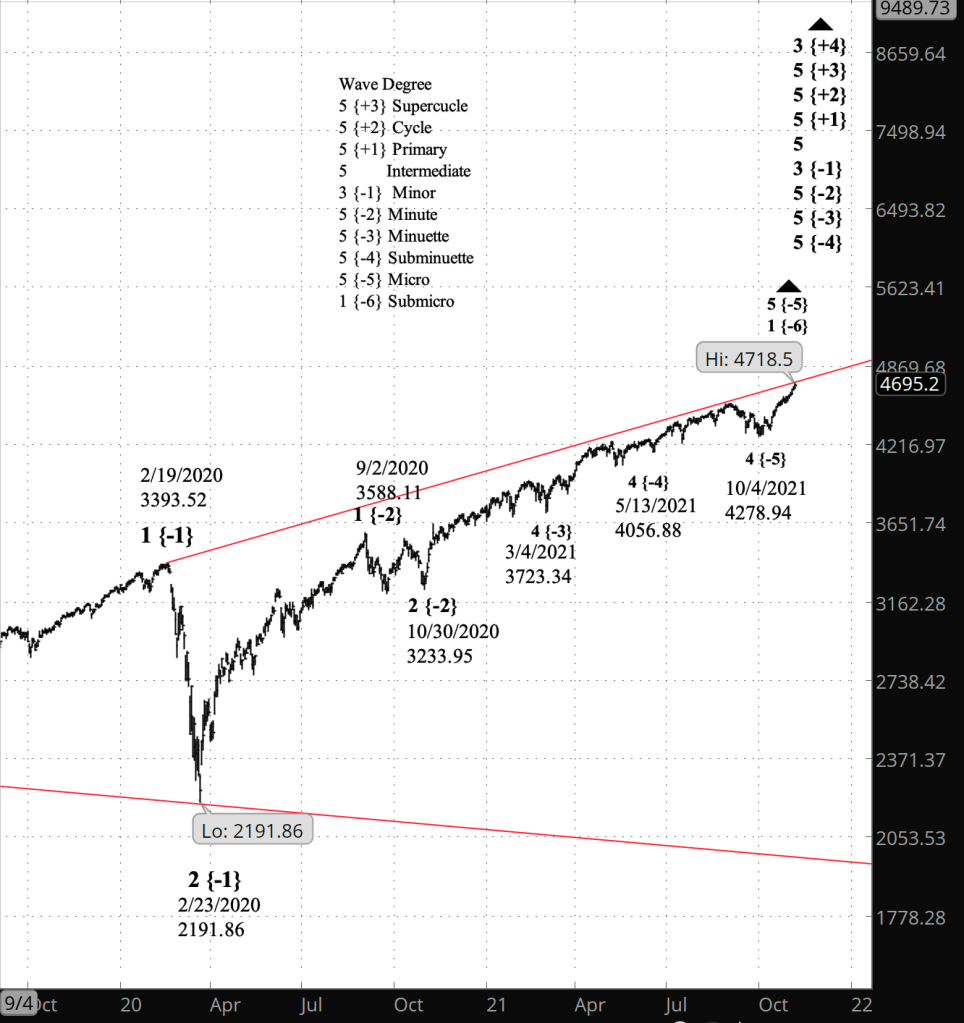
Fourth waves tend to be shallow, and the S&P 500’s present positioning is a 4th wave correction (Subbitsy) within a 4th wave correction (Subminuscule). All of that is happening within a rising 3rd wave of Minuscule degree {-7} within a 1st wave of Submicro degree {-8}, and going higher, within a series of 5th waves all the way up to wave 5 of Minute degree {-2}, which is within wave 3 of Minor degree {-1} within wave 5 of Intermediate degree (no subscript). The entire rise from the low of the early pandemic crash on February 23, 2020 is wave 3 of Minor degree.

Wave 5 of Intermediate degree is an expanding Diagonal Triangle that began on December 26, 2018.

Learning and other resources. Elliott wave analysis provides context, not prophecy. As the 20th century semanticist Alfred Korzybski put it in his book Science and Sanity (1933), “The map is not the territory … The only usefulness of a map depends on similarity of structure between the empirical world and the map.” And I would add, in the ever-changing markets, we can judge that similarity of structure only after the fact.

See the menu page Analytical Methods for a rundown on where to go for information on Elliott wave analysis.

By Tim Bovee, Portland, Oregon, November 12, 2021

Disclaimer

Tim Bovee, Private Trader tracks the analysis and trades of a private trader for his own accounts. Nothing in this blog constitutes a recommendation to buy or sell stocks, options or any other financial instrument. The only purpose of this blog is to provide education and entertainment.

No trader is ever 100 percent successful in his or her trades. Trading in the stock and option markets is risky and uncertain. Each trader must make trading decisions for his or her own account, and take responsibility for the consequences.

License
Creative Commons License

All content on Tim Bovee, Private Trader by Timothy K. Bovee is licensed under a Creative Commons Attribution-ShareAlike 4.0 International License.

Based on a work at www.timbovee.com.
SP500 Analysis

3:30 p.m. New York time

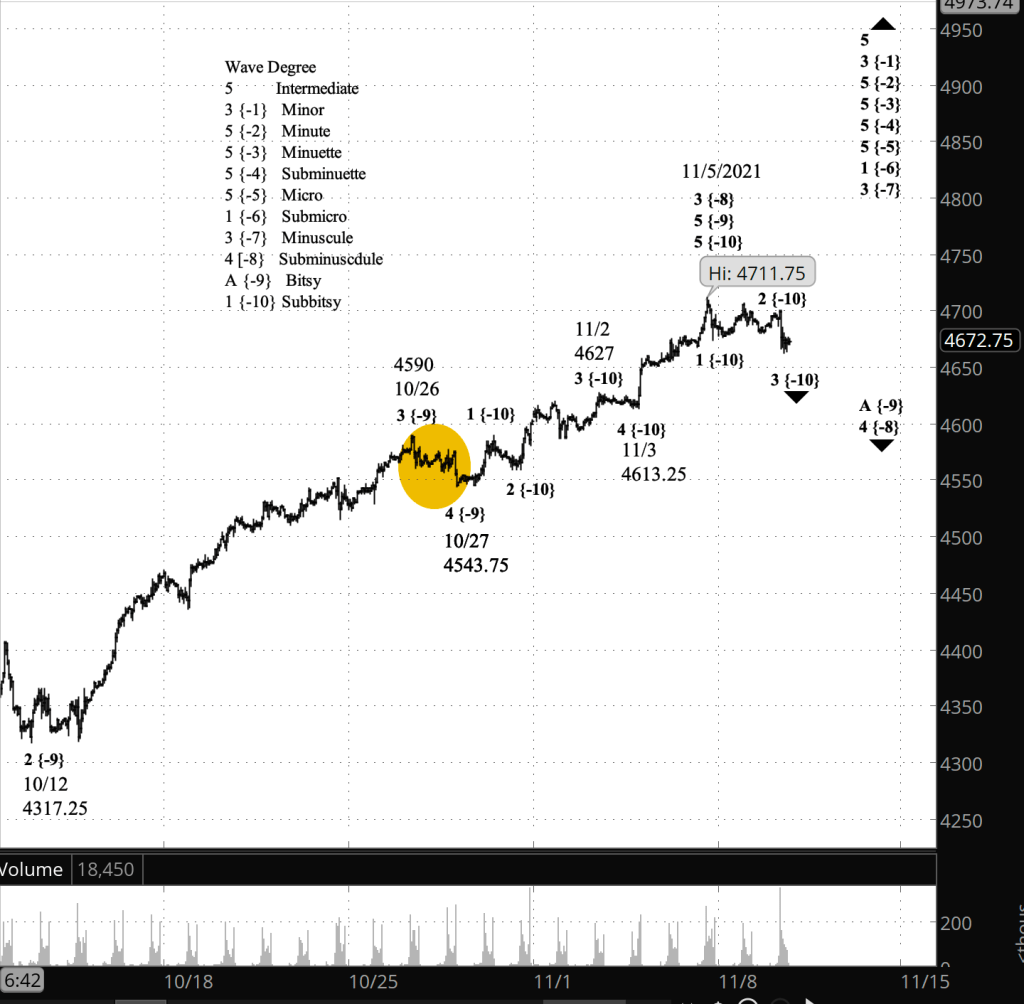
Half an hour before the closing bell. The S&P 500 fell back slightly from its peak of the day. No change in the analysis. Wave A of Bitsy degree within wave 4 of Subminuscule degree continues. I’ve updated the chart.

2:15 p.m. New York time

My trades. I’ve closed by short bear call options spread on FXI for a loss and updated the entry analysis with results.

9:35 a.m. New York time

What’s happening now? The S&P 500 E-mini futures rose slightly in overnight trading, reaching 4661.50, and then fell slightly at the opening bell.

What does it mean? The rise is the second upward correction within the first downward leg of a larger correction that began on November 5.

What’s the alternative? The rise could be a level or two smaller than in my principal analysis, which means that the first leg of the larger correction has earlier potential to the downside.

[S&P 500 E-mini futures at 3:30 p.m., hourly bars, with volume]

What does Elliott wave theory say? Under my principal analysis, the rise is wave 4 of Subbitsy degree within wave A of Bitsy degree, the latter being the first wave within a 4th wave correction of Subminuscule degree. The 4th wave of Subbitsy degree will be followed by a 5th wave decline that will likely bring the price within the correction’s target range, defined by the 4th wave of Bitsy degree within the 3rd wave of Subminuscule degree. I’ve marked that 4th wave on the chart with a tan oval.

Under my alternative analysis, the rise is part of a degree one or two levels below Subbitsy within declining wave 3 of Subbitsy degree. This scenario increases the likelihood that Subbitsy wave 3 will reach the target range before the subsequent wave 4 carries the price higher again.

The practical differences between the two scenarios is quite small. Under the principal analysis, the decline into the target range will come later than is likely under the alternative scenario.

Learning and other resources. Elliott wave analysis provides context, not prophecy. As the 20th century semanticist Alfred Korzybski put it in his book Science and Sanity (1933), “The map is not the territory … The only usefulness of a map depends on similarity of structure between the empirical world and the map.” And I would add, in the ever-changing markets, we can judge that similarity of structure only after the fact.

See the menu page Analytical Methods for a rundown on where to go for information on Elliott wave analysis.

By Tim Bovee, Portland, Oregon, November 11, 2021

Disclaimer

Tim Bovee, Private Trader tracks the analysis and trades of a private trader for his own accounts. Nothing in this blog constitutes a recommendation to buy or sell stocks, options or any other financial instrument. The only purpose of this blog is to provide education and entertainment.

No trader is ever 100 percent successful in his or her trades. Trading in the stock and option markets is risky and uncertain. Each trader must make trading decisions for his or her own account, and take responsibility for the consequences.

License
Creative Commons License

All content on Tim Bovee, Private Trader by Timothy K. Bovee is licensed under a Creative Commons Attribution-ShareAlike 4.0 International License.

Based on a work at www.timbovee.com.
SP500 Analysis

3:30 p.m. New York time

Half an hour before the closing bell. The S&P 500 fell sharply beginning shortly before noon and has so far reached a low of 4625.25, putting it within 35 points of the target range: Wave 4 of Bitsy degree within wave 3 of Subminuette degree, stretching from 4590 down to 4543.75. No change in the analysis. Wave 4 of Subminuette degree continues. I’ve updated the chart.

9:35 a.m. New York time

What’s happening now? The S&P 500 E-mini futures continued their decline in overnight trading, reaching a low of 4656.75.

What does it mean? The correction that began on November 5 has a target in the 4590 down to 4543.75 range. The low puts the price 67 points above the target’s upper boundary. The lower the price descends, the more likely this principal count is correct. The target is marked on the chart by a tan circle.

What’s the alternative? It’s possible that November 5 wasn’t the end of the rise that began October 12 and that the correction we’re seeing is at a smaller level. The further down the price goes, the less likely this scenario is.

[S&P 500 E-mini futures at 3:30 p.m., hourly bars, with volume]

What does Elliott wave theory say? By my principal analysis, the correction is wave 4 of Subminuscule degree. The target is the 4th wave one degree lower within wave 3 of Subminuscule degree. Internally, Subminuscule 4 is in wave A of Bitsy degree, and within that, wave 3 of Subbitsy degree.

The completion of wave 4 of Subminuscule degree will mark the beginning of a 5th wave rise to new highs, which in turn when complete will mark the end of the parent wave 1 of Minsucule degree.

So, long story short: Shallow correction, new highs. Sideways for the short term, upward for the slightly longer term.

By my alternative analysis, wave 3 of Subminuscule degree is still underway, and the pullback is a lower degree correction that will soon reach its end as the 3rd-wave uptrend removes.

Long story short: The same as with the principle analysis (above), except a shallower correction and a longer wait for the end of Minuscule wave 1.

Learning and other resources. Elliott wave analysis provides context, not prophecy. As the 20th century semanticist Alfred Korzybski put it in his book Science and Sanity (1933), “The map is not the territory … The only usefulness of a map depends on similarity of structure between the empirical world and the map.” And I would add, in the ever-changing markets, we can judge that similarity of structure only after the fact.

See the menu page Analytical Methods for a rundown on where to go for information on Elliott wave analysis.

By Tim Bovee, Portland, Oregon, November 10, 2021

Disclaimer

Tim Bovee, Private Trader tracks the analysis and trades of a private trader for his own accounts. Nothing in this blog constitutes a recommendation to buy or sell stocks, options or any other financial instrument. The only purpose of this blog is to provide education and entertainment.

No trader is ever 100 percent successful in his or her trades. Trading in the stock and option markets is risky and uncertain. Each trader must make trading decisions for his or her own account, and take responsibility for the consequences.

License
Creative Commons License

All content on Tim Bovee, Private Trader by Timothy K. Bovee is licensed under a Creative Commons Attribution-ShareAlike 4.0 International License.

Based on a work at www.timbovee.com.
SP500 Analysis

3:30 p.m. New York time

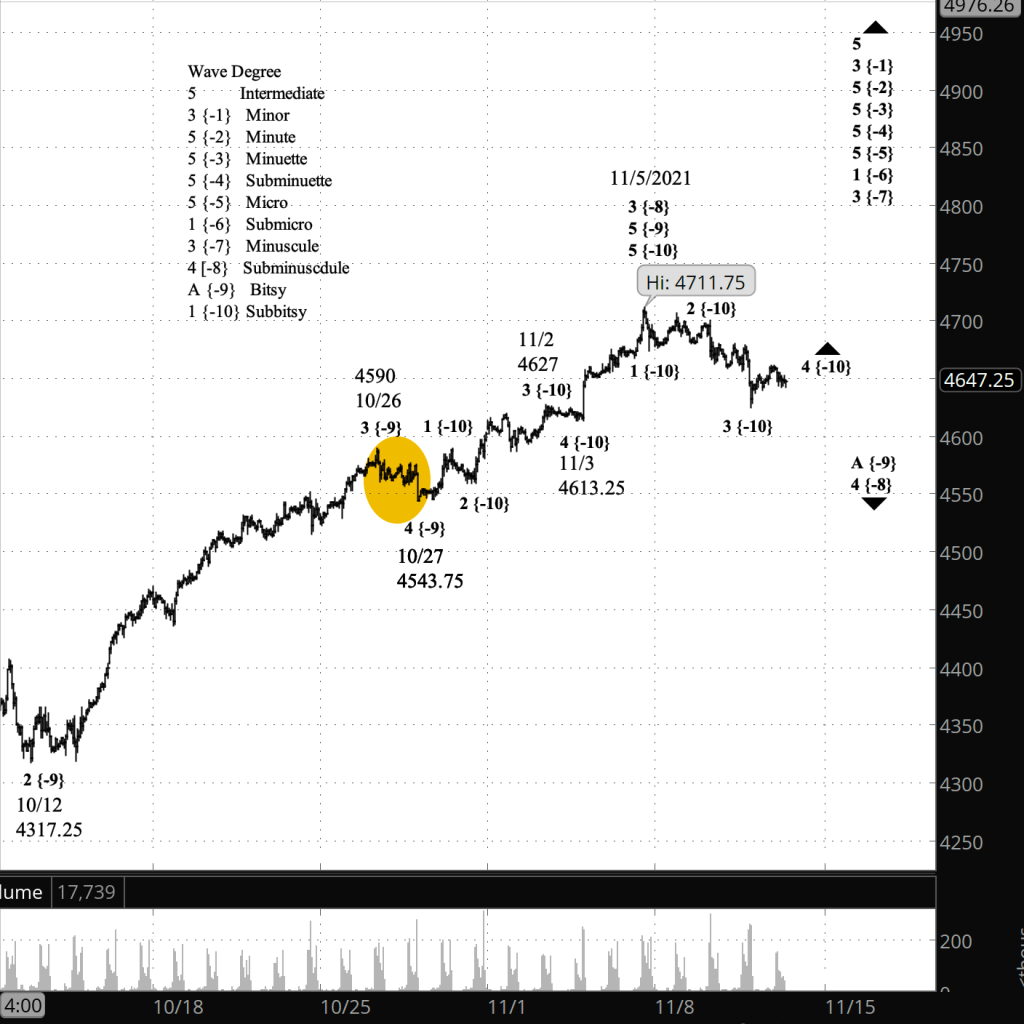
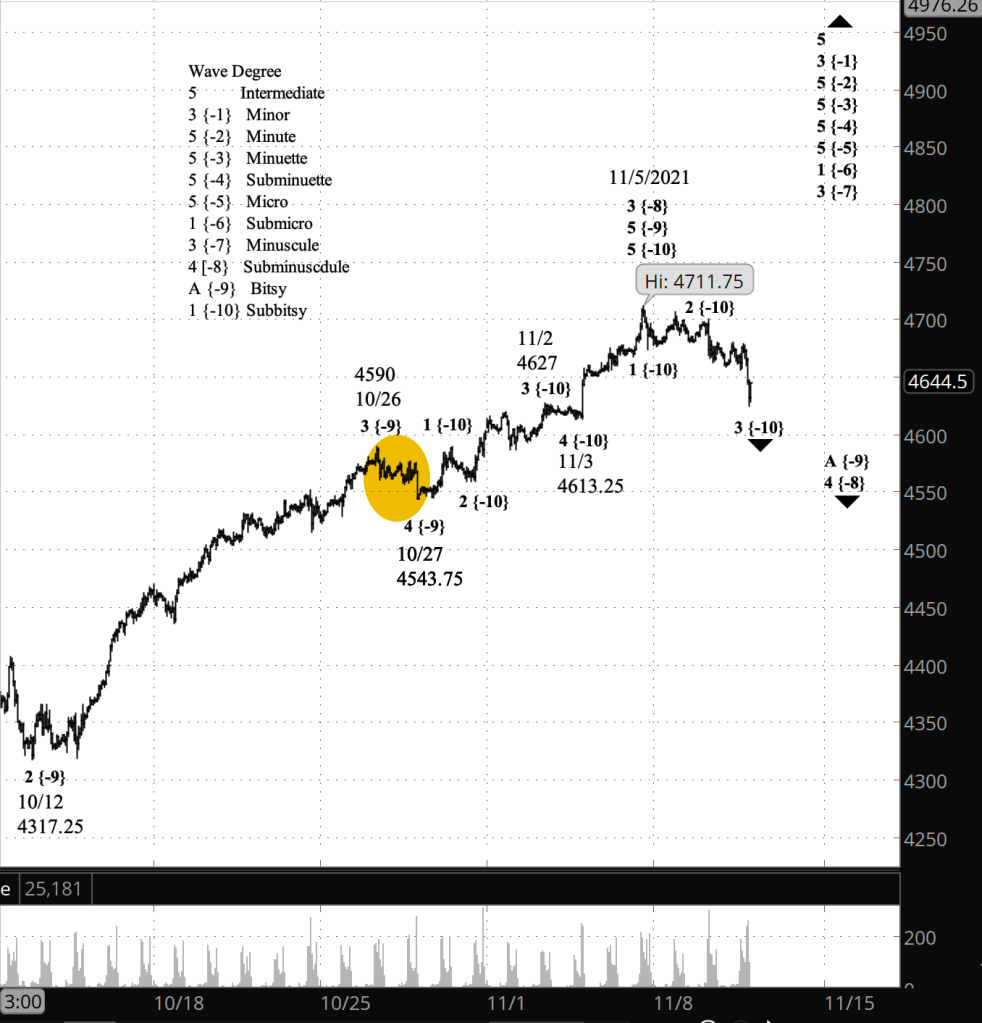
Half an hour before the closing bell. The S&P 500 decline below the sideways movement that has defined it since the November 5 peak. The decline adds a bit of weight to the idea that November 5 marks the end of wave 3 of Subminscule degree, and that the 4th wave has begun. The 4th wave target range, discussed below, remains valid. I’ve added a new chart with the revised mark-up, leaving this morning’s chart with the old mark-up for comparison.

What I’ve marked after November 5 as waves 1 , 2 and 3 with a {-10} subscript, indicating Subbitsy degree, may well be a or two below Subbitsy. The chart will gain clarity as the post-November 5 decline develops.

[Revised mark-up: S&P 500 E-mini futures at 3:30 p.m., 57-minute bars, with volume]

1:35 p.m. New York time

My trades. Today is the last day under my rules to enter an options spread position using contracts that expire December 17. The ambiguity that I see in the S&P 500 also exists in various forms in my prospective trades. So I’ll be trading simple long calls and puts, and shares, until the entry period for options expiring January 21. Entry runs from November 30 to December 14, with December 7 being the optimal date.

Meanwhile, my short bear call spread on FXI is slightly above the profit zone. It expires next week on Friday, and ideally I’ll be out of the position before the end of this week, for a profit or a small loss.

9:35 a.m. New York time

What’s happening now? The S&P 500 E-mini futures continued to move sideways, having completed three waves and embarked on a fourth.

What does it mean? If the price moves above the November 5 peak, 4711.75, then the correction is over and the uptrend has resumed.

What’s the alternative? If the price remains below 4711.75, then the chart is ensnared in a great deal of ambiguity. The correction seems too shallow to be at the level of the rise that began on October 27, or even down one level from that. I discuss the targets in the Elliott wave theory section below.

(The chart below is the old mark-up from this morning, which has the rise still underway. The chart above, posted shortly before the closing bell, shows the revised mark-up with the rise ending on November 5.)

[Old mark-up: S&P 500 E-mini Futures at 9:35 a.m., 57-minute bars, with volume]

What does Elliott wave theory say? The S&P 500 is present in wave 5 of Subbitsy degree within wave 5 of Bitsy degree within wave 3 of Subminuscule degree. The sideways movement beginning November 5 is a 4th wave correction within wave 5 of Subbitsy degree.

A 4th wave differs in form from the prior 2nd wave of the same degree. That is, if wave 2 is a Zigzag, then wave 4 will most likely be a Flat. And indeed, within wave 3 of Subminuscule degree, Bitsy wave 2 was a Zigzag and so the 4th wave correction most likely will be a Flat or a Triangle.

If a 4th wave correction takes the form of a Flat, it tends to reach down into the range 4th wave one degree lower within the preceding 3rd wave. In this case, if wave 4 of Subminuscule degree has begun, it should reach down to the range of wave 4 of Bitsy degree within wave 3 of Subminuscule degree. I’ve marked that 3rd wave on the chart with a tan circle. The range is 4543.75 up to 4590.

The present sideways pattern at its lowest is 80 points above the target range. And so, is the correction a 4th wave of Subminuscule degree, or of some lower degree.

The target range is a tendency, not a firm expectation. So this extremely shallow correction could be wave 4 of Subminuscule degree. But it’s not a certainty, and I’ve refrained from labelling it that way on the chart.

The ambiguity can be resolved either by the price exceeding the November 5 peak, meaning that wave 3 of Subminuscule degree is still underway, or by the price declining to within, or at least close to, the range marked by the tan circle, which would mean that wave 4 of Subminuscule degree began on November 5.

Give the low degree of the conundrum, I expect a resolution of the question within days, a week or so at the longest. That’s a guess, not a guarantee.

Learning and other resources. Elliott wave analysis provides context, not prophecy. As the 20th century semanticist Alfred Korzybski put it in his book Science and Sanity (1933), “The map is not the territory … The only usefulness of a map depends on similarity of structure between the empirical world and the map.” And I would add, we can judge that similarity of structure only after the fact.

See the menu page Analytical Methods for a rundown on where to go for information on Elliott wave analysis.

By Tim Bovee, Portland, Oregon, November 9, 2021

Disclaimer

Tim Bovee, Private Trader tracks the analysis and trades of a private trader for his own accounts. Nothing in this blog constitutes a recommendation to buy or sell stocks, options or any other financial instrument. The only purpose of this blog is to provide education and entertainment.

No trader is ever 100 percent successful in his or her trades. Trading in the stock and option markets is risky and uncertain. Each trader must make trading decisions for his or her own account, and take responsibility for the consequences.

License
Creative Commons License

All content on Tim Bovee, Private Trader by Timothy K. Bovee is licensed under a Creative Commons Attribution-ShareAlike 4.0 International License.

Based on a work at www.timbovee.com.
SP500 Analysis

3:30 p.m. New York time

Half an hour before the closing bell. The S&P 500 has remained below Friday’s peak so far in the trading session. The price has traced three waves down, three waves up, and now has entered the last leg, which should have five waves internally. The problem with this analysis is that the price is barely 10 points below the peak, and the more likely target would bee around 100 points below the peak. There’s something happening here, but what it is isn’t exactly clear. I’ll retain my present count, that wave 3 of Subminuscule degree is still rising, until the chart regains its clarity.

9:35 a.m. New York time

What’s happening now? The S&P 500 E-mini futures moved up in overnight trading, so far remaining below Friday’s peak of 4711.75.

What does it mean? The rise could be a resumption of the uptrend that began November 3 and could lead to new heights.

What’s the alternative? Or the rise could be a small upward correction in a downtrend that began from the peak of November 5.

[S&P 500 E-mini futures at 3:30 p.m., 80-minute bars, with volume]

What does Elliott wave theory say? Under my principal analysis, wave 5 of Subbitsy degree within wave 5 of Bitsy degree within wave 3 of Subminuscule degree remains underway.

Under my alternative analysis, Subbitsy 5, Bitsy 5 and Subminuscule 3 ended at Friday’s peak, and the present wave is Subbitsy A within Bitsy A within Subminuscule 4, a correction that will most likely take the form of a Flat.

At this point, in my view, both analyses have an equal chance of playing out.

If Subminuscule 4 is a Flat, it’s likely target range is the boundaries of wave 4 of Bitsy degree within the preceding wave 3 of Subminuscule degree, ranging from 4543.75 up to 4590. I’ve marked that wave with a tan oval on the chart.

Learning and other resources. Elliott wave analysis provides context, not prophecy. As the 20th century semanticist Alfred Korzybski put it in his book Science and Sanity (1933), “The map is not the territory … The only usefulness of a map depends on similarity of structure between the empirical world and the map.” And I would add, we can judge that similarity of structure only after the fact.

See the menu page Analytical Methods for a rundown on where to go for information on Elliott wave analysis.

By Tim Bovee, Portland, Oregon, November 8, 2021

Disclaimer

Tim Bovee, Private Trader tracks the analysis and trades of a private trader for his own accounts. Nothing in this blog constitutes a recommendation to buy or sell stocks, options or any other financial instrument. The only purpose of this blog is to provide education and entertainment.

No trader is ever 100 percent successful in his or her trades. Trading in the stock and option markets is risky and uncertain. Each trader must make trading decisions for his or her own account, and take responsibility for the consequences.

License
Creative Commons License

All content on Tim Bovee, Private Trader by Timothy K. Bovee is licensed under a Creative Commons Attribution-ShareAlike 4.0 International License.

Based on a work at www.timbovee.com.
SP500 Analysis

3:30 p.m. New York time

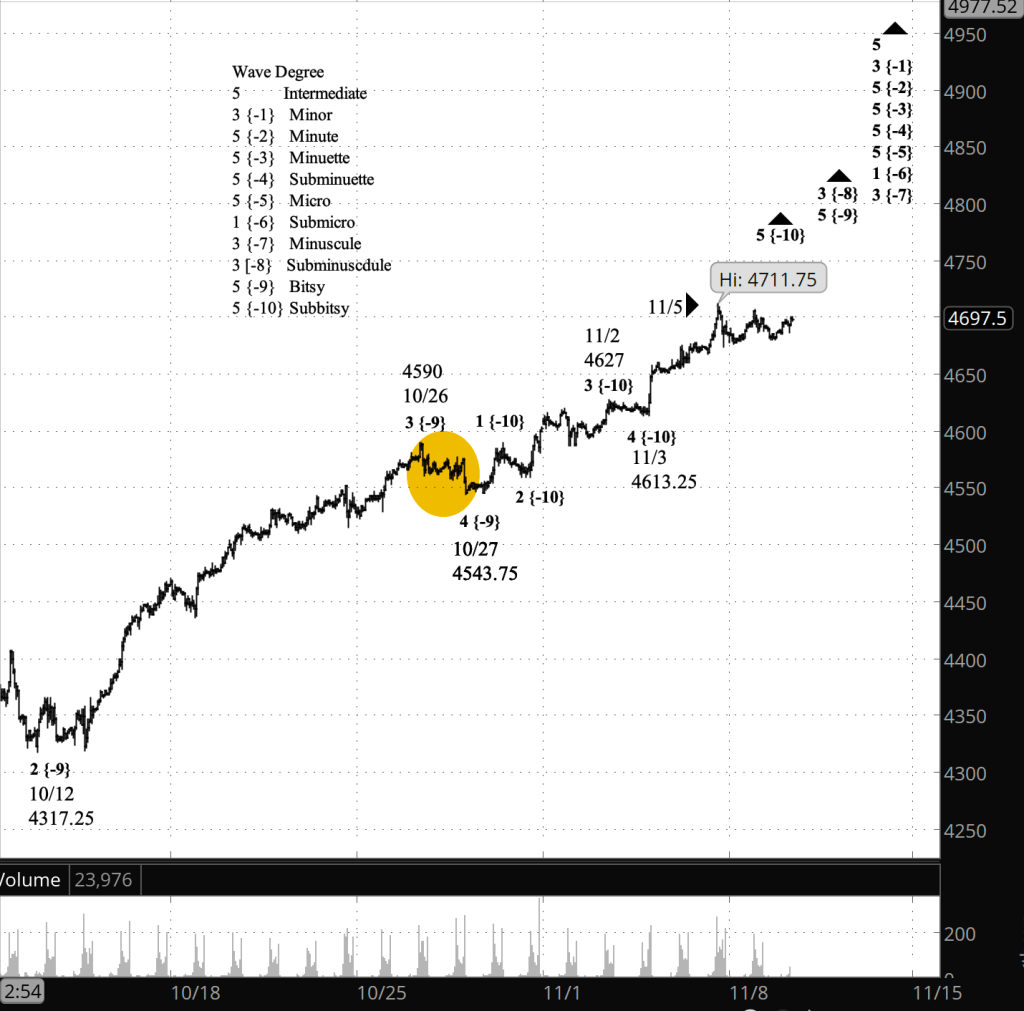
Half an hour before the closing bell. The S&P 500 peaked half an hour into the trading session and then declined, giving back its overnight gains. The peak was 4711.75 on the futures, 4718.50 on the index. The decline is not yet large enough to reach a conclusion that the peak ends the rise that began October 27. It might have done so, but then again, maybe not.

In Elliott wave analysis, there’s a trick of the trade. When a wave has fulfilled all of the requirements for completion, and yet has a small pullback and then a rise to even higher highs, the normal practice is to count that pullback and rise, and perhaps some earlier fluctuations, as being of a smaller degree; basically, the analyst pushes them down a degree, quite arbitrarily, in order for the count to work.

I’ll do that if the price reverses quickly and moves to a new peak. Otherwise, I’m going to wait for more decline, and then make a decision.

So how long should I wait? If today’s peak is in fact the end of of the rise from October 27 — wave 5 of Bitsy, it is also the end of wave 3 of the parent wave of Subminuscule degree. So the subsequent correction will be wave 4 of Subinuscule degree, probably a Flat, and it is likely to end within the price range of wave 4 of Bitsy degree within wave 3 of Minuscule degree. That Bitsy wave 4 declined from 4590 to 4543.75 (marked on the chart with a tan oval). And so if the price reaches the low 4600s, then I’ll be inclined to label the present wave as wave 4 of Subminuscule degree. That target range is something that often happens with 4th waves, but it’s not a rule, so the decline could be shallower or deeper. Which will make chart analysis decisions “interesting” over the next few days.

I’ve added in a longer-term chart showing the upper and lower boundaries of the expanding Diagonal Triangle, wave 5 of Intermediate degree, that began in December 2018. It is currently in its 3rd wave, of Minor degree, which began on February 23, 2020, at the end of the early pandemic market crash. In an Expanding Triangle, the boundaries keep moving further from each other, which creates additional room for upside potential without the price moving too far past the upper boundary.

9:37 a.m. New York time

What’s happening now? The S&P 500 E-mini futures rose to a new peak in overnight trading and the price moved still higher after the opening bell rang, so far to 4705 on the futures, 4712.28 on the index.

What does it mean? The rise that began November 3 continues.

What’s the alternative? Under the rules of Elliott wave analysis the rise has met all of the requirements for completion. Any peak could be, but won’t necessarily be, the end the rise.

[S&P 500 E-mini futures at 3:30 p.m., 55-minute bars, with volume]
[S&P 500 Index at 3:25 p.m., daily bars]

What does Elliott wave theory say? The rise from November 3 is wave 5 of Subbitsy degree within wave 5 of Bitsy degree within wave 3 of Subminuscule degree. Under Elliott, a move in the direction of the trend consists of five waves, so the rise is on its last leg at the Subbitsy and Bitsy degrees. Their completion will also be the end of wave 3 of Subminuscule degree, which began October 13. Subminuscule 3 will be followed by a 4th wave correction, likely taking the form of a Flat, in contrast to the Zigzag pattern of the preceding 2nd wave. In Elliott this is known as the Rule of Alternation. Subminuscule wave 4 will be followed by a 5th wave rise to new heights.

Learning and other resources. Elliott wave analysis provides context, not prophecy. As the 20th century semanticist Alfred Korzybski put it in his book Science and Sanity (1933), “The map is not the territory … The only usefulness of a map depends on similarity of structure between the empirical world and the map.” And I would add, we can judge that similarity of structure only after the fact.

See the menu page Analytical Methods for a rundown on where to go for information on Elliott wave analysis.

By Tim Bovee, Portland, Oregon, November 5, 2021

Disclaimer

Tim Bovee, Private Trader tracks the analysis and trades of a private trader for his own accounts. Nothing in this blog constitutes a recommendation to buy or sell stocks, options or any other financial instrument. The only purpose of this blog is to provide education and entertainment.

No trader is ever 100 percent successful in his or her trades. Trading in the stock and option markets is risky and uncertain. Each trader must make trading decisions for his or her own account, and take responsibility for the consequences.

License
Creative Commons License

All content on Tim Bovee, Private Trader by Timothy K. Bovee is licensed under a Creative Commons Attribution-ShareAlike 4.0 International License.

Based on a work at www.timbovee.com.
SP500 Analysis

3:30 p.m. New York time

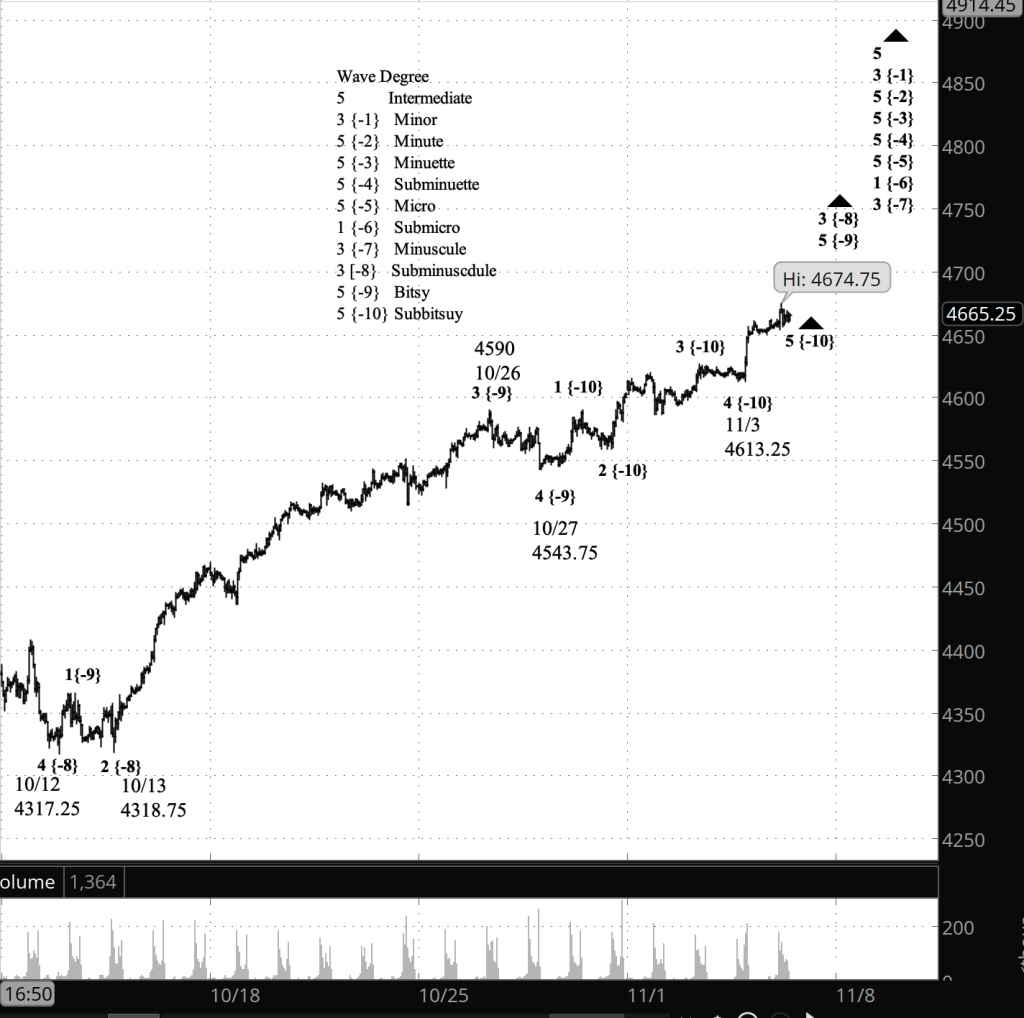
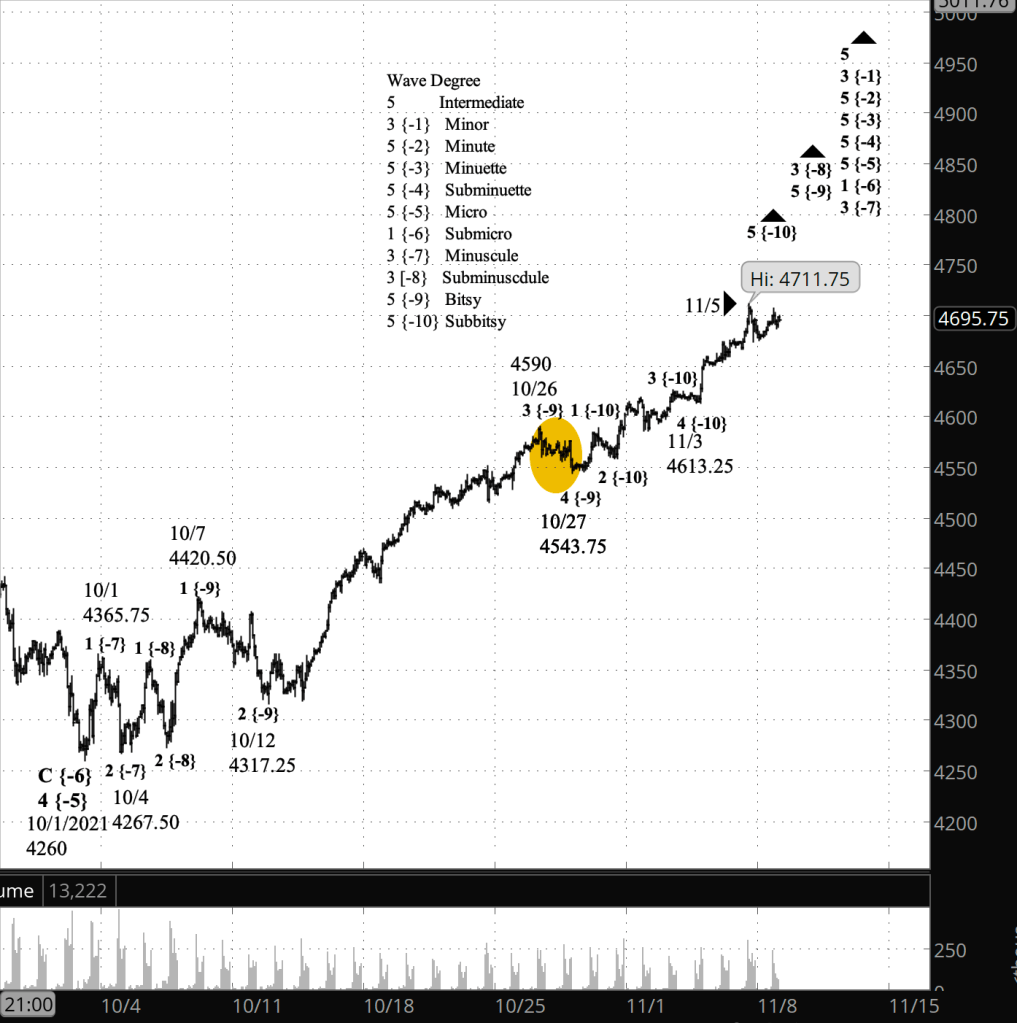
Half an hour before the opening bell. The S&P 500 moved to higher peak 40 minutes after the opening bell, to 4674.75 on the futures, 4683 on the index. Thereafter the price has so far traded in a narrow range. No change in the analysis. I’ve updated the chart.

9:35 a.m. New York time

What’s happening now? The S&P 500 E-mini futures attained a new high in overnight trading, 4662.50. The greater part of the rise that began with yesterday’s Federal Open Market Committee statement was complete by yesterday evening, and today’s early morning peak came during a sideways movement.

What does it mean? The price has met all of the requirements for completion of the rise that began on October 27 from 4543.75. However, there’s also no barrier to the rise continuing. I’ll discuss the matter further in the Elliott wave theory section. If the rise is complete, the next movement will be a 4th wave correction of the rise from late October.

What’s the alternative? As noted above, there’s ambiguity in whether the rise has further to go. There’s also ambiguity as to the degree — the size — of the rise. Does the end of the present rise mean the end of the rise that began on October 13? Or is it a lower level rise within a parent wave that has much further to go before reaching completion?

[S&P 500 E-mini futures at 3:30 p.m., 50-minute bars, with volume]

What does Elliott wave theory say? The rise from October 27 is wave 5 of Bitsy degree within wave 3 of Subminuscule degree, which began October 13 from 4318.75. Internally, Bitsy wave is in its 5th and final wave, of Subbitsy degree.

In Elliott, there is no limit to how high a 5th wave can go, nor any barrier to it being over with only a small rise.

On the chart, I’ve labeled the rise from October 27 as being of Subbitsy degree, but it’s possible that it could be a degree or even two degrees smaller, a 1st wave of Subbitsy degree. This would magnify the amount of upside we can expect.

In any case, the end of Subbitsy 5 also marks the end of Bitsy wave 5 and Subminuscule wave 3, and will be followed by a 4th wave correction of Subminuscule degree.

Learning and other resources. Elliott wave analysis provides context, not prophecy. As the 20th century semanticist Alfred Korzybski put it in his book Science and Sanity (1933), “The map is not the territory … The only usefulness of a map depends on similarity of structure between the empirical world and the map.” And I would add, we can judge that similarity of structure only after the fact.

See the menu page Analytical Methods for a rundown on where to go for information on Elliott wave analysis.

By Tim Bovee, Portland, Oregon, November 4, 2021

Disclaimer

Tim Bovee, Private Trader tracks the analysis and trades of a private trader for his own accounts. Nothing in this blog constitutes a recommendation to buy or sell stocks, options or any other financial instrument. The only purpose of this blog is to provide education and entertainment.

No trader is ever 100 percent successful in his or her trades. Trading in the stock and option markets is risky and uncertain. Each trader must make trading decisions for his or her own account, and take responsibility for the consequences.

License
Creative Commons License

All content on Tim Bovee, Private Trader by Timothy K. Bovee is licensed under a Creative Commons Attribution-ShareAlike 4.0 International License.

Based on a work at www.timbovee.com.
SP500 Analysis

3:30 p.m, New York time

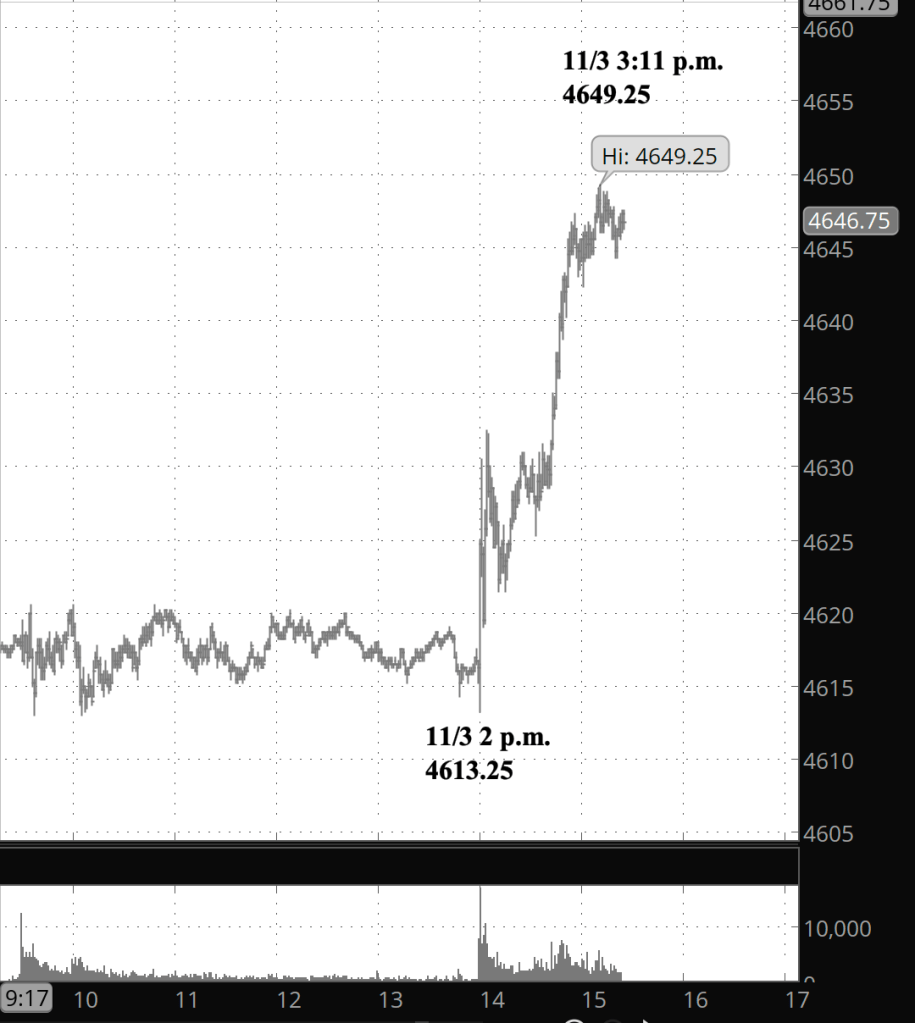
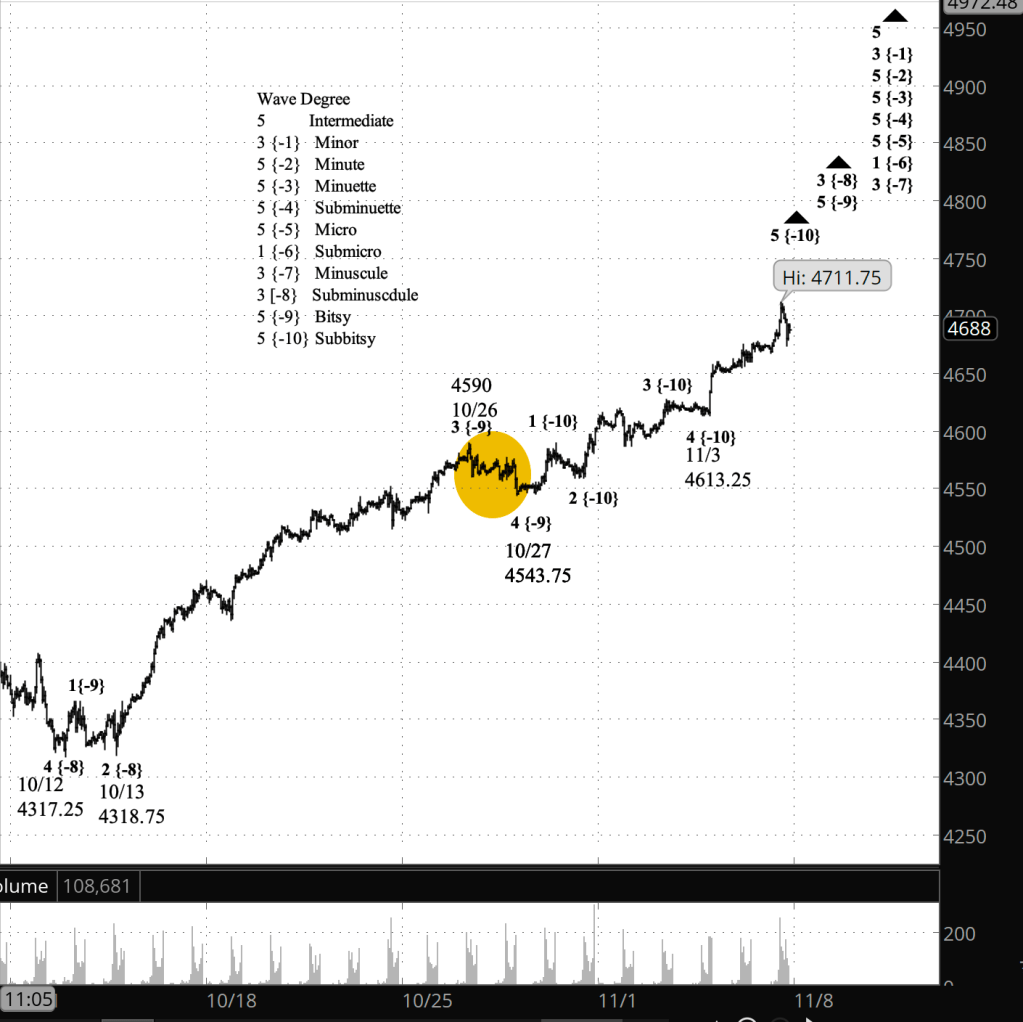
Half an hour before the closing bell. The S&P 500 began to climb immediately upon the release of the Federal Open Market Committee statement on monetary policy. The futures rose by 36 points in 71 minutes, from 4613.25 to 4649.25 and at present has fallen back a little in a correction of very low degree. In terms of the analysis, the low degree correction within wave 5 of Bitsy degree is over and the price is again trending upward.

I’ve added a very near term chart showing the rise and updated the longer term chart from this morning.

[S&P 500 E-mini futures at 3:25 p.m., 1-minute bars, with volume]

9:35 a.m. New York time

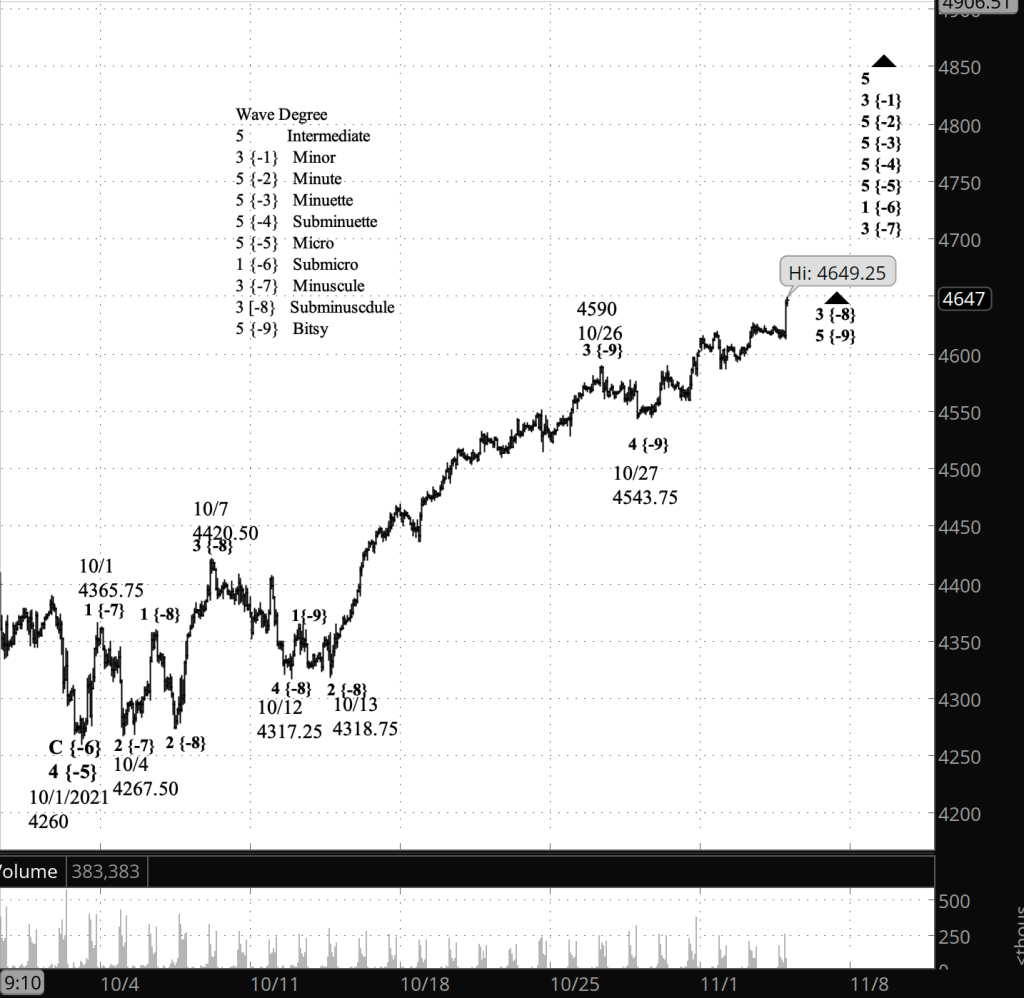
What’s happening now? The S&P 500 moved sideways in overnight trading, for the most part staying within 10 points of yesterday’s high of 4627 on the futures, 4635.15 on the index.

What does it mean? The movement can be interpreted as the second correction within the rise that began on October 27. Typically such corrections are shallow, without much in the way of drama.

What’s the alternative? The placement of the fluctuations within the rise from late October are open to interpretation. Is the present correction one level down from the top level of the rise? Two levels down? The answer as an impact mainly on the timing of future movements.

[S&P 500 E-mini futures at 3:30 p.m., 70-minute bars, with volume]

What does Elliott wave theory say? My analysis yesterday labeled the movement as down one degree, to the Subbitsy degree, from the parent wave 5 of Bitsy degree. It’s also possible that the degree is below the Subbitsy level. In any case, the end of the parent wave, the 5th of Bitsy degree, will mark the end of the parent wave 3 of Subminuscule degree and the beginning of a 4th wave correction, most likely a shallow Flat pattern, as 4th waves tend to be. It will be followed by a rise to new highs.

Learning and other resources. Elliott wave analysis provides context, not prophecy. As the 20th century semanticist Alfred Korzybski put it in his book Science and Sanity (1933), “The map is not the territory … The only usefulness of a map depends on similarity of structure between the empirical world and the map.” And I would add, we can judge that similarity of structure only after the fact.

See the menu page Analytical Methods for a rundown on where to go for information on Elliott wave analysis.

By Tim Bovee, Portland, Oregon, November 3, 2021

Disclaimer

Tim Bovee, Private Trader tracks the analysis and trades of a private trader for his own accounts. Nothing in this blog constitutes a recommendation to buy or sell stocks, options or any other financial instrument. The only purpose of this blog is to provide education and entertainment.

No trader is ever 100 percent successful in his or her trades. Trading in the stock and option markets is risky and uncertain. Each trader must make trading decisions for his or her own account, and take responsibility for the consequences.

License
Creative Commons License

All content on Tim Bovee, Private Trader by Timothy K. Bovee is licensed under a Creative Commons Attribution-ShareAlike 4.0 International License.

Based on a work at www.timbovee.com.